Overview
The midpoint formula is a fundamental coordinate geometry concept that appears regularly on the GRE Quantitative Reasoning section. This formula allows test-takers to find the exact center point between two coordinates on a coordinate plane, a skill that underlies numerous geometry problems involving line segments, polygons, and spatial relationships. Understanding the midpoint formula is not merely about memorizing an equation—it represents a critical bridge between algebraic thinking and geometric visualization that the GRE frequently exploits in medium to high-difficulty questions.
On the GRE, the gre midpoint formula appears in multiple contexts: directly asking for the midpoint of a segment, requiring reverse-engineering to find an endpoint when given a midpoint, testing understanding of geometric properties like diagonals of rectangles, or embedding the concept within complex multi-step problems involving distance, symmetry, or transformations. The formula's versatility makes it a high-yield topic that connects to broader Quantitative Reasoning skills including algebraic manipulation, problem-solving strategy, and spatial reasoning.
Mastering the midpoint formula provides students with a reliable tool for tackling coordinate geometry questions efficiently. Since the GRE emphasizes problem-solving speed alongside accuracy, having instant recall of this formula and understanding its applications can save valuable time during the exam. The midpoint formula also serves as a foundation for understanding more advanced geometric concepts such as the distance formula, circle equations, and properties of quadrilaterals—all of which may appear on the test. Students who thoroughly understand this topic gain confidence in approaching a wide range of geometry problems, making it an essential component of comprehensive GRE preparation.
Learning Objectives
- [ ] Identify when Midpoint formula is being tested
- [ ] Explain the core rule or strategy behind Midpoint formula
- [ ] Apply Midpoint formula to GRE-style questions accurately
- [ ] Derive the midpoint formula from first principles using averaging
- [ ] Solve reverse midpoint problems where an endpoint must be found given the midpoint and other endpoint
- [ ] Recognize and apply midpoint properties in complex geometric figures including rectangles, parallelograms, and triangles
- [ ] Integrate midpoint calculations with other coordinate geometry concepts such as distance and slope
Prerequisites
- Coordinate plane basics: Understanding x and y axes, plotting points, and reading coordinates is essential since the midpoint formula operates entirely within the coordinate system
- Basic arithmetic operations: The ability to add, subtract, multiply, and divide integers, fractions, and decimals is necessary for calculating midpoint coordinates
- Algebraic manipulation: Solving simple equations and working with variables is required when finding unknown endpoints or coordinates
- Averaging concept: Understanding that an average represents the central value between numbers provides the conceptual foundation for the midpoint formula
Why This Topic Matters
The midpoint formula has significant practical applications beyond standardized testing. In computer graphics, midpoint calculations determine pixel positions and create smooth curves. Urban planners use midpoint concepts to identify optimal locations for public facilities that serve multiple communities. Engineers apply midpoint principles in structural design to find centers of mass and balance points. Navigation systems calculate midpoints to determine waypoints along routes, and architects use these concepts to ensure symmetry in building designs.
On the GRE, midpoint problems appear in approximately 5-8% of Quantitative Reasoning questions, making them moderately frequent but highly predictable. The Educational Testing Service (ETS) particularly favors midpoint questions because they efficiently test multiple skills simultaneously: coordinate geometry understanding, algebraic manipulation, and logical reasoning. Questions typically appear as Quantitative Comparison problems comparing midpoint coordinates, Multiple Choice questions asking for specific midpoint values, or Numeric Entry problems requiring calculated coordinates.
Common exam presentations include: finding the midpoint of a line segment connecting two given points; determining an unknown endpoint when given the midpoint and one endpoint; identifying properties of geometric shapes using midpoint relationships (such as proving a quadrilateral is a parallelogram by showing diagonals bisect each other); and multi-step problems where finding a midpoint is one component of a larger geometric or algebraic challenge. The GRE also tests conceptual understanding by asking which point lies on the perpendicular bisector of a segment or by requiring students to recognize that the midpoint divides a segment into two equal parts.
Core Concepts
The Midpoint Formula Definition
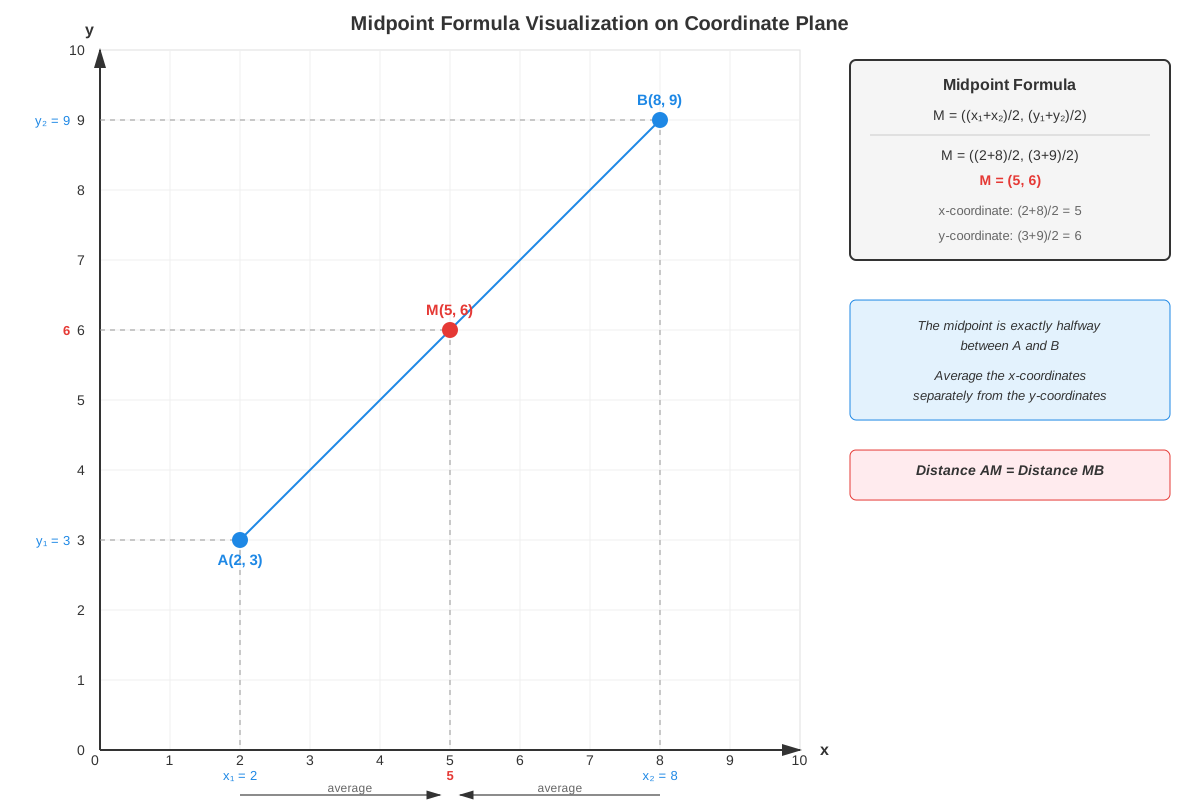
The midpoint formula provides the coordinates of the point that lies exactly halfway between two points on a coordinate plane. For two points with coordinates (x₁, y₁) and (x₂, y₂), the midpoint M has coordinates:
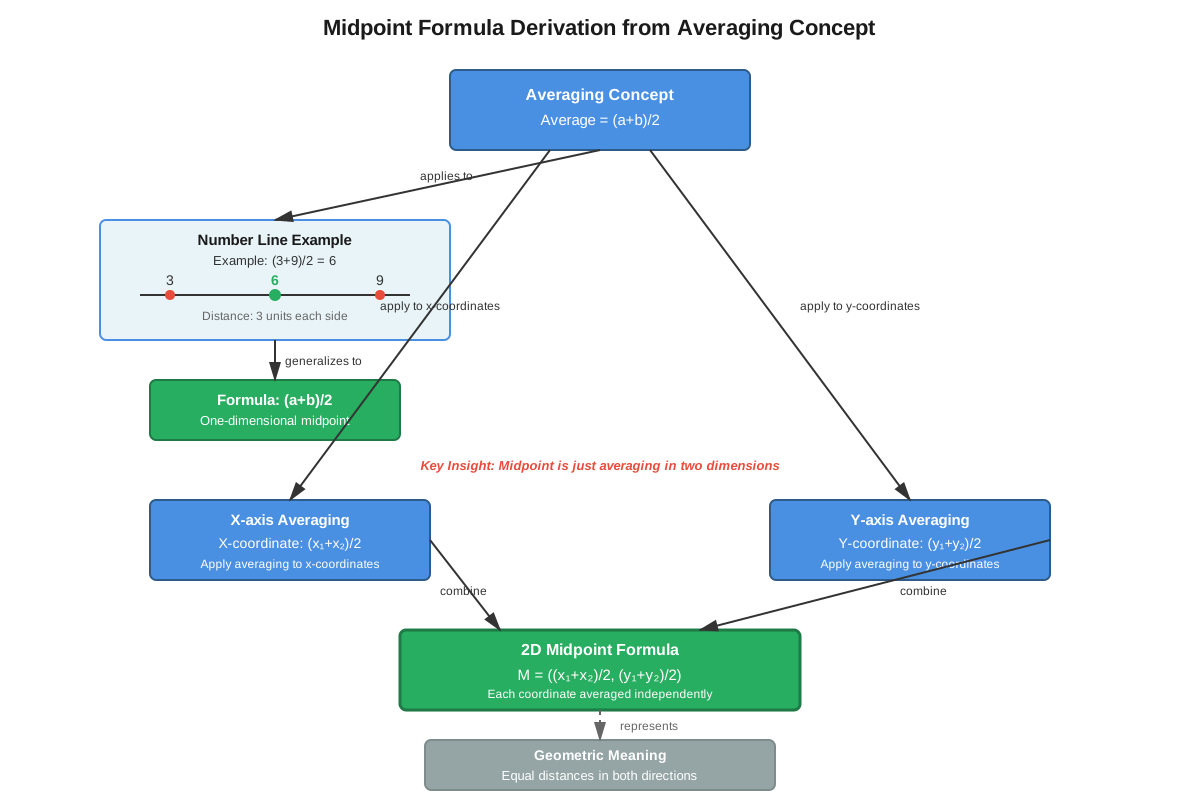
M = ((x₁ + x₂)/2, (y₁ + y₂)/2)This formula essentially averages the x-coordinates to find the x-coordinate of the midpoint, and averages the y-coordinates to find the y-coordinate of the midpoint. The elegance of this formula lies in its simplicity: the midpoint is literally the arithmetic mean of the corresponding coordinates of the two endpoints.
Conceptual Understanding: Why Averaging Works
To understand why the midpoint formula uses averaging, consider movement along a number line. If you start at position 2 and end at position 8, the middle position is 5—which is (2 + 8)/2. This same principle extends to two dimensions. The midpoint must be equidistant from both endpoints, and averaging ensures this equal distance property. When you average the x-coordinates, you find the horizontal center; when you average the y-coordinates, you find the vertical center. Together, these averaged coordinates identify the unique point that sits at the geometric center of the line segment.
Step-by-Step Application Process
To apply the midpoint formula systematically:
- Identify and label the endpoints: Clearly designate which point is (x₁, y₁) and which is (x₂, y₂). Note that the order doesn't matter—the midpoint will be the same regardless of which point you call "first."
- Calculate the x-coordinate of the midpoint: Add the two x-coordinates together and divide by 2: (x₁ + x₂)/2
- Calculate the y-coordinate of the midpoint: Add the two y-coordinates together and divide by 2: (y₁ + y₂)/2
- Write the midpoint as an ordered pair: Combine your results as M = (x-coordinate, y-coordinate)
- Verify reasonableness: Check that your midpoint coordinates fall between the original endpoint coordinates (unless dealing with negative numbers, where you should verify the midpoint makes geometric sense)
Working with Negative Coordinates
The midpoint formula works identically with negative coordinates, but students must exercise care with arithmetic. When adding a negative number, remember that you're effectively subtracting. For example, if the endpoints are (-3, 4) and (5, -2), the midpoint calculation becomes:
- x-coordinate: (-3 + 5)/2 = 2/2 = 1
- y-coordinate: (4 + (-2))/2 = 2/2 = 1
- Midpoint: (1, 1)
Reverse Midpoint Problems
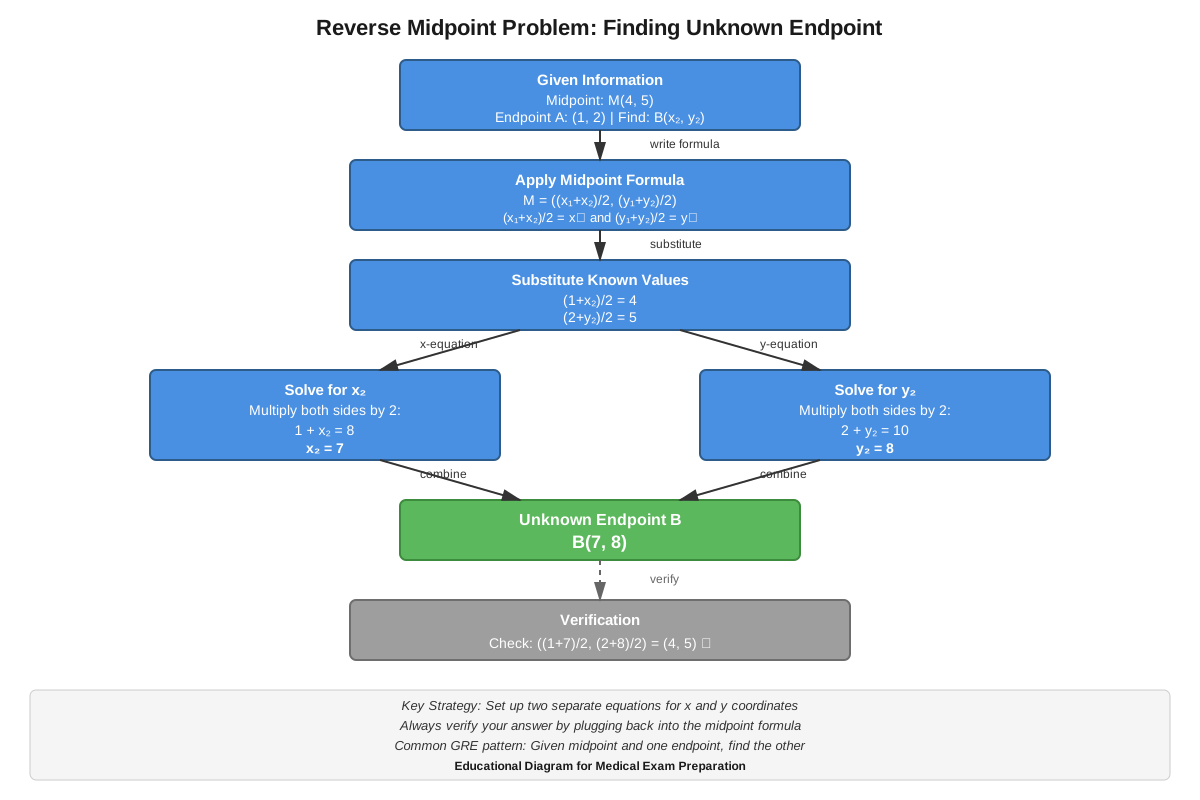
A common GRE variation provides the midpoint and one endpoint, requiring you to find the other endpoint. This requires algebraic manipulation of the midpoint formula. If M = (mx, my) is the midpoint, and one endpoint is (x₁, y₁), then the unknown endpoint (x₂, y₂) can be found using:
x₂ = 2mx - x₁
y₂ = 2my - y₁
This formula derives from rearranging the midpoint formula. Since mx = (x₁ + x₂)/2, multiplying both sides by 2 gives 2mx = x₁ + x₂, and solving for x₂ yields x₂ = 2mx - x₁. The same logic applies to the y-coordinate.
Midpoint Properties in Geometric Figures
The midpoint formula connects to several important geometric properties:
| Geometric Figure | Midpoint Property | Application |
|---|---|---|
| Line Segment | Midpoint divides segment into two congruent parts | Finding the center of any segment |
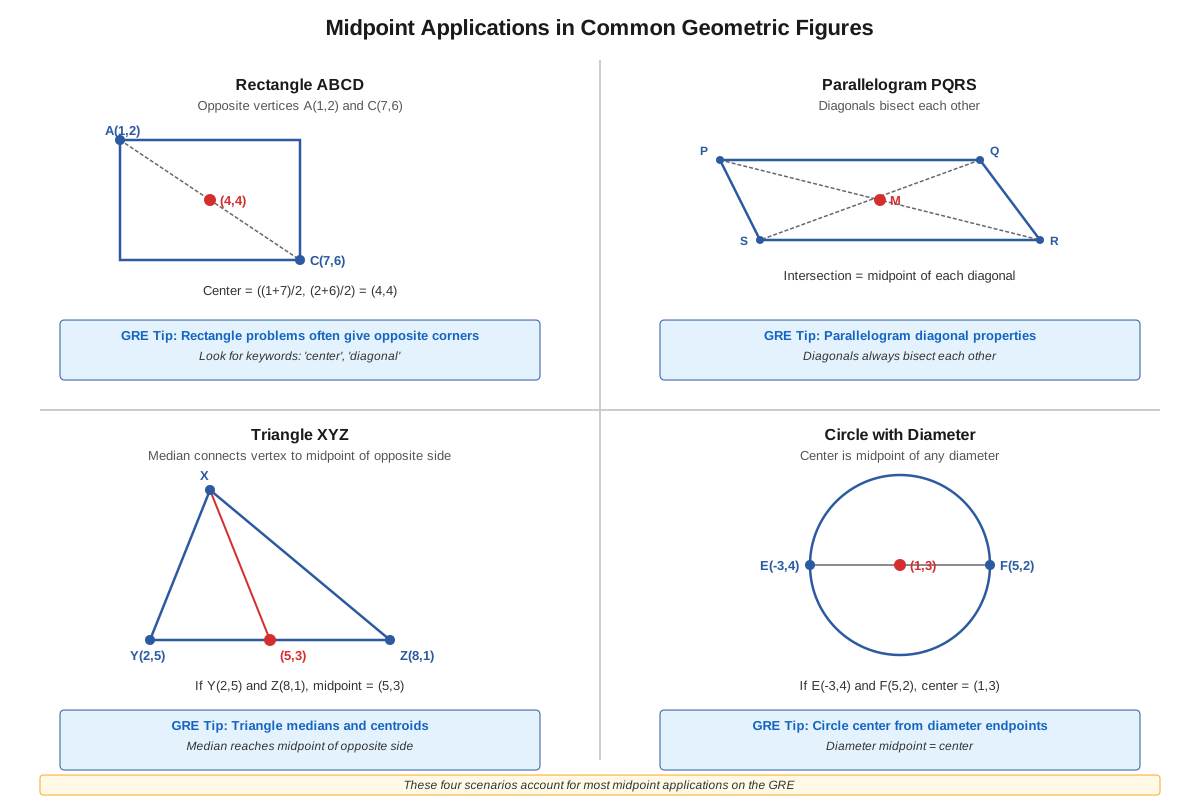
| Rectangle/Parallelogram | Diagonals bisect each other at their midpoint | Proving a quadrilateral is a parallelogram |
| Triangle | Median connects vertex to midpoint of opposite side | Finding medians and centroids |
| Trapezoid | Midsegment connects midpoints of legs | Calculating midsegment length |
Three-Dimensional Extension
While the GRE primarily focuses on two-dimensional coordinate geometry, understanding that the midpoint formula extends to three dimensions demonstrates conceptual mastery. For points (x₁, y₁, z₁) and (x₂, y₂, z₂), the midpoint is ((x₁ + x₂)/2, (y₁ + y₂)/2, (z₁ + z₂)/2). This extension follows the same averaging principle across all dimensions.
Concept Relationships
The midpoint formula sits at the intersection of algebra and geometry, serving as a bridge between numerical calculation and spatial visualization. The formula directly builds upon the averaging concept from basic arithmetic—understanding that an average represents a central value is prerequisite knowledge that makes the midpoint formula intuitive rather than arbitrary.
The midpoint formula connects closely to the distance formula, which calculates the length of a line segment between two points. Together, these formulas provide complete information about a line segment: the distance formula tells you how long it is, while the midpoint formula tells you where its center lies. Many GRE problems require both formulas in sequence—for example, finding the midpoint of a segment and then calculating the distance from that midpoint to a third point.
Within coordinate geometry, the midpoint formula enables understanding of symmetry and reflection. When a point is reflected across a line, the line of reflection passes through the midpoint of the segment connecting the original point and its reflection. This relationship appears in transformation problems on the GRE.
The formula also connects to properties of quadrilaterals. A quadrilateral is a parallelogram if and only if its diagonals bisect each other—meaning the diagonals share the same midpoint. This provides a coordinate-based method for proving geometric properties algebraically.
Relationship flow: Averaging → Midpoint Formula → Geometric Properties → Complex Problem Solving. Additionally: Midpoint Formula + Distance Formula → Complete Segment Analysis. The midpoint formula also enables Perpendicular Bisector problems, since the perpendicular bisector of a segment passes through the segment's midpoint.
High-Yield Facts
⭐ The midpoint formula is M = ((x₁ + x₂)/2, (y₁ + y₂)/2) for points (x₁, y₁) and (x₂, y₂)
⭐ The midpoint formula works by averaging the x-coordinates and averaging the y-coordinates separately
⭐ The order of the points doesn't matter—you'll get the same midpoint regardless of which point you designate as "first"
⭐ To find an unknown endpoint when given the midpoint and one endpoint, use x₂ = 2mx - x₁ and y₂ = 2my - y₁
⭐ The midpoint divides a line segment into two congruent (equal length) segments
- The midpoint formula works with negative coordinates, fractions, and decimals using the same process
- In a parallelogram or rectangle, the diagonals bisect each other, meaning they share the same midpoint
- The midpoint of a segment is the only point on that segment equidistant from both endpoints
- If three points are collinear and one is the midpoint of the other two, the distances from the midpoint to each endpoint are equal
- The coordinates of a midpoint always fall between the coordinates of the endpoints (considering the number line for each dimension)
- Finding the midpoint is often an intermediate step in multi-step GRE problems involving distance, area, or other geometric properties
- The perpendicular bisector of a segment always passes through the segment's midpoint
Quick check — test yourself on Midpoint formula so far.
Try Flashcards →Common Misconceptions
Misconception: The midpoint formula requires subtracting the coordinates before dividing by 2 → Correction: The formula requires adding the coordinates and then dividing by 2. The midpoint is the average (mean) of the coordinates, which requires addition, not subtraction. Subtraction is used in the distance formula, not the midpoint formula.
Misconception: When working with negative coordinates, you should ignore the negative signs and add them back later → Correction: Negative signs must be included in all calculations. When adding a negative number, you're effectively subtracting. For example, (-4 + 2)/2 = -2/2 = -1, not 6/2 = 3.
Misconception: The midpoint must always have positive coordinates → Correction: The midpoint can have negative coordinates, positive coordinates, or a mix of both, depending on the location of the endpoints. If both endpoints have negative x-coordinates, the midpoint will also have a negative x-coordinate.
Misconception: You need to use the distance formula before you can find the midpoint → Correction: The midpoint formula is completely independent of the distance formula. You can find a midpoint knowing only the coordinates of the endpoints, without any information about the distance between them.
Misconception: The midpoint formula only works for horizontal or vertical line segments → Correction: The midpoint formula works for line segments in any orientation—horizontal, vertical, or diagonal. The formula applies universally to any two points on the coordinate plane regardless of their relative positions.
Misconception: When finding an unknown endpoint, you should divide the midpoint coordinates by 2 → Correction: To find an unknown endpoint, you multiply the midpoint coordinates by 2 and then subtract the known endpoint coordinates. The formula is x₂ = 2mx - x₁, not x₂ = mx/2.
Misconception: The midpoint of a segment from (0, 0) to (x, y) is always (x/2, y/2) → Correction: This is actually correct, but students sometimes overgeneralize this special case and try to divide only one endpoint's coordinates by 2 even when the other endpoint isn't the origin. The formula always requires adding both coordinates before dividing.
Worked Examples
Example 1: Direct Midpoint Calculation
Problem: Find the midpoint of the line segment connecting points A(-3, 7) and B(5, -1).
Solution:
Step 1: Identify the coordinates
- Point A: (x₁, y₁) = (-3, 7)
- Point B: (x₂, y₂) = (5, -1)
Step 2: Apply the midpoint formula for the x-coordinate
- x-coordinate of midpoint = (x₁ + x₂)/2
- x-coordinate = (-3 + 5)/2 = 2/2 = 1
Step 3: Apply the midpoint formula for the y-coordinate
- y-coordinate of midpoint = (y₁ + y₂)/2
- y-coordinate = (7 + (-1))/2 = 6/2 = 3
Step 4: Write the midpoint as an ordered pair
- Midpoint M = (1, 3)
Step 5: Verify reasonableness
- The x-coordinate 1 falls between -3 and 5 ✓
- The y-coordinate 3 falls between -1 and 7 ✓
Connection to Learning Objectives: This example demonstrates direct application of the midpoint formula to GRE-style questions, showing the systematic process for calculating midpoint coordinates with both positive and negative values.
Example 2: Reverse Midpoint Problem
Problem: The midpoint of segment CD is M(4, -2). If point C has coordinates (1, 3), what are the coordinates of point D?
Solution:
Step 1: Identify known values
- Midpoint M: (mx, my) = (4, -2)
- Known endpoint C: (x₁, y₁) = (1, 3)
- Unknown endpoint D: (x₂, y₂) = (?, ?)
Step 2: Use the reverse midpoint formula for x-coordinate
- x₂ = 2mx - x₁
- x₂ = 2(4) - 1
- x₂ = 8 - 1 = 7
Step 3: Use the reverse midpoint formula for y-coordinate
- y₂ = 2my - y₁
- y₂ = 2(-2) - 3
- y₂ = -4 - 3 = -7
Step 4: Write the coordinates of point D
- Point D = (7, -7)
Step 5: Verify by checking the midpoint
- Check x: (1 + 7)/2 = 8/2 = 4 ✓
- Check y: (3 + (-7))/2 = -4/2 = -2 ✓
- This confirms M(4, -2) is indeed the midpoint
Connection to Learning Objectives: This example shows how to solve reverse midpoint problems, a common GRE variation that tests deeper understanding of the formula through algebraic manipulation. It demonstrates the strategy of working backward from the midpoint to find missing information.
Example 3: Midpoint in Geometric Context
Problem: A rectangle has vertices at A(2, 1), B(8, 1), C(8, 5), and D(2, 5). Show that the diagonals bisect each other by finding their midpoints.
Solution:
Step 1: Identify the diagonals
- Diagonal 1: AC connects (2, 1) and (8, 5)
- Diagonal 2: BD connects (8, 1) and (2, 5)
Step 2: Find the midpoint of diagonal AC
- x-coordinate: (2 + 8)/2 = 10/2 = 5
- y-coordinate: (1 + 5)/2 = 6/2 = 3
- Midpoint of AC = (5, 3)
Step 3: Find the midpoint of diagonal BD
- x-coordinate: (8 + 2)/2 = 10/2 = 5
- y-coordinate: (1 + 5)/2 = 6/2 = 3
- Midpoint of BD = (5, 3)
Step 4: Compare the midpoints
- Both diagonals have the same midpoint (5, 3)
- This confirms the diagonals bisect each other
Connection to Learning Objectives: This example demonstrates how the midpoint formula applies to proving geometric properties, showing the integration of coordinate geometry with traditional geometric theorems—a high-yield skill for GRE problems involving quadrilaterals.
Exam Strategy
When approaching GRE questions involving the midpoint formula, begin by identifying trigger words and phrases: "midpoint," "halfway between," "center of the segment," "bisects," "divides equally," or "equidistant from both endpoints." These phrases signal that the midpoint formula is likely relevant to the solution.
Exam Tip: If a problem mentions two points and asks about a third point "between" them without specifying the exact location, check whether that third point might be the midpoint. The GRE often tests whether students recognize midpoint relationships without explicitly using the word "midpoint."
For Quantitative Comparison questions involving midpoints, avoid calculating unless necessary. Sometimes you can determine the relationship by reasoning about properties. For example, if comparing the x-coordinate of a midpoint to a specific value, check whether both endpoints' x-coordinates are greater than or less than that value—this can sometimes allow you to determine the answer without calculation.
Process-of-elimination strategies specific to midpoint problems:
- If answer choices for a midpoint coordinate fall outside the range between the two endpoint coordinates, eliminate them immediately (unless dealing with negative numbers where you must be more careful)
- For reverse midpoint problems, eliminate any answer that would make the given point not actually be the midpoint when you check
- If a problem asks which point could be a midpoint, eliminate any point that isn't equidistant from the two endpoints
Time allocation advice: Direct midpoint calculations should take 30-45 seconds. If you find yourself spending more than one minute on a midpoint problem, you may be overcomplicating it—consider whether there's a simpler approach or whether you've misidentified what the question is actually asking. Reverse midpoint problems typically require 60-90 seconds due to the additional algebraic manipulation.
Strategic approach sequence:
- Read the question carefully to determine what is being asked (midpoint itself, an endpoint, or a property involving the midpoint)
- Extract and label all given coordinates clearly
- Determine which formula or approach to use (direct midpoint, reverse midpoint, or property-based reasoning)
- Perform calculations carefully, especially with negative numbers
- Check that your answer makes geometric sense before selecting it
For problems involving multiple steps where finding a midpoint is just one component, complete the midpoint calculation first and write it down clearly before moving to the next step. This prevents errors from trying to hold too much information mentally.
Memory Techniques
Mnemonic for the formula structure: "Add then Divide" — You Add the coordinates, then Divide by 2. This reminds you of the correct operation order and prevents confusion with the distance formula.
Visualization strategy: Picture a seesaw or balance beam with the two endpoints as the ends and the midpoint as the fulcrum in the center. This physical image reinforces that the midpoint is the balance point, equidistant from both ends. When you average coordinates, you're finding where the balance point would be.
Acronym for reverse problems: "TMO" — Twice the Midpoint minus the Other point. This helps you remember that to find an unknown endpoint, you multiply the midpoint by 2 and subtract the known endpoint.
Finger counting technique: When working with small integers, you can visualize the number line on your fingers. If one endpoint is at 2 and another at 8, count up from 2 to 8 on your fingers (6 steps), then count half that distance from 2 (3 steps) to reach 5, the midpoint. This kinesthetic approach reinforces the concept of "halfway between."
Rhyme for checking work: "Between the two, the middle's true" — The midpoint coordinates must fall between the endpoint coordinates (considering each dimension separately). This quick rhyme helps you remember to verify your answer makes geometric sense.
Pattern recognition: For segments starting at the origin (0, 0), the midpoint is simply half of the other endpoint's coordinates. Recognizing this special case can save time: midpoint of (0, 0) and (a, b) is always (a/2, b/2).
Summary
The midpoint formula is an essential coordinate geometry tool that calculates the exact center point between two coordinates by averaging their x-coordinates and y-coordinates separately. The formula M = ((x₁ + x₂)/2, (y₁ + y₂)/2) applies universally to any two points on the coordinate plane, regardless of whether coordinates are positive, negative, fractional, or decimal. GRE questions test this concept through direct midpoint calculations, reverse problems requiring algebraic manipulation to find unknown endpoints, and geometric applications involving properties of polygons and line segments. Mastery requires understanding both the mechanical application of the formula and the conceptual foundation of averaging that underlies it. The midpoint formula connects to broader coordinate geometry concepts including distance, slope, and geometric properties, making it a high-yield topic that appears in approximately 5-8% of Quantitative Reasoning questions. Success on midpoint problems demands careful arithmetic with signed numbers, systematic problem-solving approaches, and the ability to recognize when midpoint relationships are being tested even when not explicitly stated.
Key Takeaways
- The midpoint formula averages x-coordinates and y-coordinates separately: M = ((x₁ + x₂)/2, (y₁ + y₂)/2)
- To find an unknown endpoint when given the midpoint and one endpoint, use x₂ = 2mx - x₁ and y₂ = 2my - y₁
- The midpoint always falls between the endpoints (considering each coordinate dimension separately on the number line)
- Midpoint problems appear in multiple GRE contexts: direct calculation, reverse problems, and geometric property proofs
- The formula works identically with negative numbers, but requires careful attention to arithmetic with signed values
- Diagonals of parallelograms and rectangles bisect each other, meaning they share the same midpoint—a testable property
- Verifying that your calculated midpoint makes geometric sense is a crucial error-checking step that takes only seconds
Related Topics
Distance Formula: After mastering the midpoint formula, students should study the distance formula, which calculates the length of line segments between two points. Together, these formulas provide complete information about any line segment on the coordinate plane.
Slope and Linear Equations: Understanding how to calculate slope between two points and write equations of lines complements midpoint knowledge, as many GRE problems require multiple coordinate geometry concepts in combination.
Properties of Quadrilaterals: The midpoint formula enables coordinate-based proofs of quadrilateral properties, particularly for parallelograms, rectangles, and rhombuses where diagonal relationships are significant.
Circle Equations: The center of a circle can be found using midpoint concepts when given endpoints of a diameter, connecting midpoint knowledge to circle geometry.
Geometric Transformations: Reflections, rotations, and translations often involve midpoint calculations, particularly when determining lines of symmetry or centers of rotation.
Practice CTA
Now that you've mastered the conceptual foundation and strategic approaches for the midpoint formula, it's time to solidify your understanding through active practice. Attempt the practice questions to test your ability to recognize midpoint problems in various contexts, apply the formula accurately under timed conditions, and integrate this knowledge with other coordinate geometry concepts. Work through the flashcards to build instant recall of the formula and its variations. Remember: the difference between understanding a concept and scoring points on test day is deliberate practice. Each problem you solve strengthens your pattern recognition and builds the confidence you need to tackle any midpoint question the GRE presents. You've invested the time to learn this high-yield topic—now invest the effort to make it automatic!
Sign up free to keep reading
Create a free AnvayaPrep account to finish this GRE guide on Midpoint formula — plus flashcards and practice questions.