Overview
The distance formula is a fundamental mathematical tool that allows test-takers to calculate the straight-line distance between any two points in a coordinate plane. Derived directly from the Pythagorean theorem, this formula is essential for solving a wide range of GRE Quantitative Reasoning problems involving coordinate geometry, spatial relationships, and geometric figures plotted on the xy-plane. The gre distance formula appears frequently in questions that require determining lengths of line segments, radii of circles, diagonals of polygons, or the shortest path between two locations.
Understanding the distance formula is crucial for GRE success because it bridges multiple mathematical concepts including coordinate geometry, algebra, and right triangle relationships. Questions testing this concept often appear in both Quantitative Comparison and Problem Solving formats, and they may be embedded within more complex multi-step problems involving circles, polygons, or optimization scenarios. The formula itself is straightforward, but the GRE tests students' ability to recognize when to apply it, manipulate it algebraically, and combine it with other geometric principles.
Mastery of the distance formula connects directly to broader Quantitative Reasoning skills including algebraic manipulation, geometric visualization, and analytical problem-solving. This topic frequently intersects with questions about circles (where distance represents radius), midpoints, slopes, and the properties of geometric shapes. Students who can quickly and accurately apply the distance formula gain a significant advantage on test day, as it enables efficient solutions to problems that might otherwise require lengthy geometric constructions or multiple calculation steps.
Learning Objectives
- [ ] Identify when Distance formula is being tested
- [ ] Explain the core rule or strategy behind Distance formula
- [ ] Apply Distance formula to GRE-style questions accurately
- [ ] Derive the distance formula from the Pythagorean theorem
- [ ] Recognize distance formula applications in circle equations and geometric figures
- [ ] Simplify radical expressions resulting from distance calculations efficiently
- [ ] Solve multi-step problems combining distance formula with other coordinate geometry concepts
Prerequisites
- Pythagorean theorem (a² + b² = c²): The distance formula is a direct application of this theorem in the coordinate plane
- Coordinate plane basics: Understanding ordered pairs (x, y) and plotting points is essential for identifying the coordinates needed in the formula
- Simplifying radicals and square roots: Distance calculations often produce radical expressions that require simplification
- Basic algebraic manipulation: Substituting values, squaring terms, and solving equations are necessary skills for applying the formula
- Right triangle properties: Recognizing how horizontal and vertical distances form the legs of a right triangle helps visualize the formula's geometric meaning
Why This Topic Matters
The distance formula appears in approximately 5-8% of GRE Quantitative Reasoning questions, making it a high-yield topic that warrants thorough preparation. Beyond its direct applications, the formula serves as a foundation for understanding circle equations, optimization problems, and spatial reasoning questions that are staples of the exam. Real-world applications include navigation systems calculating shortest routes, computer graphics determining pixel distances, architecture measuring spatial relationships, and physics analyzing motion in two dimensions.
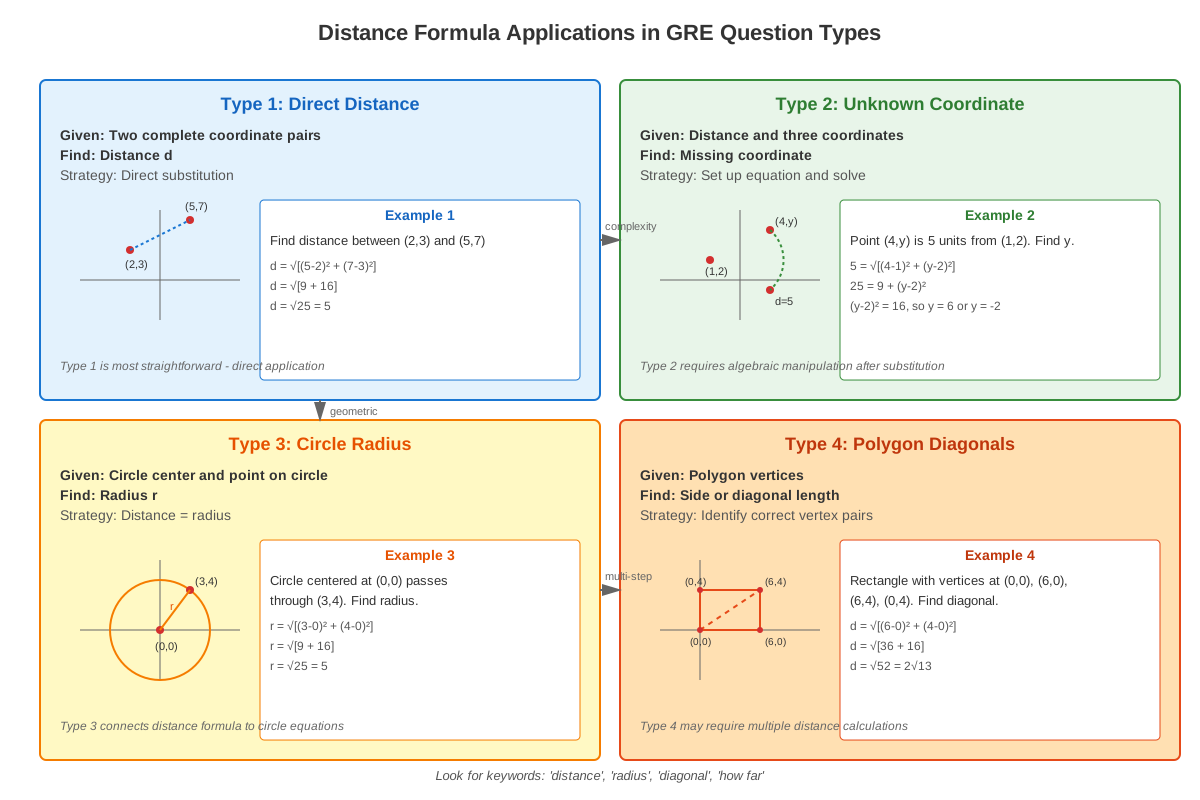
On the GRE, distance formula questions typically appear in several formats: direct calculation problems asking for the distance between two given points, questions requiring students to find an unknown coordinate given a distance, problems involving circles where the distance represents a radius, and complex scenarios where distance calculations are one step in a multi-part solution. The formula also appears implicitly in questions about perpendicular bisectors, loci of points, and geometric optimization.
Common question types include Quantitative Comparison problems comparing distances between different point pairs, Problem Solving questions requiring exact or approximate distance calculations, and Data Interpretation questions where coordinate data must be analyzed spatially. The GRE frequently combines distance formula concepts with other topics such as area calculations, triangle properties, or algebraic equations, testing students' ability to integrate multiple mathematical concepts efficiently.
Core Concepts
The Distance Formula Derivation
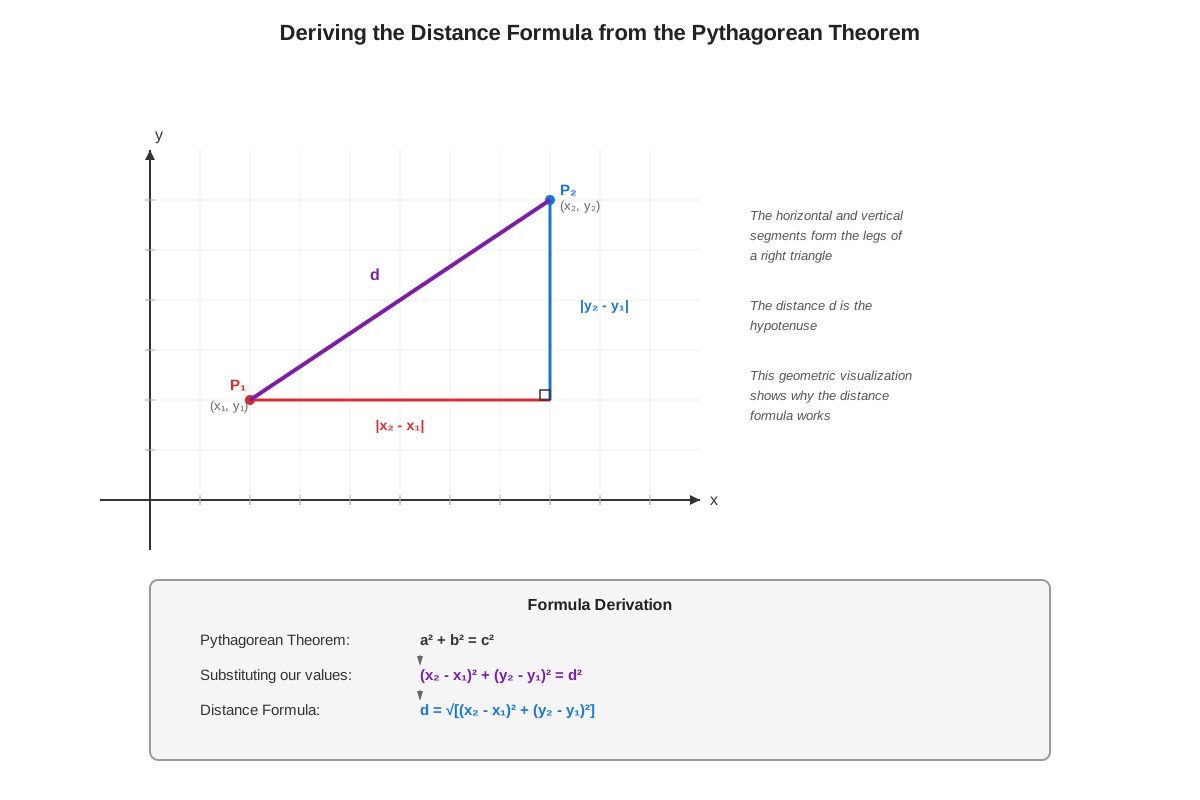
The distance formula calculates the straight-line distance between two points (x₁, y₁) and (x₂, y₂) in a coordinate plane. The formula is:
d = √[(x₂ - x₁)² + (y₂ - y₁)²]This formula derives directly from the Pythagorean theorem. When two points are plotted on a coordinate plane, they form the endpoints of a line segment. By drawing a right triangle where this segment is the hypotenuse, the horizontal leg has length |x₂ - x₁| and the vertical leg has length |y₂ - y₁|. Applying the Pythagorean theorem yields the distance formula.
The beauty of this formula lies in its universality—it works regardless of which quadrant the points occupy, whether the line segment is horizontal, vertical, or diagonal, and whether coordinates are positive or negative. The squaring operation within the formula automatically handles absolute values, eliminating the need to worry about the order of subtraction.
Components and Calculation Steps
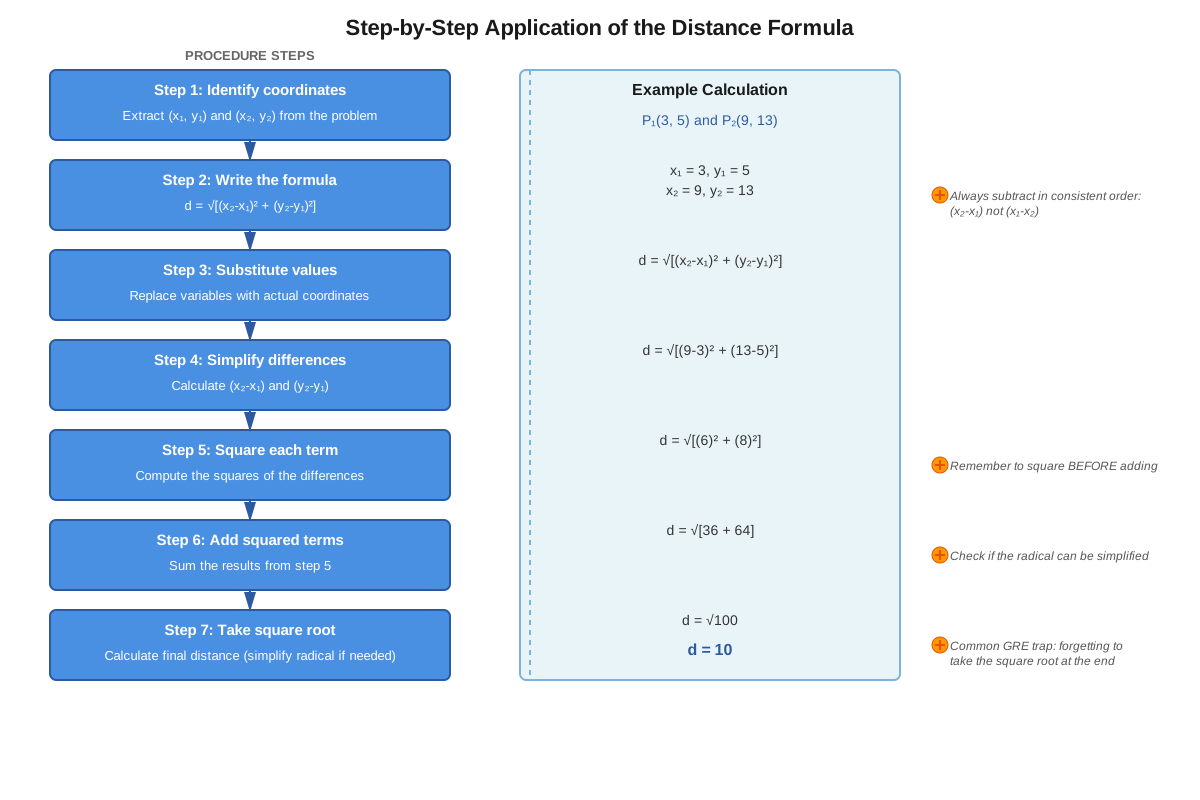
To apply the distance formula systematically, follow these steps:
- Identify the coordinates: Label the two points clearly as (x₁, y₁) and (x₂, y₂)
- Calculate horizontal difference: Find (x₂ - x₁) and square the result
- Calculate vertical difference: Find (y₂ - y₁) and square the result
- Sum the squared differences: Add the two squared values together
- Take the square root: Extract the square root of the sum to find the distance
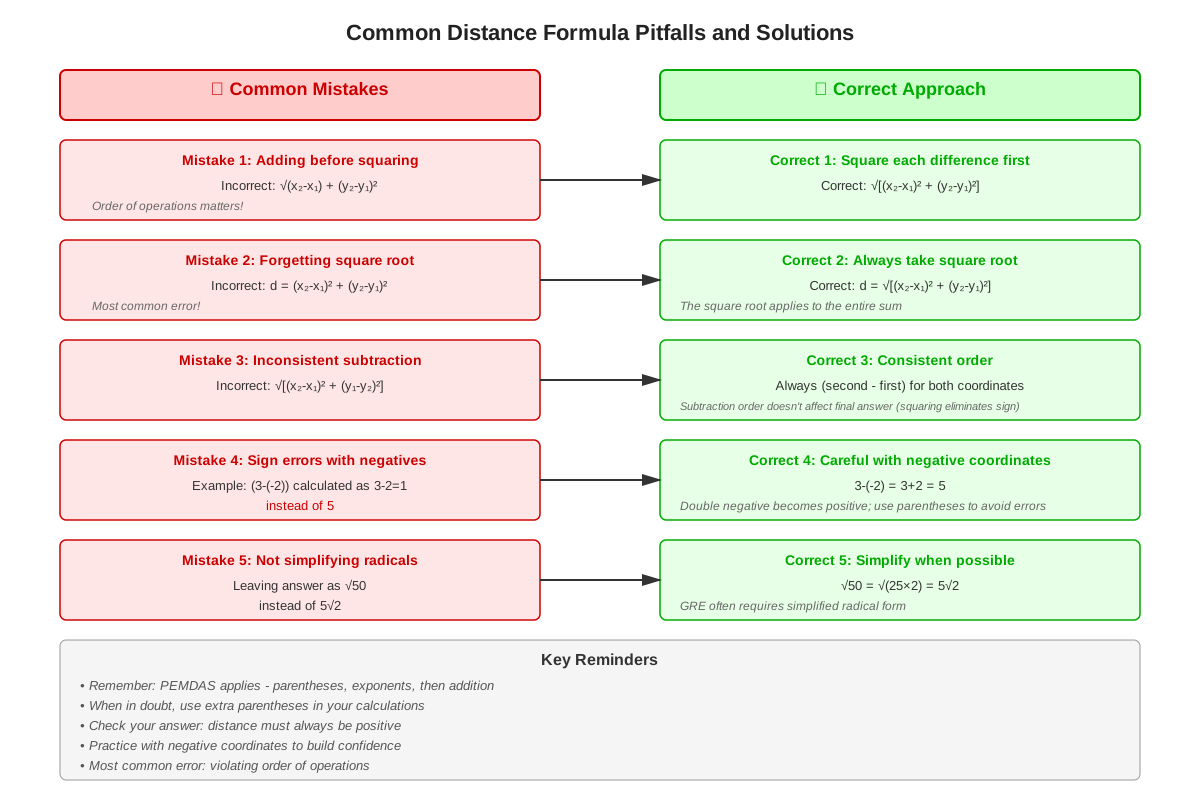
The order in which points are labeled does not matter because squaring eliminates any negative signs. For example, (x₂ - x₁)² = (x₁ - x₂)², so the distance from point A to point B equals the distance from point B to point A.
Special Cases and Simplifications
Several special cases allow for simplified calculations:
| Scenario | Simplification | Example | ||
|---|---|---|---|---|
| Horizontal line (same y-coordinates) | d = \ | x₂ - x₁\ | Distance from (2, 5) to (7, 5) is 5 | |
| Vertical line (same x-coordinates) | d = \ | y₂ - y₁\ | Distance from (3, 1) to (3, 8) is 7 | |
| Points on axes | One coordinate is zero | Distance from origin (0, 0) to (3, 4) is 5 | ||
| Integer Pythagorean triples | Distance is an integer | Points forming 3-4-5, 5-12-13, 8-15-17 triangles |
Recognizing these patterns can significantly reduce calculation time on the GRE. When both points share a coordinate, the distance calculation simplifies to basic subtraction without requiring the full formula.
Distance Formula in Circle Equations
The distance formula is fundamental to understanding circle equations. The standard form of a circle equation is:
(x - h)² + (y - k)² = r²This equation represents all points (x, y) that are exactly distance r from the center point (h, k). The left side of the equation is precisely the squared distance formula, demonstrating that every point on the circle maintains constant distance (the radius) from the center.
GRE questions frequently test this connection by asking students to determine whether a point lies on, inside, or outside a circle. By calculating the distance from the point to the center and comparing it to the radius, students can answer such questions efficiently.
Three-Dimensional Extension
While the GRE primarily focuses on two-dimensional coordinate geometry, understanding that the distance formula extends to three dimensions provides deeper conceptual insight:
d = √[(x₂ - x₁)² + (y₂ - y₁)² + (z₂ - z₁)²]This extension follows the same logical pattern, adding a third squared difference for the z-coordinate. Though rarely tested directly, this concept may appear in advanced problem-solving questions or data interpretation scenarios.
Algebraic Manipulation with Distance
Many GRE problems require algebraic manipulation involving the distance formula. Common scenarios include:
- Finding an unknown coordinate: Given one point, a distance, and partial information about a second point, solve for the missing coordinate
- Setting up equations: Use the distance formula to create equations that can be solved simultaneously with other constraints
- Optimization problems: Minimize or maximize distance subject to certain conditions
- Locus problems: Find all points satisfying a distance condition
These applications require comfort with squaring both sides of equations, working with radicals, and solving quadratic equations that emerge from distance calculations.
Concept Relationships
The distance formula serves as a central hub connecting multiple coordinate geometry concepts. It derives from the Pythagorean theorem, which itself is foundational to all right triangle relationships. This connection means that any problem involving right triangles in the coordinate plane can potentially be solved using the distance formula.
The formula connects directly to circle equations because the defining property of a circle—constant distance from a center point—is expressed through the distance formula. Understanding this relationship enables students to transition seamlessly between geometric and algebraic representations of circles.
Midpoint formula and distance formula are complementary tools in coordinate geometry. While the midpoint formula finds the center point between two coordinates, the distance formula measures how far apart they are. Together, these formulas enable complete analysis of line segments in the coordinate plane.
The relationship flows as follows: Coordinate plane basics → Pythagorean theorem → Distance formula → Circle equations and Geometric optimization. Additionally, the distance formula connects to slope concepts because perpendicular lines and distance calculations often appear together in problems involving perpendicular bisectors or shortest distance from a point to a line.
High-Yield Facts
⭐ The distance formula is d = √[(x₂ - x₁)² + (y₂ - y₁)²], derived directly from the Pythagorean theorem
⭐ The order of point subtraction does not matter because squaring eliminates negative signs
⭐ For horizontal lines (same y-coordinate), distance simplifies to |x₂ - x₁|
⭐ For vertical lines (same x-coordinate), distance simplifies to |y₂ - y₁|
⭐ The distance from the origin (0, 0) to any point (a, b) is √(a² + b²)
- Common Pythagorean triples (3-4-5, 5-12-13, 8-15-17) often appear in distance problems with integer answers
- The distance formula squared equals (x₂ - x₁)² + (y₂ - y₁)², which appears in circle equations
- Distance is always non-negative; the minimum distance between two distinct points is greater than zero
- The distance between a point and itself is always zero
- In circle problems, comparing the calculated distance to the radius determines whether a point is inside (d < r), on (d = r), or outside (d > r) the circle
Quick check — test yourself on Distance formula so far.
Try Flashcards →Common Misconceptions
Misconception: The order of subtraction matters in the distance formula, and you must always subtract the smaller coordinate from the larger one.
Correction: Because both differences are squared, the order of subtraction is irrelevant. (x₂ - x₁)² always equals (x₁ - x₂)², so you can subtract in either order without affecting the result.
Misconception: When both coordinates are negative, you should make them positive before applying the formula.
Correction: The distance formula works with negative coordinates exactly as written. The squaring operation automatically handles the signs correctly, so no preliminary adjustments are needed.
Misconception: The distance formula only works for points in the first quadrant.
Correction: The formula works universally for points in any quadrant or on any axis. The algebraic structure of the formula accounts for all possible coordinate signs and positions.
Misconception: If the calculated distance contains a radical, you must always simplify it completely.
Correction: While simplification is often helpful, the GRE sometimes accepts answers in various forms. However, when comparing distances or when answer choices are simplified, you should simplify radicals to match the format.
Misconception: The distance formula gives the shortest path between two points only if there are no obstacles.
Correction: In coordinate geometry, the distance formula always gives the straight-line (Euclidean) distance, which is by definition the shortest possible distance between two points in a plane, regardless of any conceptual "obstacles."
Misconception: You need different formulas for horizontal, vertical, and diagonal line segments.
Correction: The distance formula works for all orientations. While horizontal and vertical cases can be simplified, the general formula produces correct results for every case.
Worked Examples
Example 1: Direct Distance Calculation
Problem: What is the distance between points A(-2, 3) and B(4, -5)?
Solution:
Step 1: Identify the coordinates
- Point A: (x₁, y₁) = (-2, 3)
- Point B: (x₂, y₂) = (4, -5)
Step 2: Apply the distance formula
d = √[(x₂ - x₁)² + (y₂ - y₁)²]
d = √[(4 - (-2))² + (-5 - 3)²]
Step 3: Simplify the differences
d = √[(4 + 2)² + (-8)²]
d = √[6² + (-8)²]
d = √[36 + 64]
Step 4: Complete the calculation
d = √100
d = 10Answer: The distance is 10 units.
Key insights: This problem demonstrates how the formula handles negative coordinates seamlessly. Notice that -5 - 3 = -8, but when squared, this becomes positive 64. The result is a perfect square, yielding a clean integer answer—a common GRE pattern.
Example 2: Finding an Unknown Coordinate
Problem: Point P has coordinates (5, y), and the distance from P to point Q(1, 2) is 5 units. What are the possible values of y?
Solution:
Step 1: Set up the distance formula equation
5 = √[(5 - 1)² + (y - 2)²]Step 2: Square both sides to eliminate the radical
25 = (5 - 1)² + (y - 2)²
25 = 4² + (y - 2)²
25 = 16 + (y - 2)²
Step 3: Isolate the squared term
25 - 16 = (y - 2)²
9 = (y - 2)²
Step 4: Take the square root of both sides
±3 = y - 2Step 5: Solve for both possible values
y - 2 = 3  →  y = 5
y - 2 = -3 → y = -1Answer: y = 5 or y = -1
Key insights: This problem illustrates that distance problems can yield two solutions because squaring creates symmetry. Geometrically, this makes sense: there are two points on the vertical line x = 5 that are exactly 5 units from Q(1, 2)—one above and one below. This type of problem tests both distance formula application and algebraic equation-solving skills.
Example 3: Circle Application
Problem: A circle has center C(2, -1) and radius 6. Is point P(5, 3) inside, on, or outside the circle?
Solution:
Step 1: Calculate the distance from P to C
d = √[(5 - 2)² + (3 - (-1))²]
d = √[3² + 4²]
d = √[9 + 16]
d = √25
d = 5
Step 2: Compare the distance to the radius
- Distance from P to C: 5 units
- Radius of circle: 6 units
- Since 5 < 6, point P is inside the circle
Answer: Point P is inside the circle.
Key insights: This problem demonstrates the practical application of the distance formula to circle problems. Rather than working with the circle equation algebraically, calculating the distance and comparing it to the radius provides a direct, intuitive solution. This approach is often faster on the GRE than algebraic substitution.
Exam Strategy
When approaching GRE questions involving the distance formula, begin by identifying trigger words and phrases: "distance between," "how far," "length of segment," "radius," or any question asking about the separation between two points. Questions about circles, especially those asking whether points lie inside or outside, almost always involve distance calculations.
Exam Tip: Before applying the full formula, check whether the points share an x-coordinate or y-coordinate. If they do, you can calculate distance through simple subtraction, saving valuable time.
For Quantitative Comparison questions, avoid unnecessary calculations. If comparing distances, sometimes you can determine which is greater by comparing the squared distances, eliminating the need to calculate square roots. Remember that if d₁² > d₂², then d₁ > d₂ for positive distances.
Time allocation is crucial. A straightforward distance calculation should take 30-45 seconds. If a problem requires finding an unknown coordinate or involves multiple steps, allocate 90-120 seconds. If you find yourself spending more time, consider whether there's a simpler approach or whether you should mark the question and return to it later.
Watch for answer choices that represent common calculation errors: forgetting to take the square root, adding instead of subtracting coordinates, or failing to square the differences. The GRE deliberately includes these trap answers. Always verify that you've completed all steps of the formula correctly.
When problems combine distance with other concepts (circles, midpoints, optimization), sketch a quick coordinate plane diagram. Visual representation often reveals relationships that aren't obvious from coordinates alone and can help you avoid algebraic errors.
Memory Techniques
Mnemonic for the formula structure: "Difference Squared Sum Root" (DSSR)
- Difference: Subtract corresponding coordinates
- Squared: Square each difference
- Sum: Add the squared differences
- Root: Take the square root of the sum
Visualization strategy: Picture a right triangle with the two points as opposite corners. The horizontal leg represents the x-difference, the vertical leg represents the y-difference, and the hypotenuse (which you're finding) represents the distance. This mental image reinforces why the Pythagorean theorem applies.
Acronym for special cases: "HIVE"
- Horizontal lines: only x-difference matters
- Integer triples: look for 3-4-5 patterns
- Vertical lines: only y-difference matters
- Equation form: connects to circles
Memory hook: "Distance is the square root of the sum of squared differences"—this phrase, when memorized, contains the entire formula structure in words.
Summary
The distance formula, d = √[(x₂ - x₁)² + (y₂ - y₁)²], is an essential tool for calculating straight-line distances between points in the coordinate plane. Derived from the Pythagorean theorem, this formula applies universally regardless of quadrant, coordinate signs, or line orientation. GRE questions test the distance formula both directly—asking for calculations between given points—and indirectly through applications to circles, geometric figures, and optimization problems. Mastery requires recognizing when the formula applies, executing calculations accurately, simplifying radicals efficiently, and combining distance concepts with other coordinate geometry principles. Special cases, including horizontal and vertical lines, allow for simplified calculations that save time. The formula's connection to circle equations makes it fundamental for understanding whether points lie inside, on, or outside circles. Success on distance formula questions depends on systematic application of the formula steps, careful algebraic manipulation, and recognition of common patterns like Pythagorean triples.
Key Takeaways
- The distance formula d = √[(x₂ - x₁)² + (y₂ - y₁)²] calculates straight-line distance between any two points in a coordinate plane
- The formula derives from the Pythagorean theorem and works universally regardless of coordinate signs or quadrant locations
- Horizontal lines (same y-coordinate) and vertical lines (same x-coordinate) allow simplified distance calculations using absolute value of a single coordinate difference
- The squared distance formula (x₂ - x₁)² + (y₂ - y₁)² appears in circle equations, connecting distance concepts to circle geometry
- Common Pythagorean triples (3-4-5, 5-12-13, 8-15-17) frequently appear in GRE distance problems, enabling quick recognition of integer answers
- Distance problems may require finding unknown coordinates by setting up and solving equations, often yielding two solutions due to geometric symmetry
- Always check for opportunities to simplify before calculating—shared coordinates or recognizable patterns can significantly reduce computation time
Related Topics
Midpoint Formula: Calculates the coordinates of the point exactly halfway between two given points, using the average of x-coordinates and y-coordinates. Mastering distance formula provides the foundation for understanding how midpoint and distance work together to analyze line segments completely.
Circle Equations: The standard form (x - h)² + (y - k)² = r² directly incorporates the squared distance formula. Understanding distance enables deeper comprehension of circle properties, tangent lines, and problems involving multiple circles.
Pythagorean Theorem Applications: Beyond the distance formula, the Pythagorean theorem applies to numerous GRE geometry problems involving right triangles, diagonals, and three-dimensional figures. Distance formula mastery reinforces Pythagorean thinking.
Slope and Perpendicular Lines: Distance calculations often combine with slope concepts, particularly in problems about perpendicular bisectors or shortest distances from points to lines. These topics together enable comprehensive coordinate geometry problem-solving.
Optimization in Coordinate Geometry: Advanced problems may ask for minimum or maximum distances subject to constraints, requiring combination of distance formula with algebraic inequalities or calculus-like reasoning.
Practice CTA
Now that you've mastered the theoretical foundations and strategic approaches to the distance formula, it's time to solidify your understanding through practice. Attempt the practice questions designed specifically for this topic, focusing on applying the systematic approach outlined in this guide. Work through the flashcards to reinforce the formula structure, special cases, and common patterns. Remember that consistent practice with GRE-style questions is the key to achieving automaticity—the ability to recognize and solve distance problems quickly and accurately under test conditions. Each practice problem you complete strengthens your geometric intuition and builds the confidence you need for test day success!
Sign up free to keep reading
Create a free AnvayaPrep account to finish this GRE guide on Distance formula — plus flashcards and practice questions.