Overview
The Pythagorean theorem stands as one of the most fundamental and frequently tested concepts in GRE Quantitative Reasoning. This ancient mathematical principle, discovered by the Greek mathematician Pythagoras, establishes the relationship between the sides of a right triangle. On the GRE, this theorem appears not only in straightforward geometry problems but also disguised within coordinate geometry questions, word problems involving distances, and complex multi-step problems that require recognizing hidden right triangles. Mastery of this concept is non-negotiable for students aiming for competitive scores, as it forms the foundation for understanding triangle properties, distance calculations, and spatial reasoning.
The GRE Pythagorean theorem questions test more than simple formula application—they assess pattern recognition, problem-solving efficiency, and the ability to identify when a right triangle exists even when not explicitly stated. Students must develop the skill to spot right angles in diagrams, recognize Pythagorean triples for rapid calculation, and understand how the theorem extends to three-dimensional problems. The theorem's versatility makes it appear across multiple question formats, from Quantitative Comparison to Data Interpretation, making it a high-yield topic that deserves focused attention.
Within the broader Quantitative Reasoning framework, the Pythagorean theorem connects directly to coordinate geometry (calculating distances between points), triangle properties (area calculations and side relationships), circles (chord and radius problems), and even algebraic problem-solving. Understanding this theorem unlocks efficient solution pathways for numerous GRE problems and reduces solving time significantly when students recognize its applications automatically.
Learning Objectives
- [ ] Identify when Pythagorean theorem is being tested
- [ ] Explain the core rule or strategy behind Pythagorean theorem
- [ ] Apply Pythagorean theorem to GRE-style questions accurately
- [ ] Recognize and utilize common Pythagorean triples to accelerate problem-solving
- [ ] Determine when a triangle is right-angled using the converse of the Pythagorean theorem
- [ ] Apply the Pythagorean theorem in coordinate plane problems to calculate distances
- [ ] Solve three-dimensional problems involving right triangles and spatial reasoning
Prerequisites
- Basic algebra: Ability to solve equations with one or two variables, essential for manipulating the Pythagorean equation when solving for unknown sides
- Square roots and exponents: Understanding how to calculate squares and square roots, necessary for applying the formula a² + b² = c²
- Triangle fundamentals: Knowledge of triangle terminology (hypotenuse, legs, vertices) and basic properties
- Right angle recognition: Ability to identify 90-degree angles in diagrams and understand perpendicular relationships
- Coordinate plane basics: Familiarity with plotting points and understanding x and y coordinates for distance problems
Why This Topic Matters
The Pythagorean theorem appears in approximately 10-15% of GRE Quantitative Reasoning questions, making it one of the highest-yield geometry concepts. Beyond pure geometry problems, this theorem underlies distance formula questions, diagonal calculations in rectangles and squares, and problems involving circles inscribed in or circumscribed around triangles. Real-world applications include navigation, construction, computer graphics, and physics—disciplines that value spatial reasoning and mathematical precision.
On the GRE, Pythagorean theorem questions manifest in several distinct formats: direct application problems where students must find a missing side; Quantitative Comparison questions requiring students to compare expressions involving right triangle sides; word problems describing real-world scenarios that translate into right triangle setups; coordinate geometry problems asking for distances between points; and complex multi-step problems where recognizing a right triangle is just one component of the solution. The theorem also appears in Data Interpretation sets involving geometric figures and in problems testing special right triangles (45-45-90 and 30-60-90 triangles).
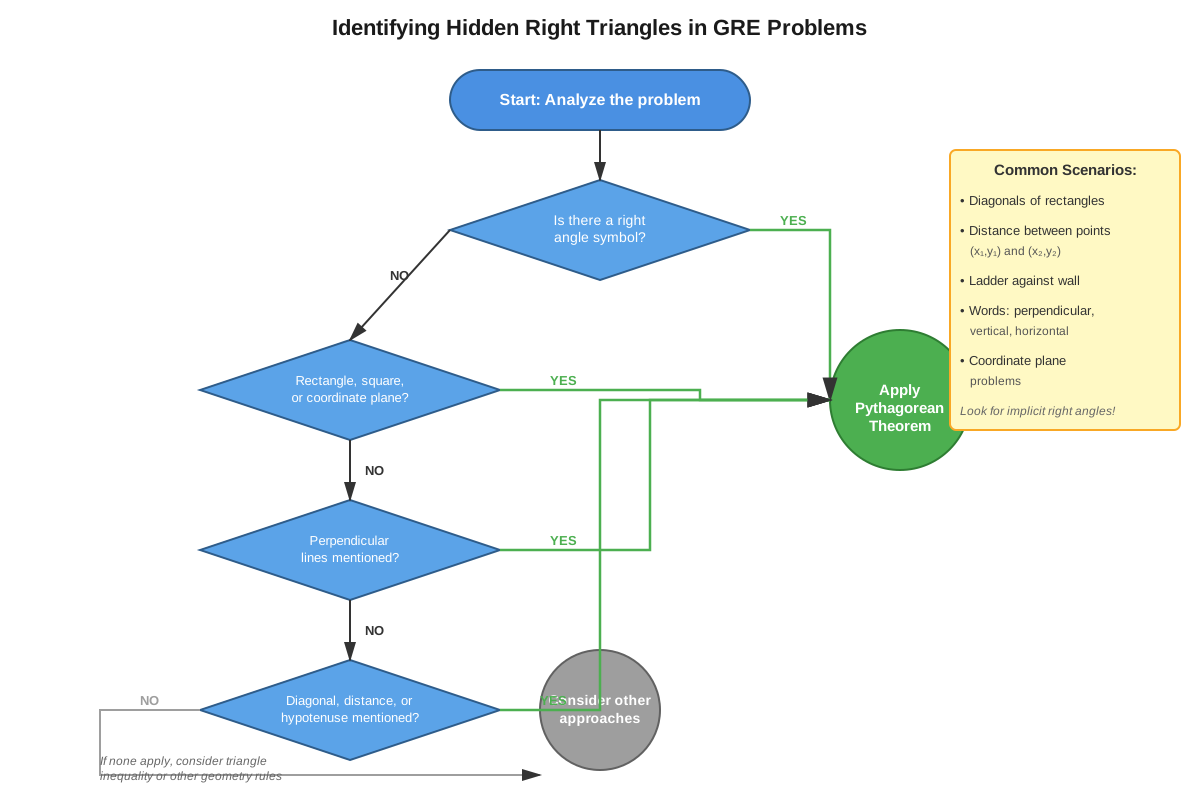
Test-makers frequently embed Pythagorean theorem applications within problems that don't explicitly mention right triangles, requiring students to recognize perpendicular relationships, identify right angles in complex figures, or understand that the shortest distance between a point and a line creates a right angle. This hidden application makes pattern recognition skills as important as formula knowledge.
Core Concepts
The Fundamental Formula
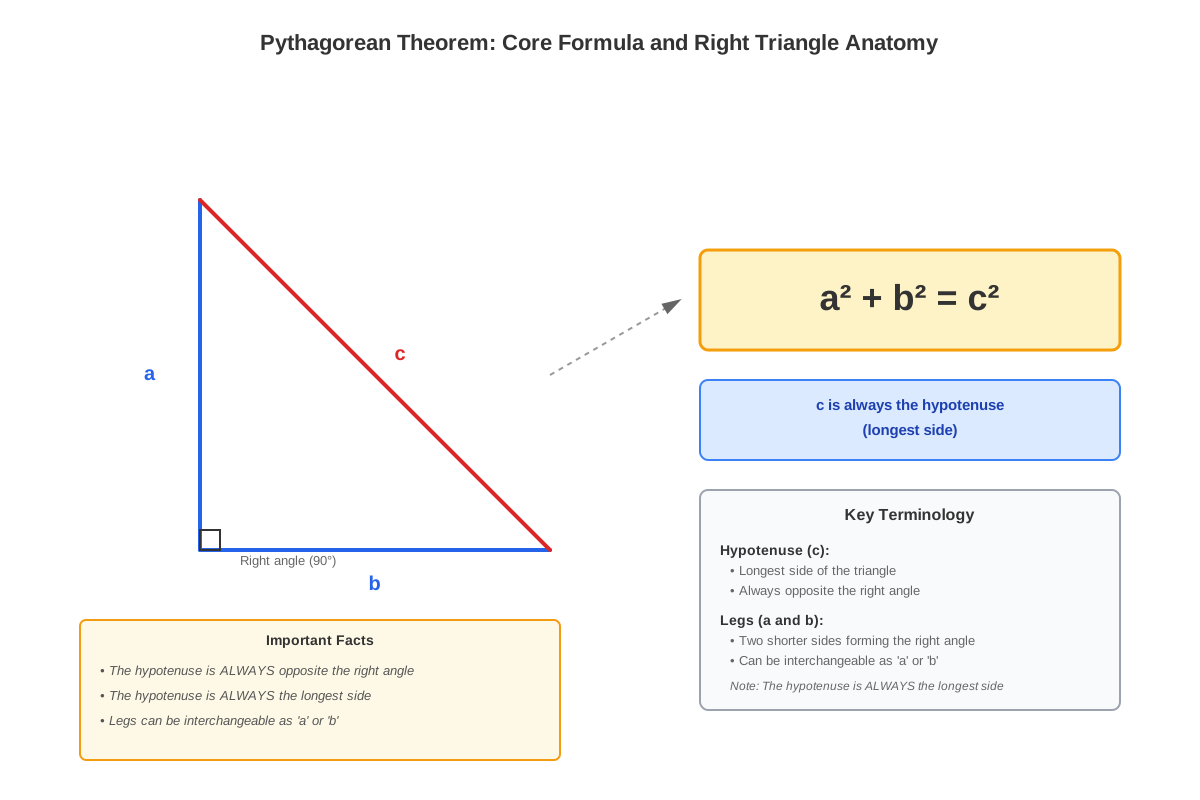
The Pythagorean theorem states that in any right triangle, the square of the length of the hypotenuse (the side opposite the right angle) equals the sum of the squares of the lengths of the other two sides (called legs). Mathematically expressed:
a² + b² = c²Where:
- a and b represent the lengths of the two legs (the sides that form the right angle)
- c represents the length of the hypotenuse (the longest side, opposite the right angle)
This relationship holds true exclusively for right triangles—triangles containing exactly one 90-degree angle. The hypotenuse is always the longest side and always lies opposite the right angle. The legs can be of any positive length, and either can be designated as "a" or "b" since addition is commutative.
Pythagorean Triples
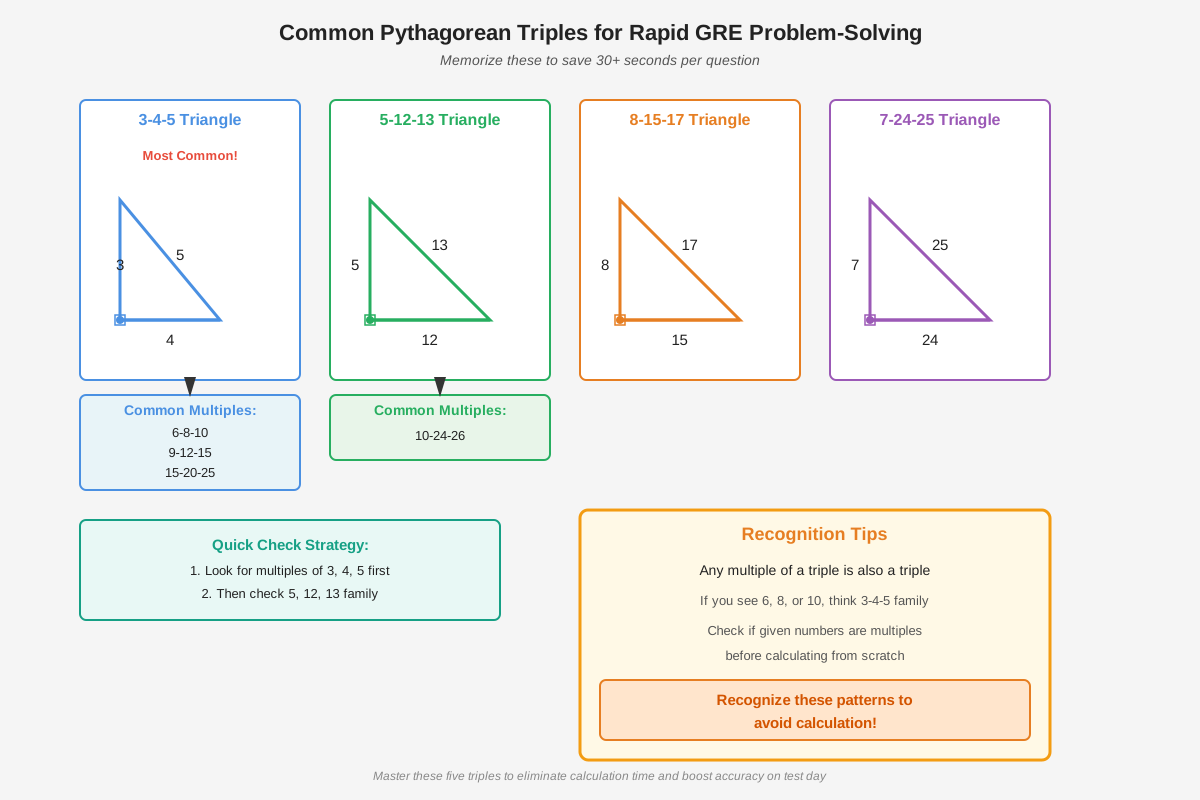
Pythagorean triples are sets of three positive integers that satisfy the Pythagorean theorem equation. Recognizing these patterns allows for instant calculation without using the formula, saving valuable time on the GRE. The most common triples include:
| Basic Triple | Common Multiples | Application |
|---|---|---|
| 3-4-5 | 6-8-10, 9-12-15, 12-16-20, 15-20-25 | Most frequent on GRE |
| 5-12-13 | 10-24-26, 15-36-39 | Second most common |
| 8-15-17 | 16-30-34 | Less frequent but valuable |
| 7-24-25 | 14-48-50 | Occasionally appears |
When a GRE problem presents two sides of a right triangle that match a Pythagorean triple pattern, students should immediately recognize the third side without calculation. For example, if a right triangle has legs of 9 and 12, recognizing this as 3(3-4-5) immediately reveals the hypotenuse as 15.
The Converse of the Pythagorean Theorem
The converse states that if three sides of a triangle satisfy the equation a² + b² = c² (where c is the longest side), then the triangle must be a right triangle. This powerful tool allows students to determine whether a triangle contains a right angle when given all three side lengths. On the GRE, this appears in questions asking whether a triangle is acute, right, or obtuse:
- If a² + b² = c², the triangle is right
- If a² + b² > c², the triangle is acute (all angles less than 90°)
- If a² + b² < c², the triangle is obtuse (one angle greater than 90°)
Application in Coordinate Geometry
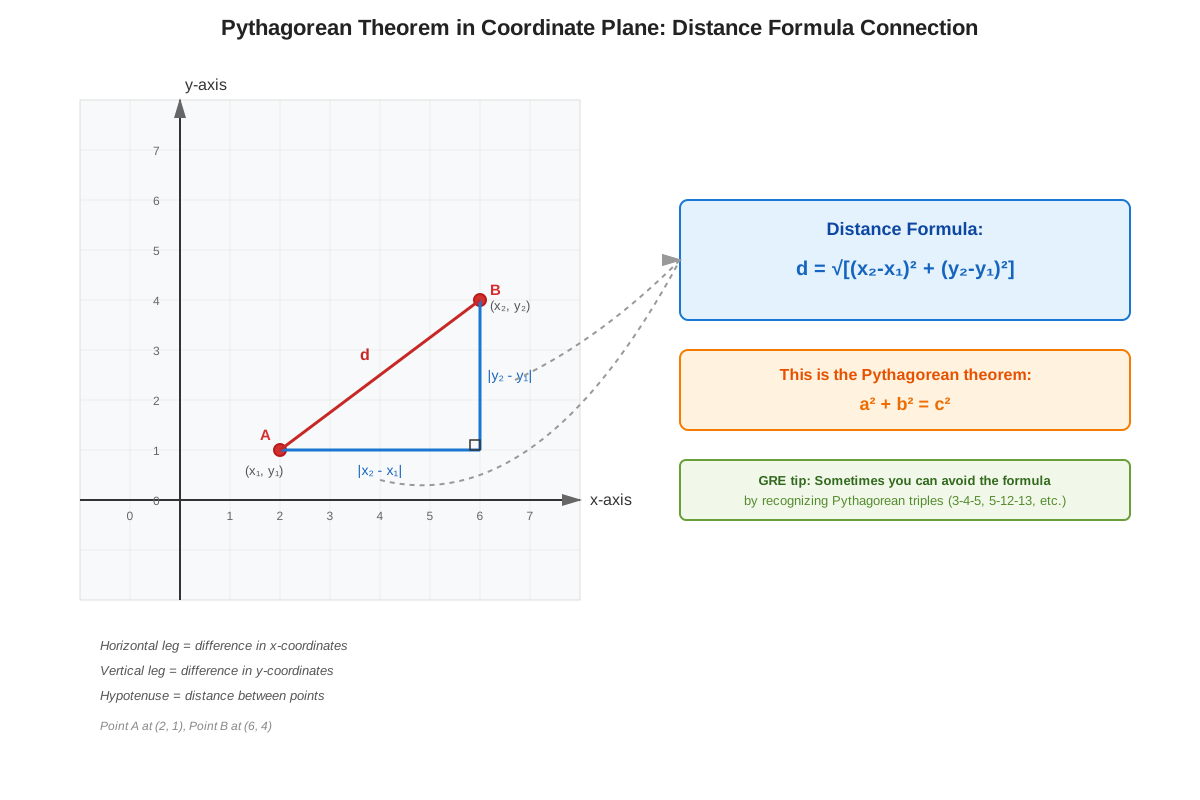
The distance formula derives directly from the Pythagorean theorem. To find the distance between two points (x₁, y₁) and (x₂, y₂) on a coordinate plane, visualize a right triangle where:
- The horizontal leg has length |x₂ - x₁|
- The vertical leg has length |y₂ - y₁|
- The hypotenuse represents the distance between the points
distance = √[(x₂ - x₁)² + (y₂ - y₁)²]This application frequently appears in GRE problems asking for the distance between two points, the length of a line segment, or the radius of a circle given center and a point on the circumference.
Three-Dimensional Applications
The Pythagorean theorem extends to three-dimensional problems through sequential application. To find the space diagonal of a rectangular box with dimensions length (l), width (w), and height (h):
- First, find the diagonal of the base: d₁ = √(l² + w²)
- Then, use this diagonal with the height: d₂ = √(d₁² + h²) = √(l² + w² + h²)
This two-step process appears in problems involving room diagonals, box diagonals, or shortest paths through three-dimensional space.
Special Right Triangles Connection
While special right triangles (45-45-90 and 30-60-90) have their own ratio patterns, they derive from the Pythagorean theorem. Understanding this connection helps students verify their work and provides an alternative solution method when special triangle ratios are forgotten.
Concept Relationships
The Pythagorean theorem serves as a central hub connecting multiple geometric concepts. At its foundation, it relies on right angle recognition and triangle properties, building directly from prerequisite knowledge. The theorem then branches into several applications: it generates the distance formula in coordinate geometry, which in turn enables calculations of circle radii, line segment lengths, and midpoint-related problems.
The relationship flows as follows: Right Triangle Identification → Pythagorean Theorem Application → Side Length Calculation → Area Determination (using the triangle area formula with known sides). Simultaneously, the theorem connects to Pythagorean Triples → Rapid Calculation → Time Efficiency, creating a parallel pathway for pattern recognition.
The converse relationship works backward: Three Known Sides → Converse Application → Triangle Classification (right, acute, or obtuse) → Angle Property Determination. This bidirectional understanding allows students to both solve for unknowns and verify triangle properties.
In three-dimensional space, the concept extends: 2D Pythagorean Application → Intermediate Diagonal → Second Pythagorean Application → 3D Distance, demonstrating how the theorem compounds for complex spatial problems. Understanding these interconnections allows students to recognize when the Pythagorean theorem provides the key to unlocking multi-step problems.
High-Yield Facts
⭐ The Pythagorean theorem applies exclusively to right triangles: a² + b² = c², where c is always the hypotenuse
⭐ The 3-4-5 triangle and its multiples (6-8-10, 9-12-15, etc.) are the most frequently tested Pythagorean triples on the GRE
⭐ The distance formula is the Pythagorean theorem applied to coordinate geometry: d = √[(x₂ - x₁)² + (y₂ - y₁)²]
⭐ The hypotenuse is always the longest side of a right triangle and always lies opposite the 90-degree angle
⭐ If a² + b² = c², the triangle is right; if a² + b² > c², it's acute; if a² + b² < c², it's obtuse
- The 5-12-13 triple and its multiples (10-24-26) appear frequently in harder GRE problems
- In an isosceles right triangle (45-45-90), if each leg is x, the hypotenuse is x√2
- The altitude to the hypotenuse of a right triangle creates two smaller right triangles similar to the original
- A diagonal of a rectangle divides it into two congruent right triangles
- The diagonal of a square with side s equals s√2, derived from the Pythagorean theorem
- In three dimensions, the space diagonal of a rectangular box equals √(l² + w² + h²)
- Any triangle inscribed in a semicircle with the diameter as one side is a right triangle (Thales' theorem)
Quick check — test yourself on Pythagorean theorem so far.
Try Flashcards →Common Misconceptions
Misconception: The Pythagorean theorem works for all triangles, not just right triangles.
Correction: The equation a² + b² = c² holds true only for right triangles. For other triangles, the Law of Cosines must be used. Always verify that a 90-degree angle exists before applying the theorem.
Misconception: Any side can be designated as "c" in the formula.
Correction: The variable "c" must always represent the hypotenuse—the longest side opposite the right angle. The legs (forming the right angle) are "a" and "b," which are interchangeable. Using the wrong side as the hypotenuse produces incorrect results.
Misconception: If two sides of a triangle are 3 and 4, the third side must be 5.
Correction: The third side is 5 only if the angle between the sides of length 3 and 4 is a right angle. If these are not the legs forming the right angle, or if no right angle exists, the third side will differ. Always confirm the triangle's configuration.
Misconception: The Pythagorean theorem gives the same result whether you add the squares or the sides first.
Correction: You must square each side length before adding. The expression (a + b)² does not equal a² + b². For example, (3 + 4)² = 49, but 3² + 4² = 25. Always square individual sides, then sum.
Misconception: Pythagorean triples only work with the exact numbers (like 3-4-5) and cannot be scaled.
Correction: Any multiple of a Pythagorean triple is also a valid triple. If 3-4-5 works, then 6-8-10, 30-40-50, and 0.3-0.4-0.5 all work. Recognizing scaled versions accelerates problem-solving significantly.
Misconception: In coordinate geometry, the distance between points can be negative.
Correction: Distance is always non-negative. While coordinate differences (x₂ - x₁) can be negative, squaring these differences in the distance formula eliminates negative values, and the square root produces only the positive result.
Misconception: The altitude to the hypotenuse in a right triangle creates triangles unrelated to the original.
Correction: The altitude to the hypotenuse creates two smaller right triangles that are similar to each other and to the original triangle, preserving proportional relationships. This property enables solving for unknown segments using proportions.
Worked Examples
Example 1: Direct Application with Unknown Hypotenuse
Problem: A rectangular garden measures 12 meters by 16 meters. A straight path is to be built from one corner to the opposite corner. What is the length of this path?
Solution:
Step 1: Recognize the setup. A diagonal across a rectangle creates two congruent right triangles. The diagonal is the hypotenuse, and the rectangle's sides are the legs.
Step 2: Identify the known values:
- Leg a = 12 meters
- Leg b = 16 meters
- Hypotenuse c = unknown
Step 3: Check for Pythagorean triples. Notice that 12 and 16 are both multiples of 4:
- 12 = 4 × 3
- 16 = 4 × 4
This matches the 3-4-5 triple scaled by 4, so the hypotenuse should be 4 × 5 = 20 meters.
Step 4: Verify using the formula:
c² = a² + b²
c² = 12² + 16²
c² = 144 + 256
c² = 400
c = √400 = 20Answer: The path length is 20 meters.
Learning Objective Connection: This example demonstrates identifying when the Pythagorean theorem applies (rectangular diagonal creating right triangle) and applying both the triple recognition strategy and the formula for accuracy.
Example 2: Coordinate Geometry Application
Problem: Point A is located at coordinates (2, 3) and point B is at (10, 9). What is the distance between points A and B?
Solution:
Step 1: Recognize that distance between two points requires the distance formula, which derives from the Pythagorean theorem.
Step 2: Visualize the right triangle:
- Horizontal leg: |10 - 2| = 8
- Vertical leg: |9 - 3| = 6
- Hypotenuse: the distance we seek
Step 3: Check for Pythagorean triples. We have legs of 6 and 8, which is 2 × (3-4-5), so the hypotenuse should be 2 × 5 = 10.
Step 4: Apply the distance formula to verify:
d = √[(x₂ - x₁)² + (y₂ - y₁)²]
d = √[(10 - 2)² + (9 - 3)²]
d = √[8² + 6²]
d = √[64 + 36]
d = √100 = 10Answer: The distance between points A and B is 10 units.
Learning Objective Connection: This demonstrates recognizing the Pythagorean theorem in coordinate geometry contexts and applying the pattern recognition strategy for efficient solving.
Example 3: Converse Application
Problem: A triangle has sides of length 7, 24, and 25. Is this triangle acute, right, or obtuse?
Solution:
Step 1: Identify the longest side (potential hypotenuse): 25
Step 2: Apply the converse of the Pythagorean theorem by checking if a² + b² = c²:
7² + 24² = 49 + 576 = 625
25² = 625
Step 3: Since 7² + 24² = 25², the equation holds exactly.
Answer: This is a right triangle (the 7-24-25 Pythagorean triple).
Learning Objective Connection: This illustrates using the converse to determine triangle type and recognizing less common Pythagorean triples.
Exam Strategy
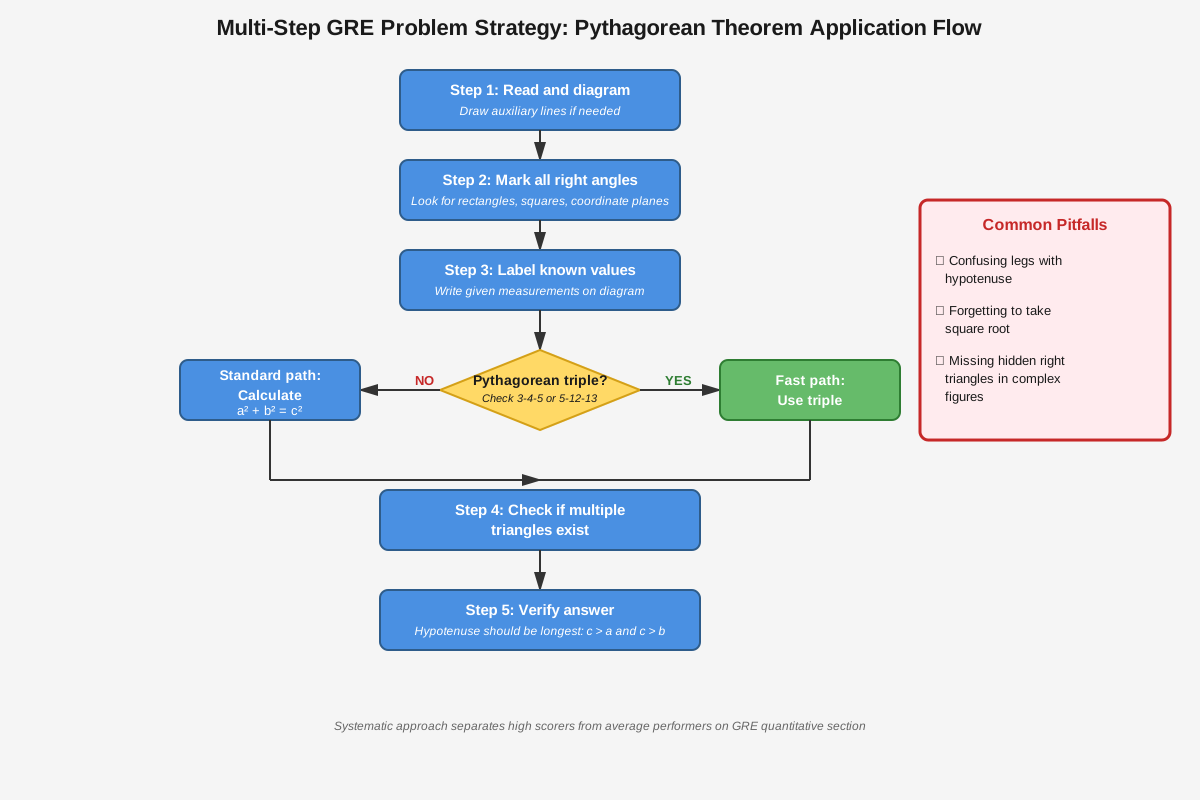
When approaching GRE questions involving the Pythagorean theorem, begin by scanning the problem for trigger words and phrases: "right triangle," "perpendicular," "diagonal," "distance between points," "rectangular," "square," or any mention of a 90-degree angle. Even without explicit mention, look for visual cues in diagrams—small squares in corners indicating right angles, or coordinate plane setups suggesting distance calculations.
Time-saving recognition patterns should become automatic. When you see two sides of a right triangle, immediately check if they match or scale to common Pythagorean triples (3-4-5, 5-12-13, 8-15-17). If they do, write the third side immediately without calculation. This saves 20-30 seconds per problem—significant time on a test where every second counts.
For Quantitative Comparison questions, avoid full calculations when possible. If comparing expressions involving right triangle sides, consider whether you can determine relationships without solving completely. For example, if comparing the hypotenuse of a 3-4-5 triangle to the number 6, recognize immediately that 5 < 6 without any calculation.
Process of elimination works effectively when answer choices are given. If you've calculated one side of a right triangle and the answer choices are far apart, you may not need exact precision. For instance, if you calculate √50 and choices are 6, 7, 8, 9, and 10, knowing that √49 = 7 and √64 = 8 tells you the answer must be between 7 and 8, likely 7.1 or similar.
Diagram analysis is crucial. When a diagram appears incomplete or ambiguous, mark right angles you identify, label known sides, and draw auxiliary lines if they reveal right triangles. Many GRE problems hide right triangles within complex figures—finding them is often the key insight.
Allocate approximately 1-1.5 minutes for straightforward Pythagorean theorem problems and up to 2 minutes for multi-step problems requiring multiple applications or integration with other concepts. If a problem requires more time, mark it for review and move forward to maintain pacing.
Memory Techniques
Mnemonic for the formula: "A squared plus B squared equals C squared—Always Be Certain the right angle is there!" This reminds students both of the formula structure and the critical requirement that the triangle be right-angled.
Visualization strategy: Picture a right triangle as a "corner" shape, like the corner of a room or a book. The hypotenuse "cuts across" this corner, always being the longest path. This spatial memory helps students identify the hypotenuse correctly.
Triple memorization: Remember Pythagorean triples using the phrase "3-4-5, I'm alive! 5-12-13, I'm in heaven! 8-15-17, I'm in triple heaven!" The rhythm and rhyme make these most common triples memorable.
Coordinate geometry connection: Think "Distance Derives from Diagonals"—the distance formula is just the Pythagorean theorem applied to the diagonal of a rectangle formed by coordinate differences.
Converse memory aid: "If the squares are fair (equal), the angle is square (right)." This helps recall that when a² + b² equals c² exactly, you have a right angle.
Summary
The Pythagorean theorem establishes the fundamental relationship in right triangles: the square of the hypotenuse equals the sum of the squares of the two legs (a² + b² = c²). This theorem appears throughout GRE Quantitative Reasoning in direct geometry problems, coordinate geometry distance calculations, and complex multi-step questions. Mastery requires three levels of competency: recognizing when the theorem applies (including hidden right triangles), efficiently applying the formula or recognizing Pythagorean triples for rapid calculation, and understanding the converse to determine triangle types. The most common Pythagorean triples—particularly 3-4-5 and 5-12-13 with their multiples—enable instant solutions without calculation. The theorem extends to coordinate geometry through the distance formula and to three-dimensional problems through sequential application. Success on GRE questions demands pattern recognition, strategic use of triples, and the ability to identify right triangles in various contexts, from explicit geometry problems to disguised applications in word problems and coordinate systems.
Key Takeaways
- The Pythagorean theorem (a² + b² = c²) applies exclusively to right triangles, where c represents the hypotenuse opposite the right angle
- Recognizing Pythagorean triples (3-4-5, 5-12-13, 8-15-17) and their multiples eliminates calculation time and reduces errors
- The distance formula in coordinate geometry is the Pythagorean theorem applied to horizontal and vertical coordinate differences
- The converse determines triangle type: if a² + b² = c², the triangle is right; if greater, acute; if less, obtuse
- Hidden right triangles appear in rectangles (diagonals), coordinate planes (distance problems), and complex figures requiring auxiliary lines
- Always verify that you've correctly identified the hypotenuse (longest side, opposite the right angle) before applying the formula
- Multi-step problems often require sequential applications of the theorem, particularly in three-dimensional contexts
Related Topics
Special Right Triangles (45-45-90 and 30-60-90): These triangles have fixed side ratios that derive from the Pythagorean theorem, enabling even faster calculations in specific scenarios. Mastering the Pythagorean theorem provides the foundation for understanding why these ratios work.
Triangle Properties and Classification: Understanding how the Pythagorean theorem's converse classifies triangles connects to broader triangle inequality principles and angle-side relationships, expanding geometric problem-solving capabilities.
Coordinate Geometry: The distance formula, midpoint formula, and circle equations all build upon Pythagorean theorem principles, making this topic essential for coordinate plane mastery.
Three-Dimensional Geometry: Calculating space diagonals, surface distances, and spatial relationships requires extending the Pythagorean theorem to three dimensions, a natural progression from two-dimensional applications.
Trigonometry Basics: The Pythagorean theorem underlies trigonometric identities and relationships, particularly the fundamental identity sin²θ + cos²θ = 1, which students encounter in advanced GRE problems.
Practice CTA
Now that you've mastered the core concepts, relationships, and strategies for the Pythagorean theorem, it's time to solidify your understanding through active practice. Attempt the practice questions designed specifically for this topic, focusing on recognizing patterns, applying Pythagorean triples, and identifying hidden right triangles. Use the flashcards to reinforce quick recall of common triples and key formulas. Remember: pattern recognition and speed come only through repeated, deliberate practice. Each problem you solve strengthens your ability to spot Pythagorean theorem applications instantly on test day. Your investment in practice now translates directly to points on the GRE—make it count!
Sign up free to keep reading
Create a free AnvayaPrep account to finish this GRE guide on Pythagorean theorem — plus flashcards and practice questions.