Overview
45-45-90 triangles are one of the two special right triangles that appear frequently on the GRE Quantitative Reasoning section. These triangles, also known as isosceles right triangles, possess unique properties that allow test-takers to quickly determine side lengths without relying on the Pythagorean theorem or trigonometric functions. Understanding these triangles is not merely about memorizing a ratio—it's about recognizing when this geometric relationship appears in disguised forms across various question types, from coordinate geometry to area calculations to complex multi-step problems.
The importance of mastering GRE 45-45-90 triangles cannot be overstated. These triangles appear in approximately 10-15% of all geometry questions on the GRE, and they often serve as building blocks within more complex problems involving squares, coordinate planes, and composite figures. When a square's diagonal is drawn, two 45-45-90 triangles are created. When calculating distances in coordinate geometry where horizontal and vertical distances are equal, a 45-45-90 triangle emerges. The ability to instantly recognize these patterns and apply the side-length ratio saves precious time and reduces calculation errors.
Within the broader context of GRE Quantitative Reasoning, 45-45-90 triangles connect directly to multiple geometric concepts including the Pythagorean theorem, properties of squares and rectangles, coordinate geometry, and area calculations. They represent a fundamental pattern-recognition skill that separates high-scoring test-takers from those who struggle with geometry. Mastery of this topic enables rapid problem-solving and provides a foundation for tackling the more complex 30-60-90 triangles and general right triangle problems that also appear on the exam.
Learning Objectives
- [ ] Identify when 45-45-90 triangles is being tested
- [ ] Explain the core rule or strategy behind 45-45-90 triangles
- [ ] Apply 45-45-90 triangles to GRE-style questions accurately
- [ ] Derive the side-length ratio from first principles using the Pythagorean theorem
- [ ] Recognize 45-45-90 triangles embedded within squares, coordinate geometry, and composite figures
- [ ] Calculate areas and perimeters of figures containing 45-45-90 triangles efficiently
- [ ] Convert between leg lengths and hypotenuse lengths in both directions without hesitation
Prerequisites
- Basic right triangle properties: Understanding that one angle measures 90° and the Pythagorean theorem (a² + b² = c²) applies to all right triangles, which forms the foundation for deriving special triangle ratios
- Properties of isosceles triangles: Knowing that two equal sides create two equal angles, which explains why 45-45-90 triangles have their specific angle measurements
- Square root operations: Facility with simplifying expressions involving √2, multiplying and dividing by radicals, and rationalizing denominators, as these operations appear in every 45-45-90 calculation
- Properties of squares: Understanding that diagonals of squares bisect each other at right angles and create congruent triangles, since squares are the most common source of 45-45-90 triangles on the GRE
- Coordinate plane basics: Familiarity with plotting points and calculating horizontal and vertical distances, as coordinate geometry frequently involves 45-45-90 relationships
Why This Topic Matters
In real-world applications, 45-45-90 triangles appear in architecture, engineering, and design whenever diagonal bracing or support is needed at equal angles. The 45-degree angle represents the optimal balance point in many structural applications, and understanding these relationships helps in fields ranging from construction to computer graphics. Navigation systems, urban planning with grid-based street layouts, and even the design of staircases all utilize these fundamental geometric relationships.
On the GRE specifically, 45-45-90 triangles appear in approximately 2-3 questions per exam, making them one of the highest-yield geometry topics relative to study time investment. These triangles appear in multiple question formats: Quantitative Comparison questions asking students to compare diagonal lengths to side lengths, Problem Solving questions involving area calculations, and Data Interpretation questions where coordinate geometry plays a role. The topic frequently appears in medium to medium-hard difficulty questions, making it essential for students targeting scores above the 160 mark.
Common exam presentations include: squares with diagonals drawn where students must find the diagonal length given the side or vice versa; coordinate geometry problems where two points form equal horizontal and vertical distances; area problems where a square is divided by its diagonal; perimeter calculations involving composite figures; and word problems describing isosceles right triangles without explicitly naming them. The GRE test-makers deliberately avoid stating "this is a 45-45-90 triangle" in most cases, requiring students to recognize the pattern from contextual clues such as "isosceles right triangle," "square diagonal," or equal leg lengths in a right triangle.
Core Concepts
The Fundamental Side-Length Ratio
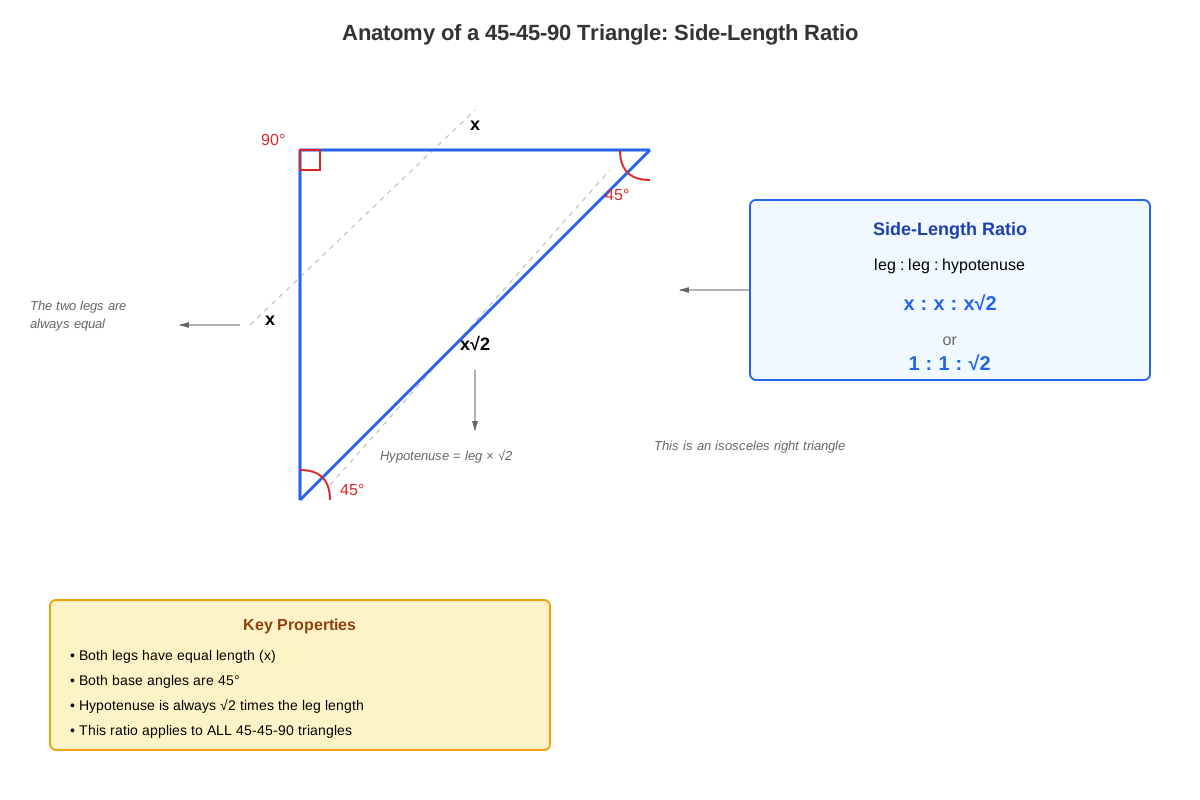
A 45-45-90 triangle is a right triangle with two 45-degree angles and one 90-degree angle. Because two angles are equal, the triangle must be isosceles, meaning the two legs (the sides adjacent to the right angle) are congruent. The defining characteristic that makes this a "special" triangle is the consistent ratio between the legs and the hypotenuse.
If each leg has length x, then the hypotenuse has length x√2. This ratio can be expressed as:
Leg : Leg : Hypotenuse = x : x : x√2Or simplified to the standard form:
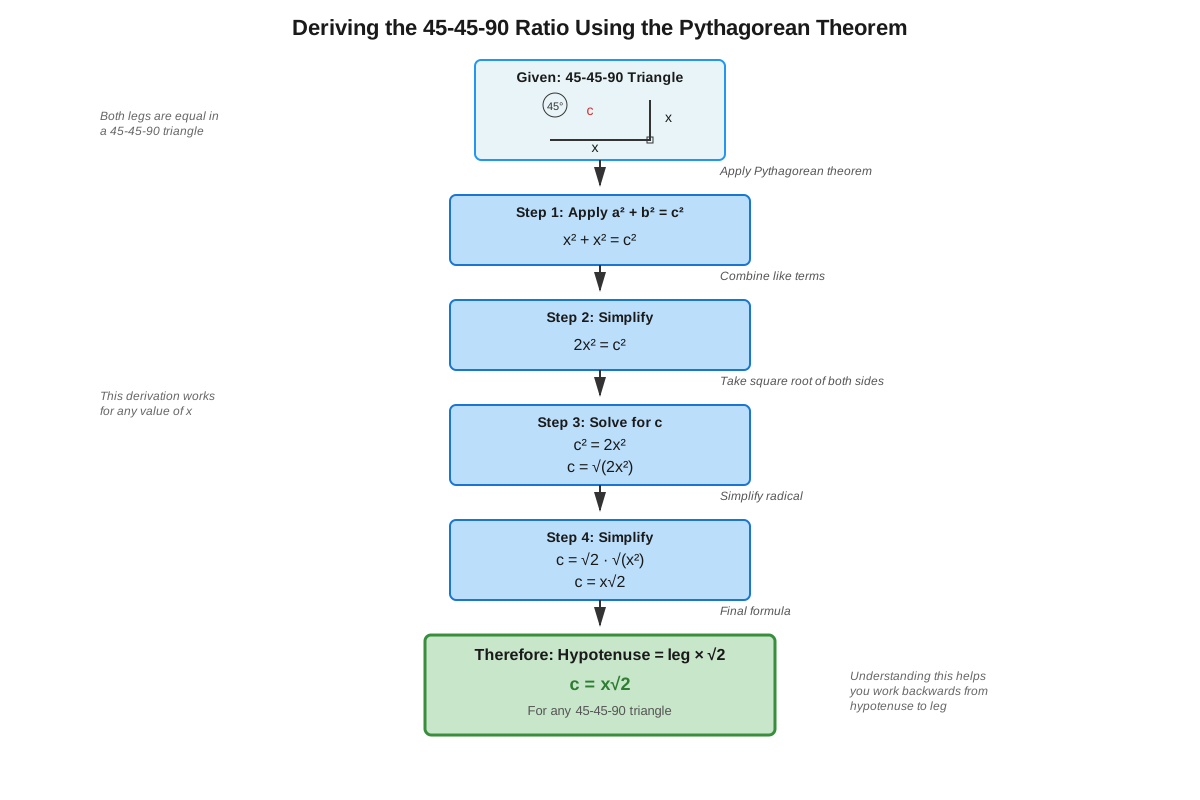
1 : 1 : √2This ratio is derived directly from the Pythagorean theorem. If both legs equal x, then:
x² + x² = hypotenuse²
2x² = hypotenuse²
hypotenuse = √(2x²) = x√2
Understanding this derivation helps students remember the ratio and apply it correctly rather than confusing it with the 30-60-90 ratio.
Working Backward from the Hypotenuse
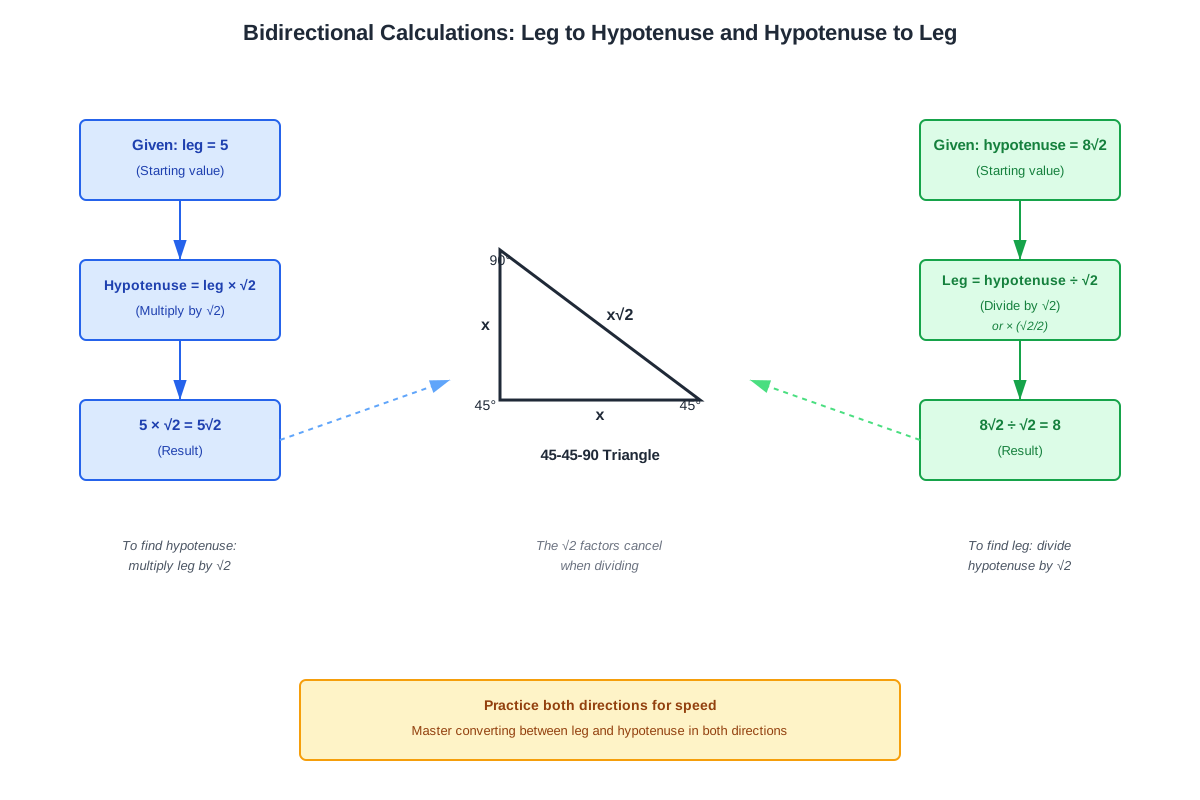
While most introductory problems provide the leg length and ask for the hypotenuse, GRE questions frequently reverse this relationship. Given a hypotenuse of length h, the leg length equals:
leg = h/√2 = h√2/2The second form (h√2/2) results from rationalizing the denominator, which is often the form expected in GRE answer choices. Students must be comfortable with both representations and recognize them as equivalent.
For example, if a 45-45-90 triangle has a hypotenuse of 10, each leg measures:
10/√2 = 10√2/2 = 5√2Recognition Patterns in Squares
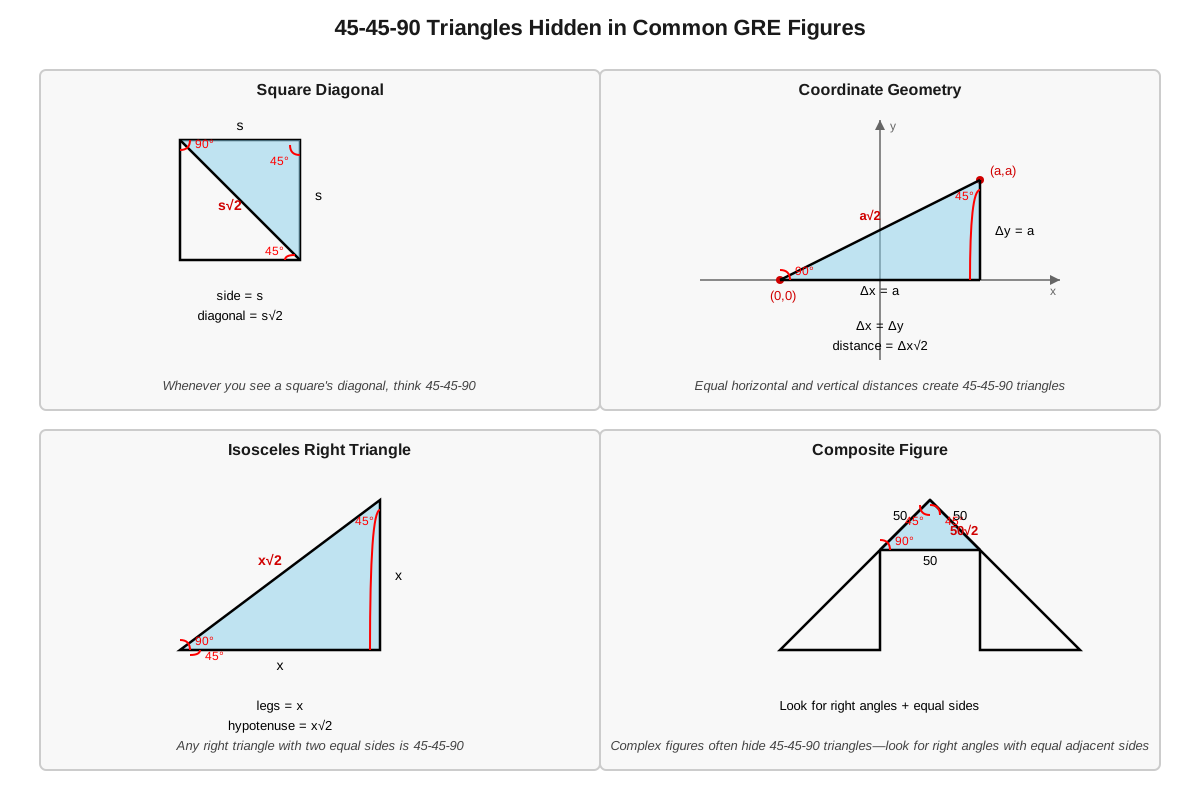
The most common source of 45-45-90 triangles on the GRE is the diagonal of a square. When a diagonal is drawn in a square with side length s, it creates two congruent 45-45-90 triangles. The diagonal serves as the hypotenuse, so its length equals s√2.
Conversely, if a square has diagonal length d, each side measures d/√2 or d√2/2.
This relationship enables rapid calculation of:
- Square area from diagonal length: Area = d²/2
- Square perimeter from diagonal length: Perimeter = 4d/√2 = 2d√2
- Diagonal length from area: If Area = A, then side = √A, and diagonal = √A × √2 = √(2A)
Coordinate Geometry Applications
In the coordinate plane, 45-45-90 triangles appear when the horizontal and vertical distances between two points are equal. For instance, the points (2, 3) and (5, 6) have:
- Horizontal distance: 5 - 2 = 3
- Vertical distance: 6 - 3 = 3
These equal distances form the legs of a 45-45-90 triangle, making the straight-line distance between the points 3√2.
This pattern also appears when finding distances from the origin to points where x and y coordinates have equal absolute values, such as (4, 4), (-3, -3), or (5, -5).
Area Calculations
The area of a 45-45-90 triangle with leg length x is:
Area = (1/2) × base × height = (1/2) × x × x = x²/2If given the hypotenuse h instead, the area becomes:
Area = (1/2) × (h/√2) × (h/√2) = (1/2) × h²/2 = h²/4This formula is particularly useful when a square is divided by its diagonal, as each resulting triangle has area equal to half the square's area.
Composite Figure Applications
GRE questions often embed 45-45-90 triangles within more complex figures. Common scenarios include:
| Figure Type | How 45-45-90 Appears | Key Insight |
|---|---|---|
| Square with diagonal | Diagonal creates two 45-45-90 triangles | Diagonal = side × √2 |
| Rectangle with specific dimensions | When length = width, diagonal creates 45-45-90 | Only works when rectangle is actually a square |
| Octagon (regular) | Cutting corners from square creates 45-45-90 triangles | Corner triangles are 45-45-90 |
| Coordinate plane | Equal horizontal and vertical distances | Distance = leg × √2 |
| Isosceles right triangle (explicit) | Directly stated in problem | Two legs equal, one 90° angle |
Concept Relationships
The 45-45-90 triangle serves as a bridge between multiple geometric concepts. At its foundation, it derives from the Pythagorean theorem (a² + b² = c²), which becomes 2x² = c² when both legs equal x. This simplification leads directly to the signature ratio of 1:1:√2.
The concept connects strongly to properties of squares because every square diagonal creates two 45-45-90 triangles. This relationship flows bidirectionally: understanding 45-45-90 triangles enables quick diagonal calculations, while recognizing square diagonals helps identify hidden 45-45-90 triangles in complex figures.
In coordinate geometry, the 45-45-90 triangle emerges when horizontal and vertical distances are equal, linking algebraic distance calculations to geometric visualization. This connection enables students to bypass the distance formula in specific cases, using the simpler calculation: distance = leg × √2.
The relationship to area calculations flows from the basic triangle area formula (½ × base × height). Because both legs are equal in a 45-45-90 triangle, the area simplifies to x²/2, which connects to the square's area formula (s²) since each 45-45-90 triangle formed by a square's diagonal has area equal to half the square.
Finally, 45-45-90 triangles relate to 30-60-90 triangles as the two special right triangles tested on the GRE. While they share the property of having consistent side ratios, their ratios differ (1:1:√2 versus 1:√3:2), and recognizing which triangle applies in a given situation is crucial for accurate problem-solving.
Concept flow: Pythagorean theorem → Isosceles right triangle → 1:1:√2 ratio → Square diagonal applications → Coordinate geometry shortcuts → Area calculations → Composite figure recognition
High-Yield Facts
⭐ The side ratio for 45-45-90 triangles is always leg : leg : hypotenuse = 1 : 1 : √2
⭐ If a square has side length s, its diagonal measures s√2
⭐ If a 45-45-90 triangle has hypotenuse h, each leg measures h/√2 or h√2/2 (rationalized form)
⭐ The area of a 45-45-90 triangle with leg length x is x²/2
⭐ In coordinate geometry, when horizontal and vertical distances are equal, the diagonal distance is (distance)√2
- A 45-45-90 triangle is always an isosceles right triangle, and every isosceles right triangle is a 45-45-90 triangle
- The angles in a 45-45-90 triangle sum to 180°: 45° + 45° + 90° = 180°
- When a square's diagonal is drawn, it creates two congruent 45-45-90 triangles
- The area of a 45-45-90 triangle with hypotenuse h is h²/4
- If a square has diagonal d, its area is d²/2 (not d²)
- The perimeter of a 45-45-90 triangle with leg x is x + x + x√2 = x(2 + √2)
- Multiplying a leg length by √2 gives the hypotenuse; dividing a hypotenuse by √2 gives the leg length
- The altitude from the right angle to the hypotenuse in a 45-45-90 triangle equals half the hypotenuse length
Quick check — test yourself on 45-45-90 triangles so far.
Try Flashcards →Common Misconceptions
Misconception: The hypotenuse of a 45-45-90 triangle is twice the leg length.
Correction: The hypotenuse is √2 times the leg length (approximately 1.414 times), not 2 times. This confusion often stems from mixing up the 45-45-90 ratio (1:1:√2) with the 30-60-90 ratio (1:√3:2), where the hypotenuse is indeed twice the shortest side.
Misconception: If a right triangle has two equal sides, those equal sides must be the legs.
Correction: While this is true for 45-45-90 triangles, students sometimes incorrectly assume a right triangle with two equal sides could have an equal leg and hypotenuse. By definition, the hypotenuse is always the longest side in a right triangle, so if two sides are equal, they must be the legs.
Misconception: The diagonal of any rectangle creates 45-45-90 triangles.
Correction: Only the diagonal of a square (a special rectangle where length equals width) creates 45-45-90 triangles. In non-square rectangles, the diagonal creates right triangles, but they are not 45-45-90 triangles because the legs have different lengths.
Misconception: When rationalizing h/√2, the answer is h√2.
Correction: When rationalizing h/√2, multiply both numerator and denominator by √2 to get (h√2)/(√2 × √2) = h√2/2, not h√2. This error leads to answers that are twice the correct value.
Misconception: The area of a square with diagonal d is d².
Correction: The area is d²/2, not d². Since the diagonal equals side × √2, if diagonal = d, then side = d/√2, and area = (d/√2)² = d²/2. Students often forget to square the denominator.
Misconception: All isosceles triangles are 45-45-90 triangles.
Correction: Only isosceles right triangles are 45-45-90 triangles. An isosceles triangle has two equal sides and two equal angles, but those angles are only 45° when the third angle is 90°. Other isosceles triangles exist with different angle measurements.
Worked Examples
Example 1: Square Diagonal to Area
Problem: A square has a diagonal of length 8. What is the area of the square?
Solution:
Step 1: Recognize that the diagonal of a square creates two 45-45-90 triangles.
Step 2: Identify what we know and what we need. We have the hypotenuse (diagonal = 8) and need the side length to calculate area.
Step 3: Apply the 45-45-90 ratio. If the hypotenuse is 8, and the ratio is leg : leg : hypotenuse = x : x : x√2, then:
x√2 = 8
x = 8/√2
x = 8√2/2
x = 4√2
Step 4: Calculate the area using the side length:
Area = side² = (4√2)² = 16 × 2 = 32Alternative approach: Use the direct formula for square area from diagonal:
Area = d²/2 = 8²/2 = 64/2 = 32Connection to learning objectives: This problem demonstrates identifying a 45-45-90 triangle (the diagonal creates them), explaining the core strategy (using the 1:1:√2 ratio), and applying it accurately to find the area.
Example 2: Coordinate Geometry Distance
Problem: In the coordinate plane, point A is at (3, 5) and point B is at (8, 10). What is the distance from A to B?
Solution:
Step 1: Calculate the horizontal and vertical distances.
Horizontal distance: 8 - 3 = 5
Vertical distance: 10 - 5 = 5
Step 2: Recognize the pattern. Since horizontal and vertical distances are equal (both 5), the right triangle formed is a 45-45-90 triangle.
Step 3: Apply the 45-45-90 relationship. The legs both equal 5, so the hypotenuse (the direct distance from A to B) equals:
Distance = leg × √2 = 5√2Verification using distance formula:
d = √[(8-3)² + (10-5)²]
d = √[5² + 5²]
d = √[25 + 25]
d = √50
d = √(25 × 2)
d = 5√2 ✓
Connection to learning objectives: This example shows how to identify 45-45-90 triangles in coordinate geometry (equal horizontal and vertical distances), apply the core ratio efficiently, and verify the answer through an alternative method.
Example 3: Composite Figure with Multiple Triangles
Problem: A square with side length 6 has both diagonals drawn, dividing it into four triangles. What is the area of one of these triangles?
Solution:
Step 1: Visualize the figure. Drawing both diagonals in a square creates four congruent 45-45-90 triangles, all meeting at the center.
Step 2: Determine the dimensions of one triangle. Each triangle has:
- Two legs that are half-diagonals
- The right angle at the center of the square
Step 3: Calculate the diagonal length:
Diagonal = side × √2 = 6√2Step 4: Each leg of the small triangle is half the diagonal:
Leg = (6√2)/2 = 3√2Step 5: Calculate the area of one triangle:
Area = (1/2) × leg × leg
Area = (1/2) × 3√2 × 3√2
Area = (1/2) × 9 × 2
Area = 9
Alternative approach: The square's area is 6² = 36, and it's divided into four equal triangles, so each triangle has area 36/4 = 9.
Connection to learning objectives: This problem requires recognizing 45-45-90 triangles within a composite figure, applying the ratio in a multi-step problem, and using strategic thinking to verify the answer.
Exam Strategy
When approaching GRE questions involving 45-45-90 triangles, begin by scanning for trigger words and phrases: "isosceles right triangle," "square diagonal," "equal legs," or any mention of 45-degree angles in a right triangle. In coordinate geometry, watch for points with equal horizontal and vertical distances from each other or from a reference point.
Visual recognition is crucial. If a diagram shows a square with a diagonal, immediately mark the two 45-45-90 triangles created. If you see a right triangle where two sides appear equal (even without measurements), consider whether it might be a 45-45-90 triangle. The GRE often provides figures "not drawn to scale," but the relationships still hold.
For Quantitative Comparison questions, 45-45-90 triangles frequently appear in comparisons between diagonal and side lengths, or between areas of different figures. Remember that the diagonal is always longer than the side (by a factor of √2 ≈ 1.414), but less than twice the side length. This knowledge helps eliminate impossible answer choices quickly.
Time-saving techniques:
- Memorize that √2 ≈ 1.414, which helps estimate answers quickly
- When you see a square, immediately think "diagonal = side × √2"
- In coordinate geometry with equal distances, skip the distance formula and use the 45-45-90 shortcut
- Recognize that rationalizing denominators (converting x/√2 to x√2/2) is often necessary to match answer choices
Process of elimination: If answer choices include both rationalized and non-rationalized forms (like 5/√2 and 5√2/2), they're the same answer—eliminate other options first. If a problem involves a square with side 5, eliminate any answer choice suggesting the diagonal is 10 (it should be 5√2 ≈ 7.07). If calculating area from a diagonal, eliminate answers that forgot to divide by 2.
Time allocation: Most 45-45-90 problems should take 60-90 seconds once you recognize the pattern. If you're spending more than 2 minutes, you may be overcomplicating the problem—step back and look for the 45-45-90 relationship you might have missed.
Memory Techniques
The "One-One-Root-Two" Chant: Memorize the ratio by repeating "one, one, root two" while visualizing a right triangle with equal legs. This rhythmic pattern helps recall the ratio under test pressure.
The Square Diagonal Mnemonic: "Square Diagonal = Side × √2" (SD = S√2). The alliteration of "Square" and "Side" helps link the concepts.
The Coordinate Geometry Rule: "Equal Distances = Diagonal × √2" (EDD√2). When horizontal and vertical distances are equal, multiply by root two.
Visual Anchor: Picture a square pizza box. When you draw a line from one corner to the opposite corner to divide it for two people, you've created two 45-45-90 triangles. The diagonal cut is longer than the side, but not twice as long—it's √2 times as long.
The "Half-Square" Area Trick: Remember that a 45-45-90 triangle formed by a square's diagonal has exactly half the square's area. If you know the square's area, divide by 2 for the triangle's area.
Rationalization Reminder: "Divide by root two, Multiply top and bottom" (DM). When you see x/√2, remember to multiply both numerator and denominator by √2 to get x√2/2.
The 1.4 Approximation: √2 ≈ 1.4 (more precisely 1.414). This approximation helps with estimation: a square with side 10 has diagonal approximately 14, not 20.
Summary
The 45-45-90 triangle is a special right triangle characterized by two 45-degree angles, two equal legs, and a hypotenuse that is √2 times the length of each leg. This fundamental ratio—1:1:√2—enables rapid calculations without requiring the Pythagorean theorem or calculator. These triangles appear most commonly as the result of drawing a diagonal in a square, where the diagonal equals the side length multiplied by √2. In coordinate geometry, 45-45-90 triangles emerge when horizontal and vertical distances between points are equal, allowing for quick distance calculations. The area of such a triangle with leg length x is x²/2, or equivalently h²/4 when given hypotenuse h. Mastery requires not just memorizing the ratio, but recognizing when these triangles appear in disguised forms within composite figures, coordinate problems, and area calculations. Success on GRE questions depends on pattern recognition—identifying trigger words like "isosceles right triangle" or "square diagonal"—and fluency with converting between leg and hypotenuse measurements in both directions, including proper rationalization of denominators.
Key Takeaways
- The side ratio for 45-45-90 triangles is always 1 : 1 : √2 (leg : leg : hypotenuse), derived from applying the Pythagorean theorem to a right triangle with equal legs
- A square's diagonal creates two 45-45-90 triangles, with diagonal length equal to side × √2; conversely, given diagonal d, the side equals d√2/2
- When working backward from hypotenuse to leg, remember to rationalize: h/√2 = h√2/2, not h√2
- In coordinate geometry, equal horizontal and vertical distances create a 45-45-90 triangle, making the diagonal distance equal to (leg length) × √2
- The area of a 45-45-90 triangle is x²/2 when given leg length x, or h²/4 when given hypotenuse h
- Recognition is key: look for trigger phrases like "isosceles right triangle," "square diagonal," or "equal legs" to identify these triangles quickly
- The value √2 ≈ 1.414 helps with estimation and eliminating unreasonable answer choices on the GRE
Related Topics
30-60-90 Triangles: The other special right triangle tested on the GRE, with side ratio 1:√3:2. Mastering 45-45-90 triangles provides the foundation for understanding this related pattern and knowing which ratio to apply in different contexts.
Pythagorean Theorem and Pythagorean Triples: While 45-45-90 triangles provide shortcuts, understanding the underlying Pythagorean theorem (a² + b² = c²) enables verification of answers and handling of non-special right triangles.
Properties of Squares and Rectangles: Since square diagonals create 45-45-90 triangles, deeper knowledge of quadrilateral properties enhances problem-solving efficiency and reveals additional solution pathways.
Coordinate Geometry and Distance Formula: The distance formula d = √[(x₂-x₁)² + (y₂-y₁)²] simplifies dramatically when horizontal and vertical distances are equal, making 45-45-90 triangle knowledge essential for coordinate plane efficiency.
Trigonometry Basics: While not heavily tested on the GRE, understanding that sin(45°) = cos(45°) = √2/2 connects to the 45-45-90 ratio and provides alternative solution methods for advanced problems.
Practice CTA
Now that you've mastered the core concepts of 45-45-90 triangles, it's time to solidify your understanding through active practice. Attempt the practice questions associated with this topic, focusing on recognizing the patterns quickly and applying the 1:1:√2 ratio accurately. Use the flashcards to drill the key formulas and relationships until they become automatic. Remember, the difference between knowing these concepts and scoring points on test day lies in repeated, deliberate practice. Challenge yourself to identify 45-45-90 triangles in increasingly complex scenarios, and time yourself to build the speed necessary for GRE success. You've built a strong foundation—now transform that knowledge into test-day confidence through consistent practice!
Sign up free to keep reading
Create a free AnvayaPrep account to finish this GRE guide on 45-45-90 triangles — plus flashcards and practice questions.