Overview
The radius is one of the most fundamental concepts in geometry and appears frequently throughout the GRE Quantitative Reasoning section. As the distance from the center of a circle to any point on its circumference, the radius serves as the building block for understanding circles, spheres, cylinders, and numerous other geometric figures. Mastery of radius-related concepts is essential because the GRE tests this topic both directly—through straightforward calculation problems—and indirectly—by embedding radius within complex multi-step problems involving area, circumference, coordinate geometry, and three-dimensional figures.
Understanding the gre radius concept extends far beyond simple memorization of formulas. The GRE frequently presents radius problems in disguised forms, requiring students to recognize when a radius measurement is the key to unlocking a solution. Questions may provide diameter, circumference, or area and expect test-takers to work backward to find the radius, then use that value in subsequent calculations. Additionally, radius appears in coordinate geometry problems involving the distance formula, in problems about inscribed and circumscribed figures, and in questions about sectors and arcs.
The radius concept connects intimately with other Quantitative Reasoning topics including area and perimeter calculations, the Pythagorean theorem, coordinate geometry, and three-dimensional geometry. A solid grasp of radius relationships enables efficient problem-solving across multiple geometry question types and serves as a foundation for more advanced spatial reasoning. Given that geometry comprises approximately 15% of GRE Quantitative questions, and radius appears in a significant portion of these problems, investing time to master this topic yields substantial returns on test day.
Learning Objectives
- [ ] Identify when Radius is being tested in GRE questions, including disguised presentations
- [ ] Explain the core rule or strategy behind Radius and its relationship to other circle properties
- [ ] Apply Radius to GRE-style questions accurately and efficiently
- [ ] Convert between radius, diameter, circumference, and area using appropriate formulas
- [ ] Recognize radius applications in coordinate geometry and three-dimensional figures
- [ ] Solve multi-step problems where radius serves as an intermediate value
- [ ] Apply radius concepts to inscribed and circumscribed figure problems
Prerequisites
- Basic algebraic manipulation: Essential for isolating radius in equations and solving for unknown values when given other circle properties
- Understanding of π (pi): Necessary because all circle formulas involving radius incorporate π as a constant (approximately 3.14159)
- Exponent rules: Required for working with radius squared (r²) in area calculations and for understanding how changes in radius affect area
- Square roots: Needed to extract radius from area formulas and to work with the distance formula in coordinate geometry
- Basic coordinate geometry: Relevant for understanding circles on the coordinate plane where radius represents distance from center point
Why This Topic Matters
In real-world applications, radius calculations appear in engineering, architecture, physics, astronomy, and everyday problem-solving. From determining the coverage area of a wireless router to calculating the volume of cylindrical containers, radius serves as a fundamental measurement that translates circular dimensions into practical information. Urban planners use radius to define service areas, while scientists employ it to describe atomic structures and planetary orbits.
On the GRE specifically, radius-related questions appear in approximately 3-5 questions per Quantitative Reasoning section, making it one of the highest-yield geometry topics. These questions span multiple difficulty levels and question formats, including Quantitative Comparison, Multiple Choice (single and multiple answer), and Numeric Entry. The Educational Testing Service (ETS) particularly favors questions that combine radius with other concepts, testing whether students can recognize the appropriate formula and execute multi-step solutions under time pressure.
Common GRE presentations of radius include: direct calculation problems asking for circumference or area given radius; reverse problems providing area or circumference and requiring radius calculation; coordinate geometry problems where radius equals the distance from a center point; problems involving semicircles, quarter circles, or sectors; three-dimensional problems with spheres, cylinders, or cones; and complex figures where circles are inscribed in or circumscribed about polygons. The GRE also tests radius through data interpretation questions where circular graphs or diagrams require geometric analysis.
Core Concepts
Definition and Basic Properties
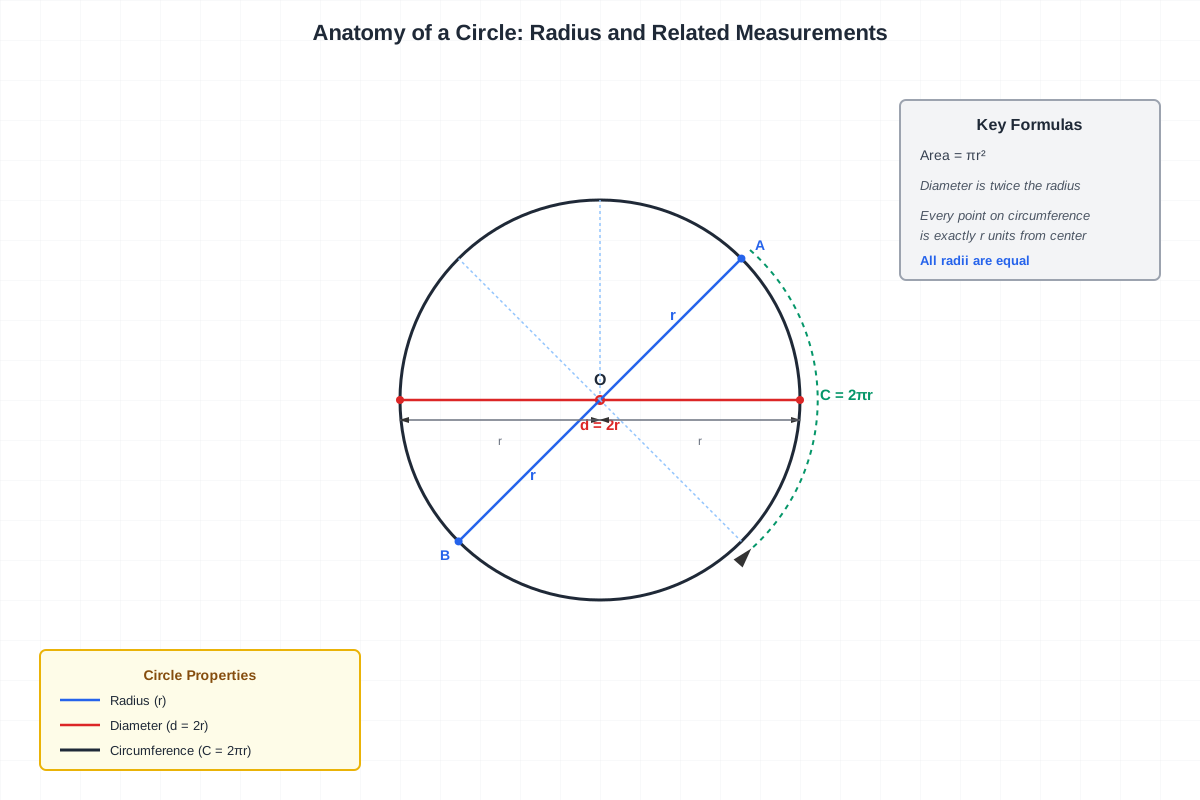
The radius (plural: radii) is defined as the distance from the center of a circle to any point on the circle's circumference. This distance remains constant for all points on the circle, which is precisely what defines a circle as a geometric shape. Every circle has infinitely many radii, but all radii of the same circle have identical length. The radius is typically denoted by the variable r in mathematical formulas and serves as the fundamental measurement from which all other circle properties derive.
The relationship between radius and diameter is straightforward: the diameter equals twice the radius (d = 2r), or conversely, the radius equals half the diameter (r = d/2). This relationship appears frequently on the GRE, often requiring students to convert between these measurements. Understanding that the diameter represents the longest distance across a circle—passing through the center—helps visualize why it equals two radii placed end-to-end.
Radius and Circumference
The circumference (the distance around a circle) relates to radius through the formula:
C = 2πrThis formula indicates that circumference is directly proportional to radius—doubling the radius doubles the circumference. On the GRE, questions may provide circumference and require solving for radius by rearranging the formula:
r = C/(2π)When working with circumference problems, students should recognize that π can be left in symbolic form or approximated as 3.14 or 22/7, depending on the question's requirements. The GRE typically accepts answers in terms of π unless specifically requesting a decimal approximation.
Radius and Area
The area of a circle relates to radius through the formula:
A = πr²This quadratic relationship means that area increases with the square of the radius—doubling the radius quadruples the area, tripling the radius increases area ninefold, and so forth. This non-linear relationship frequently appears in GRE comparison questions. To solve for radius when given area, students must rearrange the formula:
r = √(A/π)This requires taking a square root, which means students should be comfortable with both exact radical expressions and decimal approximations.
Radius in Coordinate Geometry
On the coordinate plane, a circle with center at point (h, k) and radius r satisfies the equation:
(x - h)² + (y - k)² = r²This standard form of a circle equation derives from the distance formula, where radius represents the constant distance from center to circumference. For a circle centered at the origin (0, 0), the equation simplifies to:
x² + y² = r²GRE questions may provide a circle equation and ask for the radius (requiring students to identify r² and take the square root) or provide center and radius and ask for points on the circle.
Radius in Three-Dimensional Figures
The radius concept extends to three-dimensional geometry in several important figures:
| Figure | Radius Definition | Volume Formula | Surface Area Formula |
|---|---|---|---|
| Sphere | Distance from center to surface | V = (4/3)πr³ | SA = 4πr² |
| Cylinder | Distance from central axis to curved surface | V = πr²h | SA = 2πr² + 2πrh |
| Cone | Distance from central axis to base edge | V = (1/3)πr²h | SA = πr² + πr√(r² + h²) |
In each case, radius serves as a critical dimension, and changes in radius have exponential effects on volume (cubic relationship for spheres, quadratic for cylinders and cones).
Arcs, Sectors, and Segments
When working with portions of circles, radius remains essential:
- Arc length for a sector with central angle θ (in degrees): L = (θ/360) × 2πr
- Sector area with central angle θ (in degrees): A = (θ/360) × πr²
- Chord length for a chord subtending angle θ at center: c = 2r sin(θ/2)
These formulas show that radius scales all measurements proportionally for circular portions.
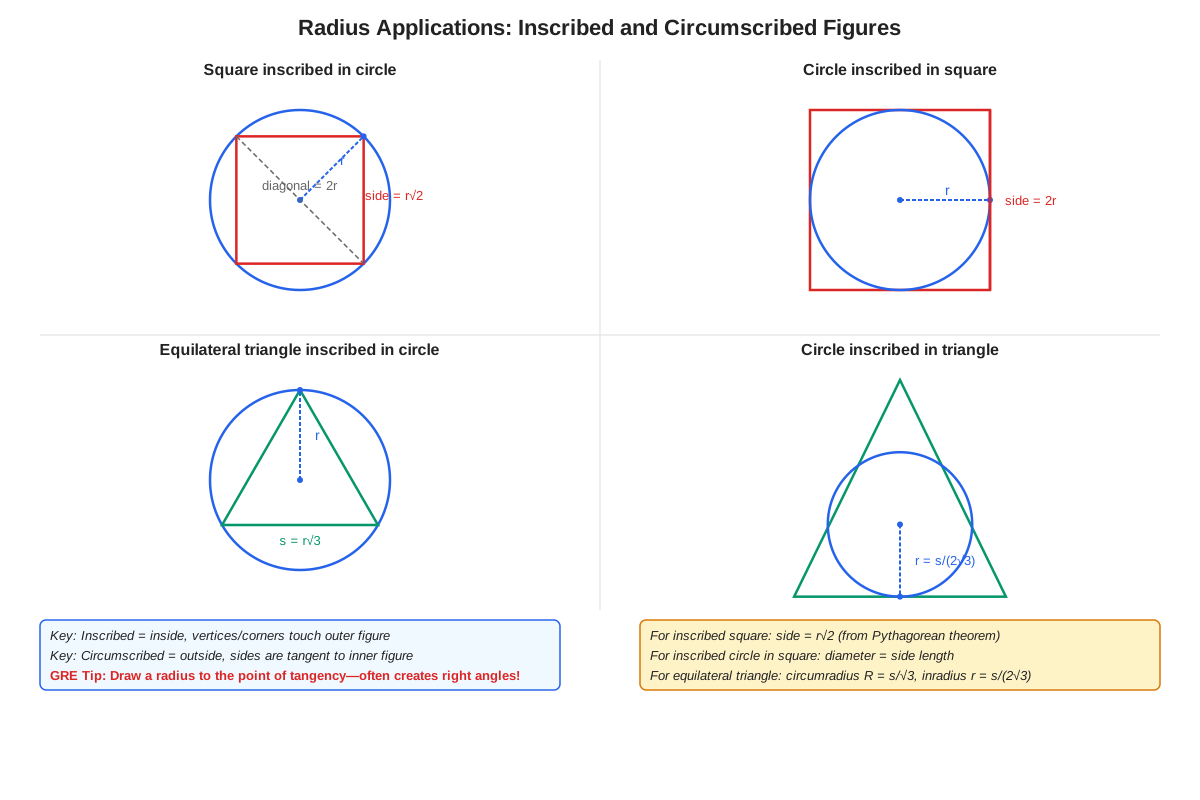
Inscribed and Circumscribed Circles
For polygons and circles:
- A circle inscribed in a polygon touches all sides; its radius is called the inradius
- A circle circumscribed about a polygon passes through all vertices; its radius is called the circumradius
For regular polygons, these radii have specific relationships to side length. For example, in an equilateral triangle with side s:
- Circumradius: R = s/√3
- Inradius: r = s/(2√3)
Concept Relationships
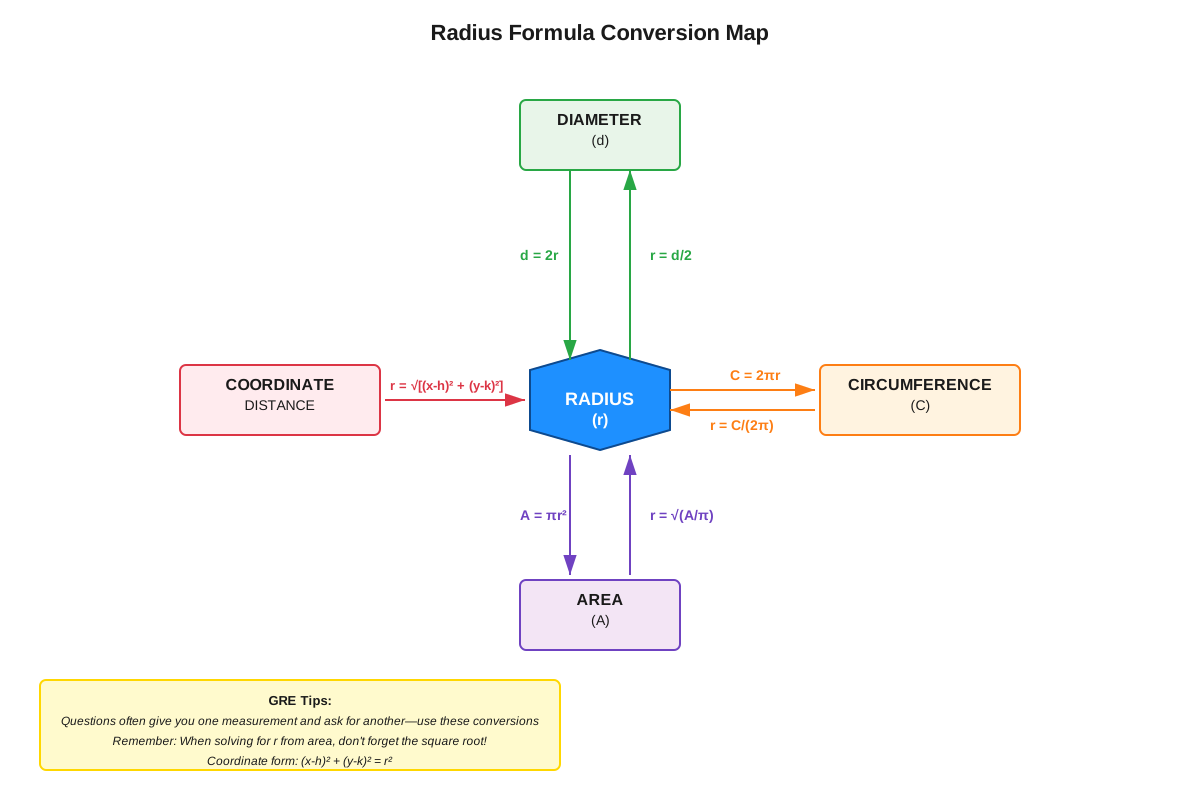
The radius serves as the central hub connecting multiple geometric concepts. The relationship flow typically follows this pattern:
Radius → Diameter (through multiplication by 2) → Circumference (through C = πd = 2πr) → Arc Length (as a fraction of circumference)
Simultaneously, Radius → Area (through A = πr²) → Sector Area (as a fraction of total area)
In coordinate geometry: Distance Formula → Radius → Circle Equation → Points on Circle
For three-dimensional figures: Radius → Cross-sectional Area → Volume (through integration or formula application)
The radius also connects to the Pythagorean Theorem in problems involving chords, tangent lines, and inscribed figures. When a radius meets a tangent line, they form a right angle, creating right triangles where the radius serves as one leg. Similarly, when a radius bisects a chord, it creates right triangles useful for calculations.
Understanding these relationships enables students to recognize that radius often serves as an intermediate value—not the final answer but a necessary step toward finding area, volume, or other measurements. This recognition is crucial for multi-step GRE problems.
Quick check — test yourself on Radius so far.
Try Flashcards →High-Yield Facts
⭐ The radius is exactly half the diameter: r = d/2, a relationship tested in virtually every radius problem
⭐ Circumference formula: C = 2πr, used to find radius when circumference is given: r = C/(2π)
⭐ Area formula: A = πr², used to find radius when area is given: r = √(A/π)
⭐ Doubling the radius quadruples the area: If r becomes 2r, then A becomes 4A (because (2r)² = 4r²)
⭐ In coordinate geometry, r² appears in the circle equation: (x - h)² + (y - k)² = r²
- The radius is perpendicular to a tangent line at the point of tangency, creating a 90° angle
- A radius that bisects a chord is perpendicular to that chord
- For a circle inscribed in a square with side s, the radius equals s/2
- For a circle circumscribed about a square with side s, the radius equals s√2/2
- The sphere volume formula V = (4/3)πr³ shows that volume increases with the cube of radius
- In a semicircle, the radius still extends from the center to the curved edge, not to the diameter endpoints
- When a central angle is given in radians (θ), arc length = rθ (without the 360° conversion)
- The area of a circle with radius r equals the area of a rectangle with length πr and width r
Common Misconceptions
Misconception: The radius extends from any point on the circle to any other point on the circle.
Correction: The radius specifically extends from the center to the circumference. The distance between two points on the circumference is a chord (or diameter if it passes through the center).
Misconception: Doubling the radius doubles the area.
Correction: Doubling the radius quadruples the area because area depends on r², not r. If r → 2r, then πr² → π(2r)² = 4πr².
Misconception: The radius of a semicircle is half the radius of the full circle.
Correction: A semicircle has the same radius as the full circle from which it's formed; it's the area and circumference that are halved (though the perimeter includes the diameter).
Misconception: In the circle equation (x - h)² + (y - k)² = r², the value on the right side is the radius.
Correction: The value on the right side is r² (radius squared), not the radius itself. To find the radius, take the square root of that value.
Misconception: π equals 3.14 exactly, so calculations using π should always use this value.
Correction: π ≈ 3.14159... is irrational and never-ending. On the GRE, leave answers in terms of π when possible, or use the approximation the question specifies. Using 3.14 introduces rounding error.
Misconception: The radius of a circle inscribed in a triangle equals half the triangle's height.
Correction: The inradius formula depends on the triangle's area and semi-perimeter: r = A/s, where s is the semi-perimeter. Only in specific cases (like an equilateral triangle) does a simple relationship to height exist.
Misconception: All radii problems require calculating π to multiple decimal places.
Correction: Many GRE problems are designed so that π cancels out or remains symbolic. Look for opportunities to simplify before multiplying by π's decimal approximation.
Worked Examples
Example 1: Multi-Step Area and Circumference Problem
Question: A circular garden has a circumference of 36π feet. If a circular fountain with an area of 64π square feet is placed at the center of the garden, what is the difference between the radius of the garden and the radius of the fountain?
Solution:
Step 1: Find the radius of the garden using the circumference formula.
- Given: C = 36π feet
- Formula: C = 2πr
- Substitute: 36π = 2πr
- Divide both sides by 2π: r = 36π/(2π) = 18 feet
Step 2: Find the radius of the fountain using the area formula.
- Given: A = 64π square feet
- Formula: A = πr²
- Substitute: 64π = πr²
- Divide both sides by π: 64 = r²
- Take the square root: r = 8 feet
Step 3: Calculate the difference.
- Garden radius - Fountain radius = 18 - 8 = 10 feet
Answer: 10 feet
Connection to Learning Objectives: This problem requires identifying that both circumference and area formulas involve radius (Objective 1), applying the core formulas correctly (Objective 2), and executing accurate calculations (Objective 3). It also demonstrates radius as an intermediate value in multi-step problems (Objective 6).
Example 2: Coordinate Geometry with Radius
Question: In the xy-plane, a circle has center at (3, -4) and passes through the point (7, -1). What is the area of this circle?
Solution:
Step 1: Recognize that the radius equals the distance from center to any point on the circle.
- Center: (3, -4)
- Point on circle: (7, -1)
Step 2: Apply the distance formula to find the radius.
- Distance formula: d = √[(x₂ - x₁)² + (y₂ - y₁)²]
- r = √[(7 - 3)² + (-1 - (-4))²]
- r = √[(4)² + (3)²]
- r = √[16 + 9]
- r = √25 = 5
Step 3: Calculate the area using the radius.
- Formula: A = πr²
- A = π(5)²
- A = 25π square units
Answer: 25π square units
Connection to Learning Objectives: This problem tests the ability to identify radius in a coordinate geometry context (Objective 1 and 5), apply the distance formula to find radius (Objective 2), and use that radius to calculate area (Objective 3 and 6).
Exam Strategy
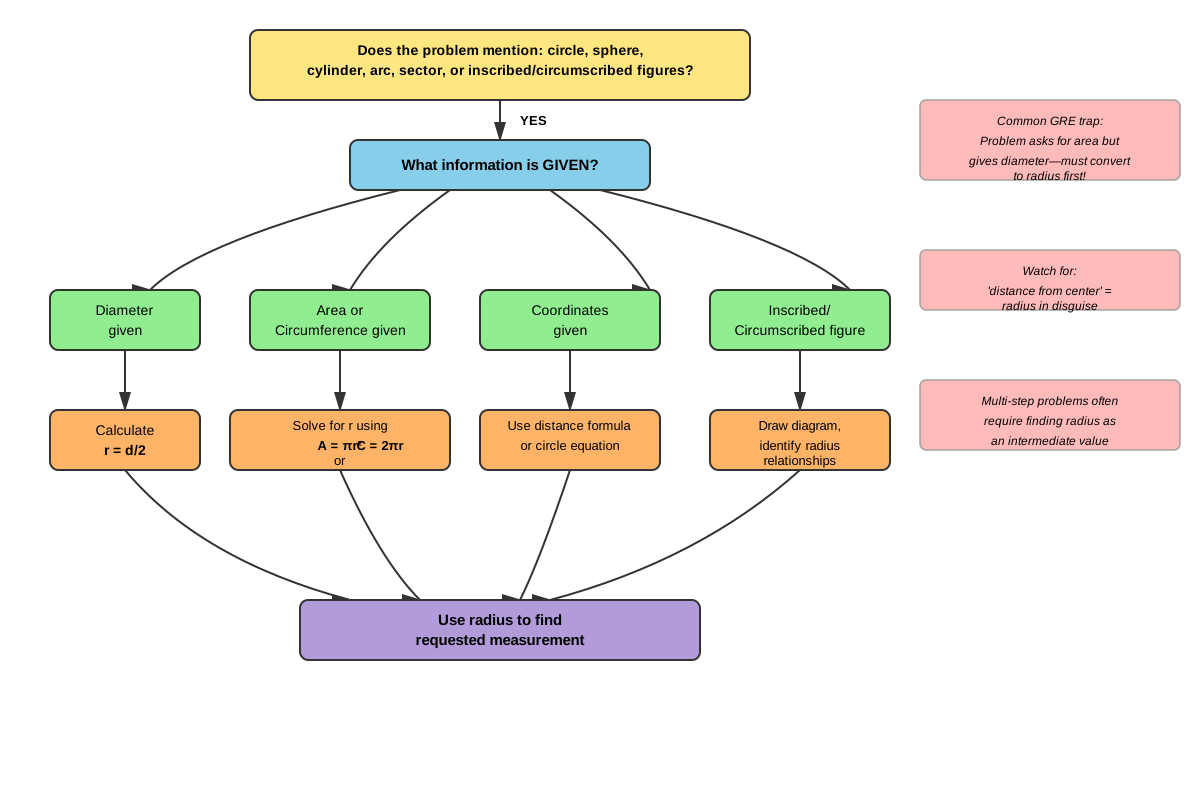
When approaching gre radius questions, begin by identifying what information is provided and what is being asked. Create a mental checklist: Do I have radius, diameter, circumference, or area? What do I need to find? Often, the radius serves as a bridge between given information and the desired answer.
Trigger words and phrases to watch for include: "distance from the center," "passes through," "inscribed," "circumscribed," "circular," "sphere," "cylinder," "cone," and any mention of circumference or area. In coordinate geometry, phrases like "center at" or "equation of a circle" signal radius involvement. Word problems about wheels, gears, pizzas, or any circular objects inherently involve radius.
For Quantitative Comparison questions involving radius, pay special attention to how changes in radius affect other measurements. Remember the quadratic relationship with area and cubic relationship with volume. If comparing two circles, don't assume equal radii unless explicitly stated. Look for opportunities to set up ratios rather than calculating exact values.
Process-of-elimination strategies:
- Eliminate answers that don't include π when the question asks for exact values involving circles
- Eliminate answers that show linear relationships when quadratic relationships apply (e.g., if radius doubles, eliminate answers showing area doubles)
- Check units carefully—radius in feet means area in square feet and volume in cubic feet
- For coordinate geometry, eliminate answers where r² is negative (impossible for real circles)
Time allocation: Simple radius problems (given one value, find another) should take 30-45 seconds. Multi-step problems involving radius as an intermediate value warrant 60-90 seconds. Complex problems combining radius with other geometric concepts may require up to 2 minutes. If a radius problem seems to require extensive calculation, look for a shortcut—the GRE often designs problems where π cancels or where ratios eliminate the need for exact values.
Exam Tip: When a problem provides diameter, immediately write down the radius (half the diameter) before attempting any calculations. This simple step prevents the common error of using diameter in radius formulas.
Memory Techniques
Mnemonic for circle formulas: "Circumference is 2 times around, Area is r squared" helps remember C = 2πr and A = πr².
Visualization strategy: Picture the radius as a spoke in a bicycle wheel, extending from the hub (center) to the rim (circumference). This image reinforces that all radii are equal length and that they're perpendicular to tangent lines (like the ground touching the wheel).
Acronym for radius relationships: DRAC - Diameter (2r), Radius (r), Area (πr²), Circumference (2πr). This sequence helps recall the four fundamental circle measurements and their relationships.
Scaling memory aid: "Square the radius for area, cube the radius for volume" reminds students that area formulas contain r² while volume formulas contain r³, explaining why changes in radius have exponential effects.
Coordinate geometry reminder: Think "r² on the right" for the circle equation (x - h)² + (y - k)² = r², helping remember that radius appears squared and on the right side of the equation.
Summary
The radius represents the fundamental measurement of circular and spherical objects, defined as the distance from center to circumference. Mastery of radius requires understanding its relationships to diameter (d = 2r), circumference (C = 2πr), and area (A = πr²), along with the ability to manipulate these formulas algebraically to solve for radius when other values are given. The GRE tests radius both directly and as an intermediate value in multi-step problems, often combining it with coordinate geometry, three-dimensional figures, and inscribed/circumscribed shapes. Critical insights include recognizing the quadratic relationship between radius and area (doubling radius quadruples area) and the appearance of r² in the standard circle equation. Success on radius problems requires identifying when radius is being tested (even in disguised forms), selecting the appropriate formula, executing calculations accurately, and understanding how radius connects to broader geometric concepts. Students must be comfortable working with π in both symbolic and decimal forms, converting between related measurements, and applying radius concepts across multiple geometric contexts.
Key Takeaways
- The radius is half the diameter (r = d/2) and serves as the foundation for all circle calculations
- Circumference and area formulas (C = 2πr and A = πr²) allow conversion between these measurements and radius
- Doubling the radius quadruples the area and multiplies volume by eight—relationships frequently tested in comparisons
- In coordinate geometry, radius appears as r² in the circle equation: (x - h)² + (y - k)² = r²
- Radius often serves as an intermediate value requiring multi-step problem-solving
- The GRE presents radius in various contexts: direct calculation, coordinate geometry, three-dimensional figures, and inscribed/circumscribed shapes
- Recognizing trigger words and understanding formula relationships enables efficient problem-solving under time pressure
Related Topics
Diameter and Circumference: Building directly on radius concepts, these topics explore the perimeter of circles and the relationships between linear measurements. Mastering radius provides the foundation for understanding how circumference scales and how to work with arc lengths.
Area of Circles and Sectors: This topic extends radius knowledge to two-dimensional space calculations, including partial circles. Understanding the r² relationship in area formulas is essential for these more complex problems.
Coordinate Geometry - Circles: Advanced applications of radius in the xy-plane, including circle equations, tangent lines, and systems involving circles and other figures. Radius mastery enables progression to these higher-level coordinate geometry problems.
Three-Dimensional Geometry: Spheres, cylinders, and cones all depend on radius for volume and surface area calculations. The concepts learned here extend naturally to these spatial reasoning problems.
Inscribed and Circumscribed Figures: Complex problems involving circles and polygons require understanding how radius relates to other geometric measurements. This advanced topic builds directly on fundamental radius knowledge.
Practice CTA
Now that you've mastered the core concepts of radius and its applications on the GRE, it's time to reinforce your learning through active practice. Attempt the practice questions associated with this topic to test your ability to identify radius problems, apply the appropriate formulas, and execute multi-step solutions efficiently. Use the flashcards to drill the key formulas and relationships until they become automatic. Remember, geometry problems reward pattern recognition and formula fluency—skills that develop through consistent practice. Each problem you solve strengthens your ability to recognize radius applications in their many forms, building the confidence and speed you need for test day success. You've invested the time to understand the concepts; now invest the time to master their application!
Sign up free to keep reading
Create a free AnvayaPrep account to finish this GRE guide on Radius — plus flashcards and practice questions.