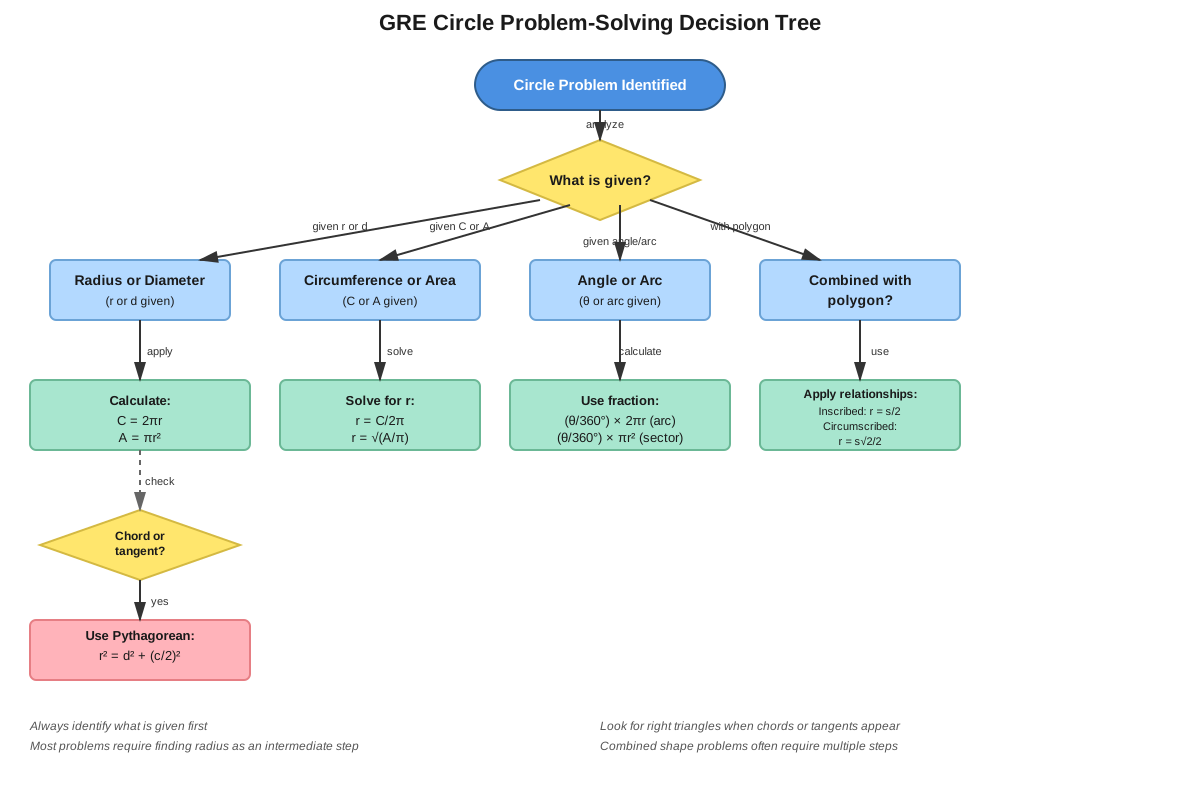
Overview
Circles represent one of the most frequently tested geometric shapes on the GRE Quantitative Reasoning section. Understanding circles requires mastery of their fundamental properties, relationships between various measurements (radius, diameter, circumference, and area), and the ability to apply these concepts to complex problem-solving scenarios. Circle problems on the GRE often appear in multiple formats: as standalone quantitative comparison questions, as part of data interpretation sets, and embedded within word problems that require spatial reasoning. The elegance of circular geometry lies in its perfect symmetry, which creates predictable mathematical relationships that test-takers must recognize and exploit under time pressure.
The importance of GRE circles extends beyond isolated geometry questions. Circle concepts frequently integrate with coordinate geometry (equations of circles on the xy-plane), algebra (solving for unknown variables using circle formulas), and even data interpretation (pie charts representing circular divisions). A solid grasp of circle properties enables students to tackle multi-step problems that combine several mathematical domains, which is precisely what the GRE demands at higher difficulty levels. Questions may involve inscribed or circumscribed figures, sectors and arcs, or the relationship between circles and other polygons.
Within the broader Quantitative Reasoning framework, circles serve as a bridge between pure geometry and applied problem-solving. They test not only formula memorization but also conceptual understanding—such as recognizing that doubling a radius quadruples the area, or that the longest chord in any circle must be its diameter. Mastering circles provides the foundation for understanding more complex geometric relationships and demonstrates the analytical thinking skills that graduate programs value. This topic typically accounts for 2-4 questions per GRE exam, making it a high-yield area for focused study.
Learning Objectives
- [ ] Identify when Circles is being tested in GRE questions
- [ ] Explain the core rule or strategy behind Circles
- [ ] Apply Circles to GRE-style questions accurately
- [ ] Calculate circumference and area given radius or diameter, and vice versa
- [ ] Determine arc length and sector area as fractions of the whole circle
- [ ] Solve problems involving circles inscribed in or circumscribed about polygons
- [ ] Apply the Pythagorean theorem to find chord lengths and distances within circles
Prerequisites
- Basic algebra: Solving equations and manipulating formulas is essential for working with circle equations and finding unknown measurements
- Understanding of π (pi): Recognizing π ≈ 3.14159 as the ratio of circumference to diameter underlies all circle calculations
- Pythagorean theorem: Many circle problems involve right triangles formed by radii, chords, and tangent lines
- Area and perimeter concepts: Familiarity with measuring two-dimensional shapes provides the foundation for understanding circular measurements
- Coordinate plane basics: Some circle problems require plotting points and understanding distance formulas
Why This Topic Matters
In real-world applications, circles appear everywhere: from engineering designs and architectural plans to satellite orbits and signal coverage areas. Understanding circular geometry enables professionals to calculate material requirements for circular structures, determine optimal placement of resources within a radius, and analyze rotational systems. The mathematical principles governing circles form the basis for trigonometry, calculus, and advanced physics.
On the GRE specifically, circle questions appear with high frequency—typically 2-4 questions per exam across both Quantitative Reasoning sections. These questions test multiple skill levels: straightforward formula application (easier questions), multi-step reasoning involving relationships between circle parts (medium difficulty), and complex problems combining circles with other geometric figures or coordinate geometry (harder questions). Circle problems commonly appear as:
- Quantitative Comparison questions asking students to compare two circle measurements
- Multiple-choice problems requiring calculation of area, circumference, or arc length
- Data Interpretation questions involving pie charts or circular diagrams
- Geometry diagrams showing circles inscribed in or circumscribed about triangles, squares, or other polygons
- Word problems describing circular paths, wheels, or cylindrical objects
The GRE particularly favors questions that test conceptual understanding rather than mere computation. For example, questions might ask how area changes when radius doubles, or require recognizing that a tangent line forms a right angle with a radius. These conceptual questions reward students who understand the underlying relationships rather than just memorizing formulas.
Core Concepts
Basic Circle Definitions and Components
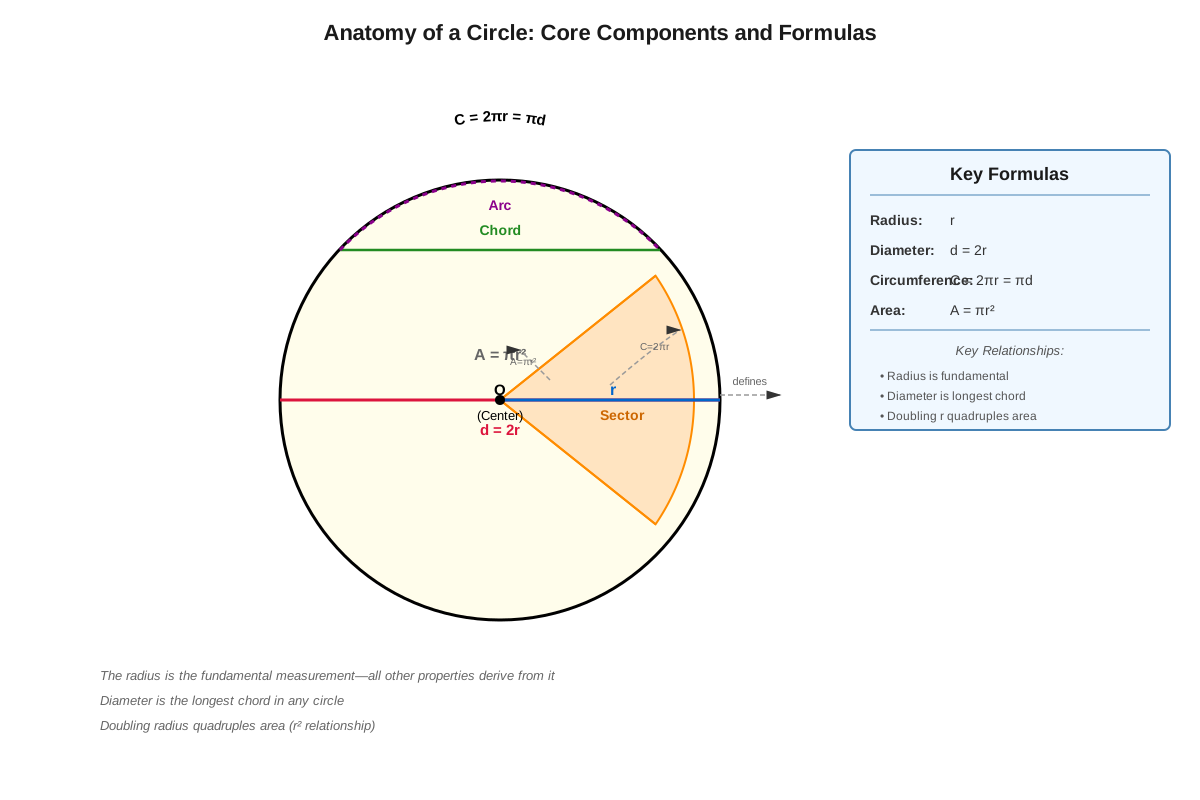
A circle is the set of all points in a plane that are equidistant from a fixed center point. This constant distance is called the radius (r), which extends from the center to any point on the circle. The diameter (d) is the longest possible chord—a line segment connecting two points on the circle—and always passes through the center, making it exactly twice the radius: d = 2r.
The circumference (C) represents the distance around the circle—essentially the perimeter of a circular shape. The relationship between circumference and diameter is constant for all circles, defined by the mathematical constant π (pi):
C = πd = 2πrThe area (A) of a circle measures the space enclosed within its boundary:
A = πr²These two formulas—circumference and area—form the foundation of virtually all GRE circle problems. Understanding that both depend on the radius means that knowing any one measurement (radius, diameter, circumference, or area) allows calculation of all others.
Key Circle Components
| Component | Definition | Formula/Relationship |
|---|---|---|
| Radius | Distance from center to edge | r = d/2 |
| Diameter | Distance across through center | d = 2r |
| Circumference | Distance around the circle | C = 2πr = πd |
| Area | Space enclosed by circle | A = πr² |
| Chord | Line segment connecting two points on circle | Diameter is longest chord |
| Arc | Portion of the circumference | Length = (θ/360°) × 2πr |
| Sector | Pie-slice region bounded by two radii | Area = (θ/360°) × πr² |
Arcs and Sectors
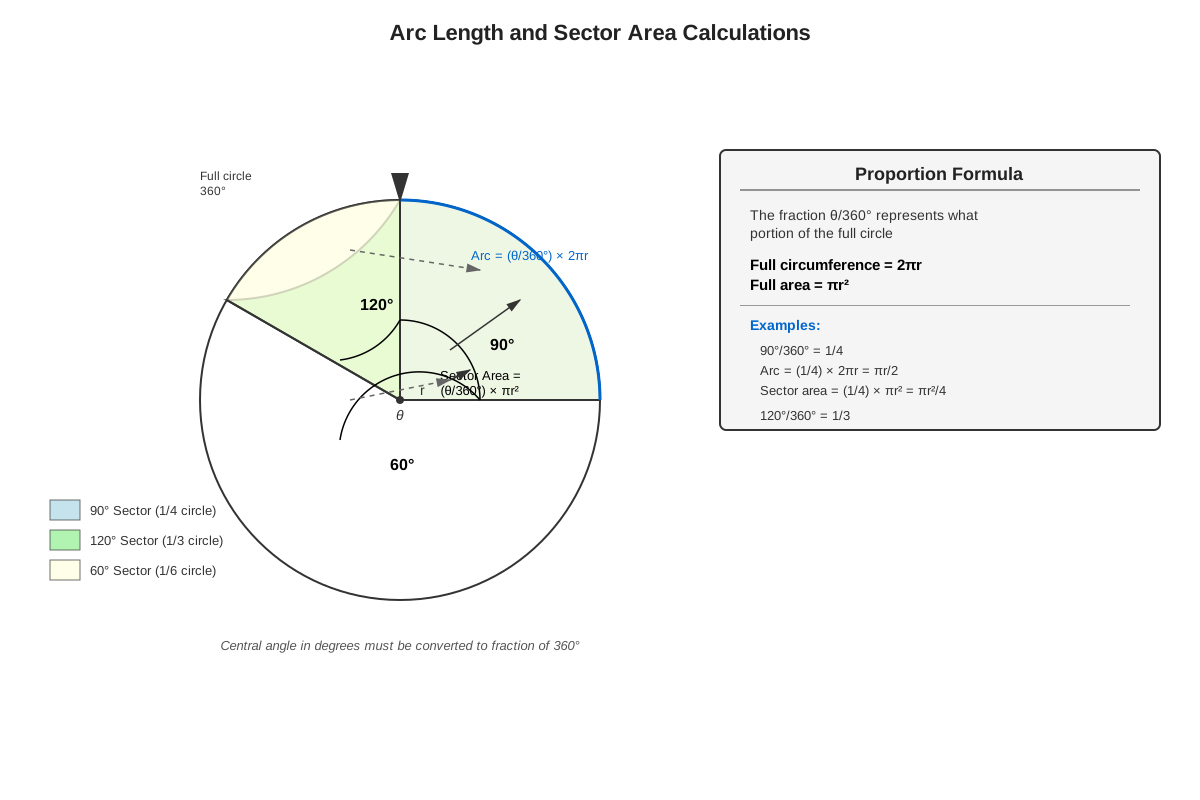
An arc is a portion of the circle's circumference, defined by a central angle. The central angle is formed by two radii extending from the center to the arc's endpoints. Arc length is proportional to the central angle:
Arc Length = (central angle/360°) × 2πrFor example, a 90° arc represents one-quarter of the circle's circumference, so its length equals (90/360) × 2πr = (1/4) × 2πr.
A sector is the region bounded by two radii and the arc between them—like a slice of pie. Sector area follows the same proportional relationship:
Sector Area = (central angle/360°) × πr²The GRE frequently tests whether students can recognize these proportional relationships. A 60° sector contains 60/360 = 1/6 of the circle's total area.
Inscribed and Circumscribed Figures
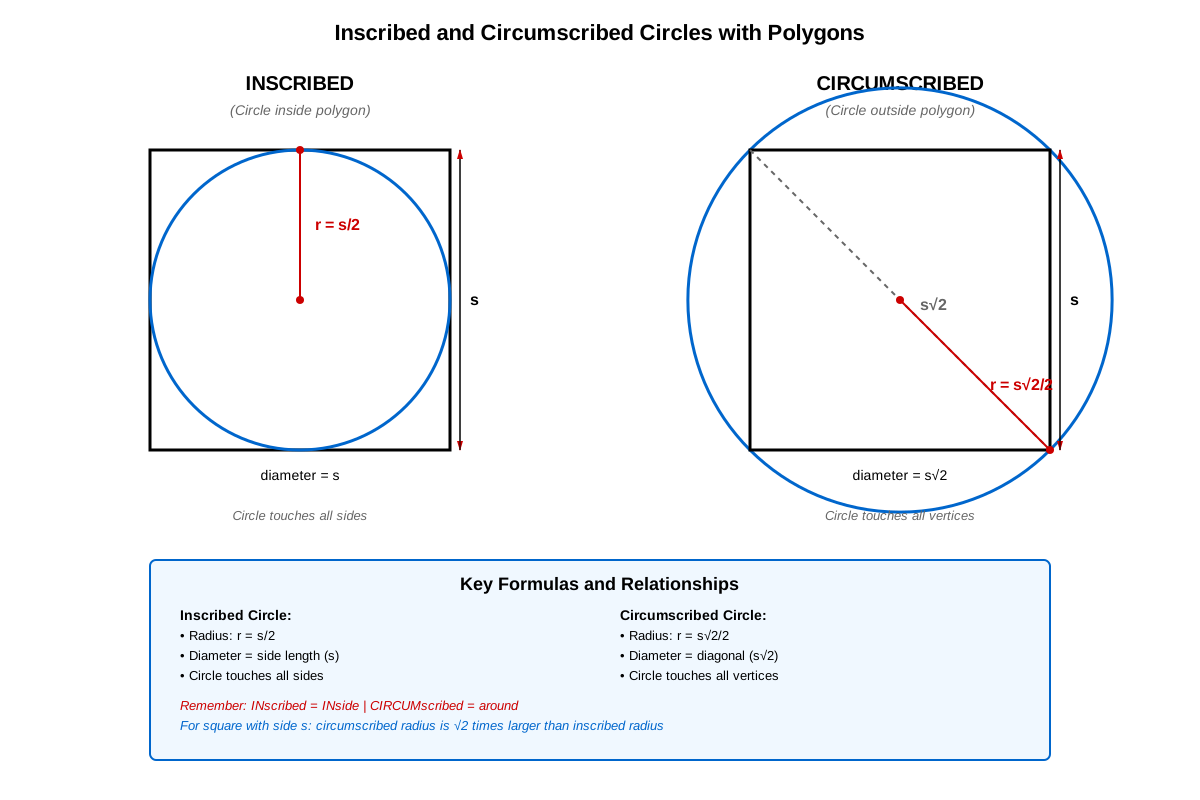
A circle inscribed in a polygon touches all sides of the polygon from the inside. The radius of an inscribed circle is called the inradius. For example, a circle inscribed in a square with side length s has radius r = s/2, because the diameter equals the side length.
A circle circumscribed about a polygon passes through all vertices of the polygon. The radius of a circumscribed circle is called the circumradius. For a square with side length s, the circumscribed circle's diameter equals the square's diagonal: d = s√2, so r = (s√2)/2.
These relationships become critical for GRE problems involving multiple shapes. Key relationships to memorize:
- Circle inscribed in square (side s): r = s/2, Area = πs²/4
- Circle circumscribed about square (side s): r = s√2/2, Area = πs²/2
- Square inscribed in circle (radius r): side = r√2, Area = 2r²
Tangent Lines and Right Angles
A tangent line touches a circle at exactly one point. The crucial property: a radius drawn to the point of tangency is always perpendicular to the tangent line, forming a 90° angle. This creates right triangles in many GRE problems.
When two tangent lines are drawn from an external point to a circle, they have equal length. This symmetry property often appears in complex geometry problems.
Circles in the Coordinate Plane
The standard equation of a circle with center (h, k) and radius r is:
(x - h)² + (y - k)² = r²For a circle centered at the origin (0, 0), this simplifies to:
x² + y² = r²GRE questions may provide this equation and ask for the radius, center coordinates, or whether specific points lie on, inside, or outside the circle. A point (x, y) lies:
- On the circle if it satisfies the equation exactly
- Inside the circle if (x - h)² + (y - k)² < r²
- Outside the circle if (x - h)² + (y - k)² > r²
Chords and the Pythagorean Theorem
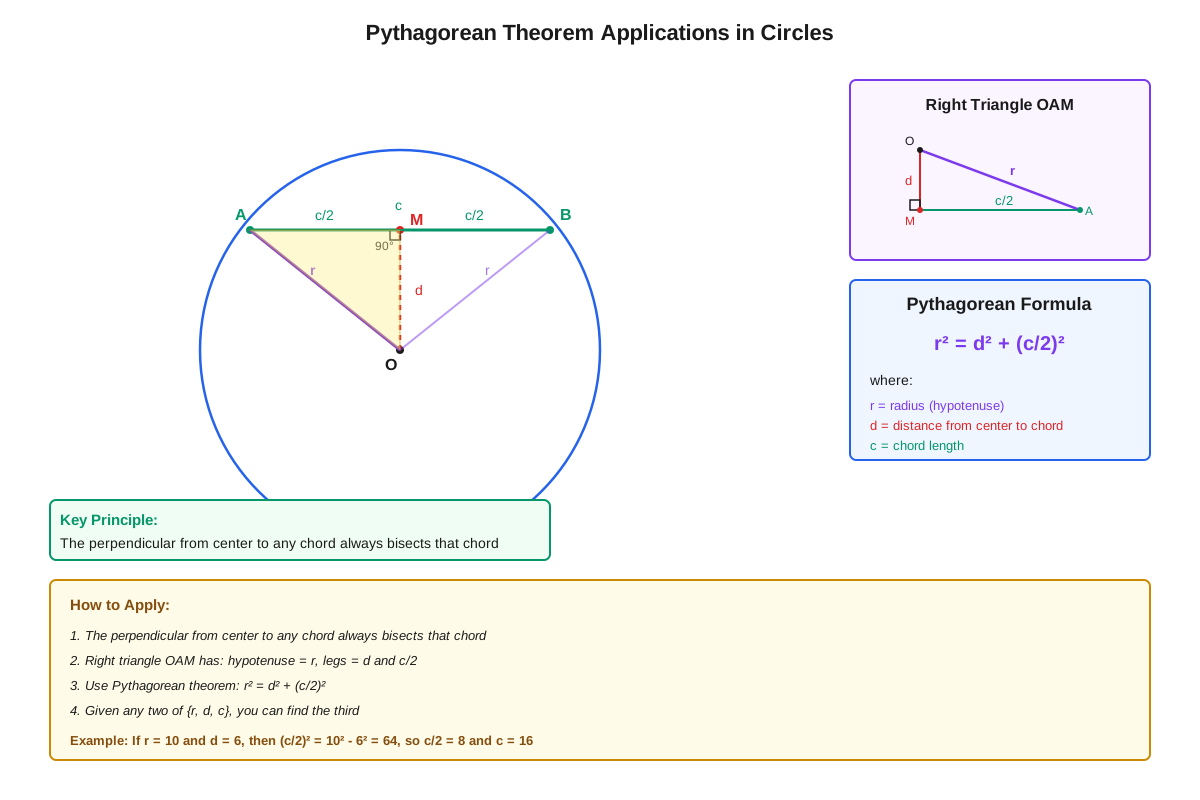
A chord is any line segment connecting two points on a circle. The perpendicular from the center to a chord bisects that chord—cuts it into two equal parts. This creates right triangles that can be solved using the Pythagorean theorem.
For a chord of length c at distance d from the center of a circle with radius r:
r² = d² + (c/2)²This relationship allows calculation of any one variable when the other two are known, making it a powerful tool for multi-step problems.
Concept Relationships
The fundamental relationship in circle geometry flows from the radius to all other measurements. Radius serves as the primary variable: once known, it determines both circumference (C = 2πr) and area (A = πr²). The diameter is simply a scaled version of radius (d = 2r), making it interchangeable in calculations.
Arcs and sectors represent fractional portions of the whole circle, connected through the central angle. The proportion (central angle/360°) scales both the full circumference to get arc length and the full area to get sector area. This proportional thinking—recognizing that a 45° angle represents 45/360 = 1/8 of the circle—is essential for efficient problem-solving.
Inscribed and circumscribed figures connect circles to polygons, particularly squares and triangles. These relationships often involve the Pythagorean theorem because radii, chords, and tangent lines frequently form right triangles. For example, finding the diagonal of a square inscribed in a circle requires recognizing that the diagonal equals the diameter, then using the relationship between a square's side and diagonal (side × √2).
Coordinate geometry integrates circles with algebra through the circle equation (x - h)² + (y - k)² = r². This connects to the distance formula, which is essentially the Pythagorean theorem applied to coordinate points. The radius becomes the distance from center to any point on the circle.
Relationship map:
Radius → Diameter (×2) → Circumference (×π) → Arc Length (×angle proportion)
Radius → Area (×πr) → Sector Area (×angle proportion)
Radius + Pythagorean Theorem → Chord lengths, tangent distances
Radius + Coordinate Plane → Circle equations, point relationships
Quick check — test yourself on Circles so far.
Try Flashcards →High-Yield Facts
⭐ The area formula is A = πr², not πr — squaring the radius is the most common source of calculation errors
⭐ Circumference is C = 2πr or πd — both forms are equally valid; choose based on given information
⭐ Doubling the radius quadruples the area — because area depends on r², a 2× radius increase yields 4× area increase
⭐ The diameter is the longest chord in any circle — any other chord must be shorter
⭐ A tangent line is perpendicular to the radius at the point of tangency — this creates 90° angles for right triangle problems
- Arc length and sector area use the same proportional relationship: (central angle/360°) × whole circle measurement
- A circle inscribed in a square has diameter equal to the square's side length
- A circle circumscribed about a square has diameter equal to the square's diagonal
- The perpendicular from a circle's center to any chord bisects that chord
- In the coordinate plane, a circle centered at origin has equation x² + y² = r²
- Two tangent segments drawn from the same external point to a circle have equal length
- A 180° arc is a semicircle with length πr and area πr²/2
- The ratio of circumference to diameter is always π, regardless of circle size
- When radius increases by factor k, circumference increases by k but area increases by k²
- A right angle inscribed in a circle (with vertices on the circle) must have its hypotenuse as a diameter
Common Misconceptions
Misconception: The area formula is A = πr or A = 2πr
Correction: The area formula is A = πr² (radius squared). The formula 2πr gives circumference, not area. Always square the radius when calculating area.
Misconception: Doubling the radius doubles the area
Correction: Doubling the radius quadruples the area because area depends on r². If r becomes 2r, then A = π(2r)² = 4πr², which is four times the original area πr².
Misconception: Diameter and radius are interchangeable in formulas
Correction: While related (d = 2r), they are not interchangeable. Using diameter in the area formula A = πd² gives four times the correct answer. Always convert to radius first: r = d/2, then calculate A = πr².
Misconception: A 90° sector has area equal to πr²/2
Correction: A 90° sector represents 90/360 = 1/4 of the circle, so its area is πr²/4, not πr²/2. A semicircle (180°) has area πr²/2.
Misconception: All chords have the same length
Correction: Chord length varies depending on distance from the center. Only the diameter (a special chord through the center) has maximum length 2r. Chords closer to the center are longer than those near the edge.
Misconception: Arc length and central angle are the same thing
Correction: Central angle is measured in degrees; arc length is measured in linear units (cm, inches, etc.). Arc length = (angle/360°) × 2πr converts the angle to an actual distance.
Misconception: The equation (x - h)² + (y - k)² = r² means the radius is r
Correction: Actually, r² appears in the equation, so the radius is √(r²) = r. If the equation shows (x - 2)² + (y + 3)² = 25, the radius is √25 = 5, not 25.
Misconception: A tangent line passes through the center of the circle
Correction: A tangent line touches the circle at exactly one point and never passes through the center. A line through the center is either a diameter (if it intersects the circle at two points) or a radius (from center to edge).
Worked Examples
Example 1: Multi-Step Area and Circumference Problem
Problem: A circular garden has a circumference of 36π feet. A landscaper wants to install a fence around the garden and plant grass inside. (a) What is the radius of the garden? (b) What is the area that will be covered with grass? (c) If the fence costs $8 per foot, what is the total fencing cost?
Solution:
Step 1: Find the radius from circumference
Given: C = 36π feet
Using the circumference formula C = 2πr:
- 36π = 2πr
- Divide both sides by 2π: r = 36π/(2π) = 18 feet
Step 2: Calculate the area
Using A = πr² with r = 18:
- A = π(18)²
- A = π(324)
- A = 324π square feet
For a numerical approximation: 324π ≈ 324(3.14) ≈ 1,017.36 square feet
Step 3: Calculate fencing cost
The fence goes around the circumference: 36π feet
Cost = (circumference) × (price per foot)
- Cost = 36π × $8
- Cost = 288π dollars
- Cost ≈ 288(3.14) ≈ $904.32
Answers: (a) radius = 18 feet, (b) area = 324π ≈ 1,017 square feet, (c) cost = 288π ≈ $904
Key Concepts Applied: This problem demonstrates the interconnection between circumference, radius, and area. Notice that we must find radius first (the fundamental measurement) before calculating area. The problem also shows that GRE questions often leave answers in terms of π rather than requiring decimal approximation.
Example 2: Inscribed Circle and Sector Area
Problem: A circle with center O has radius 10. Points A and B lie on the circle such that the central angle AOB measures 72°. What is the area of sector AOB?
Solution:
Step 1: Identify what we're finding
We need the area of a sector (pie-slice region) with central angle 72° in a circle with radius 10.
Step 2: Determine what fraction of the circle this sector represents
Fraction = (central angle)/(360°) = 72°/360° = 1/5
The sector is one-fifth of the entire circle.
Step 3: Calculate the full circle's area
A = πr² = π(10)² = 100π
Step 4: Find the sector area
Sector Area = (fraction) × (total area)
- Sector Area = (1/5) × 100π
- Sector Area = 20π
Answer: The area of sector AOB is 20π (or approximately 62.8 square units)
Alternative Method: Using the sector formula directly:
Sector Area = (θ/360°) × πr² = (72/360) × π(10)² = (1/5) × 100π = 20π
Key Concepts Applied: This problem tests understanding of sectors as proportional parts of circles. Recognizing that 72° is exactly 1/5 of 360° allows for simplified calculation. The GRE rewards this kind of fractional thinking over mechanical formula application.
Exam Strategy
Recognizing Circle Questions
Watch for these trigger words and phrases that signal circle problems:
- "circular," "round," "wheel," "disk"
- "radius," "diameter," "circumference"
- "inscribed in a circle," "circumscribed about a circle"
- "arc," "sector," "central angle"
- "tangent to the circle"
- Equations in the form (x - h)² + (y - k)² = r²
Systematic Approach
- Identify what's given and what's asked: Circle problems often provide one measurement (radius, diameter, circumference, or area) and ask for another. Write down the given information clearly.
- Find the radius first: Since radius is the fundamental measurement, convert any given information (diameter, circumference, or area) into radius before proceeding.
- Draw a diagram: Even if the problem provides a figure, redraw it with labels. Mark the center, radius, and any relevant angles or chords.
- Look for right triangles: Many circle problems involve the Pythagorean theorem. Radii, chords, tangent lines, and perpendiculars frequently form right triangles.
- Use proportional thinking for arcs and sectors: Instead of memorizing separate formulas, recognize that arc length and sector area are fractions of the whole circle based on the central angle.
Quantitative Comparison Strategy
For questions comparing two circle measurements:
- If comparing areas with different radii: Remember that area grows with the square of radius. A circle with radius 2r has area 4 times greater than a circle with radius r.
- If comparing circumferences: Circumference grows linearly with radius. A circle with radius 2r has circumference 2 times greater.
- Watch for hidden information: Sometimes the relationship between two circles isn't directly stated but can be inferred from a diagram or context.
Time Management
- Simple formula application (finding area given radius): 30-45 seconds
- Multi-step problems (finding radius from area, then circumference): 60-90 seconds
- Complex problems (inscribed figures, coordinate geometry): 2-3 minutes
If a circle problem involves more than three steps or combines multiple geometric concepts, consider marking it for review and returning after completing easier questions.
Common Traps to Avoid
- Don't confuse area and circumference formulas: Area has r², circumference has r
- Don't forget to square the radius when calculating area
- Don't use diameter in the area formula without first converting to radius
- Don't assume all chords are diameters: Only chords through the center are diameters
- Don't forget π: Many students calculate r² but forget to multiply by π
Memory Techniques
The "2-Pi-R" Mnemonic
"Two pies are round" → C = 2πr (circumference)
"Pie are squared" → A = πr² (area)
This playful phrase helps distinguish the two fundamental formulas and prevents mixing them up under test pressure.
The Doubling Rule
"Double radius, FOUR times area" — Remember that area depends on r², so any change to radius gets squared for area. Triple the radius → nine times the area. Half the radius → one-quarter the area.
The Right Angle Rule
"Tangent makes a T" — The letter T has a right angle, just like a tangent line meeting a radius. This visual reminds you that tangent lines are perpendicular to radii at the point of contact.
The Fraction Method for Sectors
"Angle over 360, times the whole" — For any arc or sector problem, write the fraction (angle/360°) first, then multiply by either 2πr (for arc length) or πr² (for sector area). This systematic approach prevents formula confusion.
Inscribed vs. Circumscribed
"IN-scribed is IN-side" — The inscribed circle fits inside the polygon
"CIRCUM-scribed goes CIRCUM-ference around" — The circumscribed circle goes around the polygon, with the polygon inside
The Diameter-Chord Rule
"Diameter is the KING of chords" — It's the longest possible chord, always passing through the center. Any other chord is shorter.
Summary
Circles represent a high-yield topic on the GRE Quantitative Reasoning section, appearing in 2-4 questions per exam across multiple question types. Mastery requires understanding the fundamental relationship between radius and all other circle measurements: circumference (C = 2πr), area (A = πr²), arc length, and sector area. The radius serves as the key variable—once determined, all other measurements follow. Critical concepts include recognizing that area grows with the square of radius (doubling radius quadruples area), understanding arcs and sectors as proportional parts of the whole circle based on central angle, and applying the Pythagorean theorem to problems involving chords, tangent lines, and inscribed figures. The GRE particularly tests conceptual understanding through problems involving circles inscribed in or circumscribed about polygons, tangent lines forming right angles with radii, and coordinate plane equations. Success requires not just formula memorization but the ability to recognize relationships, draw helpful diagrams, and apply proportional reasoning efficiently under time pressure.
Key Takeaways
- Master the two fundamental formulas: C = 2πr for circumference and A = πr² for area—all other circle calculations derive from these
- Radius is the key variable: Always find or convert to radius first, as it unlocks all other circle measurements
- Area scales with r²: When radius changes by factor k, area changes by factor k²—doubling radius quadruples area
- Arcs and sectors are proportional: Use (central angle/360°) as a multiplier for the full circumference or area
- Tangent lines create right angles: A radius to the point of tangency is always perpendicular to the tangent line, enabling Pythagorean theorem applications
- Diameter is the longest chord: Any chord not passing through the center must be shorter than the diameter
- Draw diagrams systematically: Label centers, radii, angles, and look for right triangles—visual organization prevents errors and reveals solution paths
Related Topics
Coordinate Geometry: Understanding circle equations (x - h)² + (y - k)² = r² connects circle concepts to the coordinate plane, enabling problems involving distances, intersections with lines, and graphical analysis.
Triangles and Polygons: Many advanced circle problems involve circles inscribed in or circumscribed about triangles, squares, and regular polygons, requiring integration of multiple geometric concepts.
Three-Dimensional Geometry: Mastering circles provides the foundation for understanding cylinders, cones, and spheres, where circular cross-sections determine volume and surface area.
Trigonometry: Arc length and sector area connect to radian measure and trigonometric functions, forming the basis for more advanced mathematical applications.
Ratios and Proportions: The proportional relationships in circles (arc to circumference, sector to area) reinforce broader quantitative reasoning skills applicable across the GRE.
Practice CTA
Now that you've mastered the core concepts of circles, it's time to solidify your understanding through active practice. Attempt the practice questions to apply these formulas and strategies to GRE-style problems, and use the flashcards to reinforce key facts and formulas until they become automatic. Remember: understanding the concepts is just the first step—achieving test-day confidence requires repeated application under timed conditions. Each practice problem you solve strengthens your pattern recognition and builds the speed you'll need to excel on exam day. You've got this!
Sign up free to keep reading
Create a free AnvayaPrep account to finish this GRE guide on Circles — plus flashcards and practice questions.