Overview
The diameter is one of the most fundamental and frequently tested concepts in GRE Quantitative Reasoning geometry questions. As the longest chord that passes through the center of a circle, the diameter serves as a critical measurement that connects multiple geometric properties including radius, circumference, and area. Understanding diameter relationships is essential not only for solving direct circle problems but also for tackling complex questions involving inscribed figures, coordinate geometry, and three-dimensional shapes like cylinders and spheres.
On the GRE, gre diameter questions appear in various formats—from straightforward calculations to multi-step problems that require integrating diameter properties with other geometric concepts. Test-makers frequently embed diameter relationships within Quantitative Comparison questions, Data Interpretation sets, and word problems involving circular objects. The ability to quickly recognize when a diameter relationship is being tested and to apply the appropriate formula or property can save valuable time and improve accuracy on test day.
Mastering diameter concepts provides a foundation for understanding broader circle geometry, which accounts for approximately 10-15% of all GRE geometry questions. The diameter's relationship to radius (d = 2r) serves as a gateway to understanding circumference (C = πd), area (A = πr²), and arc length calculations. Additionally, diameter properties extend into coordinate geometry when dealing with circle equations, and into three-dimensional geometry when working with spheres, cylinders, and cones. A solid grasp of diameter concepts enables students to approach these interconnected topics with confidence and efficiency.
Learning Objectives
- [ ] Identify when Diameter is being tested in GRE questions
- [ ] Explain the core rule or strategy behind Diameter calculations
- [ ] Apply Diameter to GRE-style questions accurately
- [ ] Convert between diameter and radius measurements fluently
- [ ] Recognize diameter relationships in inscribed and circumscribed figures
- [ ] Solve multi-step problems involving diameter, circumference, and area
- [ ] Apply diameter concepts to three-dimensional geometric shapes
Prerequisites
- Basic circle terminology: Understanding terms like center, radius, and chord is essential because diameter is defined as a special type of chord
- Algebraic manipulation: Solving for variables in equations is necessary for working with diameter formulas like d = 2r and C = πd
- Pi (π) as a constant: Familiarity with π ≈ 3.14 or 22/7 is required for circumference and area calculations involving diameter
- Pythagorean theorem: This foundational concept connects to diameter problems involving right triangles inscribed in circles
- Basic coordinate geometry: Understanding distance between points helps when calculating diameter from coordinate plane representations
Why This Topic Matters
Diameter concepts appear in real-world applications ranging from engineering and architecture to manufacturing and design. Calculating the diameter of circular objects—from pipes and wheels to planetary orbits—is fundamental to practical problem-solving across numerous fields. Understanding diameter relationships enables professionals to determine material requirements, calculate capacities, and design circular structures efficiently.
On the GRE, diameter-related questions appear in approximately 8-12% of all Quantitative Reasoning geometry problems. These questions manifest in several formats: direct calculation problems asking for diameter given circumference or area; Quantitative Comparison questions comparing diameters of different circles; Data Interpretation questions involving circular graphs or objects; and complex multi-step problems where diameter serves as an intermediate calculation. The GRE particularly favors questions that test whether students can move fluidly between diameter, radius, circumference, and area.
Test-makers commonly embed diameter concepts within problems involving inscribed polygons (especially right triangles where the hypotenuse equals the diameter), semicircles, circular sectors, and three-dimensional shapes. Questions may present information about a circle's circumference or area and require students to work backward to find the diameter, then use that diameter to solve for another property. The ability to recognize these multi-step pathways distinguishes high-scoring students from those who struggle with geometry sections.
Core Concepts
Definition and Basic Properties
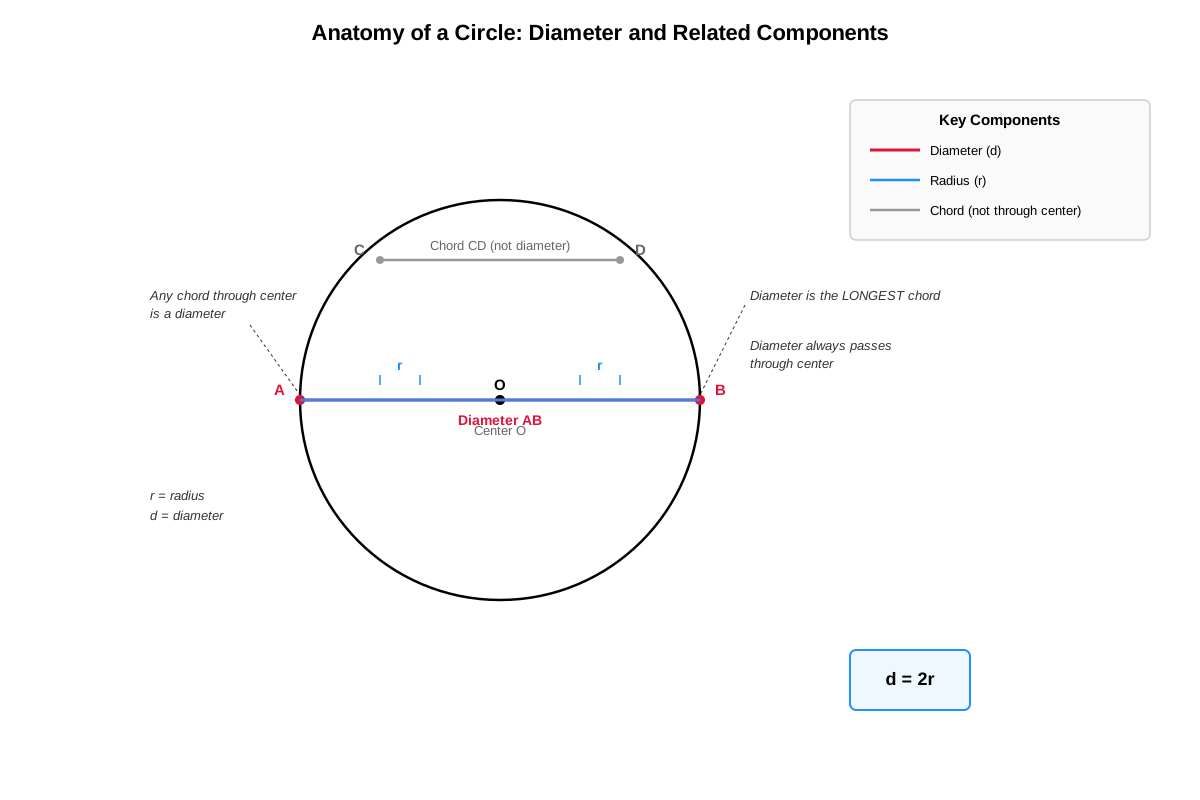
The diameter of a circle is defined as a line segment that passes through the center of the circle and has both endpoints on the circle's circumference. It represents the longest possible distance between any two points on a circle. Every circle has infinitely many diameters, all of equal length, and each diameter divides the circle into two congruent semicircles.
The fundamental relationship between diameter and radius is expressed as:
d = 2r or r = d/2where d represents diameter and r represents radius. This relationship is the most frequently tested diameter property on the GRE and serves as the foundation for all other diameter-related calculations.
Key properties of diameter include:
- The diameter is the longest chord in a circle
- All diameters of the same circle are equal in length
- A diameter bisects the circle into two equal semicircles
- Any angle inscribed in a semicircle (with the diameter as one side) is a right angle (90°)
- The diameter is twice the distance from the center to any point on the circumference
Diameter and Circumference
The circumference (perimeter) of a circle has a direct relationship with its diameter, expressed through the constant π (pi):
C = πdThis formula can be rearranged to solve for diameter when circumference is known:
d = C/πSince π ≈ 3.14159, the circumference is approximately 3.14 times the diameter. On the GRE, students should be comfortable using both the exact value (leaving π in the answer) and approximate values (using 3.14 or 22/7 for π).
The relationship between circumference and diameter can also be expressed using radius:
C = 2πrUnderstanding when to use the diameter form versus the radius form can simplify calculations and reduce errors on timed exams.
Diameter and Area
While area formulas typically use radius, understanding the diameter relationship is crucial for efficient problem-solving:
A = πr² = π(d/2)² = πd²/4This means that if given a diameter, students can either:
- Convert to radius first (r = d/2), then calculate area using A = πr²
- Use the diameter directly with A = πd²/4
The GRE often tests whether students can work backward from area to diameter:
d = 2√(A/π)Diameter in Inscribed Angles
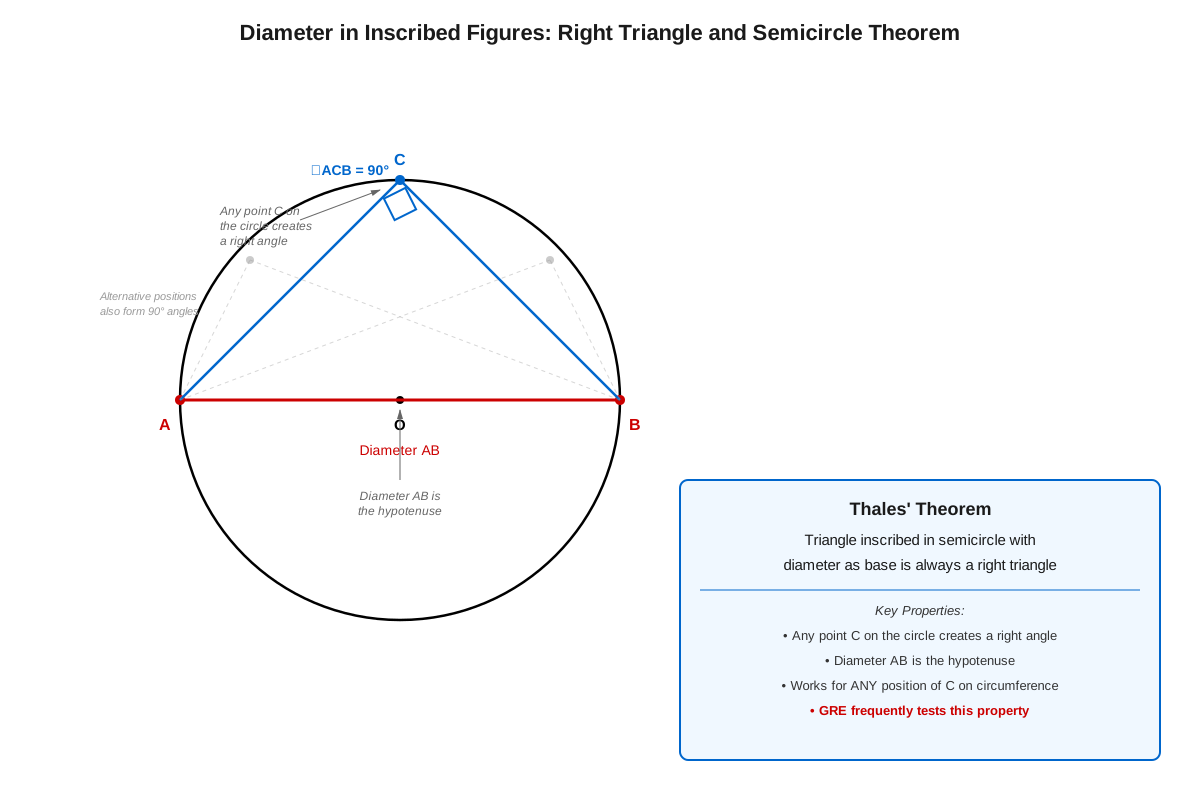
One of the most powerful diameter properties involves inscribed angles. Thales' theorem states that any angle inscribed in a semicircle (where the diameter forms one side of the angle) must be a right angle (90°). This property appears frequently in GRE problems involving triangles inscribed in circles.
If triangle ABC is inscribed in a circle with AC as the diameter, then angle ABC = 90°. This relationship works in reverse: if a right triangle is inscribed in a circle, the hypotenuse must be a diameter of that circle.
Diameter in Three-Dimensional Shapes
Diameter concepts extend to three-dimensional geometry in several important ways:
| Shape | Diameter Relationship | Key Formula |
|---|---|---|
| Sphere | Same in all directions through center | Volume = (4/3)πr³ = πd³/6 |
| Cylinder | Diameter of circular base | Volume = πr²h = πd²h/4 |
| Cone | Diameter of circular base | Volume = (1/3)πr²h = πd²h/12 |
Understanding these relationships allows students to solve complex three-dimensional problems efficiently by working with whichever measurement (radius or diameter) is provided.
Diameter in Coordinate Geometry
When a circle is represented on a coordinate plane, the diameter can be calculated using the distance formula between two points on opposite sides of the circle. If points (x₁, y₁) and (x₂, y₂) are endpoints of a diameter:
d = √[(x₂-x₁)² + (y₂-y₁)²]The center of the circle is located at the midpoint of any diameter:
Center = ((x₁+x₂)/2, (y₁+y₂)/2)Concept Relationships
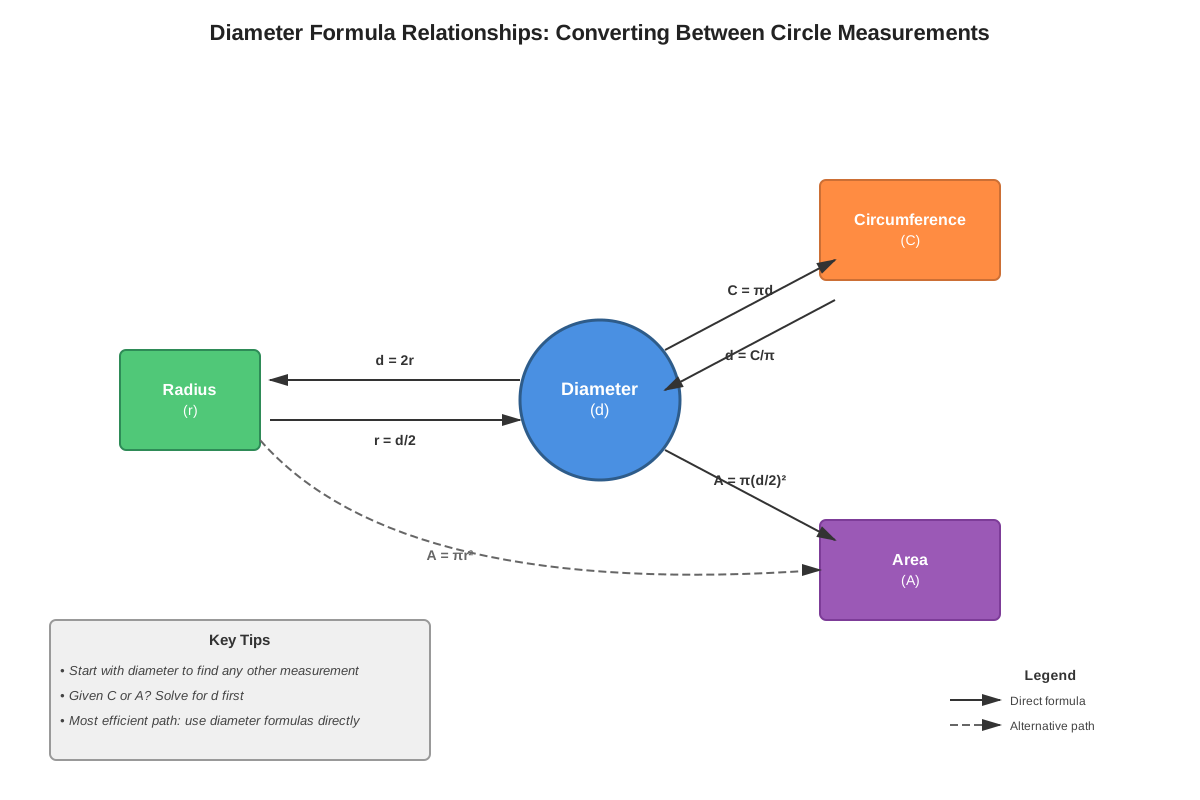
The diameter serves as a central hub connecting multiple geometric concepts. The most direct relationship is diameter → radius (d = 2r), which then branches into two primary pathways: radius → circumference (C = 2πr) and radius → area (A = πr²). These relationships can be traversed in either direction, allowing students to work forward from diameter to other properties or backward from circumference or area to diameter.
The inscribed angle theorem creates a connection between diameter → right angles, specifically that any triangle inscribed in a semicircle with the diameter as its base must be a right triangle. This links diameter concepts to the Pythagorean theorem and trigonometry.
In three-dimensional geometry, diameter → volume relationships extend through the base measurements of cylinders, cones, and through the entire structure of spheres. The diameter of a sphere relates to its surface area (SA = πd²) and volume (V = πd³/6).
Coordinate geometry creates a bidirectional relationship: coordinates → diameter (via distance formula) and diameter → circle equation (via the standard form (x-h)² + (y-k)² = r² where r = d/2).
Understanding these interconnections allows students to identify multiple solution pathways for complex problems, choosing the most efficient route based on the given information.
High-Yield Facts
⭐ The diameter is exactly twice the radius: d = 2r (most frequently tested relationship)
⭐ Circumference equals π times diameter: C = πd (essential for working backward from circumference)
⭐ Any angle inscribed in a semicircle is a right angle: If a triangle is inscribed with the diameter as one side, the opposite angle is 90°
⭐ The diameter is the longest chord in a circle: No other line segment connecting two points on the circle can be longer
⭐ Area can be expressed using diameter: A = πd²/4 (useful when diameter is given directly)
- All diameters of the same circle have equal length and pass through the center
- A diameter divides a circle into two congruent semicircles of equal area
- The perpendicular bisector of any chord passes through the center; if that chord is a diameter, any perpendicular line through its midpoint passes through the center
- In a sphere, the diameter is the same regardless of which direction it's measured through the center
- When a circle is inscribed in a square, the diameter equals the side length of the square
- When a circle is circumscribed about a square, the diameter equals the diagonal of the square (d = s√2)
- The diameter of a circle inscribed in a right triangle with legs a and b and hypotenuse c is: d = (a + b - c)
Quick check — test yourself on Diameter so far.
Try Flashcards →Common Misconceptions
Misconception: The diameter and radius are the same thing. → Correction: The diameter is always exactly twice the radius. Confusing these measurements leads to answers that are off by a factor of 2 or 4 (when dealing with area).
Misconception: Circumference is calculated as C = 2πd. → Correction: Circumference is C = πd (or equivalently C = 2πr). The formula C = 2πd would give a circumference twice as large as the actual value.
Misconception: When the diameter doubles, the area doubles. → Correction: When the diameter doubles, the area quadruples because area depends on the square of the radius (or diameter). If d₂ = 2d₁, then A₂ = 4A₁.
Misconception: Any chord that passes through the circle is a diameter. → Correction: Only chords that pass through the center of the circle are diameters. Other chords are shorter than the diameter.
Misconception: The diameter of a semicircle is the curved edge. → Correction: The diameter of a semicircle is the straight edge (the base), not the curved arc. The curved portion is half the circumference.
Misconception: In coordinate geometry, any two points on a circle can be used to find the diameter using the distance formula. → Correction: Only points that are diametrically opposite (with the center as their midpoint) will give the diameter. Other pairs of points on the circle will give chord lengths shorter than the diameter.
Misconception: π can be approximated as 3 for quick calculations. → Correction: While π ≈ 3.14, using 3 introduces significant error (about 4.5%). The GRE typically expects either exact answers with π or approximations using 3.14 or 22/7.
Worked Examples
Example 1: Multi-Step Problem Involving Diameter and Area
Problem: A circular garden has a circumference of 44 meters. If a square walkway is built around the garden such that the circle is inscribed in the square (touching all four sides), what is the area of the walkway?
Solution:
Step 1: Find the diameter from the circumference.
- Given: C = 44 meters
- Using C = πd, we get: 44 = πd
- Solving for d: d = 44/π
- Using π ≈ 22/7: d = 44 ÷ (22/7) = 44 × (7/22) = 14 meters
Step 2: Determine the side length of the square.
- When a circle is inscribed in a square, the diameter of the circle equals the side length of the square
- Therefore, side of square = 14 meters
Step 3: Calculate the area of the square.
- Area of square = s² = 14² = 196 square meters
Step 4: Calculate the area of the circular garden.
- Radius = d/2 = 14/2 = 7 meters
- Area of circle = πr² = π(7)² = 49π square meters
- Using π ≈ 22/7: Area = 49 × (22/7) = 154 square meters
Step 5: Find the area of the walkway.
- Area of walkway = Area of square - Area of circle
- Area of walkway = 196 - 154 = 42 square meters
Connection to Learning Objectives: This problem demonstrates the ability to identify diameter relationships (circumference to diameter), apply the core formula (C = πd), and solve a multi-step GRE-style problem involving diameter, area, and inscribed figures.
Example 2: Inscribed Triangle and Diameter
Problem: In the figure (described), circle O has a diameter AC of length 10. Point B lies on the circle such that AB = 6. What is the length of BC?
Solution:
Step 1: Recognize the key diameter property.
- Since AC is a diameter and B is a point on the circle, triangle ABC is inscribed in a semicircle
- By Thales' theorem, angle ABC must be a right angle (90°)
Step 2: Identify the triangle type.
- Triangle ABC is a right triangle with the right angle at B
- AC is the hypotenuse (the diameter) = 10
- AB is one leg = 6
- BC is the unknown leg
Step 3: Apply the Pythagorean theorem.
- AC² = AB² + BC²
- 10² = 6² + BC²
- 100 = 36 + BC²
- BC² = 64
- BC = 8
Connection to Learning Objectives: This problem tests the ability to identify when diameter is being tested (recognizing the inscribed angle theorem), explain the core strategy (any angle inscribed in a semicircle is a right angle), and apply this knowledge to solve accurately using the Pythagorean theorem.
Exam Strategy
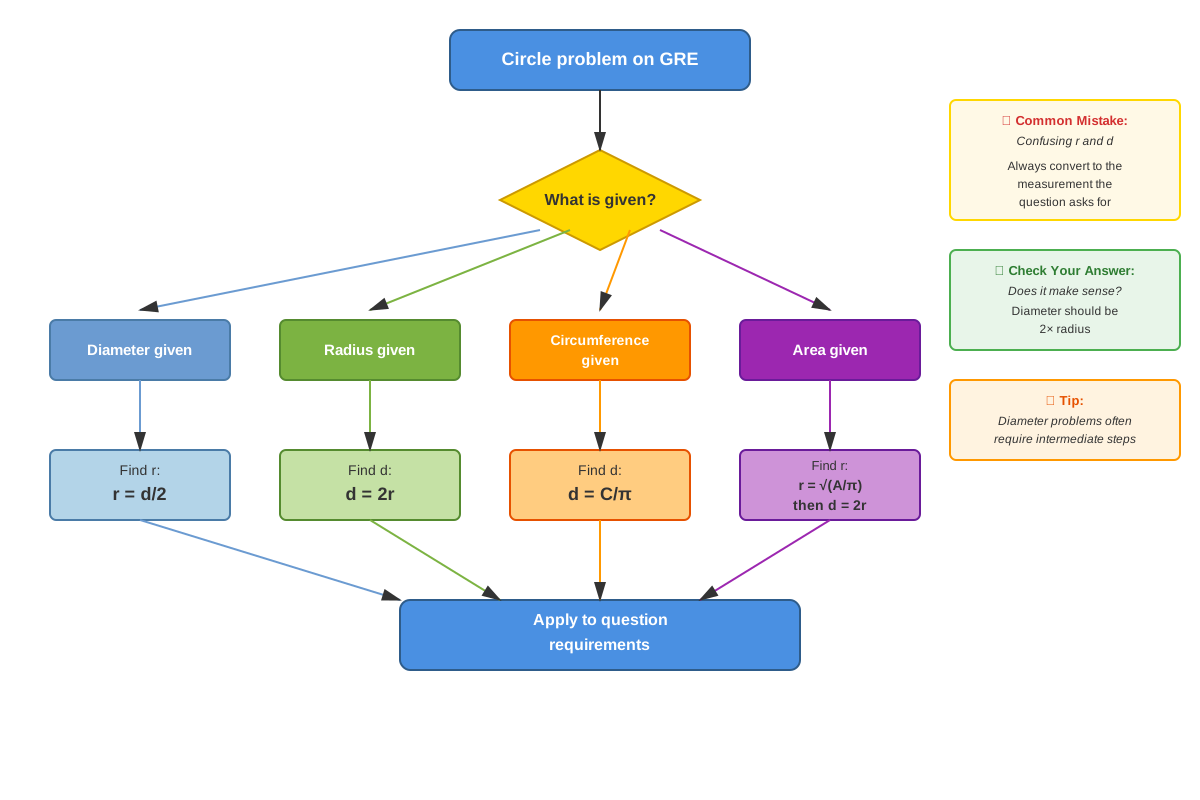
When approaching GRE diameter questions, begin by identifying what information is given and what is being asked. Create a mental or written map: "I have circumference, I need area, so I must find diameter or radius first." This intermediate-step thinking prevents errors and reveals the solution pathway.
Trigger words and phrases that indicate diameter concepts include:
- "passes through the center"
- "longest distance across"
- "inscribed in a semicircle"
- "the circle's width"
- "diametrically opposite"
- Any mention of circumference with a need to find area (or vice versa)
For Quantitative Comparison questions, remember that diameter relationships are proportional but not always linear. If comparing areas of circles with different diameters, recall that doubling the diameter quadruples the area. Use the relationship A₁/A₂ = (d₁/d₂)² to compare efficiently without calculating exact values.
Process-of-elimination strategies:
- Eliminate answers that confuse radius and diameter (often off by a factor of 2)
- Eliminate answers that don't include π when the question asks for an exact value
- Eliminate answers that use incorrect exponents (d instead of d² for area-related questions)
- Check whether the answer makes logical sense: diameter must be positive, must be longer than any given chord, and must be twice any given radius
Time allocation: Simple diameter-to-radius conversions should take 15-30 seconds. Multi-step problems involving diameter, circumference, and area typically require 60-90 seconds. Complex problems with inscribed figures or three-dimensional shapes may require up to 2 minutes. If a problem requires more time, mark it for review and move forward to maintain pacing.
Always verify that your final answer addresses what the question actually asks. If the question asks for diameter but you calculated radius, multiply by 2 before selecting your answer. This simple check prevents careless errors on straightforward problems.
Memory Techniques
"Diameter Doubles Radius" - The alliteration helps remember that d = 2r, with both words starting with 'D' emphasizing the doubling relationship.
"Pi Diameter = Circumference" (PDC) - This acronym captures the formula C = πd in the order you multiply: Pi × Diameter = Circumference.
"Semicircle = Right Angle" - Visualize a semicircle as a smile, and remember that any triangle drawn with the diameter as the base and a point on the arc creates a right angle at that point, like the corner of a smile.
"Area needs Radius, Circumference needs Diameter" - While both formulas can use either measurement, the standard forms (A = πr² and C = πd) help you remember which conversion might be simpler for each calculation.
"DRAC" (Diameter-Radius-Area-Circumference) - This sequence represents the typical problem-solving flow: given diameter, find radius, then calculate area or circumference. Visualize it as a dragon (DRAC) connecting these concepts.
The "4 in the denominator" rule - When using diameter directly in area calculations, remember A = πd²/4. The "4" comes from squaring the "2" in the radius-to-diameter relationship: (d/2)² = d²/4.
Summary
The diameter is the fundamental measurement representing the longest distance across a circle, defined as any line segment passing through the center with endpoints on the circumference. Its relationship to radius (d = 2r) serves as the gateway to all circle calculations, including circumference (C = πd) and area (A = πd²/4 or A = πr²). On the GRE, diameter questions test the ability to convert between measurements, work backward from circumference or area to find diameter, and apply special properties like the inscribed angle theorem (any angle inscribed in a semicircle is a right angle). Mastery requires fluent conversion between diameter and radius, recognition of when diameter relationships are embedded in complex problems, and efficient application of formulas in both two-dimensional and three-dimensional contexts. Success on diameter questions depends on identifying the given information, mapping the solution pathway through intermediate steps, and carefully checking that the final answer addresses what the question asks while avoiding common errors like confusing radius and diameter or misapplying exponents in area calculations.
Key Takeaways
- The diameter is always exactly twice the radius (d = 2r), the most fundamental and frequently tested relationship
- Circumference can be found directly from diameter using C = πd, making diameter the efficient choice for circumference problems
- Any triangle inscribed in a semicircle with the diameter as its base has a right angle opposite the diameter
- When working with area, convert diameter to radius first (r = d/2) or use A = πd²/4 directly
- The diameter is the longest possible chord in a circle and divides it into two congruent semicircles
- In three-dimensional shapes, diameter relationships extend to volume calculations for spheres, cylinders, and cones
- Always verify whether the question asks for diameter or radius before selecting your final answer to avoid factor-of-2 errors
Related Topics
Radius and Circle Basics - Understanding radius properties deepens diameter mastery since these measurements are intrinsically linked through d = 2r, and many circle theorems involve both.
Circumference and Arc Length - Building on diameter knowledge, circumference represents the complete perimeter while arc length represents portions, both calculated using diameter or radius relationships.
Circle Area and Sector Area - Area calculations depend on radius (derived from diameter), and sector areas extend this to portions of circles using central angles.
Inscribed and Circumscribed Figures - Diameter plays a crucial role in problems involving polygons inscribed in or circumscribed about circles, particularly with squares and right triangles.
Three-Dimensional Geometry - Spheres, cylinders, and cones all incorporate diameter in their volume and surface area formulas, extending two-dimensional circle concepts into spatial reasoning.
Coordinate Geometry of Circles - The standard form equation of a circle uses radius (derived from diameter), and diameter can be calculated from coordinate points using the distance formula.
Practice CTA
Now that you've mastered the core concepts of diameter and its relationships to other circle properties, it's time to reinforce your understanding through active practice. Attempt the practice questions to test your ability to identify diameter relationships in various problem formats, apply formulas efficiently, and avoid common pitfalls. Use the flashcards to build automatic recall of key formulas and properties—speed and accuracy on diameter questions will boost your overall Quantitative Reasoning score. Remember, diameter concepts appear in approximately 10% of GRE geometry questions, making this topic a high-yield investment of your study time. Approach each practice problem strategically, and you'll develop the pattern recognition skills that distinguish top scorers on test day.
Sign up free to keep reading
Create a free AnvayaPrep account to finish this GRE guide on Diameter — plus flashcards and practice questions.