Overview
Extreme values represent one of the most powerful and frequently tested strategies in GRE Quantitative Comparison questions. This approach involves testing the boundaries of possible values—the smallest, largest, zero, negative, positive, or fractional values—to determine whether one quantity is always greater than, always less than, or sometimes equal to another quantity. Rather than attempting to solve algebraically or reason through every possible scenario, the extreme values strategy allows test-takers to quickly identify cases where quantities might be equal or where one might exceed the other, often revealing that the relationship cannot be determined from the given information.
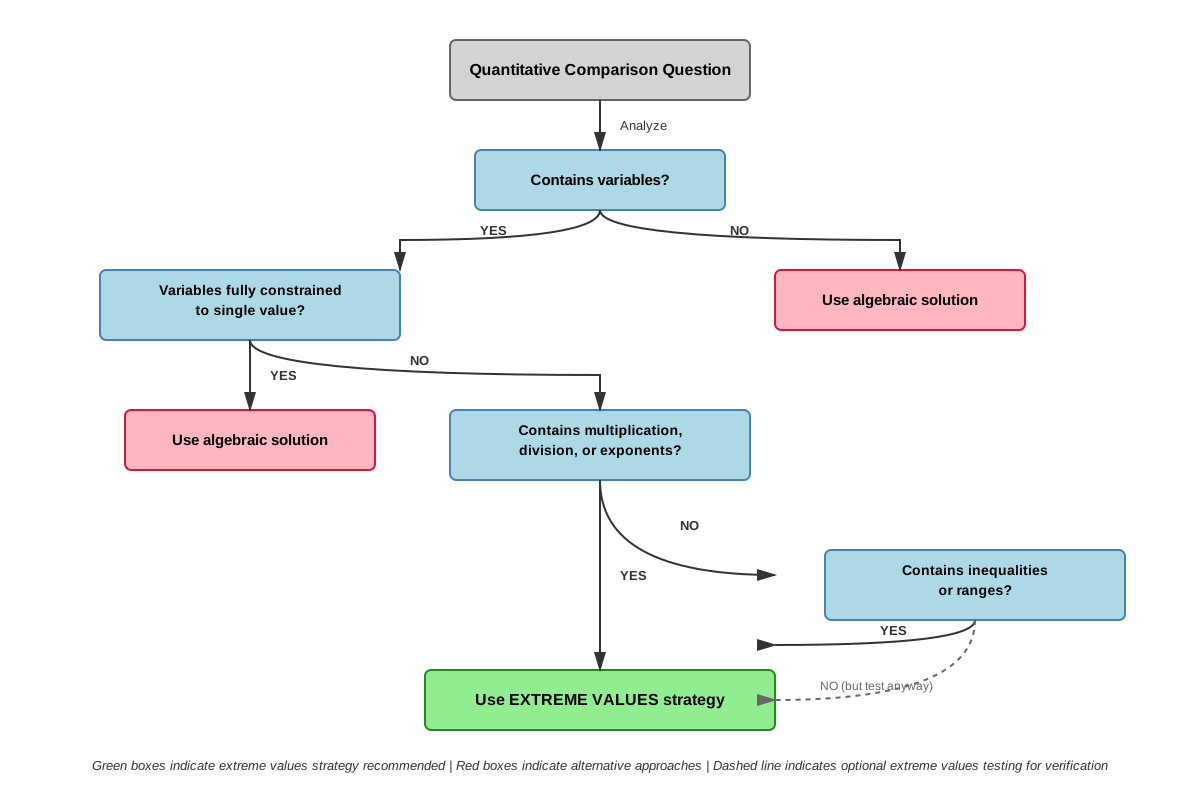
Understanding gre extreme values is essential because Quantitative Comparison questions constitute approximately one-third of the Quantitative Reasoning section, and extreme values testing is the most efficient approach for a significant portion of these questions. Many students waste valuable time trying to manipulate algebraic expressions or reason through general cases when simply plugging in extreme values would immediately reveal the answer. This strategy is particularly effective when variables are present without sufficient constraints, when dealing with inequalities, or when the problem involves expressions that behave differently across different number domains (positive vs. negative, integers vs. fractions).
The extreme values strategy connects deeply to fundamental mathematical concepts including number properties, algebraic manipulation, and logical reasoning. It requires understanding how different types of numbers (integers, fractions, negatives, zero) affect mathematical operations differently. This topic also reinforces the critical GRE skill of strategic thinking—knowing when to calculate versus when to test cases. Mastering extreme values enhances performance not only on Quantitative Comparison questions but also on Problem Solving questions where testing boundary cases can eliminate incorrect answer choices or verify solutions.
Learning Objectives
- [ ] Identify when Extreme values is being tested
- [ ] Explain the core rule or strategy behind Extreme values
- [ ] Apply Extreme values to GRE-style questions accurately
- [ ] Determine which extreme values to test based on the constraints and expressions given
- [ ] Recognize when extreme value testing proves a relationship is indeterminate (answer choice D)
- [ ] Combine extreme value testing with algebraic manipulation for maximum efficiency
Prerequisites
- Basic algebra and equation manipulation: Essential for understanding the expressions being compared and recognizing when variables can take different values
- Number properties (integers, fractions, positive/negative numbers, zero): Critical for selecting appropriate extreme values to test
- Understanding of Quantitative Comparison question format: Necessary to know the four answer choices and what each represents
- Order of operations and expression evaluation: Required to correctly calculate quantities when substituting extreme values
Why This Topic Matters
In real-world problem-solving, testing extreme cases is a fundamental debugging and validation technique used by engineers, scientists, and analysts. When designing systems, professionals ask "What happens at the boundaries?" to identify potential failures or unexpected behaviors. This same logical framework applies to mathematical reasoning and is precisely what the GRE tests through extreme values questions.
On the GRE, extreme values questions appear with high frequency—approximately 40-50% of Quantitative Comparison questions can be efficiently solved or partially solved using this strategy. These questions typically appear 4-6 times per Quantitative Reasoning section, making this one of the highest-yield strategies for score improvement. The GRE specifically designs questions to trap students who fail to consider boundary cases, making extreme values testing not just helpful but often necessary for correct answers.
Common manifestations include: comparing expressions with unconstrained variables, questions involving absolute values or squared terms (which behave differently for positive and negative inputs), fraction comparisons where numerator or denominator signs matter, and inequality-based comparisons. The test writers deliberately create questions where the relationship between quantities changes depending on whether variables are positive, negative, zero, fractional, or large integers. Students who master extreme values gain a significant strategic advantage and typically save 30-45 seconds per question compared to purely algebraic approaches.
Core Concepts
The Fundamental Principle of Extreme Values
The extreme values strategy is based on a simple logical principle: if you want to determine whether Quantity A is always greater than Quantity B, you need to find even one case where it isn't. If such a case exists, the answer cannot be "Quantity A is greater" (choice A) or "Quantity B is greater" (choice B)—it must be "The relationship cannot be determined" (choice D). Conversely, if you test multiple extreme cases and the same quantity is always larger, you gain confidence (though not absolute proof) that one quantity is consistently greater.
The strategy works because mathematical expressions often behave dramatically differently at boundary values. An expression like x² might be very large when x = 100, but it equals 1 when x = 1 and equals 0.25 when x = 0.5. By testing these extreme cases, you quickly discover whether the relationship between two quantities remains constant or varies.
Categories of Extreme Values to Test
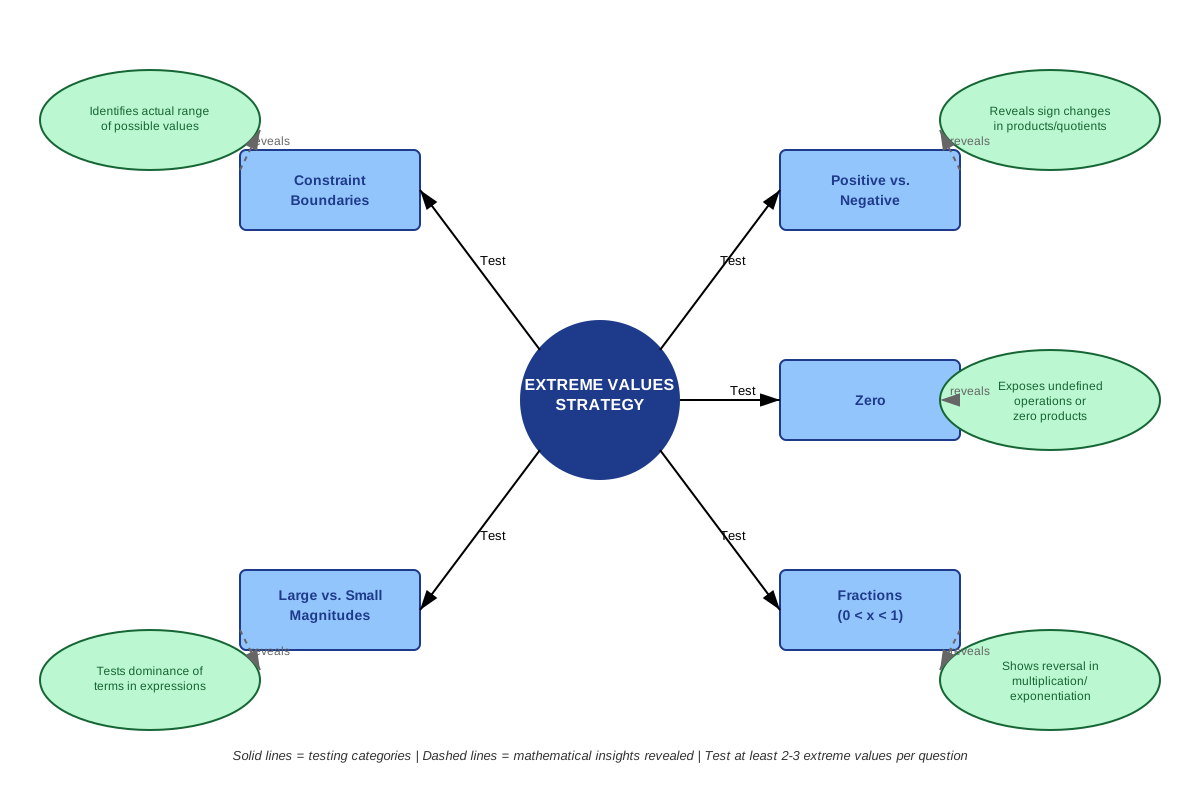
When applying this strategy, systematically consider these categories of extreme values:
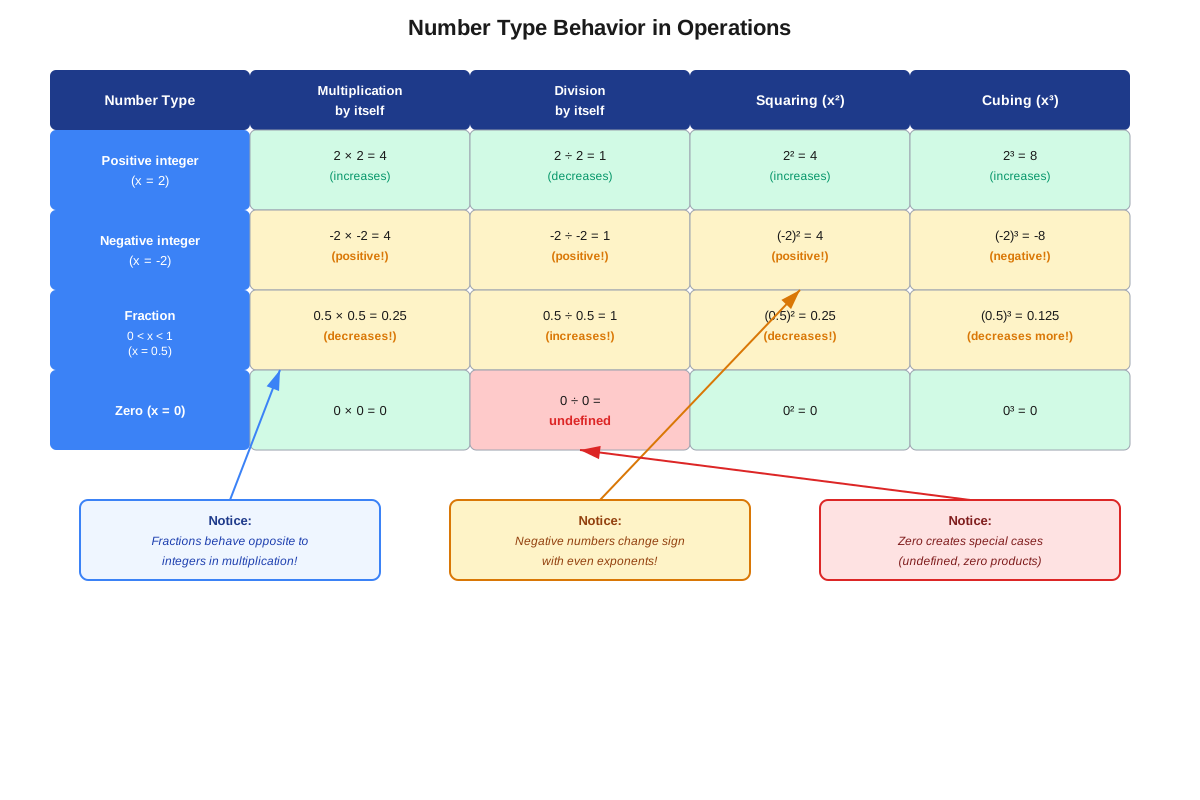
Positive and Negative Values: Many expressions change behavior across zero. For example, x² is always positive regardless of whether x is positive or negative, but x³ maintains the sign of x. Testing both positive and negative values often reveals different relationships.
Zero: Perhaps the most powerful extreme value to test. Zero has unique properties: it's neither positive nor negative, any number multiplied by zero equals zero, and zero divided by any non-zero number equals zero. Many relationships break down or reverse when zero is substituted.
Fractions Between 0 and 1: These values have counterintuitive properties. When you square a proper fraction, it becomes smaller (0.5² = 0.25). When you take the reciprocal of a proper fraction, it becomes larger (1/0.5 = 2). Testing fractions often reveals unexpected relationships.
Fractions Between -1 and 0: These combine the properties of negative numbers and proper fractions, often producing surprising results.
The Value 1: This is a special case because 1² = 1, 1³ = 1, and 1/1 = 1. Testing x = 1 can reveal whether exponents or reciprocals affect the relationship.
The Value -1: Similar to 1, but with sign changes. (-1)² = 1, but (-1)³ = -1, making this valuable for testing expressions with exponents.
Very Large Numbers: Sometimes expressions grow at different rates, and testing large values (like 100 or 1000) reveals which quantity dominates.
Very Small Numbers (approaching zero): Values like 0.001 can reveal behavior as quantities approach limits.
Strategic Selection of Values
Not every problem requires testing all extreme values. Efficient test-takers develop intuition about which values to test based on the expressions involved:
| Expression Type | Priority Extreme Values | Reason |
|---|---|---|
| Variables with exponents | 0, 1, -1, 0.5, 2 | Exponents behave differently for these values |
| Fractions/reciprocals | 0.5, 1, 2 | Reveals fraction vs. whole number behavior |
| Absolute values | Positive and negative versions | Absolute value eliminates sign |
| Squared terms | Positive and negative | Squaring eliminates sign |
| Products | 0, 1, values > 1, values between 0 and 1 | Products scale differently |
| Sums/differences | Positive, negative, zero | Addition preserves more information than multiplication |
The Two-Value Test
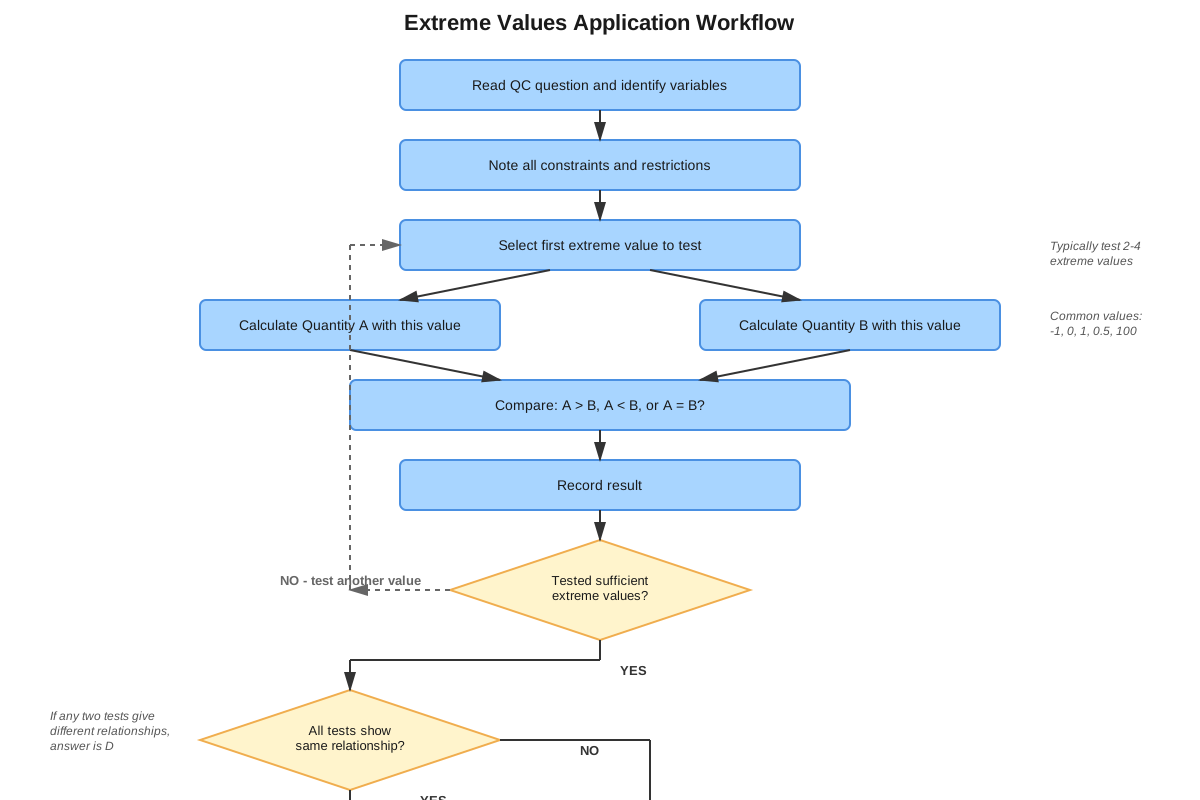
A highly efficient approach is the two-value test: select two extreme values that are likely to produce different relationships. If both values produce the same relationship (e.g., Quantity A is larger in both cases), the answer is likely A or B. If the two values produce different relationships (e.g., Quantity A is larger for one value but Quantity B is larger for another), the answer must be D (cannot be determined).
For example, when comparing x² and x³, test x = 0.5 and x = 2:
- When x = 0.5: x² = 0.25 and x³ = 0.125, so x² > x³
- When x = 2: x² = 4 and x³ = 8, so x² < x³
Since the relationship reverses, the answer is D.
Combining Extreme Values with Algebraic Manipulation
The most sophisticated approach combines extreme values testing with algebraic simplification. First, simplify the comparison algebraically as much as possible. Then, if variables remain or the relationship is unclear, apply extreme values testing to the simplified expressions. This hybrid approach is faster than pure algebra and more reliable than testing values without simplification.
For instance, when comparing 3x + 5 versus 2x + 7, first subtract 2x from both sides to compare x + 5 versus 7, which simplifies to comparing x versus 2. Now the extreme values test is simple: if x > 2, Quantity A is greater; if x < 2, Quantity B is greater. If x is unconstrained, the answer is D.
Concept Relationships
The extreme values strategy builds directly on number properties, as you must understand how different types of numbers behave in operations to select appropriate test values. It connects to algebraic manipulation because simplifying expressions before testing values increases efficiency. The strategy also relates to inequality reasoning—when you test extreme values and find that Quantity A is sometimes larger and sometimes smaller, you've essentially proven that neither inequality (A > B or A < B) holds universally.
Within the topic itself, the concepts flow logically: Fundamental Principle (understanding why testing extremes works) → Categories of Extreme Values (knowing what values to test) → Strategic Selection (choosing efficiently based on expression type) → Two-Value Test (implementing efficiently) → Combining with Algebra (maximizing effectiveness).
The extreme values strategy also connects forward to data interpretation and word problems, where testing boundary cases helps verify whether solutions are reasonable. It reinforces logical reasoning skills that apply across the entire GRE, including the Verbal section, where considering extreme interpretations of passages can eliminate answer choices.
Quick check — test yourself on Extreme values so far.
Try Flashcards →High-Yield Facts
⭐ Testing just two well-chosen extreme values can often determine whether the answer is D (relationship cannot be determined) by revealing that the relationship reverses.
⭐ Zero is the single most powerful extreme value to test—it appears in approximately 60% of extreme values questions.
⭐ When expressions contain exponents or roots, always test proper fractions (between 0 and 1) because they behave counterintuitively.
⭐ If testing multiple extreme values consistently shows the same relationship, the answer is likely A or B, not D.
⭐ For expressions with absolute values or even exponents, always test both positive and negative versions of the same number.
- When variables are unconstrained (no inequalities or restrictions given), this is a strong signal to use extreme values testing.
- The value 1 is particularly useful because it's the identity element for multiplication and makes many expressions equal.
- Testing x = 0.5 and x = 2 is an efficient pair for most problems because they're reciprocals and span the critical boundary of 1.
- If you can find even one extreme value that makes Quantity A larger and one that makes Quantity B larger, you've proven the answer is D.
- Negative fractions between -1 and 0 are often overlooked but can reveal relationships that positive values miss.
Common Misconceptions
Misconception: Testing one value that makes Quantity A larger proves that A is always larger.
Correction: Testing one value only eliminates certain answer choices. To prove A is always larger, you must either test all possible values (impossible) or use algebraic proof. Testing values is most useful for proving the answer is D by finding contradictory cases.
Misconception: Extreme values only means testing very large or very small numbers.
Correction: "Extreme values" refers to boundary cases across all relevant categories—positive/negative, integer/fraction, zero, and yes, sometimes very large or small numbers. The "extreme" refers to testing the boundaries of different number types, not just magnitude.
Misconception: If the problem gives a constraint like "x > 0," you can ignore negative values entirely.
Correction: While you shouldn't test values that violate constraints, you should still test values at the boundary of the constraint (like values very close to 0 if x > 0) and consider whether the constraint eliminates certain answer choices.
Misconception: Extreme values testing works for all Quantitative Comparison questions.
Correction: This strategy is most effective when variables are present with minimal constraints. For questions with specific numerical values or highly constrained variables, direct calculation or algebraic manipulation may be more efficient.
Misconception: Testing x = 1 and x = 2 is sufficient for most problems.
Correction: While these are useful values, they're both positive integers greater than or equal to 1. This misses the behavior of fractions, negative numbers, and zero—often the most revealing extreme values.
Worked Examples
Example 1: Exponents with Unconstrained Variable
Question:
- Quantity A: x⁴
- Quantity B: x⁵
Solution:
Step 1: Identify that this is an extreme values question. The variable x has no constraints, and the expressions involve exponents that behave differently for different values.
Step 2: Select strategic extreme values. For exponents, test: 0, 1, -1, 0.5, and 2.
Step 3: Test x = 0:
- Quantity A: 0⁴ = 0
- Quantity B: 0⁵ = 0
- Relationship: A = B
Step 4: Test x = 1:
- Quantity A: 1⁴ = 1
- Quantity B: 1⁵ = 1
- Relationship: A = B
Step 5: Test x = 2:
- Quantity A: 2⁴ = 16
- Quantity B: 2⁵ = 32
- Relationship: A < B
Step 6: Test x = 0.5:
- Quantity A: (0.5)⁴ = 0.0625
- Quantity B: (0.5)⁵ = 0.03125
- Relationship: A > B
Step 7: Analyze results. We found cases where A = B, A < B, and A > B. Since the relationship varies, the answer is D (The relationship cannot be determined).
Connection to Learning Objectives: This example demonstrates identifying when extreme values is being tested (unconstrained variable with exponents), applying the strategy accurately (testing multiple values), and determining that the relationship is indeterminate.
Example 2: Combining Algebra with Extreme Values
Question:
Given: x ≠ 0
- Quantity A: (x² + 3x)/x
- Quantity B: x + 3
Solution:
Step 1: Recognize that while this looks like an extreme values question, algebraic simplification should come first.
Step 2: Simplify Quantity A:
(x² + 3x)/x = x²/x + 3x/x = x + 3
Step 3: Compare simplified expressions:
- Quantity A: x + 3
- Quantity B: x + 3
Step 4: The quantities are identical for all values of x (except x = 0, which is excluded by the constraint).
Answer: C (The two quantities are equal)
Step 5: Verification with extreme values (optional but good practice):
- Test x = 1: Quantity A = 4, Quantity B = 4 ✓
- Test x = -2: Quantity A = 1, Quantity B = 1 ✓
- Test x = 0.5: Quantity A = 3.5, Quantity B = 3.5 ✓
Connection to Learning Objectives: This example shows the importance of combining algebraic manipulation with extreme values testing. It also demonstrates that sometimes simplification reveals the answer without needing to test multiple values, though testing can verify your algebraic work.
Exam Strategy
Trigger Recognition
Watch for these signals that extreme values testing is the optimal strategy:
- Unconstrained variables: When variables appear without inequalities or specific value restrictions
- Exponents and roots: Expressions like x², x³, √x behave dramatically differently for different value types
- Absolute values: |x| eliminates sign information, making positive/negative testing essential
- Fractions with variables: Expressions like 1/x or x/(x+1) change behavior across different domains
- Multiple variables: When two or more variables appear without equations relating them
Systematic Approach
Follow this process for maximum efficiency:
- Simplify first (15-20 seconds): Perform any obvious algebraic simplification before testing values
- Identify constraints (5 seconds): Note any restrictions on variables
- Select two strategic values (5 seconds): Choose values likely to produce different relationships
- Test and compare (20-30 seconds): Calculate both quantities for each value
- Determine answer (5 seconds): If relationships differ, choose D; if consistent, choose A, B, or C
Time Allocation
Extreme values questions should take 60-90 seconds total. If you find yourself testing more than three values, you're likely overthinking—two well-chosen values usually suffice. If testing two values shows the same relationship both times, you can confidently select A, B, or C without testing further.
Process of Elimination
Use extreme values testing to eliminate answer choices:
- If you find one case where A > B and one where B > A, eliminate A, B, and C—the answer must be D
- If you find one case where A = B, eliminate A and B
- If all tested values show A > B, eliminate B, C, and D—the answer is likely A (though algebraic proof would confirm)
Common Traps to Avoid
The GRE deliberately creates questions where:
- Testing only positive integers gives one relationship, but fractions or negatives reverse it
- Zero creates equality while other values show inequality
- The relationship appears obvious algebraically but actually depends on variable values
Always test at least one fraction and consider zero unless explicitly excluded.
Memory Techniques
The ZERO-FAN Mnemonic
Remember the six most important extreme values to test:
- Zero (0)
- Even/Odd consideration (2 and 3 for integers)
- Reciprocals (0.5 and 2)
- One (1)
- Fraction (0.5 or any proper fraction)
- Anti-one (-1)
- Negative (-2 or any negative)
Visualization Strategy
Picture a number line with marked "danger zones" where expressions change behavior:
- The zone around zero (where signs change)
- The zone around one (where exponents and reciprocals behave specially)
- The negative region (where even/odd exponents matter)
- The fraction region between 0 and 1 (where squaring makes smaller)
When you see an extreme values question, mentally visualize this number line and ask: "Have I tested values from each danger zone?"
The "Two and Through" Rule
For efficiency, remember: Two strategic values are usually enough. If you test two well-chosen extreme values and get the same relationship both times, you can confidently select your answer. If they differ, the answer is D. This prevents overthinking and saves time.
Summary
Extreme values testing is a powerful strategic approach for GRE Quantitative Comparison questions that involves testing boundary cases—zero, one, negative values, proper fractions, and large numbers—to determine whether the relationship between two quantities remains constant or varies. Rather than attempting complex algebraic proofs, this strategy efficiently reveals whether the answer is "cannot be determined" by finding cases where the relationship reverses. The most effective approach combines algebraic simplification with strategic testing of two or three carefully chosen extreme values, particularly zero and proper fractions, which most commonly reveal changing relationships. Success requires understanding how different number types behave in mathematical operations and recognizing question patterns that signal extreme values testing as the optimal strategy. This high-yield technique appears in approximately 40-50% of Quantitative Comparison questions and, when mastered, significantly improves both accuracy and speed.
Key Takeaways
- Extreme values testing is most powerful for proving answer choice D by finding cases where the relationship between quantities reverses
- Zero and proper fractions (0 < x < 1) are the highest-yield extreme values to test, appearing in the majority of these questions
- Always test at least two strategically different values—typically one fraction and one integer, or one positive and one negative
- Combine algebraic simplification with extreme values testing for maximum efficiency; simplify first, then test if variables remain
- Unconstrained variables with exponents, absolute values, or in fractions are strong signals to apply this strategy
- Testing values doesn't prove a relationship holds universally, but finding contradictory cases definitively proves the answer is D
- Allocate 60-90 seconds per extreme values question; testing more than three values usually indicates overthinking
Related Topics
Quantitative Comparison Strategies: Extreme values is one of several specialized strategies for QC questions, alongside estimation, algebraic manipulation, and geometric reasoning. Mastering extreme values provides a foundation for understanding when to apply each strategy type.
Number Properties: Deep understanding of how integers, fractions, positive/negative numbers, and zero behave in operations is essential for selecting appropriate extreme values and predicting expression behavior.
Inequalities: Extreme values testing connects closely to inequality reasoning, as testing boundary cases helps determine when inequalities hold or fail.
Functions and Graphs: The concept of testing extreme values extends to analyzing function behavior at boundaries, critical points, and asymptotes—skills tested in higher-level GRE questions.
Algebraic Manipulation: Combining simplification techniques with extreme values testing creates a powerful hybrid approach that's faster than pure algebra and more reliable than pure testing.
Practice CTA
Now that you understand the extreme values strategy, it's time to cement your mastery through practice. Work through the practice questions, focusing on identifying when to apply this strategy and selecting the most revealing extreme values to test. Use the flashcards to reinforce the key categories of extreme values and when each is most useful. Remember: this strategy appears in nearly half of all Quantitative Comparison questions, making it one of the highest-yield topics you can master. Every practice question you complete builds the pattern recognition and intuition that will save you valuable time and boost your accuracy on test day. You've got this!
Sign up free to keep reading
Create a free AnvayaPrep account to finish this GRE guide on Extreme values — plus flashcards and practice questions.