Overview
When to estimate is a critical strategic skill for the GRE Quantitative Reasoning section, particularly within Quantitative Comparison questions. This technique involves recognizing situations where calculating an exact answer wastes valuable time and where approximation yields sufficient information to answer correctly. The GRE is designed to reward test-takers who work efficiently, and estimation is one of the most powerful time-saving strategies available. Many students fall into the trap of performing lengthy calculations when a quick approximation would reveal the answer in seconds.
Understanding when to estimate transforms test performance by reducing calculation errors, conserving mental energy, and allowing more time for genuinely challenging problems. The GRE deliberately includes questions where exact calculation is possible but inefficient, testing whether students can distinguish between necessary precision and strategic approximation. This skill becomes especially valuable in Quantitative Comparison questions, where the goal is not to find exact values but to determine relationships between quantities.
Estimation connects deeply to other Quantitative Reasoning concepts including number properties, order of magnitude analysis, and strategic problem-solving. It requires solid foundational knowledge of arithmetic operations, fraction comparisons, and algebraic manipulation, but elevates these skills by adding a layer of strategic decision-making. Mastering estimation doesn't mean abandoning precision—it means developing the judgment to know when precision matters and when it doesn't.
Learning Objectives
- [ ] Identify when When to estimate is being tested
- [ ] Explain the core rule or strategy behind When to estimate
- [ ] Apply When to estimate to GRE-style questions accurately
- [ ] Distinguish between problems requiring exact calculation versus estimation
- [ ] Execute estimation techniques that maintain sufficient accuracy for answer selection
- [ ] Recognize trigger patterns in question stems that signal estimation opportunities
- [ ] Evaluate the trade-offs between calculation time and estimation accuracy
Prerequisites
- Basic arithmetic operations: Estimation requires understanding how operations affect magnitude and direction of numbers
- Fraction and decimal comparison: Approximating values depends on recognizing relative sizes of rational numbers
- Order of magnitude concepts: Estimating effectively requires understanding powers of ten and scale
- Quantitative Comparison format: The structure of QC questions creates unique estimation opportunities
- Time management awareness: Recognizing that the GRE rewards efficiency, not just accuracy
Why This Topic Matters
In real-world applications, estimation is fundamental to engineering, finance, scientific research, and everyday decision-making. Professionals constantly make quick approximations to assess feasibility, compare options, and validate detailed calculations. The ability to estimate effectively demonstrates mathematical maturity and practical problem-solving skills that extend far beyond standardized testing.
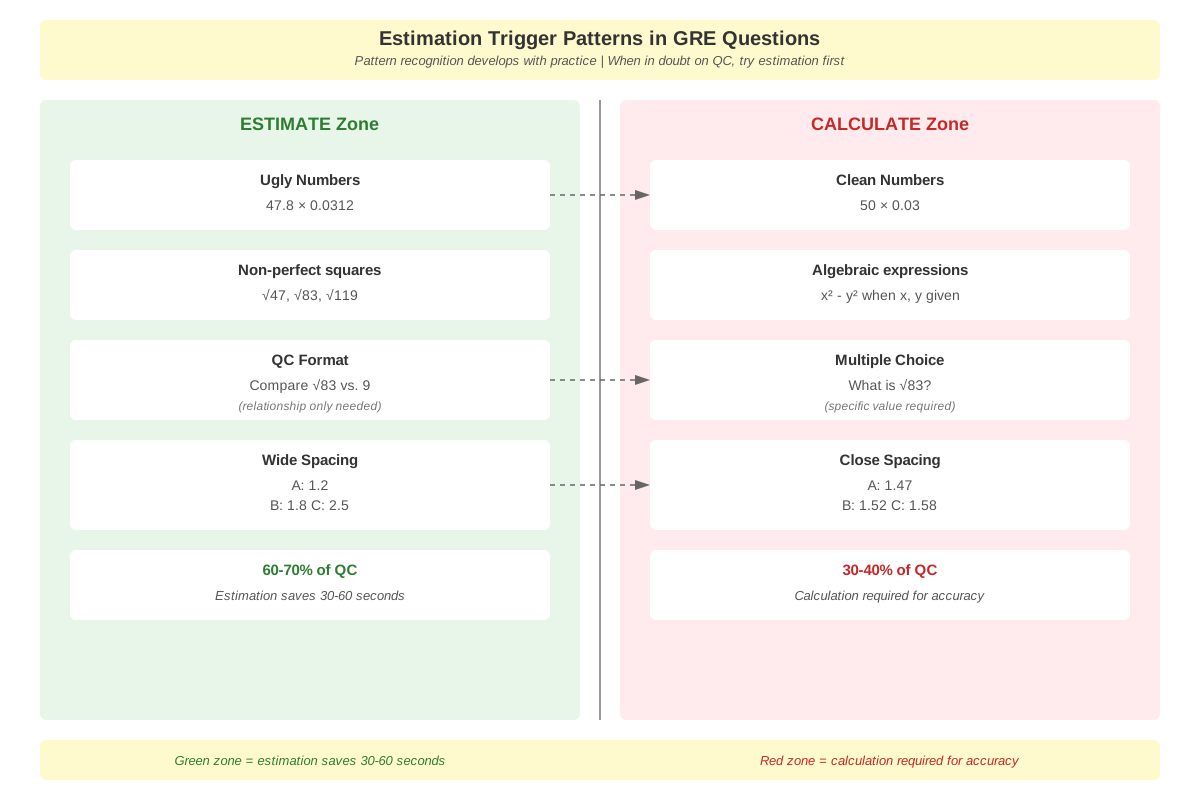
On the GRE, estimation-friendly questions appear in approximately 30-40% of Quantitative Comparison problems and 15-20% of Problem Solving questions. The test designers intentionally create problems with "ugly" numbers—values like 47.8, 0.0312, or √83—that discourage exact calculation. Questions involving these numbers often have answer choices or comparison quantities that are sufficiently different that estimation provides clear discrimination.
This topic appears most commonly in Quantitative Comparison questions asking students to compare expressions involving multiplication or division of decimals, fractions near benchmark values (like 1/2 or 1), products of numbers close to powers of ten, and square roots of non-perfect squares. The GRE also tests estimation in Problem Solving questions where answer choices are widely spaced, indicating that approximation will suffice. Recognizing these patterns is essential for efficient test-taking.
Core Concepts
The Fundamental Principle of Strategic Estimation
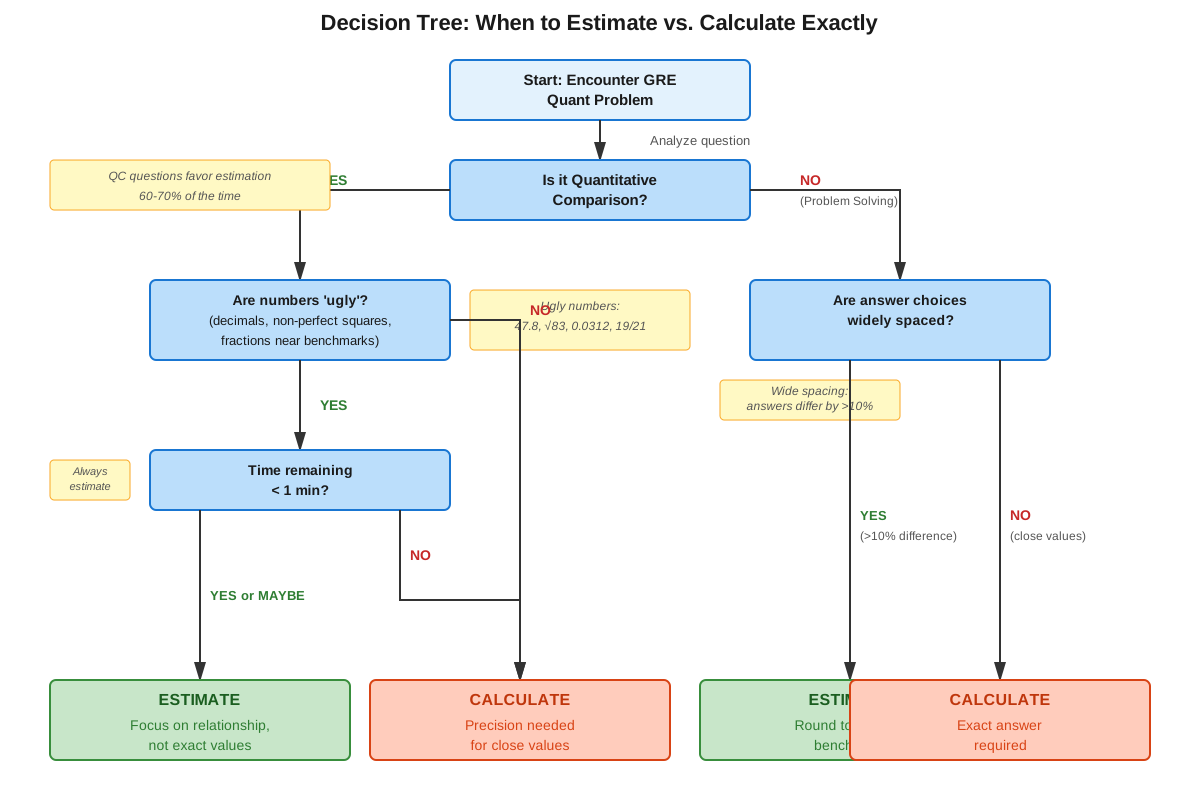
GRE when to estimate situations arise when the question structure, answer format, or number characteristics indicate that approximation will yield a definitive answer more efficiently than exact calculation. The core principle is simple: estimate when the time saved exceeds the risk of error, and when the level of precision required is lower than what exact calculation provides.
Three conditions typically signal estimation opportunities:
- Widely spaced answer choices or comparison quantities: When options differ by 20% or more, rough approximation suffices
- "Ugly" numbers: Non-integers, irrational numbers, or values requiring multi-step calculations
- Quantitative Comparison format: Since only the relationship matters, not exact values
Quantitative Comparison: The Estimation Sweet Spot
Quantitative Comparison questions create the ideal environment for estimation because they require only determining which quantity is larger, not calculating exact values. Consider comparing Quantity A: 47 × 23 versus Quantity B: 1,100. Rather than multiplying 47 × 23 exactly, estimate: 50 × 20 = 1,000, which is clearly less than 1,100. The answer is definitive without exact calculation.
The key insight is that when to estimate in Quantitative Comparison depends on whether your approximation maintains the relationship between quantities. If Quantity A estimates to approximately 1,000 and Quantity B is 1,100, the margin is sufficient to conclude B is larger. However, if Quantity B were 1,020, the margin becomes too narrow for safe estimation.
Benchmark Value Approximation
Benchmark values are reference points that simplify mental math. Common benchmarks include:
| Benchmark | Common Approximations |
|---|---|
| 1/2 | 0.5, 50%, values near 0.48-0.52 |
| 1/3 | 0.33, 33%, values near 0.32-0.34 |
| √2 | 1.4 (actual: 1.414...) |
| √3 | 1.7 (actual: 1.732...) |
| π | 3.14 or simply 3 for rough estimates |
| e | 2.7 (actual: 2.718...) |
When numbers appear close to these benchmarks, replace them with the benchmark value. For example, if comparing 0.48 × 620 versus 310, recognize that 0.48 ≈ 0.5, so the expression becomes approximately (1/2) × 620 = 310, indicating the quantities are approximately equal. This signals the need for more careful analysis or exact calculation.
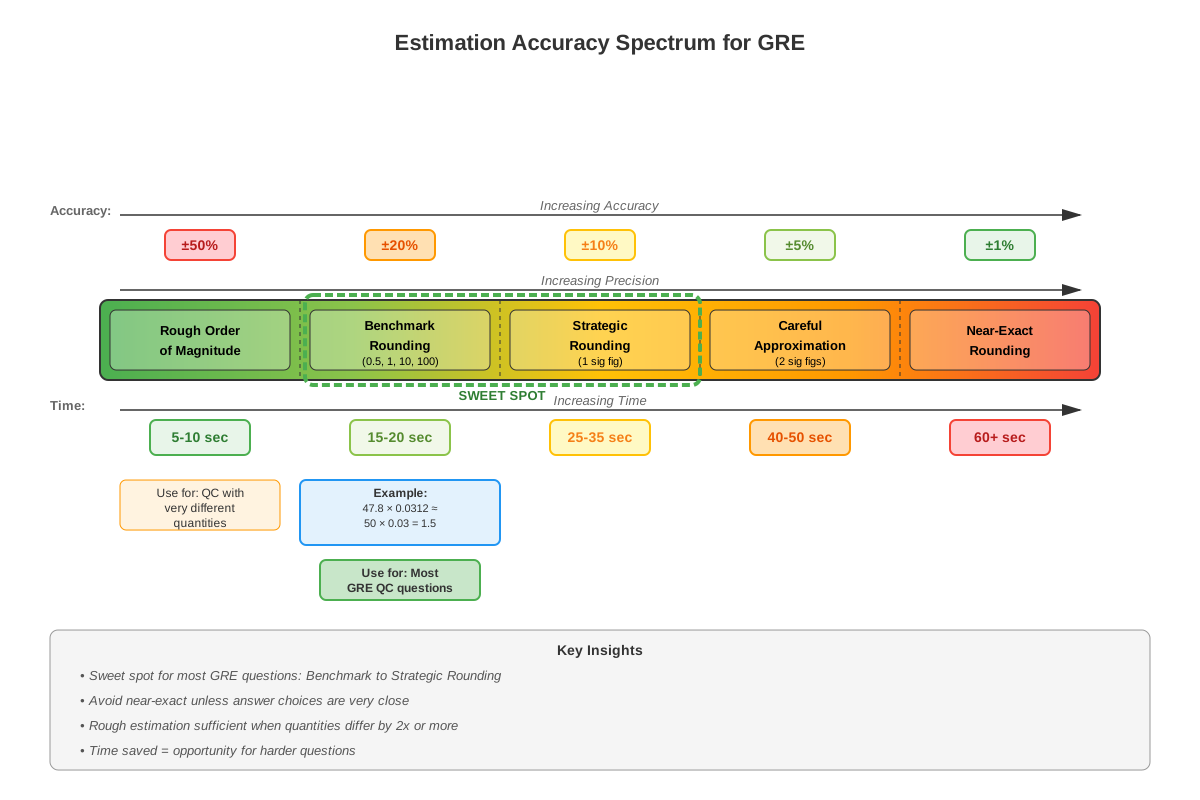
Rounding Strategies and Directional Awareness
Effective estimation requires directional awareness—knowing whether your approximation overestimates or underestimates the true value. This becomes critical when comparing quantities.
Rounding rules for estimation:
- Round one factor up and another down to balance errors
- When comparing, round both quantities in the same direction to maintain relative relationship
- For products, rounding both factors up overestimates; rounding both down underestimates
- For quotients, rounding the numerator up and denominator down overestimates
Example: Compare 48 × 73 versus 52 × 68. Round the first to 50 × 70 = 3,500 and the second to 50 × 70 = 3,500. Since both round to the same value, examine the rounding direction: 48 × 73 rounded both factors toward 50 × 70 (48 up, 73 up), while 52 × 68 rounded both toward 50 × 70 (52 down, 68 down). The actual value of 48 × 73 is less than 50 × 70, while 52 × 68 is greater than 50 × 70, so 52 × 68 is larger.
Magnitude Estimation for Complex Expressions
For expressions involving multiple operations, estimate the order of magnitude first, then refine if necessary. Order of magnitude refers to the power of ten closest to a value.
Process for magnitude estimation:
- Replace each number with the nearest power of ten or simple multiple thereof
- Perform operations on these simplified values
- Determine if the resulting approximation provides sufficient discrimination
- Refine only if the margin is too narrow
Example: Estimate (4,832 × 0.0197) / 0.503. Replace with (5,000 × 0.02) / 0.5 = (100) / 0.5 = 200. This gives the order of magnitude without tedious calculation.
When NOT to Estimate
Recognizing when estimation is inappropriate is equally important. Avoid estimation when:
- Answer choices are closely spaced (within 5-10% of each other)
- The problem explicitly requests an exact value
- Quantities being compared are very close in estimated value
- The calculation is simple enough to perform exactly in comparable time
- Estimation would require multiple refinement steps, negating time savings
The Two-Stage Estimation Approach
For borderline cases, use a two-stage approach:
Stage 1: Quick rough estimate to determine if quantities are clearly different
Stage 2: If Stage 1 is inconclusive, perform a more refined estimate or exact calculation
This approach maximizes efficiency by investing calculation time only when necessary. Most estimation opportunities resolve at Stage 1.
Concept Relationships
The concepts within estimation form a hierarchical decision tree: Fundamental Principle (recognize estimation opportunity) → Format Analysis (Quantitative Comparison vs. Problem Solving) → Number Characteristics (identify ugly numbers, benchmarks) → Technique Selection (rounding, magnitude, benchmark substitution) → Directional Verification (confirm approximation maintains relationship) → Refinement Decision (determine if additional precision needed).
Estimation connects to prerequisite topics by building on arithmetic operations (understanding how operations affect magnitude), fraction comparison (recognizing relative sizes), and order of magnitude (scaling numbers appropriately). It relates to broader Quantitative Reasoning strategies including process of elimination, answer choice analysis, and time management.
The relationship between estimation and exact calculation is complementary, not oppositional. Strong calculation skills enable better estimation because understanding precise relationships helps predict approximate ones. Conversely, estimation practice improves number sense, making exact calculations faster and more accurate.
High-Yield Facts
⭐ Quantitative Comparison questions are the highest-yield estimation opportunities on the GRE
⭐ When answer choices differ by more than 20%, estimation almost always suffices
⭐ Rounding one factor up and another down in multiplication balances estimation error
⭐ Numbers ending in 7, 8, 9 round up; numbers ending in 1, 2, 3 round down; 4, 5, 6 require judgment
⭐ If estimated quantities are within 10% of each other, perform exact calculation
- Benchmark values (0.5, 0.33, √2, π) should be memorized for instant substitution
- Order of magnitude estimation is fastest for expressions with multiple operations
- Directional awareness prevents systematic errors in comparison questions
- "Ugly" numbers (47.8, 0.0312, √83) are deliberate signals to estimate
- Estimation saves an average of 30-45 seconds per question when applied appropriately
- The GRE rewards strategic thinking over computational endurance
- Practicing estimation improves overall number sense and mental math speed
- When both quantities estimate to the same value, the answer is often "Cannot be determined" or requires exact calculation
- Estimation accuracy of ±5% is sufficient for most GRE questions
- Time saved through estimation should be invested in more challenging problems
Quick check — test yourself on When to estimate so far.
Try Flashcards →Common Misconceptions
Misconception: Estimation is less accurate and should be avoided when possible → Correction: Strategic estimation is highly accurate when applied to appropriate problems. The GRE designs many questions where estimation provides definitive answers more reliably than rushed exact calculations prone to arithmetic errors.
Misconception: Always round to the nearest integer for simplicity → Correction: Effective rounding depends on context. Sometimes rounding to the nearest ten, hundred, or benchmark value (like 0.5) is more appropriate. The goal is simplification while maintaining sufficient accuracy.
Misconception: Estimation only works for Problem Solving questions with widely spaced answers → Correction: Quantitative Comparison questions are actually the best estimation opportunities because they require only relationship determination, not exact values. Many QC questions are designed specifically to reward estimation.
Misconception: If you estimate and get an inconclusive result, you've wasted time → Correction: A quick estimation attempt that proves inconclusive typically takes 5-10 seconds and provides valuable information about the problem structure. This is not wasted time—it's efficient reconnaissance.
Misconception: Estimation means guessing or being careless with numbers → Correction: Strategic estimation is a precise skill requiring number sense, directional awareness, and judgment. It's the opposite of carelessness—it's mathematical sophistication applied to time management.
Misconception: You should estimate the same way for all problems → Correction: Different problems require different estimation techniques. Benchmark substitution works for some, magnitude estimation for others, and strategic rounding for still others. Flexibility is essential.
Misconception: Strong math students don't need to estimate because they can calculate quickly → Correction: The fastest calculators still benefit from estimation because it provides a check against errors and saves mental energy for genuinely difficult problems. Estimation is a skill for strong students, not a crutch for weak ones.
Worked Examples
Example 1: Quantitative Comparison with Strategic Rounding
Problem:
- Quantity A: 47 × 82
- Quantity B: 3,900
Solution:
Step 1: Recognize this as an estimation opportunity. Both numbers in Quantity A are "ugly" (not round numbers), and Quantity B is a round number, suggesting the test-maker expects estimation.
Step 2: Round strategically. Round 47 to 50 (up by 3) and 82 to 80 (down by 2). This balances the rounding errors.
Step 3: Calculate the estimate: 50 × 80 = 4,000
Step 4: Apply directional awareness. We rounded 47 up by 3 (a 6.4% increase) and 82 down by 2 (a 2.4% decrease). The net effect is a slight overestimate, but minimal.
Step 5: Compare. Our estimate of 4,000 is greater than 3,900, and since we slightly overestimated, the true value of 47 × 82 is likely very close to 4,000 but possibly slightly less. However, the margin (100) is sufficient to conclude Quantity A is greater.
Step 6: Verify the margin is adequate. The difference between 4,000 and 3,900 is 100, which is 2.5% of 4,000. Our estimation error is unlikely to exceed this margin.
Answer: Quantity A is greater
Connection to Learning Objectives: This example demonstrates identifying an estimation opportunity (ugly numbers in multiplication), applying strategic rounding technique, and using directional awareness to confirm the answer.
Example 2: Benchmark Value Substitution
Problem:
- Quantity A: 0.497 × 840
- Quantity B: 420
Solution:
Step 1: Recognize that 0.497 is very close to the benchmark value 0.5 (which equals 1/2).
Step 2: Substitute the benchmark: 0.5 × 840 = 420
Step 3: Analyze the result. Our estimate equals Quantity B exactly. This is a red flag indicating the quantities are very close.
Step 4: Determine if refinement is needed. Since 0.497 is slightly less than 0.5, the actual value of Quantity A is slightly less than 420.
Step 5: Calculate the difference. 0.5 - 0.497 = 0.003. The difference is 0.003 × 840 = 2.52.
Step 6: Conclude. Quantity A = 420 - 2.52 = 417.48, which is less than Quantity B.
Answer: Quantity B is greater
Connection to Learning Objectives: This example shows how benchmark value recognition leads to quick estimation, but also demonstrates when to refine the estimate because the initial approximation was too close to call. It illustrates the two-stage estimation approach.
Example 3: Order of Magnitude for Complex Expressions
Problem: Which is greater?
- Quantity A: (5,127 × 0.0198) / 0.489
- Quantity B: 200
Solution:
Step 1: Recognize this as a magnitude estimation opportunity due to multiple operations and ugly numbers.
Step 2: Replace each number with a nearby simple value:
- 5,127 ≈ 5,000
- 0.0198 ≈ 0.02 (or 2/100)
- 0.489 ≈ 0.5 (or 1/2)
Step 3: Calculate with simplified values:
(5,000 × 0.02) / 0.5 = 100 / 0.5 = 200
Step 4: Analyze rounding direction:
- 5,127 rounded down to 5,000 (underestimate)
- 0.0198 rounded up to 0.02 (overestimate)
- 0.489 rounded up to 0.5 (makes denominator larger, so underestimates the quotient)
Step 5: Assess net effect. We have mixed rounding, but the denominator rounding (0.489 to 0.5) has minimal impact (2% change), while the numerator effects partially cancel. The estimate of 200 is very close to the true value.
Step 6: Since the estimate equals Quantity B and our rounding effects approximately cancel, the quantities are very close. However, examining more carefully: 5,127 is 2.5% above 5,000, 0.0198 is 1% above 0.02, and 0.489 is 2.2% below 0.5. The denominator being smaller makes the quotient larger, so the true value is slightly above 200.
Answer: Quantity A is greater (but very close)
Connection to Learning Objectives: This demonstrates magnitude estimation for complex expressions and the importance of directional awareness when estimates are close to comparison values.
Exam Strategy
Approach Process for GRE Estimation Questions:
- Scan for estimation triggers (5 seconds): Look for ugly numbers, Quantitative Comparison format, widely spaced answers
- Assess calculation complexity (3 seconds): Would exact calculation take more than 20 seconds?
- Choose estimation technique (2 seconds): Rounding, benchmark, or magnitude?
- Execute estimation (10-15 seconds): Perform the approximation
- Evaluate margin (5 seconds): Is the difference between quantities sufficient?
- Decide: Answer confidently or refine if margin is narrow
Trigger Words and Phrases:
- "Approximately" in the question stem (explicit permission to estimate)
- "Which is greater?" in Quantitative Comparison (relationship, not exact value)
- Numbers with many decimal places or non-perfect square roots
- Answer choices that differ by 15% or more
- Expressions involving products or quotients of multiple terms
Process of Elimination Tips:
In Problem Solving questions, estimate to eliminate clearly wrong answers first. If three of five answer choices are far from your estimate, eliminate them immediately and focus on the remaining two. This transforms a difficult calculation into a 50-50 guess if time is short, or a targeted refinement if time permits.
For Quantitative Comparison, if your estimate shows quantities are clearly different (margin >15%), select that answer confidently. If they're close (margin <10%), either refine your estimate or calculate exactly—don't guess on close QC questions.
Time Allocation:
Budget 45-60 seconds for estimation-friendly questions versus 90-120 seconds for calculation-intensive questions. The time saved should be banked for difficult questions later in the section. If you find yourself spending more than 30 seconds on an estimation, you've likely missed the estimation opportunity and should switch to exact calculation or strategic guessing.
Exam Tip: Practice the "10-second decision rule"—within 10 seconds of reading a question, decide whether to estimate or calculate exactly. This prevents time-wasting indecision.
Memory Techniques
WISE Mnemonic for When to Estimate:
- Widely spaced answers or quantities
- Inconvenient (ugly) numbers
- Simple relationship needed (not exact value)
- Efficiency gain exceeds error risk
Benchmark Value Visualization:
Picture a number line with flags at 0, 0.25, 0.5, 0.75, and 1.0. When you see a decimal, visualize which flag it's closest to. This creates instant benchmark recognition.
Rounding Balance Acronym - UPDOWN:
- Up on one factor
- Pairs with
- DOWN on another
- Optimizes
- Whole
- Number accuracy
The 20% Rule:
Hold up your hand with fingers spread. Each finger represents 20%. If answer choices or quantities differ by more than one finger-width (20%), estimation works. This physical memory aid helps during the test.
Magnitude Mantra:
"Powers of ten, then refine again" - First estimate to the nearest power of ten, then refine by one step if needed.
Summary
Strategic estimation is a high-yield GRE skill that transforms test performance by reducing calculation time, minimizing errors, and conserving mental energy. The core principle is recognizing when approximation provides sufficient information to answer definitively—typically in Quantitative Comparison questions, problems with ugly numbers, and situations with widely spaced answer choices. Effective estimation requires three competencies: pattern recognition (identifying estimation opportunities), technique execution (rounding, benchmark substitution, magnitude analysis), and directional awareness (knowing whether approximations over- or underestimate). The most common mistake is over-calculating when estimation suffices, while the second most common is estimating when precision is required. Mastery comes from practicing the decision-making process—not just the calculation techniques—and developing number sense that makes approximation intuitive. Students who master when to estimate typically save 5-8 minutes per Quantitative section, time that can be reinvested in challenging problems to significantly improve scores.
Key Takeaways
- Quantitative Comparison questions offer the best estimation opportunities because they require only relationship determination, not exact values
- The 20% rule: When quantities or answer choices differ by more than 20%, estimation almost always provides a definitive answer
- Strategic rounding balances errors by rounding one factor up and another down in multiplication problems
- Benchmark values (0.5, 0.33, √2, π) enable instant substitution when numbers fall near these reference points
- Directional awareness prevents systematic errors—always know whether your approximation over- or underestimates
- The two-stage approach (quick estimate, then refine if needed) maximizes efficiency without sacrificing accuracy
- Time saved through estimation should be invested in difficult problems, not rushed through—strategic estimation is about working smarter, not faster
Related Topics
Quantitative Comparison Strategies: Mastering estimation enables more sophisticated QC approaches, including variable manipulation and algebraic comparison techniques that build on the estimation foundation.
Number Properties and Divisibility: Understanding how numbers behave under operations deepens estimation accuracy, particularly for products and quotients involving primes and factors.
Percent and Ratio Approximation: Estimation techniques extend naturally to percent problems, where benchmark percents (10%, 25%, 50%) enable rapid approximation.
Data Interpretation Efficiency: Graph and table questions often reward estimation when exact values are difficult to read or calculate, making this skill transferable across question types.
Mental Math Acceleration: Estimation practice improves overall mental calculation speed by developing number sense and pattern recognition that applies to exact calculations as well.
Practice CTA
Now that you understand when and how to estimate strategically, it's time to build automaticity through practice. The flashcards will help you memorize benchmark values and trigger patterns, while the practice questions will develop your decision-making speed and technique execution. Focus especially on Quantitative Comparison questions, where estimation provides the highest yield. Remember: every second saved through smart estimation is a second you can invest in the problems that truly challenge you. Your goal isn't just to estimate correctly—it's to recognize estimation opportunities instantly and execute confidently. Start practicing now to transform this knowledge into test-day performance!
Sign up free to keep reading
Create a free AnvayaPrep account to finish this GRE guide on When to estimate — plus flashcards and practice questions.