Overview
Comparison word problems represent a critical category of quantitative reasoning questions on the GRE that test a student's ability to translate verbal descriptions of relationships between quantities into mathematical equations and solve for unknown values. These problems typically present scenarios where two or more entities are compared using phrases like "more than," "less than," "twice as much," or "the ratio of," requiring test-takers to establish algebraic relationships and manipulate them to find solutions.
On the GRE, gre comparison word problems appear frequently across both the Quantitative Comparison and Problem Solving question formats, making them essential for achieving competitive scores. These problems assess not just computational ability but also reading comprehension, logical reasoning, and the capacity to convert everyday language into precise mathematical statements. Students who master comparison word problems gain a significant advantage because these questions often serve as the foundation for more complex multi-step problems involving percentages, ratios, rates, and algebraic reasoning.
The relationship between comparison word problems and broader Quantitative Reasoning concepts is fundamental. These problems integrate algebraic thinking with practical scenario analysis, bridging the gap between abstract mathematical operations and real-world applications. They frequently combine with topics such as linear equations, systems of equations, percent change, and ratio/proportion problems, making them a cornerstone skill that supports performance across multiple question types on the exam.
Learning Objectives
- [ ] Identify when Comparison word problems is being tested
- [ ] Explain the core rule or strategy behind Comparison word problems
- [ ] Apply Comparison word problems to GRE-style questions accurately
- [ ] Translate comparison language (more than, less than, times as much) into algebraic expressions with 95%+ accuracy
- [ ] Construct and solve systems of equations from multi-entity comparison scenarios
- [ ] Recognize and avoid common translation errors that lead to incorrect equation setup
- [ ] Evaluate answer choices efficiently using estimation and logical constraints from comparison relationships
Prerequisites
- Basic algebraic manipulation: Essential for setting up and solving equations derived from comparison statements; students must be comfortable isolating variables and performing operations on both sides of equations
- Linear equation solving: Required to find unknown values once comparison relationships are translated into mathematical form
- Fundamental arithmetic operations: Necessary for computing final answers and checking solution reasonability
- Variable representation: Understanding how to assign variables to unknown quantities forms the foundation of translating word problems into solvable equations
- Order of operations: Critical for correctly evaluating expressions and avoiding calculation errors in multi-step problems
Why This Topic Matters
Comparison word problems appear in approximately 15-20% of GRE Quantitative Reasoning questions, making them one of the most frequently tested problem types. Their prevalence stems from their effectiveness in assessing multiple competencies simultaneously: verbal comprehension, logical reasoning, algebraic thinking, and computational accuracy. Test-makers favor these questions because they reveal whether students can move beyond rote memorization to apply mathematical concepts in context.
In real-world applications, comparison reasoning underlies countless practical decisions: comparing prices, evaluating investment returns, analyzing survey data, interpreting scientific results, and making resource allocation decisions. Graduate programs value this skill because research, business analysis, and policy evaluation all require the ability to quantify and compare relationships between variables.
On the GRE, comparison word problems commonly appear as:
- Quantitative Comparison questions where two quantities derived from comparison statements must be evaluated
- Multiple-choice Problem Solving questions requiring calculation of specific values
- Numeric Entry questions where students must compute exact answers without answer choices to guide them
- Data Interpretation questions where comparison relationships must be extracted from tables or graphs and then solved
The topic frequently integrates with percentage problems (comparing percent increases/decreases), age problems (comparing ages at different times), work rate problems (comparing speeds or efficiencies), and mixture problems (comparing concentrations or compositions).
Core Concepts
Understanding Comparison Language
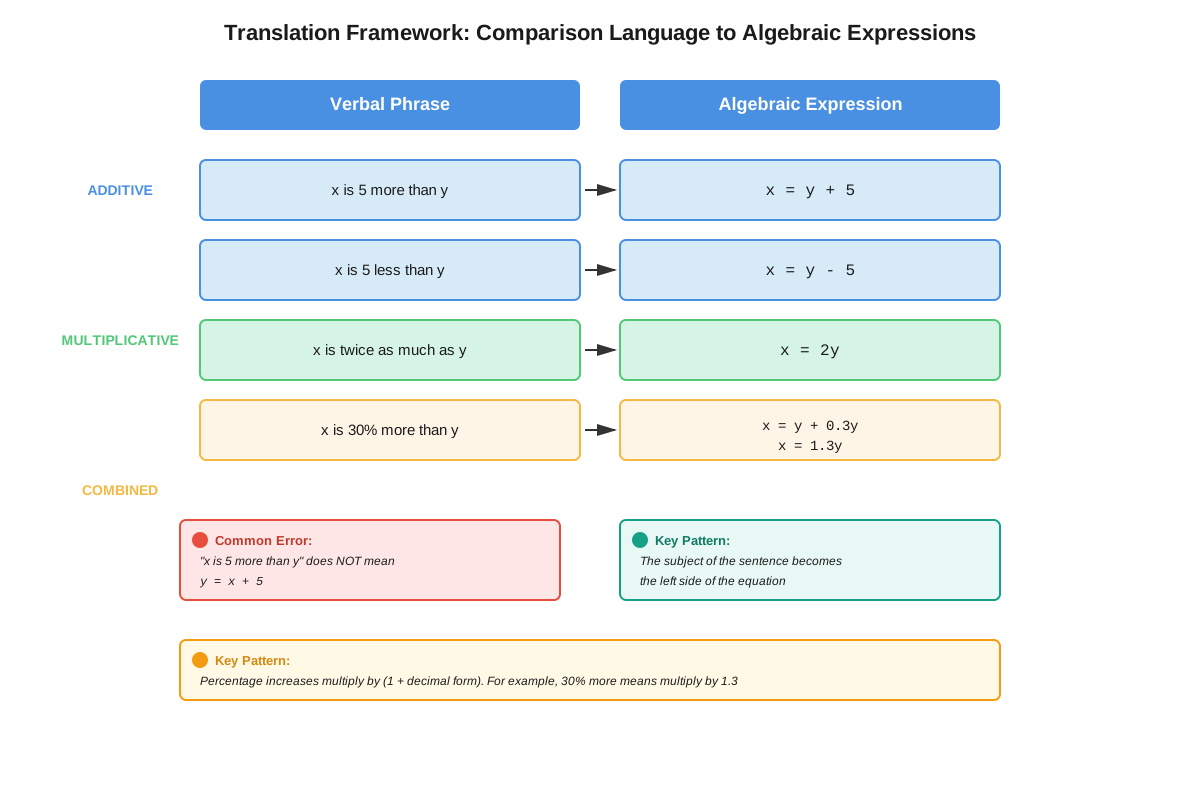
The foundation of solving comparison word problems lies in accurately translating verbal comparison statements into mathematical expressions. The GRE uses specific linguistic patterns that correspond to precise algebraic relationships:
Additive Comparisons involve adding or subtracting a quantity:
- "A is 5 more than B" translates to: A = B + 5
- "A is 5 less than B" translates to: A = B - 5
- "A exceeds B by 5" translates to: A = B + 5
- "A is 5 fewer than B" translates to: A = B - 5
Multiplicative Comparisons involve multiplication or division:
- "A is twice B" or "A is two times B" translates to: A = 2B
- "A is three times as much as B" translates to: A = 3B
- "A is half of B" translates to: A = B/2 or A = 0.5B
- "A is 50% of B" translates to: A = 0.5B
Combined Comparisons mix additive and multiplicative relationships:
- "A is 5 more than twice B" translates to: A = 2B + 5
- "A is 10 less than three times B" translates to: A = 3B - 10
- "A exceeds half of B by 7" translates to: A = B/2 + 7
The Variable Assignment Strategy
Effective problem-solving begins with strategic variable assignment. The optimal approach typically involves:
- Identify all entities being compared (people, quantities, measurements)
- Assign a variable to the simplest or most fundamental quantity (often the smaller value or the one other quantities reference)
- Express all other quantities in terms of this base variable using the comparison relationships
- Use the constraint or total given in the problem to create an equation
For example, if "John has 3 more books than Mary, and together they have 27 books," assign M = Mary's books, then John's books = M + 3, and the equation becomes: M + (M + 3) = 27.
Setting Up Equations from Comparisons
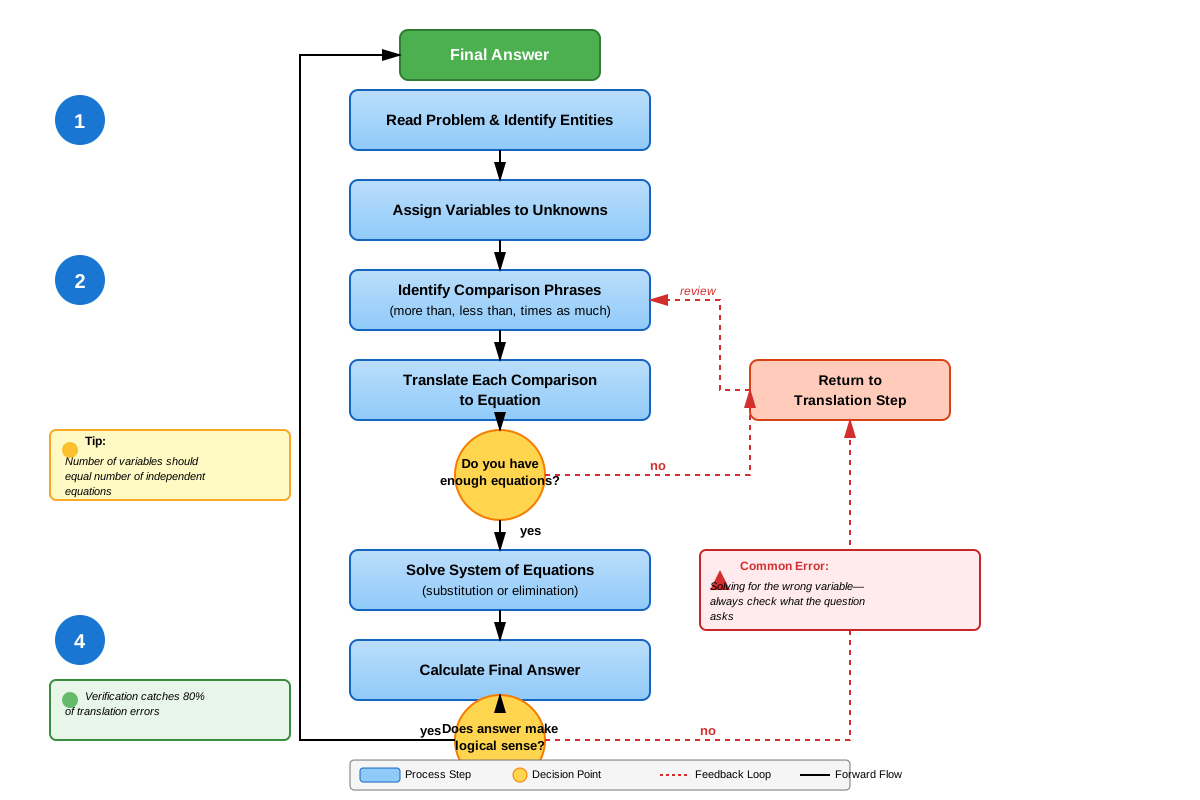
The systematic process for equation setup follows these steps:
- Read the entire problem carefully to identify all comparison relationships and constraints
- Define variables explicitly (write down what each variable represents)
- Translate each comparison statement into an algebraic expression
- Identify the equation-creating constraint (total, difference, ratio, or other relationship)
- Substitute expressions to create a solvable equation in one variable
- Solve and back-substitute to find all requested quantities
- Verify the solution against all original conditions
Multi-Entity Comparisons
Problems involving three or more entities require careful tracking of relationships. Consider this structure:
| Entity | Relationship | Expression |
|---|---|---|
| Entity A | Base variable | x |
| Entity B | Compared to A | Expression in terms of x |
| Entity C | Compared to A or B | Expression in terms of x |
When Entity C is compared to Entity B (which is already expressed in terms of x), substitute the expression for B into the relationship defining C.
Ratio-Based Comparisons
Some comparison problems express relationships as ratios rather than additive/multiplicative statements:
- "The ratio of A to B is 3:2" means A/B = 3/2, which can be rewritten as A = (3/2)B or 2A = 3B
- Alternatively, use ratio multipliers: if A:B = 3:2, then A = 3k and B = 2k for some constant k
This approach is particularly powerful when dealing with three or more quantities in ratio relationships, as all quantities can be expressed in terms of a single multiplier.
Percent Comparison Problems
Percentage comparisons require converting percent language into decimal multipliers:
- "A is 20% more than B" translates to: A = B + 0.20B = 1.20B
- "A is 30% less than B" translates to: A = B - 0.30B = 0.70B
- "A is 150% of B" translates to: A = 1.50B
The key insight is that "percent more/less than" requires adding/subtracting the percentage from 100%, while "percent of" directly uses the percentage as a multiplier.
Reverse Comparisons
Some problems present comparisons in reverse order from the natural solving sequence:
- "5 more than a number is 17" means x + 5 = 17 (not 5 + x = 17, though these are equivalent)
- "Twice a number, decreased by 7, equals 23" means 2x - 7 = 23
Careful parsing of sentence structure prevents misinterpretation. The phrase structure "comparison phrase + verb + result" typically means "expression = result."
Concept Relationships
The concepts within comparison word problems form a hierarchical structure: Comparison Language Translation serves as the foundation, enabling Variable Assignment Strategy, which then supports Equation Setup. These three core skills combine to handle Multi-Entity Comparisons and specialized variants like Ratio-Based Comparisons and Percent Comparison Problems.
Comparison word problems connect directly to prerequisite topics: Linear Equations provide the solving mechanisms once equations are established, while Algebraic Manipulation enables the transformation and simplification of expressions. The topic also bridges to more advanced concepts: Systems of Equations extend comparison problems to scenarios requiring multiple equations, Percent Problems represent a specialized application of multiplicative comparisons, and Ratio and Proportion problems often embed comparison relationships within their structure.
The relationship map flows as follows:
Verbal Comparison Statement → Translation to Algebraic Expression → Variable Assignment → Equation Formation → Algebraic Solution → Answer Verification → Correct Response
Each step depends on the previous one, making the translation phase the critical bottleneck where most errors occur. Mastery of comparison word problems also enables progression to Age Problems, Work Rate Problems, Mixture Problems, and Distance-Rate-Time Problems, all of which embed comparison relationships within more complex scenarios.
High-Yield Facts
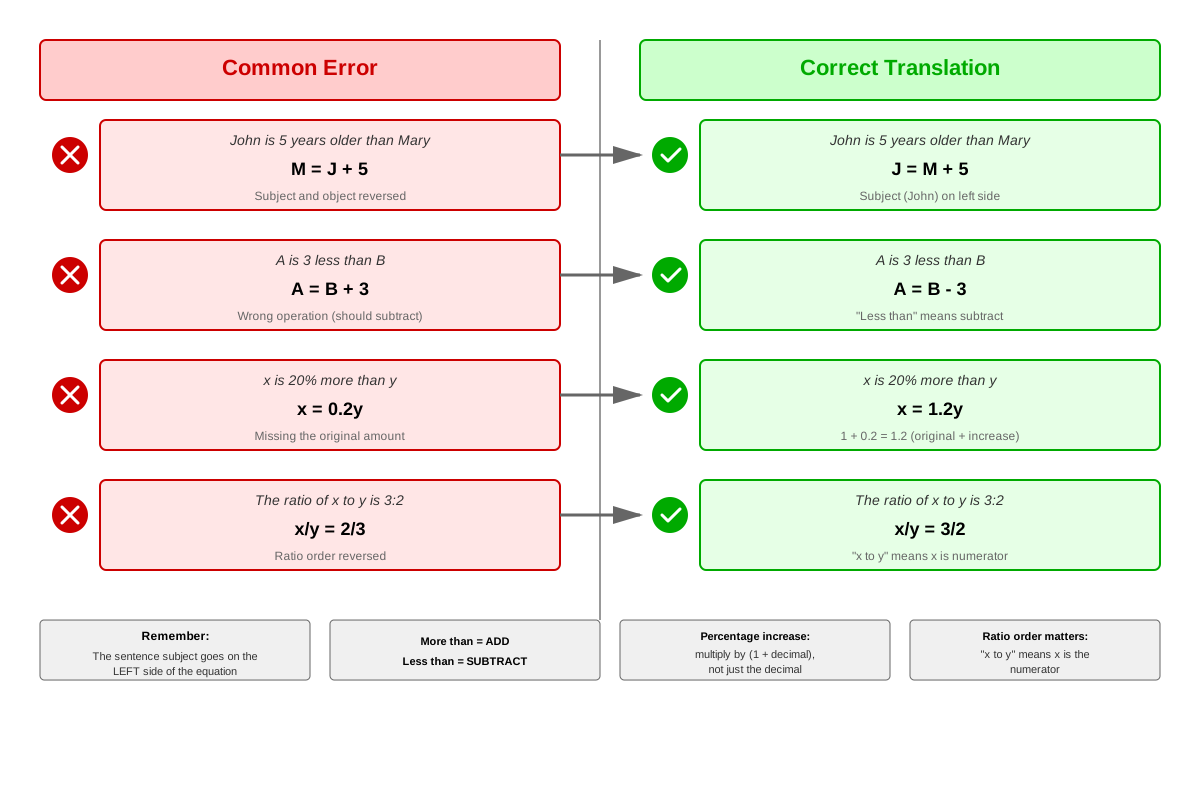
⭐ "More than" translates to addition: "A is 5 more than B" means A = B + 5, not B = A + 5
⭐ "Less than" reverses the order: "A is 5 less than B" means A = B - 5, where B is the larger quantity
⭐ "Times as much" requires multiplication: "A is three times B" means A = 3B, making A the larger quantity
⭐ Combined operations follow order: "5 more than twice B" means 2B + 5, not 2(B + 5)
⭐ Percent more/less requires adding to 100%: "20% more than B" means 1.20B, not 0.20B
- Ratio relationships create proportional expressions: A:B = 3:2 means A = 3k and B = 2k for some multiplier k
- "Exceeds by" is equivalent to "more than": Both indicate addition of the difference
- "Twice" means multiply by 2: "Twice as much" and "two times" are equivalent to multiplying by 2
- Variable assignment to the simpler quantity reduces complexity: Assign the variable to the quantity others are compared to
- Total/sum constraints create equations: When told "together they have X," add all expressions and set equal to X
- Difference constraints also create equations: "The difference between A and B is 10" means A - B = 10 or B - A = 10 depending on which is larger
- Half means multiply by 0.5 or divide by 2: These operations are equivalent
- Verification catches translation errors: Substituting the solution back into the original verbal statement confirms correctness
- Three-entity problems often require two comparison statements: One comparison links A to B, another links B to C or A to C
- Age problems are comparison problems in disguise: They compare ages at different time points using additive relationships
Quick check — test yourself on Comparison word problems so far.
Try Flashcards →Common Misconceptions
Misconception: "A is 5 less than B" means B = A - 5
Correction: This reverses the relationship. "A is 5 less than B" means A is the smaller quantity, so A = B - 5. The quantity after "than" is the reference point.
Misconception: "Twice as much as B" means 2 + B
Correction: "Twice" indicates multiplication, not addition. "Twice as much as B" means 2 × B = 2B. The word "as" signals multiplication in comparison contexts.
Misconception: "5 more than twice B" means 2(B + 5)
Correction: The phrase structure indicates 2B + 5, not 2(B + 5). "More than" applies to the entire preceding expression "twice B," so first multiply B by 2, then add 5.
Misconception: "A is 20% more than B" means A = 0.20B
Correction: "20% more than" means the original amount (100% = 1.00B) plus an additional 20% (0.20B), giving A = 1.20B. The 20% is added to the base, not replacing it.
Misconception: In ratio problems A:B = 3:2, this means A = 3 and B = 2
Correction: The ratio indicates the relationship between quantities, not their actual values. A = 3k and B = 2k for some multiplier k. Only when given additional information (like the sum or difference) can actual values be determined.
Misconception: "The difference between A and B is 10" always means A - B = 10
Correction: Without knowing which quantity is larger, the equation could be A - B = 10 or B - A = 10. Context clues or testing both possibilities determines the correct setup. Alternatively, use |A - B| = 10.
Misconception: All comparison problems require only one equation
Correction: Multi-entity problems or problems with multiple constraints may require systems of equations. For example, "A is twice B, and A is 5 more than C" gives two equations: A = 2B and A = C + 5.
Misconception: Variables can be assigned arbitrarily without affecting difficulty
Correction: Strategic variable assignment significantly impacts solution efficiency. Assigning the variable to the quantity that others reference (typically the smallest or most fundamental quantity) minimizes algebraic complexity.
Worked Examples
Example 1: Basic Additive and Multiplicative Comparison
Problem: Sarah has 3 times as many books as Tom. If Sarah has 12 more books than Tom, how many books does Tom have?
Solution:
Step 1: Define variables
Let T = number of books Tom has
Then Sarah has 3T books (from "3 times as many")
Step 2: Translate the second comparison
"Sarah has 12 more books than Tom" means:
Sarah's books = Tom's books + 12
3T = T + 12
Step 3: Solve the equation
3T = T + 12
3T - T = 12
2T = 12
T = 6
Step 4: Verify
Tom has 6 books
Sarah has 3(6) = 18 books
Is Sarah's count 12 more than Tom's? 18 = 6 + 12 ✓
Answer: Tom has 6 books
Connection to Learning Objectives: This problem demonstrates identifying comparison language ("3 times as many" and "more than"), translating both statements into algebraic expressions, and solving accurately.
Example 2: Three-Entity Comparison with Total
Problem: In a company, the number of managers is 5 fewer than twice the number of directors. The number of employees is 10 more than three times the number of directors. If there are 85 people total (directors, managers, and employees), how many directors are there?
Solution:
Step 1: Define variables strategically
Let D = number of directors (the base quantity that others reference)
Step 2: Express other quantities in terms of D
Managers = 2D - 5 (from "5 fewer than twice the directors")
Employees = 3D + 10 (from "10 more than three times the directors")
Step 3: Use the total constraint
Directors + Managers + Employees = 85
D + (2D - 5) + (3D + 10) = 85
Step 4: Simplify and solve
D + 2D - 5 + 3D + 10 = 85
6D + 5 = 85
6D = 80
D = 80/6 = 40/3 = 13.33...
Step 5: Recognize the issue
Since the number of directors must be a whole number, check the problem setup. If the problem is stated correctly as given, the answer would be 40/3, but this suggests a potential error in the problem statement or that we should round to the nearest whole number depending on context.
Alternative interpretation check:
If D = 13: Total = 13 + (26-5) + (39+10) = 13 + 21 + 49 = 83
If D = 14: Total = 14 + (28-5) + (42+10) = 14 + 23 + 52 = 89
Answer: The mathematical solution is D = 40/3 ≈ 13.33. On the GRE, if this were a numeric entry question, the problem would be constructed to yield a whole number. This example illustrates the importance of verification and recognizing when a solution doesn't match expected constraints.
Connection to Learning Objectives: This demonstrates multi-entity comparison setup, strategic variable assignment, and the critical importance of verification. It also shows how to handle problems where multiple quantities reference a common base.
Exam Strategy
Approaching GRE Comparison Word Problems
Initial Reading Strategy: Read the entire problem once without attempting to solve, identifying: (1) what quantities are being compared, (2) what relationships connect them, and (3) what the question asks for. This prevents premature solving that misses critical information.
Trigger Words and Phrases to Watch For:
- Additive triggers: "more than," "less than," "fewer than," "exceeds by," "increased by," "decreased by"
- Multiplicative triggers: "times as much," "twice," "triple," "half of," "double"
- Ratio triggers: "ratio of," "for every," "per"
- Percent triggers: "percent more," "percent less," "percent of"
- Constraint triggers: "together," "total," "sum," "difference," "combined"
Exam Tip: When you see "more than" or "less than," immediately identify which quantity is the reference point (the one after "than") and which is being described (the one before "is").
Process of Elimination for Multiple Choice
- Estimate before calculating: Use the comparison relationships to determine approximate magnitude. If A is "much more than" B, eliminate answer choices where A and B are similar.
- Test extreme cases: If the problem allows, consider what happens if one variable equals 0 or 1, then eliminate choices that violate the comparison relationships.
- Check dimensional consistency: Ensure answer choices have appropriate units and reasonable magnitudes for the context.
- Verify with the strongest constraint: If time permits, substitute answer choices back into the most restrictive condition to eliminate incorrect options quickly.
Time Allocation Advice
- Simple two-entity comparisons: Allocate 60-90 seconds
- Three-entity comparisons with one constraint: Allocate 90-120 seconds
- Complex multi-step comparisons: Allocate 120-180 seconds
- If stuck after 30 seconds on setup: Re-read the problem focusing solely on one comparison relationship at a time, translating each individually before combining
Exam Tip: Write down variable definitions explicitly (e.g., "Let x = Tom's age"). This 5-second investment prevents confusion in multi-step problems and makes verification faster.
Common Question Variations
Quantitative Comparison Format: When comparison word problems appear in QC format, often you can determine the relationship without solving completely. Set up expressions for Quantity A and Quantity B, then compare their algebraic forms.
Data Sufficiency Style: Some problems present comparison information across multiple statements. Evaluate whether each statement alone provides enough constraints to create a solvable equation.
Memory Techniques
The "THAN" Rule Mnemonic
The quantity after THAN is the reference
Higher or lower is determined by "more" or "less"
Add for "more," subtract for "less"
Number before "than" gets the operation
Visualization Strategy for Multiplicative Comparisons
Picture a number line or bar diagram:
- For "A is twice B," visualize A as a bar twice the length of B's bar
- For "A is 5 more than B," visualize B's bar, then A's bar extending 5 units beyond it
- This spatial representation helps prevent reversal errors
The "PERCENT PLUS" Acronym
Percent more means Plus the percent to 100%
Example: 20% more = 120% = 1.20
Remember: percent less means subtract from 100%
Convert to decimal before multiplying
Example: 30% less = 70% = 0.70
Never use just the percent alone
The base is always 100% (1.00)
The Comparison Translation Chant
"More than means add to the base,
Less than means subtract with grace,
Times as much means multiply,
Half of means divide, don't ask why,
After 'than' is where you start,
Before 'is' is the other part."
The Three-Entity Memory Device
Use the acronym BRE: Base variable, Relate others to base, Equation from constraint
This ensures systematic setup of complex problems.
Summary
Comparison word problems constitute a fundamental GRE Quantitative Reasoning skill that integrates verbal comprehension with algebraic problem-solving. Success requires mastering the translation of comparison language—particularly "more than," "less than," and multiplicative phrases—into accurate algebraic expressions. The core strategy involves strategic variable assignment (typically to the simplest or most-referenced quantity), systematic translation of each comparison statement, and using given constraints (totals, differences, or ratios) to create solvable equations. Common pitfalls include reversing the order in "less than" statements, confusing additive and multiplicative operations, and mishandling percent comparisons by forgetting to add/subtract from 100%. Multi-entity problems require careful tracking of relationships, often expressing all quantities in terms of a single base variable. Verification by substituting solutions back into original conditions catches translation errors and confirms accuracy. With approximately 15-20% of GRE Quantitative questions involving comparison relationships, mastery of this topic significantly impacts overall performance and provides the foundation for more complex word problem types.
Key Takeaways
- Translation accuracy is paramount: "More than" means addition, "less than" means subtraction, "times as much" means multiplication—the quantity after "than" is always the reference point
- Strategic variable assignment simplifies algebra: Assign the variable to the quantity that others are compared to, typically the smallest or most fundamental value
- Percent comparisons require adding to or subtracting from 100%: "20% more than B" means 1.20B, not 0.20B
- Combined operations follow specific order: "5 more than twice B" means 2B + 5, performing multiplication before addition
- Verification prevents costly errors: Always substitute your solution back into the original verbal statements to confirm all relationships hold
- Multi-entity problems need systematic setup: Express all quantities in terms of one base variable, then use the constraint to create an equation
- Trigger words signal specific operations: Recognize "exceeds," "fewer," "double," and "half" as immediate translation cues requiring specific algebraic operations
Related Topics
Systems of Linear Equations: Comparison word problems with multiple constraints naturally extend to systems requiring two or more equations solved simultaneously. Mastering basic comparison problems provides the translation skills needed for these more complex scenarios.
Age Problems: A specialized application of comparison word problems where relationships between ages at different time points create comparison equations. The core translation skills transfer directly.
Percent Problems: Many percent questions embed comparison relationships ("20% more than," "30% less than"), making comparison word problem skills essential for this high-frequency GRE topic.
Ratio and Proportion: Ratio-based comparisons represent a specific type of comparison problem where relationships are expressed as ratios rather than additive/multiplicative statements, requiring proportional reasoning.
Work Rate Problems: These problems compare rates of work completion, using comparison language to establish relationships between individual and combined work rates.
Mixture Problems: Comparing concentrations, quantities, or values in mixture scenarios requires the same translation and equation-setup skills developed through comparison word problems.
Practice CTA
Now that you've mastered the core concepts and strategies for comparison word problems, it's time to solidify your understanding through active practice. Attempt the practice questions associated with this topic, focusing on accurate translation before rushing to solve. Use the flashcards to drill the trigger words and their corresponding algebraic translations until the conversions become automatic. Remember: the GRE rewards both accuracy and speed, and speed comes from pattern recognition developed through deliberate practice. Each problem you solve correctly builds the confidence and competence needed to tackle these high-yield questions efficiently on test day. You've got this!
Sign up free to keep reading
Create a free AnvayaPrep account to finish this GRE guide on Comparison word problems — plus flashcards and practice questions.