Overview
Multi-step word problems represent one of the most frequently tested question types on the GRE Quantitative Reasoning section, appearing in approximately 20-30% of all quantitative questions. These problems require test-takers to translate complex verbal descriptions into mathematical operations, perform calculations across multiple stages, and synthesize information from various parts of a problem to reach a final answer. Unlike single-step problems that test isolated computational skills, multi-step word problems assess a student's ability to break down complex scenarios, identify relevant information, establish logical sequences of operations, and maintain accuracy throughout extended solution processes.
The significance of mastering GRE multi-step word problems extends beyond simply answering individual questions correctly. These problems serve as a comprehensive assessment of mathematical reasoning, testing whether students can integrate concepts from arithmetic, algebra, geometry, and data analysis within realistic contexts. Success with multi-step problems demonstrates not just computational proficiency but also critical thinking, problem decomposition skills, and the ability to work systematically under time pressure—all qualities that graduate programs value highly.
Multi-step word problems form a bridge between pure mathematical computation and applied quantitative reasoning. They connect foundational arithmetic operations with more advanced algebraic thinking, requiring students to move fluidly between different mathematical domains. A single problem might require calculating percentages, setting up equations, working with ratios, and interpreting results—all within a coherent narrative framework. This integrative nature makes multi-step word problems both challenging and highly predictive of overall GRE performance, as they reveal whether a student has truly mastered quantitative concepts or merely memorized isolated procedures.
Learning Objectives
- [ ] Identify when multi-step word problems are being tested by recognizing characteristic question structures and complexity indicators
- [ ] Explain the core rule or strategy behind multi-step word problems, including systematic problem decomposition and sequential solution planning
- [ ] Apply multi-step word problems to GRE-style questions accurately by executing multi-stage calculations without computational errors
- [ ] Translate complex verbal descriptions into appropriate mathematical representations and equations
- [ ] Determine which information is relevant versus extraneous in problems containing multiple data points
- [ ] Verify solutions by checking intermediate steps and confirming that final answers satisfy all problem constraints
Prerequisites
- Basic arithmetic operations (addition, subtraction, multiplication, division): Essential for performing the computational steps that comprise multi-step solutions
- Algebraic equation setup and solving: Required for translating word problem relationships into mathematical expressions and isolating variables
- Percentage, ratio, and proportion calculations: Frequently appear as individual steps within larger multi-step problems
- Unit conversion and dimensional analysis: Necessary for problems involving different measurement systems or rate calculations
- Order of operations (PEMDAS): Critical for executing calculations in the correct sequence and avoiding computational errors
Why This Topic Matters
Multi-step word problems appear with remarkable consistency across GRE administrations, making them one of the highest-yield topics for focused preparation. Research on GRE question distributions indicates that approximately 6-9 questions per Quantitative Reasoning section involve multi-step reasoning, either as explicit word problems or as quantitative comparison questions requiring multiple calculations. This frequency means that mastering this topic can directly impact 30-45% of a test-taker's quantitative score.
In real-world applications, multi-step problem-solving mirrors the analytical demands of graduate-level research and professional work. Whether calculating compound growth rates in economics, determining optimal resource allocation in operations research, or analyzing experimental results in the sciences, professionals regularly encounter situations requiring sequential reasoning and multi-stage calculations. The GRE uses multi-step word problems to assess readiness for these academic and professional challenges.
On the exam, multi-step word problems commonly appear in several formats: work and rate problems involving multiple workers or changing rates, mixture problems combining substances with different concentrations, distance-rate-time scenarios with multiple legs of travel, financial calculations involving interest, profit, or cost analysis, and population or growth problems requiring compound calculations. These problems typically provide a narrative context, present multiple pieces of information (some relevant, some potentially distracting), and require 2-5 distinct computational or logical steps to reach the solution. The GRE deliberately designs these problems to test not just mathematical knowledge but also reading comprehension, information synthesis, and systematic thinking under time constraints.
Core Concepts
Problem Structure Recognition
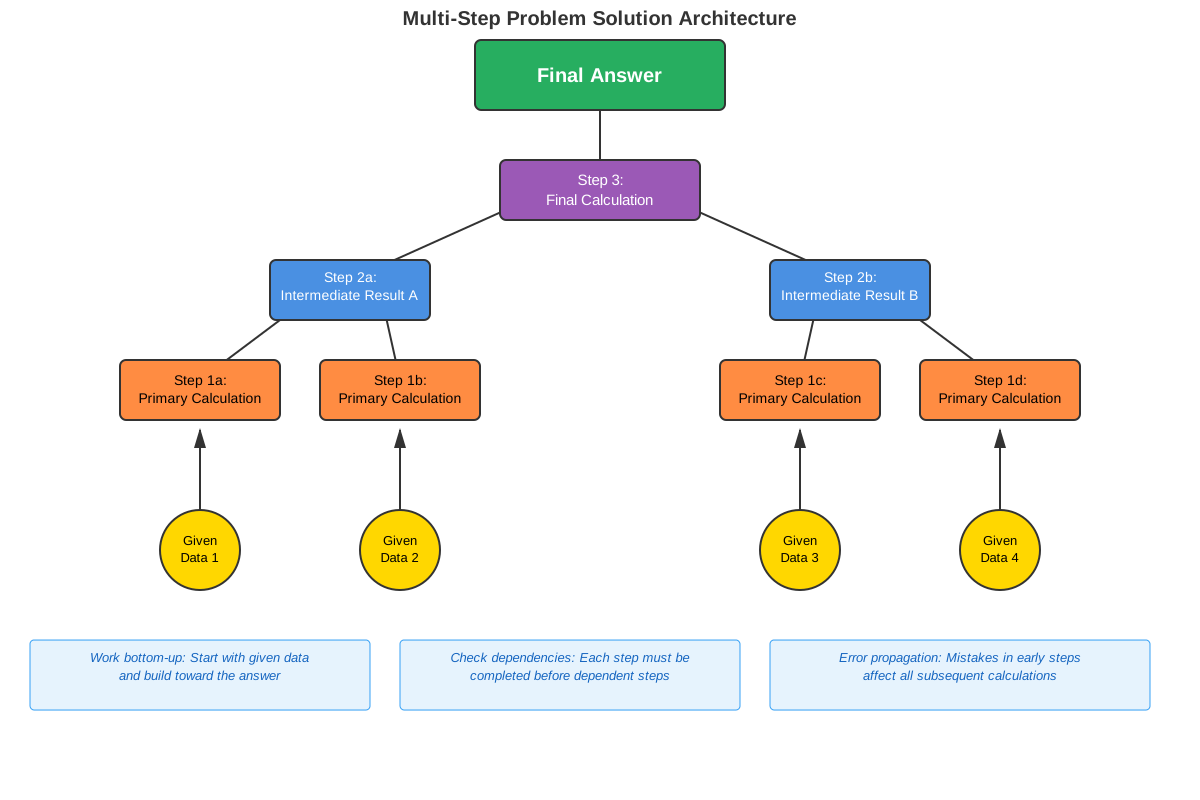
Multi-step word problems possess distinctive structural characteristics that distinguish them from simpler question types. These problems present information in narrative form, often embedding numerical data within sentences that describe relationships, sequences of events, or comparative scenarios. The defining feature is that solving requires performing multiple dependent operations—where the output of one calculation becomes the input for the next.
Key structural elements include: a setup phase that establishes initial conditions or starting values, transformation steps that describe changes or operations applied to those values, and a target question that asks about a final state or derived quantity. Recognizing this three-part structure helps students organize their solution approach systematically.
The Systematic Decomposition Strategy
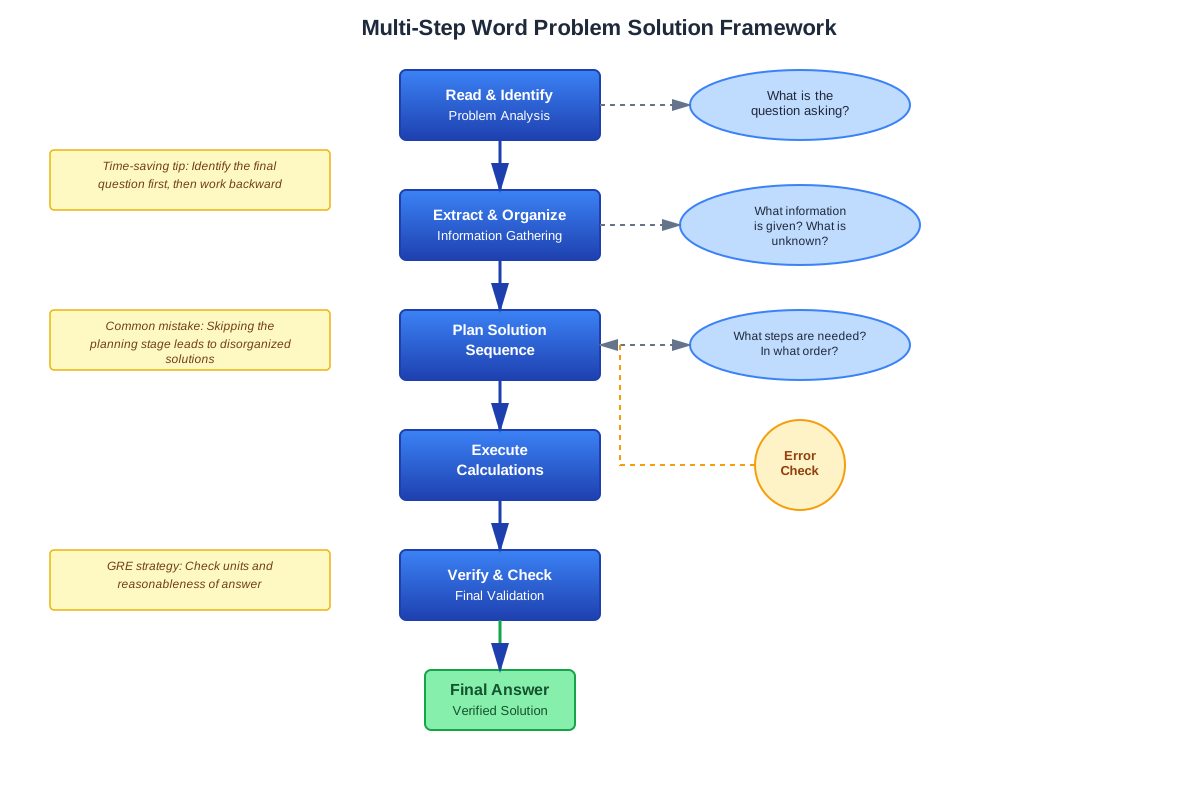
The most reliable approach to GRE multi-step word problems involves breaking complex problems into manageable sequential steps:
- Read completely and identify the question: Determine exactly what the problem asks for before attempting calculations
- Extract and organize given information: List known values, relationships, and constraints
- Identify the solution pathway: Determine which operations are needed and in what order
- Execute calculations sequentially: Perform one step at a time, recording intermediate results
- Verify the solution: Check that the answer makes logical sense and satisfies all problem conditions
This systematic approach reduces cognitive load by transforming an overwhelming problem into a series of manageable tasks. Each step should be completed fully before moving to the next, with intermediate results clearly noted to prevent errors in subsequent calculations.
Information Management and Relevance Filtering
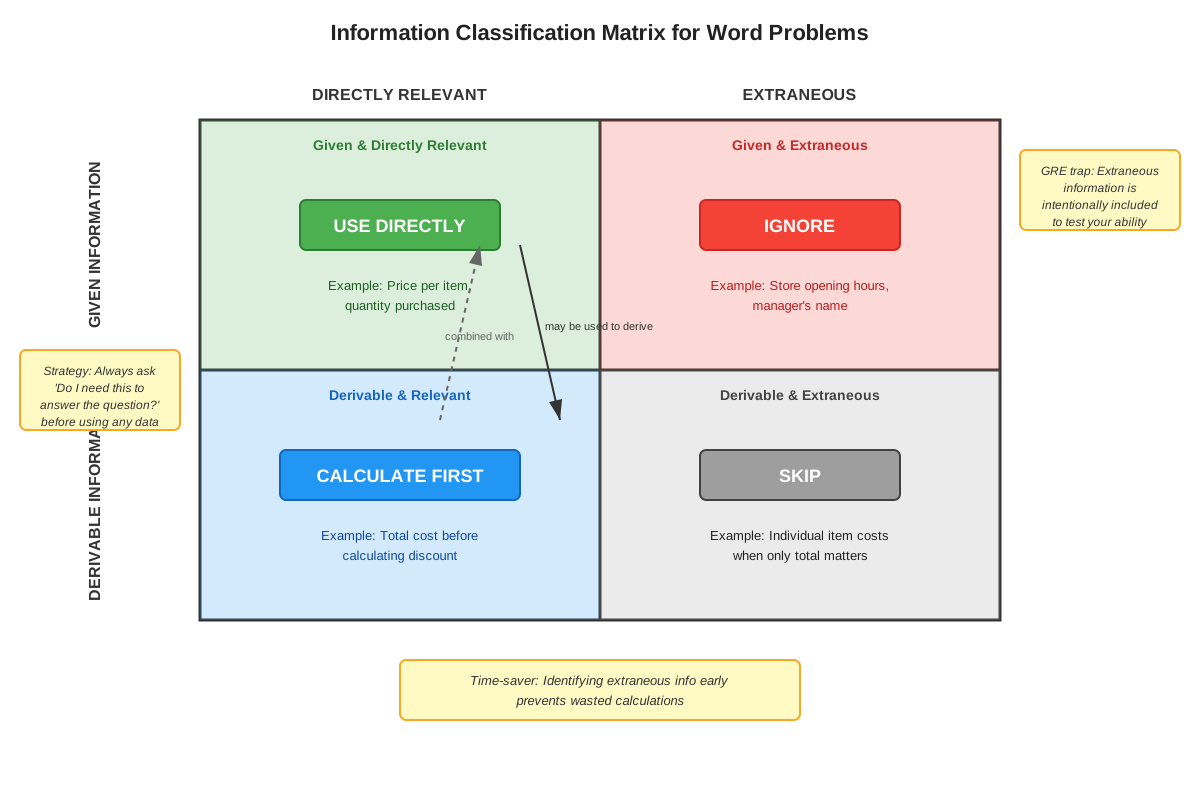
Multi-step word problems frequently include more information than necessary for the solution, testing whether students can distinguish relevant from irrelevant data. This information filtering skill requires understanding which quantities directly contribute to answering the target question versus which serve as context or potential distractors.
Effective strategies include: creating a variable map that assigns symbols to unknown quantities, drawing relationship diagrams that show how different values connect, and maintaining a calculation log that tracks which information has been used. Students should actively question whether each piece of given information serves a purpose in their solution pathway—if not, it may be extraneous.
Translation from Verbal to Mathematical Form
A critical skill in multi-step problems is converting verbal descriptions into mathematical expressions. Common translation patterns include:
| Verbal Phrase | Mathematical Representation |
|---|---|
| "A is 20% more than B" | A = 1.20B or A = B + 0.20B |
| "The sum of two consecutive integers" | n + (n+1) |
| "Working together, they complete the job" | 1/rate₁ + 1/rate₂ = 1/combined_rate |
| "After a 15% discount" | Final = Original × 0.85 |
| "The ratio of x to y is 3:4" | x/y = 3/4 or x = 3k, y = 4k |
Mastering these translation patterns enables rapid conversion of word problem statements into workable equations, significantly reducing solution time.
Sequential Calculation Management
Multi-step problems require maintaining accuracy across multiple calculations, where errors in early steps propagate through to final answers. Effective calculation management involves:
- Labeling intermediate results: Assign clear names (Step 1 result, initial rate, etc.) to values calculated along the way
- Preserving precision: Avoid premature rounding; carry extra decimal places through intermediate steps
- Dimensional consistency: Track units throughout calculations to catch setup errors
- Checkpoint verification: After each major step, verify that the result is reasonable before proceeding
Common Multi-Step Problem Archetypes
Work and Rate Problems
These problems involve entities (workers, machines, pipes) completing tasks at specified rates. The fundamental relationship is: Work = Rate × Time. Multi-step versions might involve workers with different rates, changing conditions, or combined efforts.
Example structure: "Worker A completes a job in 6 hours. Worker B completes the same job in 4 hours. How long will it take them working together?"
Solution pathway: Calculate individual rates → Combine rates → Find time from combined rate
Mixture and Concentration Problems
These involve combining substances with different properties (concentrations, prices, compositions). The key principle is that total quantity × average property = sum of (individual quantities × individual properties).
Example structure: "A chemist mixes 30 liters of 20% acid solution with 20 liters of 50% acid solution. What is the concentration of the mixture?"
Solution pathway: Calculate acid amount in each solution → Sum total acid → Sum total volume → Divide for concentration
Multi-Stage Percentage Problems
These problems apply successive percentage changes, testing understanding that percentages apply to changing base values. A critical insight is that successive percentage changes are multiplicative, not additive.
Example structure: "A price increases by 20%, then decreases by 20%. What is the net change?"
Solution pathway: Apply first percentage → Use result as new base → Apply second percentage → Compare to original
Distance-Rate-Time with Multiple Segments
These problems involve travel with changing rates, multiple legs, or relative motion. The fundamental relationship is Distance = Rate × Time, applied separately to each segment.
Example structure: "A train travels 120 miles at 40 mph, then 180 miles at 60 mph. What is the average speed for the entire trip?"
Solution pathway: Calculate time for each segment → Sum distances and times → Calculate overall average (total distance/total time)
Concept Relationships
The core concepts within multi-step word problems form an interconnected system where each element supports the others. Problem structure recognition serves as the foundation, enabling students to identify that a multi-step approach is necessary. This recognition triggers the systematic decomposition strategy, which provides the procedural framework for solution. Within this framework, information management determines which data points feed into calculations, while verbal-to-mathematical translation converts those data points into workable expressions. Finally, sequential calculation management ensures accuracy as the solution unfolds across multiple steps.
These concepts connect to prerequisite knowledge in essential ways: algebraic equation solving provides the tools for executing individual calculation steps, percentage and ratio operations frequently appear as components within larger multi-step sequences, and arithmetic proficiency ensures computational accuracy throughout. The relationship flows bidirectionally—multi-step problems both require and reinforce these foundational skills.
Looking forward, mastery of multi-step word problems enables progression to more advanced quantitative reasoning topics. The systematic thinking developed here transfers directly to data interpretation problems requiring multi-stage analysis, optimization problems involving constraint satisfaction, and quantitative comparison questions where efficient multi-step reasoning determines which quantity is larger. The conceptual map follows this progression:
Problem Recognition → Systematic Decomposition → Information Filtering → Mathematical Translation → Sequential Calculation → Solution Verification → Advanced Problem Types
High-Yield Facts
⭐ Multi-step word problems appear in approximately 20-30% of GRE Quantitative Reasoning questions, making them one of the highest-frequency question types
⭐ The most common error in multi-step problems is using an intermediate result as the final answer rather than completing all required steps
⭐ Successive percentage changes multiply rather than add: a 20% increase followed by 20% decrease does NOT return to the original value
⭐ When workers/machines operate together, their rates add: if A completes a job in 4 hours (rate = 1/4 per hour) and B in 6 hours (rate = 1/6 per hour), together they work at rate 1/4 + 1/6 = 5/12 per hour
⭐ Average speed for a multi-segment trip equals total distance divided by total time, NOT the average of the individual speeds
- In mixture problems, the final concentration must fall between the concentrations of the components being mixed
- Problems asking for "how much more" or "the difference" require subtraction as the final step, even after multiple preliminary calculations
- When a problem provides more information than necessary, the extraneous data often appears early in the problem statement to test information filtering
- Unit consistency is critical: if rates are given in different units (hours vs. minutes, miles vs. kilometers), conversion must occur before combining values
- The phrase "working together" in rate problems indicates adding rates, while "working in shifts" indicates adding times
- In multi-stage percentage problems, each percentage applies to the result of the previous stage, not the original value
- Problems involving "consecutive integers" can be represented as n, n+1, n+2, etc., reducing the number of variables needed
Quick check — test yourself on Multi-step word problems so far.
Try Flashcards →Common Misconceptions
Misconception: All information provided in a word problem must be used in the solution.
Correction: GRE multi-step word problems frequently include extraneous information to test whether students can identify relevant data. Part of problem-solving skill involves determining which values are necessary for the specific question being asked.
Misconception: Successive percentage changes can be added together to find the net effect.
Correction: Percentage changes are multiplicative, not additive. A 10% increase followed by a 10% decrease results in a net change of -1% (multiply by 1.10, then by 0.90, yielding 0.99), not 0%. Each percentage applies to the current value, which changes after each operation.
Misconception: Average speed equals the average of individual speeds.
Correction: Average speed for a trip with multiple segments equals total distance divided by total time. If you travel 60 miles at 30 mph (2 hours) and 60 miles at 60 mph (1 hour), the average speed is 120 miles ÷ 3 hours = 40 mph, not (30+60)/2 = 45 mph.
Misconception: When workers complete a job together, their times should be added.
Correction: When workers operate simultaneously, their rates (work per unit time) add, not their times. If Worker A completes a job in 3 hours (rate = 1/3 job per hour) and Worker B in 6 hours (rate = 1/6 job per hour), together they work at rate 1/3 + 1/6 = 1/2 job per hour, completing the job in 2 hours, not 9 hours.
Misconception: The first calculation performed represents the final answer.
Correction: Multi-step problems by definition require multiple operations. Students must read the question carefully to identify what is actually being asked, which is often several steps beyond the first calculation. Creating a solution roadmap before calculating helps avoid stopping prematurely.
Misconception: Rounding intermediate results doesn't affect final answer accuracy.
Correction: Rounding during intermediate steps can introduce significant error that compounds through subsequent calculations. Best practice is to maintain full precision (or at least 3-4 decimal places) throughout the solution process, rounding only the final answer to the requested precision.
Misconception: Complex problems require complex solutions.
Correction: Most GRE multi-step word problems, despite appearing complex, break down into sequences of straightforward operations. The complexity lies in problem decomposition and organization, not in the individual calculations. Systematic approaches typically reveal that each step involves basic arithmetic or simple algebra.
Worked Examples
Example 1: Multi-Stage Work Problem
Problem: Machine A can produce 240 widgets in 6 hours. Machine B can produce 240 widgets in 8 hours. If both machines work together for 3 hours, then Machine A breaks down and Machine B continues alone, how many additional hours will Machine B need to complete a total order of 400 widgets?
Solution Process:
Step 1 - Identify the question: We need to find the additional time Machine B works alone after the 3-hour joint period.
Step 2 - Calculate individual rates:
- Machine A rate: 240 widgets ÷ 6 hours = 40 widgets/hour
- Machine B rate: 240 widgets ÷ 8 hours = 30 widgets/hour
Step 3 - Calculate production during joint work:
- Combined rate: 40 + 30 = 70 widgets/hour
- Production in 3 hours: 70 × 3 = 210 widgets
Step 4 - Determine remaining work:
- Total order: 400 widgets
- Remaining: 400 - 210 = 190 widgets
Step 5 - Calculate time for Machine B alone:
- Time = Remaining work ÷ Machine B rate
- Time = 190 ÷ 30 = 6.33 hours (or 6⅓ hours)
Answer: Machine B needs approximately 6.33 additional hours.
Connection to learning objectives: This problem demonstrates systematic decomposition (breaking into rate calculation → joint production → remaining work → final time), information management (recognizing that Machine A's breakdown is the transition point), and sequential calculation management (using the result of each step as input for the next).
Example 2: Multi-Stage Percentage and Mixture Problem
Problem: A store marks up the wholesale cost of an item by 60%, then offers a 25% discount during a sale. If a customer pays $72 for the item during the sale, what was the original wholesale cost?
Solution Process:
Step 1 - Identify the question: We need to find the original wholesale cost, working backward from the final price.
Step 2 - Set up the relationship chain:
- Let W = wholesale cost
- After 60% markup: Price = W × 1.60
- After 25% discount: Final = (W × 1.60) × 0.75
Step 3 - Simplify the expression:
- Final = W × 1.60 × 0.75
- Final = W × 1.20
- We know Final = $72
Step 4 - Solve for wholesale cost:
- 72 = W × 1.20
- W = 72 ÷ 1.20
- W = $60
Step 5 - Verify the solution:
- Wholesale: $60
- After 60% markup: $60 × 1.60 = $96
- After 25% discount: $96 × 0.75 = $72 ✓
Answer: The original wholesale cost was $60.
Connection to learning objectives: This problem illustrates verbal-to-mathematical translation (converting "marked up by 60%" to "multiply by 1.60"), demonstrates that successive percentages multiply, and shows the importance of solution verification by working forward through the problem after solving.
Exam Strategy
When approaching multi-step word problems on the GRE, implement these strategic practices to maximize accuracy and efficiency:
Initial Assessment (15-20 seconds): Before calculating anything, read the entire problem and identify the target question. Underline or mentally note what is being asked. This prevents the common error of solving for an intermediate value rather than the final answer. Look for complexity indicators: multiple entities (workers, vehicles, substances), sequential events (then, after, next), or compound conditions (if...then structures).
Trigger Words and Phrases: Train yourself to recognize language that signals multi-step requirements:
- "How much more/less" → requires subtraction after preliminary calculations
- "Working together" → indicates rate addition
- "Then" or "after that" → signals sequential operations
- "Average" or "mean" → requires summing components then dividing
- "Percent increase/decrease" → may involve multiple percentage applications
- "Remaining" or "left over" → indicates subtraction from a total
Organization Techniques: Use your scratch paper strategically. Create a clear workspace with:
- Given information listed at the top
- A labeled section for each calculation step
- Clear notation for intermediate results (Step 1 result, Step 2 result, etc.)
- The target question written prominently to maintain focus
Process of Elimination: For multiple-choice questions, eliminate answers that:
- Are intermediate results rather than final answers (check if the problem requires additional steps)
- Fall outside logical bounds (e.g., a mixture concentration outside the range of its components)
- Have incorrect units or magnitude (if traveling at 60 mph for 2 hours, distance cannot be 20 miles)
- Result from common errors (like adding percentages instead of multiplying)
Time Allocation: Allocate approximately 2-3 minutes for multi-step word problems. If you exceed 2.5 minutes without clear progress, make an educated guess and move on. Mark the question for review if time permits at the end. The systematic approach should actually save time by preventing false starts and calculation errors that require rework.
Verification Shortcuts: When time is limited, use quick reasonableness checks:
- Does the answer have appropriate magnitude? (If combining two workers who each take 4-6 hours, the combined time should be 2-3 hours, not 10 hours)
- Do units make sense? (Speed should be distance/time, not time/distance)
- Does the answer satisfy obvious constraints? (A percentage cannot exceed 100% in most contexts)
Memory Techniques
RIDER Mnemonic for multi-step problem approach:
- Read completely and identify the target question
- Inventory given information and relationships
- Decompose into sequential steps
- Execute calculations systematically
- Review and verify the solution
Rate Problem Visualization: Picture rates as "filling buckets." Each worker/machine/pipe fills at a certain rate (fraction of bucket per hour). When working together, their streams combine, filling the bucket faster. This mental image helps remember that rates add when working simultaneously.
Percentage Chain Rule: "Each link changes the chain." Visualize successive percentages as links in a chain, where each link transforms what came before. This reinforces that each percentage applies to the current value, not the original.
WART Acronym for work problems:
- Work = Rate × Time
- Add rates when working together
- Reciprocal of combined rate gives time
- Total work is often set to 1 (one complete job)
Distance-Rate-Time Triangle: Visualize a triangle with Distance at the top, Rate and Time at the bottom. Cover what you're solving for; the position of the remaining variables shows the operation (D at top = R × T; R at bottom = D ÷ T; T at bottom = D ÷ R).
The "Then Test": If you can insert the word "then" into the problem description, you likely have multiple sequential steps. Count the "thens" to estimate the number of calculation stages required.
Summary
Multi-step word problems constitute a critical component of GRE Quantitative Reasoning, testing the ability to decompose complex scenarios into manageable sequential operations. Success requires systematic problem-solving approaches: reading completely to identify the target question, extracting and organizing relevant information while filtering extraneous data, translating verbal descriptions into mathematical expressions, executing calculations sequentially with careful attention to intermediate results, and verifying solutions for logical consistency. The most common problem archetypes—work and rate problems, mixture problems, multi-stage percentage calculations, and distance-rate-time scenarios—each follow predictable patterns that can be mastered through deliberate practice. Critical insights include recognizing that successive percentages multiply rather than add, that combined rates equal the sum of individual rates, and that average speed requires total distance divided by total time rather than averaging individual speeds. By implementing structured approaches like the RIDER framework, maintaining organized scratch work, and developing fluency with verbal-to-mathematical translation patterns, students can transform seemingly complex multi-step problems into straightforward sequences of familiar operations, significantly improving both accuracy and efficiency on this high-yield question type.
Key Takeaways
- Multi-step word problems appear in 20-30% of GRE Quantitative questions and require systematic decomposition into sequential operations rather than attempting to solve everything at once
- The most critical skill is identifying what the question actually asks for, preventing the common error of stopping at an intermediate result rather than completing all necessary steps
- Successive percentage changes are multiplicative, not additive: each percentage applies to the current value, which changes after each operation
- In rate problems, when entities work together simultaneously, their rates add; the combined rate's reciprocal gives the time to complete one unit of work
- Average speed equals total distance divided by total time, not the average of individual speeds—a distinction that appears frequently on the GRE
- Effective information management involves distinguishing relevant from extraneous data, as GRE problems often include unnecessary information to test filtering skills
- Maintaining precision through intermediate steps and verifying solutions through reasonableness checks prevents the error propagation that commonly occurs in multi-step calculations
Related Topics
Quantitative Comparison with Multi-Step Reasoning: Builds on multi-step problem-solving by requiring students to determine relationships between quantities without necessarily calculating exact values, developing efficiency in strategic calculation.
Data Interpretation Problems: Extends multi-step reasoning to scenarios involving tables, graphs, and charts, where information extraction precedes the multi-step calculation process.
Optimization and Constraint Problems: Applies multi-step thinking to scenarios involving maximization or minimization under constraints, requiring systematic exploration of possibilities.
Algebraic Word Problems with Multiple Variables: Advances multi-step skills by introducing systems of equations derived from word problems, requiring simultaneous consideration of multiple relationships.
Probability and Counting Multi-Step Problems: Combines multi-step reasoning with probability principles, often involving sequential events or multiple conditions that must all be satisfied.
Mastering multi-step word problems provides the foundational systematic thinking required for all these advanced topics, making it an essential stepping stone in GRE quantitative preparation.
Practice CTA
Now that you've developed a comprehensive understanding of multi-step word problems, it's time to solidify your mastery through deliberate practice. Attempt the practice questions associated with this topic, focusing on implementing the systematic RIDER approach with each problem. As you work through questions, pay particular attention to identifying the target question before calculating, organizing your scratch work clearly, and verifying that your final answer addresses what was actually asked. The flashcards will help reinforce key translation patterns and common problem archetypes, building the pattern recognition that enables rapid problem classification on test day. Remember: multi-step problems reward systematic thinking over computational speed—accuracy through organization will serve you far better than rushing through calculations. Your investment in mastering this high-yield topic will pay dividends across a significant portion of your GRE Quantitative score!
Sign up free to keep reading
Create a free AnvayaPrep account to finish this GRE guide on Multi-step word problems — plus flashcards and practice questions.