Overview
Constraint identification is a critical analytical skill tested extensively throughout the GRE Quantitative Reasoning section, particularly within word problems. This skill involves recognizing and extracting the limiting conditions, boundaries, and requirements embedded within problem statements that govern what solutions are possible or valid. When students encounter complex word problems involving multiple variables, relationships, or conditions, the ability to systematically identify constraints separates high scorers from those who struggle with time management and accuracy.
The GRE frequently embeds constraints within dense problem text, requiring test-takers to parse verbal information and translate it into mathematical relationships. These constraints might appear as budget limitations, capacity restrictions, ordering requirements, non-negativity conditions, or logical dependencies between variables. Mastering gre constraint identification enables students to quickly establish the boundaries of a problem space, eliminate impossible solutions, and focus computational effort only on viable approaches. This skill is particularly valuable because it reduces cognitive load—rather than attempting every possible solution path, students can immediately narrow their focus to mathematically valid options.
Within the broader landscape of Quantitative Reasoning, constraint identification serves as a foundational bridge between reading comprehension and mathematical problem-solving. It connects directly to topics like systems of equations, optimization problems, data interpretation, and logical reasoning. Students who excel at identifying constraints can more efficiently tackle multi-step problems, avoid calculation errors stemming from invalid assumptions, and demonstrate the analytical rigor that the GRE rewards with top percentile scores.
Learning Objectives
- [ ] Identify when Constraint identification is being tested in GRE word problems
- [ ] Explain the core rule or strategy behind Constraint identification
- [ ] Apply Constraint identification to GRE-style questions accurately
- [ ] Distinguish between explicit constraints (directly stated) and implicit constraints (logically necessary)
- [ ] Translate verbal constraint statements into mathematical inequalities, equations, or logical conditions
- [ ] Recognize when multiple constraints interact to further limit solution spaces
- [ ] Evaluate whether proposed solutions satisfy all identified constraints
Prerequisites
- Basic algebraic manipulation: Essential for translating identified constraints into mathematical expressions and solving resulting equations or inequalities
- Reading comprehension skills: Necessary to parse complex problem statements and extract relevant limiting conditions from surrounding text
- Understanding of inequalities: Required to represent constraints involving "at least," "at most," "no more than," and similar boundary language
- Set theory fundamentals: Helpful for understanding how multiple constraints create intersections of valid solution spaces
- Integer properties: Important when constraints specify whole numbers, counting scenarios, or discrete quantities
Why This Topic Matters
In real-world applications, constraint identification mirrors the analytical thinking required in business planning (budget constraints, resource limitations), engineering design (physical boundaries, material properties), project management (time constraints, dependency relationships), and scientific research (experimental limitations, ethical boundaries). Professionals across industries must regularly identify what limits their options before proposing solutions, making this skill valuable far beyond standardized testing.
On the GRE specifically, constraint identification appears in approximately 30-40% of Quantitative Reasoning word problems, making it one of the highest-yield skills to master. The Educational Testing Service (ETS) deliberately embeds constraints within problem narratives to test whether students can distinguish relevant from irrelevant information and apply systematic analytical thinking under time pressure. Questions involving constraints appear across multiple formats: Quantitative Comparison questions where constraints determine which quantity is larger, Problem Solving questions where constraints eliminate answer choices, and Data Interpretation questions where constraints govern valid conclusions from graphs or tables.
Common manifestations include: optimization problems asking for maximum or minimum values subject to constraints; mixture problems with component limitations; work-rate problems with time or capacity restrictions; geometry problems with measurement constraints; probability problems with conditional restrictions; and number theory problems with divisibility or range constraints. The GRE particularly favors problems where 2-3 constraints interact, requiring students to consider their combined effect rather than treating each in isolation.
Core Concepts
Definition and Types of Constraints
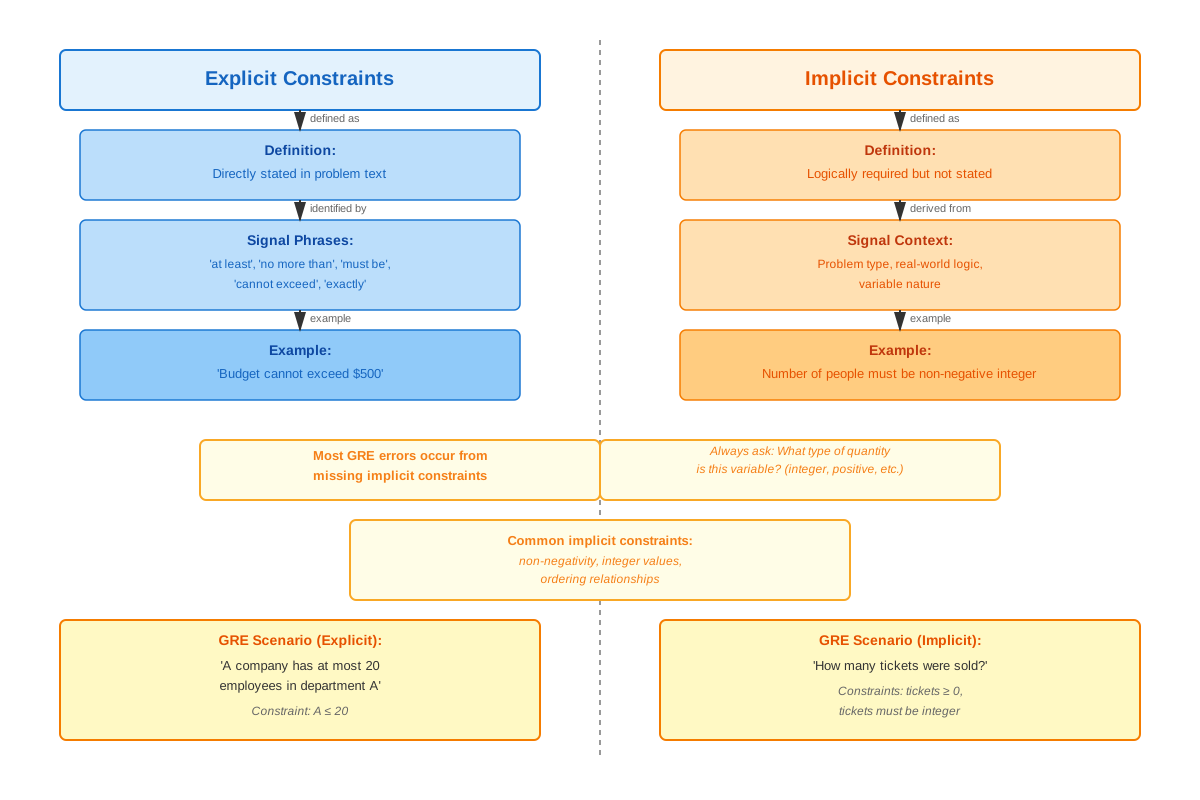
A constraint is any condition, limitation, or requirement that restricts the possible values, arrangements, or solutions in a problem. Constraints define the boundaries of what is mathematically and logically permissible. Understanding constraint types helps students systematically search for them in problem text.
Explicit constraints are directly stated in the problem language. Examples include "the budget cannot exceed $500," "at least 3 people must attend," or "the container holds exactly 10 liters." These constraints typically translate directly into mathematical expressions.
Implicit constraints are logically necessary but not directly stated. Common implicit constraints include non-negativity (you cannot have negative quantities of physical objects), integer requirements (you cannot have fractional people), ordering constraints (if event A must precede event B, certain sequences are impossible), and domain restrictions (percentages must fall between 0 and 100).
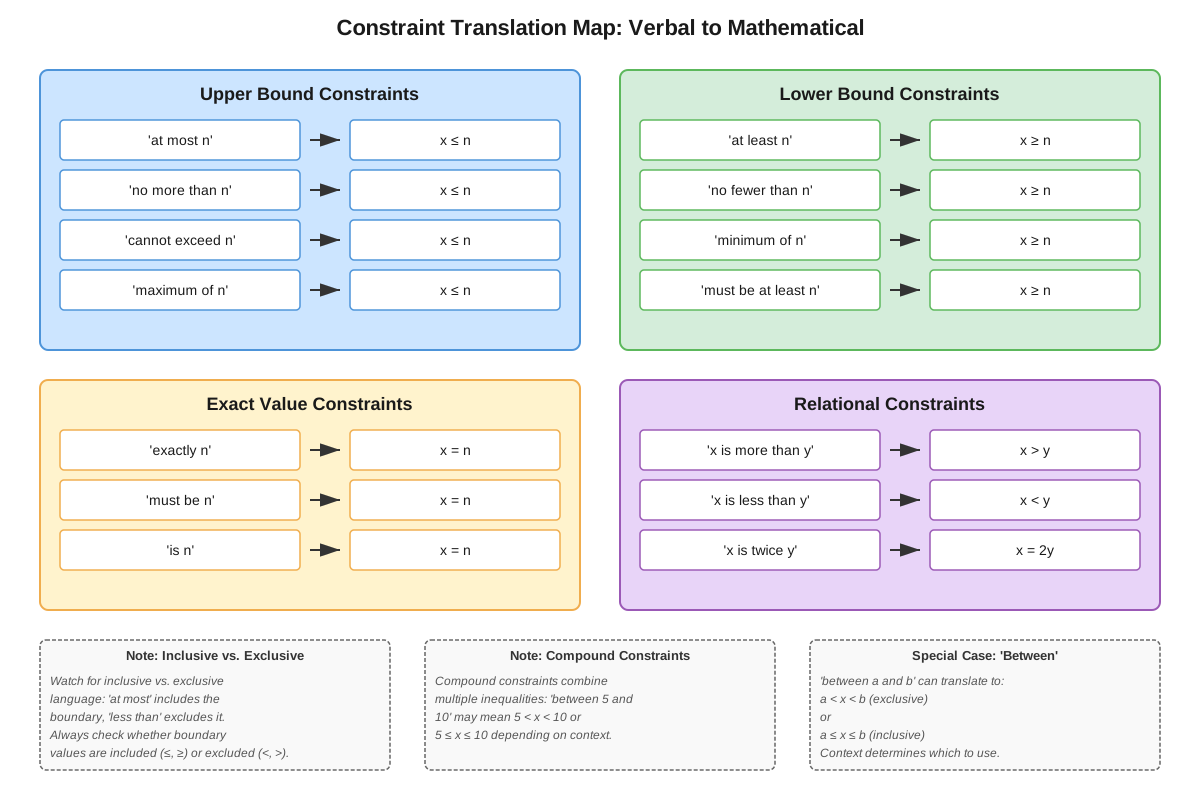
Boundary constraints specify upper or lower limits using language like "at most," "no more than," "at least," "minimum," or "maximum." These translate into inequalities (≤, ≥, <, >).
Equality constraints specify exact values or relationships using language like "exactly," "equals," "is," or "must be." These translate into equations (=).
Logical constraints specify conditional relationships using language like "if...then," "only if," "requires," or "depends on." These often involve multiple variables and create dependency relationships.
The Constraint Identification Process
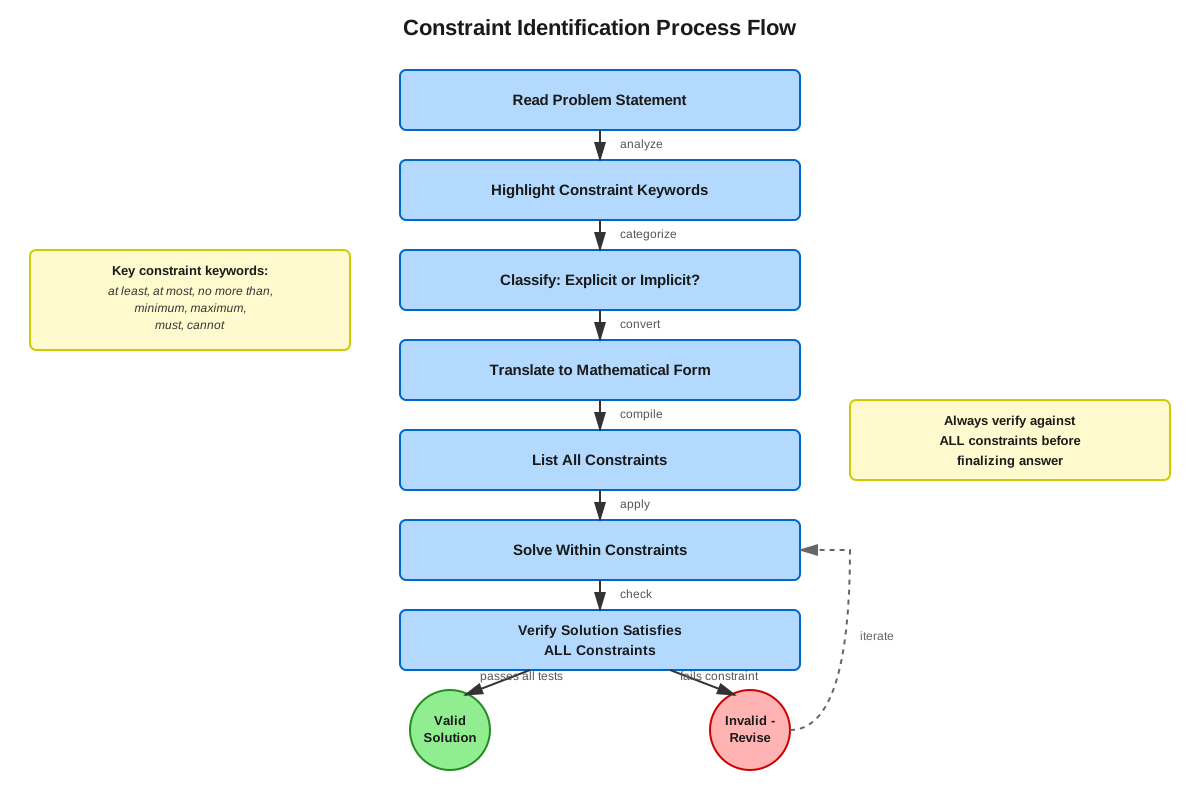
Effective constraint identification follows a systematic four-step process:
- Read actively for limiting language: Scan the problem for keywords that signal boundaries, requirements, or conditions. Flag words like "must," "cannot," "only," "exactly," "at least," "at most," "maximum," "minimum," "requires," "limited to," and "subject to."
- Distinguish constraints from objectives: Separate what the problem asks you to find (the objective) from what limits your solution space (the constraints). The question "What is the maximum number of..." identifies an objective, while "given that the total cost cannot exceed..." identifies a constraint.
- Translate verbal statements into mathematical expressions: Convert each identified constraint into symbolic form. "At least 5 red marbles" becomes r ≥ 5. "The sum of two numbers is 20" becomes x + y = 20. "Budget cannot exceed $1000" becomes cost ≤ 1000.
- Check for implicit constraints: After identifying explicit constraints, consider what logical requirements the problem context imposes. If counting people, add n ≥ 0 and n ∈ integers. If dealing with percentages, add 0 ≤ p ≤ 100. If ordering events, add temporal sequence constraints.
Constraint Interaction and Solution Spaces
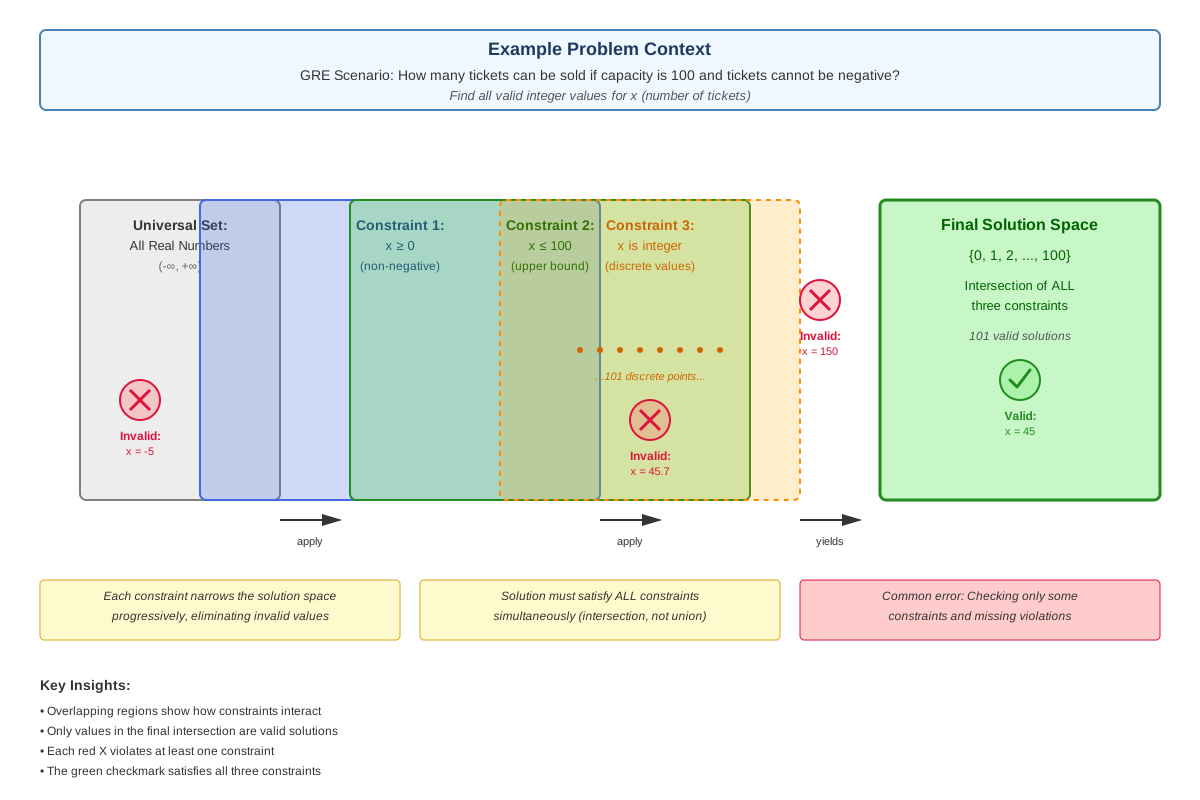
Multiple constraints typically work together to define a solution space—the set of all values or arrangements that satisfy every constraint simultaneously. Understanding how constraints interact is crucial for GRE success.
Intersection of constraints: When multiple constraints apply, valid solutions must satisfy all of them. If x ≥ 5 AND x ≤ 10, the solution space is 5 ≤ x ≤ 10. The GRE frequently tests whether students recognize that adding constraints shrinks the solution space.
Contradictory constraints: Occasionally, constraints may be impossible to satisfy simultaneously, meaning no solution exists. Recognizing this quickly saves valuable time. If x > 10 AND x < 5, no real number satisfies both constraints.
Redundant constraints: Sometimes one constraint is entirely contained within another, making it redundant. If x ≥ 10 AND x ≥ 5, the first constraint is stronger and the second adds no additional restriction.
Common Constraint Categories on the GRE
| Constraint Category | Typical Language | Mathematical Form | Example |
|---|---|---|---|
| Non-negativity | "cannot be negative," "positive quantity" | x ≥ 0 | Number of tickets sold ≥ 0 |
| Capacity/Budget | "at most," "cannot exceed," "maximum" | x ≤ M | Total cost ≤ $500 |
| Minimum requirement | "at least," "minimum," "no fewer than" | x ≥ m | At least 3 representatives |
| Exact value | "exactly," "equals," "is" | x = k | Exactly 12 participants |
| Integer requirement | "whole number," "counting," "people" | x ∈ ℤ | Number of cars (must be integer) |
| Percentage bounds | "percent," "proportion" | 0 ≤ p ≤ 100 | Discount percentage |
| Ordering | "before," "after," "first," "last" | Sequence constraints | Task A before Task B |
| Dependency | "if...then," "requires," "only if" | Conditional logic | If x > 5, then y < 10 |
Translating Constraint Language
The GRE uses specific verbal patterns to encode constraints. Recognizing these patterns enables rapid translation:
- "At least X" → ≥ X (includes X and everything above)
- "At most X" → ≤ X (includes X and everything below)
- "More than X" → > X (excludes X itself)
- "Fewer than X" → < X (excludes X itself)
- "No more than X" → ≤ X
- "No fewer than X" → ≥ X
- "Between X and Y" → X < value < Y (typically exclusive) or X ≤ value ≤ Y (sometimes inclusive—context dependent)
- "Exceeds X by Y" → = X + Y
- "X less than Y" → = Y - X
Concept Relationships
Constraint identification serves as the foundational first step in solving complex word problems, creating a logical flow: Problem Reading → Constraint Identification → Variable Definition → Equation/Inequality Formation → Solution → Constraint Verification.
Within the constraint identification process itself, concepts connect hierarchically: Active Reading (recognizing limiting language) → Classification (determining constraint type) → Translation (converting to mathematical form) → Integration (understanding how multiple constraints interact) → Application (using constraints to narrow solution spaces).
Constraint identification connects directly to prerequisite knowledge: Algebraic manipulation enables translation of constraints into workable mathematical forms; inequality understanding allows proper representation of boundary constraints; reading comprehension facilitates extraction of constraints from dense text; logical reasoning helps identify implicit constraints and dependencies.
This topic enables progression to advanced concepts: Optimization problems require identifying constraints that bound maximum/minimum values; systems of equations often represent multiple constraints that must be satisfied simultaneously; linear programming (occasionally tested) explicitly involves maximizing/minimizing objectives subject to constraints; data sufficiency questions test whether given information provides sufficient constraints to determine a unique answer.
High-Yield Facts
⭐ Constraint identification appears in 30-40% of GRE Quantitative word problems, making it one of the most frequently tested analytical skills.
⭐ Every word problem contains at least one constraint—the challenge is distinguishing explicit from implicit constraints.
⭐ Non-negativity and integer constraints are implicit in most counting problems but rarely stated explicitly; students must add these automatically.
⭐ The phrase "at least" translates to ≥ (greater than or equal to), while "at most" translates to ≤ (less than or equal to).
⭐ Multiple constraints always narrow the solution space—adding constraints never expands possibilities.
- Constraints can be represented as equations (exact values), inequalities (boundaries), or logical conditions (dependencies).
- The GRE frequently embeds constraints in the middle of problem text rather than at the beginning, testing careful reading.
- Boundary language like "maximum," "minimum," "cannot exceed," and "requires at least" always signals constraints.
- When constraints appear contradictory, either no solution exists or the problem requires re-reading for misinterpretation.
- Verifying that your final answer satisfies all identified constraints is essential—the GRE includes trap answers that violate constraints.
- Percentage problems implicitly constrain values to 0 ≤ p ≤ 100, and probabilities to 0 ≤ P ≤ 1.
- Time-based problems often include implicit ordering constraints (events cannot occur before they begin).
- Mixture problems typically include conservation constraints (total volume/mass remains constant).
- Geometry problems include implicit constraints from definitions (triangle inequality, angle sum properties).
- Budget/cost problems almost always include an upper bound constraint, even if phrased indirectly.
Quick check — test yourself on Constraint identification so far.
Try Flashcards →Common Misconceptions
Misconception: "At least 5" means exactly 5.
Correction: "At least 5" means 5 or more (≥ 5), including 5, 6, 7, and all larger values. Only "exactly 5" means precisely 5.
Misconception: All constraints are explicitly stated in the problem.
Correction: Many crucial constraints are implicit based on context. Physical quantities cannot be negative, counts must be integers, percentages have natural bounds, and logical sequences impose ordering constraints—all without explicit statement.
Misconception: More constraints make problems easier by providing more information.
Correction: While constraints do narrow solution spaces, they increase complexity by requiring simultaneous satisfaction of multiple conditions. More constraints mean more conditions to track and verify.
Misconception: "Between 5 and 10" always includes both 5 and 10.
Correction: "Between" is ambiguous—it may mean 5 < x < 10 (exclusive) or 5 ≤ x ≤ 10 (inclusive). The GRE usually clarifies with "between 5 and 10, inclusive" when endpoints are included, but context matters.
Misconception: If one constraint is satisfied, the solution is correct.
Correction: Valid solutions must satisfy ALL constraints simultaneously. A value might satisfy one or two constraints but violate a third, making it invalid. Always verify against every identified constraint.
Misconception: Constraints only appear in optimization problems.
Correction: Constraints appear across all word problem types—mixture problems, work-rate problems, number theory problems, geometry problems, and probability problems all involve constraints that limit valid solutions.
Misconception: The objective and constraints are the same thing.
Correction: The objective is what you're asked to find (maximize profit, determine the number of solutions, calculate the probability), while constraints are the conditions that limit your solution space. Confusing these leads to solving the wrong problem.
Worked Examples
Example 1: Multi-Constraint Integer Problem
Problem: A company must hire between 15 and 25 employees, inclusive. The number of full-time employees must be at least twice the number of part-time employees. If the company hires exactly 20 employees total, what is the minimum number of full-time employees possible?
Solution:
Step 1: Identify all constraints
- Total employees: 15 ≤ total ≤ 25 (boundary constraint, explicit)
- Full-time ≥ 2 × Part-time (relationship constraint, explicit)
- Total = 20 (equality constraint, explicit)
- Full-time ≥ 0, Part-time ≥ 0 (non-negativity, implicit)
- Full-time and Part-time must be integers (integer constraint, implicit)
Step 2: Define variables and translate constraints
Let F = full-time employees, P = part-time employees
Constraints become:
- F + P = 20 (from "exactly 20 employees total")
- F ≥ 2P (from "at least twice")
- F ≥ 0, P ≥ 0 (implicit)
- F, P ∈ integers (implicit)
Step 3: Apply constraints to find minimum F
From constraint 1: P = 20 - F
Substitute into constraint 2:
F ≥ 2(20 - F)
F ≥ 40 - 2F
3F ≥ 40
F ≥ 40/3 ≈ 13.33
Since F must be an integer (constraint 4), F ≥ 14.
Step 4: Verify the solution satisfies all constraints
If F = 14, then P = 20 - 14 = 6
- Check: 15 ≤ 20 ≤ 25 ✓
- Check: 14 ≥ 2(6) = 12 ✓
- Check: 14 + 6 = 20 ✓
- Check: Both are non-negative integers ✓
Answer: The minimum number of full-time employees is 14.
Learning objective connection: This problem demonstrates identifying multiple constraint types (boundary, relationship, equality, implicit), translating them into mathematical form, and applying them systematically to find a solution that satisfies all conditions simultaneously.
Example 2: Budget Constraint with Multiple Categories
Problem: A student has $120 to spend on books and supplies. Each textbook costs $35, and each notebook costs $4. The student needs at least 2 textbooks and wants to buy as many notebooks as possible. What is the maximum number of notebooks the student can purchase?
Solution:
Step 1: Identify all constraints
- Total budget: ≤ $120 (budget constraint, explicit)
- Minimum textbooks: ≥ 2 (minimum requirement, explicit)
- Textbook cost: $35 each (pricing constraint, explicit)
- Notebook cost: $4 each (pricing constraint, explicit)
- Number of textbooks ≥ 0, number of notebooks ≥ 0 (non-negativity, implicit)
- Both quantities must be integers (integer constraint, implicit)
Step 2: Define variables and translate constraints
Let T = number of textbooks, N = number of notebooks
Constraints:
- 35T + 4N ≤ 120 (budget constraint)
- T ≥ 2 (minimum textbooks)
- T, N ≥ 0 (non-negativity)
- T, N ∈ integers (implicit)
Step 3: Maximize N given constraints
To maximize N, minimize T. The minimum value of T is 2 (from constraint 2).
With T = 2:
35(2) + 4N ≤ 120
70 + 4N ≤ 120
4N ≤ 50
N ≤ 12.5
Since N must be an integer, N ≤ 12.
Step 4: Verify the solution
With T = 2 and N = 12:
- Cost: 35(2) + 4(12) = 70 + 48 = $118 ≤ $120 ✓
- Textbooks: 2 ≥ 2 ✓
- Both are non-negative integers ✓
Answer: The maximum number of notebooks is 12.
Learning objective connection: This problem illustrates how constraints interact to define optimization boundaries, demonstrates the importance of implicit integer constraints, and shows how minimizing one variable (given its constraint) can maximize another within budget limitations.
Exam Strategy
Approach GRE constraint identification questions systematically: First, read the entire problem to understand the context and objective. Second, re-read specifically to identify and underline all limiting language. Third, list constraints separately from the question being asked. Fourth, translate each constraint into mathematical notation. Fifth, solve using the constraints. Sixth, verify your answer against every constraint before selecting it.
Trigger words and phrases to watch for: Develop automatic recognition of constraint signals. "At least," "at most," "no more than," "no fewer than," "minimum," "maximum," "cannot exceed," "must be," "requires," "exactly," "between," "only," "limited to," and "subject to" all indicate constraints. When you see these phrases, immediately translate them into mathematical form.
Process-of-elimination tips: On Quantitative Comparison and multiple-choice questions, use constraints to eliminate answer choices quickly. If an answer choice violates any identified constraint, eliminate it immediately without further calculation. For example, if the problem states "the number of attendees must be at least 50," immediately eliminate any answer choice below 50. This strategy is particularly powerful when 2-3 answer choices violate obvious constraints, leaving only 1-2 viable options to evaluate.
Time allocation advice: Spend 15-20% of your problem-solving time on constraint identification before attempting calculations. This upfront investment prevents wasted time pursuing invalid solution paths. For a 2-minute problem, spend 20-25 seconds identifying and translating constraints. This systematic approach is faster than trial-and-error or attempting to solve without clear boundaries.
Exam Tip: When stuck on a complex problem, return to your constraint list. Often, students identify constraints but forget to apply one during solution, leading to incorrect answers. Checking each constraint against your proposed answer frequently reveals errors.
Watch for constraint-based trap answers: The GRE deliberately includes answer choices that would be correct if one constraint were removed. These trap answers test whether students track all constraints throughout the problem. Always verify that your selected answer satisfies every single constraint you identified.
Use constraints to check reasonableness: Before finalizing an answer, ask whether it makes logical sense given the constraints. If you calculated 47.3 people but the problem involves counting individuals (implicit integer constraint), you know an error occurred. If you calculated a 150% discount (violates implicit percentage bounds), recalculate immediately.
Memory Techniques
LIMIT mnemonic for constraint identification:
- Language: Look for limiting language (at least, at most, maximum, minimum)
- Implicit: Identify implicit constraints (non-negativity, integers, bounds)
- Mathematical: Convert to Mathematical form (equations, inequalities)
- Interaction: Consider how constraints Interact and overlap
- Test: Test your answer against all constraints
Visualization strategy: Picture constraints as fences or boundaries that create an enclosed space. Each constraint is one fence. The solution must lie within the area where all fences overlap. Adding more constraints means adding more fences, which shrinks the enclosed space. This mental model helps understand why multiple constraints narrow solution spaces.
Inequality direction memory aid: "At least" points left on a number line (≥), including the number and everything to the right. "At most" points to the mountain top (≤), including the peak and everything below. While these aren't perfect linguistic matches, the visual association helps many students remember inequality directions.
Acronym for common implicit constraints - NIPO:
- Non-negativity (physical quantities ≥ 0)
- Integers (counting problems require whole numbers)
- Percentage bounds (0 ≤ p ≤ 100)
- Ordering (temporal/logical sequences)
Summary
Constraint identification is the systematic process of recognizing, extracting, and translating the limiting conditions embedded within GRE word problems into mathematical expressions that define valid solution spaces. This high-yield skill appears in 30-40% of Quantitative Reasoning questions and serves as the critical first step in solving complex multi-variable problems. Effective constraint identification requires distinguishing between explicit constraints (directly stated) and implicit constraints (logically necessary), recognizing common constraint categories (boundary, equality, logical, integer, non-negativity), and understanding how multiple constraints interact to narrow solution spaces. Students must master translating verbal constraint language ("at least," "at most," "cannot exceed") into mathematical notation (inequalities and equations) and systematically verify that proposed solutions satisfy all identified constraints simultaneously. The GRE rewards this analytical rigor by making constraint-based elimination a powerful strategy for quickly narrowing answer choices and avoiding trap answers that violate subtle constraints. Mastery requires active reading for limiting language, automatic recognition of implicit constraints based on problem context, and disciplined verification of solutions against every constraint before finalizing answers.
Key Takeaways
- Constraint identification is tested in 30-40% of GRE Quantitative word problems, making it one of the highest-yield skills to master for score improvement.
- Every constraint narrows the solution space—valid answers must satisfy all constraints simultaneously, not just one or two.
- Implicit constraints (non-negativity, integer requirements, percentage bounds) are as important as explicit constraints but require contextual recognition rather than direct reading.
- Systematic translation of verbal constraint language into mathematical notation (≥, ≤, =, <, >) is essential for accurate problem-solving.
- Always verify your final answer against every identified constraint—the GRE includes trap answers that violate subtle constraints to test thoroughness.
- Constraint identification enables efficient process-of-elimination—answer choices violating any constraint can be eliminated immediately without calculation.
- The LIMIT framework (Language, Implicit, Mathematical, Interaction, Test) provides a systematic approach to ensure no constraints are overlooked during problem-solving.
Related Topics
Systems of Equations and Inequalities: Constraint identification directly enables solving systems where each equation or inequality represents a constraint. Mastering constraint identification makes systems problems more approachable by clarifying what each component represents.
Optimization Problems: These explicitly ask for maximum or minimum values subject to constraints. Strong constraint identification skills are prerequisite for recognizing what limits optimal solutions.
Data Sufficiency: These questions test whether given information provides sufficient constraints to determine a unique answer. Understanding constraints helps evaluate whether additional conditions are needed.
Linear Programming: Though rarely tested directly on the GRE, this advanced topic involves maximizing/minimizing objectives subject to multiple linear constraints, representing the culmination of constraint identification skills.
Logical Reasoning: Constraint identification in quantitative contexts parallels identifying premises and conditions in logical arguments, strengthening overall analytical reasoning.
Practice CTA
Now that you understand the systematic approach to constraint identification, it's time to apply these strategies to authentic GRE-style problems. Work through the practice questions methodically, identifying and translating all constraints before attempting calculations. Use the flashcards to reinforce recognition of constraint language and common implicit constraints. Remember: constraint identification is a skill that improves dramatically with deliberate practice. Each problem you solve strengthens your pattern recognition and translation speed, directly improving your GRE Quantitative score. Approach practice with the same systematic rigor you'll use on test day, and you'll build the confidence and competence needed to tackle even the most complex constraint-based problems efficiently.
Sign up free to keep reading
Create a free AnvayaPrep account to finish this GRE guide on Constraint identification — plus flashcards and practice questions.