Overview
Units in word problems represent one of the most practical and frequently tested concepts on the GRE Quantitative Reasoning section. Every real-world scenario involves quantities measured in specific units—whether distance in miles, time in hours, volume in gallons, or cost in dollars. The GRE tests whether students can track, convert, and manipulate these units correctly while solving multi-step problems. Mastery of unit handling separates students who merely understand arithmetic from those who can apply mathematical reasoning to complex, realistic scenarios.
Understanding GRE units in word problems is essential because unit errors account for a significant portion of incorrect answers on the exam. Students often perform calculations correctly but fail to convert between units (such as hours to minutes, or feet to inches), leading to answers that are off by factors of 60, 12, or other conversion ratios. The GRE deliberately includes answer choices that reflect common unit conversion errors, making this topic a high-yield area for score improvement. Questions involving rates, ratios, proportions, and mixture problems all depend fundamentally on proper unit management.
This topic connects deeply to broader Quantitative Reasoning concepts including rate problems, ratio and proportion questions, geometry (where linear, area, and volume units differ), and data interpretation (where graphs may use different units than the question asks for). Unit analysis serves as a powerful error-checking mechanism across virtually all quantitative problem types, making it an essential foundational skill that enhances performance throughout the entire exam.
Learning Objectives
- [ ] Identify when Units in word problems is being tested
- [ ] Explain the core rule or strategy behind Units in word problems
- [ ] Apply Units in word problems to GRE-style questions accurately
- [ ] Convert between different units within the same measurement system (metric or imperial)
- [ ] Recognize and correct unit mismatches in multi-step calculations
- [ ] Use dimensional analysis to verify answer reasonableness and eliminate incorrect choices
Prerequisites
- Basic arithmetic operations: Multiplication, division, addition, and subtraction form the foundation for all unit conversions and calculations
- Understanding of fractions and ratios: Unit conversions are essentially multiplicative relationships expressed as ratios
- Familiarity with common measurement units: Recognizing standard units (feet, meters, hours, gallons) enables quick problem interpretation
- Algebraic manipulation: Setting up equations with units requires comfort with variables and solving for unknowns
Why This Topic Matters
In real-world applications, unit management is critical across engineering, medicine, finance, and science. Medication dosing errors, construction miscalculations, and even spacecraft failures have resulted from unit conversion mistakes. The GRE tests this practical skill because graduate programs require students who can work accurately with quantitative information in various formats and units.
On the GRE Quantitative Reasoning section, approximately 20-30% of word problems explicitly test unit handling or include unit conversion as a necessary step. These questions appear across multiple formats: Quantitative Comparison questions may present the same quantity in different units, Multiple Choice questions often include distractor answers representing common unit errors, and Numeric Entry questions require students to provide answers in specified units without the safety net of answer choices.
Common question types involving units include: rate problems (miles per hour converted to feet per second), work problems (hours to complete tasks converted to minutes or days), mixture problems (concentrations in different volume units), geometry problems (converting between linear measurements, square units for area, and cubic units for volume), and data interpretation (reading graphs in one unit while answering in another). The GRE frequently embeds unit challenges within multi-step problems, where students must track units through several operations before arriving at the final answer.
Core Concepts
Understanding Unit Dimensions
Every measurement consists of two components: a numerical value and a unit of measurement. The unit indicates what is being measured (length, time, mass, volume, etc.) and the scale of measurement. Units have dimensions—fundamental categories like length [L], time [T], and mass [M]. Derived units combine these fundamental dimensions: speed has dimensions [L]/[T], while density has dimensions [M]/[L³].
Understanding dimensions helps identify when units match or require conversion. Two quantities can only be directly added or subtracted if they share the same dimensions and units. For example, 5 meters + 3 feet requires conversion to a common unit before addition, while 5 meters + 3 seconds is dimensionally meaningless.
Unit Conversion Fundamentals
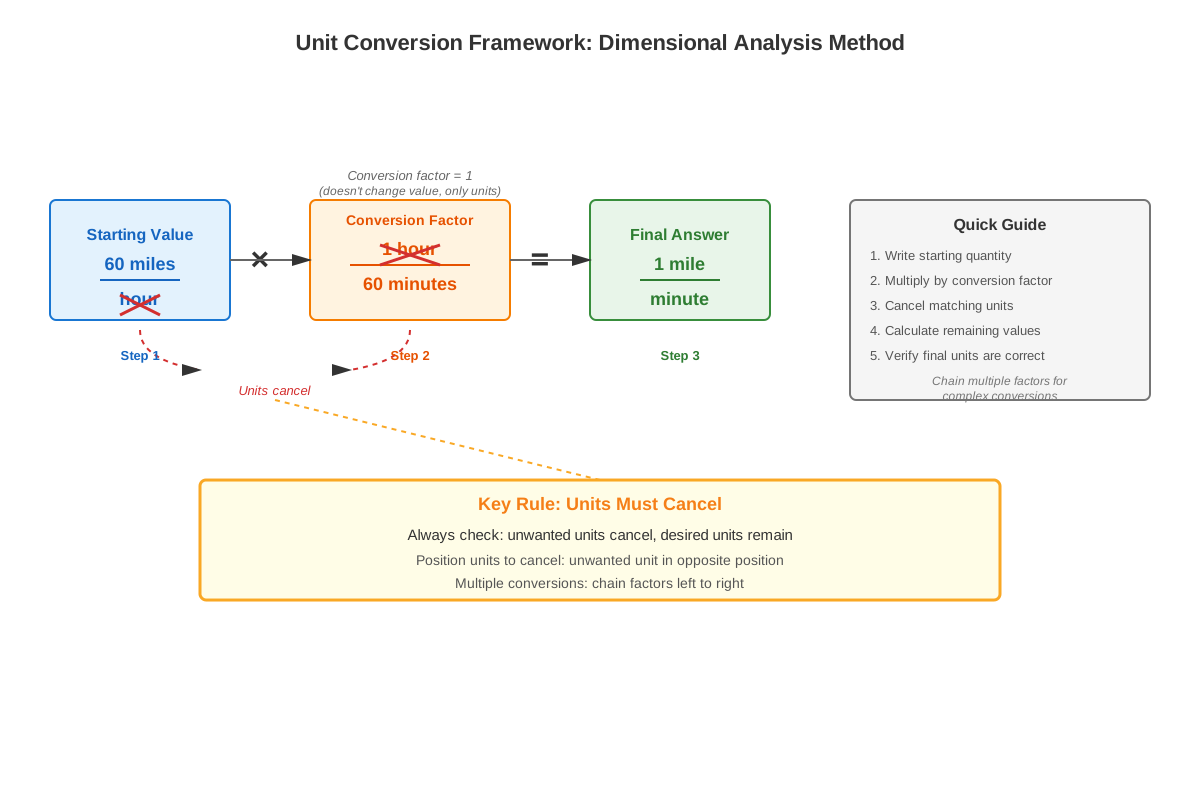
Unit conversion involves multiplying by conversion factors—ratios equal to 1 that change the unit without changing the actual quantity. For example, since 1 hour = 60 minutes, the ratios (1 hour)/(60 minutes) and (60 minutes)/(1 hour) both equal 1. Multiplying by these ratios changes units while preserving the quantity's value.
The key principle: arrange conversion factors so unwanted units cancel. If converting 120 minutes to hours, multiply by the factor with minutes in the denominator:
120 minutes × (1 hour / 60 minutes) = 2 hoursThe "minutes" units cancel algebraically, leaving the answer in hours.
Common Conversion Factors
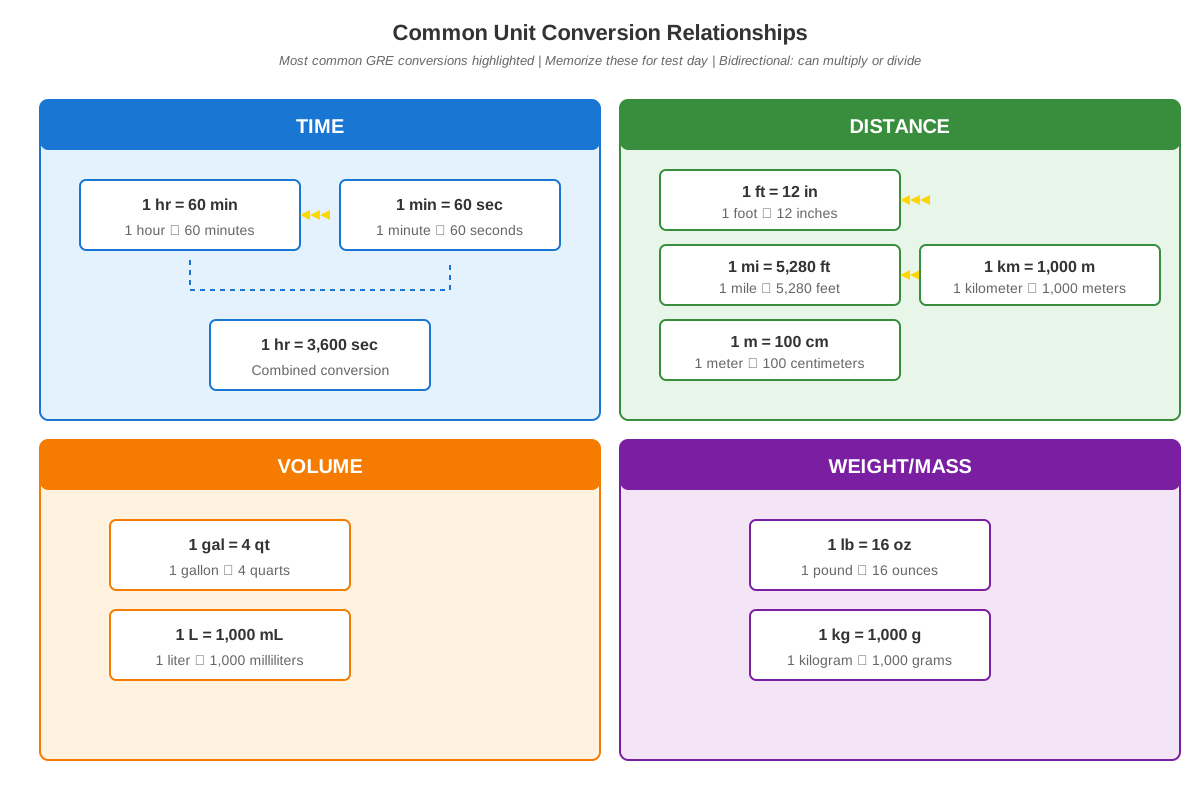
| Category | Conversion | Factor |
|---|---|---|
| Time | 1 hour | 60 minutes |
| 1 minute | 60 seconds | |
| 1 hour | 3,600 seconds | |
| Length (Imperial) | 1 foot | 12 inches |
| 1 yard | 3 feet | |
| 1 mile | 5,280 feet | |
| Length (Metric) | 1 meter | 100 centimeters |
| 1 kilometer | 1,000 meters | |
| Volume | 1 gallon | 4 quarts |
| 1 quart | 2 pints | |
| Weight | 1 pound | 16 ounces |
| 1 ton | 2,000 pounds |
Compound Units and Rate Conversions
Compound units involve multiple dimensions, such as miles per hour (distance/time) or dollars per pound (cost/weight). Converting compound units requires converting each component separately. To convert 60 miles per hour to feet per second:
- Convert miles to feet: 60 miles × 5,280 feet/mile = 316,800 feet
- Convert hours to seconds: 1 hour × 3,600 seconds/hour = 3,600 seconds
- Form the new rate: 316,800 feet / 3,600 seconds = 88 feet per second
Alternatively, use multiple conversion factors in sequence:
60 miles/hour × (5,280 feet/1 mile) × (1 hour/3,600 seconds) = 88 feet/secondDimensional Analysis
Dimensional analysis (also called the factor-label method) is a systematic approach where units are treated as algebraic quantities that multiply and cancel. This method provides built-in error checking: if the final units don't match what the question asks for, an error occurred somewhere in the calculation.
Steps for dimensional analysis:
- Write the given quantity with its units
- Identify the target units
- Set up conversion factors as fractions
- Arrange factors so unwanted units cancel
- Verify that remaining units match the target
- Perform the arithmetic
Area and Volume Unit Conversions
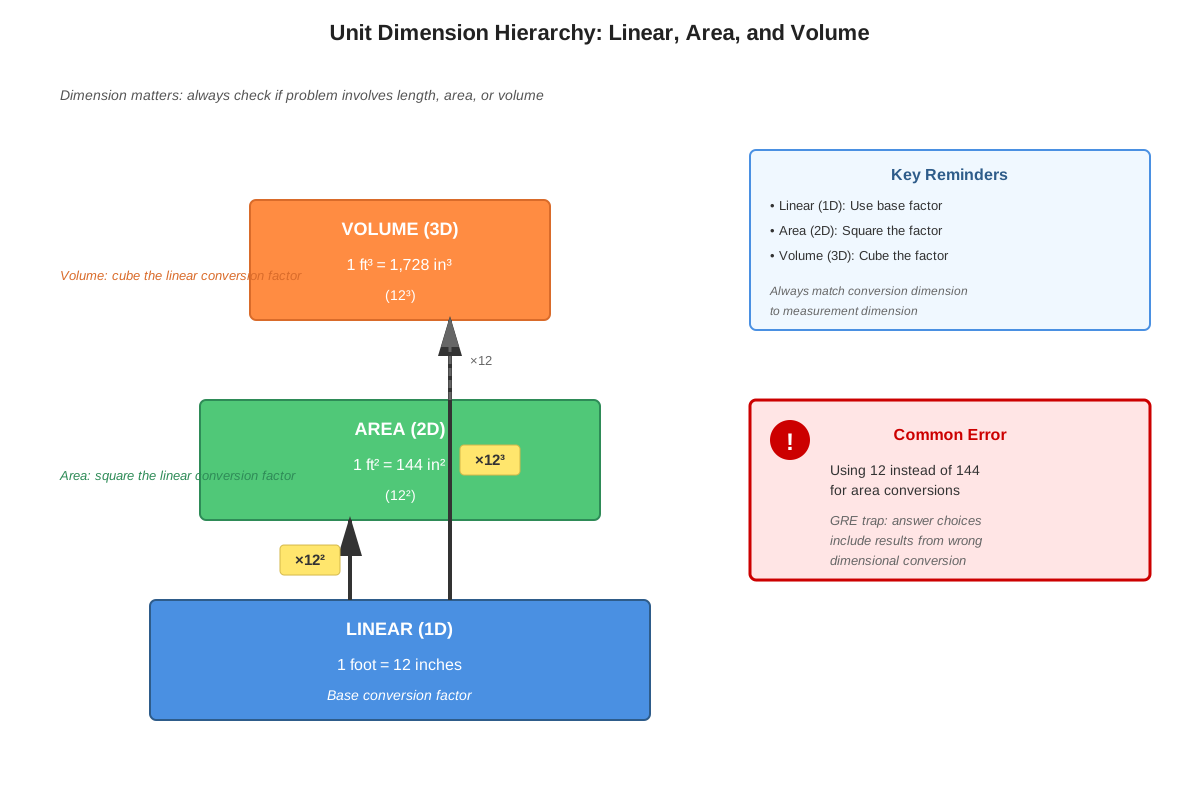
When converting area units, the conversion factor must be squared. If 1 foot = 12 inches, then 1 square foot = 144 square inches (12²). Similarly, volume units require cubing the conversion factor: 1 cubic foot = 1,728 cubic inches (12³).
This is a frequent source of errors. Converting 5 square feet to square inches requires:
5 ft² × (12 in/1 ft)² = 5 ft² × 144 in²/ft² = 720 in²Not 5 × 12 = 60, which would be incorrect.
Unit Consistency in Equations
In any equation, all terms must have consistent units. When solving rate problems like distance = rate × time, if rate is in miles per hour and time is in minutes, conversion is necessary before multiplication. The equation's dimensional consistency provides a powerful check: if you're calculating distance and end up with units of time, something went wrong.
Implicit Units in Word Problems
Some GRE problems present implicit units—quantities without explicitly stated units that must be inferred from context. A problem stating "a car travels 60 in 2" likely means 60 miles in 2 hours, based on typical conventions. However, always verify from context, as assumptions can lead to errors. When units aren't specified in the answer choices, the problem typically expects the most natural unit for that context.
Concept Relationships
The core concepts in unit handling form a hierarchical structure. Understanding unit dimensions serves as the foundation, establishing what units represent and when they're compatible. This leads directly to unit conversion fundamentals, which provide the mechanical process for changing between units. Common conversion factors represent the specific knowledge needed to execute conversions for GRE-relevant units.
Compound units and rate conversions build upon basic conversions by applying them to multi-dimensional quantities, which connects to virtually all rate problems on the GRE. Dimensional analysis synthesizes all previous concepts into a systematic methodology that both solves problems and checks work. Area and volume conversions extend the basic conversion principles with the critical insight about squaring and cubing factors.
These concepts connect to prerequisite knowledge of ratios (conversion factors are ratios), fractions (conversion factors are expressed as fractions), and algebra (unit cancellation follows algebraic rules). They enable progression to advanced topics like rate problems (where units of distance/time must be managed), work problems (units of work/time), mixture problems (units of concentration), and geometry (where linear, area, and volume units interact).
The relationship map: Unit Dimensions → Unit Conversion Fundamentals → Common Conversion Factors → Compound Units → Dimensional Analysis → Area/Volume Conversions → Application in Complex Word Problems
High-Yield Facts
⭐ Unit conversion factors are ratios equal to 1, allowing multiplication without changing the quantity's actual value
⭐ When converting area units, square the linear conversion factor; when converting volume units, cube it
⭐ Compound units (like miles per hour) require converting each component dimension separately
⭐ Dimensional analysis provides automatic error-checking: if final units don't match the question's requirements, an error occurred
⭐ The GRE frequently includes distractor answers that represent common unit conversion errors (forgetting to convert, using wrong conversion factors)
- 1 hour = 60 minutes = 3,600 seconds (memorize this for quick rate conversions)
- 1 mile = 5,280 feet (essential for distance/rate problems)
- When units appear in both numerator and denominator, they cancel algebraically
- Always verify what units the question asks for before selecting an answer
- Rate problems typically require at least one unit conversion (e.g., hours to minutes)
- In Quantitative Comparison questions, quantities may be presented in different units to test conversion skills
- Metric conversions involve powers of 10, making them simpler than imperial conversions
- Unit mismatches in addition or subtraction indicate an error—only like units can be combined
- Time conversions are the most frequently tested on the GRE
- When no units are specified in answer choices, use the most natural unit for the context
Quick check — test yourself on Units in word problems so far.
Try Flashcards →Common Misconceptions
Misconception: Adding the conversion factor instead of multiplying by it → Correction: Unit conversion requires multiplication by a ratio equal to 1, not addition. To convert 2 hours to minutes, multiply 2 × 60 = 120 minutes, not 2 + 60 = 62.
Misconception: Using the conversion factor upside-down, resulting in answers off by the square of the factor → Correction: Arrange conversion factors so the unwanted unit appears in the denominator and cancels. Converting 180 minutes to hours requires multiplying by (1 hour/60 minutes), not (60 minutes/1 hour).
Misconception: Forgetting to square or cube conversion factors when converting area or volume units → Correction: If 1 foot = 12 inches, then 1 square foot = 144 square inches (12²) and 1 cubic foot = 1,728 cubic inches (12³). The conversion factor must be raised to the same power as the dimension.
Misconception: Assuming all unit conversions involve simple multiplication by whole numbers → Correction: Some conversions produce fractions or decimals. Converting feet per second to miles per hour involves multiplying by 3,600/5,280 = 0.681818..., which simplifies to multiplying by approximately 0.68 or dividing by approximately 1.47.
Misconception: Believing that units in the numerator and denominator of different terms can cancel → Correction: Units only cancel when they appear in the same term (numerator and denominator of the same fraction). In the expression (60 miles)/(2 hours) + 30 miles, the "miles" in the first term doesn't cancel with the "miles" in the second term because they're in separate terms being added.
Misconception: Thinking that dimensional analysis is only for complex problems → Correction: Dimensional analysis is valuable for all unit problems, including simple ones, because it provides systematic error-checking. Even straightforward conversions benefit from writing out units explicitly.
Misconception: Assuming the answer must be in the same units as the given information → Correction: GRE questions frequently ask for answers in different units than provided in the problem. Always check what units the question requests before finalizing your answer.
Worked Examples
Example 1: Rate Conversion with Multiple Steps
Problem: A train travels at 90 kilometers per hour. What is its speed in meters per second?
Solution:
Step 1: Identify given and target units
- Given: 90 kilometers per hour (km/h)
- Target: meters per second (m/s)
Step 2: Identify necessary conversions
- Kilometers to meters: 1 km = 1,000 m
- Hours to seconds: 1 hour = 3,600 seconds
Step 3: Set up dimensional analysis with conversion factors arranged for cancellation
90 km/h × (1,000 m / 1 km) × (1 h / 3,600 s)Step 4: Cancel units
- "km" cancels between first and second terms
- "h" cancels between first and third terms
- Remaining units: m/s ✓
Step 5: Perform arithmetic
90 × 1,000 / 3,600 = 90,000 / 3,600 = 25 m/sAnswer: 25 meters per second
Connection to learning objectives: This example demonstrates applying dimensional analysis to compound unit conversions, a core GRE skill. It shows how to identify when unit conversion is necessary and execute it systematically.
Example 2: Area Conversion in a Geometry Problem
Problem: A rectangular room measures 15 feet by 12 feet. If carpet costs $3.50 per square yard, what is the cost to carpet the entire room?
Solution:
Step 1: Calculate area in square feet
- Area = length × width = 15 ft × 12 ft = 180 ft²
Step 2: Identify the unit mismatch
- Area calculated: square feet
- Price given: per square yard
- Must convert ft² to yd²
Step 3: Determine the conversion factor
- 1 yard = 3 feet (linear)
- 1 square yard = 9 square feet (3² = 9)
Step 4: Convert area to square yards
180 ft² × (1 yd² / 9 ft²) = 180/9 = 20 yd²Step 5: Calculate total cost
- Cost = 20 yd² × $3.50/yd² = $70
Answer: $70
Common trap: Students often use the linear conversion factor (3) instead of squaring it, getting 180/3 = 60 yd², leading to an incorrect answer of $210. This demonstrates why understanding that area conversions require squaring the factor is crucial.
Connection to learning objectives: This example shows how to identify implicit unit conversion requirements in multi-step problems and correctly apply squared conversion factors for area units.
Exam Strategy
Identifying Unit Problems
Watch for these trigger phrases that signal unit handling is being tested:
- "Convert to..." or "Express in terms of..."
- Problems giving information in one unit while answer choices use another
- Rate problems with time units that don't match (e.g., "miles per hour" with "30 minutes")
- Geometry problems mixing feet and inches, or meters and centimeters
- Any problem stating "per" (miles per hour, dollars per pound, etc.)
Systematic Approach
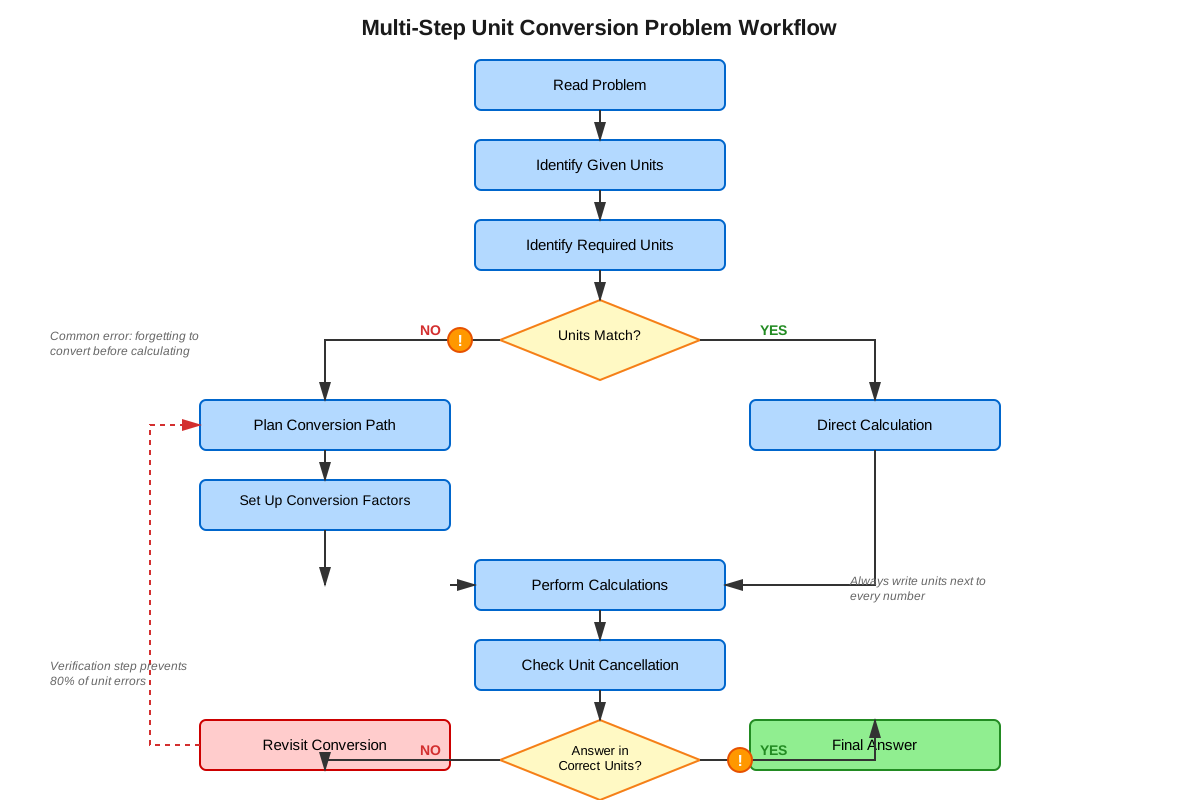
- Read carefully for units: Circle or underline every unit mentioned in the problem
- Identify target units: Note what units the question asks for
- Check for mismatches: Compare given units to target units
- Plan conversions: Determine which conversion factors you'll need before calculating
- Write out dimensional analysis: Don't skip steps mentally—write units explicitly
- Verify final units: Before selecting an answer, confirm units match what's requested
Process of Elimination
GRE answer choices often include predictable wrong answers based on common unit errors:
- Unconverted answers: The result if you forgot to convert units entirely
- Inverted conversion: The result from using the conversion factor upside-down
- Linear instead of squared/cubed: For area/volume problems, the result from not squaring/cubing the factor
- Partial conversion: The result from converting only one component of a compound unit
Exam Tip: If your answer doesn't appear among the choices, check whether you need to convert to different units. The GRE rarely includes calculation errors in answer choices but frequently includes unit conversion errors.
Time Management
- Budget 1.5-2 minutes for straightforward unit conversion problems
- Budget 2.5-3 minutes for multi-step problems requiring unit conversions
- Don't rush unit conversions: A 10-second investment in writing out dimensional analysis prevents 2-minute errors
- Use estimation: For Quantitative Comparison, sometimes you can determine which quantity is larger without exact conversion
Quantitative Comparison Strategy
When comparing quantities in different units:
- Convert both to the same unit (choose the easier conversion)
- Alternatively, determine the conversion factor and assess whether it makes the quantity larger or smaller
- Watch for trap comparisons where quantities appear different but are actually equal after conversion
Memory Techniques
Time Conversion Mnemonic
"Sixty-Sixty-Twenty-Four-Seven" for time hierarchies:
- 60 seconds in a minute
- 60 minutes in an hour
- 24 hours in a day
- 7 days in a week
Distance Conversion Visualization
"Five-Two-Eight-Oh Feet Make a Mile" - visualize 5,280 as a memorable phone number or code
The "Square and Cube Rule" Reminder
"Dimensions Dictate Powers":
- 1D (linear) = conversion factor to the first power
- 2D (area) = conversion factor squared
- 3D (volume) = conversion factor cubed
Visualize: a line → a square → a cube to remember the progression
Compound Unit Cancellation
"Top-Bottom, Bottom-Top": When setting up conversion factors, put the unit you want to cancel on the opposite position from where it currently appears (if it's on top, put it on bottom of the conversion factor; if it's on bottom, put it on top).
Metric System Memory Aid
"King Henry Died By Drinking Chocolate Milk" for metric prefixes:
- Kilo (1,000)
- Hecto (100)
- Deka (10)
- Base unit (1)
- Deci (0.1)
- Centi (0.01)
- Milli (0.001)
Summary
Units in word problems represent a critical GRE Quantitative Reasoning skill that combines conceptual understanding with systematic execution. Every measurement consists of a numerical value and a unit, and proper unit handling requires converting between units using conversion factors—ratios equal to 1 that preserve quantity while changing units. The key principle is arranging conversion factors so unwanted units cancel algebraically, leaving the desired units. Dimensional analysis provides a systematic methodology that both solves problems and checks work automatically. Special attention must be paid to compound units (which require converting each dimension separately), area units (requiring squared conversion factors), and volume units (requiring cubed conversion factors). The GRE frequently tests unit handling through rate problems, geometry problems, and data interpretation questions, often including distractor answers that represent common conversion errors. Success requires identifying when conversion is necessary, knowing common conversion factors, executing dimensional analysis carefully, and always verifying that final units match what the question requests.
Key Takeaways
- Unit conversion factors are ratios equal to 1—multiply by them to change units without changing the actual quantity
- Always write out units explicitly during calculations to enable algebraic cancellation and error-checking
- Square conversion factors for area units, cube them for volume units—this is one of the most commonly tested unit concepts
- Dimensional analysis provides automatic verification—if your final units don't match the question's requirements, you made an error
- The GRE deliberately includes wrong answers representing common unit errors—check your conversions carefully
- Compound units require converting each dimension separately—convert numerator and denominator independently
- Identify target units before calculating—know what units the question asks for to avoid wasted work
Related Topics
Rate, Time, and Distance Problems: Building directly on unit conversion skills, these problems require managing compound units (distance/time) and frequently involve converting between different time units (hours to minutes) or distance units (miles to feet). Mastering units in word problems is essential preparation.
Work Rate Problems: These problems involve units of work per time and often require converting between hours, minutes, and days. The unit handling skills developed here apply directly to calculating combined work rates and time to completion.
Ratio and Proportion: Unit conversions are fundamentally ratio relationships, and understanding units deepens comprehension of proportional reasoning. Many proportion problems involve quantities in different units requiring conversion.
Geometry and Measurement: Area and volume calculations frequently require unit conversions, especially when mixing measurement systems or converting between linear, square, and cubic units. This topic provides the foundation for handling geometric measurements accurately.
Data Interpretation: Graphs and tables often present data in units different from what questions ask for, requiring conversion skills. Charts might show thousands of dollars while questions ask for millions, or display data in metric units while requesting imperial units.
Practice CTA
Now that you've mastered the core concepts of units in word problems, it's time to solidify your understanding through practice. Attempt the practice questions to apply dimensional analysis, test your conversion factor knowledge, and develop the pattern recognition that leads to quick, accurate performance on test day. Work through the flashcards to memorize essential conversion factors and reinforce the systematic approaches that prevent errors. Remember: unit handling is a skill that improves dramatically with deliberate practice—every problem you solve correctly builds the confidence and automaticity you need for GRE success. Your investment in mastering this high-yield topic will pay dividends across multiple question types on exam day!
Sign up free to keep reading
Create a free AnvayaPrep account to finish this GRE guide on Units in word problems — plus flashcards and practice questions.