Overview
Variable definition is a foundational skill in GRE Quantitative Reasoning that involves translating word problems into mathematical expressions by assigning appropriate variables to unknown quantities. This process forms the critical bridge between verbal problem descriptions and algebraic solutions. When students encounter complex word problems on the GRE, success depends on their ability to systematically identify what is unknown, represent these unknowns with variables, and establish relationships between them using equations. The skill of gre variable definition extends beyond simple substitution—it requires strategic thinking about which quantities to represent directly, which to express in terms of others, and how to minimize complexity while maintaining accuracy.
Mastering variable definition is essential for the GRE because approximately 30-40% of Quantitative Reasoning questions involve word problems that require translating verbal information into mathematical form. Without proper variable definition, students often create unnecessarily complicated equations, miss critical relationships between quantities, or set up problems incorrectly from the start. The ability to define variables efficiently separates high-scoring test-takers from those who struggle with time management and accuracy. This skill is particularly crucial for multi-step problems involving rates, mixtures, age relationships, work problems, and geometric scenarios where multiple unknowns interact.
Within the broader landscape of Quantitative Reasoning, variable definition serves as the entry point for algebraic problem-solving. It connects directly to equation-solving, systems of equations, inequalities, and optimization problems. Strong variable definition skills enable students to approach unfamiliar problem types with confidence, knowing they can systematically break down any scenario into manageable mathematical components. This topic also reinforces logical reasoning and analytical thinking—core competencies that the GRE assesses across all question types.
Learning Objectives
- [ ] Identify when Variable definition is being tested
- [ ] Explain the core rule or strategy behind Variable definition
- [ ] Apply Variable definition to GRE-style questions accurately
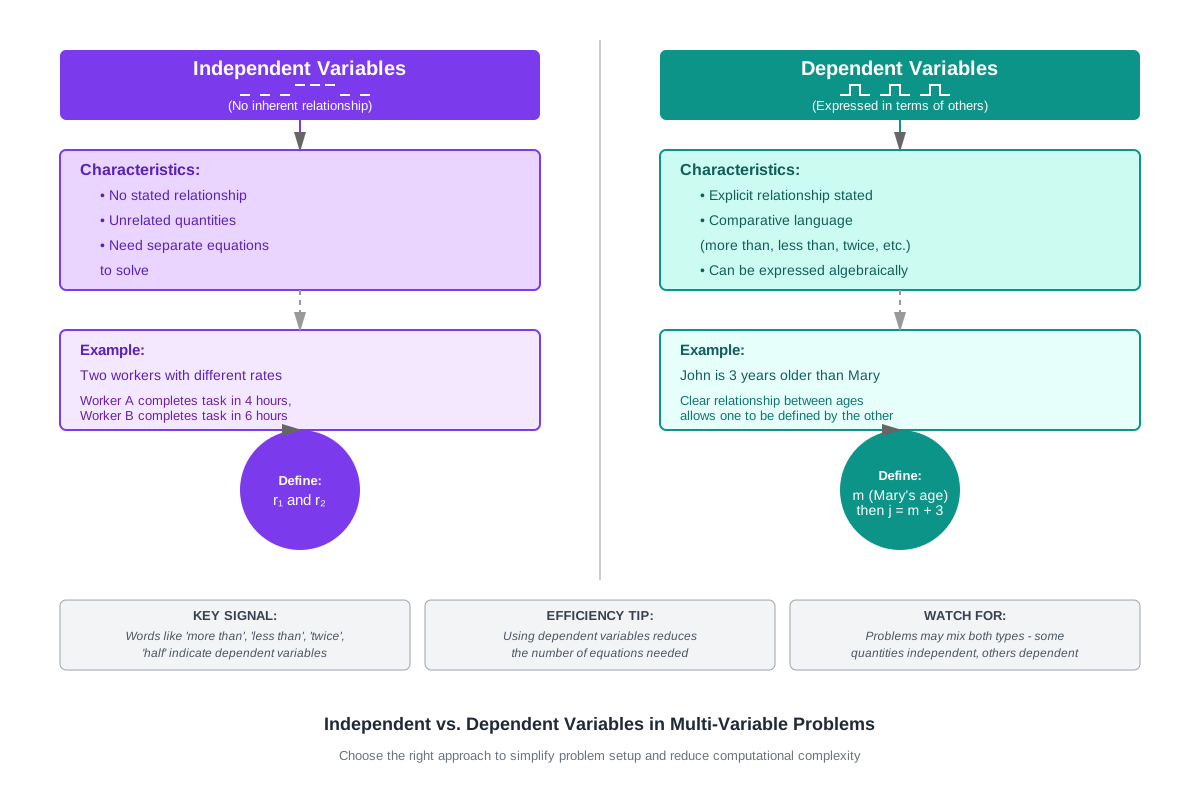
- [ ] Distinguish between dependent and independent variables in multi-variable scenarios
- [ ] Construct efficient variable systems that minimize algebraic complexity
- [ ] Translate complex verbal relationships into precise mathematical expressions using appropriate variables
Prerequisites
- Basic algebra: Understanding how to manipulate algebraic expressions and solve linear equations is essential because variable definition leads directly to equation formation and solution
- Reading comprehension: The ability to parse complex sentences and identify key information is necessary because word problems embed mathematical relationships within verbal descriptions
- Arithmetic operations: Fluency with addition, subtraction, multiplication, and division enables quick translation of verbal operations into mathematical symbols
- Ratio and proportion concepts: Understanding relationships between quantities helps in defining variables that represent comparative or relative values
Why This Topic Matters
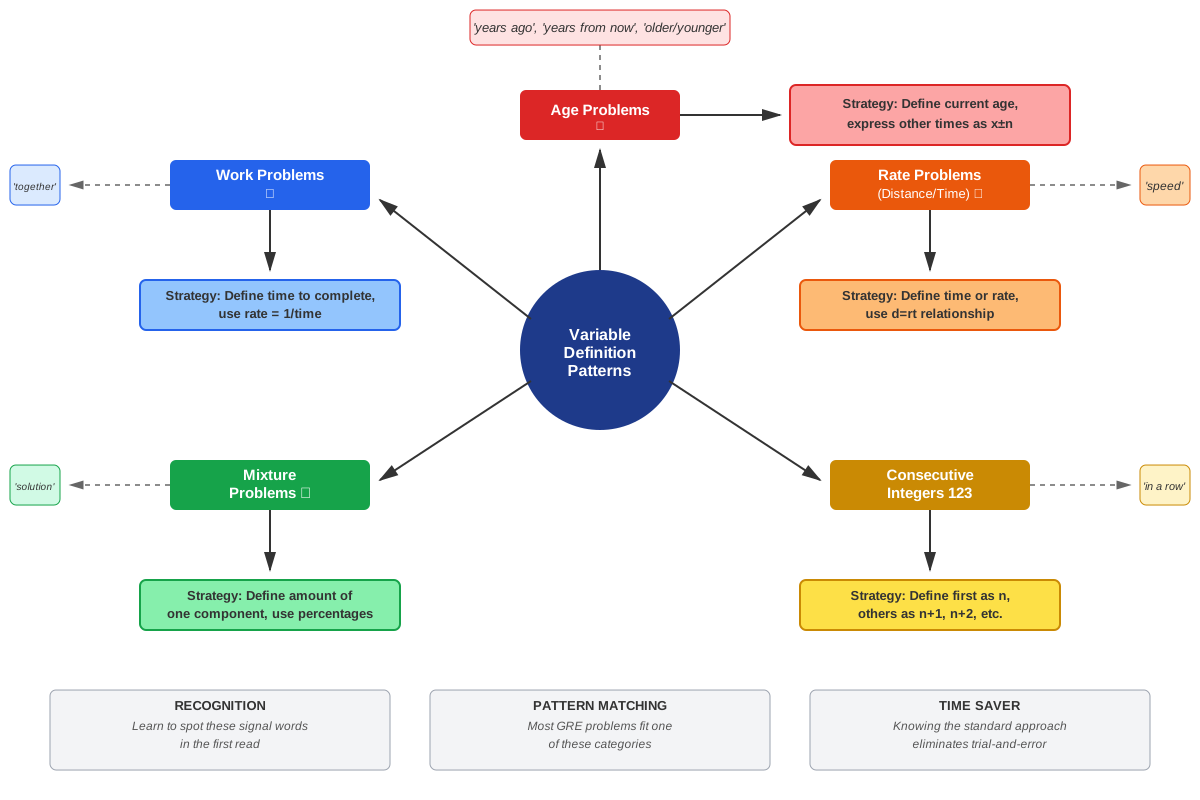
Variable definition appears in virtually every word problem on the GRE Quantitative Reasoning section, making it one of the most frequently tested skills. Research on GRE question patterns shows that approximately 12-15 questions per test require explicit variable definition, while many others benefit from this approach even when alternative methods exist. The skill appears across diverse problem types: age problems, distance-rate-time scenarios, work problems, mixture problems, consecutive integer questions, geometric relationships, and percentage applications.
In real-world applications, variable definition represents the fundamental process of mathematical modeling—taking complex situations and representing them with precise mathematical structures. This skill is essential in fields ranging from economics and engineering to data science and operations research. Professionals regularly translate business problems, scientific phenomena, and social patterns into mathematical models, making variable definition a transferable skill with lasting value beyond test preparation.
On the GRE specifically, variable definition questions appear in both Quantitative Comparison and Problem Solving formats. Test-makers often embed variable definition challenges within multi-step problems where incorrect initial setup leads to wasted time and wrong answers. The exam frequently tests whether students can identify the most efficient variable to define first, recognize when multiple variables are necessary, and understand relationships between dependent and independent quantities. Common question stems include phrases like "in terms of," "express as," and "if x represents," signaling that variable definition skills are being directly assessed.
Core Concepts
The Fundamental Principle of Variable Definition
The core principle of variable definition is to represent unknown quantities with symbols (typically letters) in a way that facilitates problem-solving while maintaining clarity about what each symbol represents. A well-defined variable has three essential components: a symbol (like x, y, or n), a clear description of what quantity it represents, and appropriate units or context. For example, "let x = the number of hours worked" is complete, while "let x = hours" lacks precision about whether x represents a specific person's hours, total hours, or something else.
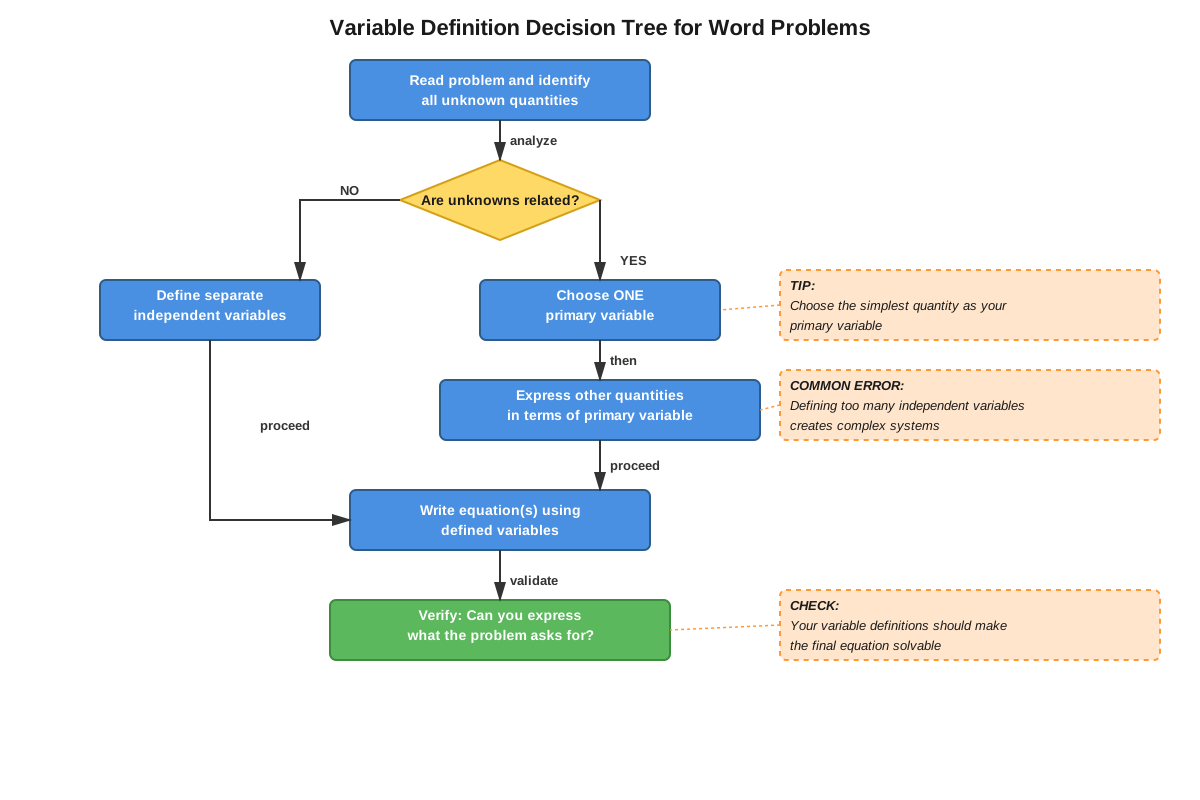
The strategic aspect of variable definition involves choosing which unknown to represent with your primary variable. This choice significantly impacts problem difficulty. Generally, define your variable as the quantity the problem asks you to find, or as the most fundamental unknown from which other quantities can be expressed. This approach minimizes the number of variables needed and simplifies subsequent algebraic manipulation.
Single Variable vs. Multiple Variable Systems
Single-variable problems occur when all unknown quantities can be expressed in terms of one variable. For example, if two consecutive integers exist, defining x as the first integer automatically makes the second integer (x + 1). The key skill is recognizing relationships that allow multiple unknowns to be expressed using a single variable, reducing system complexity.
Multiple-variable systems become necessary when unknowns are independent—no direct relationship exists that allows expressing one in terms of another. For instance, if John and Mary have different amounts of money with no stated relationship, you need separate variables: j for John's amount and m for Mary's amount. The problem statement will then provide equations relating these variables.
| Scenario Type | Variable Approach | Example |
|---|---|---|
| Consecutive integers | Single variable | x, x+1, x+2 |
| Two quantities with stated ratio | Single variable | x and 3x (if ratio is 1:3) |
| Two independent quantities | Two variables | x and y |
| Three quantities with two relationships | Two or three variables | Depends on relationship structure |
Expressing Dependent Relationships
Many GRE problems involve dependent variables—quantities whose values depend on other quantities. Recognizing and expressing these dependencies correctly is crucial. Common dependency patterns include:
Complementary relationships: When two quantities sum to a known total, define one as x and express the other as (total - x). For example, if a 100-question test has multiple choice and free response questions, defining m as multiple choice questions makes the free response questions (100 - m).
Proportional relationships: When quantities maintain a constant ratio, define one as x and express others as multiples. If Sarah has twice as many books as Tom, define t as Tom's books and 2t as Sarah's books.
Sequential relationships: For consecutive integers, consecutive even integers, or consecutive odd integers, use x, (x+1), (x+2) or x, (x+2), (x+4) respectively.
Rate-based relationships: In distance-rate-time problems, if rate is constant, distance and time are proportional. Define one variable and express the other using the rate relationship.
The "In Terms Of" Construction
GRE questions frequently ask students to express one quantity "in terms of" another, directly testing variable definition skills. This construction requires identifying the independent variable (the one given in the "in terms of" phrase) and expressing the target quantity using only that variable and constants. For example, "Express the total cost in terms of n, the number of items purchased" means your final answer should contain only n, numbers, and operation symbols—no other variables.
Constraint Identification
Effective variable definition includes recognizing constraints—limitations on what values variables can take. These constraints often come from real-world context: you cannot have negative numbers of people, fractional numbers of discrete objects, or times that exceed 24 hours in a day. Identifying constraints helps eliminate impossible answers and guides problem-solving strategy. For instance, if x represents the number of students in a class, x must be a positive integer, immediately eliminating any negative or fractional solutions.
Variable Definition in Geometric Problems
Geometric word problems require special attention to variable definition because multiple quantities (lengths, angles, areas) often interrelate through geometric principles. The strategy is to define variables for the most fundamental measurements and express derived quantities using geometric formulas. For a rectangle problem, define length as l and width as w, then express perimeter as 2l + 2w and area as lw. For similar figures, define one dimension and express corresponding dimensions using the scale factor.
Concept Relationships
Variable definition serves as the foundation that connects to virtually all algebraic problem-solving on the GRE. The relationship flow typically follows this pattern:
Word Problem → Variable Definition → Equation Formation → Algebraic Manipulation → Solution → Interpretation
Within the topic itself, the concepts build hierarchically. Understanding single-variable definition precedes multiple-variable systems. Recognizing when quantities are dependent versus independent determines whether single or multiple variables are needed. The "in terms of" construction represents an advanced application that combines variable definition with algebraic manipulation.
Variable definition connects backward to prerequisite topics: basic algebra provides the manipulation skills needed after variables are defined, while reading comprehension enables extraction of mathematical relationships from verbal descriptions. It connects forward to systems of equations (which require defining multiple variables), inequalities (where variables must satisfy constraints), and optimization problems (where variables represent quantities to be maximized or minimized).
The relationship between variable definition and equation formation is particularly tight—poor variable definition leads to unnecessarily complex equations, while strategic variable definition produces elegant, easily-solved equations. This relationship exemplifies how foundational skills compound: investing time in careful variable definition saves time in subsequent solution steps.
Quick check — test yourself on Variable definition so far.
Try Flashcards →High-Yield Facts
⭐ Define your variable as the quantity the problem asks you to find whenever possible—this minimizes the steps needed to reach your final answer
⭐ When two quantities sum to a known total, define one as x and express the other as (total - x) to create a single-variable problem
⭐ Consecutive integers are represented as x, (x+1), (x+2); consecutive even or odd integers as x, (x+2), (x+4)
⭐ In ratio problems, if the ratio of A to B is m:n, define A as mx and B as nx for some variable x
⭐ Always write a clear statement of what your variable represents, including units: "let x = the number of hours" not just "let x = hours"
- In age problems, define variables for current ages and express past or future ages by subtracting or adding the time difference
- For rate problems (distance, work, flow), identify which quantity is constant and define variables for the changing quantities
- When a problem involves percentages of an unknown quantity, define the unknown base quantity as your variable
- If a problem gives information about differences between quantities, define one quantity as x and express others as x + difference or x - difference
- In mixture problems, define variables for the amounts of each component or for the total amount, depending on what's asked
- Variables representing counts of discrete objects (people, items, events) must be non-negative integers—use this constraint to eliminate impossible answers
Common Misconceptions
Misconception: Any letter can represent any quantity without explicit definition → Correction: Every variable must be clearly defined with a statement explaining exactly what quantity it represents. Writing "let x = 5" is meaningless without context; you must write "let x = the number of apples, then x = 5."
Misconception: More variables always mean more complexity, so always try to use just one variable → Correction: When quantities are truly independent with no stated relationship, forcing a single-variable approach creates artificial complexity. Use multiple variables when appropriate, then use the given relationships to form equations.
Misconception: In consecutive integer problems, you must start with the smallest integer → Correction: You can define any of the consecutive integers as your variable. Sometimes defining the middle integer (especially in odd-numbered sequences) simplifies the algebra.
Misconception: The variable must always be called "x" → Correction: Choose variable names that make sense for the problem context. Using "r" for rate, "t" for time, or "n" for number of items improves clarity and reduces errors.
Misconception: Variable definition is just the first step and doesn't affect the rest of the solution → Correction: Strategic variable definition dramatically impacts solution efficiency. Poor initial variable choices can turn a simple problem into an algebraic nightmare, while optimal choices make solutions nearly trivial.
Misconception: If a problem mentions multiple quantities, you need a separate variable for each → Correction: Look for relationships that allow expressing multiple quantities in terms of fewer variables. Two quantities with a stated ratio, sum, or difference can often be expressed using a single variable.
Worked Examples
Example 1: Age Problem with Dependent Variables
Problem: Maria is currently three times as old as her daughter Sofia. In 12 years, Maria will be twice as old as Sofia. How old is Maria now?
Solution:
Step 1: Identify what we need to find
The problem asks for Maria's current age.
Step 2: Define variables strategically
Since we need Maria's age and there's a relationship between the two ages, we could define either age as our variable. Let's define:
- Let s = Sofia's current age (in years)
- Then Maria's current age = 3s (since Maria is three times Sofia's age)
Step 3: Express the future relationship
In 12 years:
- Sofia's age will be: s + 12
- Maria's age will be: 3s + 12
Step 4: Set up the equation using the second condition
"Maria will be twice as old as Sofia" translates to:
3s + 12 = 2(s + 12)
Step 5: Solve
3s + 12 = 2s + 24
3s - 2s = 24 - 12
s = 12
Step 6: Answer the question asked
Sofia is currently 12 years old, so Maria is currently 3(12) = 36 years old.
Step 7: Verify
Currently: Maria (36) is three times Sofia's age (12) ✓
In 12 years: Maria (48) will be twice Sofia's age (24) ✓
Connection to learning objectives: This example demonstrates identifying dependent variables (Maria's age depends on Sofia's age through the "three times" relationship), choosing an efficient variable definition (defining the smaller quantity simplified the arithmetic), and translating verbal relationships into precise equations.
Example 2: Mixture Problem with Multiple Variables
Problem: A chemist needs to create 100 liters of a 30% acid solution by mixing a 20% acid solution with a 50% acid solution. How many liters of the 20% solution should be used?
Solution:
Step 1: Identify unknowns
We need to find the amount of 20% solution. There are two unknown quantities: amount of 20% solution and amount of 50% solution.
Step 2: Define variables
Let x = liters of 20% acid solution
Let y = liters of 50% acid solution
Step 3: Identify relationships
The total volume must be 100 liters: x + y = 100
The total amount of pure acid must equal 30% of 100 liters.
Step 4: Set up the acid equation
Pure acid from 20% solution: 0.20x
Pure acid from 50% solution: 0.50y
Pure acid in final mixture: 0.30(100) = 30
Therefore: 0.20x + 0.50y = 30
Step 5: Solve the system
From equation 1: y = 100 - x
Substitute into equation 2:
0.20x + 0.50(100 - x) = 30
0.20x + 50 - 0.50x = 30
-0.30x = -20
x = 66.67 liters
Step 6: Verify
66.67 liters of 20% solution + 33.33 liters of 50% solution = 100 liters ✓
Pure acid: 0.20(66.67) + 0.50(33.33) = 13.33 + 16.67 = 30 liters ✓
30 liters of acid in 100 liters = 30% ✓
Connection to learning objectives: This example shows when multiple variables are necessary (two independent quantities with no direct ratio), how to identify constraint equations (total volume), and how to translate percentage relationships into algebraic expressions.
Exam Strategy
When approaching GRE questions that require variable definition, follow this systematic process:
Step 1: Read the entire problem first before defining any variables. Understanding what the question asks is crucial for choosing efficient variables. Circle or underline what you need to find.
Step 2: Identify trigger phrases that signal variable definition:
- "Let x represent..."
- "In terms of..."
- "Express... as..."
- "If n is the number of..."
- Phrases describing unknowns: "a certain number," "some amount," "a person's age"
Step 3: Count the unknowns and relationships. If you have n unknowns, you need n independent equations to solve. If the problem provides fewer relationships, look for dependencies that allow expressing multiple unknowns with fewer variables.
Step 4: Choose your primary variable strategically:
- Define the quantity the problem asks for, if possible
- In comparison problems, define the smaller or simpler quantity
- In sequential problems, consider defining the middle term
- Use intuitive variable names (r for rate, t for time, n for number)
Step 5: Write explicit definitions. On your scratch paper, write "Let x = [complete description with units]." This prevents confusion in multi-step problems.
Exam Tip: If you find yourself with three or more variables in a GRE problem, you've likely missed a relationship that would allow using fewer variables. Re-read the problem for ratios, sums, or other dependencies.
Time allocation: Spend 15-20% of your problem-solving time on careful variable definition. This upfront investment prevents costly errors and reduces total solution time. For a 2-minute problem, spending 20-25 seconds on variable definition is appropriate.
Process of elimination: After defining variables and setting up equations, check whether your variable definitions allow for the answer choices given. If the problem asks for "the number of students" and your variable represents "the number of classrooms," you'll need an extra step to convert your answer.
Memory Techniques
The DEFINE acronym for variable definition:
- Determine what the question asks for
- Examine all unknown quantities
- Find relationships between unknowns
- Identify the most efficient variable to define first
- Name your variable with a clear, complete statement
- Express other unknowns in terms of your variable(s)
Visualization strategy: Picture the problem scenario as a labeled diagram. For age problems, draw a timeline. For mixture problems, draw containers. For distance problems, draw a path. Then label unknown quantities with variables directly on your diagram.
The "Total Trick" mnemonic: When two parts make a whole, remember "Total One Part" → define one part as x, express the other as (Total - x). This works for complementary angles (90° - x), supplementary angles (180° - x), budget allocations, time divisions, and many other scenarios.
Consecutive integer patterns:
- Regular: x, x+1, x+2 (think: "add one each time")
- Even/Odd: x, x+2, x+4 (think: "skip one each time")
- Remember: consecutive even integers and consecutive odd integers use the same pattern!
Summary
Variable definition is the essential skill of translating word problems into mathematical language by representing unknown quantities with symbols and establishing relationships between them. Success requires strategic thinking about which quantities to define directly versus expressing in terms of other variables, recognizing dependencies that allow single-variable solutions, and writing clear, complete variable definitions that include units and context. The most efficient approach defines the variable as the quantity being asked for, uses relationships in the problem to express other unknowns in terms of that variable, and identifies constraints that limit possible values. On the GRE, variable definition appears in approximately 30-40% of Quantitative Reasoning questions across diverse problem types including age problems, mixtures, rates, consecutive integers, and geometric relationships. Mastery requires practice recognizing when quantities are dependent versus independent, translating verbal relationships into precise mathematical expressions, and choosing variable definitions that minimize algebraic complexity in subsequent solution steps.
Key Takeaways
- Always define variables with complete statements including what quantity they represent and appropriate units
- Define your variable as the quantity the problem asks you to find whenever possible to minimize solution steps
- When two quantities sum to a known total, use a single variable: define one as x and express the other as (total - x)
- Recognize dependency patterns: ratios suggest defining one quantity and expressing others as multiples; consecutive sequences have standard forms
- Count unknowns and relationships—you need as many independent equations as unknowns, or you need to express multiple unknowns using fewer variables
- Poor variable definition creates unnecessarily complex algebra; strategic variable definition makes problems significantly easier
- In "express in terms of" questions, your final answer must contain only the specified variable, constants, and operation symbols
Related Topics
Systems of Linear Equations: After defining multiple variables, you'll need techniques for solving systems of two or more equations simultaneously. Mastering variable definition makes system setup straightforward, allowing you to focus on solution methods like substitution and elimination.
Inequalities with Variables: Variable definition extends to problems where unknowns must satisfy inequality constraints rather than equations. The same strategic principles apply, but solutions become ranges rather than specific values.
Functions and Function Notation: Functions represent a formalized way of expressing how one variable depends on another. Strong variable definition skills provide the foundation for understanding domain, range, and function composition.
Optimization Problems: These advanced problems require defining variables for quantities to be maximized or minimized, then expressing constraints and objective functions in terms of those variables.
Algebraic Word Problems (Advanced): More complex scenarios involving work rates, mixture problems with multiple components, and multi-stage processes build directly on fundamental variable definition skills.
Practice CTA
Now that you understand the principles and strategies of variable definition, it's time to solidify your mastery through practice. Attempt the practice questions associated with this topic, focusing on writing clear variable definitions before solving. Use the flashcards to reinforce key patterns like consecutive integer representations and dependency relationships. Remember: every expert problem-solver started by practicing the fundamentals. Your investment in mastering variable definition will pay dividends across every quantitative problem type on the GRE. Start practicing now, and watch your confidence and accuracy soar!
Sign up free to keep reading
Create a free AnvayaPrep account to finish this GRE guide on Variable definition — plus flashcards and practice questions.