Overview
Venn diagram word problems represent a critical category of questions on the GRE Quantitative Reasoning section that test a student's ability to organize, visualize, and manipulate information about overlapping sets. These problems typically present scenarios involving groups with shared characteristics—such as students taking multiple courses, employees with various skills, or survey respondents with different preferences—and require test-takers to determine quantities related to intersections, unions, and complements of these sets. The elegance of Venn diagrams lies in their ability to transform complex verbal information into visual representations that make logical relationships immediately apparent.
On the GRE, gre venn diagram word problems appear with notable frequency, often disguised within data interpretation questions, word problems, or quantitative comparison formats. These questions assess not just mathematical computation but also logical reasoning and the ability to translate verbal descriptions into mathematical relationships. Success with Venn diagram problems requires understanding the principle of inclusion-exclusion, recognizing when information about overlapping categories is being presented, and systematically accounting for all elements without double-counting.
Mastery of Venn diagram word problems connects directly to broader Quantitative Reasoning skills including set theory, probability, data analysis, and logical reasoning. The techniques learned here extend to more complex scenarios involving three or more sets, conditional probability questions, and data sufficiency problems. Furthermore, the organizational thinking required for Venn diagrams strengthens overall problem-solving abilities that benefit performance across the entire GRE Quantitative section.
Learning Objectives
- [ ] Identify when Venn diagram word problems is being tested
- [ ] Explain the core rule or strategy behind Venn diagram word problems
- [ ] Apply Venn diagram word problems to GRE-style questions accurately
- [ ] Construct accurate Venn diagrams from verbal descriptions involving two or three overlapping sets
- [ ] Apply the inclusion-exclusion principle to calculate totals, intersections, and complements
- [ ] Solve for unknown quantities using algebraic equations derived from Venn diagram relationships
- [ ] Distinguish between "only A," "A and B," and "A or B" language in problem statements
Prerequisites
- Basic set notation and terminology: Understanding terms like "union," "intersection," and "complement" provides the mathematical vocabulary needed to interpret Venn diagram relationships
- Algebraic equation solving: Many Venn diagram problems require setting up and solving linear equations with one or more variables
- Word problem translation skills: The ability to convert verbal descriptions into mathematical expressions is essential for extracting information from problem statements
- Basic arithmetic operations: Addition, subtraction, and working with whole numbers form the computational foundation for these problems
Why This Topic Matters
Venn diagram word problems appear in approximately 5-8% of GRE Quantitative Reasoning questions, making them a high-yield topic that can directly impact scores. These problems frequently appear as medium to medium-hard difficulty questions, representing opportunities to earn points that separate good scores from excellent ones. The GRE particularly favors two-set and three-set problems involving real-world scenarios like course enrollment, survey responses, product features, or demographic characteristics.
Beyond the exam context, Venn diagram reasoning reflects critical thinking skills used extensively in data analysis, market research, epidemiology, and business strategy. The ability to analyze overlapping categories appears in contexts ranging from customer segmentation to medical diagnosis to logical argumentation. Professionals regularly use this type of reasoning when analyzing survey data, understanding audience overlap, or making decisions based on multiple criteria.
On the GRE, Venn diagram problems commonly appear as: standalone word problems requiring calculation of specific quantities; quantitative comparison questions asking students to compare two set-related values; data interpretation questions embedded within tables or charts; and data sufficiency questions where students must determine whether given information is adequate to solve for an unknown. The versatility of this question type means students must be prepared to recognize and solve Venn diagram problems across multiple question formats.
Core Concepts
The Fundamental Structure of Venn Diagrams
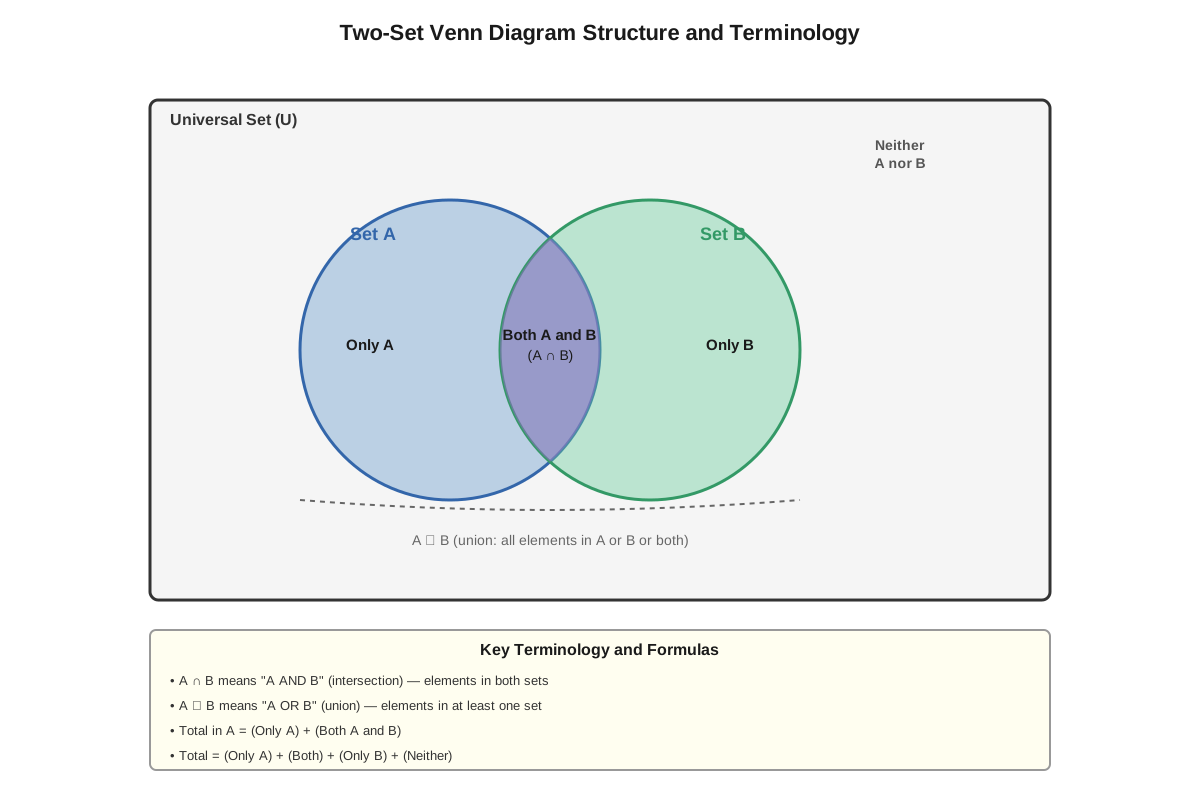
A Venn diagram is a visual representation using overlapping circles (or other closed curves) to show logical relationships between sets. Each circle represents a set of elements sharing a common property, and the spatial relationships between circles illustrate how sets intersect, overlap, or remain distinct. The most common GRE scenarios involve two or three sets, though the underlying principles extend to any number of sets.
For a two-set Venn diagram with sets A and B, four distinct regions exist:
- Elements in A only (A but not B)
- Elements in B only (B but not A)
- Elements in both A and B (the intersection A ∩ B)
- Elements in neither A nor B (outside both circles)
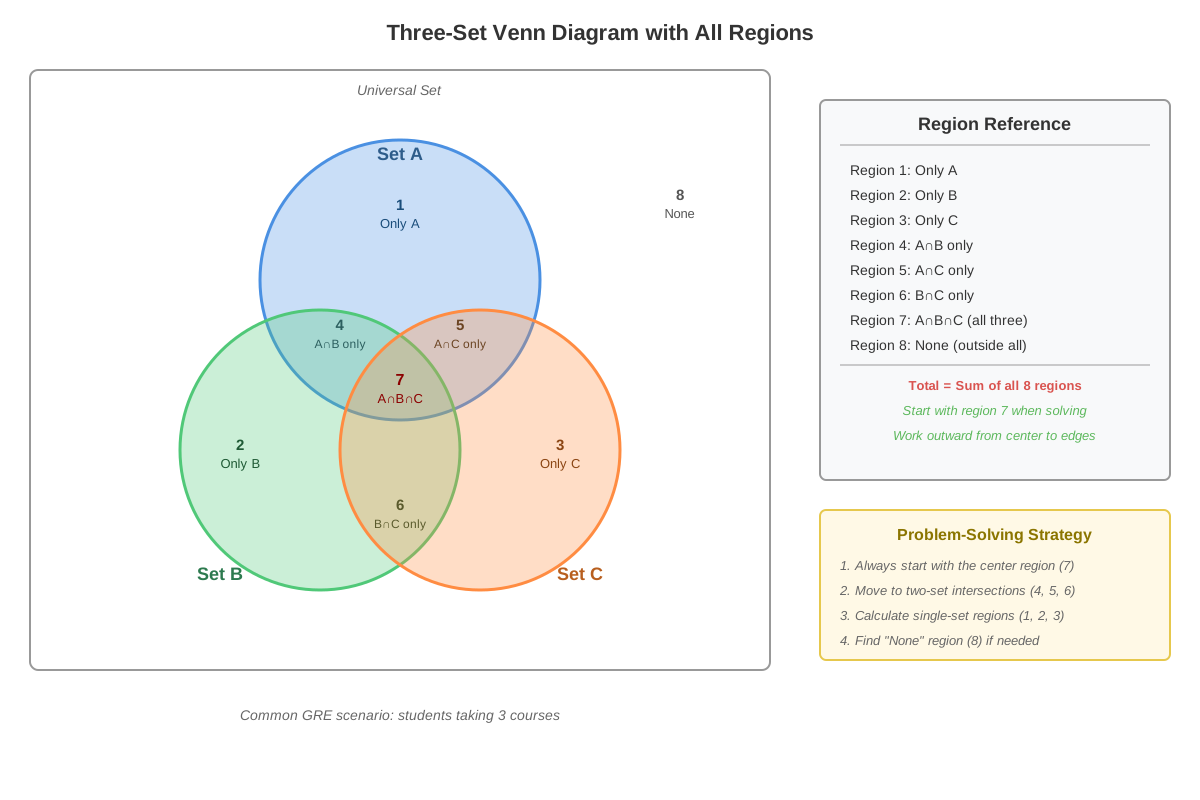
For a three-set Venn diagram with sets A, B, and C, eight distinct regions exist, including the central region where all three sets overlap. Understanding these regions is crucial because GRE problems often provide information about some regions and ask students to calculate others.
The Inclusion-Exclusion Principle
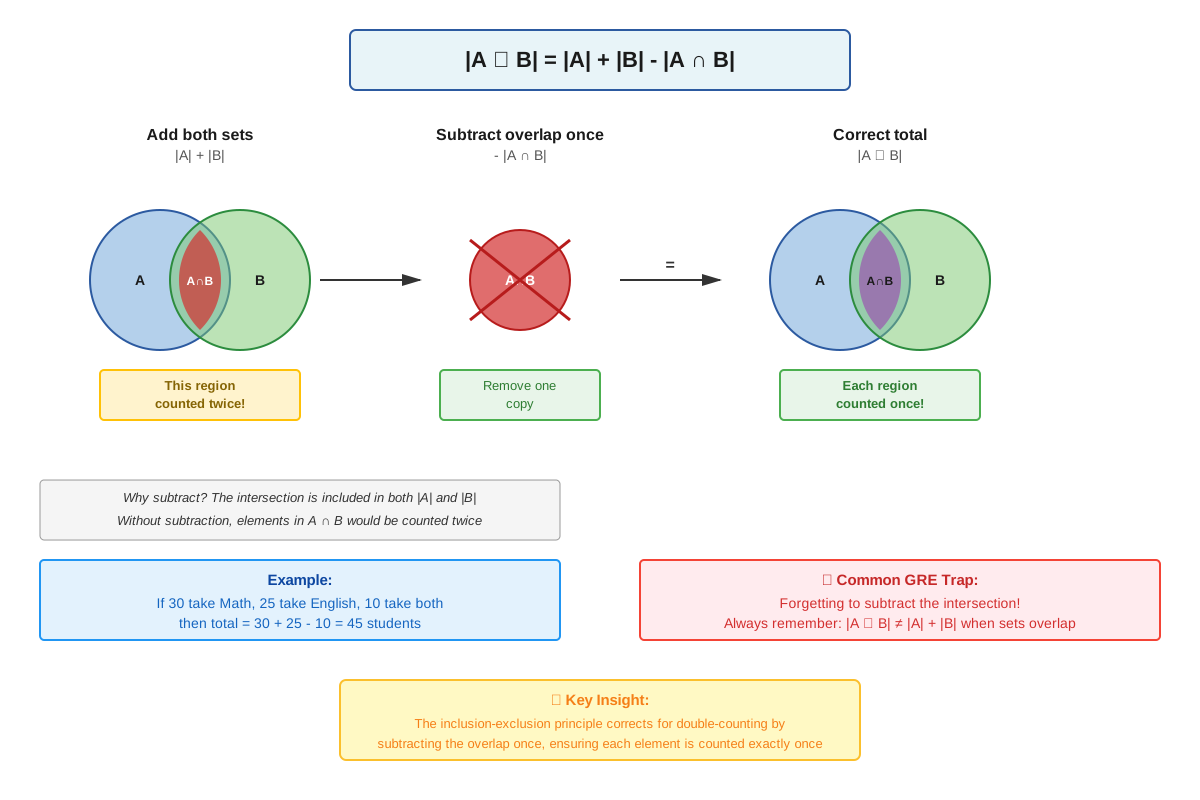
The inclusion-exclusion principle is the mathematical foundation underlying all Venn diagram calculations. For two sets, this principle states:
|A ∪ B| = |A| + |B| - |A ∩ B|Where:
- |A ∪ B| represents the total number of elements in either A or B (or both)
- |A| represents the number of elements in set A
- |B| represents the number of elements in set B
- |A ∩ B| represents the number of elements in both A and B
The subtraction of |A ∩ B| is necessary because when we add |A| and |B|, we count the intersection twice—once as part of A and once as part of B. This principle prevents double-counting, which is the most common error in Venn diagram problems.
For three sets, the inclusion-exclusion principle extends to:
|A ∪ B ∪ C| = |A| + |B| + |C| - |A ∩ B| - |A ∩ C| - |B ∩ C| + |A ∩ B ∩ C|The addition of |A ∩ B ∩ C| at the end corrects for the fact that this central region gets subtracted three times in the pairwise intersections but should only be subtracted twice.
Working from the Inside Out
A critical strategy for solving three-set Venn diagram problems involves working from the inside out. This means:
- First, identify or calculate the central region where all three sets overlap
- Next, determine the three regions where exactly two sets overlap (subtracting the central region from each pairwise intersection)
- Then, calculate the three regions where only one set is present (subtracting all overlaps from each set total)
- Finally, if needed, determine elements outside all sets
This systematic approach prevents errors and ensures all regions are properly accounted for without double-counting.
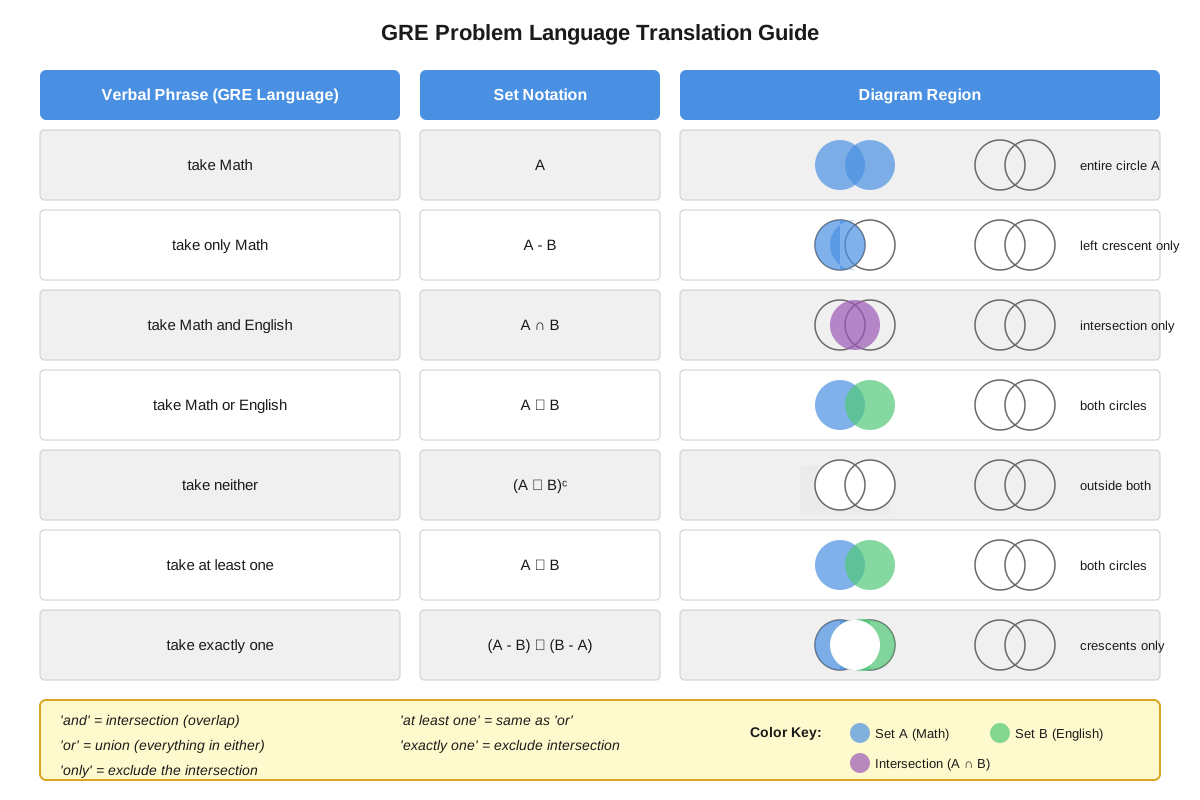
Translating Verbal Descriptions
GRE problems rarely present information using mathematical notation. Instead, they use natural language that must be carefully interpreted:
| Verbal Description | Mathematical Meaning | Venn Diagram Region |
|---|---|---|
| "Only A" or "A but not B" | Elements in A excluding any overlap | A minus all intersections |
| "Both A and B" or "A and B" | Elements in the intersection | A ∩ B (may include three-way overlap) |
| "A or B" or "At least one of A or B" | Elements in either or both | A ∪ B |
| "Exactly one of A or B" | Elements in A or B but not both | (A ∪ B) - (A ∩ B) |
| "Neither A nor B" | Elements outside both sets | Complement of A ∪ B |
| "All three" or "A, B, and C" | Elements in the central region | A ∩ B ∩ C |
Careful attention to these linguistic distinctions is essential, as the GRE deliberately uses similar-sounding phrases that have different mathematical meanings.
Setting Up Equations
Many GRE Venn diagram problems require setting up algebraic equations based on the relationships described. The key steps include:
- Define variables for unknown quantities (often the overlapping regions)
- Express known totals in terms of these variables and given information
- Create equations by setting expressions equal to stated totals
- Solve systematically using substitution or elimination
For example, if told that 50 students take math, 40 take science, 20 take both, and we need to find how many take at least one subject, we can use the inclusion-exclusion principle directly: 50 + 40 - 20 = 70 students.
The Universal Set and Complements
The universal set (often denoted U) represents all elements under consideration in a problem. In GRE contexts, this might be "all survey respondents," "all employees," or "all students in a class." The complement of a set A (denoted A' or Aᶜ) consists of all elements in the universal set that are not in A.
Understanding complements is crucial for problems that ask about "neither A nor B" or provide information about what percentage of the total does NOT have a certain characteristic. The relationship is:
|A'| = |U| - |A|Concept Relationships
The core concepts within Venn diagram word problems form an interconnected system. The inclusion-exclusion principle serves as the mathematical foundation that explains why we must subtract overlapping regions when calculating unions. This principle directly informs the working from the inside out strategy, which provides a systematic method for applying inclusion-exclusion to three-set problems.
Translating verbal descriptions acts as the bridge between the problem statement and mathematical representation, enabling students to identify which regions correspond to which given information. This translation skill then feeds into setting up equations, where verbal information becomes algebraic expressions that can be manipulated to find unknown quantities. The concept of the universal set and complements provides the framework for understanding what "neither" and "outside all sets" means, completing the picture of how all elements are accounted for.
The relationship flow can be visualized as: Verbal Problem → Translation → Venn Diagram Structure → Inclusion-Exclusion Principle → Equations → Solution. Each step depends on the previous one, and weakness in any area compromises the entire problem-solving process.
These concepts connect to prerequisite knowledge of set theory (providing the formal mathematical language), algebraic equation solving (enabling calculation of unknowns), and word problem translation (allowing interpretation of complex scenarios). They also relate forward to probability problems (which often involve calculating ratios of set sizes), data interpretation questions (which may present set information in tables or charts), and logical reasoning questions (which test similar organizational thinking).
High-Yield Facts
⭐ The inclusion-exclusion principle for two sets: Total in A or B = A + B - (A and B)
⭐ For three sets, always start by finding the region where all three overlap before calculating other regions
⭐ "Both A and B" means the intersection, which may include elements also in C in three-set problems
⭐ "Only A" means A excluding all overlaps, not just the total number in A
⭐ The sum of all regions in a Venn diagram must equal the universal set total (use this to check your work)
- When a problem states "20 students take both courses," this refers to the intersection region, not the total overlap in a three-set scenario
- "At least one" means the union of all sets (everything inside at least one circle)
- "Exactly one" means elements in one set but not in any others (requires subtracting all overlaps)
- "Neither A nor B" equals the total minus the union of A and B
- In three-set problems, there are exactly eight distinct regions to account for (including outside all sets)
- If given percentages instead of counts, the same principles apply but calculations use decimal or percentage arithmetic
- The phrase "how many more" requires subtraction of two calculated quantities
- Problems asking for "the minimum" or "the maximum" number in a region often require considering extreme cases of overlap
Quick check — test yourself on Venn diagram word problems so far.
Try Flashcards →Common Misconceptions
Misconception: "Both A and B" in a three-set problem means only the region where A and B overlap but C does not.
Correction: "Both A and B" includes all regions where A and B intersect, including the central region where all three sets overlap. To find "A and B but not C," you must explicitly subtract the three-way intersection.
Misconception: When given "50 in A" and "30 in both A and B," there are 20 in "only A."
Correction: This is only true for two-set problems. In three-set problems, "50 in A" includes all overlaps with B and C, so finding "only A" requires subtracting all overlapping regions, not just one.
Misconception: The inclusion-exclusion formula can be applied by simply adding all given numbers.
Correction: The formula requires careful attention to what each number represents. Intersections must be subtracted because they're counted multiple times when individual sets are added. Simply adding all numbers will overcount overlapping elements.
Misconception: If 40% of respondents chose A and 50% chose B, then 90% chose at least one.
Correction: This is only true if A and B don't overlap. The actual percentage choosing at least one equals 40% + 50% - (percentage choosing both), which requires information about the intersection.
Misconception: "Neither A nor B" is the same as "not A and not B" and can be found by subtracting A and B separately from the total.
Correction: While "neither A nor B" and "not A and not B" are logically equivalent, finding this quantity requires subtracting the union (A ∪ B) from the total, not subtracting A and B separately, which would incorrectly handle the overlap.
Misconception: In a three-set problem, if you know all three individual set sizes and all three pairwise intersections, you can find the three-way intersection by subtraction.
Correction: You need additional information (like the total in at least one set) to determine the three-way intersection. The pairwise intersections include the three-way intersection, so knowing them doesn't uniquely determine it.
Worked Examples
Example 1: Two-Set Problem with Algebraic Setup
Problem: In a survey of 100 people, 60 drink coffee, 45 drink tea, and 15 drink neither. How many people drink both coffee and tea?
Solution:
Step 1: Identify what we're looking for and what we know.
- Universal set: 100 people
- Set C (coffee drinkers): 60 people
- Set T (tea drinkers): 45 people
- Neither: 15 people
- Find: |C ∩ T| (both coffee and tea)
Step 2: Recognize that if 15 drink neither, then 100 - 15 = 85 people drink at least one beverage.
Step 3: Apply the inclusion-exclusion principle.
|C ∪ T| = |C| + |T| - |C ∩ T|
85 = 60 + 45 - |C ∩ T|
85 = 105 - |C ∩ T|
|C ∩ T| = 105 - 85 = 20
Step 4: Verify the answer makes sense.
- Coffee only: 60 - 20 = 40
- Tea only: 45 - 20 = 25
- Both: 20
- Neither: 15
- Total: 40 + 25 + 20 + 15 = 100 ✓
Answer: 20 people drink both coffee and tea.
This problem demonstrates the core strategy of using the inclusion-exclusion principle and the importance of accounting for the "neither" category to find the union total.
Example 2: Three-Set Problem with Inside-Out Approach
Problem: In a class of 50 students, 30 study French, 25 study Spanish, and 20 study German. Additionally, 12 study both French and Spanish, 8 study both French and German, 6 study both Spanish and German, and 4 study all three languages. How many students study none of these languages?
Solution:
Step 1: Draw a three-circle Venn diagram and work from the inside out.
Step 2: Start with the center (all three languages): 4 students
Step 3: Find the regions where exactly two languages overlap:
- French and Spanish only (not German): 12 - 4 = 8 students
- French and German only (not Spanish): 8 - 4 = 4 students
- Spanish and German only (not French): 6 - 4 = 2 students
Step 4: Find the regions where only one language is studied:
- Only French: 30 - 8 - 4 - 4 = 14 students
- Only Spanish: 25 - 8 - 2 - 4 = 11 students
- Only German: 20 - 4 - 2 - 4 = 10 students
Step 5: Sum all regions inside the circles:
14 + 11 + 10 + 8 + 4 + 2 + 4 = 53 students
Step 6: This presents a problem! We have 53 students studying at least one language, but only 50 students total. Let's verify our calculations...
Actually, let me recalculate Step 4 more carefully:
- Only French: 30 - (8 + 4 + 4) = 30 - 16 = 14 students
- Only Spanish: 25 - (8 + 2 + 4) = 25 - 14 = 11 students
- Only German: 20 - (4 + 2 + 4) = 20 - 10 = 10 students
Step 5 (corrected): Sum all regions:
14 + 11 + 10 + 8 + 4 + 2 + 4 = 53 students
This indicates an inconsistency in the problem as stated (which can happen on the GRE as a trap). However, if we proceed with the given numbers:
Students studying none = 50 - 53 = -3, which is impossible.
Important lesson: This example shows why checking your work is crucial. In an actual GRE problem, the numbers would be consistent, but if you get an impossible answer, you should review your calculations. If the problem had stated 55 students total, the answer would be 55 - 53 = 2 students studying none of the languages.
Exam Strategy
Trigger Words: Watch for phrases like "both," "either," "neither," "at least one," "exactly one," "only," and "all three." These signal set relationships and often indicate a Venn diagram approach.
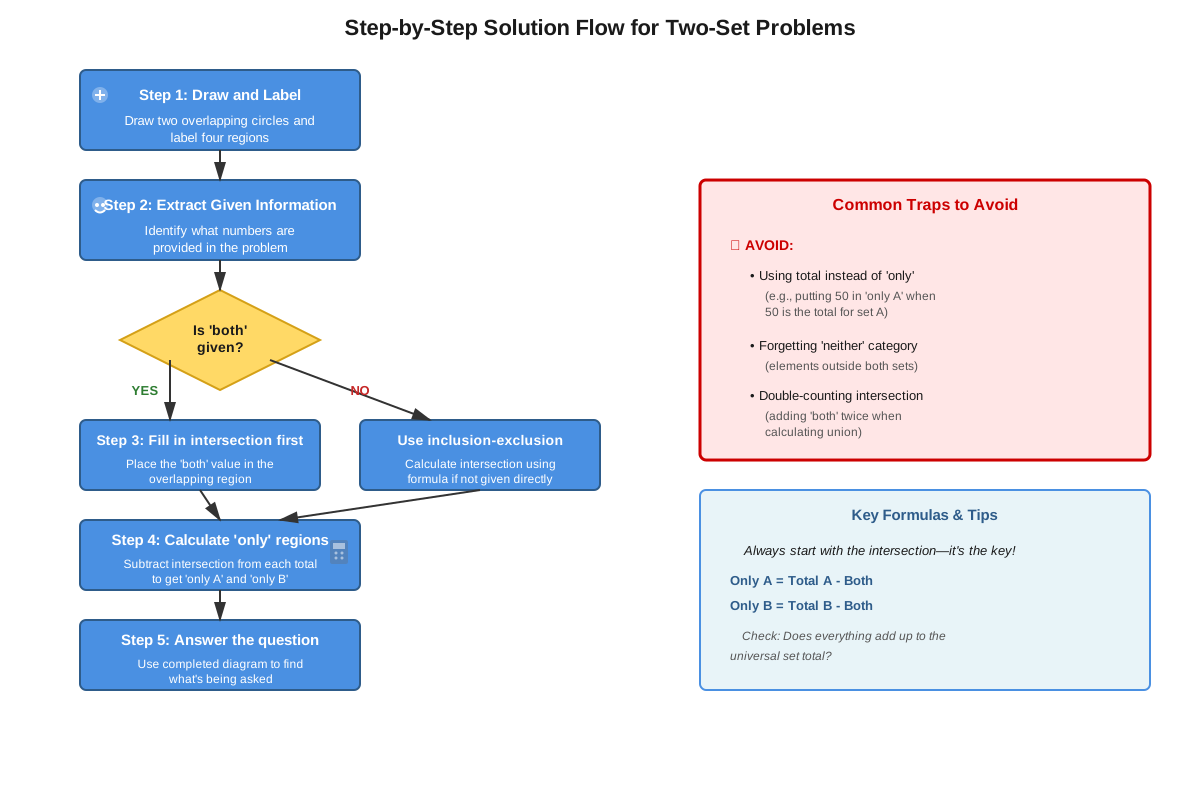
When approaching GRE Venn diagram word problems, follow this systematic process:
Step 1: Recognize the problem type (15-20 seconds)
- Look for scenarios involving overlapping categories or groups
- Identify phrases indicating intersections or unions
- Note whether two or three sets are involved
Step 2: Sketch a quick diagram (20-30 seconds)
- Draw circles for each set, even if roughly
- Label each circle clearly
- This visual reference prevents confusion during calculations
Step 3: Extract and organize information (30-45 seconds)
- Write down all given quantities next to your diagram
- Distinguish between totals, intersections, and "only" regions
- Note what the question asks for specifically
Step 4: Work systematically (60-90 seconds)
- For three-set problems, always start with the center
- Calculate each region methodically
- Use the inclusion-exclusion principle for unions
Step 5: Verify your answer (15-20 seconds)
- Check that all regions sum to the total
- Ensure your answer makes logical sense
- Confirm you answered the actual question asked
Process-of-elimination tips:
- Eliminate answer choices that exceed the total population
- Eliminate answers that are negative (impossible for counts)
- If asked for "at least one," the answer must be less than the sum of all individual sets
- If asked for "both," the answer cannot exceed the smaller of the two sets
Time allocation: Allocate approximately 2-2.5 minutes for two-set problems and 2.5-3 minutes for three-set problems. If you're stuck after 90 seconds, make your best educated guess and move on—these problems can be time-consuming, and spending 4-5 minutes on one question hurts overall performance.
Quantitative Comparison strategy: When Venn diagram concepts appear in QC format, often you can determine the relationship without calculating exact values. Look for whether one quantity must always be larger based on set relationships, or whether the relationship depends on the specific overlap.
Memory Techniques
The "UNION minus OVERLAP" mnemonic: For two sets, remember "U-O" (You Owe):
- Union = Add everything
- Overlap = Subtract what you counted twice
The "Inside-Out" visualization: Picture peeling an onion—start at the center (all three) and work outward layer by layer. This prevents the confusion of three-set problems.
The "BOTH includes ALL" reminder: When you see "both A and B," remember it includes the region where C also appears. Think "BOTH is BIGGER than you think."
The "ONLY means LONELY" technique: "Only A" means A is alone, without B or C. This helps distinguish "only A" from "A total."
The acronym TUNE for problem-solving:
- Translate the verbal description
- Understand what's being asked
- Notate your diagram clearly
- Evaluate using inclusion-exclusion
The "100% check" for percentage problems: All regions must sum to 100%. If they don't, you've made an error. This provides a built-in verification method.
Summary
Venn diagram word problems on the GRE test the ability to organize information about overlapping sets, apply the inclusion-exclusion principle, and systematically calculate quantities in various regions. Success requires recognizing when a problem involves overlapping categories, accurately translating verbal descriptions into mathematical relationships, and working methodically through the regions of a Venn diagram. The fundamental principle—that adding sets together counts overlaps multiple times, requiring subtraction—underlies all calculations. For two-set problems, the formula |A ∪ B| = |A| + |B| - |A ∩ B| is essential. For three-set problems, working from the inside out (starting with the region where all three sets overlap) prevents errors and ensures accurate accounting of all elements. Careful attention to language is critical, as "both A and B," "only A," and "A or B" have distinct mathematical meanings that the GRE exploits. Students must also remember to account for elements outside all sets when given a universal set total. Mastery of these problems provides a reliable source of points on the GRE and strengthens logical reasoning skills applicable across the Quantitative section.
Key Takeaways
- The inclusion-exclusion principle prevents double-counting by subtracting overlapping regions when calculating unions
- "Both A and B" includes all regions where A and B intersect, including three-way overlaps in three-set problems
- Always work from the inside out in three-set problems: start with the center, then two-way overlaps, then single-set regions
- Distinguish carefully between "only A" (A excluding all overlaps) and "A total" (A including all overlaps)
- The sum of all regions must equal the universal set total—use this to verify your calculations
- Sketch a quick Venn diagram for every problem, even if rough, to organize information visually
- Watch for trigger words like "both," "either," "neither," "at least one," and "exactly one" that signal specific set relationships
Related Topics
Set Theory Fundamentals: Understanding formal set notation, operations, and properties provides the mathematical foundation for more advanced Venn diagram applications and connects to discrete mathematics concepts.
Probability with Overlapping Events: Venn diagram reasoning extends directly to probability problems involving non-mutually exclusive events, where calculating P(A ∪ B) requires the same inclusion-exclusion thinking.
Data Interpretation with Multiple Categories: Tables and charts presenting data with overlapping categories require Venn diagram reasoning to extract correct information and avoid double-counting.
Logic and Categorical Reasoning: The logical relationships represented in Venn diagrams connect to formal logic, syllogisms, and the categorical reasoning tested in analytical sections of other standardized tests.
Mastering Venn diagram word problems builds the organizational thinking and systematic problem-solving approach that benefits performance across all GRE Quantitative Reasoning question types.
Practice CTA
Now that you've mastered the core concepts and strategies for Venn diagram word problems, it's time to solidify your understanding through practice. Attempt the practice questions to apply these techniques to GRE-style problems, and use the flashcards to reinforce key formulas and concepts. Remember, Venn diagram problems reward systematic thinking and careful attention to language—skills that improve rapidly with focused practice. Each problem you solve strengthens your pattern recognition and builds the confidence needed to tackle these high-yield questions efficiently on test day. You've got this!
Sign up free to keep reading
Create a free AnvayaPrep account to finish this GRE guide on Venn diagram word problems — plus flashcards and practice questions.