Overview
Counting word problems represent a critical category of quantitative reasoning questions on the GRE that test a student's ability to determine the number of ways events can occur, objects can be arranged, or selections can be made from a set. These problems require systematic thinking and the application of fundamental counting principles, including the multiplication principle, addition principle, permutations, and combinations. Unlike straightforward arithmetic problems, counting word problems demand that test-takers translate complex verbal scenarios into mathematical frameworks, identify the appropriate counting method, and execute calculations accurately under time pressure.
The importance of mastering GRE counting word problems cannot be overstated. These questions appear regularly on the quantitative reasoning sections and often serve as score differentiators between average and high-performing test-takers. The GRE frequently embeds counting principles within real-world contexts such as committee formation, password creation, route planning, and arrangement scenarios. Success requires not just memorizing formulas but developing the conceptual understanding to recognize which counting technique applies to each unique situation.
Within the broader landscape of GRE Quantitative Reasoning, counting problems bridge multiple mathematical domains. They connect to probability (since probability calculations often require counting favorable and total outcomes), set theory (through inclusion-exclusion principles), and logical reasoning (through systematic case analysis). Mastery of counting techniques also enhances performance on data interpretation questions where understanding sample spaces and possible outcomes becomes essential. The analytical skills developed through counting problems—breaking complex scenarios into manageable cases, identifying constraints, and avoiding double-counting—transfer directly to other challenging GRE question types.
Learning Objectives
- [ ] Identify when Counting word problems is being tested
- [ ] Explain the core rule or strategy behind Counting word problems
- [ ] Apply Counting word problems to GRE-style questions accurately
- [ ] Distinguish between permutation and combination scenarios based on problem context
- [ ] Apply the multiplication and addition principles to multi-stage counting problems
- [ ] Recognize and handle counting problems with restrictions or special conditions
- [ ] Verify counting solutions using alternative methods or logical reasoning
Prerequisites
- Basic arithmetic operations: Multiplication and division are fundamental to calculating permutations and combinations
- Factorial notation: Understanding n! (n factorial) is essential since permutation and combination formulas rely on factorial calculations
- Set theory basics: Familiarity with sets, elements, and basic set operations helps in understanding selection and arrangement problems
- Algebraic manipulation: Simplifying expressions involving factorials and solving equations appears frequently in counting problems
- Logical reasoning: The ability to break down complex scenarios into cases and identify constraints is crucial for systematic counting
Why This Topic Matters
Counting problems appear in approximately 10-15% of GRE Quantitative Reasoning questions, making them a high-yield topic for focused study. These questions test mathematical maturity and problem-solving sophistication rather than computational speed, aligning with the GRE's emphasis on analytical thinking. Performance on counting problems strongly correlates with overall quantitative scores, as they require the integration of multiple mathematical concepts and careful logical analysis.
In real-world applications, counting principles underpin decision-making in fields ranging from computer science (algorithm analysis, cryptography) to business (market research, quality control) to genetics (calculating genetic combinations). The systematic thinking required for counting problems—identifying all possibilities without omission or duplication—represents a fundamental analytical skill valued across professional contexts.
On the GRE, counting problems typically appear as quantitative comparison questions, multiple-choice questions with five answer choices, or numeric entry questions. Common scenarios include: forming committees or teams from a group of people, arranging objects in a line or circle, creating passwords or codes with specific requirements, counting paths between locations, selecting items with or without replacement, and determining outcomes when rolling dice or drawing cards. The exam frequently adds complexity through restrictions (certain people must or cannot be together), multiple stages (first select, then arrange), or complementary counting (finding what's NOT possible).
Core Concepts
The Fundamental Counting Principle (Multiplication Principle)
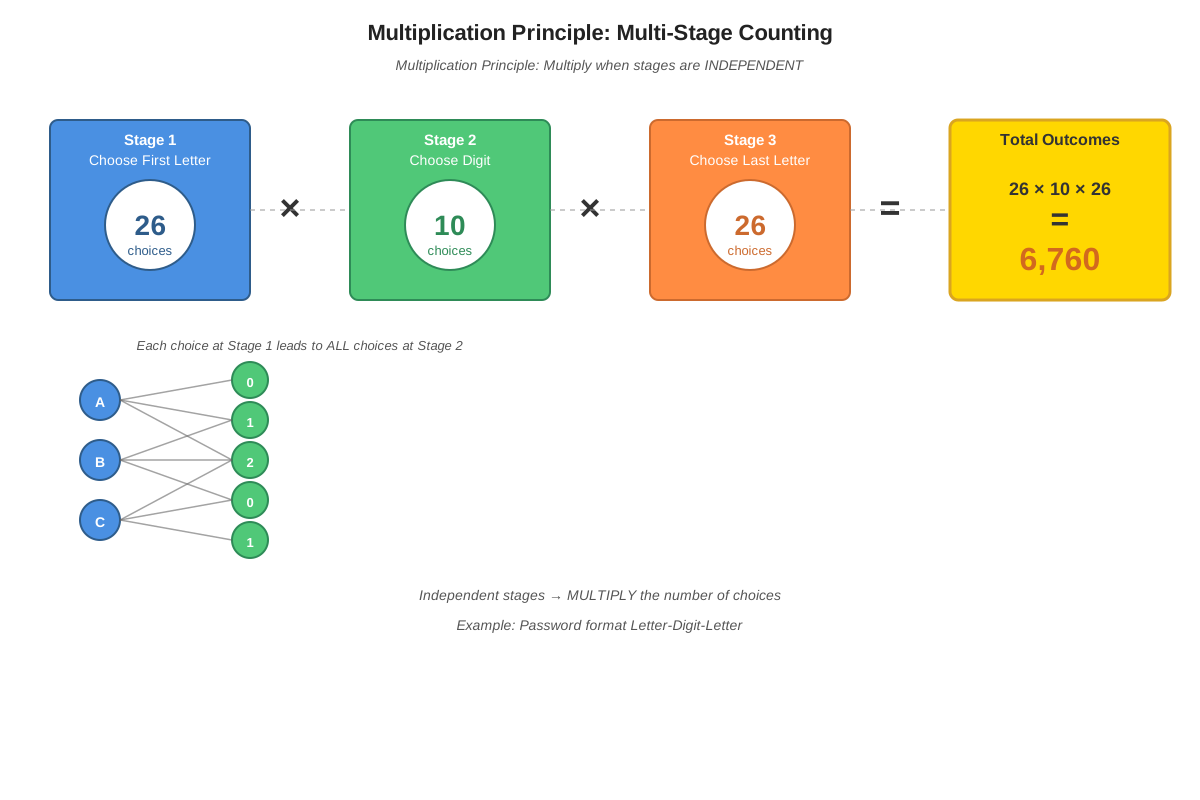
The multiplication principle states that if one event can occur in m ways and a second independent event can occur in n ways, then both events occurring in sequence can happen in m × n ways. This principle extends to any number of sequential events: multiply the number of ways each stage can occur.
For example, if a restaurant offers 4 appetizers, 6 main courses, and 3 desserts, the number of complete three-course meals equals 4 × 6 × 3 = 72. Each choice is independent, and the multiplication principle applies directly.
The multiplication principle becomes the foundation for solving multi-stage counting problems. When a problem describes a sequence of decisions or selections where each stage has a certain number of options, multiply those options together. The key recognition trigger is sequential language: "first... then...", "and", or descriptions of multiple independent choices.
The Addition Principle
The addition principle states that if events are mutually exclusive (cannot occur simultaneously), the total number of ways either event can occur equals the sum of the individual possibilities. If event A can occur in m ways and event B can occur in n ways, and A and B cannot both happen, then A or B can occur in m + n ways.
Consider choosing a dessert from either 5 cakes or 3 pies. Since you select one dessert (not both a cake and a pie), the total options equal 5 + 3 = 8. The addition principle applies when problems use "or" language and describe mutually exclusive categories.
More complex problems combine both principles. For instance, counting routes from City A to City C might involve: (routes through City B) + (routes through City D), where each term itself requires multiplication for multi-leg journeys.
Permutations: Arrangements Where Order Matters
A permutation represents an arrangement of objects where the order of selection matters. The number of permutations of n distinct objects taken r at a time is denoted P(n,r) or nPr and calculated as:
P(n,r) = n!/(n-r)!This formula represents selecting r objects from n total objects and arranging them in order. The first position has n choices, the second has (n-1) remaining choices, continuing until r positions are filled: n × (n-1) × (n-2) × ... × (n-r+1).
For example, arranging 3 books from a shelf of 8 books: P(8,3) = 8!/(8-3)! = 8!/5! = 8 × 7 × 6 = 336 different arrangements. Each different ordering (Book A-B-C versus Book B-A-C) counts as a distinct permutation.
Special case: Permutations of all n objects equals n! (n factorial). Arranging 5 people in a line: 5! = 5 × 4 × 3 × 2 × 1 = 120 arrangements.
Combinations: Selections Where Order Doesn't Matter
A combination represents a selection of objects where the order does NOT matter. The number of combinations of n objects taken r at a time is denoted C(n,r), nCr, or (n choose r), calculated as:
C(n,r) = n!/(r!(n-r)!)This formula equals the number of permutations divided by r! because each combination of r objects can be arranged in r! different orders, but all those arrangements represent the same combination.
For example, selecting 3 books from 8 books where order doesn't matter: C(8,3) = 8!/(3!×5!) = (8×7×6)/(3×2×1) = 336/6 = 56 different selections. Selecting books A, B, and C is the same combination regardless of selection order.
Distinguishing Permutations from Combinations
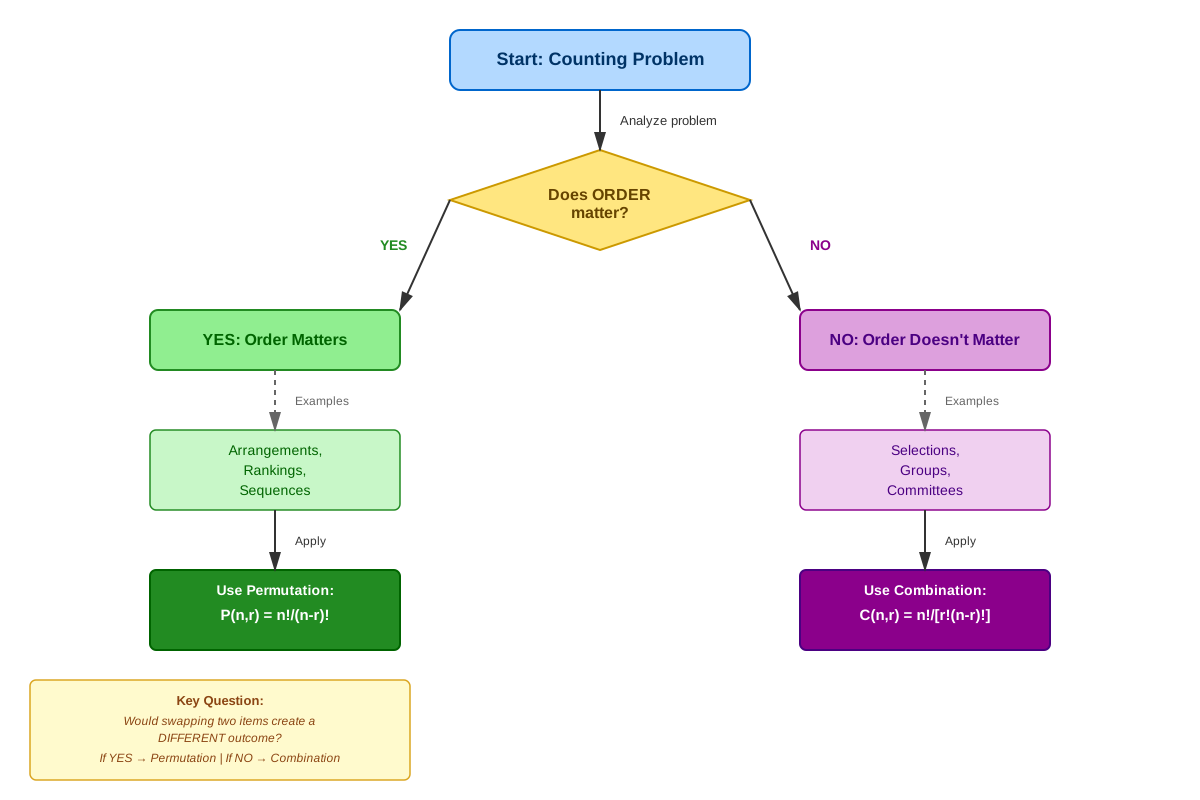
The critical distinction: Does order matter? If rearranging the selected items creates a different outcome, use permutations. If rearrangement produces the same outcome, use combinations.
| Scenario | Order Matters? | Use |
|---|---|---|
| Forming a committee of 5 from 12 people | No | Combination |
| Assigning President, VP, Secretary from 12 people | Yes | Permutation |
| Creating a 4-digit PIN | Yes | Permutation |
| Selecting 4 toppings for pizza | No | Combination |
| Arranging 6 books on a shelf | Yes | Permutation |
| Choosing 3 questions to answer from 10 | No | Combination |
Trigger words for permutations: arrange, order, sequence, schedule, rank, position, first/second/third.
Trigger words for combinations: select, choose, committee, group, team, subset (when positions don't matter).
Counting with Restrictions
Many GRE counting problems include restrictions or special conditions that modify standard permutation/combination calculations. Common restriction types include:
1. Mandatory inclusion/exclusion: Certain elements must be included or excluded from the selection or arrangement.
2. Adjacent/non-adjacent requirements: Specific items must be next to each other or must be separated.
3. Relative ordering: Some items must appear in a particular order relative to others.
4. Grouping constraints: Certain items must be treated as a unit.
Strategy for restrictions:
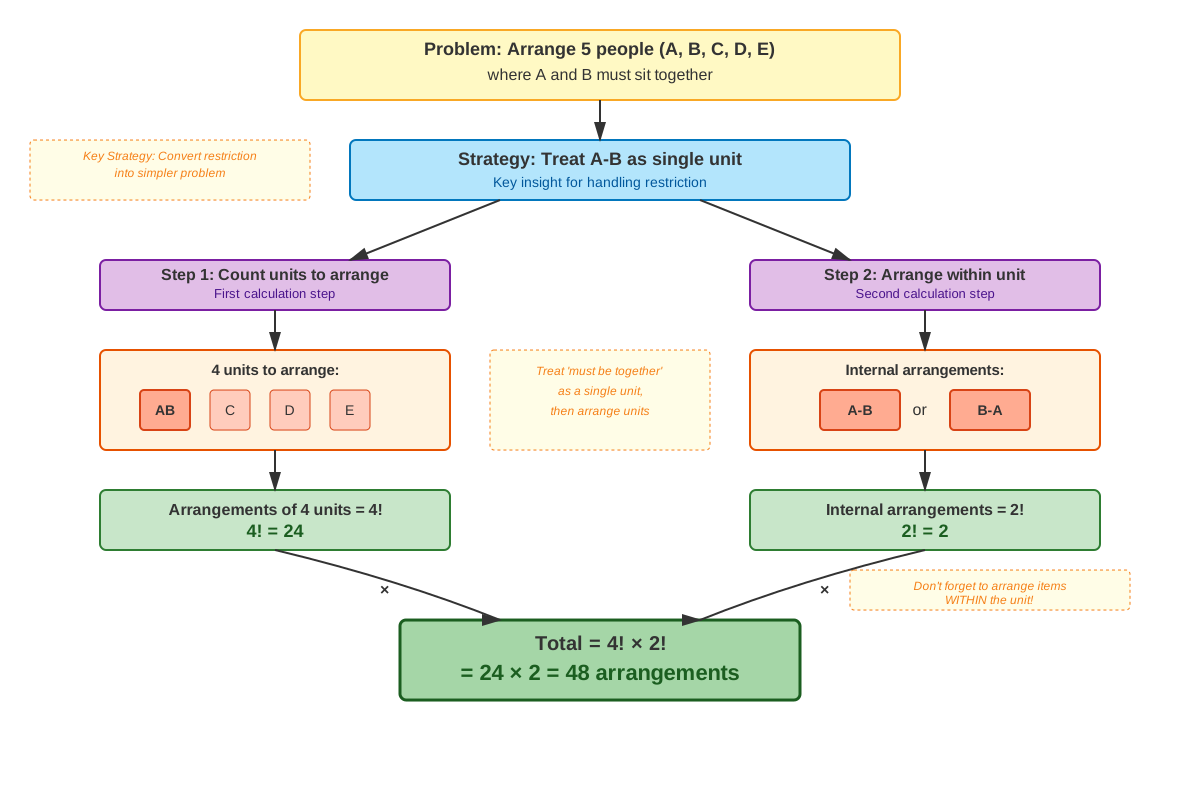
- For "must be together" problems: treat the restricted items as a single unit, count arrangements of units, then multiply by internal arrangements
- For "must be separated" problems: use complementary counting (total arrangements minus restricted arrangements)
- For "specific positions" problems: fill restricted positions first, then count arrangements for remaining positions
Complementary Counting
Complementary counting involves calculating the total possibilities minus the unwanted cases, often simpler than directly counting desired outcomes. The principle: Number of desired outcomes = Total outcomes - Undesired outcomes.
Example: Counting 5-letter "words" (arrangements) from letters A, B, C, D, E where A and B are NOT adjacent. Direct counting is complex, but complementary counting works: Total arrangements (5!) minus arrangements where A and B are adjacent. Treat AB as one unit: 4! arrangements of {AB, C, D, E} × 2 arrangements of A and B = 4! × 2 = 48. Answer: 120 - 48 = 72.
This technique proves especially valuable for "at least one" problems or scenarios with multiple restrictions.
Arrangements with Repetition
When objects include identical items, the standard permutation formula overcounts. The formula for arranging n objects where some are identical:
n!/(n₁! × n₂! × ... × nₖ!)where n₁, n₂, ..., nₖ represent the frequencies of each identical type.
Example: Arranging the letters in MISSISSIPPI (11 letters: 1 M, 4 I's, 4 S's, 2 P's):
11!/(1! × 4! × 4! × 2!) = 39,916,800/(1 × 24 × 24 × 2) = 34,650 arrangements.
The division accounts for the fact that swapping identical letters produces the same arrangement.
Concept Relationships
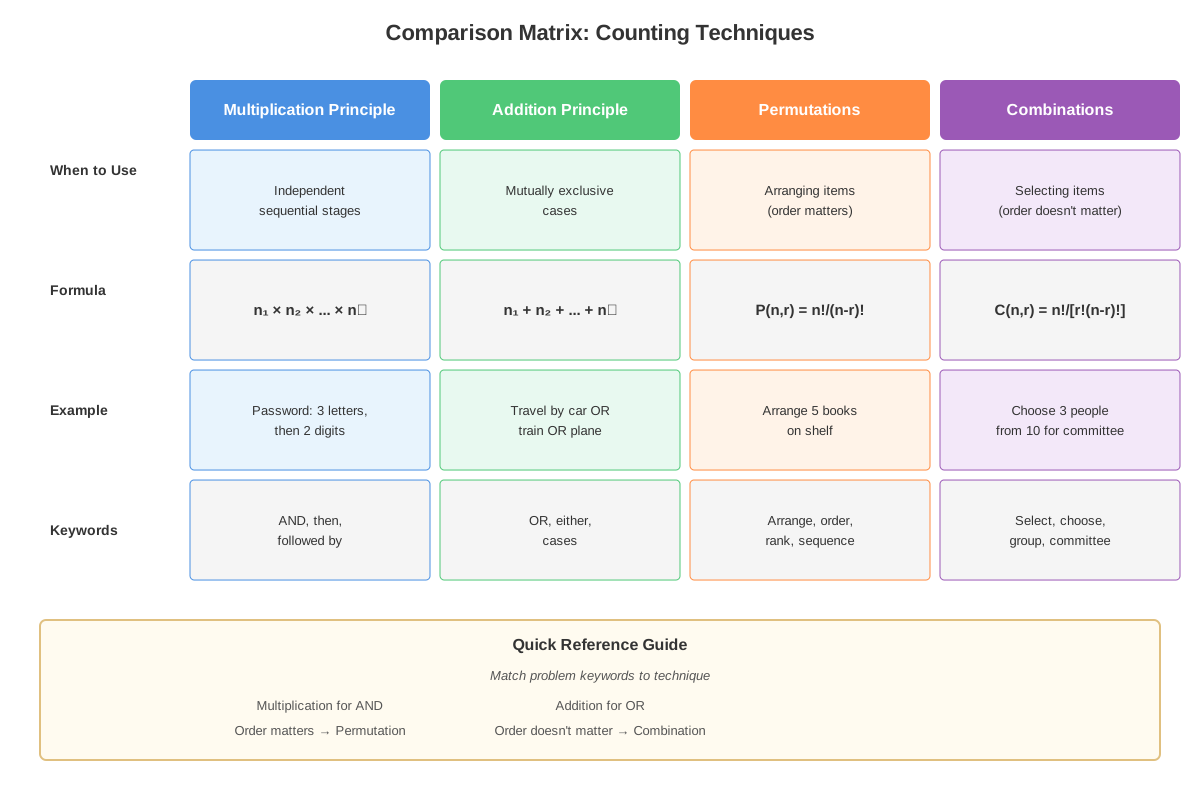
The counting concepts form a hierarchical structure built on the fundamental counting principles. The multiplication principle serves as the foundation, explaining why permutation and combination formulas work. When making sequential selections, each stage's possibilities multiply—this underlies the factorial expressions in permutation calculations.
Permutations and combinations represent two branches from this foundation, distinguished solely by whether order matters. Both use factorial notation and share the same numerator (n!/(n-r)!), but combinations divide by an additional r! to eliminate order distinctions. Understanding this relationship helps students remember formulas and choose the correct approach.
Restrictions and complementary counting represent advanced applications that modify basic permutation/combination calculations. Restriction problems often require breaking the scenario into cases, applying the multiplication principle to each case, then using the addition principle to sum across mutually exclusive cases. Complementary counting leverages the addition principle in reverse: total = desired + undesired, so desired = total - undesired.
Arrangements with repetition connect back to the division principle: when identical items exist, we divide by the factorial of each group's size to avoid overcounting arrangements that look identical.
The progression for mastery follows: Multiplication/Addition Principles → Basic Permutations/Combinations → Distinguishing Between Them → Applying Restrictions → Complementary Counting → Complex Multi-stage Problems. Each level builds on previous concepts, and the most challenging GRE problems combine multiple techniques within a single question.
Quick check — test yourself on Counting word problems so far.
Try Flashcards →High-Yield Facts
⭐ The multiplication principle applies when events occur in sequence; multiply the number of options at each stage
⭐ Use permutations when order matters; use combinations when order doesn't matter
⭐ P(n,r) = n!/(n-r)! counts arrangements; C(n,r) = n!/(r!(n-r)!) counts selections
⭐ For "at least one" problems, complementary counting (total minus none) often provides the fastest solution
⭐ When items must be adjacent, treat them as a single unit, calculate arrangements, then multiply by internal arrangements of the unit
- The addition principle applies when events are mutually exclusive; add the number of ways each can occur
- C(n,r) = C(n, n-r): selecting r items to include equals selecting (n-r) items to exclude
- For circular arrangements, fix one object's position to avoid counting rotations as different arrangements: (n-1)! arrangements
- When selecting with replacement, each selection has the same number of options: multiply n by itself r times (n^r)
- Factorial growth is extremely rapid: 10! = 3,628,800; this helps eliminate unreasonable answer choices
- For problems with multiple groups, multiply the combinations from each group: C(n₁,r₁) × C(n₂,r₂)
- The number of ways to arrange n objects in a circle where clockwise and counterclockwise are the same: (n-1)!/2
Common Misconceptions
Misconception: Permutations and combinations are interchangeable, and the choice doesn't significantly affect the answer.
Correction: Permutations always yield larger values than combinations for the same n and r (except when r=1). Using the wrong formula can produce answers off by factors of hundreds or thousands. Always ask: "Does rearranging the selected items create a different outcome?"
Misconception: In restriction problems, simply subtract the number of restricted arrangements from the total.
Correction: This approach only works for complementary counting when the restriction describes what to exclude. For "must include" restrictions, calculate directly by filling required positions first, then counting arrangements for remaining positions. Subtraction doesn't work for mandatory inclusion.
Misconception: When a problem says "at least," calculate each case (exactly 1, exactly 2, etc.) and add them.
Correction: While this method works, complementary counting is usually faster. "At least one" equals "total minus none." "At least two" equals "total minus none minus exactly one." The complementary approach reduces calculation steps significantly.
Misconception: C(n,r) can be calculated by computing n! and (n-r)! separately, then dividing.
Correction: For large n, factorials exceed calculator limits. Instead, expand only the necessary terms: C(8,3) = (8×7×6)/(3×2×1), canceling common factors before multiplying. This prevents overflow errors and speeds calculation.
Misconception: In problems with identical objects, use the standard permutation formula and divide by 2 if there are two identical items.
Correction: Divide by the factorial of each group's size, not just 2. If arranging AABBC, divide by 2! for the A's, 2! for the B's, and 1! for the C: 5!/(2!×2!×1!) = 30. Each group of identical items requires its own factorial divisor.
Misconception: The multiplication and addition principles can be used interchangeably.
Correction: These principles apply to fundamentally different scenarios. Multiplication applies to sequential events (this AND that), while addition applies to mutually exclusive alternatives (this OR that). Confusing them produces dramatically incorrect answers.
Worked Examples
Example 1: Committee Formation with Restrictions
Problem: A committee of 5 people must be formed from 6 men and 7 women. The committee must include at least 2 women. How many different committees can be formed?
Solution:
Step 1: Identify the problem type. This is a combination problem (order doesn't matter in committee membership) with a restriction (at least 2 women).
Step 2: Consider using complementary counting. "At least 2 women" means we exclude committees with 0 women or 1 woman.
Step 3: Calculate total committees without restrictions.
- Total people: 6 + 7 = 13
- Total committees: C(13,5) = 13!/(5!×8!) = (13×12×11×10×9)/(5×4×3×2×1) = 1,287
Step 4: Calculate committees with 0 women (all 5 men).
- C(6,5) = 6 (only 6 ways to choose 5 men from 6)
Step 5: Calculate committees with exactly 1 woman.
- Choose 1 woman from 7: C(7,1) = 7
- Choose 4 men from 6: C(6,4) = C(6,2) = 15
- Total: 7 × 15 = 105
Step 6: Apply complementary counting.
- Committees with at least 2 women = 1,287 - 6 - 105 = 1,176
Alternative Direct Method (to verify):
- 2 women, 3 men: C(7,2) × C(6,3) = 21 × 20 = 420
- 3 women, 2 men: C(7,3) × C(6,2) = 35 × 15 = 525
- 4 women, 1 man: C(7,4) × C(6,1) = 35 × 6 = 210
- 5 women, 0 men: C(7,5) × C(6,0) = 21 × 1 = 21
- Total: 420 + 525 + 210 + 21 = 1,176 ✓
Key Takeaway: Complementary counting required fewer calculations (3 terms vs. 4 terms), demonstrating its efficiency for "at least" problems.
Example 2: Arrangement with Adjacent Restrictions
Problem: Seven people (A, B, C, D, E, F, G) stand in a line for a photograph. If persons A and B must stand next to each other, and persons C and D must NOT stand next to each other, how many different arrangements are possible?
Solution:
Step 1: Handle the "must be together" restriction first. Treat A and B as a single unit [AB].
Step 2: Count arrangements with A and B together.
- Units to arrange: [AB], C, D, E, F, G = 6 units
- Arrangements of 6 units: 6! = 720
- Internal arrangements of [AB]: 2! = 2 (AB or BA)
- Total with A and B together: 720 × 2 = 1,440
Step 3: From these 1,440 arrangements, subtract those where C and D are also adjacent (violating the second restriction).
Step 4: Count arrangements where A-B are together AND C-D are together.
- Units to arrange: [AB], [CD], E, F, G = 5 units
- Arrangements of 5 units: 5! = 120
- Internal arrangements: [AB] has 2!, [CD] has 2!
- Total: 120 × 2 × 2 = 480
Step 5: Apply complementary counting for the second restriction.
- A and B together, C and D NOT together: 1,440 - 480 = 960
Answer: 960 arrangements
Key Takeaway: For multiple restrictions, handle "must be together" constraints first by creating units, then apply complementary counting for "must NOT be together" constraints. This systematic approach prevents confusion and ensures all conditions are satisfied.
Exam Strategy
Recognition Triggers: GRE counting problems typically include phrases like "how many ways," "how many different," "how many possible," or "in how many arrangements." Watch for scenarios involving selection (committees, teams, subsets), arrangement (ordering, scheduling, positioning), or multi-stage processes (passwords, routes, outcomes).
Step-by-Step Approach:
- Identify the counting type: Does order matter? (Permutation vs. Combination)
- Check for restrictions: Are there mandatory inclusions, exclusions, or adjacency requirements?
- Choose your method: Direct counting, complementary counting, or case-by-case analysis
- Set up the calculation: Write the formula or multiplication sequence before computing
- Simplify before calculating: Cancel common factors in combinations to avoid large numbers
- Verify reasonableness: Does the answer make logical sense given the scenario?
Time Management: Allocate 1.5-2 minutes for straightforward counting problems, up to 2.5 minutes for complex problems with multiple restrictions. If a direct approach seems overwhelming, immediately consider complementary counting or breaking into simpler cases.
Process of Elimination Tips:
- Eliminate answers that confuse permutations with combinations (typically differ by a factor of r!)
- For "at least one" problems, the answer must be less than the total but significantly greater than zero
- Answers involving factorials should be simplified; if answer choices show simplified numbers, calculate accordingly
- If two answer choices differ by a factor of 2, 6, or 24, suspect a permutation/combination confusion or missing internal arrangements
Common Traps:
- Problems that seem to require permutations but actually need combinations (or vice versa)
- Forgetting to multiply by internal arrangements when treating items as units
- Double-counting in problems with multiple overlapping restrictions
- Forgetting that C(n,0) = 1 and C(n,n) = 1 (important for complementary counting)
Calculator Usage: The GRE calculator handles factorials up to 69!, but for combinations, calculate by expanding and canceling rather than computing full factorials. For C(50,3), calculate (50×49×48)/(3×2×1) rather than 50!/47!×3!.
Memory Techniques
Permutation vs. Combination Mnemonic: "Permutation = Position matters" or "Combination = Choosing without Care for order"
Formula Memory Device:
- Permutation: "Permutation has Partial factorial" (divide by (n-r)!)
- Combination: "Combination Cuts more" (divide by both r! and (n-r)!)
Restriction Strategy Acronym - FUSE:
- Fix restricted positions first
- Unit-ize items that must be together
- Subtract for complementary counting
- Enumerate cases when necessary
Multiplication vs. Addition Principle: "AND means multiply, OR means add" - If the problem describes doing this AND that (sequential), multiply. If it describes this OR that (alternatives), add.
Visualization for Combinations: Picture selecting items and placing them in an unordered bag—once in the bag, their order doesn't matter. For permutations, picture placing items in numbered slots—each slot creates a distinct arrangement.
Factorial Approximation: Remember key factorials for quick estimation:
- 5! = 120
- 6! = 720
- 7! = 5,040
- 10! ≈ 3.6 million
These benchmarks help verify whether calculated answers are reasonable.
Summary
Counting word problems on the GRE test the ability to systematically determine the number of possible outcomes in selection and arrangement scenarios. Mastery requires understanding the fundamental multiplication and addition principles, distinguishing between permutations (order matters) and combinations (order doesn't matter), and applying appropriate formulas: P(n,r) = n!/(n-r)! for permutations and C(n,r) = n!/(r!(n-r)!) for combinations. Success depends on recognizing problem types through trigger words, handling restrictions through strategic approaches (treating adjacent items as units, using complementary counting for "at least" problems, filling restricted positions first), and verifying answers for logical consistency. The most challenging problems combine multiple counting techniques, require case-by-case analysis, or involve complementary counting to avoid complex direct calculations. Efficient problem-solving involves simplifying expressions before calculating, using complementary counting when appropriate, and systematically checking whether order matters in each scenario. These skills transfer across multiple GRE question formats and represent high-value content for score improvement.
Key Takeaways
- Distinguish permutations from combinations by asking whether order matters—this single question determines which formula to apply and prevents the most common counting errors
- The multiplication principle (for sequential events) and addition principle (for mutually exclusive alternatives) form the foundation of all counting problems—recognize AND vs. OR language in problem statements
- Complementary counting (total minus unwanted) often provides the fastest solution for "at least" problems—calculate what you don't want and subtract from the total
- For restriction problems, use systematic strategies: treat adjacent items as units, fill restricted positions first, or enumerate cases—don't attempt to modify formulas intuitively
- Simplify combination calculations by expanding and canceling before multiplying—this prevents calculator overflow and speeds computation
- Verify answers using logical reasoning: Does the magnitude make sense? Is it larger/smaller than related scenarios?—this catches formula application errors
- Practice identifying problem types quickly through trigger words and scenario patterns—recognition speed directly impacts time management and accuracy under test conditions
Related Topics
Probability: Counting principles provide the foundation for calculating probabilities, as probability equals favorable outcomes divided by total outcomes. Mastering counting enables solving complex probability problems involving multiple events, conditional probability, and expected value calculations.
Set Theory and Venn Diagrams: The inclusion-exclusion principle extends counting to overlapping sets, allowing calculation of elements in unions and intersections. This connects counting to data interpretation questions involving overlapping categories.
Sequences and Series: Certain counting problems involve summing arithmetic or geometric sequences, particularly when counting outcomes across multiple stages or calculating cumulative possibilities.
Number Properties: Factorial notation connects to divisibility, prime factorization, and properties of integers. Understanding factorial structure helps solve problems involving divisibility by specific numbers.
Data Interpretation: Many data interpretation questions require counting possible outcomes, arrangements, or selections from presented data sets, making counting skills directly applicable to chart and table analysis.
Practice CTA
Now that you've mastered the core concepts, strategies, and common pitfalls of counting word problems, it's time to solidify your understanding through active practice. Attempt the practice questions designed specifically for this topic—they mirror actual GRE question formats and difficulty levels. As you work through problems, focus on identifying problem types quickly, choosing the most efficient solution method, and verifying your answers through logical reasoning. Use the flashcards to reinforce formulas, trigger words, and key distinctions between permutations and combinations. Remember: counting problems reward systematic thinking and careful analysis. Each practice problem you solve builds the pattern recognition and strategic thinking that will serve you on test day. Your investment in mastering this high-yield topic will pay dividends across multiple question types on the GRE Quantitative Reasoning section!
Sign up free to keep reading
Create a free AnvayaPrep account to finish this GRE guide on Counting word problems — plus flashcards and practice questions.