Overview
Analogy reasoning is a critical cognitive skill tested throughout the GRE Verbal Reasoning section, particularly within Reading Comprehension and Text Completion questions. While the GRE no longer features standalone analogy questions (as it did before 2011), the underlying reasoning pattern—identifying parallel relationships between concepts, structures, or situations—remains fundamental to success on the exam. When the test presents an argument, passage, or scenario that draws comparisons between two domains, understanding how analogical structures work becomes essential for accurate comprehension and response selection.
The essence of GRE analogy reasoning involves recognizing when an author uses one situation to illuminate another, identifying the specific relationship being mapped between source and target domains, and evaluating whether that mapping is valid, complete, or flawed. This skill appears when passages compare historical events to contemporary situations, when arguments use precedents to support claims, or when answer choices require recognizing parallel logical structures. Mastering analogy reasoning enables test-takers to quickly identify the core relationship in complex comparisons and predict how that relationship should extend to new contexts.
Within the broader landscape of Verbal Reasoning, analogy reasoning connects intimately with argument structure analysis, logical reasoning patterns, and inference-making. It serves as a bridge between literal comprehension and abstract reasoning, requiring students to move beyond surface-level vocabulary to understand deep structural parallels. Strong analogy reasoning skills enhance performance across multiple question types, from "select the sentence" questions that require identifying parallel examples to "strengthen/weaken" questions where analogical arguments must be evaluated for relevance and validity.
Learning Objectives
- [ ] Identify when Analogy reasoning is being tested in GRE passages and questions
- [ ] Explain the core rule or strategy behind Analogy reasoning
- [ ] Apply Analogy reasoning to GRE-style questions accurately
- [ ] Distinguish between valid and flawed analogical arguments in reading passages
- [ ] Recognize the structural components of analogies (source domain, target domain, mapped relationships)
- [ ] Evaluate answer choices that strengthen or weaken analogical reasoning
- [ ] Predict how analogical relationships extend to new scenarios presented in questions
Prerequisites
- Basic logical reasoning: Understanding of premises, conclusions, and argument structure is necessary because analogies function as a specific type of reasoning pattern within arguments
- Reading comprehension fundamentals: Ability to identify main ideas and supporting details enables recognition of when authors shift from direct explanation to analogical comparison
- Vocabulary knowledge: Familiarity with relationship words (similar to, parallel to, analogous to, likewise, correspondingly) helps signal when analogy reasoning appears in passages
Why This Topic Matters
Analogy reasoning appears in approximately 30-40% of GRE Verbal Reasoning questions, either as the primary reasoning structure being tested or as a secondary element requiring evaluation. This high frequency makes it one of the most valuable reasoning patterns to master. In Reading Comprehension passages, authors frequently use analogies to explain complex scientific concepts, support historical arguments, or illustrate abstract philosophical positions. Text Completion and Sentence Equivalence questions often require recognizing parallel structures or relationships to select appropriate vocabulary.
Beyond the exam, analogical reasoning represents a fundamental cognitive skill used in legal reasoning (precedent-based arguments), scientific thinking (model systems and experimental analogies), business strategy (applying lessons from one market to another), and everyday problem-solving. The GRE tests this skill because graduate-level work across disciplines requires the ability to transfer knowledge from familiar domains to novel situations, recognize when comparisons are apt or misleading, and construct valid arguments based on parallel cases.
Common manifestations in GRE passages include: scientific passages comparing biological systems to mechanical systems; humanities passages drawing parallels between historical periods; social science passages using case studies to support broader claims; and argument-based questions where the reasoning depends on the similarity between two situations. Questions may ask test-takers to identify assumptions underlying analogies, find parallel reasoning in answer choices, or determine what would strengthen or weaken an analogical argument.
Core Concepts
The Structure of Analogical Reasoning
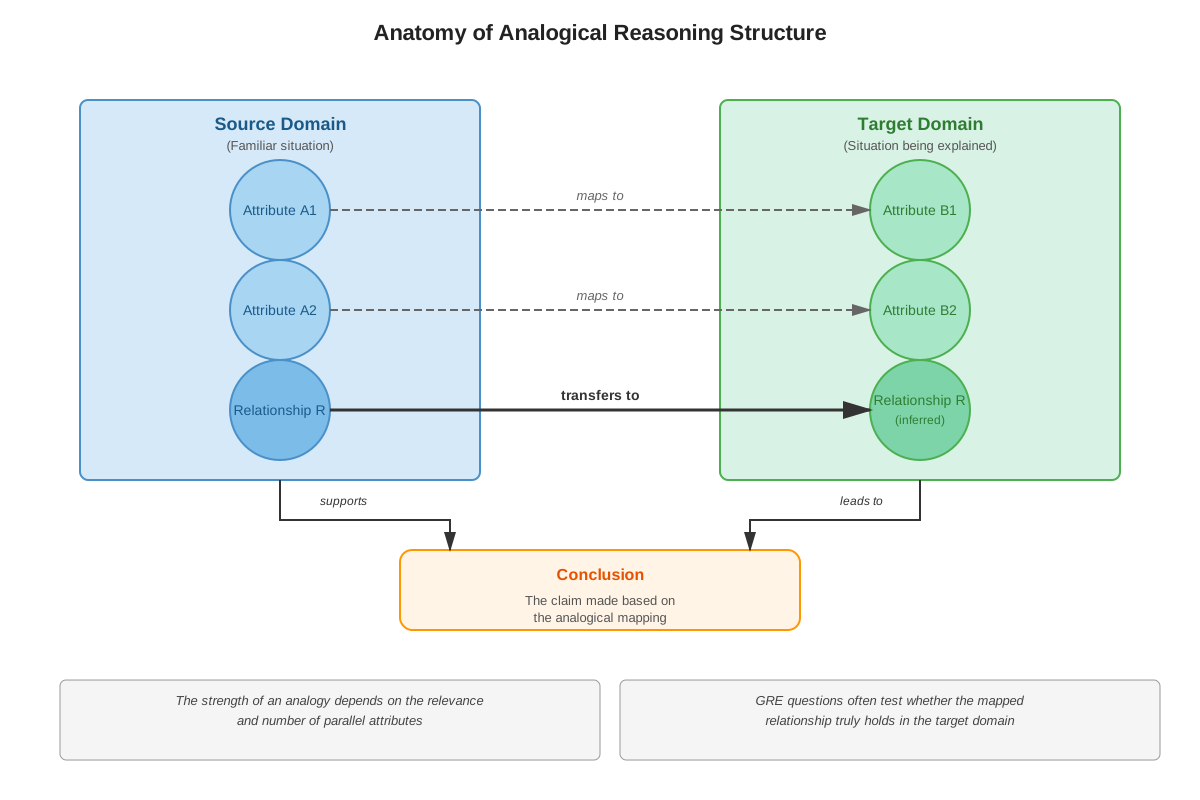
Analogy reasoning involves mapping relationships from a source domain (the familiar or established case) to a target domain (the new or disputed case). The fundamental structure consists of four elements: two entities in the source domain with a specific relationship, and two entities in the target domain that allegedly share the same relationship. For example: "Just as a heart pumps blood through the body, a water pump circulates water through a heating system." Here, the source domain is biological (heart/blood/body), the target domain is mechanical (pump/water/heating system), and the mapped relationship is "circulates fluid through a system."
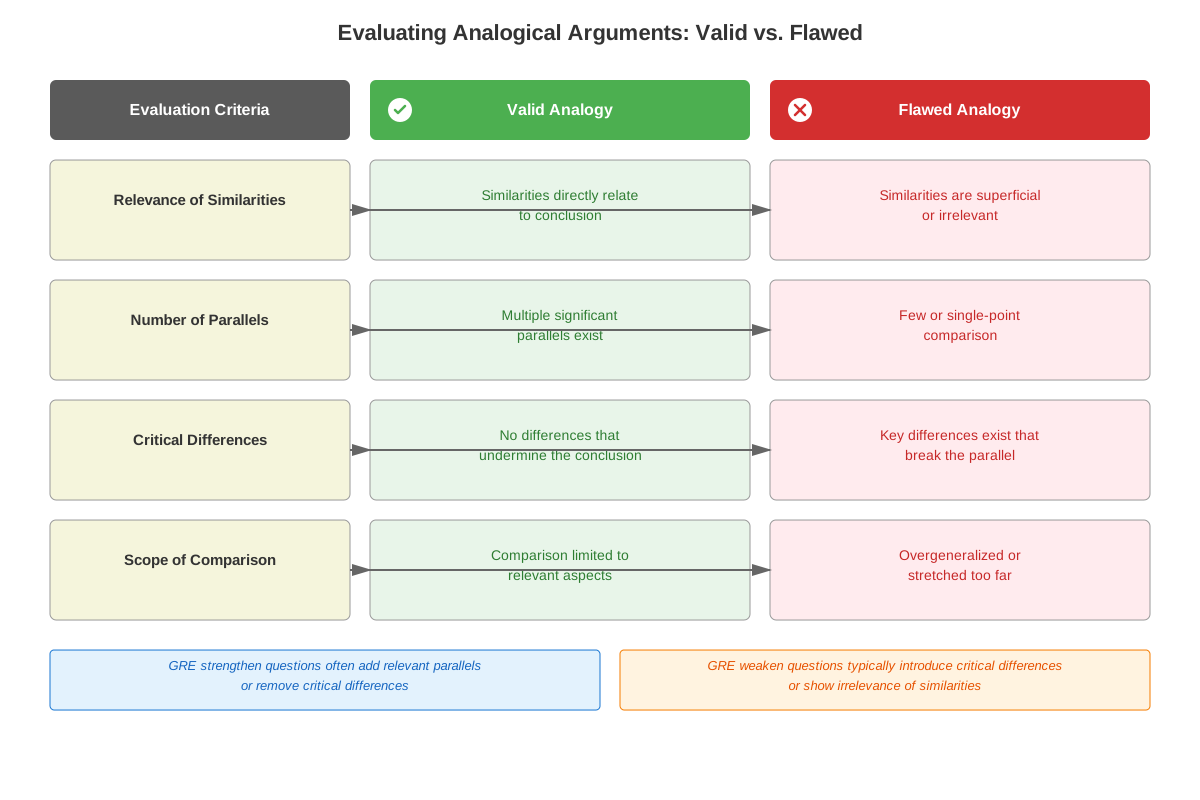
The validity of an analogy depends on relevant similarity—the degree to which the compared entities share properties that matter for the relationship being mapped. Not all similarities are relevant; superficial resemblances don't support analogical arguments. The GRE tests whether students can distinguish between analogies based on deep structural parallels versus those based on surface-level similarities. Strong analogies map essential, causally relevant features, while weak analogies rely on coincidental or irrelevant resemblances.
Types of Analogies on the GRE
| Analogy Type | Purpose | Example Context |
|---|---|---|
| Explanatory | Clarify complex concepts using familiar comparisons | "DNA replication resembles photocopying documents" |
| Argumentative | Support claims by citing parallel cases | "Regulation succeeded in Industry X, so it should work in Industry Y" |
| Predictive | Forecast outcomes based on similar past situations | "Previous technological disruptions caused unemployment; AI will too" |
| Structural | Highlight parallel logical or organizational patterns | "The relationship between state and federal law mirrors that between local and state law" |
Identifying Analogy Reasoning in Questions
Several trigger phrases signal that analogy reasoning is being tested:
- "Similarly," "likewise," "in the same way," "just as," "analogously"
- "Parallels the reasoning in which of the following"
- "Most similar to," "corresponds to," "mirrors"
- "By analogy," "comparable to," "can be likened to"
- "Precedent," "previous case," "historical parallel"
When these phrases appear, the question tests whether the student can identify the specific relationship being mapped and evaluate whether that mapping is appropriate. The GRE often presents answer choices that share superficial similarities with the passage but lack the crucial structural parallel.
The Analogy Evaluation Framework
To evaluate any analogical argument, apply this systematic approach:
- Identify the source and target domains: What is being compared to what?
- Extract the relationship: What specific connection exists in the source domain?
- Map the relationship: Does that same connection hold in the target domain?
- Assess relevant similarities: Do the domains share properties that matter for this relationship?
- Consider relevant differences: Are there dissimilarities that undermine the comparison?
The GRE frequently tests step 5—recognizing when differences between domains are significant enough to invalidate the analogy. A passage might argue that because educational intervention X worked in Country A, it will work in Country B. The correct answer might point out a relevant difference (different literacy rates, cultural contexts, or economic conditions) that breaks the analogy.
Strengthening and Weakening Analogies
Questions asking what would "strengthen" or "weaken" an analogical argument test understanding of relevant similarity. To strengthen an analogy, identify information that:
- Highlights additional relevant similarities between domains
- Shows the mapped relationship holds across multiple cases
- Eliminates potential relevant differences
- Demonstrates the relationship is causal, not coincidental
To weaken an analogy, identify information that:
- Reveals relevant differences between the domains
- Shows the source domain relationship doesn't generalize
- Demonstrates the similarity is superficial rather than structural
- Provides counterexamples where similar cases yielded different outcomes
Parallel Reasoning Questions
A specific question type asks test-takers to identify which answer choice "most closely parallels the reasoning" in the passage. These questions test pure analogical reasoning—finding the option with the same logical structure, regardless of content. The strategy involves:
- Abstract the argument structure: Convert the passage into a general pattern (e.g., "All X have property Y; Z is an X; therefore Z has property Y")
- Ignore content: Focus on logical relationships, not subject matter
- Match structure to answer choices: Find the option with identical reasoning pattern
- Verify the match: Ensure each element corresponds correctly
For example, if a passage argues "All effective teachers inspire curiosity; Professor Smith inspires curiosity; therefore Professor Smith is an effective teacher," the parallel reasoning would have the same flawed structure (affirming the consequent), not necessarily anything about teachers.
Concept Relationships
The concepts within analogy reasoning form a hierarchical structure: Analogy structure (source domain, target domain, mapped relationship) serves as the foundation. This structure enables analogy identification in passages and questions. Once identified, analogy evaluation applies the framework of relevant similarities and differences. Evaluation skills then support strengthening/weakening analysis and parallel reasoning identification.
Analogy reasoning connects to prerequisite topics through its dependence on argument structure analysis—analogies function as a specific type of inductive argument. It relates to inference-making because extending analogies requires inferring how relationships will hold in new contexts. The skill also connects forward to assumption identification (analogies rest on assumptions about similarity) and logical flaw recognition (weak analogies constitute a common reasoning error).
Relationship map: Argument Structure → Analogy Structure → Analogy Identification → Analogy Evaluation → (branches to) Strengthening/Weakening Analysis AND Parallel Reasoning Questions → Overall Critical Reasoning Mastery
High-Yield Facts
- ⭐ Analogy reasoning tests whether relationships, not just entities, are similar between domains
- ⭐ Relevant similarity matters more than number of similarities—one crucial difference can invalidate an analogy
- ⭐ "Parallel reasoning" questions require matching logical structure, not content or subject matter
- ⭐ Trigger words like "similarly," "likewise," and "just as" signal analogical reasoning in passages
- ⭐ Weakening an analogy requires identifying relevant differences, not any differences
- Explanatory analogies clarify concepts; argumentative analogies support claims through precedent
- Surface-level similarities (both involve water, both are blue) don't support valid analogies
- Strong analogies map causal or functional relationships, not coincidental correlations
- The GRE tests analogy reasoning in Reading Comprehension, not standalone analogy questions
- Analogies can be strengthened by showing the relationship holds across multiple similar cases
- Historical parallels in passages often serve as analogical arguments requiring evaluation
- Disanalogies (relevant differences) are more powerful than additional similarities for evaluation
- Predictive analogies assume past patterns will continue—this assumption can be questioned
- Structural analogies focus on organizational or logical patterns rather than content similarities
Quick check — test yourself on Analogy reasoning so far.
Try Flashcards →Common Misconceptions
Misconception: Any similarity between two things makes them analogous → Correction: Valid analogies require relevant similarities—properties that matter for the specific relationship being mapped. Superficial resemblances (both are round, both are old) don't support analogical reasoning unless those properties are causally connected to the relationship in question.
Misconception: More similarities always make an analogy stronger → Correction: One relevant difference can outweigh numerous irrelevant similarities. An analogy between two countries might cite ten similarities, but if they differ in the one factor that determines the outcome being predicted (e.g., legal system, climate, population density), the analogy fails.
Misconception: Parallel reasoning questions require finding similar content → Correction: These questions test logical structure, not subject matter. An argument about biology can parallel an argument about economics if they share the same reasoning pattern (e.g., both use conditional logic, both commit the same fallacy).
Misconception: All analogies in GRE passages are flawed and should be criticized → Correction: Many passages use valid analogies for explanation or support. The task is to evaluate whether the specific analogy is appropriate, not to assume all analogical reasoning is weak. Some questions ask what would strengthen an analogy, requiring recognition of its potential validity.
Misconception: Identifying an analogy means the work is done → Correction: Recognition is only the first step. GRE questions require evaluating the analogy's validity, identifying its assumptions, determining what would affect its strength, or finding parallel structures. Simply noting "this is an analogy" doesn't answer the question.
Misconception: Historical precedents always support current policy arguments → Correction: Historical analogies depend on relevant similarity between past and present contexts. Changed circumstances, different causal factors, or unique contemporary conditions can break the parallel, making historical precedent inapplicable.
Worked Examples
Example 1: Evaluating an Analogical Argument
Passage: "The city council should implement congestion pricing for downtown traffic. When London introduced similar pricing in 2003, traffic decreased by 30% within the first year. Our city faces comparable congestion problems, and we can expect similar results."
Question: Which of the following, if true, most weakens the argument?
Answer Choices:
A) Some London residents initially opposed the pricing scheme
B) The city's public transportation system is far less developed than London's was in 2003
C) Traffic congestion has increased in other cities that did not implement pricing
D) The proposed pricing structure differs slightly from London's original plan
E) Congestion pricing generates revenue that can fund transportation improvements
Solution Process:
- Identify the analogy structure: Source domain = London 2003; Target domain = our city now; Mapped relationship = congestion pricing → 30% traffic reduction
- Recognize this is an argumentative/predictive analogy: The argument uses London as precedent to predict outcomes in another city
- Determine what would weaken it: Need a relevant difference between London and our city that would prevent the same outcome
- Evaluate each choice:
- A) Opposition doesn't affect whether the policy works, only political feasibility—irrelevant to the outcome
- B) CORRECT - This is a relevant difference. If London had robust public transit alternatives when pricing was introduced, people could switch to buses/trains. Without those alternatives, pricing might not reduce traffic—people have no other options. This breaks the analogy.
- C) Other cities without pricing are not relevant to whether pricing works—this doesn't address the comparison
- D) "Slightly" different structure doesn't establish a relevant difference that would change outcomes
- E) This strengthens by adding a benefit, doesn't weaken the traffic reduction prediction
Connection to Learning Objectives: This example demonstrates identifying analogy reasoning (trigger: "similar"), explaining the strategy (find relevant differences), and applying it accurately (selecting B).
Example 2: Parallel Reasoning
Passage: "All the company's most successful products were developed by teams with diverse expertise. The new smartphone project involves a diverse team. Therefore, the smartphone will likely be successful."
Question: Which of the following most closely parallels the reasoning above?
Answer Choices:
A) All championship teams practice daily; this team practices daily; therefore, this team will win the championship
B) Most award-winning films have large budgets; this film has a large budget; therefore, this film will win awards
C) Every effective medication underwent rigorous testing; this medication underwent rigorous testing; therefore, it will be effective
D) Some profitable restaurants serve organic food; this restaurant serves organic food; therefore, it will be profitable
E) No reliable cars were manufactured before 1990; this car was manufactured in 1985; therefore, it is unreliable
Solution Process:
- Abstract the passage structure: All successful X have property Y; Z has property Y; therefore, Z will be successful. This commits the fallacy of affirming the consequent (having Y doesn't guarantee success; Y might be necessary but not sufficient).
- Ignore content, focus on structure: Don't look for anything about products or teams; look for the same logical pattern.
- Analyze each choice:
- A) CORRECT - All champions have Y (daily practice); this team has Y; therefore, this team will be champion. Identical structure and same logical flaw.
- B) "Most" changes the structure (passage says "all")
- C) Same structure, but this is actually valid reasoning if testing is sufficient for effectiveness
- D) "Some" changes the structure completely
- E) This uses "no" and "before," creating different logical structure (valid modus tollens)
- Verify the match: Choice A maps perfectly: successful products ↔ championship teams; diverse expertise ↔ daily practice; new smartphone ↔ this team; will be successful ↔ will win championship.
Connection to Learning Objectives: This demonstrates applying analogy reasoning to identify parallel logical structures, a high-frequency GRE question type.
Exam Strategy
Approaching Analogy Questions
When a passage or question involves analogical reasoning, follow this systematic approach:
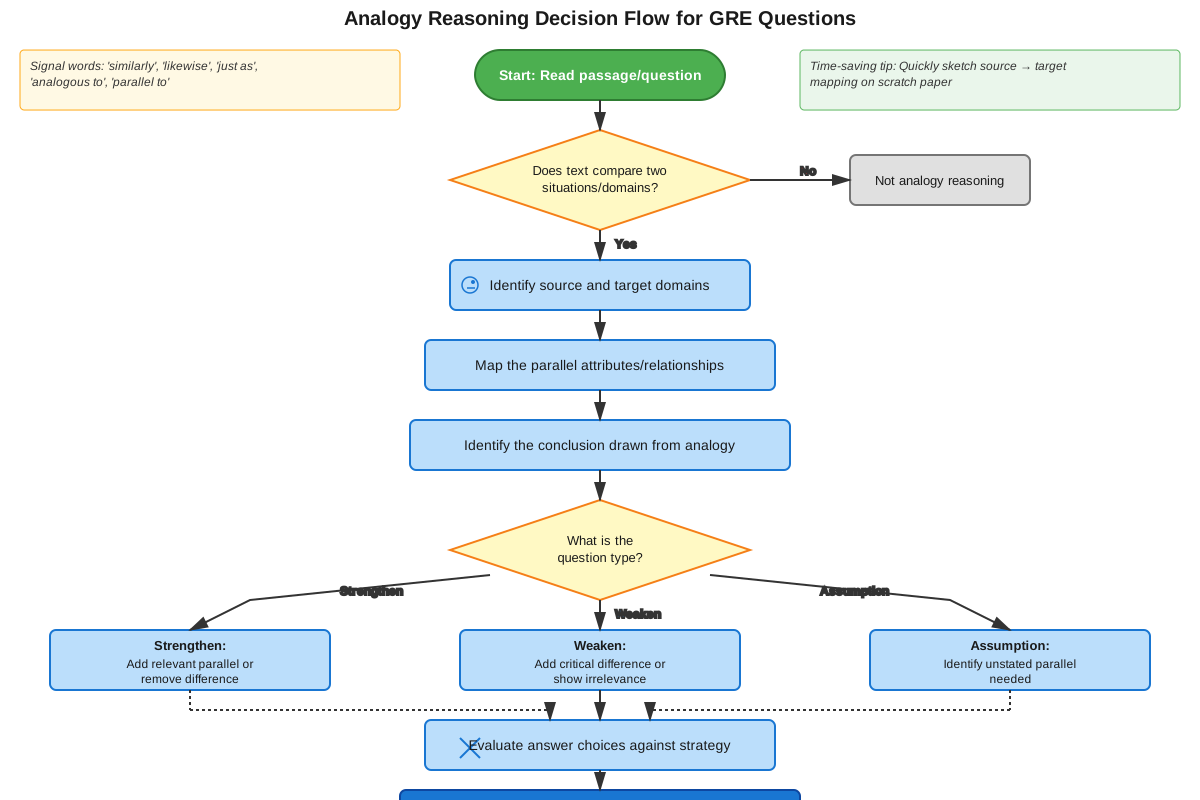
- Scan for trigger words (similarly, likewise, just as, parallel) to identify that analogy reasoning is being tested
- Box or underline the two domains being compared to keep them visually distinct
- Write out the relationship being mapped in simple terms (X causes Y in domain 1, so X should cause Y in domain 2)
- Predict what would matter: Before reading answer choices, think "What difference would break this comparison?" or "What similarity would strengthen it?"
- Eliminate answers that address irrelevant similarities or differences
Trigger Words and Phrases
High-priority triggers that signal analogy reasoning:
- "Similarly," "likewise," "in the same way," "analogously," "correspondingly"
- "Parallels," "mirrors," "resembles," "comparable to"
- "Just as... so too," "like," "as with"
- "Precedent," "previous case," "historical example"
- "By analogy," "can be likened to"
Exam Tip: When you see "Which of the following most closely parallels the reasoning," immediately abstract the argument structure before reading answer choices. Write it as a formula: "All X are Y; Z is Y; therefore Z is X."
Process of Elimination Strategies
For strengthening/weakening analogy questions:
- Eliminate choices that mention irrelevant similarities or differences (e.g., both cities have rivers—irrelevant unless water transport matters for the argument)
- Eliminate choices that address practical concerns rather than the analogy's validity (e.g., "it would be expensive"—doesn't affect whether the comparison is apt)
- Keep choices that highlight factors causally connected to the predicted outcome
For parallel reasoning questions:
- Eliminate any choice with different logical structure (all vs. some, if-then vs. either-or)
- Eliminate choices where the conclusion type differs (prediction vs. explanation vs. recommendation)
- Don't be distracted by similar content—focus solely on reasoning pattern
Time Allocation
Analogy reasoning questions typically require 60-90 seconds:
- 15-20 seconds: Identify the analogy structure and relationship
- 20-30 seconds: Predict what would strengthen/weaken or abstract the structure
- 30-40 seconds: Evaluate answer choices
- 10 seconds: Verify your selection
For parallel reasoning questions, spend extra time (up to 2 minutes) on abstraction—getting the structure right is crucial and saves time on answer evaluation.
Memory Techniques
The SMART Analogy Framework
Use SMART to remember how to evaluate analogies:
- Source and target domains identified
- Mapped relationship extracted
- Assess relevant similarities
- Recognize relevant differences
- Test whether the relationship truly transfers
Visualization Strategy
Picture analogies as bridges: the source domain is one riverbank (familiar territory), the target domain is the other bank (where you want to apply knowledge), and the relationship is the bridge structure. A strong analogy has solid support beams (relevant similarities); a weak analogy has missing planks (relevant differences that break the connection). This visual helps remember that the bridge's integrity depends on structural support, not decorative similarities.
The "Content vs. Structure" Reminder
For parallel reasoning questions, remember: "Same skeleton, different skin." The logical structure (skeleton) must match exactly, but the content (skin) should differ. If an answer choice discusses the same topic as the passage, it's probably wrong—parallel reasoning requires different content with identical structure.
Acronym for Weakening Analogies
CRUD identifies what weakens analogies:
- Crucial difference between domains
- Relationship doesn't generalize
- Unique factors in target domain
- Dissimilarity in causal mechanism
Summary
Analogy reasoning remains a cornerstone of GRE Verbal Reasoning despite the elimination of standalone analogy questions in 2011. The skill involves identifying when passages or arguments compare two domains, extracting the specific relationship being mapped from source to target, and evaluating whether that mapping is valid based on relevant similarities and differences. Success requires distinguishing between superficial resemblances and deep structural parallels, recognizing that one relevant difference can invalidate an analogy regardless of numerous irrelevant similarities. The GRE tests this skill through Reading Comprehension passages that use analogies for explanation or argument, strengthen/weaken questions that require identifying what affects an analogy's validity, and parallel reasoning questions that demand matching logical structures across different content domains. Mastery involves systematic application of the SMART framework: identifying domains, mapping relationships, assessing similarities, recognizing differences, and testing whether the relationship transfers. Students must train themselves to abstract logical structure from content, focus on causally relevant features rather than coincidental resemblances, and quickly predict what would strengthen or weaken analogical arguments before evaluating answer choices.
Key Takeaways
- Analogy reasoning tests relationship mapping, not entity similarity—focus on whether the connection between elements transfers, not whether the elements themselves are alike
- Relevant differences outweigh irrelevant similarities—one crucial dissimilarity breaks an analogy regardless of superficial resemblances
- Parallel reasoning requires identical logical structure with different content—abstract the argument pattern and ignore subject matter
- Trigger words like "similarly," "likewise," and "just as" signal analogical reasoning and should prompt immediate structural analysis
- Strengthening analogies requires highlighting relevant similarities or eliminating potential differences; weakening requires identifying relevant dissimilarities
- Evaluate analogies systematically using SMART: Source/target identification, Mapped relationship, Assess similarities, Recognize differences, Test transfer
- Predictive and argumentative analogies are most testable—watch for historical precedents and cross-domain predictions that rest on analogical reasoning
Related Topics
Assumption Identification: Analogical arguments rest on assumptions about similarity between domains; mastering analogy reasoning enables recognition of these unstated premises, a crucial skill for assumption questions.
Causal Reasoning: Many analogies map causal relationships from one domain to another; understanding causation helps evaluate whether the causal mechanism truly transfers between contexts.
Logical Fallacies: Weak analogies (false analogies) constitute a common reasoning flaw; recognizing flawed analogical reasoning connects to broader fallacy identification skills.
Argument Structure Analysis: Analogies function as a specific type of inductive argument; mastering their structure deepens overall argument analysis capabilities.
Inference and Implication: Extending analogies to new cases requires inference skills; strong analogy reasoning enhances the ability to draw valid conclusions from passage information.
Practice CTA
Now that you understand the structure and evaluation of analogy reasoning, it's time to cement these skills through active practice. Attempt the practice questions to apply the SMART framework to GRE-style scenarios, and use the flashcards to reinforce trigger words and evaluation strategies. Remember: analogy reasoning appears in 30-40% of Verbal questions, making it one of the highest-yield skills to master. Each practice question you work through builds the pattern recognition and structural analysis speed essential for test day success. Your ability to quickly identify domains, map relationships, and evaluate relevant similarities will directly translate to points on the exam—so dive into practice with confidence!
Sign up free to keep reading
Create a free AnvayaPrep account to finish this GRE guide on Analogy reasoning — plus flashcards and practice questions.