Overview
Correlation versus causation is one of the most frequently tested concepts in GRE Verbal Reasoning, particularly within Critical Reasoning questions. This fundamental logical principle addresses the relationship between two events or variables: just because two things occur together or show a statistical relationship does not mean that one causes the other. The GRE consistently tests whether students can identify flawed reasoning that assumes causation from mere correlation, making this a high-yield topic that appears across multiple question types including argument analysis, assumption questions, and strengthen/weaken tasks.
Understanding the distinction between correlation and causation is essential for success on the GRE because it forms the foundation of logical reasoning and argument evaluation. Many GRE passages present data showing that two phenomena occur together—for example, that cities with more bookstores have higher literacy rates—and then make an unwarranted leap to conclude that one causes the other. Students who can spot this logical gap and identify alternative explanations will consistently score higher on Critical Reasoning questions. This skill also integrates with other Verbal Reasoning competencies such as identifying assumptions, evaluating evidence, and recognizing logical fallacies.
The GRE correlation versus causation questions appear in various formats: you might be asked to identify an assumption the argument depends on, find a statement that weakens the causal claim, or select an answer that provides an alternative explanation for the observed correlation. Mastering this topic requires not just recognizing when causation is incorrectly inferred from correlation, but also understanding the specific types of alternative explanations that can account for correlational relationships, including reverse causation, common cause scenarios, and coincidental relationships.
Learning Objectives
- [ ] Identify when Correlation versus causation is being tested in GRE questions
- [ ] Explain the core rule or strategy behind Correlation versus causation
- [ ] Apply Correlation versus causation to GRE-style questions accurately
- [ ] Distinguish between legitimate causal claims and unwarranted causal inferences
- [ ] Generate alternative explanations for observed correlations
- [ ] Recognize the three main types of non-causal correlational relationships (reverse causation, common cause, coincidence)
- [ ] Evaluate what additional evidence would be needed to establish causation
Prerequisites
- Basic logical reasoning: Understanding of premises and conclusions is necessary to identify where causal claims appear in arguments
- Argument structure recognition: Ability to distinguish evidence from conclusions helps identify when correlation (evidence) is being used to support causation (conclusion)
- Statistical literacy fundamentals: Basic understanding that variables can be related or associated without one influencing the other
- Critical reading skills: Capacity to read passages carefully and identify implicit assumptions underlying arguments
Why This Topic Matters
In real-world contexts, the correlation-causation distinction is crucial for evaluating research claims, policy proposals, medical recommendations, and business decisions. When a study reports that people who drink coffee live longer, critical thinkers must ask whether coffee causes longevity or whether other factors (like socioeconomic status enabling both coffee purchases and better healthcare) explain the relationship. This reasoning skill extends far beyond test preparation into professional and personal decision-making.
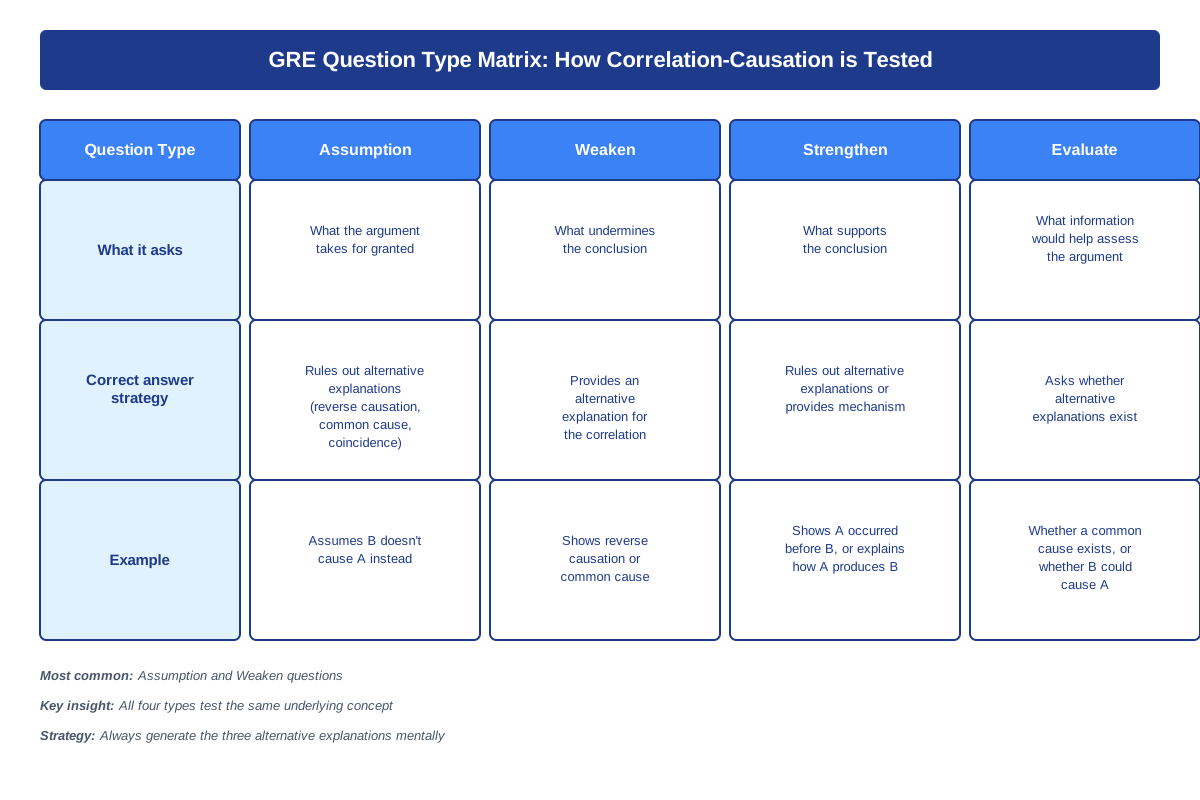
On the GRE specifically, correlation versus causation appears in approximately 15-20% of all Critical Reasoning questions, making it one of the highest-yield topics to master. These questions typically appear in several formats: Assumption questions that ask what the argument takes for granted, Weaken questions that require identifying alternative explanations, Strengthen questions that ask what would support the causal claim, and Evaluate questions that ask what information would be most useful in assessing the argument. The topic also appears in Reading Comprehension passages where authors critique studies or present competing explanations for phenomena.
Common manifestations in GRE passages include: arguments about policy effectiveness (a new program was implemented and outcomes improved, therefore the program caused the improvement), health and behavior claims (people who exercise regularly report less stress, therefore exercise reduces stress), business and economic reasoning (companies that invest in training have higher profits, therefore training causes increased profits), and social science findings (students who take music lessons score higher on math tests, therefore music lessons improve math ability). Recognizing these patterns enables rapid identification of the logical structure being tested.
Core Concepts
Defining Correlation
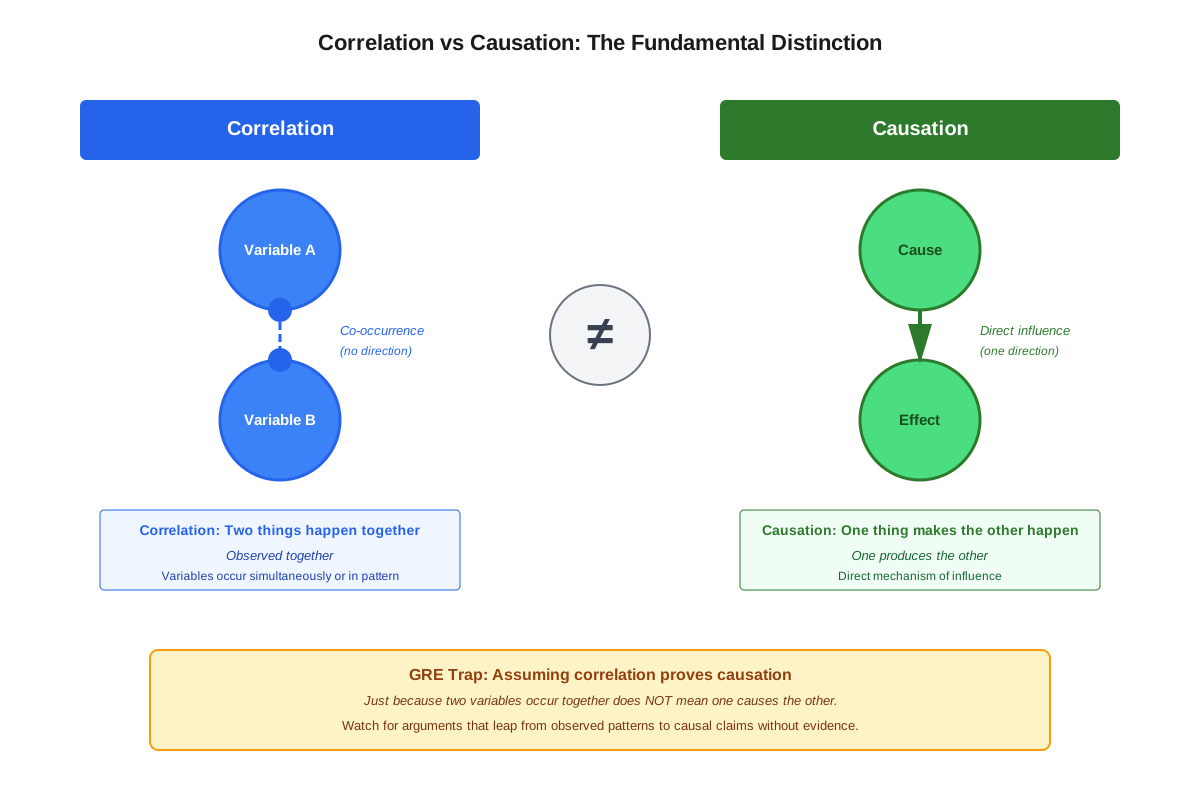
Correlation refers to a statistical relationship or association between two variables, where they tend to occur together or change together in predictable ways. When two variables are correlated, knowing the value of one variable provides information about the likely value of the other. Correlations can be positive (both variables increase together), negative (one increases as the other decreases), or zero (no relationship). Crucially, correlation is purely descriptive—it tells us that a relationship exists but provides no information about why that relationship exists or whether one variable influences the other.
For GRE purposes, correlation typically appears in arguments as observational data or statistical findings: "Studies show that X and Y occur together" or "Research indicates that as X increases, Y also increases." This correlational evidence then becomes the basis for a conclusion, and the question tests whether students recognize the logical gap between the evidence and conclusion.
Defining Causation
Causation refers to a relationship where one event, variable, or condition directly produces, influences, or brings about another. When X causes Y, changes in X directly lead to changes in Y through some mechanism. Establishing causation requires more than observing that two things occur together; it requires demonstrating that one actually influences the other and that the relationship persists when other factors are controlled.
On the GRE, causal claims typically appear in conclusions: "Therefore, X causes Y" or "X is responsible for Y" or "Y results from X." The argument structure usually presents correlational evidence (X and Y occur together) and then concludes with a causal claim (X causes Y), creating a logical gap that test questions exploit.
The Fundamental Logical Gap
The core principle is straightforward: correlation does not imply causation. Just because two variables are associated does not mean one causes the other. This represents a logical fallacy when arguments assume causation from correlation without additional evidence. The GRE tests this gap repeatedly because it's a fundamental error in reasoning that appears across disciplines and contexts.
The logical structure of these flawed arguments follows this pattern:
- Premise: X and Y are correlated (they occur together)
- Conclusion: X causes Y (one produces the other)
- Gap: No evidence establishes the direction of causation or rules out alternative explanations
Three Alternative Explanations for Correlation
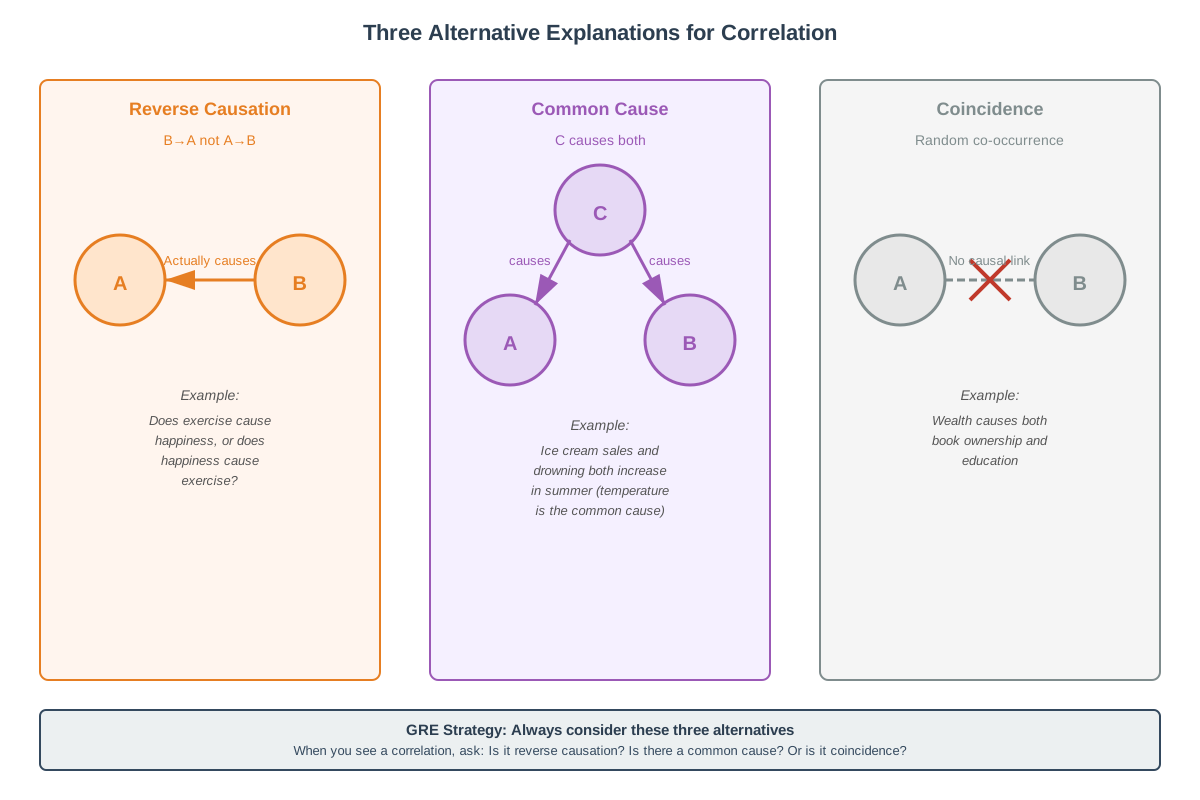
When two variables are correlated but one doesn't cause the other, three main alternative explanations account for most scenarios:
1. Reverse Causation: The causal arrow points in the opposite direction from what the argument claims. Instead of X causing Y, Y actually causes X. For example, an argument might claim that happiness causes success (people who are happy become successful), but the correlation could actually reflect that success causes happiness (people who become successful then feel happy). Both scenarios produce the same correlation (happy people are successful people), but the causal direction differs entirely.
2. Common Cause (Third Variable): Both X and Y are caused by a third factor Z, which explains why they occur together without either causing the other. For example, ice cream sales and drowning deaths are correlated, but ice cream doesn't cause drowning. Instead, hot weather (Z) causes both increased ice cream consumption (X) and more swimming (Y), which leads to more drowning incidents. The common cause creates the correlation without any direct causal relationship between the correlated variables.
3. Coincidence: The correlation is accidental or spurious, occurring by chance without any causal relationship or common cause. While less common in GRE questions, this explanation reminds us that not every correlation has a meaningful explanation, especially with small sample sizes or selective data presentation.
Comparison Table
| Feature | Correlation | Causation |
|---|---|---|
| Definition | Two variables occur together or change together | One variable directly produces changes in another |
| Evidence Required | Observational data showing association | Controlled studies, mechanism, temporal sequence |
| Logical Status | Descriptive relationship | Explanatory relationship |
| Reversibility | Symmetric (if X correlates with Y, then Y correlates with X) | Asymmetric (if X causes Y, Y doesn't necessarily cause X) |
| GRE Appearance | Usually in premises/evidence | Usually in conclusions/claims |
| Alternative Explanations | Multiple possible causes for the relationship | Specific mechanism linking variables |
Establishing Causation: What's Missing
To legitimately establish causation rather than mere correlation, arguments need several elements that GRE questions often highlight as missing:
- Temporal sequence: The cause must precede the effect in time
- Mechanism: A plausible explanation for how X produces Y
- Control for confounding variables: Evidence that other factors don't explain the relationship
- Dose-response relationship: Stronger causes produce stronger effects
- Experimental manipulation: Evidence from controlled experiments where X is deliberately changed and Y responds
- Consistency: The relationship appears across different contexts and studies
GRE questions frequently ask what would strengthen a causal argument, and the correct answer often provides one of these missing elements, particularly evidence that rules out alternative explanations or demonstrates a mechanism.
Concept Relationships
The correlation versus causation distinction connects to multiple other Critical Reasoning concepts tested on the GRE. Understanding these relationships helps students recognize when this topic is being tested and how it integrates with broader reasoning skills.
Relationship to Assumptions: Every argument that concludes causation from correlational evidence contains an implicit assumption—that no alternative explanation accounts for the correlation. Assumption questions on the GRE often test whether students can identify this gap. The logical flow is: Correlation (evidence) → Assumption (no alternative explanation) → Causation (conclusion).
Relationship to Strengthen/Weaken Questions: Weaken questions frequently present alternative explanations for correlations (introducing reverse causation or common causes), while strengthen questions provide evidence that rules out alternatives or establishes causal mechanisms. The concept map is: Correlation observed → Alternative explanations weaken causal claim → Evidence against alternatives strengthens causal claim.
Relationship to Evaluation Questions: Questions asking what information would be most useful for evaluating an argument often test correlation versus causation by asking what would help determine whether the relationship is causal. These questions essentially ask: "What would distinguish between correlation and causation in this scenario?"
Internal Concept Relationships: Within the topic itself, the three alternative explanations (reverse causation, common cause, coincidence) represent different ways the same correlation can exist without causation. Understanding one helps understand the others: Correlation → Could be causation OR reverse causation OR common cause OR coincidence. Each alternative explanation represents a different logical structure that produces the same observational evidence.
High-Yield Facts
⭐ Correlation does not imply causation is the single most important principle; observing that two variables occur together never, by itself, proves one causes the other
⭐ Reverse causation is one of the most common alternative explanations on the GRE; always consider whether Y might cause X instead of X causing Y
⭐ Common cause scenarios (third variables) explain many correlations; when two things occur together, look for what might cause both
⭐ Temporal sequence is necessary but not sufficient for causation; the cause must precede the effect, but this alone doesn't prove causation
⭐ Controlled experiments provide stronger causal evidence than observational studies; GRE strengthen questions often introduce experimental evidence
- Arguments that use words like "therefore," "thus," or "consequently" before causal claims are making logical leaps from correlation to causation
- The same correlation can support multiple competing causal explanations; identifying alternatives is key to weakening arguments
- Causal claims require mechanisms; asking "how would X produce Y?" helps identify missing links in arguments
- Sample selection bias can create spurious correlations; if the sample isn't representative, observed correlations may not reflect real relationships
- Confounding variables are factors that correlate with both the proposed cause and effect, creating apparent relationships that aren't causal
Quick check — test yourself on Correlation versus causation so far.
Try Flashcards →Common Misconceptions
Misconception: If X always occurs before Y, then X must cause Y.
Correction: Temporal sequence (X preceding Y) is necessary for causation but not sufficient. Night always precedes day, but night doesn't cause day. Both are caused by Earth's rotation. The GRE tests this by presenting arguments where timing suggests causation, but alternative explanations still exist.
Misconception: Strong correlations are more likely to be causal than weak correlations.
Correction: The strength of a correlation (how closely two variables track together) is independent of whether the relationship is causal. Two variables can be perfectly correlated due to a common cause, while weakly correlated variables might have a genuine but noisy causal relationship. The GRE exploits this by presenting strong correlations with obvious alternative explanations.
Misconception: If we can't think of an alternative explanation, the relationship must be causal.
Correction: Our inability to imagine alternatives doesn't make a relationship causal. The GRE specifically tests this by asking what would weaken an argument, with correct answers providing alternative explanations that weren't obvious from the passage. The burden of proof lies with establishing causation, not with ruling out every conceivable alternative.
Misconception: Correlation versus causation only matters in scientific or statistical contexts.
Correction: The GRE tests this logical principle across all domains—business, policy, social sciences, humanities, and everyday reasoning. Any argument that observes a pattern and concludes one thing causes another is vulnerable to this critique, regardless of subject matter.
Misconception: If multiple studies show the same correlation, it must be causal.
Correction: Replication strengthens confidence in the correlation's existence but doesn't establish causation. Multiple studies might all suffer from the same confounding variable or reverse causation issue. The GRE tests this by presenting arguments that cite multiple sources or widespread observations, then asking what would weaken the causal conclusion.
Misconception: Eliminating one alternative explanation proves causation.
Correction: Ruling out reverse causation doesn't eliminate common cause explanations; ruling out one common cause doesn't eliminate others. Establishing causation requires comprehensive evidence, not just eliminating a single alternative. GRE strengthen questions often provide evidence against one alternative, but this only partially strengthens the argument.
Worked Examples
Example 1: Identifying the Logical Gap
GRE-Style Question:
A recent study found that employees who work from home more than three days per week report higher job satisfaction than those who work primarily in the office. The researchers concluded that working from home causes increased job satisfaction. Which of the following, if true, most weakens the researchers' conclusion?
(A) Some employees who work from home report feeling isolated from colleagues
(B) Employees with higher job satisfaction are more likely to request and receive approval for remote work arrangements
(C) The study surveyed employees across multiple industries and company sizes
(D) Job satisfaction has been increasing across all work arrangements over the past decade
(E) Working from home allows employees to save time and money on commuting
Step 1: Identify the argument structure
- Premise (correlation): Remote workers report higher job satisfaction
- Conclusion (causation): Remote work causes higher job satisfaction
- Logical gap: Assumes the causal direction and rules out alternatives
Step 2: Recognize this as correlation versus causation
The trigger phrase "concluded that working from home causes" signals a causal claim based on correlational evidence (the study "found that" they occur together).
Step 3: Consider alternative explanations
- Reverse causation: Maybe satisfied employees get remote work privileges
- Common cause: Maybe a third factor causes both remote work and satisfaction
- Coincidence: Less likely given the study's findings
Step 4: Evaluate answer choices
- (A) Weakens remote work's benefits but doesn't address the causal logic
- (B) CORRECT - Presents reverse causation: satisfaction leads to remote work, not vice versa
- (C) Strengthens by showing the correlation is robust across contexts
- (D) Irrelevant to the specific causal claim about remote work
- (E) Strengthens by providing a mechanism for how remote work could cause satisfaction
Answer: (B)
This question tests the learning objective of identifying when correlation versus causation is being tested and applying the concept to weaken a causal argument by introducing reverse causation.
Example 2: Strengthening a Causal Claim
GRE-Style Question:
City officials observed that neighborhoods with more street trees have lower crime rates. They propose planting trees throughout high-crime areas to reduce criminal activity. Which of the following, if true, would most strengthen the officials' proposal?
(A) Neighborhoods with more street trees also have higher property values
(B) A controlled experiment showed that adding trees to previously treeless blocks led to measurable decreases in crime within one year
(C) Residents of tree-lined neighborhoods report feeling safer than those in areas without trees
(D) Cities that have invested in urban forestry programs have seen overall improvements in quality of life
(E) Street trees provide environmental benefits including air quality improvement and temperature reduction
Step 1: Identify the argument structure
- Premise (correlation): More trees correlates with less crime
- Conclusion (causation): Planting trees will reduce crime
- Implicit assumption: Trees cause the crime reduction (not reverse causation or common cause)
Step 2: Determine what would strengthen the causal claim
To strengthen, we need evidence that:
- Rules out alternative explanations (especially common cause)
- Provides experimental evidence of causation
- Shows temporal sequence (trees first, then crime reduction)
- Demonstrates a mechanism
Step 3: Evaluate answer choices
- (A) Introduces another correlation but doesn't establish causation; might suggest common cause (wealth)
- (B) CORRECT - Provides experimental evidence with temporal sequence and controlled conditions, directly establishing causation
- (C) Adds another correlation (feelings of safety) but doesn't prove trees cause crime reduction
- (D) Too vague; "quality of life" doesn't specifically address crime, and no causal mechanism is established
- (E) Provides benefits of trees but doesn't connect to crime reduction
Step 4: Recognize why (B) is strongest
The controlled experiment addresses the key weakness in correlational evidence: it manipulates the proposed cause (adds trees), controls for confounding variables (by comparing similar blocks), establishes temporal sequence (trees added first, then crime measured), and shows the predicted effect (crime decreased). This transforms correlation into evidence of causation.
Answer: (B)
This example demonstrates how to apply correlation versus causation concepts to strengthen questions by recognizing what type of evidence would establish causation rather than mere correlation.
Exam Strategy
Recognizing When Correlation Versus Causation Is Being Tested
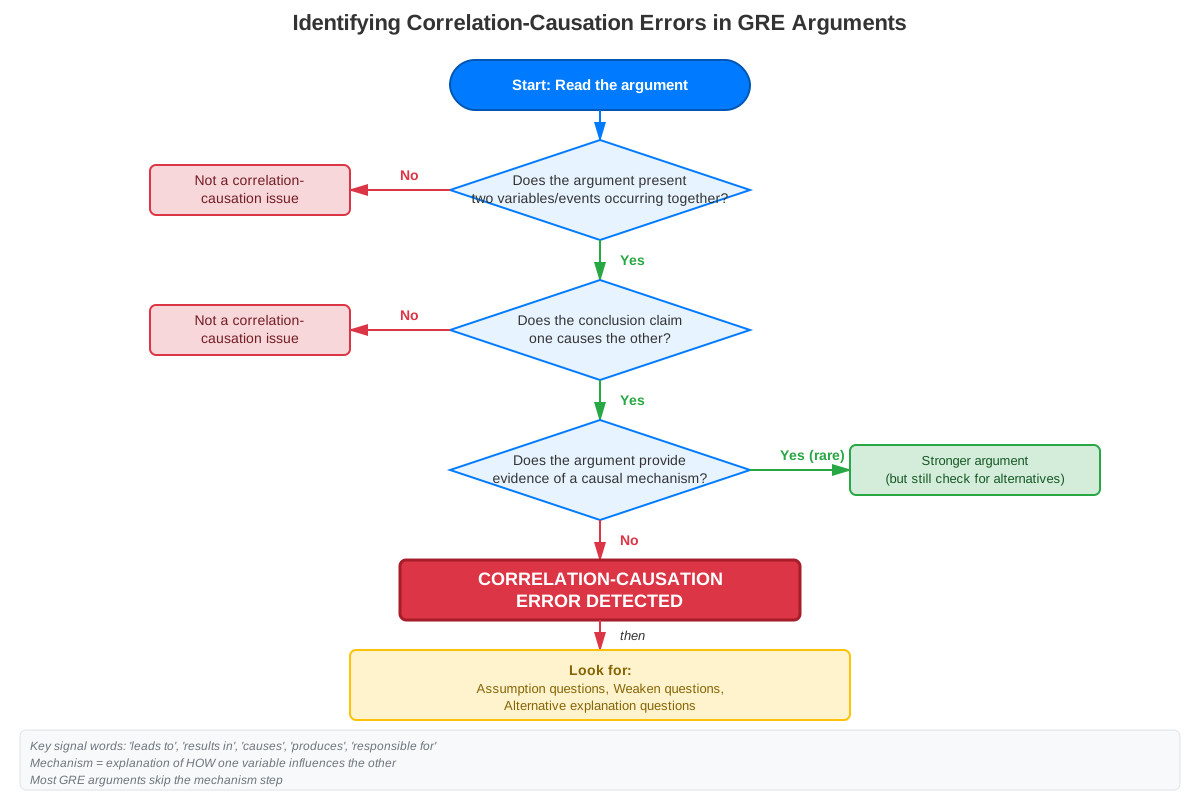
Watch for these trigger words and phrases in GRE passages:
- Causal language in conclusions: "causes," "leads to," "results in," "produces," "is responsible for," "brings about," "contributes to"
- Correlational language in premises: "is associated with," "correlates with," "occurs together with," "studies show that," "research indicates," "observations reveal"
- Policy recommendations based on observations: "Therefore, we should implement X to achieve Y"
- Temporal sequence language: "after," "following," "subsequently," "then" (suggesting but not proving causation)
Systematic Approach to These Questions
Step 1: Identify the correlation in the premises
What two things are observed to occur together? Mark this clearly.
Step 2: Identify the causal claim in the conclusion
Which direction does the argument claim causation flows? X→Y or Y→X?
Step 3: Generate alternative explanations
- Could it be reverse causation (Y→X instead)?
- Could a third variable Z cause both X and Y?
- Is there a selection bias or confounding variable?
Step 4: Match your alternatives to answer choices
- For weaken questions: Look for answers presenting your alternative explanations
- For strengthen questions: Look for answers ruling out alternatives or providing experimental evidence
- For assumption questions: Look for answers stating "no alternative explanation exists"
Process of Elimination Tips
Eliminate answers that:
- Introduce new correlations without addressing causation (common trap)
- Discuss benefits or drawbacks without addressing the logical gap
- Are too vague or general to address the specific causal claim
- Strengthen/weaken the wrong part of the argument (e.g., attacking premises when the gap is in reasoning)
Favor answers that:
- Explicitly address causal direction or alternative explanations
- Provide experimental or controlled evidence (for strengthen questions)
- Identify specific confounding variables or common causes (for weaken questions)
- State assumptions about ruling out alternatives (for assumption questions)
Time Allocation
Correlation versus causation questions should take 60-90 seconds once you recognize the pattern:
- 15-20 seconds: Read and identify the correlation→causation structure
- 10-15 seconds: Generate 2-3 alternative explanations
- 30-45 seconds: Evaluate answer choices against your alternatives
- 5-10 seconds: Confirm and select
If you're spending more than 90 seconds, you may be overthinking. The GRE tests the fundamental principle repeatedly; once you recognize the pattern, the logic is straightforward.
Memory Techniques
The "CORE" Acronym for Alternative Explanations
Common cause (third variable causes both)
Opposite direction (reverse causation)
Random chance (coincidence)
Experimental evidence needed (what's missing to prove causation)
When you see correlation→causation, mentally run through CORE to generate alternatives.
Visualization Strategy: The Arrow Test
When reading an argument, draw mental arrows:
- If the passage says "X and Y occur together" → draw X ↔ Y (correlation, no direction)
- If the conclusion says "X causes Y" → draw X → Y (causation, specific direction)
- Ask: "Could the arrow point the other way?" (Y → X)
- Ask: "Could both arrows come from something else?" (Z → X and Z → Y)
This visual approach helps distinguish correlation (bidirectional association) from causation (directional influence).
The "Ice Cream and Drowning" Memory Hook
Remember the classic example: ice cream sales correlate with drowning deaths, but ice cream doesn't cause drowning. Hot weather causes both. This memorable example encapsulates the common cause scenario and can be mentally referenced whenever you see a correlation that seems suspicious.
Mnemonic for Establishing Causation: "TEMP"
To prove causation (not just correlation), you need:
Temporal sequence (cause before effect)
Experimental evidence (controlled manipulation)
Mechanism (explanation of how X produces Y)
Preclude alternatives (rule out other explanations)
When strengthen questions ask what would support a causal claim, check which element of TEMP the answer provides.
Summary
The distinction between correlation and causation represents a fundamental logical principle that the GRE tests extensively across Critical Reasoning questions. Correlation describes an observed association between two variables—they occur together or change together—while causation describes a relationship where one variable directly produces or influences the other. The critical error in reasoning, tested repeatedly on the GRE, occurs when arguments observe a correlation and conclude causation without adequate evidence. Three primary alternative explanations account for most correlations that aren't causal: reverse causation (the causal arrow points the opposite direction), common cause (a third variable causes both observed variables), and coincidence (the relationship is spurious or accidental). To establish genuine causation requires evidence beyond mere correlation, including temporal sequence, experimental manipulation, plausible mechanisms, and ruling out confounding variables. GRE questions test this concept by presenting arguments that leap from correlational evidence to causal conclusions, then asking students to identify assumptions, generate alternative explanations, evaluate what would strengthen or weaken the argument, or determine what additional information would be most useful. Mastering this topic requires recognizing the logical structure (correlation in premises, causation in conclusion), systematically generating alternatives using the CORE framework, and matching those alternatives to answer choices.
Key Takeaways
- Correlation never proves causation by itself; observing that X and Y occur together provides no information about whether one causes the other without additional evidence
- Always consider reverse causation as the first alternative explanation; the causal arrow might point in the opposite direction from what the argument claims
- Common cause scenarios (third variables) explain many correlations; when two things occur together, ask what might cause both
- Experimental evidence is the gold standard for establishing causation; controlled studies that manipulate the proposed cause provide much stronger evidence than observational correlations
- Temporal sequence is necessary but insufficient; the cause must precede the effect, but this alone doesn't prove a causal relationship
- Trigger words signal the logical gap: correlational language in premises ("associated with," "studies show") followed by causal language in conclusions ("causes," "leads to," "results in")
- Generate alternatives systematically using CORE (Common cause, Opposite direction, Random chance, Experimental evidence needed) to quickly identify weakening answers or missing assumptions
Related Topics
Necessary versus Sufficient Conditions: Understanding causation requires distinguishing between necessary conditions (must be present for the effect) and sufficient conditions (guarantee the effect). This builds on correlation versus causation by adding nuance to causal relationships.
Sampling and Selection Bias: Many spurious correlations arise from biased samples. Mastering correlation versus causation enables deeper understanding of how sample selection creates misleading associations.
Logical Fallacies: The correlation-causation error is one specific type of logical fallacy. Understanding this concept provides foundation for recognizing other reasoning errors like post hoc ergo propter hoc (after this, therefore because of this).
Experimental Design: To fully understand what evidence establishes causation, students benefit from learning about controlled experiments, randomization, and confounding variables—topics that appear in more advanced Critical Reasoning questions.
Statistical Reasoning: While the GRE doesn't require mathematical statistics, understanding concepts like confounding variables, regression to the mean, and spurious correlations deepens mastery of correlation versus causation arguments.
Practice CTA
Now that you've mastered the conceptual foundation of correlation versus causation, it's time to cement your understanding through active practice. Attempt the practice questions associated with this topic, focusing on identifying the correlation-causation structure quickly and generating alternative explanations systematically. Use the flashcards to reinforce the key distinctions, trigger words, and alternative explanation types until recognizing these patterns becomes automatic. Remember: this is one of the highest-yield topics on the GRE Verbal Reasoning section—every minute you invest in practice will directly translate to points on test day. Challenge yourself to complete practice questions in under 90 seconds each, and review any mistakes by identifying which alternative explanation you missed or which trigger word you overlooked. Your ability to spot the logical gap between correlation and causation will serve you not just on the GRE, but in evaluating arguments and making decisions throughout your academic and professional career.
Sign up free to keep reading
Create a free AnvayaPrep account to finish this GRE guide on Correlation versus causation — plus flashcards and practice questions.