Overview
Sampling flaws represent one of the most frequently tested logical reasoning vulnerabilities on the GRE Verbal Reasoning section. These flaws occur when an argument draws conclusions about a larger population based on a sample that is unrepresentative, too small, or collected through biased methods. Understanding sampling flaws is essential because they appear in approximately 15-20% of all Critical Reasoning questions, making them a high-yield topic that directly impacts test performance. The ability to identify when a sample fails to accurately represent the population it claims to describe is a fundamental critical thinking skill that the GRE tests extensively.
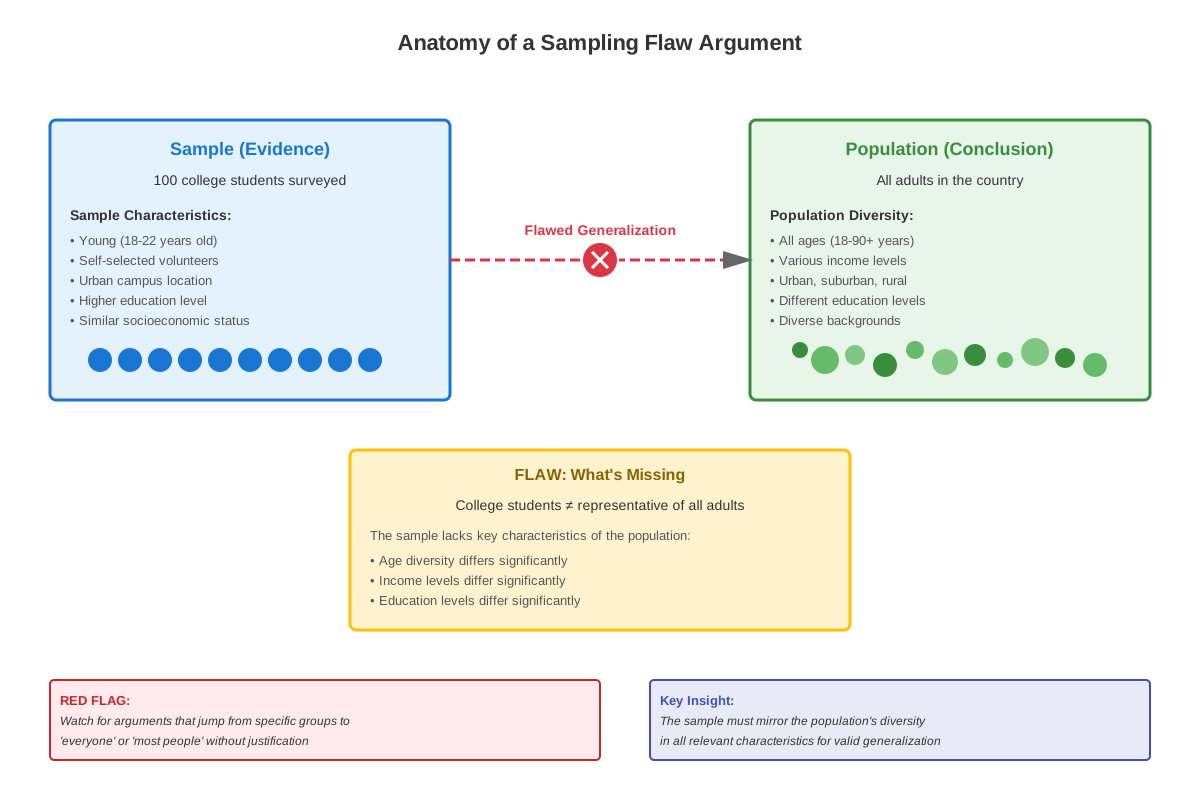
GRE sampling flaws typically manifest in arguments that generalize from limited observations to broad conclusions. For instance, an argument might survey only college students about retirement planning preferences and then claim the findings represent all adults. The test-makers deliberately craft these flawed arguments to appear superficially convincing, requiring students to scrutinize the relationship between the sample and the population. Mastering this topic enables students to quickly identify the disconnect between evidence and conclusion, making it possible to eliminate incorrect answer choices and select responses that accurately describe the logical weakness.
Within the broader context of Verbal Reasoning, sampling flaws connect directly to other critical reasoning concepts including hasty generalizations, representativeness issues, and statistical reasoning errors. This topic serves as a foundation for understanding how evidence quality affects argument strength, a principle that underlies many GRE question types including "Weaken," "Strengthen," "Assumption," and "Evaluate the Argument" questions. Students who develop expertise in identifying sampling flaws gain a transferable analytical framework applicable across multiple question formats.
Learning Objectives
- [ ] Identify when Sampling flaws is being tested in GRE Critical Reasoning questions
- [ ] Explain the core rule or strategy behind Sampling flaws and why they undermine arguments
- [ ] Apply Sampling flaws concepts to GRE-style questions accurately and efficiently
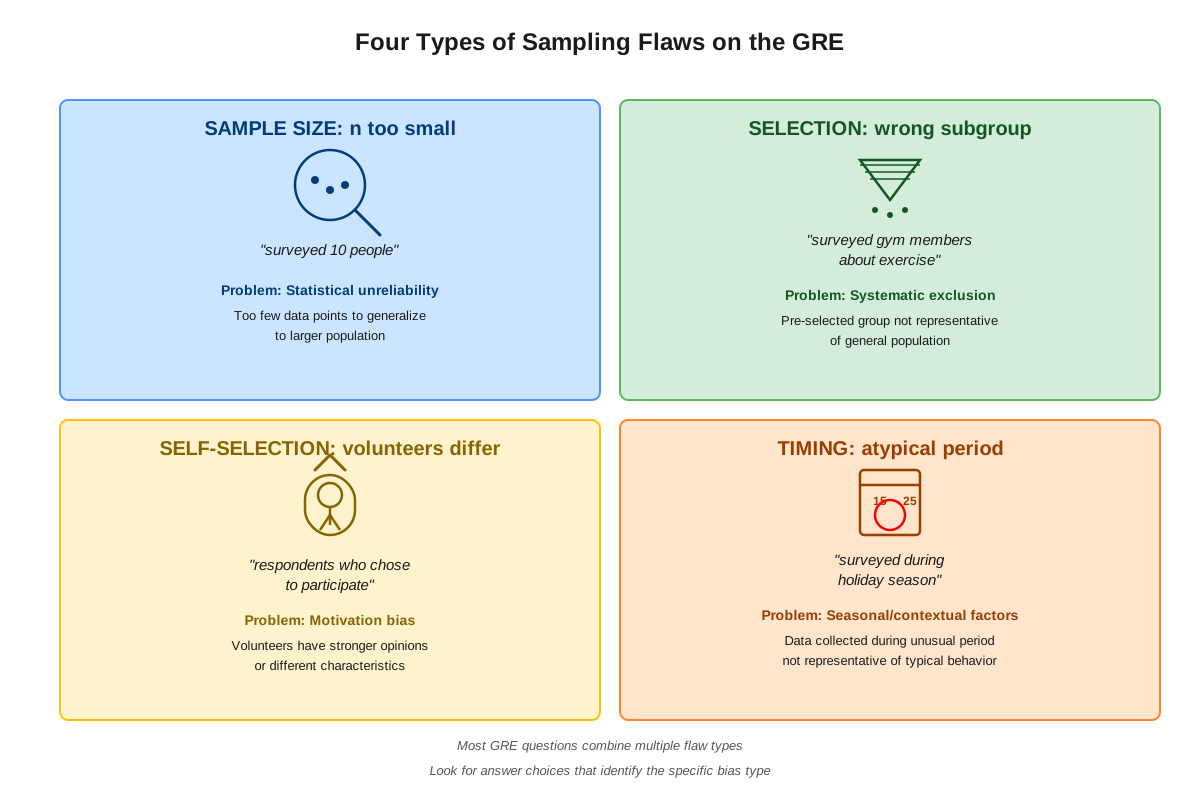
- [ ] Distinguish between different types of sampling flaws (size, bias, self-selection, timing)
- [ ] Evaluate whether a given sample is representative of its target population
- [ ] Predict which answer choices will correctly identify or address sampling issues
- [ ] Recognize the language patterns and trigger phrases that signal sampling flaw questions
Prerequisites
- Basic argument structure: Understanding premises, conclusions, and how evidence supports claims is essential because sampling flaws specifically concern the quality of evidence used to support generalizations
- Population vs. sample distinction: Recognizing the difference between a subset and the whole group enables identification of when generalizations are being made inappropriately
- Causation and correlation concepts: Many sampling flaw arguments conflate these concepts, so understanding their distinction helps identify compounded logical errors
- Quantitative reasoning fundamentals: Basic understanding of percentages, proportions, and statistical representation aids in evaluating whether sample sizes and compositions are adequate
Why This Topic Matters
Sampling flaws appear with remarkable frequency on the GRE because they test a fundamental aspect of critical thinking: the ability to evaluate evidence quality. In real-world contexts, professionals across all fields must assess whether research findings, survey results, and observational data actually support the conclusions drawn from them. Medical professionals evaluate clinical trial designs, business leaders assess market research validity, and policy makers scrutinize demographic studies—all requiring the ability to identify sampling problems. The GRE tests this skill because graduate programs value students who can critically evaluate research methodologies and avoid drawing unwarranted conclusions from limited data.
On the exam itself, sampling flaws appear in multiple question types with high frequency. Approximately 15-20% of Critical Reasoning questions involve sampling issues, appearing most commonly in "Weaken the Argument," "Identify the Flaw," and "Assumption" questions. Additionally, Reading Comprehension passages occasionally include arguments with sampling problems that students must evaluate. The predictable nature of these questions makes them high-yield: students who master sampling flaw identification can quickly recognize and correctly answer these questions, improving both accuracy and time management.
Common manifestations include arguments based on surveys with low response rates, studies using convenience samples (like college students) to represent broader populations, polls conducted in biased locations, and generalizations from extreme or unusual cases. The GRE frequently presents scenarios where a company surveys only its current customers to assess market preferences, researchers study only volunteers to draw conclusions about the general population, or analysts examine only successful cases while ignoring failures. Recognizing these patterns enables rapid question analysis and confident answer selection.
Core Concepts
Definition of Sampling Flaws
A sampling flaw occurs when an argument uses evidence from a sample (a subset of a population) to draw conclusions about a larger population, but the sample fails to accurately represent that population. The fundamental problem is that the characteristics, behaviors, or opinions observed in the sample may not reflect those of the broader group, rendering the conclusion unreliable. This logical vulnerability undermines the argument's reasoning structure because the evidence provided does not adequately support the generalization being made.
The core principle is straightforward: for a sample to support valid generalizations, it must be representative of the target population in all relevant characteristics. When this condition is violated, the argument commits a sampling flaw. The GRE tests whether students can identify the specific ways samples fail to be representative and recognize how these failures weaken the argument's logical foundation.
Types of Sampling Flaws
Unrepresentative Sample (Selection Bias)
The most common type involves samples that systematically differ from the target population in ways that affect the conclusion. For example, surveying only urban residents about national transportation preferences creates a sample biased toward public transit options, failing to represent rural perspectives. The sample's composition skews the results in a predictable direction.
Key characteristics:
- The sample is drawn from a subset that has distinctive features
- These distinctive features are relevant to the conclusion being drawn
- The sampling method systematically excludes certain population segments
Sample Size Too Small
Arguments sometimes generalize from an insufficient number of observations. While no absolute threshold defines "too small," the GRE presents scenarios where conclusions about millions are based on dozens of observations, or where rare events are assumed common based on a few instances. The problem is that small samples are more susceptible to random variation and may not capture the population's true diversity.
Self-Selection Bias
This flaw occurs when the sample consists only of individuals who chose to participate, and this choice correlates with the characteristic being measured. For instance, an online survey about internet usage habits will attract respondents who are already comfortable with technology, creating a sample that overrepresents tech-savvy individuals. The voluntary nature of participation introduces systematic bias.
Temporal Sampling Issues
Some arguments draw conclusions about general patterns based on data collected during atypical time periods. Surveying shopping preferences only during holiday seasons, measuring traffic patterns only during summer vacation, or assessing student performance immediately after a major curriculum change all involve samples that may not represent typical conditions.
Survivorship Bias
This sophisticated sampling flaw involves examining only cases that "survived" some selection process while ignoring those that didn't. For example, studying only successful companies to determine business best practices ignores failed companies that may have followed the same practices. The sample systematically excludes relevant negative cases, creating a misleadingly positive picture.
Identifying Sampling Flaws in Arguments
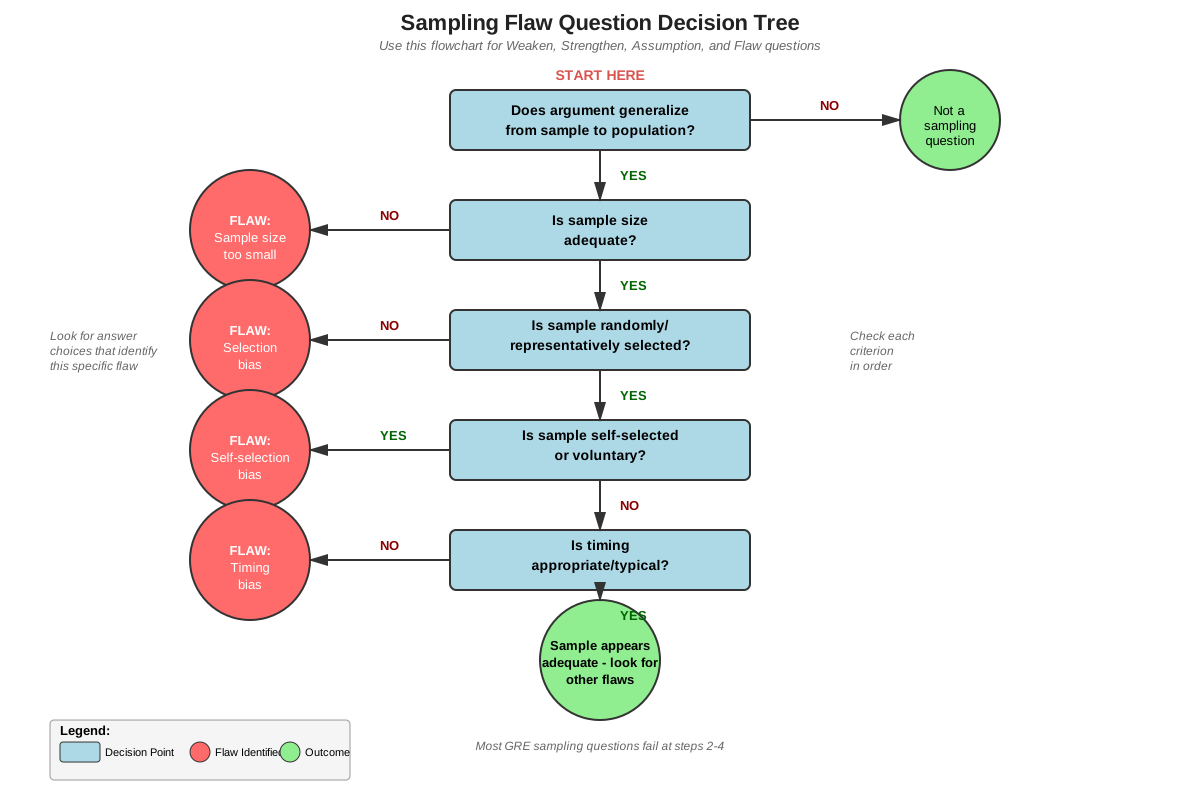
Recognition requires a systematic approach:
- Identify the conclusion: What generalization is being made? What population does it concern?
- Identify the evidence: What sample is being used? How was it collected?
- Compare sample to population: Does the sample match the population in relevant characteristics?
- Assess representativeness: Are there systematic differences that could affect the conclusion?
The Representativeness Principle
A sample is representative when it mirrors the target population's relevant characteristics in appropriate proportions. "Relevant characteristics" are those that could plausibly affect the outcome being measured. For a survey about retirement savings preferences, age and income are relevant characteristics; hair color is not. The GRE tests whether students can identify which characteristics matter for a given conclusion.
| Sample Type | Representativeness | Validity for Generalization |
|---|---|---|
| Random sample from entire population | High | Strong |
| Convenience sample (e.g., college students) | Low | Weak |
| Self-selected respondents | Low | Weak |
| Stratified sample matching population demographics | High | Strong |
| Sample from extreme cases only | Very Low | Very Weak |
Common GRE Sampling Scenarios
The exam repeatedly uses certain templates:
- Customer-only surveys: A company surveys current customers to assess market demand (ignores non-customers who might have different preferences)
- Volunteer-based studies: Research uses volunteers to represent the general population (volunteers may be systematically different)
- Single-location sampling: Conclusions about a nation/region based on one city/area (geographic bias)
- Response-rate problems: Surveys with low response rates where respondents may differ from non-respondents
- Historical comparisons: Using past data to predict future outcomes when conditions have changed
Concept Relationships
Sampling flaws connect to broader critical reasoning concepts through a hierarchical relationship. At the foundation lies the distinction between evidence and conclusion—sampling flaws specifically concern evidence quality. This connects upward to generalization errors, where sampling flaws represent one specific way generalizations can fail. The relationship flows: inadequate sample → unreliable evidence → weak generalization → flawed conclusion.
Within the topic itself, the various types of sampling flaws share a common structure: Sample characteristics ≠ Population characteristics → Conclusion about population is unwarranted. Selection bias, small sample size, self-selection, and temporal issues all represent different mechanisms by which this inequality occurs, but they produce the same logical vulnerability.
Sampling flaws also connect laterally to statistical reasoning errors. While sampling flaws concern who or what is measured, statistical errors concern how measurements are interpreted. These often appear together in GRE arguments: a biased sample combined with misinterpreted percentages creates compounded logical weaknesses.
The relationship to assumption questions is particularly important. When an argument commits a sampling flaw, it implicitly assumes the sample is representative. Therefore, sampling flaw arguments depend on the unstated assumption that "the sample accurately reflects the population." Recognizing this connection helps students answer both "Identify the Flaw" and "Identify the Assumption" questions about the same argument.
Conceptual flow: Population definition → Sample selection → Data collection → Generalization → Conclusion. Sampling flaws occur at the "Sample selection" stage but only become apparent when evaluating the "Generalization" step.
High-Yield Facts
⭐ A sample must be representative of the target population in all characteristics relevant to the conclusion being drawn
⭐ Self-selected samples (volunteers, survey respondents) are systematically biased toward individuals with stronger opinions or greater interest in the topic
⭐ Surveying only current customers cannot reveal preferences of potential customers or reasons why non-customers avoid the product
⭐ Small sample sizes are more susceptible to random variation and may not capture population diversity
⭐ Convenience samples (college students, single geographic locations) systematically differ from broader populations
- Temporal sampling during atypical periods (holidays, crises, seasonal peaks) produces unrepresentative data about normal conditions
- Survivorship bias occurs when examining only successful/surviving cases while ignoring failures or discontinued cases
- Low response rates create potential bias because respondents may systematically differ from non-respondents
- Extreme or unusual cases cannot support generalizations about typical cases
- Random sampling from the entire population produces the most representative samples
- The relevance of sample characteristics depends on the specific conclusion being drawn
- Historical samples may not represent current populations when significant changes have occurred
- Sampling flaws weaken arguments by undermining the connection between evidence and conclusion
- Multiple sampling flaws can compound, creating even weaker arguments
- Representative samples require adequate size AND appropriate composition
Quick check — test yourself on Sampling flaws so far.
Try Flashcards →Common Misconceptions
Misconception: Any sample smaller than the population is automatically flawed → Correction: Sample size alone doesn't determine validity; a well-designed sample of 1,000 can reliably represent millions if it's truly representative. The issue is representativeness, not absolute size. However, extremely small samples (e.g., 5-10 observations) are problematic regardless of selection method.
Misconception: Random sampling means haphazard or casual selection → Correction: Random sampling is a specific technical method where every population member has an equal chance of selection. It's a rigorous process designed to eliminate bias, not a casual approach. The GRE uses "random" in its technical sense.
Misconception: If a sample includes diverse individuals, it must be representative → Correction: Diversity alone doesn't ensure representativeness. A sample could include people of various ages, genders, and backgrounds but still be unrepresentative if these characteristics aren't present in the correct proportions or if other relevant characteristics are missing.
Misconception: Sampling flaws only matter for surveys and polls → Correction: Sampling issues affect any argument that generalizes from specific cases to broader conclusions, including scientific studies, business analyses, historical comparisons, and observational evidence. The GRE tests sampling flaws across diverse contexts.
Misconception: Large samples automatically eliminate sampling flaws → Correction: A large but biased sample remains biased. Surveying 10,000 college students still produces an unrepresentative sample for conclusions about all adults, regardless of the impressive size. Selection method matters more than size for representativeness.
Misconception: Sampling flaws completely invalidate conclusions → Correction: Sampling flaws weaken arguments by making conclusions less reliable, but they don't necessarily prove conclusions false. The GRE asks students to identify how arguments are weakened, not to assume conclusions are wrong. The evidence simply doesn't adequately support the generalization.
Misconception: If the argument acknowledges using a sample, it can't have a sampling flaw → Correction: Explicitly stating that a sample was used doesn't protect against sampling flaws. The issue is whether the sample is representative, not whether the argument admits using one. Many flawed arguments openly describe their sampling methods.
Worked Examples
Example 1: Customer Survey Flaw
Argument: "TechCorp surveyed 500 of its current smartphone customers and found that 85% prefer phones with screens larger than 6 inches. Therefore, TechCorp should focus its next product line exclusively on large-screen phones, as this clearly represents market demand."
Analysis Process:
Step 1 - Identify the conclusion: TechCorp should focus exclusively on large-screen phones because this represents market demand.
Step 2 - Identify the evidence: A survey of 500 current TechCorp customers showing 85% prefer large screens.
Step 3 - Identify the population: The conclusion concerns "market demand," which includes all potential smartphone buyers, not just current TechCorp customers.
Step 4 - Assess representativeness: The sample (current customers) systematically differs from the target population (all potential buyers) in critical ways:
- Current customers already chose TechCorp, suggesting they like TechCorp's existing features
- Non-customers might avoid TechCorp specifically because of large screens
- The sample excludes people who prefer small screens and therefore don't buy TechCorp phones
- Current customers may have different preferences than potential new customers
Step 5 - Identify the flaw: This is a selection bias sampling flaw. The sample is drawn exclusively from a subset (current customers) that likely has systematically different preferences than the broader market. The argument assumes current customer preferences represent all potential buyers, but people who prefer small screens probably aren't TechCorp customers.
Why this weakens the argument: The evidence doesn't support the conclusion about "market demand" because the sample can only reveal preferences of people who already chose TechCorp. It provides no information about non-customers who might represent a significant market segment with different preferences.
Connection to learning objectives: This example demonstrates how to identify sampling flaw testing (customer-only survey is a classic trigger), explains the core rule (sample must represent the target population), and shows application to a GRE-style scenario.
Example 2: Volunteer Study Flaw
Argument: "A university study examined 200 volunteers who agreed to track their exercise habits for six months. The study found that participants who exercised regularly reported 30% higher life satisfaction scores. Therefore, increasing exercise will substantially improve life satisfaction for the general population."
Analysis Process:
Step 1 - Identify the conclusion: Increasing exercise will substantially improve life satisfaction for the general population.
Step 2 - Identify the evidence: A study of 200 volunteers showing correlation between exercise and life satisfaction.
Step 3 - Identify the population: The conclusion concerns "the general population"—all people.
Step 4 - Assess representativeness: The sample consists of volunteers who agreed to track exercise habits for six months. This creates multiple representativeness problems:
- Self-selection bias: People who volunteer for exercise studies likely already value fitness and health
- These volunteers may be more motivated, disciplined, or health-conscious than average
- People with higher baseline life satisfaction might be more likely to volunteer for studies
- The sample excludes people who wouldn't commit to six months of tracking (possibly those with lower motivation or life satisfaction)
Step 5 - Identify the flaw: This is a self-selection bias sampling flaw. The voluntary nature of participation means the sample systematically overrepresents people with characteristics (motivation, health-consciousness, baseline life satisfaction) that could affect the results. The argument assumes volunteers represent the general population, but volunteers for exercise studies are likely systematically different.
Additional consideration: This argument also has a causation issue (does exercise cause higher satisfaction, or do satisfied people exercise more?), but the sampling flaw is the primary logical weakness regarding generalization to the broader population.
Why this weakens the argument: Even if the correlation is real within the volunteer sample, we cannot confidently generalize to the general population because volunteers may respond differently to exercise than non-volunteers. The sample's self-selected nature undermines its representativeness.
GRE application: On "Weaken" questions, correct answers might point out that volunteers differ from the general population. On "Assumption" questions, correct answers might state that volunteers are representative of all people. On "Flaw" questions, correct answers would identify the unrepresentative sample issue.
Exam Strategy
Recognition Triggers
Watch for these trigger phrases that signal potential sampling flaws:
- "A survey of customers found..."
- "Volunteers in the study..."
- "A poll conducted at [single location]..."
- "Researchers examined [specific subset]..."
- "Based on responses from those who..."
- "An analysis of successful cases shows..."
- "Data collected during [specific time period]..."
When these phrases appear, immediately ask: "Does this sample represent the population the conclusion is about?"
Systematic Approach
For "Identify the Flaw" questions:
- Read the conclusion first to identify the target population
- Identify the sample used as evidence
- Ask: "What's the mismatch between sample and population?"
- Look for answer choices describing representativeness problems
- Eliminate answers about other logical issues (causation, comparison, etc.)
For "Weaken the Argument" questions:
- Identify the sampling method used
- Predict: "What would make this sample unrepresentative?"
- Look for answers showing the sample differs from the population
- Correct answers often reveal that excluded groups have different characteristics
For "Strengthen the Argument" questions:
- Identify the potential sampling flaw
- Look for answers showing the sample IS representative
- Correct answers often state that included and excluded groups are similar
For "Assumption" questions:
- Identify the gap between sample and population
- The assumption bridges this gap by claiming representativeness
- Look for answers stating the sample accurately reflects the population
Time Management
Sampling flaw questions should take 60-75 seconds once recognized:
- 15-20 seconds: Identify sample and population
- 15-20 seconds: Assess representativeness
- 25-35 seconds: Evaluate answer choices
The predictable nature of these questions enables rapid processing. Don't overthink—if there's an obvious mismatch between sample and population, that's likely the answer.
Process of Elimination
Eliminate answers that:
- Discuss causation when the argument only claims correlation
- Address issues unrelated to sample representativeness
- Introduce new topics not mentioned in the argument
- Describe the sample accurately but don't explain why it's problematic
Keep answers that:
- Explicitly mention differences between sample and population
- Identify specific ways the sample is biased or unrepresentative
- Point out excluded groups that might differ from included groups
- Question whether the sample can support the generalization
Common Wrong Answer Traps
The GRE includes tempting wrong answers that:
- Identify real issues but not the primary sampling flaw
- Describe the sampling method without explaining why it's problematic
- Introduce alternative explanations when the question asks about the flaw
- Focus on sample size when the real issue is selection bias
Memory Techniques
SAMPLE Acronym
Use SAMPLE to remember key questions for evaluating representativeness:
- Size: Is the sample large enough to capture population diversity?
- Access: How was the sample accessed? (Random, convenience, self-selected?)
- Match: Do sample characteristics match population characteristics?
- Population: What population is the conclusion actually about?
- Limitations: What groups are excluded from the sample?
- Evidence: Does the evidence actually support the generalization?
The "Who's Missing?" Technique
When evaluating samples, always ask: "Who's missing from this sample, and might they be different?"
This simple question immediately reveals selection bias. If current customers are surveyed, non-customers are missing. If volunteers are studied, non-volunteers are missing. If one location is sampled, other locations are missing. The missing groups often have systematically different characteristics.
Visual Representation
Imagine two circles: a small circle (sample) inside a large circle (population). For valid generalization, the small circle must be a "mini version" of the large circle, containing all the same elements in the same proportions. Sampling flaws occur when the small circle contains only one color from a multi-colored large circle, or when it's drawn from just one section of the large circle.
The "Customer Trap" Mnemonic
Remember: "Current Customers Can't Characterize Complete Crowds"
This reminds you that surveying only current customers cannot reveal preferences of the complete market, a frequent GRE scenario.
Temporal Sampling Reminder
"Holiday data doesn't describe habitual behavior"
This phrase reminds you that data from atypical time periods (holidays, crises, seasonal peaks) doesn't represent normal patterns.
Summary
Sampling flaws represent a critical vulnerability in arguments that generalize from limited observations to broader conclusions. The fundamental principle is that samples must accurately represent their target populations in all relevant characteristics for generalizations to be valid. When samples are too small, selected through biased methods, composed of self-selected volunteers, drawn from unrepresentative subsets, or collected during atypical periods, the resulting evidence cannot reliably support broad conclusions. The GRE tests this concept extensively across multiple question types, particularly in "Weaken," "Identify the Flaw," and "Assumption" questions. Success requires systematic evaluation: identify the conclusion's target population, examine the sample used as evidence, assess whether the sample's characteristics match the population's characteristics, and recognize specific types of bias including selection bias, self-selection, survivorship bias, and temporal issues. The predictable patterns in GRE sampling flaw questions—customer-only surveys, volunteer studies, single-location sampling, and convenience samples—enable rapid recognition and confident answer selection. Mastering this high-yield topic directly improves performance on 15-20% of Critical Reasoning questions while building transferable analytical skills applicable across the Verbal Reasoning section.
Key Takeaways
- Sampling flaws occur when a sample fails to represent the population about which conclusions are drawn, undermining the argument's logical foundation
- The most common GRE sampling scenarios involve customer-only surveys, volunteer-based studies, convenience samples, and single-location data collection
- Self-selected samples (volunteers, survey respondents) are systematically biased toward individuals with stronger interest or different characteristics than the general population
- Representativeness depends on matching relevant characteristics in appropriate proportions, not merely including diverse individuals or achieving large sample sizes
- Recognition triggers include phrases like "surveyed customers," "volunteers in the study," and "data from [specific location/time]"—immediately question sample representativeness
- The systematic approach involves identifying the target population, examining the sample, comparing their characteristics, and recognizing specific bias types
- Sampling flaw questions are high-yield (15-20% of Critical Reasoning) and predictable, making them excellent opportunities for quick, confident answers
Related Topics
Hasty Generalizations: While sampling flaws specifically concern sample representativeness, hasty generalizations involve drawing conclusions from insufficient evidence more broadly. Mastering sampling flaws provides the foundation for recognizing all types of unwarranted generalizations.
Statistical Reasoning Errors: These involve misinterpreting numerical data, percentages, and correlations. Combined with sampling flaws, they represent the two primary ways arguments misuse quantitative evidence on the GRE.
Causation vs. Correlation: Many arguments with sampling flaws also confuse correlation with causation. Understanding both concepts enables identification of compounded logical weaknesses.
Survey and Study Design: Advanced understanding of research methodology, including control groups, randomization, and experimental design, builds on sampling flaw concepts and appears in more complex GRE passages.
Assumption Identification: Since sampling flaw arguments implicitly assume sample representativeness, mastering this topic directly improves performance on assumption questions across all argument types.
Practice CTA
Now that you understand the core principles of sampling flaws, it's time to cement your knowledge through active practice. Attempt the practice questions associated with this topic, focusing on applying the systematic approach outlined above. Pay special attention to identifying the mismatch between sample and population in each argument. Use the flashcards to reinforce recognition of common sampling scenarios and trigger phrases. Remember: sampling flaw questions are highly predictable and represent excellent opportunities to gain points quickly. With focused practice, you'll develop the pattern recognition skills that enable confident, rapid answers on test day. Your investment in mastering this high-yield topic will pay dividends across 15-20% of Critical Reasoning questions—make it count!
Sign up free to keep reading
Create a free AnvayaPrep account to finish this GRE guide on Sampling flaws — plus flashcards and practice questions.