Overview
Linear functions represent one of the most fundamental and frequently tested concepts in GRE Quantitative Reasoning. A linear function describes a relationship between two variables where the rate of change remains constant, producing a straight line when graphed on a coordinate plane. These functions appear in various forms throughout the GRE, from straightforward algebraic manipulation questions to complex word problems involving rates, costs, and real-world scenarios. Understanding linear functions is not merely about memorizing formulas—it requires developing an intuitive grasp of how variables relate to each other and how changes in one quantity affect another proportionally.
The importance of mastering gre linear functions cannot be overstated. These questions appear in approximately 15-20% of all GRE Quantitative Reasoning problems, making them one of the highest-yield topics for test preparation. Linear functions serve as the foundation for understanding more complex mathematical relationships, including systems of equations, inequalities, and even certain data interpretation questions. The GRE tests linear functions through multiple question formats: Quantitative Comparison questions that require understanding slopes and intercepts, Problem Solving questions involving real-world applications, and Data Interpretation questions where linear trends must be identified and analyzed.
Beyond their direct application, linear functions connect to virtually every other algebraic concept tested on the GRE. They underpin coordinate geometry questions, provide the framework for understanding rates and ratios, and form the basis for analyzing data trends in graphs and charts. Students who develop strong competency with linear functions gain a significant strategic advantage, as they can quickly recognize patterns, make predictions, and eliminate incorrect answer choices with confidence. This topic bridges pure algebra with applied problem-solving, making it essential for achieving a competitive Quantitative Reasoning score.
Learning Objectives
- [ ] Identify when Linear functions is being tested in various GRE question formats
- [ ] Explain the core rule or strategy behind Linear functions, including slope-intercept form and standard form
- [ ] Apply Linear functions to GRE-style questions accurately and efficiently
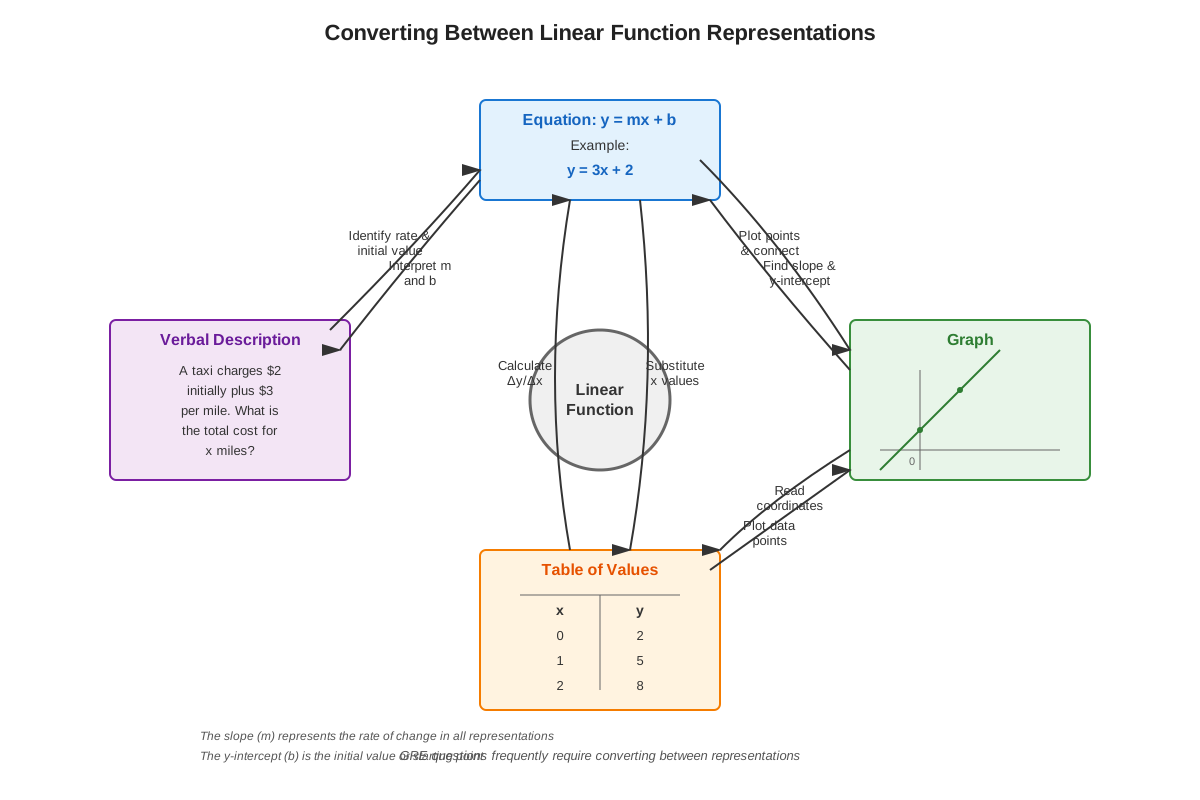
- [ ] Convert between different representations of linear functions (equations, graphs, tables, and verbal descriptions)
- [ ] Determine the slope and y-intercept from any representation and interpret their real-world meaning
- [ ] Solve systems of linear equations using substitution, elimination, and graphical methods
- [ ] Recognize parallel and perpendicular lines through their slopes and equations
Prerequisites
- Basic algebraic manipulation: Ability to solve for variables, combine like terms, and work with equations—essential for manipulating linear equations into different forms
- Coordinate plane fundamentals: Understanding of x and y axes, plotting points, and reading coordinates—necessary for graphing linear functions and interpreting their visual representations
- Fractions and negative numbers: Proficiency with operations involving fractions and negative values—critical since slopes frequently involve these number types
- Order of operations: Mastery of PEMDAS—required for correctly evaluating linear expressions and solving equations
- Basic ratio and proportion concepts: Understanding proportional relationships—forms the conceptual foundation for understanding constant rates of change
Why This Topic Matters
Linear functions model countless real-world phenomena, from calculating taxi fares (fixed base rate plus cost per mile) to predicting business profits (revenue minus fixed and variable costs). In professional contexts, linear relationships appear in financial projections, scientific data analysis, engineering calculations, and economic modeling. The ability to recognize, interpret, and manipulate linear functions is a fundamental quantitative literacy skill that extends far beyond standardized testing.
On the GRE specifically, linear functions appear in approximately 3-5 questions per test administration, making them one of the most frequently tested algebraic concepts. These questions typically appear as:
- Quantitative Comparison questions comparing slopes, intercepts, or function values
- Multiple-choice Problem Solving questions requiring equation setup and solution
- Numeric Entry questions asking for specific values like slopes or intercepts
- Data Interpretation questions where linear trends must be identified in graphs or tables
The GRE tests linear functions in both pure mathematical contexts and applied word problems. Common scenarios include distance-rate-time problems, cost analysis situations, temperature conversions, salary calculations with commissions, and depreciation models. Questions may present information in equation form, as graphs, in tables, or through verbal descriptions—requiring students to flexibly translate between representations. The test particularly favors questions that combine linear functions with other concepts, such as inequalities, absolute values, or systems of equations, making this topic a critical foundation for success across multiple question types.
Core Concepts
Definition and Standard Forms
A linear function is a mathematical relationship between two variables where the rate of change between them remains constant. The general form of a linear function is f(x) = mx + b, where x is the independent variable, f(x) or y is the dependent variable, m represents the slope (rate of change), and b represents the y-intercept (the value of y when x = 0).
Linear functions can be expressed in several equivalent forms:
| Form | Equation | Best Used When |
|---|---|---|
| Slope-intercept form | y = mx + b | You know or need to identify the slope and y-intercept |
| Standard form | Ax + By = C | Working with integer coefficients or finding intercepts quickly |
| Point-slope form | y - y₁ = m(x - x₁) | You know the slope and one point on the line |
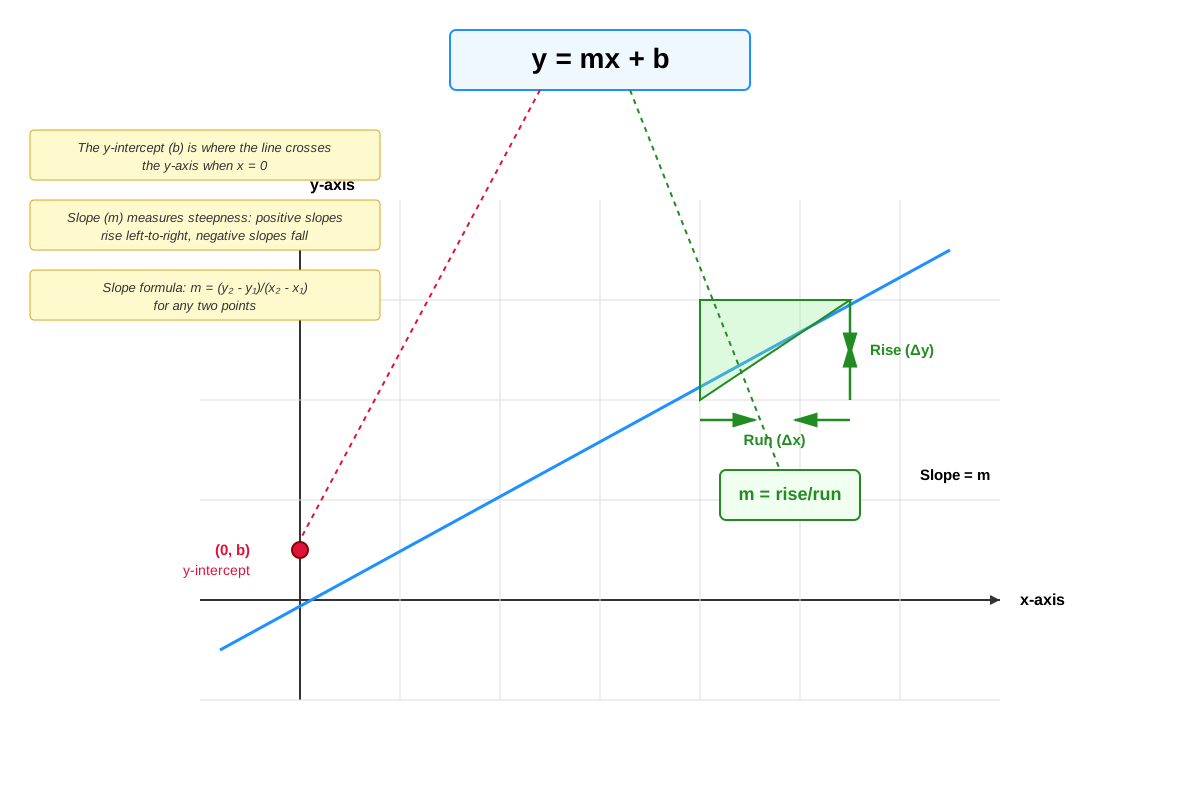
The slope-intercept form (y = mx + b) is the most commonly used on the GRE because it immediately reveals two critical characteristics: the slope m and the y-intercept b. This form allows for quick graphing and immediate interpretation of the function's behavior.
Slope: The Rate of Change
The slope of a linear function represents the rate at which y changes relative to x. Mathematically, slope is calculated as:
m = (y₂ - y₁)/(x₂ - x₁) = rise/run = change in y/change in xThe slope has several critical interpretations:
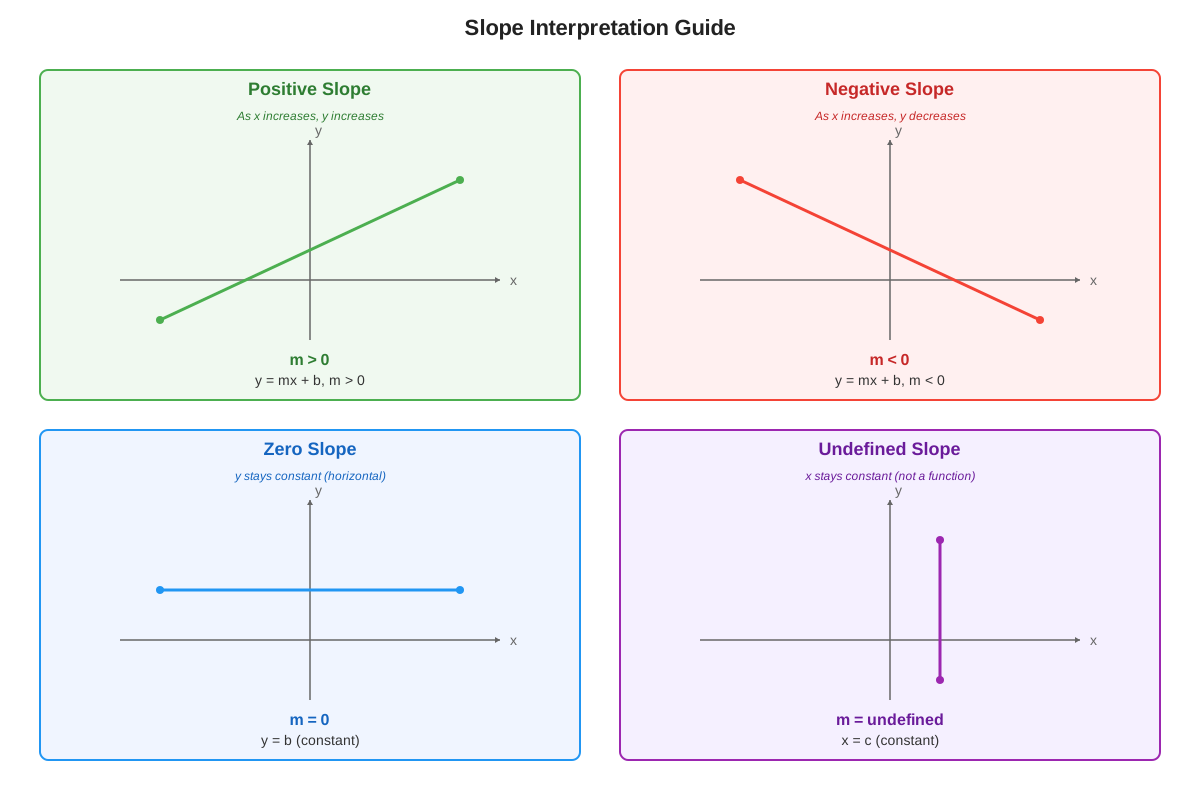
- Positive slope: The line rises from left to right; as x increases, y increases
- Negative slope: The line falls from left to right; as x increases, y decreases
- Zero slope: The line is horizontal; y remains constant regardless of x value
- Undefined slope: The line is vertical; x remains constant regardless of y value
On the GRE, slope questions often appear in real-world contexts. For example, if a linear function models cost where y represents total cost and x represents number of items, the slope represents the cost per item. If the function models distance over time, the slope represents speed or velocity.
Y-Intercept and X-Intercept
The y-intercept is the point where the line crosses the y-axis, occurring when x = 0. In the equation y = mx + b, the y-intercept is simply b. In real-world problems, the y-intercept often represents an initial value, starting amount, or fixed cost before any variable changes occur.
The x-intercept is the point where the line crosses the x-axis, occurring when y = 0. To find the x-intercept from an equation in slope-intercept form, set y = 0 and solve for x:
0 = mx + b
x = -b/m
Both intercepts provide valuable information for graphing and for understanding the practical meaning of a linear relationship. The GRE frequently tests whether students can identify these values from equations, graphs, or word problems.
Graphing Linear Functions
To graph a linear function efficiently:
- Identify the y-intercept (b) and plot this point on the y-axis at (0, b)
- Use the slope (m) to find a second point: from the y-intercept, move up or down by the rise and right by the run
- Draw a straight line through these two points, extending in both directions
Alternatively, find both intercepts and connect them with a straight line. This method is particularly efficient when working with equations in standard form.
The GRE may present graphs and ask students to identify the equation, or provide an equation and ask about graphical properties. Understanding the visual representation of slope (steepness and direction) and intercepts (where the line crosses axes) is essential for these questions.
Parallel and Perpendicular Lines
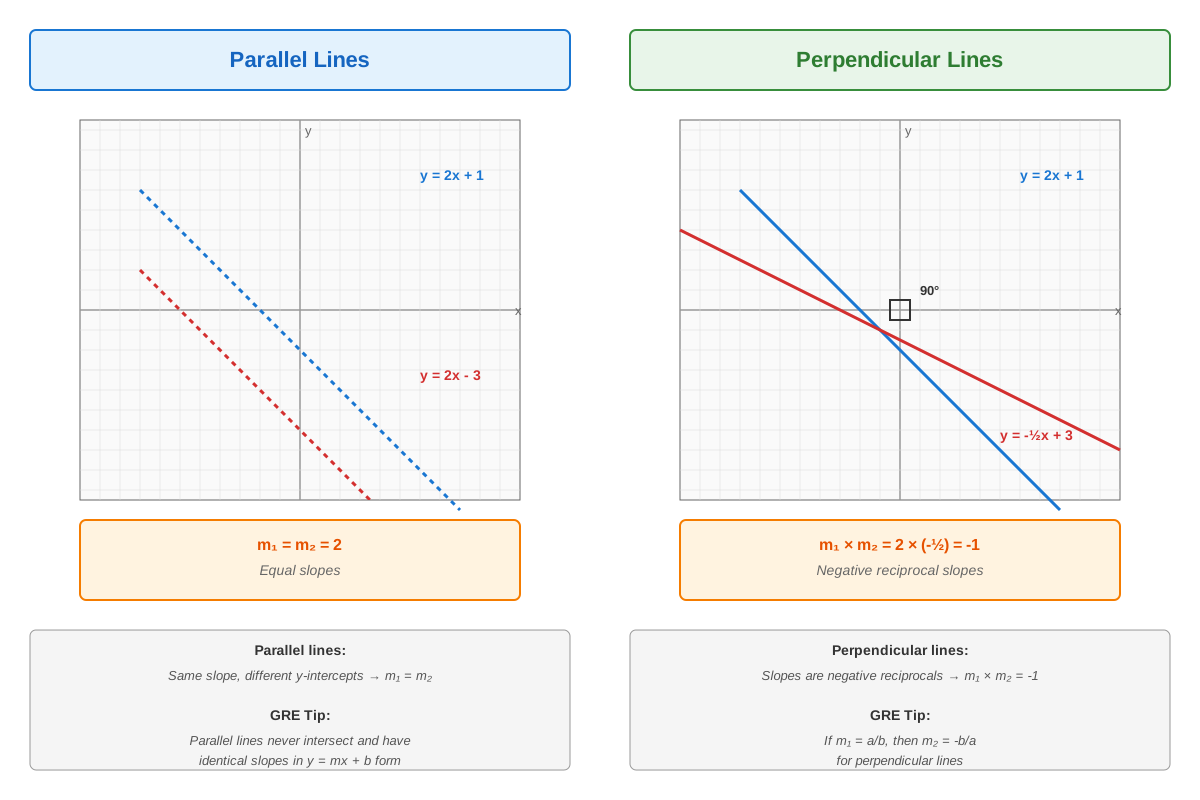
Two lines are parallel if and only if they have the same slope but different y-intercepts. Parallel lines never intersect and maintain constant distance from each other. If line 1 has equation y = m₁x + b₁ and line 2 has equation y = m₂x + b₂, the lines are parallel when m₁ = m₂ and b₁ ≠ b₂.
Two lines are perpendicular if and only if their slopes are negative reciprocals of each other. If line 1 has slope m₁ and line 2 has slope m₂, the lines are perpendicular when:
m₁ × m₂ = -1 or m₂ = -1/m₁For example, a line with slope 2/3 is perpendicular to a line with slope -3/2. The GRE tests this concept both directly (asking whether lines are parallel or perpendicular) and indirectly (in coordinate geometry problems involving rectangles or other shapes with perpendicular sides).
Systems of Linear Equations
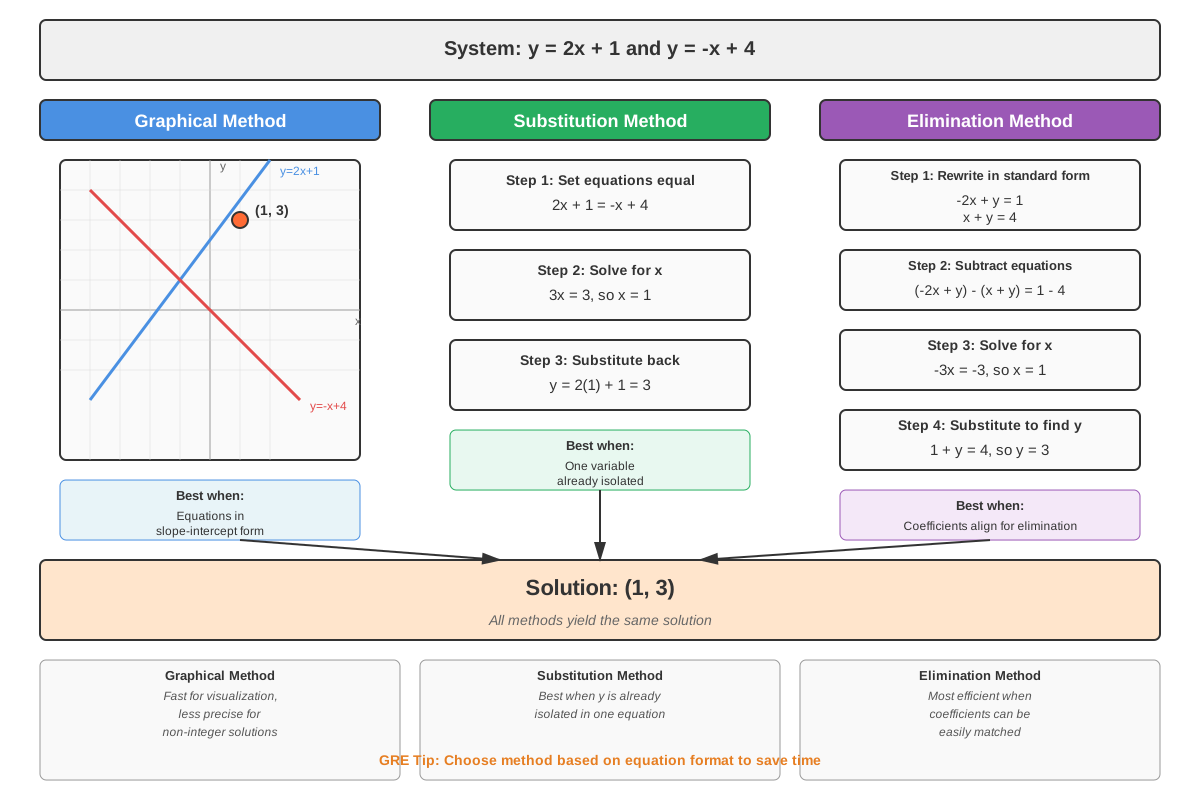
A system of linear equations consists of two or more linear equations with the same variables. The solution to a system is the point (or points) where the lines intersect—the values of x and y that satisfy all equations simultaneously.
Three methods for solving systems:
Substitution Method:
- Solve one equation for one variable
- Substitute this expression into the other equation
- Solve for the remaining variable
- Substitute back to find the other variable
Elimination Method:
- Multiply one or both equations to create matching coefficients
- Add or subtract equations to eliminate one variable
- Solve for the remaining variable
- Substitute back to find the other variable
Graphical Method:
- Graph both lines on the same coordinate plane
- Identify the intersection point
- Verify the solution satisfies both equations
The GRE most commonly requires algebraic solution methods, though understanding the graphical interpretation helps with Quantitative Comparison questions and conceptual understanding.
Concept Relationships
Linear functions form a hierarchical network of interconnected concepts. At the foundation lies the definition of a linear function as a constant rate of change relationship, which directly determines the slope concept. The slope, in turn, connects to the graphical representation (steepness and direction of the line) and to real-world interpretations (rates, costs per unit, speed).
The relationship flows as: Basic equation form → Slope and intercept identification → Graphing capabilities → Analysis of parallel/perpendicular relationships → Systems of equations. Each level builds upon the previous, with slope serving as the central connecting concept.
Slope connects to parallel lines (equal slopes) and perpendicular lines (negative reciprocal slopes), creating a branch focused on line relationships. Simultaneously, slope and intercepts connect to equation forms (slope-intercept, standard, point-slope), which enable translation between representations (equation ↔ graph ↔ table ↔ verbal description).
The concept of intercepts branches into both graphical understanding (where lines cross axes) and practical interpretation (initial values, break-even points). This connects back to word problems, where identifying what the intercepts represent is crucial for setup and solution.
Systems of linear equations represent the synthesis of multiple concepts: understanding individual linear functions, recognizing their graphical behavior, and applying algebraic manipulation skills. Systems connect to the prerequisite knowledge of solving equations while extending toward more advanced topics like linear inequalities and optimization.
Linear functions also connect outward to other GRE topics: they underpin coordinate geometry (equations of lines through points, distances), support data interpretation (trend lines, predictions), and provide context for word problems involving rates, mixtures, and work problems.
Quick check — test yourself on Linear functions so far.
Try Flashcards →High-Yield Facts
⭐ The slope of a line is calculated as (y₂ - y₁)/(x₂ - x₁) and represents the constant rate of change between variables
⭐ In the equation y = mx + b, m is the slope and b is the y-intercept
⭐ Parallel lines have equal slopes; perpendicular lines have slopes that are negative reciprocals
⭐ A positive slope indicates the line rises from left to right; a negative slope indicates the line falls from left to right
⭐ The y-intercept occurs when x = 0; the x-intercept occurs when y = 0
- A horizontal line has slope 0 and equation y = k (where k is a constant)
- A vertical line has undefined slope and equation x = k (where k is a constant)
- To convert from standard form (Ax + By = C) to slope-intercept form, solve for y: y = (-A/B)x + (C/B)
- The solution to a system of two linear equations is the point where the lines intersect
- If two lines have the same slope and same y-intercept, they are the same line (infinitely many solutions)
- If two lines have the same slope but different y-intercepts, they are parallel (no solution)
- The point-slope form y - y₁ = m(x - x₁) is useful when you know one point and the slope
- In word problems, the slope often represents a rate (cost per item, miles per hour, etc.) and the y-intercept represents an initial or fixed value
- To find where a line crosses the x-axis, set y = 0 and solve for x
- The steeper the line, the greater the absolute value of the slope
Common Misconceptions
Misconception: The slope is always positive.
Correction: Slope can be positive, negative, zero, or undefined. A line falling from left to right has a negative slope, a horizontal line has zero slope, and a vertical line has undefined slope.
Misconception: The y-intercept is always positive.
Correction: The y-intercept can be any real number—positive, negative, or zero. It simply represents the y-coordinate where the line crosses the y-axis, which can occur above, below, or at the origin.
Misconception: In the slope formula, the order of subtraction doesn't matter.
Correction: The order must be consistent. If you calculate (y₂ - y₁) in the numerator, you must calculate (x₂ - x₁) in the denominator. Reversing the order in only one part will give you the negative of the correct slope.
Misconception: Perpendicular lines have slopes that are opposites (e.g., 2 and -2).
Correction: Perpendicular lines have slopes that are negative reciprocals (e.g., 2 and -1/2). The relationship is m₁ × m₂ = -1, not m₁ = -m₂.
Misconception: A steeper line always has a larger slope value.
Correction: Steepness relates to the absolute value of the slope. A line with slope -5 is steeper than a line with slope 2, even though -5 < 2. The line with slope -5 has greater absolute value (|-5| = 5 > 2).
Misconception: The equation Ax + By = C is not a linear function if A, B, or C are negative or fractions.
Correction: Any equation that can be written in the form Ax + By = C (where A and B are not both zero) represents a linear function, regardless of whether the coefficients are positive, negative, integers, or fractions.
Misconception: When two lines intersect, both x and y coordinates of the intersection point must be positive.
Correction: The intersection point can occur in any quadrant or on any axis. The coordinates can be positive, negative, or zero depending on the specific equations.
Misconception: In a word problem, the independent variable is always x and the dependent variable is always y.
Correction: While this is conventional, the GRE may use any variables. Always read carefully to determine which variable depends on the other. For example, "cost C depends on number of items n" means C is the dependent variable.
Worked Examples
Example 1: Identifying and Applying Linear Functions from Word Problems
Problem: A taxi company charges a flat fee of $3.50 plus $0.75 per mile driven. A competing company charges $2.00 plus $1.00 per mile. For what distance do both companies charge the same amount?
Solution:
Step 1: Identify that this is a linear function problem. Each company's charge depends linearly on distance, with a fixed initial cost (y-intercept) and a constant rate per mile (slope).
Step 2: Set up equations for each company. Let C = total cost and m = miles driven.
- Company 1: C = 0.75m + 3.50
- Company 2: C = 1.00m + 2.00
Step 3: Since we want to find when charges are equal, set the equations equal to each other:
0.75m + 3.50 = 1.00m + 2.00Step 4: Solve for m by collecting like terms:
3.50 - 2.00 = 1.00m - 0.75m
1.50 = 0.25m
m = 1.50/0.25 = 6
Step 5: Verify by substituting m = 6 into both equations:
- Company 1: C = 0.75(6) + 3.50 = 4.50 + 3.50 = $8.00
- Company 2: C = 1.00(6) + 2.00 = 6.00 + 2.00 = $8.00 ✓
Answer: Both companies charge the same amount for a 6-mile trip.
Connection to Learning Objectives: This problem demonstrates identifying when linear functions are being tested (word problem with constant rates), explaining the core strategy (setting up equations with slope and y-intercept), and applying the concept accurately to find the solution.
Example 2: Working with Parallel and Perpendicular Lines
Problem: Line L has equation 3x + 4y = 12.
(a) What is the slope of line L?
(b) What is the equation of a line parallel to L that passes through the point (0, 5)?
(c) What is the slope of a line perpendicular to L?
Solution:
(a) Finding the slope of line L:
Step 1: Convert the equation to slope-intercept form by solving for y:
3x + 4y = 12
4y = -3x + 12
y = (-3/4)x + 3
Step 2: Identify the slope from the equation y = mx + b:
The slope is m = -3/4
(b) Finding a parallel line through (0, 5):
Step 1: Parallel lines have the same slope, so the new line also has slope -3/4.
Step 2: The point (0, 5) is the y-intercept (since x = 0), so b = 5.
Step 3: Write the equation using y = mx + b:
y = (-3/4)x + 5Or in standard form: 3x + 4y = 20
(c) Finding the slope of a perpendicular line:
Step 1: Perpendicular lines have slopes that are negative reciprocals.
Step 2: The original slope is -3/4, so the perpendicular slope is:
m_perpendicular = -1/(-3/4) = 4/3Answers:
(a) Slope = -3/4
(b) y = (-3/4)x + 5 or 3x + 4y = 20
(c) Slope = 4/3
Connection to Learning Objectives: This example demonstrates converting between equation forms, identifying slopes, and applying the rules for parallel and perpendicular lines—all core strategies for GRE linear function questions.
Exam Strategy
Primary Strategy: When approaching GRE linear function questions, first identify what form the information is presented in (equation, graph, table, or words) and what form you need for the answer. Often, converting to slope-intercept form provides the quickest path to the solution.
Trigger Words and Phrases to Watch For:
- "Constant rate" or "constant increase/decrease" → signals linear function
- "Per unit," "per hour," "per item" → indicates the slope
- "Initial," "starting," "fixed cost," "base fee" → indicates the y-intercept
- "Parallel" → equal slopes
- "Perpendicular" → negative reciprocal slopes
- "Intersect" or "equal" → set equations equal or solve system
Process-of-Elimination Tips:
For Quantitative Comparison questions involving linear functions:
- If comparing slopes, check the sign first (positive vs. negative) to eliminate options
- If comparing y-intercepts, determine which line is higher when x = 0
- For parallel/perpendicular questions, calculate one slope and eliminate answers that don't match the required relationship
For Multiple Choice questions:
- Eliminate answers with incorrect signs (positive when should be negative, etc.)
- Check extreme cases: plug in x = 0 to verify y-intercept, or y = 0 to verify x-intercept
- If the question involves a graph, eliminate equations whose slopes don't match the visual steepness and direction
Time Allocation Advice:
- Simple slope or intercept identification: 30-45 seconds
- Converting between equation forms: 45-60 seconds
- Word problems requiring equation setup and solving: 90-120 seconds
- Systems of equations: 90-150 seconds
- Complex problems combining multiple concepts: 120-180 seconds
Time-Saving Tip: For Quantitative Comparison questions, you often don't need to solve completely. If you can determine which quantity is larger through estimation or by testing one value, you can save significant time.
Strategic Approaches by Question Type:
For word problems: Always identify what the variables represent before setting up equations. Write down "slope = [what it represents]" and "y-intercept = [what it represents]" to avoid confusion.
For graph-based questions: If a graph is provided, estimate the slope by counting rise over run between clear grid points rather than trying to read exact coordinates.
For systems of equations: Choose elimination over substitution when coefficients are already aligned or can be easily aligned; choose substitution when one equation is already solved for a variable.
Memory Techniques
Mnemonic for Slope Formula: "You Yell Over Xylophone Xercises" → (Y₂ - Y₁)/(X₂ - X₁)
Mnemonic for Slope-Intercept Form: "Y = Mountain X + Base" → y = mx + b, where the mountain is the slope and the base is where you start (y-intercept)
Visualization for Positive vs. Negative Slope:
- Positive slope: imagine climbing uphill as you move right (/)
- Negative slope: imagine skiing downhill as you move right (\)
Acronym for Parallel and Perpendicular: "Parallel = Precisely the Same Slope" and "Perpendicular = Product is Negative One" (slopes multiply to -1)
Memory Aid for Intercepts:
- Y-intercept: "Y is where You start" (when x = 0)
- X-intercept: "X marks the spot" where the line crosses the x-axis (when y = 0)
Visualization for Converting Standard Form to Slope-Intercept:
Think of the equation Ax + By = C as a balance scale. To isolate y (get slope-intercept form), you must "move" the Ax term to the other side and then "divide everything" by B.
Conceptual Memory Device for Real-World Problems:
In cost problems: Slope = Spending per unit, Intercept = Initial cost
In distance problems: Slope = Speed, Intercept = Initial position
Summary
Linear functions represent relationships with constant rates of change and form the foundation for a significant portion of GRE Quantitative Reasoning questions. The essential equation y = mx + b encodes two critical pieces of information: the slope m (rate of change) and the y-intercept b (initial value). Mastery requires fluency in converting between different representations—equations in various forms, graphs, tables, and verbal descriptions—and recognizing which form best suits each problem type. Understanding that parallel lines share identical slopes while perpendicular lines have slopes that are negative reciprocals enables quick analysis of line relationships. Systems of linear equations, solved through substitution or elimination, represent the intersection points where multiple linear relationships hold simultaneously. On the GRE, linear functions appear both as pure algebraic problems and as models for real-world scenarios involving costs, distances, rates, and other proportional relationships. Success requires not just computational skill but conceptual understanding of what slopes and intercepts represent in context, allowing for efficient problem setup, strategic answer elimination, and confident solution verification.
Key Takeaways
- Linear functions have the form y = mx + b, where m (slope) represents constant rate of change and b (y-intercept) represents the starting value when x = 0
- Slope is calculated as (y₂ - y₁)/(x₂ - x₁) and can be positive (rising), negative (falling), zero (horizontal), or undefined (vertical)
- Parallel lines have equal slopes; perpendicular lines have slopes that multiply to -1 (negative reciprocals)
- Converting between equation forms (slope-intercept, standard, point-slope) and other representations (graphs, tables, words) is essential for efficient problem-solving
- In word problems, identify what the slope and y-intercept represent in context before setting up equations
- Systems of linear equations can be solved by substitution, elimination, or graphing, with the solution representing the intersection point
- The GRE tests linear functions through direct algebraic questions, word problems, graph interpretation, and Quantitative Comparisons—requiring both computational accuracy and conceptual understanding
Related Topics
Linear Inequalities: Building on linear functions, inequalities involve regions rather than lines, requiring understanding of boundary lines and shading. Mastering linear functions provides the foundation for graphing and solving linear inequalities.
Systems of Inequalities: Extends both linear functions and linear inequalities to finding regions that satisfy multiple constraints simultaneously, important for optimization problems.
Quadratic Functions: The next level of polynomial functions beyond linear, where the rate of change is no longer constant. Understanding linear functions provides contrast and foundation for recognizing parabolic relationships.
Coordinate Geometry: Linear functions form the basis for finding equations of lines through points, calculating distances, and determining midpoints—all essential coordinate geometry skills.
Data Interpretation with Trend Lines: Many GRE data interpretation questions involve identifying linear trends in scatter plots or predicting values using linear models, directly applying linear function concepts.
Rate Problems: Word problems involving distance-rate-time, work rates, and mixture problems often reduce to linear function applications or systems of linear equations.
Practice CTA
Now that you've mastered the core concepts of linear functions, it's time to solidify your understanding through active practice. Attempt the practice questions designed specifically for this topic, focusing on applying the strategies and techniques covered in this guide. Use the flashcards to reinforce high-yield facts and test your ability to quickly recall key formulas and relationships. Remember, the GRE rewards both accuracy and speed—consistent practice with these materials will build the automaticity you need to confidently tackle linear function questions under timed conditions. Each practice problem you solve strengthens your pattern recognition and deepens your conceptual understanding, bringing you closer to your target score. Start practicing now to transform this knowledge into test-day performance!
Sign up free to keep reading
Create a free AnvayaPrep account to finish this GRE guide on Linear functions — plus flashcards and practice questions.