Overview
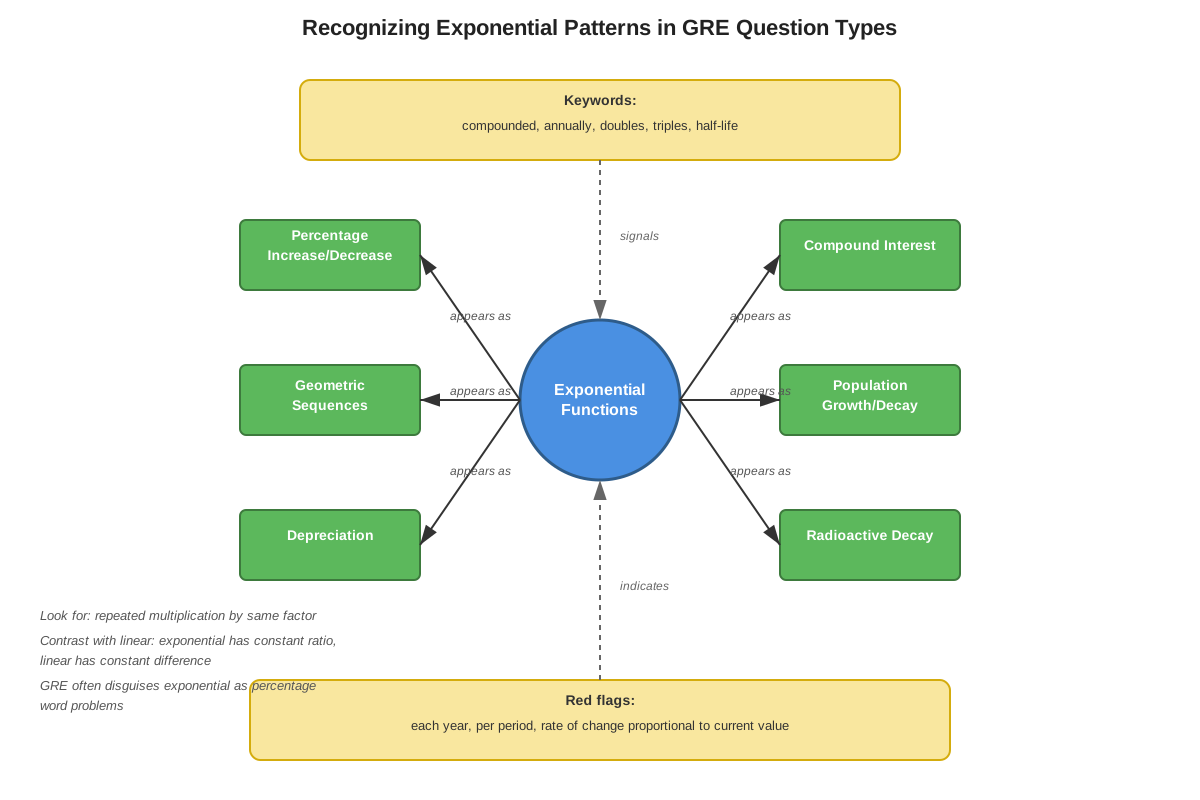
Exponential functions represent one of the most frequently tested algebraic concepts on the GRE Quantitative Reasoning section. These functions describe situations where a quantity grows or decays at a rate proportional to its current value, following the general form f(x) = a·b^x, where the variable appears in the exponent rather than the base. Understanding exponential functions is crucial because they appear not only in pure algebra questions but also in word problems involving compound interest, population growth, radioactive decay, and geometric sequences—all common GRE question types.
The GRE tests exponential functions through multiple question formats: direct computation problems requiring evaluation of exponential expressions, comparison questions asking students to determine relationships between exponential quantities, and applied word problems that require translating real-world scenarios into exponential models. Success with gre exponential functions requires both computational fluency with exponent rules and conceptual understanding of exponential growth and decay patterns. Students must recognize when a problem involves exponential relationships, often hidden within percentage increase/decrease scenarios or compound growth situations.
Exponential functions connect deeply to other Quantitative Reasoning topics including exponent properties, logarithms (their inverse functions), sequences and series (particularly geometric progressions), and percentage calculations. They also bridge to data interpretation questions where exponential trends appear in graphs and tables. Mastering exponential functions provides a foundation for understanding more complex mathematical relationships and demonstrates the quantitative reasoning skills that graduate programs value.
Learning Objectives
- [ ] Identify when Exponential functions is being tested
- [ ] Explain the core rule or strategy behind Exponential functions
- [ ] Apply Exponential functions to GRE-style questions accurately
- [ ] Distinguish between exponential growth and exponential decay based on the base value
- [ ] Convert between exponential and logarithmic forms to solve equations
- [ ] Compare exponential functions with different bases and initial values
- [ ] Solve word problems involving compound interest, population growth, and decay scenarios
Prerequisites
- Exponent rules and properties: Essential for manipulating exponential expressions, including rules for multiplication, division, and power of powers
- Basic algebra skills: Required for solving equations and isolating variables in exponential contexts
- Percentage calculations: Necessary for translating growth/decay rates into exponential form
- Function notation: Needed to understand f(x) notation and evaluate functions at specific values
- Number properties: Important for recognizing patterns in exponential sequences and comparing magnitudes
Why This Topic Matters
Exponential functions model countless real-world phenomena that appear regularly on the GRE. Financial calculations involving compound interest, investment growth, and loan repayment all follow exponential patterns. Scientific contexts including population dynamics, bacterial growth, radioactive decay, and drug concentration in the bloodstream rely on exponential models. Even technology adoption rates and viral social media spread follow exponential curves. The GRE leverages these practical applications to test both mathematical reasoning and real-world problem-solving abilities.
On the GRE Quantitative Reasoning section, exponential functions appear in approximately 10-15% of questions, making them a high-yield topic for focused study. Questions typically appear as Problem Solving (multiple choice), Quantitative Comparison, or Numeric Entry formats. The test frequently embeds exponential concepts within word problems rather than presenting them as pure algebraic exercises, requiring students to recognize exponential patterns from contextual clues.
Common exam presentations include: comparing two investment scenarios with different interest rates or compounding frequencies; determining population sizes after multiple growth periods; analyzing graphs showing exponential trends; solving for unknown exponents or bases; and evaluating expressions with fractional or negative exponents. The GRE particularly favors questions that combine exponential functions with other concepts like inequalities, requiring students to determine when one exponential expression exceeds another.
Core Concepts
Definition and Standard Form
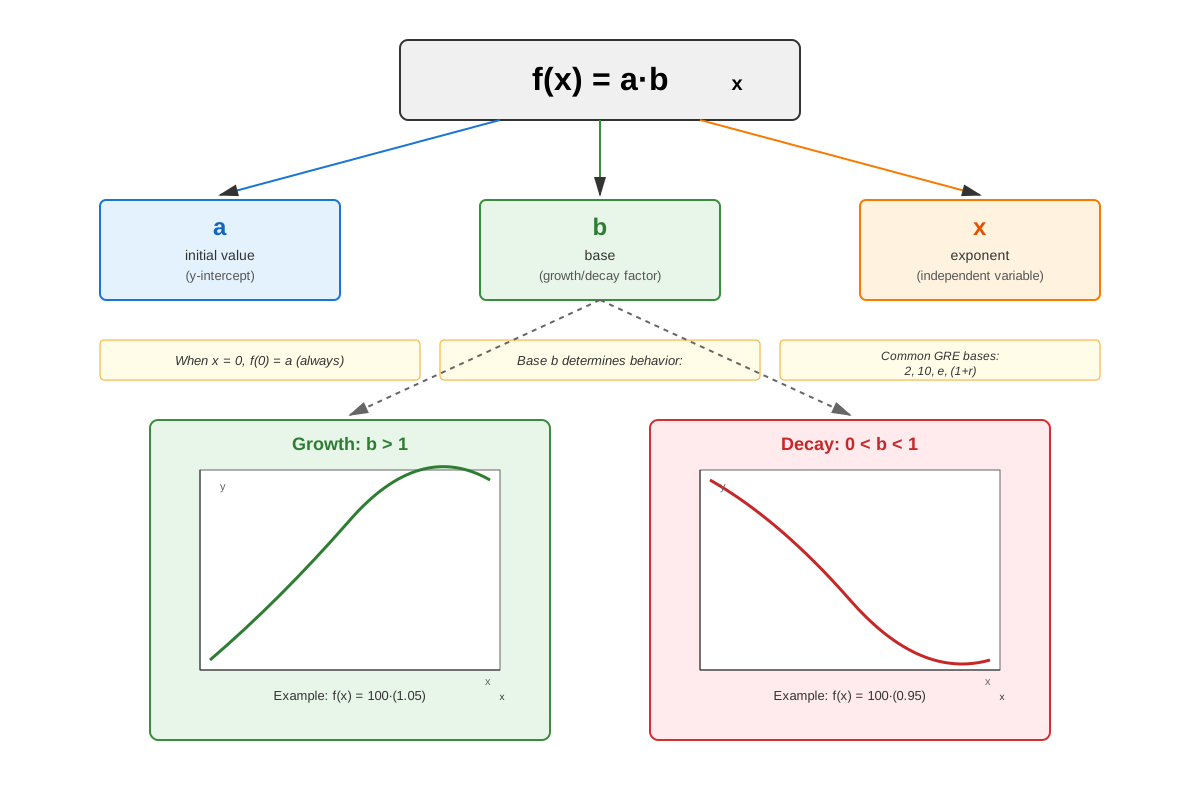
An exponential function is a mathematical function of the form f(x) = a·b^x, where:
- a is the initial value or coefficient (a ≠ 0)
- b is the base (b > 0, b ≠ 1)
- x is the exponent (the independent variable)
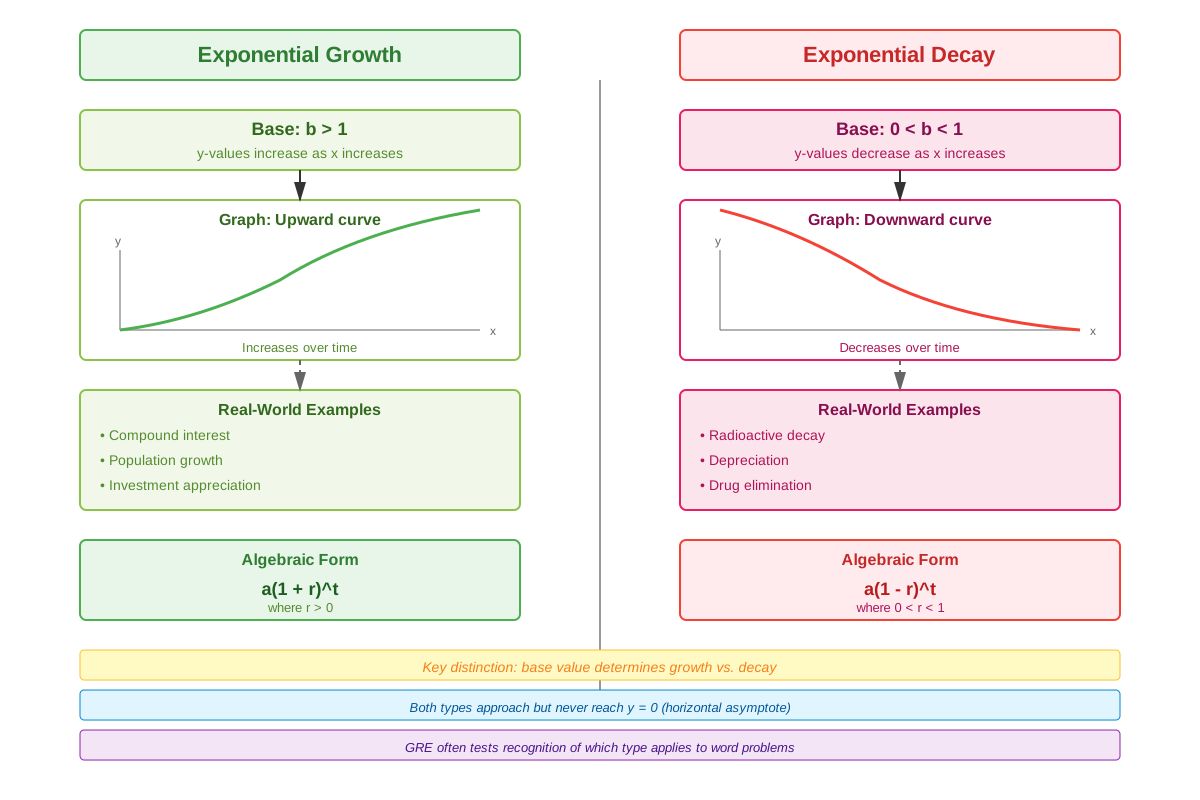
The defining characteristic is that the variable appears in the exponent position, distinguishing exponential functions from power functions where the variable is the base. When b > 1, the function exhibits exponential growth; when 0 < b < 1, it exhibits exponential decay.
Exponential Growth
Exponential growth occurs when the base b is greater than 1. In this scenario, the function value increases multiplicatively as x increases. The rate of increase itself increases over time—this is the hallmark of exponential growth. For example, f(x) = 2^x doubles with each unit increase in x:
- f(0) = 1
- f(1) = 2
- f(2) = 4
- f(3) = 8
The growth factor is the base b, representing the multiplier applied for each unit increase in the independent variable. In practical applications, growth rates are often expressed as percentages. A 5% growth rate corresponds to a growth factor of 1.05, since the quantity becomes 105% of its previous value (100% + 5% = 105% = 1.05).
Exponential Decay
Exponential decay occurs when the base b satisfies 0 < b < 1. The function value decreases multiplicatively as x increases, approaching but never reaching zero. For example, f(x) = (1/2)^x halves with each unit increase in x:
- f(0) = 1
- f(1) = 0.5
- f(2) = 0.25
- f(3) = 0.125
The decay factor is the base b, representing the fraction remaining after each time period. A 20% decay rate means 80% remains, corresponding to a decay factor of 0.80. Decay can also be expressed using negative exponents: (1/2)^x = 2^(-x), which is particularly useful for certain calculations.
Compound Interest Formula
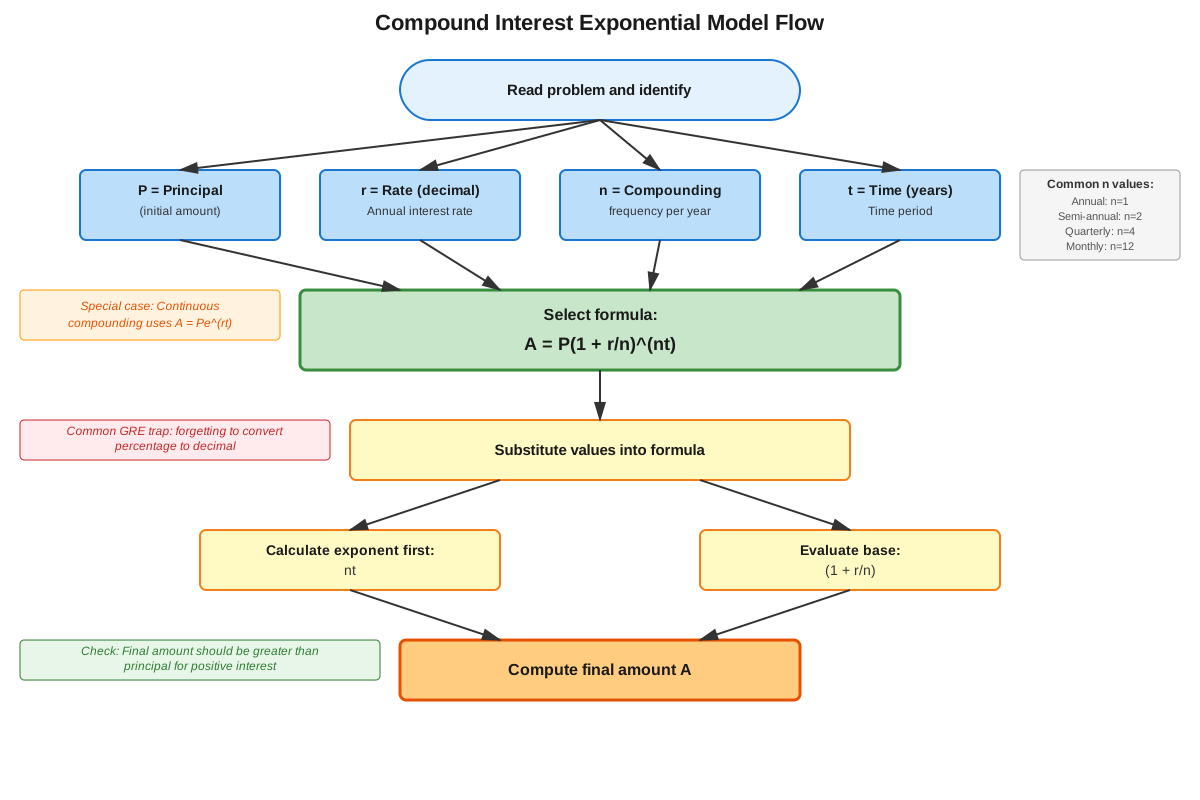
One of the most common GRE applications of exponential functions is the compound interest formula:
A = P(1 + r/n)^(nt)Where:
- A = final amount
- P = principal (initial amount)
- r = annual interest rate (as a decimal)
- n = number of times interest is compounded per year
- t = time in years
For continuous compounding, the formula becomes A = Pe^(rt), where e ≈ 2.718 is Euler's number. However, the GRE rarely tests continuous compounding, focusing instead on annual, semi-annual, quarterly, or monthly compounding.
Properties of Exponential Functions
Key properties that distinguish exponential functions include:
- Domain: All real numbers (x can be any real value)
- Range: All positive real numbers (f(x) > 0 for all x)
- Y-intercept: Always at (0, a), since b^0 = 1
- Horizontal asymptote: The x-axis (y = 0) for growth functions as x → -∞, or as x → +∞ for decay functions
- One-to-one property: If b^x = b^y, then x = y (when b > 0, b ≠ 1)
- Monotonicity: Strictly increasing (b > 1) or strictly decreasing (0 < b < 1)
Comparing Exponential Functions
The GRE frequently asks students to compare exponential expressions. Key comparison strategies include:
| Comparison Type | Strategy | Example |
|---|---|---|
| Same base, different exponents | Larger exponent yields larger value (if b > 1) | 2^5 > 2^3 |
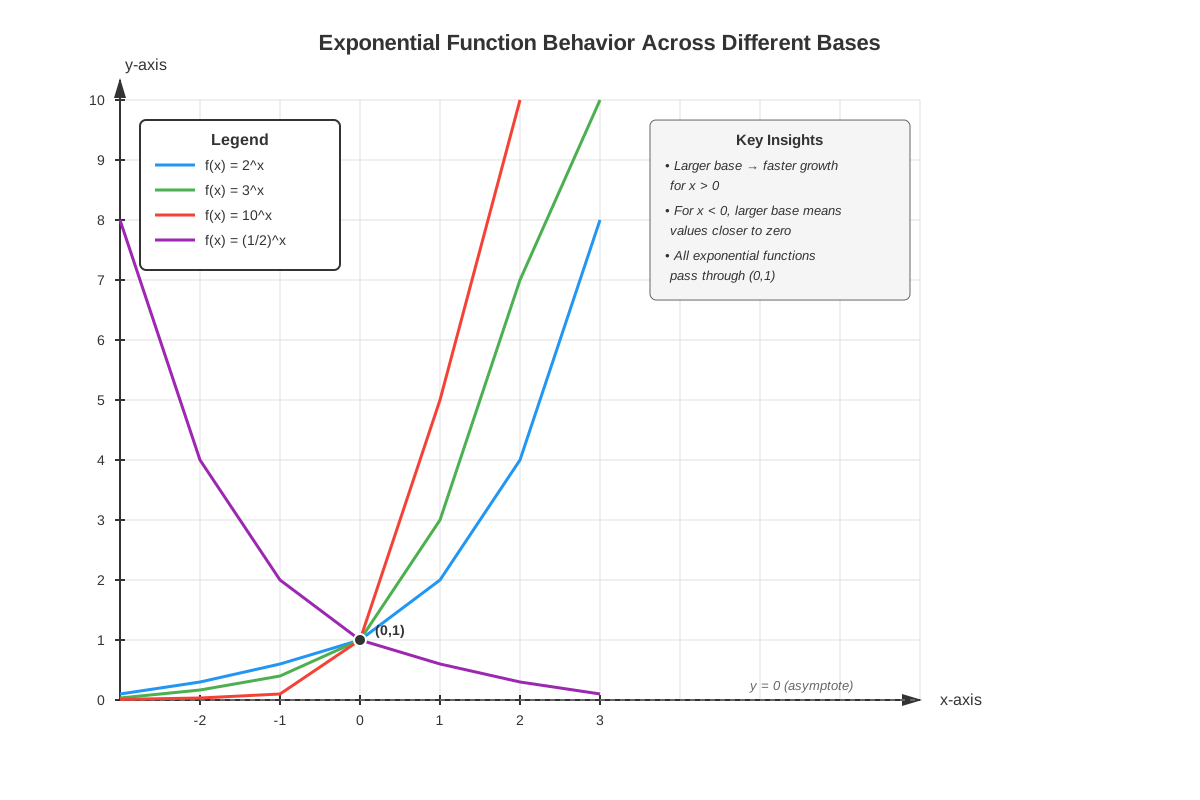
| Same exponent, different bases | Larger base yields larger value (if x > 0 and bases > 1) | 3^4 > 2^4 |
| Different bases and exponents | Convert to common base or evaluate | Compare 2^6 vs 4^3: both equal 64 |
| Negative exponents | Reciprocal relationship | 2^(-3) = 1/8 |
Exponential Equations
Solving exponential equations requires strategic application of exponent rules:
- Same base method: If possible, express both sides with the same base, then equate exponents
- Example: 2^(x+1) = 8 → 2^(x+1) = 2^3 → x + 1 = 3 → x = 2
- Substitution method: For equations like (b^x)^2 - 5(b^x) + 6 = 0, substitute u = b^x to create a quadratic equation
- Logarithmic method: Apply logarithms to both sides (though the GRE rarely requires explicit logarithm calculations)
Exponential vs. Linear Growth
Understanding the distinction between exponential and linear growth is crucial for GRE word problems:
| Feature | Linear Growth | Exponential Growth |
|---|---|---|
| Form | f(x) = mx + b | f(x) = a·b^x |
| Rate of change | Constant | Proportional to current value |
| Graph shape | Straight line | Curved (J-shaped) |
| Long-term behavior | Steady increase | Accelerating increase |
| Example | Saving $100/month | 5% monthly interest |
Concept Relationships
Exponential functions form a central node in the algebra concept network. The foundation begins with exponent rules (multiplication, division, power rules), which enable all manipulations of exponential expressions. These rules directly support solving exponential equations and simplifying complex exponential expressions.
The relationship flows as: Basic exponent properties → Exponential function definition → Growth and decay applications → Real-world problem solving
Exponential functions connect inversely to logarithmic functions: if y = b^x, then x = log_b(y). While the GRE rarely requires explicit logarithm calculations, understanding this inverse relationship helps conceptually, particularly when solving for exponents.
Geometric sequences are discrete versions of exponential functions. A geometric sequence with first term a and common ratio r follows the pattern a, ar, ar^2, ar^3, ..., which corresponds to the exponential function f(n) = a·r^n. This connection appears in GRE questions about repeated percentage changes or sequential growth.
Percentage calculations integrate deeply with exponential functions. Repeated percentage increases or decreases create exponential patterns: increasing by 10% three times means multiplying by (1.10)^3, not adding 30%. This distinction between additive (linear) and multiplicative (exponential) change is frequently tested.
The concepts also connect forward to data interpretation: exponential trends appear in graphs, requiring students to recognize exponential patterns visually and estimate values. Additionally, inequalities combine with exponential functions in comparison questions, requiring understanding of how exponential functions behave across different domains.
High-Yield Facts
⭐ The base determines growth or decay: b > 1 means growth; 0 < b < 1 means decay; b = 1 means constant function
⭐ Any positive number raised to the zero power equals 1: b^0 = 1 for all b ≠ 0
⭐ Negative exponents create reciprocals: b^(-x) = 1/(b^x)
⭐ Exponential functions never equal zero or become negative: The range is always positive real numbers
⭐ Repeated percentage changes multiply, not add: Three 10% increases = (1.10)^3 ≈ 1.331, not 1.30
- Fractional exponents represent roots: b^(1/n) = ⁿ√b
- When comparing exponential expressions with the same base, compare exponents directly (if base > 1)
- The y-intercept of f(x) = a·b^x is always the point (0, a)
- Exponential growth eventually exceeds any polynomial growth for sufficiently large x
- Compound interest with more frequent compounding yields higher returns for the same annual rate
- Converting decay rates: if something decreases by r%, the decay factor is (1 - r/100)
- For exponential functions, equal intervals in x produce equal ratios (not differences) in f(x)
Quick check — test yourself on Exponential functions so far.
Try Flashcards →Common Misconceptions
Misconception: Adding exponents when multiplying different bases (e.g., 2^3 · 3^3 = 6^6)
Correction: When bases differ, you cannot combine exponents using standard rules. Calculate each term separately: 2^3 · 3^3 = 8 · 27 = 216, which equals (2·3)^3 = 6^3, not 6^6. Only when multiplying the same base do you add exponents: b^m · b^n = b^(m+n).
Misconception: Three 10% increases equal a 30% increase
Correction: Repeated percentage changes multiply, creating exponential growth. Three 10% increases mean multiplying by 1.10 three times: (1.10)^3 = 1.331, representing a 33.1% total increase, not 30%. Each increase applies to the new, larger amount.
Misconception: Exponential functions can produce negative outputs
Correction: For real number bases and exponents, exponential functions always produce positive outputs. Even with negative exponents (which create fractions) or negative bases raised to even powers, the result remains positive. The range of f(x) = a·b^x (where a > 0, b > 0) is all positive real numbers.
Misconception: 2^3 · 2^4 = 2^12
Correction: When multiplying exponential expressions with the same base, add the exponents, don't multiply them: 2^3 · 2^4 = 2^(3+4) = 2^7 = 128. The multiplication rule is (b^m)^n = b^(mn), which is different from b^m · b^n = b^(m+n).
Misconception: A larger base always produces a larger value
Correction: This is only true when the exponent is positive. When x < 0, a larger base produces a smaller value because negative exponents create reciprocals. For example, 2^(-2) = 1/4 = 0.25, while 3^(-2) = 1/9 ≈ 0.111, so 2^(-2) > 3^(-2) even though 2 < 3.
Misconception: Exponential decay means the function eventually reaches zero
Correction: Exponential decay functions approach zero asymptotically but never actually reach it. For any exponential decay function f(x) = a·b^x where 0 < b < 1 and a > 0, the function value remains positive for all finite x values, though it becomes arbitrarily small as x increases.
Misconception: The function f(x) = x^2 is an exponential function
Correction: This is a power function (or polynomial), not an exponential function. In exponential functions, the variable must be in the exponent position (f(x) = 2^x), not the base position. The distinction is crucial: x^2 and 2^x behave completely differently and follow different rules.
Worked Examples
Example 1: Compound Interest Comparison
Problem: Sarah invests $5,000 in Account A, which earns 6% annual interest compounded annually. Michael invests $5,000 in Account B, which earns 5.8% annual interest compounded quarterly. After 10 years, which account has more money, and by approximately how much?
Solution:
Step 1: Identify this as an exponential function problem involving compound interest. The formula is A = P(1 + r/n)^(nt).
Step 2: Calculate Sarah's account (Account A):
- P = $5,000
- r = 0.06
- n = 1 (compounded annually)
- t = 10 years
- A = 5000(1 + 0.06/1)^(1·10) = 5000(1.06)^10
Step 3: Calculate (1.06)^10 using strategic multiplication:
- (1.06)^2 = 1.1236
- (1.06)^4 = (1.1236)^2 ≈ 1.262
- (1.06)^8 = (1.262)^2 ≈ 1.594
- (1.06)^10 = (1.06)^8 · (1.06)^2 ≈ 1.594 · 1.1236 ≈ 1.791
- A ≈ 5000 · 1.791 = $8,955
Step 4: Calculate Michael's account (Account B):
- P = $5,000
- r = 0.058
- n = 4 (compounded quarterly)
- t = 10 years
- A = 5000(1 + 0.058/4)^(4·10) = 5000(1.0145)^40
Step 5: Estimate (1.0145)^40:
- (1.0145)^4 ≈ 1.059
- (1.0145)^40 = [(1.0145)^4]^10 ≈ (1.059)^10
- Using (1.06)^10 ≈ 1.791 as reference, (1.059)^10 ≈ 1.765
- A ≈ 5000 · 1.765 = $8,825
Step 6: Compare: Account A has approximately $8,955 - $8,825 = $130 more than Account B.
Connection to learning objectives: This problem requires identifying exponential function testing (compound interest), applying the core compound interest formula, and accurately computing with exponential expressions.
Example 2: Exponential Decay and Comparison
Problem: A radioactive substance decays so that 15% of its mass is lost every 5 years. If the initial mass is 800 grams, compare:
Quantity A: The mass remaining after 15 years
Quantity B: 500 grams
Solution:
Step 1: Recognize this as exponential decay. If 15% is lost, then 85% remains, giving a decay factor of 0.85 per 5-year period.
Step 2: Determine the number of decay periods in 15 years:
- 15 years ÷ 5 years per period = 3 periods
Step 3: Apply the exponential decay formula:
- Final mass = Initial mass × (decay factor)^(number of periods)
- Final mass = 800 × (0.85)^3
Step 4: Calculate (0.85)^3:
- 0.85 × 0.85 = 0.7225
- 0.7225 × 0.85 = 0.614125
Step 5: Calculate final mass:
- 800 × 0.614125 = 491.3 grams
Step 6: Compare Quantity A (491.3 grams) with Quantity B (500 grams):
- Quantity B is greater
Alternative approach: Recognize that (0.85)^3 is slightly less than (0.85)^3 ≈ 0.61, so 800 × 0.61 = 488, which is definitely less than 500.
Connection to learning objectives: This demonstrates identifying exponential decay patterns, explaining the decay factor strategy, and applying exponential functions to GRE-style quantitative comparison questions.
Exam Strategy
When approaching GRE questions involving exponential functions, follow this systematic process:
Recognition triggers: Watch for these keywords and phrases that signal exponential function questions:
- "Compound interest," "compounded annually/quarterly/monthly"
- "Grows by X% each year/period"
- "Doubles every," "triples every," "halves every"
- "Decreases by X% per," "decays at a rate of"
- "Population growth," "bacterial growth"
- "Radioactive decay," "half-life"
- Expressions with variables in exponents
Initial assessment (5-10 seconds):
- Identify whether the problem involves growth (base > 1) or decay (0 < base < 1)
- Determine if you need an exact answer or can estimate
- Check if the problem can be solved by recognizing patterns rather than full calculation
Solution approach:
For Quantitative Comparison questions:
- Often you can determine the relationship without calculating exact values
- Compare exponents when bases are equal
- Compare bases when exponents are equal and positive
- Consider testing x = 0, x = 1, and x = -1 to understand behavior
- Remember that exponential functions grow faster than linear or polynomial functions for large x
For Problem Solving questions:
- Write out the exponential formula explicitly before substituting values
- Break complex exponents into manageable pieces (e.g., calculate 2^10 as 2^5 · 2^5)
- Use answer choices to guide estimation—if answers are far apart, rough approximation suffices
- Convert percentage changes to decimal multipliers immediately
Time management:
- Simple exponential evaluation: 30-45 seconds
- Compound interest problems: 60-90 seconds
- Complex comparison or word problems: 90-120 seconds
- If calculation becomes unwieldy after 60 seconds, look for a pattern or estimation approach
Process of elimination tips:
- Eliminate answers that violate basic exponential properties (e.g., negative outputs for positive bases)
- For growth problems, eliminate answers smaller than the initial value
- For decay problems, eliminate answers larger than the initial value or equal to zero
- Check dimensional consistency (if the problem involves money, eliminate non-monetary answers)
Exam Tip: When comparing exponential expressions, try to express them with a common base before calculating. For example, 4^5 vs 2^9 becomes (2^2)^5 = 2^10 vs 2^9, making the comparison immediate.
Memory Techniques
BEAD mnemonic for exponential function components:
- Base determines growth or decay
- Exponent is where the variable lives
- Always positive outputs (for positive bases)
- Doubling/halving creates base 2 or 1/2
Growth vs. Decay visualization: Picture a J-curve shooting upward for growth (base > 1) and a slide declining rightward for decay (0 < base < 1). The J-curve never touches the left side (negative y-axis), and the slide never touches the bottom (x-axis).
Percentage change conversion: Remember "PLUS for growth, MINUS for decay"
- Growth: multiply by (1 + rate) → 7% growth = 1.07
- Decay: multiply by (1 - rate) → 7% decay = 0.93
Exponent rules acronym - MADSPM:
- Multiply same bases: add exponents (b^m · b^n = b^(m+n))
- Anything to zero: equals one (b^0 = 1)
- Divide same bases: subtract exponents (b^m / b^n = b^(m-n))
- Same base, different exponents: compare exponents directly
- Power to power: multiply exponents ((b^m)^n = b^(mn))
- Minus exponent: make reciprocal (b^(-n) = 1/b^n)
Compound interest memory aid: "PRINT" for the formula components
- Principal (initial amount)
- Rate (as decimal)
- Intervals (n, compounding frequency)
- Number of years (t)
- Total = P(1 + r/n)^(nt)
Finger counting for powers of 2: Assign each finger a power of 2 from 2^1 to 2^10. This physical memory aid helps quickly recall: 2, 4, 8, 16, 32, 64, 128, 256, 512, 1024.
Summary
Exponential functions represent relationships where quantities change multiplicatively rather than additively, following the form f(x) = a·b^x with the variable in the exponent position. The base b determines whether the function exhibits growth (b > 1) or decay (0 < b < 1), while the coefficient a represents the initial value. On the GRE, exponential functions appear most frequently in compound interest problems, population growth scenarios, and percentage change questions. Success requires recognizing exponential patterns in word problems, applying exponent rules correctly, and understanding that repeated percentage changes multiply rather than add. Key strategies include converting percentage rates to decimal multipliers, breaking complex calculations into manageable steps, and comparing exponential expressions by finding common bases when possible. The most critical concepts are distinguishing exponential from linear growth, correctly applying the compound interest formula A = P(1 + r/n)^(nt), and recognizing that exponential functions always produce positive outputs and grow faster than polynomial functions for large inputs.
Key Takeaways
- Exponential functions have the form f(x) = a·b^x where the variable appears in the exponent, not the base
- The base determines behavior: b > 1 creates growth, 0 < b < 1 creates decay, and exponential functions always output positive values
- Repeated percentage changes multiply (exponential), not add (linear): three 10% increases equal (1.10)^3 = 1.331, not 1.30
- Compound interest follows A = P(1 + r/n)^(nt), where more frequent compounding produces higher returns
- When comparing exponential expressions, convert to common bases when possible, and remember that larger bases produce larger values only when exponents are positive
- Exponential growth eventually exceeds any polynomial growth, making it the fastest-growing function type on the GRE
- Recognition triggers include "compound," "doubles every," "grows by X% per," and any scenario involving repeated multiplicative change
Related Topics
Logarithmic Functions: The inverse of exponential functions, logarithms allow solving for unknown exponents. While the GRE rarely requires explicit logarithm calculations, understanding the inverse relationship deepens comprehension of exponential behavior and provides alternative solution methods for complex problems.
Geometric Sequences and Series: Discrete versions of exponential functions where each term is a constant multiple of the previous term. Mastering exponential functions provides the foundation for understanding geometric progressions, sum formulas, and infinite geometric series.
Polynomial Functions: Contrasting exponential with polynomial growth clarifies why exponential functions dominate for large values. Understanding both function types enables accurate comparison and helps identify which model fits a given scenario.
Systems of Equations: Exponential functions often appear within systems, requiring simultaneous solution of exponential and linear or quadratic equations. Proficiency with exponential functions enables tackling these more complex multi-step problems.
Data Interpretation with Exponential Trends: Graphs displaying exponential growth or decay require recognizing the characteristic curve shape and estimating values. Exponential function mastery translates directly to success with these visual reasoning questions.
Practice CTA
Now that you've mastered the core concepts of exponential functions, it's time to solidify your understanding through active practice. Attempt the practice questions to test your ability to recognize exponential patterns, apply the compound interest formula, and compare exponential expressions under time pressure. Use the flashcards to reinforce high-yield facts and commit key formulas to memory. Remember: exponential functions appear in 10-15% of GRE Quantitative questions, making this one of the highest-yield topics for your study time. Each practice problem you solve builds the pattern recognition and computational fluency that will serve you on test day. You've got this!
Sign up free to keep reading
Create a free AnvayaPrep account to finish this GRE guide on Exponential functions — plus flashcards and practice questions.