Overview
Quadratic functions represent one of the most frequently tested algebraic concepts on the GRE Quantitative Reasoning section. A quadratic function is a polynomial function of degree two, typically expressed in the form f(x) = ax² + bx + c, where a, b, and c are constants and a ≠ 0. These functions produce parabolic curves when graphed and appear in numerous problem types, from pure algebra questions to word problems involving optimization, projectile motion, and area calculations. Mastering quadratic functions is essential not only for direct questions about parabolas and equations but also for solving complex problems that require factoring, completing the square, or applying the quadratic formula.
The GRE tests quadratic functions in multiple contexts: solving quadratic equations, analyzing the properties of parabolas, finding maximum and minimum values, and interpreting the relationship between algebraic and geometric representations. Questions may ask test-takers to identify the vertex of a parabola, determine where a function crosses the x-axis, compare the values of different quadratic expressions, or solve real-world optimization problems. Understanding GRE quadratic functions requires both computational fluency and conceptual understanding of how changes in coefficients affect the shape and position of the parabola.
Within the broader Quantitative Reasoning framework, quadratic functions serve as a bridge between basic algebra and more advanced mathematical reasoning. They connect to linear functions (as the simplest polynomial functions), coordinate geometry (through graphing), inequalities (when solving quadratic inequalities), and even data interpretation (when analyzing curved trends). The ability to quickly recognize quadratic patterns, manipulate quadratic expressions, and extract meaningful information from quadratic equations is a high-yield skill that appears across multiple question formats on the GRE.
Learning Objectives
- [ ] Identify when Quadratic functions is being tested
- [ ] Explain the core rule or strategy behind Quadratic functions
- [ ] Apply Quadratic functions to GRE-style questions accurately
- [ ] Convert between different forms of quadratic functions (standard, vertex, and factored forms)
- [ ] Determine key features of parabolas including vertex, axis of symmetry, and intercepts
- [ ] Solve optimization problems using properties of quadratic functions
- [ ] Analyze how coefficient changes affect the graph and behavior of quadratic functions
Prerequisites
- Linear equations and functions: Understanding slope, intercepts, and basic function notation provides the foundation for extending to polynomial functions of higher degree
- Factoring techniques: Ability to factor expressions like x² - 5x + 6 is essential for solving quadratic equations and finding zeros
- Coordinate plane basics: Familiarity with plotting points and understanding x- and y-axes enables visualization of parabolic graphs
- Order of operations and algebraic manipulation: Expanding expressions, combining like terms, and following PEMDAS are necessary for working with quadratic expressions
- Basic exponent rules: Understanding that x² means x·x and how to manipulate squared terms is fundamental to all quadratic work
Why This Topic Matters
Quadratic functions appear in approximately 10-15% of GRE Quantitative Reasoning questions, making them one of the highest-yield algebra topics. They appear in both Quantitative Comparison and Problem Solving formats, often integrated with other concepts like inequalities, coordinate geometry, or word problems. The GRE particularly favors questions that test conceptual understanding rather than rote computation—for example, asking how changing a coefficient affects the vertex location rather than simply requesting a calculation.
In real-world applications, quadratic functions model countless phenomena: the trajectory of projectiles, profit maximization in business, the relationship between price and demand, the shape of satellite dishes and suspension bridges, and optimization problems in engineering and physics. Understanding these functions develops critical thinking skills about rates of change, maximum and minimum values, and the relationship between algebraic and geometric representations.
On the GRE, quadratic functions commonly appear in several disguised forms: area problems where dimensions are expressed algebraically (leading to quadratic equations), comparison questions asking which of two expressions is larger for certain values, data interpretation questions with parabolic trends, and word problems about maximizing profit or minimizing cost. Recognizing these patterns allows test-takers to quickly identify the underlying quadratic structure and apply appropriate solution strategies.
Core Concepts
Standard Form of Quadratic Functions
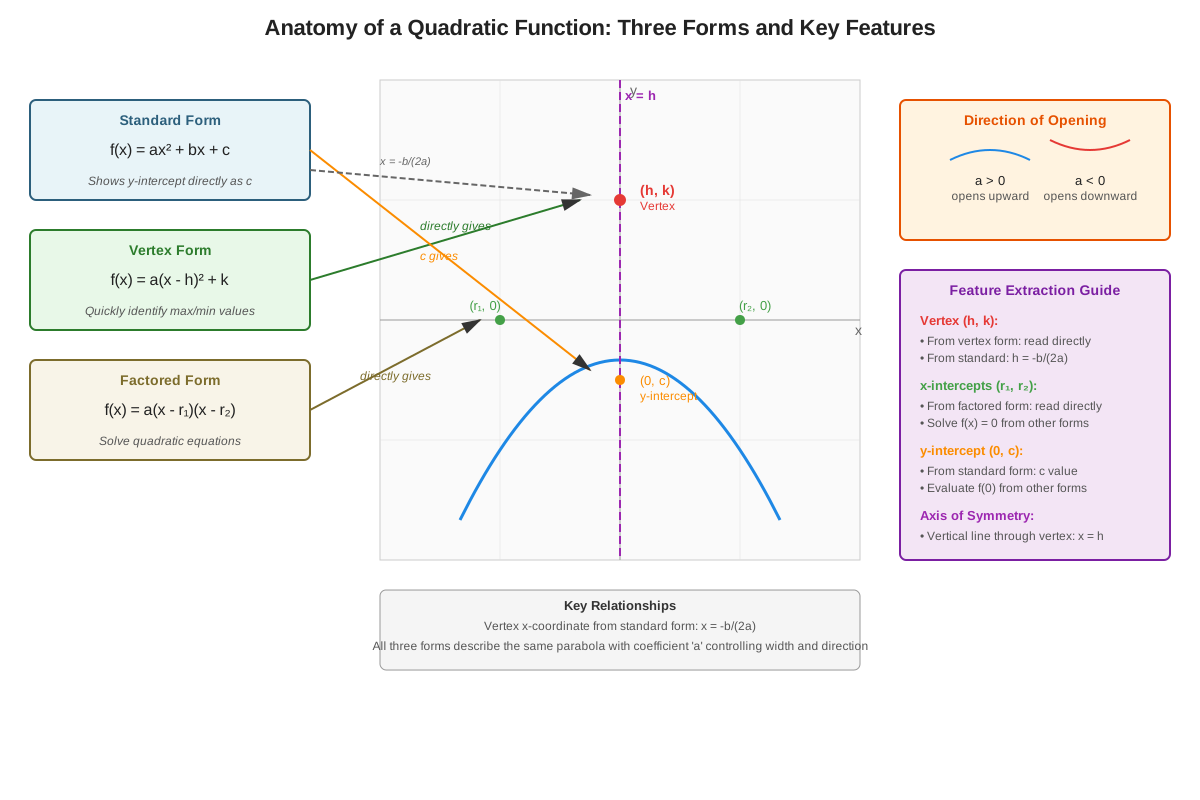
The standard form of a quadratic function is f(x) = ax² + bx + c, where:
- a is the leading coefficient (determines whether the parabola opens upward or downward)
- b is the linear coefficient (affects the location of the vertex and axis of symmetry)
- c is the constant term (represents the y-intercept)
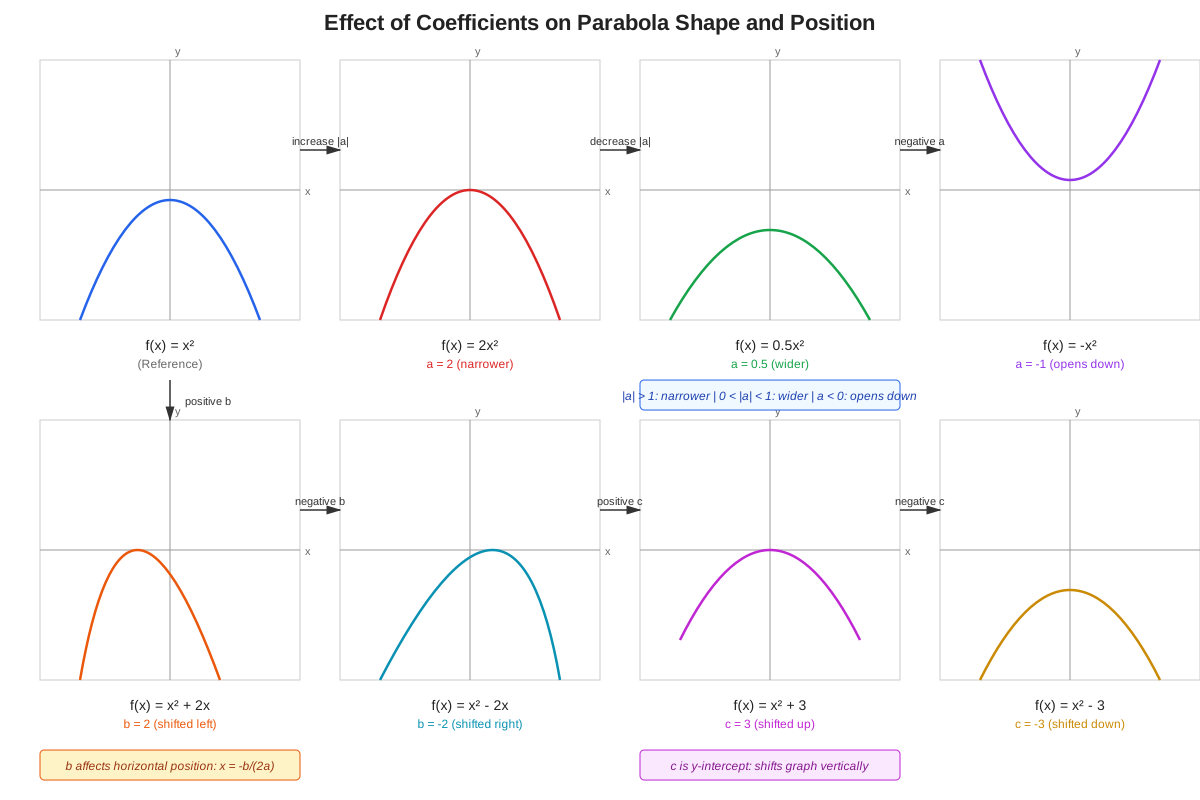
The coefficient a plays a crucial role in determining the parabola's orientation and width. When a > 0, the parabola opens upward (creating a minimum point at the vertex). When a < 0, the parabola opens downward (creating a maximum point at the vertex). The absolute value of a affects the width: larger |a| values create narrower parabolas, while smaller |a| values create wider parabolas.
Vertex Form and Finding the Vertex
The vertex form of a quadratic function is f(x) = a(x - h)² + k, where (h, k) represents the coordinates of the vertex—the highest or lowest point on the parabola. This form immediately reveals the vertex location and makes it easy to determine the maximum or minimum value of the function.
To convert from standard form to vertex form, use the vertex formula:
- The x-coordinate of the vertex: h = -b/(2a)
- The y-coordinate of the vertex: k = f(h) = f(-b/(2a))
The axis of symmetry is the vertical line x = h that passes through the vertex, dividing the parabola into two mirror-image halves. Every parabola is symmetric about this line, meaning that points equidistant from the axis of symmetry have the same y-value.
Factored Form and Finding Zeros
The factored form (or intercept form) of a quadratic function is f(x) = a(x - r₁)(x - r₂), where r₁ and r₂ are the roots, zeros, or x-intercepts of the function—the values where f(x) = 0. These are the points where the parabola crosses the x-axis.
The relationship between forms:
- Standard form is best for identifying the y-intercept quickly
- Vertex form is best for identifying maximum/minimum values and graphing
- Factored form is best for identifying x-intercepts and solving equations
Solving Quadratic Equations
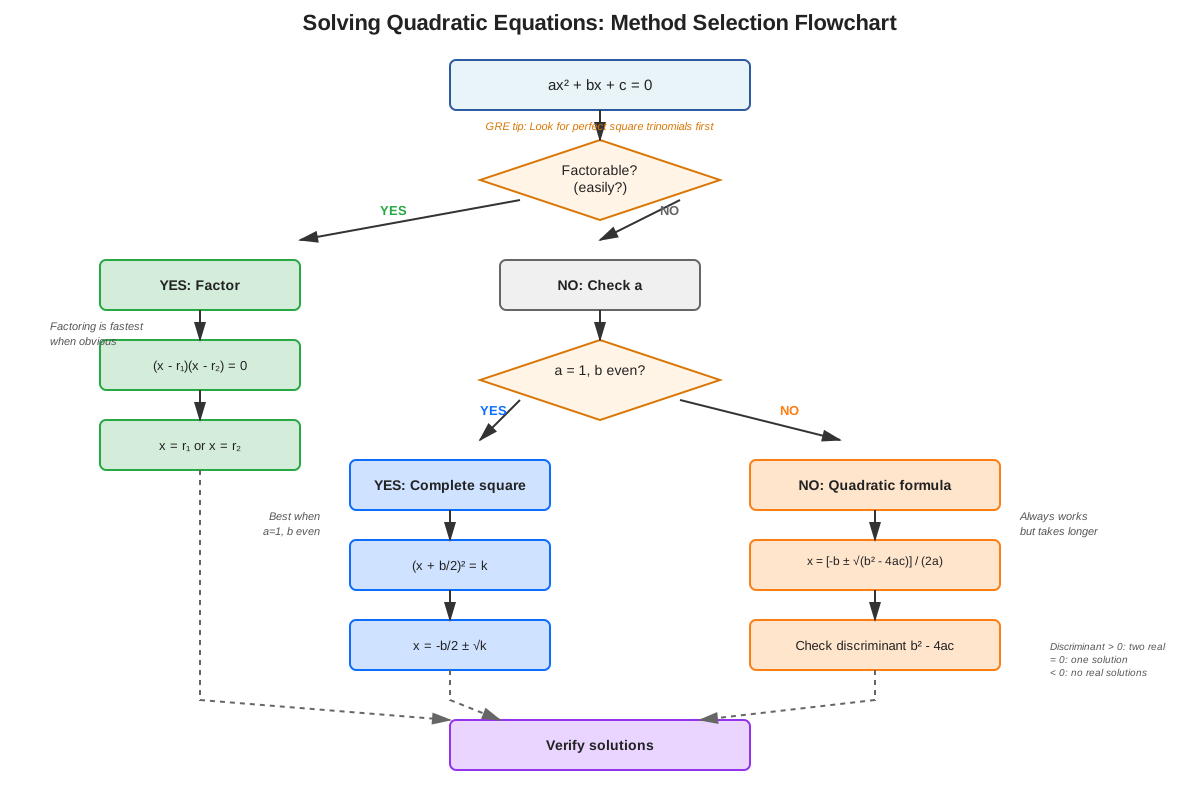
There are four primary methods for solving quadratic equations (finding values of x where ax² + bx + c = 0):
- Factoring: Express the quadratic as a product of two binomials and use the zero product property
- Example: x² - 5x + 6 = 0 → (x - 2)(x - 3) = 0 → x = 2 or x = 3
- Quadratic Formula: x = [-b ± √(b² - 4ac)] / (2a)
- Works for all quadratic equations, even when factoring is difficult or impossible
- Completing the Square: Manipulate the equation into the form (x - h)² = k
- Useful for deriving the vertex form and understanding the quadratic formula
- Graphing: Identify where the parabola crosses the x-axis
- Helpful for visualization but less precise for exact answers
The Discriminant
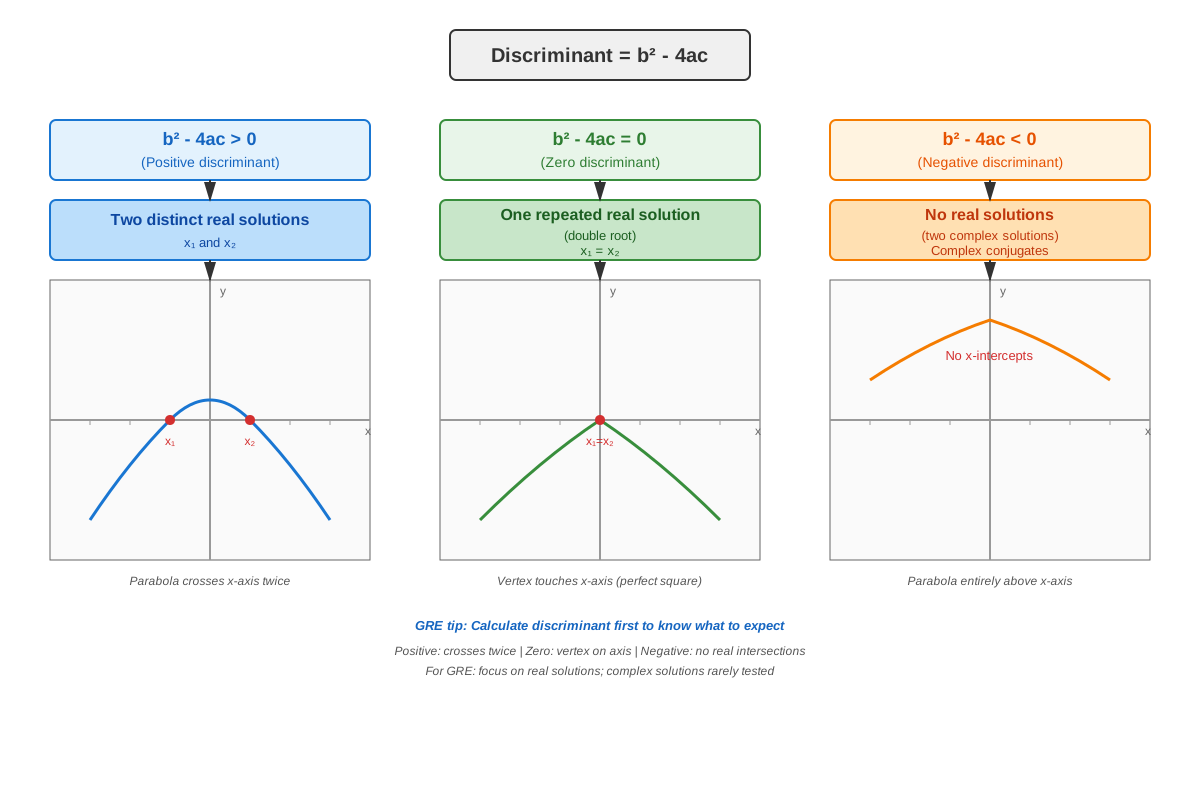
The discriminant is the expression b² - 4ac found under the square root in the quadratic formula. It determines the nature of the solutions:
| Discriminant Value | Number of Real Solutions | Graph Behavior |
|---|---|---|
| b² - 4ac > 0 | Two distinct real solutions | Parabola crosses x-axis twice |
| b² - 4ac = 0 | One real solution (repeated root) | Parabola touches x-axis at vertex |
| b² - 4ac < 0 | No real solutions | Parabola does not cross x-axis |
Key Features Summary Table
| Feature | How to Find | Significance | ||||
|---|---|---|---|---|---|---|
| Vertex | (-b/2a, f(-b/2a)) | Maximum or minimum point | ||||
| Axis of Symmetry | x = -b/2a | Line of reflection | ||||
| Y-intercept | (0, c) | Where graph crosses y-axis | ||||
| X-intercepts | Solve ax² + bx + c = 0 | Where graph crosses x-axis | ||||
| Direction | Sign of a | Opens up (a > 0) or down (a < 0) | ||||
| Width | Absolute value of a | Narrow ( | a | > 1) or wide ( | a | < 1) |
Optimization with Quadratic Functions
Many GRE word problems involve finding maximum or minimum values, which occur at the vertex of a parabola. The key steps are:
- Set up a quadratic function that models the situation
- Identify whether you're looking for a maximum (a < 0) or minimum (a > 0)
- Find the vertex using h = -b/(2a)
- Calculate the optimal value by substituting h back into the function
Common optimization scenarios include maximizing area with fixed perimeter, maximizing revenue given a price-demand relationship, and minimizing cost functions.
Concept Relationships
The three forms of quadratic functions (standard, vertex, and factored) are interconnected representations of the same mathematical object. Standard form serves as the starting point for most problems and directly reveals the y-intercept. Converting to vertex form through the vertex formula or completing the square reveals the maximum or minimum value, which connects to optimization problems. Converting to factored form through factoring or the quadratic formula reveals the zeros, which connects to solving equations and understanding where the function equals zero.
The discriminant (b² - 4ac) emerges from the quadratic formula and determines the number of real solutions, which geometrically corresponds to how many times the parabola crosses the x-axis. This connects to the graph behavior of the function. The coefficient a affects both the direction (upward or downward opening) and the width of the parabola, which connects to understanding transformations of functions.
Relationship flow: Standard Form → Vertex Formula → Vertex Form → Maximum/Minimum Value → Optimization Applications. Alternatively: Standard Form → Factoring or Quadratic Formula → Factored Form → Zeros/X-intercepts → Solution Set. The discriminant serves as a decision point: if b² - 4ac ≥ 0, real solutions exist and can be found; if b² - 4ac < 0, no real solutions exist and the parabola doesn't cross the x-axis.
High-Yield Facts
⭐ The vertex of f(x) = ax² + bx + c occurs at x = -b/(2a), and this x-value represents where the maximum or minimum occurs
⭐ When a > 0, the parabola opens upward and has a minimum value; when a < 0, it opens downward and has a maximum value
⭐ The y-intercept of any quadratic function in standard form is simply the constant term c
⭐ The discriminant b² - 4ac determines the number of real solutions: positive means two solutions, zero means one solution, negative means no real solutions
⭐ A parabola is symmetric about its axis of symmetry (the vertical line through the vertex), so points equidistant from this line have equal y-values
- The quadratic formula x = [-b ± √(b² - 4ac)] / (2a) works for all quadratic equations, even when factoring is difficult
- The sum of the roots of ax² + bx + c = 0 equals -b/a, and the product of the roots equals c/a
- Completing the square transforms ax² + bx + c into a(x - h)² + k, revealing the vertex (h, k)
- The factored form a(x - r₁)(x - r₂) immediately shows the x-intercepts at x = r₁ and x = r₂
- Larger absolute values of the coefficient a create narrower parabolas; smaller absolute values create wider parabolas
- The vertex represents the optimal value in optimization problems: maximum profit, minimum cost, maximum area, etc.
- If a quadratic function has two x-intercepts r₁ and r₂, the x-coordinate of the vertex is exactly halfway between them: x = (r₁ + r₂)/2
Quick check — test yourself on Quadratic functions so far.
Try Flashcards →Common Misconceptions
Misconception: The vertex is always at the origin or at (0, c).
Correction: The vertex location depends on both a and b coefficients. It occurs at x = -b/(2a), which can be any real number. Only when b = 0 does the vertex lie on the y-axis.
Misconception: A negative value for c means the parabola opens downward.
Correction: The direction of opening depends solely on the sign of a (the coefficient of x²). A negative c simply means the y-intercept is below the x-axis, but the parabola can still open upward if a > 0.
Misconception: If the discriminant is negative, the quadratic equation has no solutions at all.
Correction: The equation has no real solutions, but it does have complex solutions. For GRE purposes, "no real solutions" means the parabola doesn't cross the x-axis, but the function still exists and has a vertex, y-intercept, and other properties.
Misconception: The quadratic formula only works when the equation cannot be factored.
Correction: The quadratic formula works for all quadratic equations, whether they can be factored easily or not. Factoring is often faster when possible, but the formula is universal and always produces correct results.
Misconception: In optimization problems, you always want the maximum value.
Correction: The problem context determines whether you seek a maximum or minimum. Cost minimization problems seek the minimum (vertex of upward-opening parabola), while revenue maximization problems seek the maximum (vertex of downward-opening parabola). Always check whether a is positive or negative.
Misconception: The axis of symmetry is a horizontal line.
Correction: The axis of symmetry for a standard parabola (opening up or down) is always a vertical line with equation x = -b/(2a). It's perpendicular to the x-axis, not parallel to it.
Misconception: Completing the square changes the function or its graph.
Correction: Completing the square is an algebraic manipulation that rewrites the function in a different form but doesn't change its value, graph, or any of its properties. It's simply a different way of expressing the same function.
Worked Examples
Example 1: Finding Maximum Value in an Optimization Problem
Problem: A farmer has 200 feet of fencing to enclose a rectangular garden. One side of the garden borders a river and doesn't need fencing. What is the maximum area the garden can have?
Solution:
Step 1: Set up variables. Let x = width of the garden (the two sides perpendicular to the river). Since one side borders the river, the fencing covers two widths and one length: 2x + L = 200.
Step 2: Express length in terms of width: L = 200 - 2x
Step 3: Write the area function: A(x) = x · L = x(200 - 2x) = 200x - 2x²
Step 4: Rewrite in standard form: A(x) = -2x² + 200x + 0
Step 5: Identify coefficients: a = -2, b = 200, c = 0. Since a < 0, the parabola opens downward and has a maximum.
Step 6: Find the x-coordinate of the vertex (where maximum occurs):
x = -b/(2a) = -200/(2(-2)) = -200/(-4) = 50 feet
Step 7: Calculate the maximum area:
A(50) = -2(50)² + 200(50) = -2(2500) + 10,000 = -5,000 + 10,000 = 5,000 square feet
Answer: The maximum area is 5,000 square feet, achieved when the width is 50 feet and the length is 100 feet.
Connection to Learning Objectives: This problem demonstrates identifying when quadratic functions are being tested (optimization scenario), applying the core strategy (finding the vertex for maximum value), and accurately solving a GRE-style application problem.
Example 2: Analyzing a Quadratic Function Using Multiple Forms
Problem: For the function f(x) = x² - 6x + 5:
(a) Find the vertex
(b) Find the x-intercepts
(c) Find the y-intercept
(d) Determine if the function has a maximum or minimum value, and state that value
Solution:
(a) Finding the vertex:
- Coefficients: a = 1, b = -6, c = 5
- x-coordinate: h = -b/(2a) = -(-6)/(2(1)) = 6/2 = 3
- y-coordinate: k = f(3) = (3)² - 6(3) + 5 = 9 - 18 + 5 = -4
- Vertex: (3, -4)
(b) Finding x-intercepts (solve f(x) = 0):
- x² - 6x + 5 = 0
- Factor: (x - 5)(x - 1) = 0
- x-intercepts: x = 1 and x = 5
- Verification: The vertex x-coordinate (3) is exactly halfway between 1 and 5 ✓
(c) Finding y-intercept:
- Set x = 0: f(0) = (0)² - 6(0) + 5 = 5
- y-intercept: (0, 5)
(d) Maximum or minimum:
- Since a = 1 > 0, the parabola opens upward
- Therefore, the function has a minimum value
- The minimum value occurs at the vertex: minimum = -4 (at x = 3)
Summary of forms:
- Standard form: f(x) = x² - 6x + 5
- Vertex form: f(x) = (x - 3)² - 4
- Factored form: f(x) = (x - 1)(x - 5)
Connection to Learning Objectives: This comprehensive example shows how to extract all key features from a quadratic function, convert between forms, and explain the relationships between algebraic and geometric properties.
Exam Strategy
When approaching GRE questions involving quadratic functions, first identify the question type: Are you solving an equation, finding a maximum/minimum, analyzing a graph, or comparing expressions? This determines your strategy.
Trigger words and phrases that signal quadratic functions:
- "Maximum" or "minimum" (optimization problems requiring vertex)
- "Crosses the x-axis" or "zeros" (finding roots/x-intercepts)
- "Parabola" or "quadratic" (direct reference)
- "Area" or "product" in word problems (often leads to quadratic expressions)
- "Revenue," "profit," or "cost" with variable pricing (optimization)
- Expressions containing x² or squared terms
Process-of-elimination strategies:
- If a question asks about the vertex and you see answer choices with different x-coordinates, calculate x = -b/(2a) first to eliminate half the choices
- For questions about the number of solutions, calculate the discriminant to eliminate impossible answers
- When comparing quadratic expressions, test strategic values (like x = 0, x = 1, or the vertex) rather than trying to solve algebraically
- If asked whether a parabola opens up or down, check only the sign of the leading coefficient
Time allocation advice:
- Spend 10-15 seconds identifying what the question is really asking before calculating
- For optimization problems, set up the function carefully (30 seconds), then apply the vertex formula (30 seconds)
- Don't waste time completing the square unless specifically required; the vertex formula is faster
- If factoring doesn't work within 20 seconds, switch to the quadratic formula
- For Quantitative Comparison questions, test values strategically rather than solving completely
Quick decision tree:
- Need x-intercepts? → Factor or use quadratic formula
- Need maximum/minimum? → Find vertex using x = -b/(2a)
- Need to know if solutions exist? → Check discriminant b² - 4ac
- Need y-intercept? → Use the constant term c
- Comparing two expressions? → Test strategic values or analyze coefficients
GRE Tip: The test writers often create wrong answer choices by using common calculation errors. Double-check the sign of b in the vertex formula (it's -b, not b) and the sign of 4ac in the discriminant.
Memory Techniques
Vertex Formula Mnemonic: "Negative B Over Two A" - Remember this phrase rhythmically. The vertex x-coordinate is always x = -b/(2a). Think: "Be negative about 2A" (b is negative, divided by 2a).
Discriminant Decision Mnemonic: "Positive = Pair, Zero = One, Negative = None"
- Positive discriminant → Pair of solutions (2 real roots)
- Zero discriminant → One solution (1 repeated root)
- Negative discriminant → None (no real solutions)
Parabola Direction: "Positive Smiles, Negative Frowns"
- When a > 0 (positive), the parabola opens upward like a smile (U shape) → minimum
- When a < 0 (negative), the parabola opens downward like a frown (∩ shape) → maximum
Quadratic Formula Visualization: Picture the formula as a fraction with three parts:
- Numerator: "negative b PLUS-OR-MINUS square root of (b-squared minus 4ac)"
- Denominator: "all over 2a"
- Visual: -b ± √(b²-4ac) / 2a
Forms and Their Powers:
- Standard form shows the Starting point (y-intercept)
- Vertex form shows the Vertex
- Factored form shows where the Function equals zero
Axis of Symmetry: The axis is the same as the vertex x-coordinate: x = -b/(2a). Remember: "The axis runs through the vertex vertically."
Summary
Quadratic functions, expressed as f(x) = ax² + bx + c, are fundamental to GRE Quantitative Reasoning and appear in approximately 10-15% of questions. Mastery requires understanding three equivalent forms: standard form (reveals y-intercept), vertex form (reveals maximum/minimum), and factored form (reveals x-intercepts). The coefficient a determines whether the parabola opens upward (a > 0, creating a minimum) or downward (a < 0, creating a maximum), while the vertex location is found using x = -b/(2a). The discriminant b² - 4ac determines the number of real solutions: positive yields two solutions, zero yields one, and negative yields none. GRE questions test these concepts through direct equation-solving, optimization word problems, graph analysis, and quantitative comparisons. Success requires recognizing when quadratic patterns appear, choosing the most efficient solution method (factoring, quadratic formula, or vertex formula), and understanding the geometric meaning of algebraic properties. The ability to quickly convert between forms and extract key features—vertex, intercepts, axis of symmetry, and optimal values—is essential for both speed and accuracy on test day.
Key Takeaways
- Quadratic functions appear in standard form (ax² + bx + c), vertex form (a(x-h)² + k), and factored form (a(x-r₁)(x-r₂)), each revealing different key features
- The vertex at x = -b/(2a) represents the maximum (when a < 0) or minimum (when a > 0) value, crucial for optimization problems
- The discriminant b² - 4ac determines solution count: positive = 2 real solutions, zero = 1 solution, negative = 0 real solutions
- The sign of coefficient a determines parabola direction: positive opens upward (minimum at vertex), negative opens downward (maximum at vertex)
- Strategic form selection saves time: use standard form for y-intercepts, vertex form for optimization, and factored form for x-intercepts
- Parabolas are symmetric about the vertical line x = -b/(2a), meaning points equidistant from this axis have equal y-values
- Recognize trigger words like "maximum," "minimum," "crosses the x-axis," and "area" as signals that quadratic functions are being tested
Related Topics
Quadratic Inequalities: Building on quadratic equations, these problems require determining where a quadratic expression is greater than or less than a value, involving analysis of intervals and sign testing. Mastering quadratic functions provides the foundation for understanding solution regions.
Systems of Equations with Quadratics: Problems involving both linear and quadratic equations require finding intersection points, combining knowledge of quadratic functions with linear equations and graphing techniques.
Polynomial Functions of Higher Degree: Understanding quadratic functions (degree 2 polynomials) prepares students for cubic and higher-degree polynomials, extending concepts of roots, end behavior, and turning points.
Coordinate Geometry and Conic Sections: Parabolas are one type of conic section, and understanding quadratic functions connects to broader study of circles, ellipses, and hyperbolas in coordinate geometry.
Function Transformations: The relationship between different forms of quadratic functions illustrates general principles of function transformations (shifts, stretches, reflections) that apply to all function types.
Practice CTA
Now that you've mastered the core concepts of quadratic functions, it's time to solidify your understanding through active practice. Attempt the practice questions to test your ability to identify when quadratic functions are being tested, apply solution strategies efficiently, and avoid common traps. Use the flashcards to reinforce key formulas, particularly the vertex formula and discriminant interpretations. Remember: the GRE rewards both accuracy and speed, so practice not just getting the right answer, but getting it quickly by choosing the most efficient method. Each practice problem you solve builds the pattern recognition and strategic thinking that will serve you on test day. You've got this!
Sign up free to keep reading
Create a free AnvayaPrep account to finish this GRE guide on Quadratic functions — plus flashcards and practice questions.