Overview
The number line is a fundamental visual and conceptual tool in mathematics that represents real numbers as points along a continuous horizontal line. On the GRE, the number line serves as both a problem-solving framework and a direct question format, appearing in approximately 5-8% of Quantitative Reasoning questions. Understanding how to interpret, manipulate, and reason with number lines is essential for success on multiple question types, from basic arithmetic comparisons to complex inequality problems and absolute value questions.
The GRE number line questions test not just computational ability but also spatial reasoning and the capacity to translate between numerical, algebraic, and visual representations. Students who master number line concepts gain a powerful tool for checking work, visualizing abstract relationships, and solving problems that might otherwise require complex algebraic manipulation. The number line bridges multiple mathematical domains: it connects arithmetic operations with geometric distance, links inequalities with intervals, and provides intuitive understanding of concepts like absolute value, midpoints, and relative magnitude.
Within the broader Quantitative Reasoning section, number line mastery supports performance across arithmetic, algebra, and data interpretation questions. The visual nature of number line problems makes them particularly valuable for developing number sense—the intuitive understanding of how numbers relate to each other—which underlies efficient problem-solving throughout the entire GRE mathematics section. Students who can quickly sketch and interpret number lines often solve problems faster and with greater accuracy than those who rely solely on algebraic manipulation.
Learning Objectives
- [ ] Identify when Number line is being tested in GRE questions
- [ ] Explain the core rule or strategy behind Number line problems
- [ ] Apply Number line to GRE-style questions accurately
- [ ] Construct accurate number line representations from verbal or algebraic descriptions
- [ ] Determine distances, midpoints, and relative positions on a number line
- [ ] Translate between number line diagrams and inequality statements
- [ ] Solve absolute value problems using number line visualization
Prerequisites
- Basic arithmetic operations: Understanding addition, subtraction, multiplication, and division is necessary for calculating positions and distances on a number line
- Concept of positive and negative numbers: Number lines extend in both directions from zero, requiring comfort with signed numbers
- Understanding of inequalities: Number line problems frequently involve representing ranges and comparing values
- Coordinate system basics: The number line is essentially a one-dimensional coordinate system, so familiarity with plotting points is helpful
Why This Topic Matters
Number line concepts appear throughout real-world applications, from measuring temperature changes and elevation differences to understanding financial gains and losses, time zones, and scientific measurements. The ability to visualize numerical relationships spatially enhances problem-solving across disciplines, making it a foundational skill beyond standardized testing.
On the GRE, number line questions appear in multiple formats: direct visual interpretation problems where a number line diagram is provided, word problems requiring number line construction for solution, Quantitative Comparison questions involving distances or positions, and Data Interpretation questions where number lines represent data ranges. Research on GRE question patterns indicates that number line concepts appear in approximately 2-3 questions per test, but the underlying principles support correct answers on an additional 5-10 questions where number line visualization aids problem-solving even when not explicitly required.
Common GRE manifestations include: questions asking about the distance between two points (often involving negative numbers), problems requiring identification of which inequality corresponds to a shaded region, questions about midpoints or points that divide segments in specific ratios, absolute value problems that become intuitive with number line visualization, and comparison questions asking which of several values is closest to or farthest from a reference point. The GRE particularly favors questions that combine number line concepts with other topics, such as using number lines to represent solution sets for inequalities or to visualize the range of possible values in optimization problems.
Core Concepts
Structure and Components of a Number Line
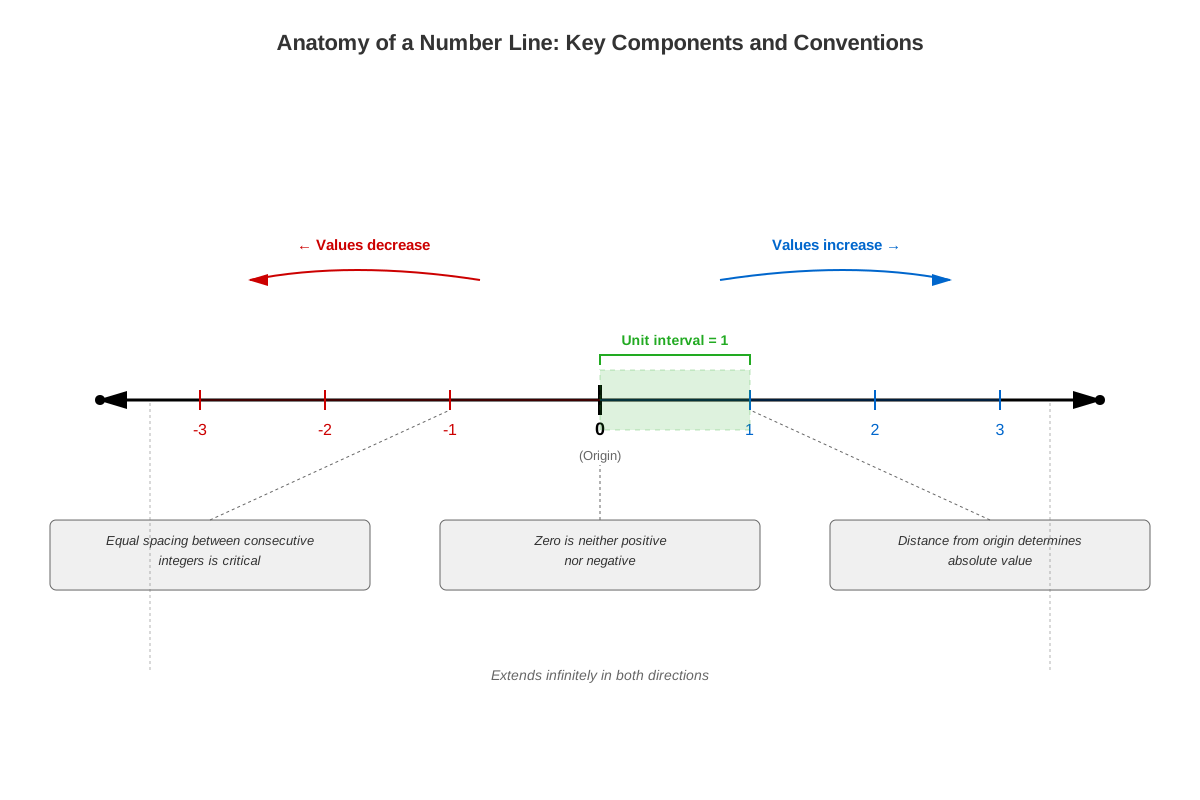
A number line is a straight horizontal line with equally spaced marks representing numbers in sequential order. The fundamental components include: the origin (typically marked as 0), which serves as the reference point; positive numbers extending infinitely to the right of zero; negative numbers extending infinitely to the left of zero; and tick marks or scale divisions that indicate unit distances. The spacing between consecutive integers must be uniform, establishing a consistent scale that allows accurate representation of all real numbers.
The direction convention is critical: moving right represents increasing values, while moving left represents decreasing values. This directional property makes the number line particularly useful for understanding inequality relationships—if point A is to the right of point B on a number line, then A > B. The number line is dense, meaning between any two points, infinitely many other points exist, representing the infinite divisibility of real numbers.
Distance on a Number Line
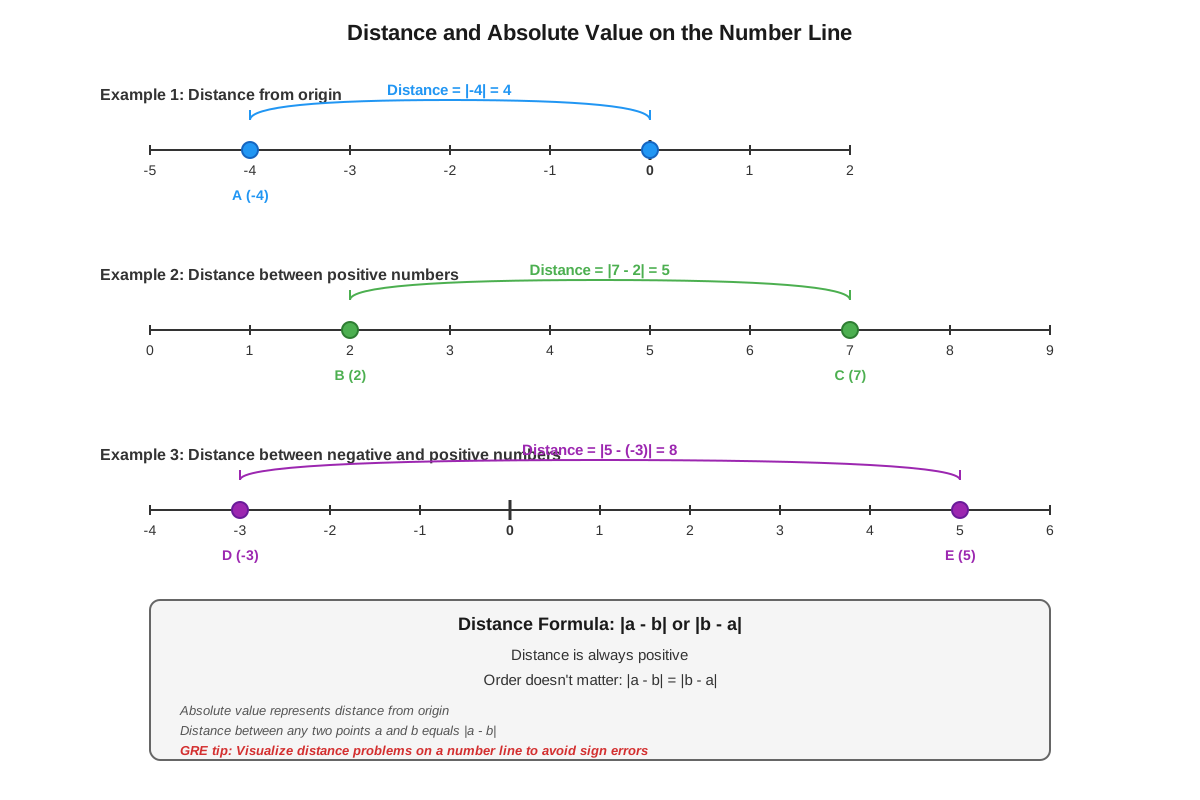
Distance on a number line always represents a non-negative value, calculated as the absolute difference between two positions. For points A and B with coordinates a and b respectively, the distance is |a - b| or equivalently |b - a|. This formula works regardless of whether the points are both positive, both negative, or on opposite sides of zero.
For example, the distance between -3 and 5 is |(-3) - 5| = |-8| = 8, which can be verified by counting: from -3 to 0 is 3 units, and from 0 to 5 is 5 units, totaling 8 units. When both numbers are positive, distance simplifies to subtraction of the smaller from the larger. When both are negative, distance equals the difference of their absolute values. The most common error occurs when students forget to take the absolute value, yielding negative "distances."
Midpoint and Division of Segments
The midpoint between two points on a number line is the point equidistant from both endpoints. For points with coordinates a and b, the midpoint M has coordinate (a + b)/2. This formula represents the arithmetic mean of the two values and works universally, regardless of signs.
For instance, the midpoint between -6 and 10 is (-6 + 10)/2 = 4/2 = 2. To verify: the distance from -6 to 2 is |-6 - 2| = 8, and the distance from 2 to 10 is |2 - 10| = 8, confirming equal distances. When dividing a segment in a specific ratio (not just in half), weighted averages apply. To find a point P that divides the segment from A to B in ratio m:n, use the formula: P = (n·a + m·b)/(m + n).
Representing Inequalities on a Number Line
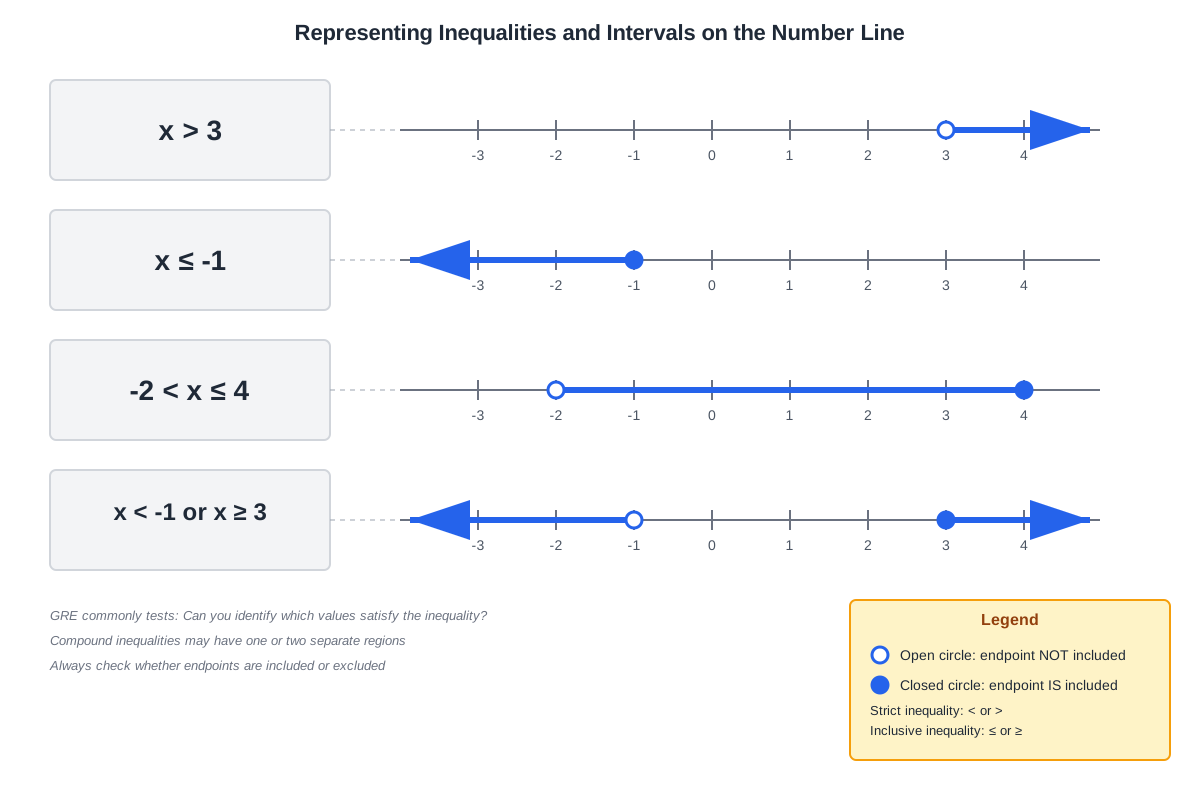
Number lines provide powerful visual representations of inequality solutions. A simple inequality like x > 3 is shown with an open circle (or hollow dot) at 3 and an arrow extending rightward, indicating all values greater than 3 but not including 3 itself. For x ≥ 3, a closed circle (or filled dot) at 3 indicates that 3 is included in the solution set.
Compound inequalities require careful representation. For "and" statements like 2 < x < 7, shade the region between 2 and 7 with appropriate open or closed circles at the endpoints. For "or" statements like x < -1 or x > 4, shade two separate regions extending in opposite directions. The visual representation immediately clarifies which values satisfy the condition, making number lines invaluable for checking algebraic work.
| Inequality Type | Symbol | Number Line Representation | Example |
|---|---|---|---|
| Greater than | x > a | Open circle at a, arrow right | x > 3 |
| Greater than or equal | x ≥ a | Closed circle at a, arrow right | x ≥ 3 |
| Less than | x < a | Open circle at a, arrow left | x < -2 |
| Less than or equal | x ≤ a | Closed circle at a, arrow left | x ≤ -2 |
| Between (exclusive) | a < x < b | Open circles at a and b, shaded between | 1 < x < 5 |
| Between (inclusive) | a ≤ x ≤ b | Closed circles at a and b, shaded between | 1 ≤ x ≤ 5 |
Absolute Value and Number Lines
Absolute value represents distance from zero on a number line, making number line visualization the most intuitive approach to absolute value problems. The expression |x| asks "how far is x from 0?" and always yields a non-negative result. For any number a, |a| equals a if a ≥ 0, and equals -a if a < 0.
More complex absolute value expressions like |x - 3| represent distance from a point other than zero. The expression |x - 3| = 5 asks "what values of x are exactly 5 units away from 3?" Visualizing on a number line immediately reveals two solutions: x = 8 (five units to the right of 3) and x = -2 (five units to the left of 3). Inequalities involving absolute value, such as |x - 3| < 5, represent all points within 5 units of 3, yielding -2 < x < 8.
Operations on the Number Line
Addition on a number line corresponds to movement: adding a positive number means moving right, while adding a negative number means moving left. To compute 4 + (-6), start at 4 and move 6 units left, arriving at -2. This visualization helps students understand why "adding a negative" produces the same result as subtraction.
Subtraction can be visualized as finding the directed distance from one point to another. Computing a - b means starting at b and determining how far and in which direction to move to reach a. If the result is positive, movement is rightward; if negative, leftward. Multiplication by positive numbers preserves order (if a < b, then 2a < 2b), while multiplication by negative numbers reverses order (if a < b, then -2a > -2b), a property visible when reflecting points across zero.
Concept Relationships
The number line serves as the foundational visual representation connecting multiple arithmetic and algebraic concepts. Basic number ordering (understanding which numbers are larger or smaller) directly translates to position on the number line (rightward means greater). This spatial representation then enables understanding of distance, which abstracts to absolute value (distance from zero) and generalizes to distance between any two points.
The concept of midpoint emerges from distance, representing the point equidistant from two endpoints, which connects to averages in statistics. Inequalities gain visual meaning through number line representation, where solution sets become shaded regions, and this visualization supports understanding of compound inequalities and absolute value inequalities.
The relationship map flows as follows:
Number Ordering → Position on Number Line → Distance Calculation → Absolute Value → Distance from Non-Zero Points → Absolute Value Equations and Inequalities
Simultaneously: Position on Number Line → Inequality Representation → Compound Inequalities → Solution Set Visualization
And: Distance Between Points → Midpoint Calculation → Segment Division → Weighted Averages
These interconnections mean that mastering number line concepts provides a unified framework for understanding seemingly disparate topics, reducing cognitive load and enabling faster problem-solving.
Quick check — test yourself on Number line so far.
Try Flashcards →High-Yield Facts
⭐ Distance between two points a and b on a number line is always |a - b|, which equals |b - a|
⭐ The midpoint between points a and b has coordinate (a + b)/2
⭐ Open circles indicate values NOT included in a solution set; closed circles indicate values that ARE included
⭐ |x - a| = d has exactly two solutions: x = a + d and x = a - d (unless d = 0)
⭐ |x - a| < d translates to the compound inequality a - d < x < a + d
- Moving right on a number line always means increasing value; moving left always means decreasing value
- The distance from any negative number to any positive number equals the sum of their absolute values
- For three points A, B, C on a number line where B is between A and C: distance(A,C) = distance(A,B) + distance(B,C)
- |x - a| > d translates to x < a - d OR x > a + d (two separate regions)
- The number line is symmetric about zero: for every positive number n, there exists a negative number -n at equal distance from zero
- When comparing distances, |a - b| = |b - a| demonstrates that distance is independent of direction
- Zero is neither positive nor negative but serves as the boundary between positive and negative numbers
Common Misconceptions
Misconception: Distance can be negative if you're moving leftward on the number line.
Correction: Distance is always non-negative. While displacement (directed distance) can be negative, distance as measured by |a - b| is always ≥ 0. The absolute value operation ensures this.
Misconception: The midpoint between -8 and 4 is found by taking the average of their absolute values: (8 + 4)/2 = 6.
Correction: The midpoint formula uses the actual values, not absolute values: (-8 + 4)/2 = -4/2 = -2. The midpoint is at -2, which is indeed equidistant from both -8 and 4 (each 6 units away).
Misconception: |x| < -3 has solutions because you can just solve x < -3 or x < 3.
Correction: |x| < -3 has NO solutions. Absolute value is always non-negative, so it can never be less than a negative number. Any inequality of the form |expression| < negative number has no solution.
Misconception: On a number line, -5 is farther from zero than -3, so -5 > -3.
Correction: While -5 has a greater absolute value (is farther from zero), it is positioned to the LEFT of -3, making it smaller: -5 < -3. Distance from zero and value are different concepts.
Misconception: For |x - 3| = 5, the only solution is x = 8 because 8 - 3 = 5.
Correction: There are two solutions: x = 8 AND x = -2. The equation asks for all points exactly 5 units from 3, which includes both 3 + 5 = 8 (to the right) and 3 - 5 = -2 (to the left).
Misconception: When representing x > 3 on a number line, use a closed circle at 3 because 3 is mentioned.
Correction: Use an open circle at 3 because the inequality is strictly greater than (>), not greater than or equal to (≥). The circle type depends on whether the boundary value is included, not on whether it's mentioned.
Misconception: The distance between -10 and -3 is 13 because |-10| + |-3| = 13.
Correction: The distance is |(-10) - (-3)| = |-10 + 3| = |-7| = 7. You only add absolute values when finding distance between a negative and positive number, not when both are negative.
Worked Examples
Example 1: Distance and Midpoint with Negative Numbers
Problem: On a number line, point A is at -7 and point C is at 11. Point B is the midpoint of segment AC. What is the distance from point B to point C?
Solution:
Step 1: Find the coordinate of point B (the midpoint).
Using the midpoint formula: B = (a + c)/2 = (-7 + 11)/2 = 4/2 = 2
Step 2: Calculate the distance from B to C.
Distance = |B - C| = |2 - 11| = |-9| = 9
Alternatively: Distance = |C - B| = |11 - 2| = |9| = 9
Verification: We can check that B is indeed the midpoint by confirming equal distances:
- Distance from A to B: |-7 - 2| = |-9| = 9 ✓
- Distance from B to C: |2 - 11| = |-9| = 9 ✓
The distances are equal, confirming B is the midpoint, and the distance from B to C is 9 units.
Connection to Learning Objectives: This problem requires applying the midpoint formula and distance calculation, demonstrating mastery of core number line strategies. It also illustrates why the absolute value is essential—without it, we might incorrectly report a negative distance.
Example 2: Absolute Value Inequality Representation
Problem: Which of the following inequalities is represented by the shaded region on a number line that includes all points more than 4 units away from 2?
(A) |x - 2| > 4
(B) |x - 2| < 4
(C) |x + 2| > 4
(D) |x - 4| > 2
(E) |x + 4| < 2
Solution:
Step 1: Translate the verbal description to mathematical language.
"More than 4 units away from 2" means the distance from x to 2 is greater than 4.
Distance from x to 2 is expressed as |x - 2|.
Therefore: |x - 2| > 4
Step 2: Verify by finding the solution set.
|x - 2| > 4 means x is either:
- More than 4 units to the right of 2: x > 2 + 4, so x > 6, OR
- More than 4 units to the left of 2: x < 2 - 4, so x < -2
This creates two separate shaded regions: x < -2 or x > 6
Step 3: Eliminate incorrect answers.
- (B) |x - 2| < 4 would give -2 < x < 6 (points WITHIN 4 units of 2)—opposite of what we want
- (C) |x + 2| > 4 represents distance from -2, not 2
- (D) |x - 4| > 2 represents distance from 4, not 2
- (E) |x + 4| < 2 represents points within 2 units of -4
Answer: (A)
Connection to Learning Objectives: This problem tests the ability to identify when number line concepts are being tested (recognizing absolute value as distance), explain the core strategy (translating between verbal, visual, and algebraic representations), and apply the concept accurately to a GRE-style question.
Exam Strategy
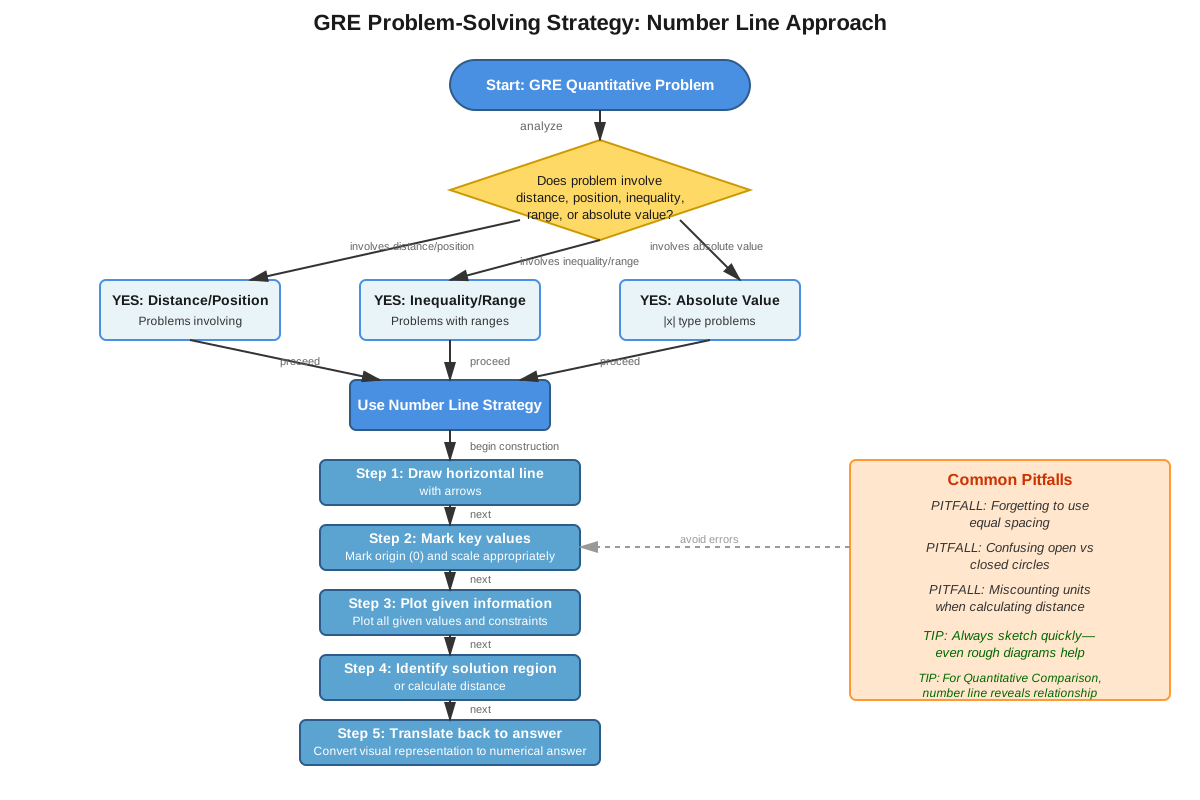
When approaching GRE number line questions, first identify the question type: Is a number line diagram provided, or must one be constructed? Is the question asking about distance, position, midpoint, or inequality representation? Recognizing the specific concept being tested allows selection of the appropriate formula or visualization strategy.
Trigger words and phrases that signal number line concepts include: "distance between," "how far," "midpoint," "halfway between," "units from," "greater than," "less than," "between," "range of values," "solution set," and any mention of absolute value. When these appear, immediately consider whether sketching a number line would clarify the problem.
For Quantitative Comparison questions involving number lines, sketch both quantities on the same number line when possible. Visual comparison often reveals relationships faster than algebraic manipulation. Pay special attention to the signs of numbers—many GRE traps involve students forgetting that negative numbers behave differently than positive ones.
Process-of-elimination strategies specific to number line questions:
- Eliminate answers that violate basic ordering (e.g., if the question states a < b, eliminate any answer suggesting a > b)
- For absolute value inequalities, eliminate answers that produce the wrong number of solution regions (one continuous region vs. two separate regions)
- Check boundary values—if an answer includes or excludes a specific value incorrectly, eliminate it
- For distance problems, eliminate any negative answers immediately
Time allocation: Simple number line questions (identifying a point, calculating basic distance) should take 30-45 seconds. Moderate questions involving midpoints or simple absolute value should take 60-90 seconds. Complex questions combining multiple concepts (compound inequalities, segment division in ratios) may require up to 2 minutes. If a problem seems to require extensive calculation, reconsider whether a visual approach might be faster.
Quick sketching technique: Don't waste time creating perfectly scaled number lines. A rough sketch with approximate positions is sufficient for most problems. Mark zero first, then place other relevant points in correct relative positions. Use clear notation for open vs. closed circles.
Memory Techniques
Mnemonic for inequality symbols and circles: "Open rejects, Closed accepts" — Open circles (< or >) reject/exclude the boundary value; Closed circles (≤ or ≥) accept/include it.
Visualization for absolute value: Remember "Absolute value = Distance from zero" by visualizing a number line with zero at the center. Any number's absolute value is literally how many steps you'd count to reach zero.
Midpoint memory aid: "Midpoint = Mean" — The midpoint formula (a + b)/2 is identical to the arithmetic mean formula. Both represent the average position.
Distance formula acronym: "DAB" — Distance equals Absolute value of the difference Between points: D = |A - B|
Inequality direction: "Right is Might" — Rightward on the number line means mightier (greater) values. This helps remember that -100 < -1 even though 100 > 1, because -1 is to the right of -100.
Compound inequality visualization: For "and" statements, imagine a segment of string between two points (one continuous region). For "or" statements, imagine two separate pieces of string extending outward (two separate regions).
Absolute value inequality memory:
- "Less than = Locked between" — |x - a| < d locks x between two values
- "Greater than = Goes to extremes" — |x - a| > d sends x to two extreme regions
Summary
The number line is an essential visual and conceptual tool for GRE Quantitative Reasoning, providing intuitive understanding of numerical relationships, distances, and inequalities. Mastery requires understanding that the number line represents all real numbers with consistent spacing, where position indicates value (rightward = greater), and distance between points is calculated using absolute value: |a - b|. The midpoint between two points is found using (a + b)/2, representing the arithmetic mean. Inequalities translate to shaded regions with open circles for strict inequalities (< or >) and closed circles for inclusive inequalities (≤ or ≥). Absolute value expressions represent distance, with |x - a| measuring distance from point a, making number line visualization the most efficient approach to absolute value equations and inequalities. Success on GRE number line questions requires fluency in translating between verbal descriptions, algebraic expressions, and visual representations, combined with careful attention to signs (positive vs. negative) and boundary conditions (included vs. excluded values). The number line framework supports problem-solving across multiple Quantitative Reasoning topics, making it a high-yield concept worthy of thorough mastery.
Key Takeaways
- Distance on a number line is always calculated as |a - b| and is always non-negative, regardless of the positions or signs of the points involved
- The midpoint formula (a + b)/2 works universally for any two points, whether positive, negative, or mixed, and represents the arithmetic mean
- Open circles exclude boundary values (< or >); closed circles include boundary values (≤ or ≥)—this distinction is critical for correctly representing solution sets
- Absolute value represents distance from zero, and |x - a| represents distance from point a, making number line visualization the most intuitive approach to absolute value problems
- Moving right on a number line always means increasing value; moving left always means decreasing value, which explains why -5 < -3 even though 5 > 3
- Compound inequalities with "and" create one continuous shaded region; compound inequalities with "or" create two separate shaded regions
- Quick sketching of number lines, even roughly scaled, dramatically improves accuracy and speed on GRE questions involving ordering, distance, and inequalities
Related Topics
Inequalities and Compound Inequalities: Building directly on number line representation, this topic explores algebraic manipulation of inequalities and solving systems of inequalities, where number line visualization remains a valuable checking tool.
Absolute Value Equations and Inequalities: This advanced topic extends the distance interpretation of absolute value to more complex equations and inequalities, with number line concepts providing the foundational understanding.
Coordinate Geometry: The number line extends to two dimensions in the coordinate plane, where the x-axis and y-axis are perpendicular number lines, and distance formulas generalize to the distance formula in the plane.
Integer Properties: Understanding integer positions on the number line supports work with consecutive integers, even/odd properties, and divisibility, as these concepts often involve relative positions and distances.
Ratios and Proportions: Segment division on a number line connects to ratio concepts, particularly when dividing segments in specific ratios or finding weighted averages.
Mastering number line concepts creates a strong foundation for these related topics, as the visual and spatial reasoning skills transfer directly to more advanced mathematical contexts.
Practice CTA
Now that you've thoroughly reviewed number line concepts, strategies, and applications, it's time to solidify your understanding through active practice. Attempt the practice questions associated with this topic, focusing on applying the visualization techniques and formulas you've learned. Work through each problem methodically, sketching number lines when helpful, and checking your reasoning against the worked examples provided. Use the flashcards to reinforce key formulas, definitions, and common traps. Remember that mastery comes through repeated application—each practice problem strengthens your pattern recognition and problem-solving speed. You've built the foundation; now construct expertise through deliberate practice. Your investment in mastering this high-yield topic will pay dividends across multiple question types on test day!
Sign up free to keep reading
Create a free AnvayaPrep account to finish this GRE guide on Number line — plus flashcards and practice questions.