Overview
30-60-90 triangles are one of the most frequently tested special right triangles on the GRE Quantitative Reasoning section. These triangles possess a unique and predictable relationship between their angles and side lengths, making them powerful tools for solving geometry problems quickly and efficiently. Unlike general triangles that require the Pythagorean theorem or trigonometric functions to solve, 30-60-90 triangles follow a fixed ratio pattern that allows test-takers to determine any missing side length when given just one measurement. This predictability makes them high-yield content for the GRE, appearing in both discrete quantitative comparison questions and problem-solving items.
Understanding GRE 30-60-90 triangles is essential because they frequently appear embedded within more complex geometric figures such as equilateral triangles, rectangles, hexagons, and coordinate geometry problems. The GRE test designers deliberately incorporate these special triangles into multi-step problems to reward students who recognize the pattern and can apply it efficiently. Mastery of this topic can save valuable time during the exam—instead of working through lengthy calculations using the Pythagorean theorem, recognizing a 30-60-90 triangle allows for immediate application of the side ratio formula.
Within the broader Quantitative Reasoning curriculum, 30-60-90 triangles connect directly to several fundamental geometry concepts including the Pythagorean theorem, properties of equilateral triangles, area calculations, and coordinate geometry. They also relate to the other special right triangle (45-45-90 triangles) and serve as building blocks for understanding more complex polygons. The ability to identify and work with these triangles demonstrates spatial reasoning skills and pattern recognition—both critical competencies that the GRE assesses across multiple question types.
Learning Objectives
- [ ] Identify when 30-60-90 triangles is being tested
- [ ] Explain the core rule or strategy behind 30-60-90 triangles
- [ ] Apply 30-60-90 triangles to GRE-style questions accurately
- [ ] Derive the side ratio relationship from an equilateral triangle
- [ ] Recognize 30-60-90 triangles embedded within complex geometric figures
- [ ] Calculate area and perimeter of figures containing 30-60-90 triangles
- [ ] Solve coordinate geometry problems involving 30-60-90 triangles
Prerequisites
- Right triangle fundamentals: Understanding that one angle measures 90° and the relationship between legs and hypotenuse is essential for recognizing how 30-60-90 triangles are a special case of right triangles.
- Pythagorean theorem (a² + b² = c²): This theorem provides the foundation for understanding why the side ratios work and can verify 30-60-90 relationships when needed.
- Basic angle relationships: Knowledge that triangle angles sum to 180° helps identify when a triangle has the 30-60-90 angle configuration.
- Radical simplification: Ability to work with √3 and simplify expressions involving square roots is necessary for applying the side ratio formula.
- Equilateral triangle properties: Understanding that equilateral triangles have three 60° angles and equal sides helps recognize how 30-60-90 triangles are formed.
Why This Topic Matters
In real-world applications, 30-60-90 triangles appear in architecture, engineering, and design contexts where specific angle relationships create structural stability or aesthetic appeal. They're fundamental to understanding hexagonal patterns in nature (such as honeycomb structures) and are used in navigation, surveying, and construction projects requiring precise angle measurements. The mathematical elegance of these triangles has made them essential in fields ranging from computer graphics to crystallography.
On the GRE specifically, 30-60-90 triangles appear in approximately 10-15% of geometry questions, making them one of the highest-yield geometry topics to master. They appear across multiple question formats including quantitative comparison questions, multiple-choice problem solving, and numeric entry questions. The Educational Testing Service (ETS) frequently uses these triangles in medium to hard difficulty questions because they reward pattern recognition and efficient problem-solving—key skills the GRE aims to assess.
Common GRE question patterns involving 30-60-90 triangles include: finding the height of an equilateral triangle given its side length; determining coordinates of points in the coordinate plane; calculating areas of composite figures; solving for diagonal lengths in rectangles with specific angle relationships; and analyzing properties of regular hexagons. These triangles also appear in data interpretation questions involving geometric diagrams and in word problems describing real-world scenarios with specific angle measurements. The ability to quickly recognize and apply the 30-60-90 ratio can mean the difference between solving a problem in 30 seconds versus 2-3 minutes—a critical advantage given the GRE's time constraints.
Core Concepts
The Fundamental Side Ratio
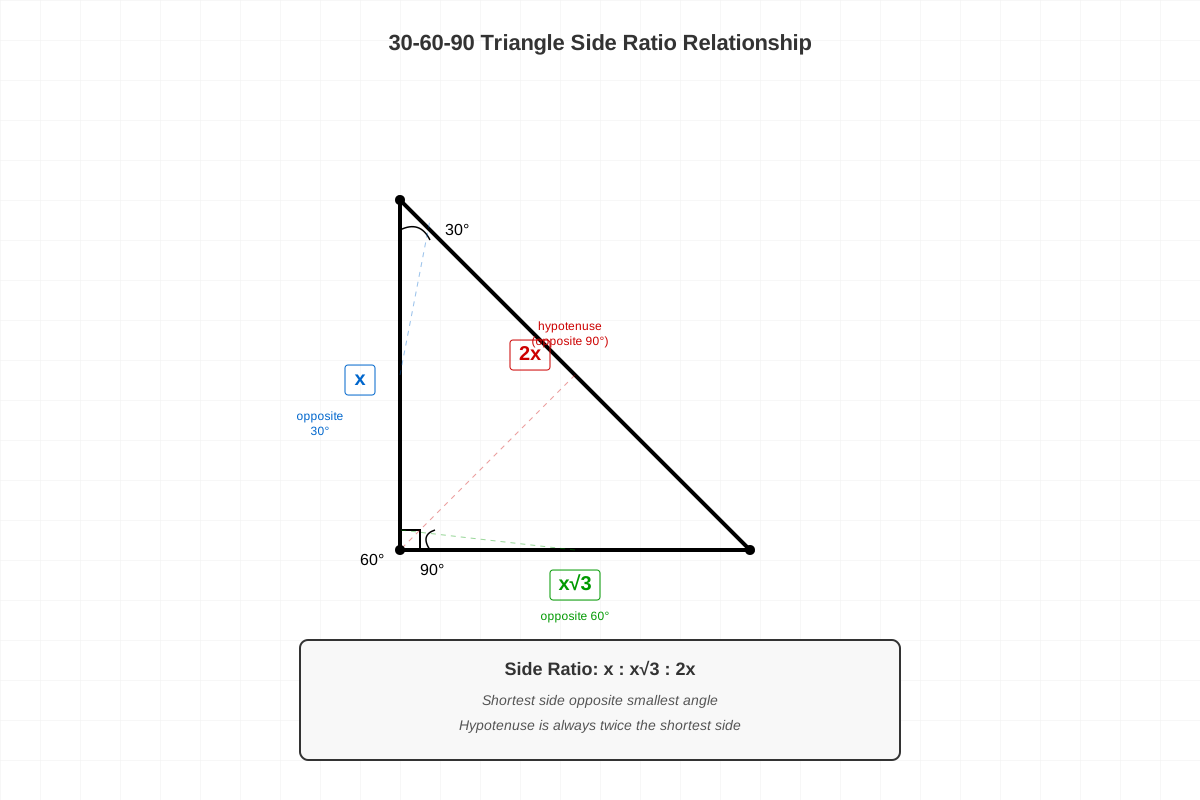
The defining characteristic of a 30-60-90 triangle is its fixed side length ratio. In any 30-60-90 triangle, the sides opposite the 30°, 60°, and 90° angles are always in the ratio x : x√3 : 2x, where x represents the length of the shortest side (opposite the 30° angle). This ratio is invariant—it holds true regardless of the actual size of the triangle, making it a powerful tool for solving problems.
Specifically:
- The side opposite the 30° angle (shortest side) = x
- The side opposite the 60° angle (medium side) = x√3
- The side opposite the 90° angle (hypotenuse, longest side) = 2x
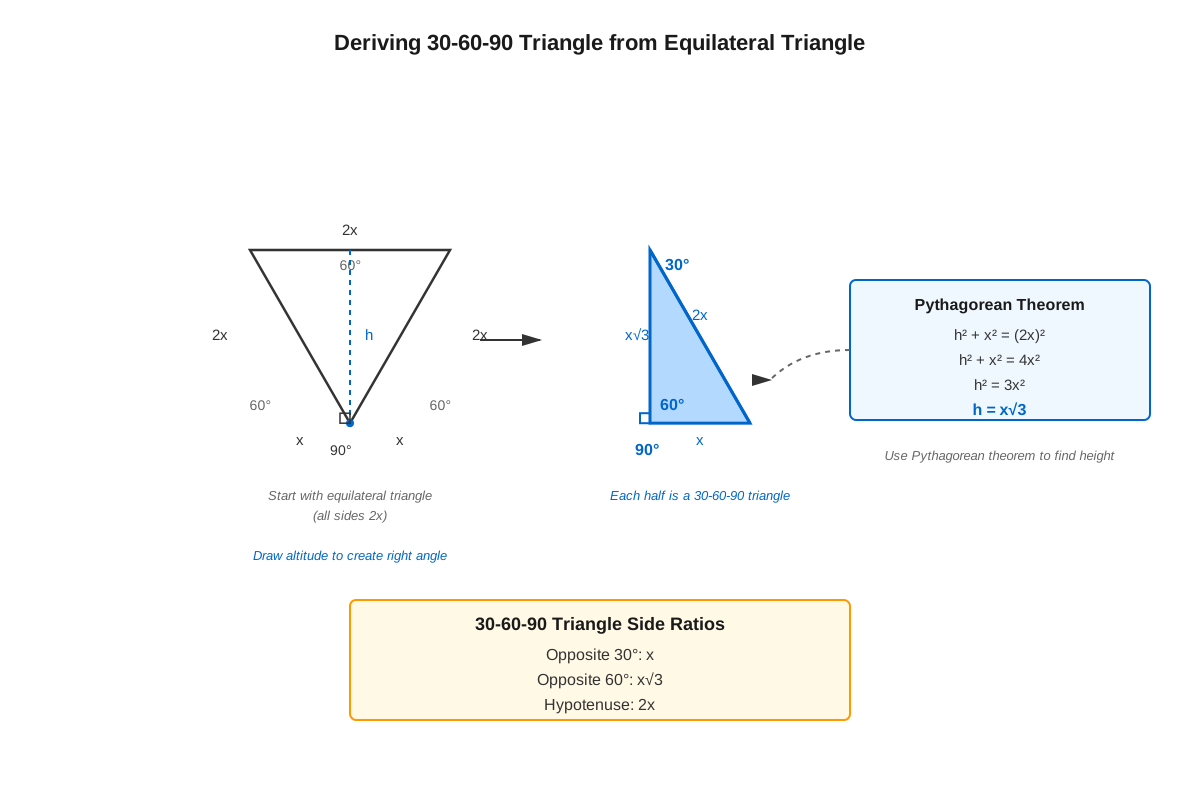
This ratio can be derived from an equilateral triangle. When an altitude is drawn from any vertex of an equilateral triangle to the opposite side, it bisects both the angle (creating two 30° angles) and the base (creating two equal segments). The original 60° angles remain, and the altitude creates a 90° angle with the base. If the equilateral triangle has side length 2x, the altitude creates two 30-60-90 triangles, each with hypotenuse 2x and shortest side x. Using the Pythagorean theorem: x² + h² = (2x)², which simplifies to h² = 4x² - x² = 3x², therefore h = x√3.
Identifying 30-60-90 Triangles
Recognition is the first critical skill. A triangle is a 30-60-90 triangle if:
- Explicit angle measures: The problem states or shows angles of 30°, 60°, and 90°
- Equilateral triangle division: An altitude, median, or angle bisector is drawn in an equilateral triangle
- Half of an equilateral triangle: The problem describes or shows half of an equilateral triangle
- Side ratio clues: Given sides are in the ratio 1 : √3 : 2 or any multiple thereof
- Coordinate geometry: A point forms specific coordinates suggesting these angles (e.g., moving √3 units vertically and 1 unit horizontally from a point)
Working with the Ratio
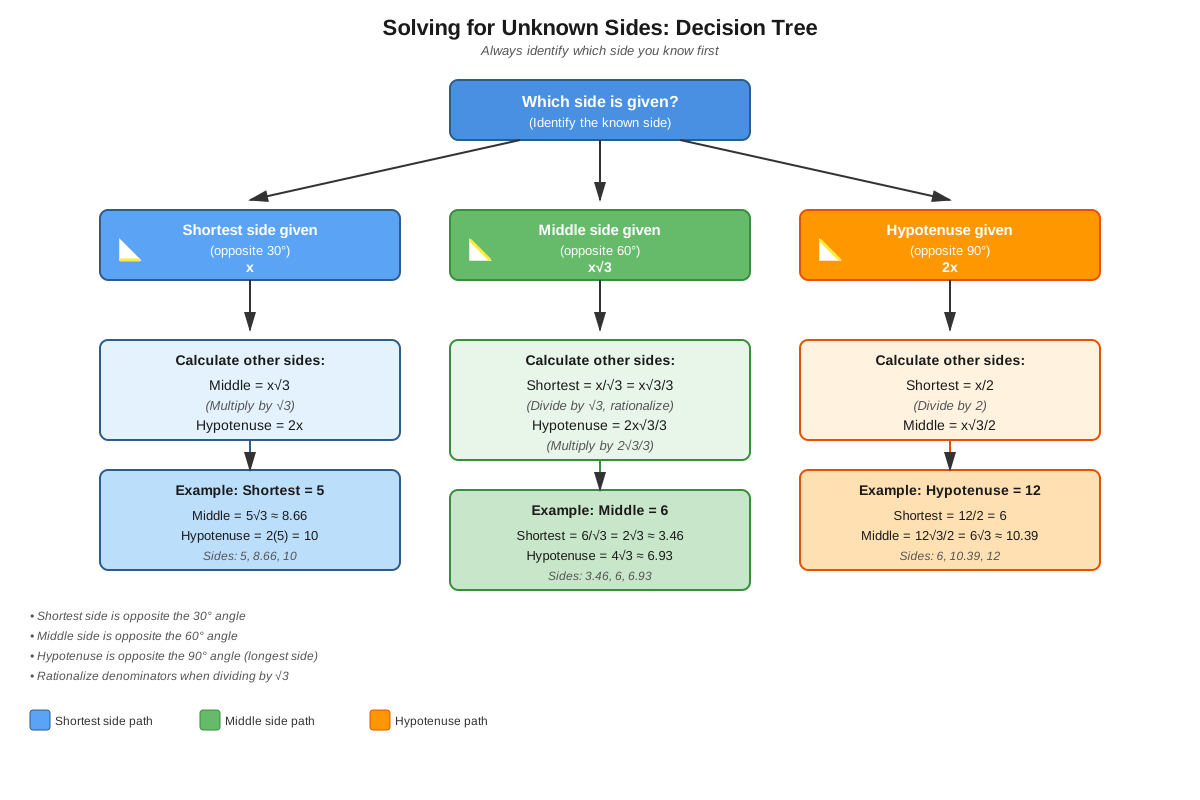
To solve problems efficiently, follow this systematic approach:
- Identify which side you know: Determine whether the given measurement corresponds to the side opposite 30°, 60°, or 90°
- Determine the value of x: Solve for x based on which side is given
- Calculate remaining sides: Use the ratio to find all other sides
Example relationships:
- If the shortest side (opposite 30°) = 5, then x = 5, so the other sides are 5√3 and 10
- If the hypotenuse (opposite 90°) = 12, then 2x = 12, so x = 6, and the other sides are 6 and 6√3
- If the medium side (opposite 60°) = 7√3, then x√3 = 7√3, so x = 7, and the other sides are 7 and 14
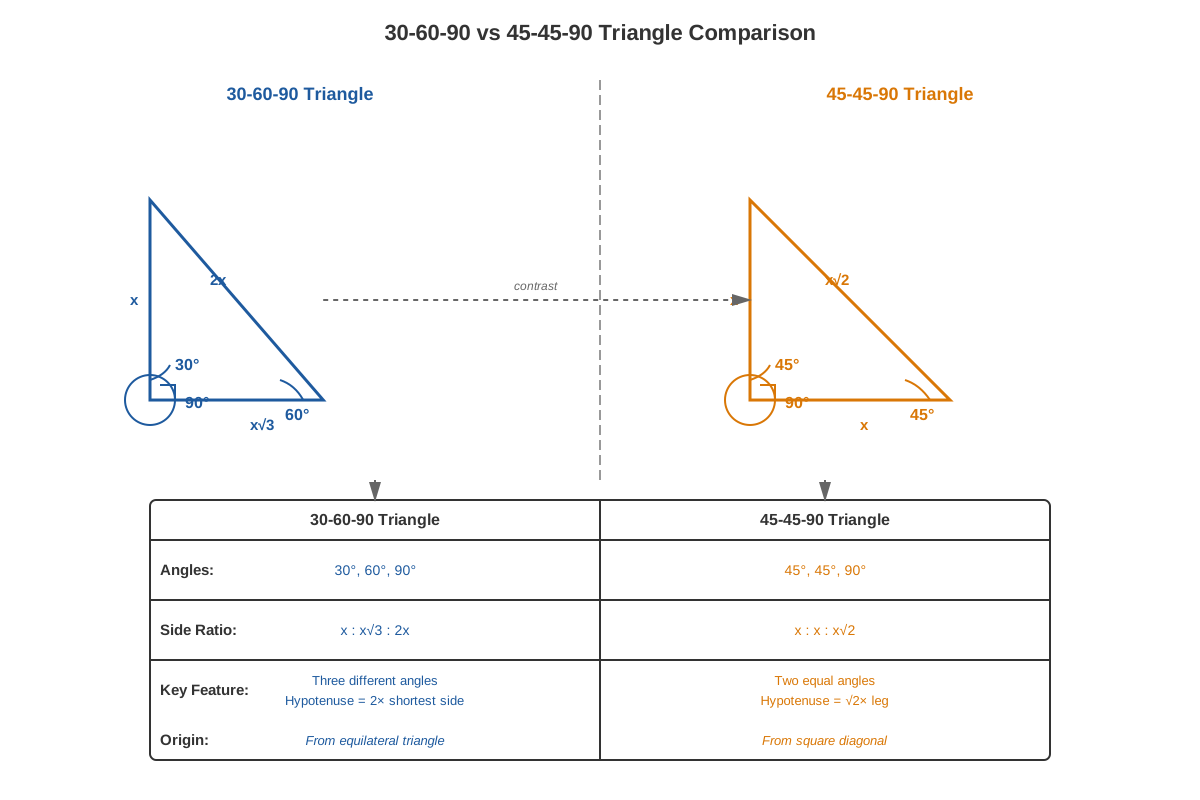
Comparison with Other Special Triangles
| Triangle Type | Angles | Side Ratio | Key Feature |
|---|---|---|---|
| 30-60-90 | 30°-60°-90° | x : x√3 : 2x | Derived from equilateral triangle |
| 45-45-90 | 45°-45°-90° | x : x : x√2 | Derived from square diagonal |
| 3-4-5 | Varies | 3 : 4 : 5 | Pythagorean triple, not fixed angles |
Area Calculations
The area of a 30-60-90 triangle can be calculated using the standard triangle area formula: A = ½ × base × height. Since the two legs (sides opposite 30° and 60°) are perpendicular, they serve as base and height:
Area = ½ × x × x√3 = (x²√3)/2
This formula is particularly useful when only one side length is known, as it allows direct area calculation without finding all three sides.
Applications in Complex Figures
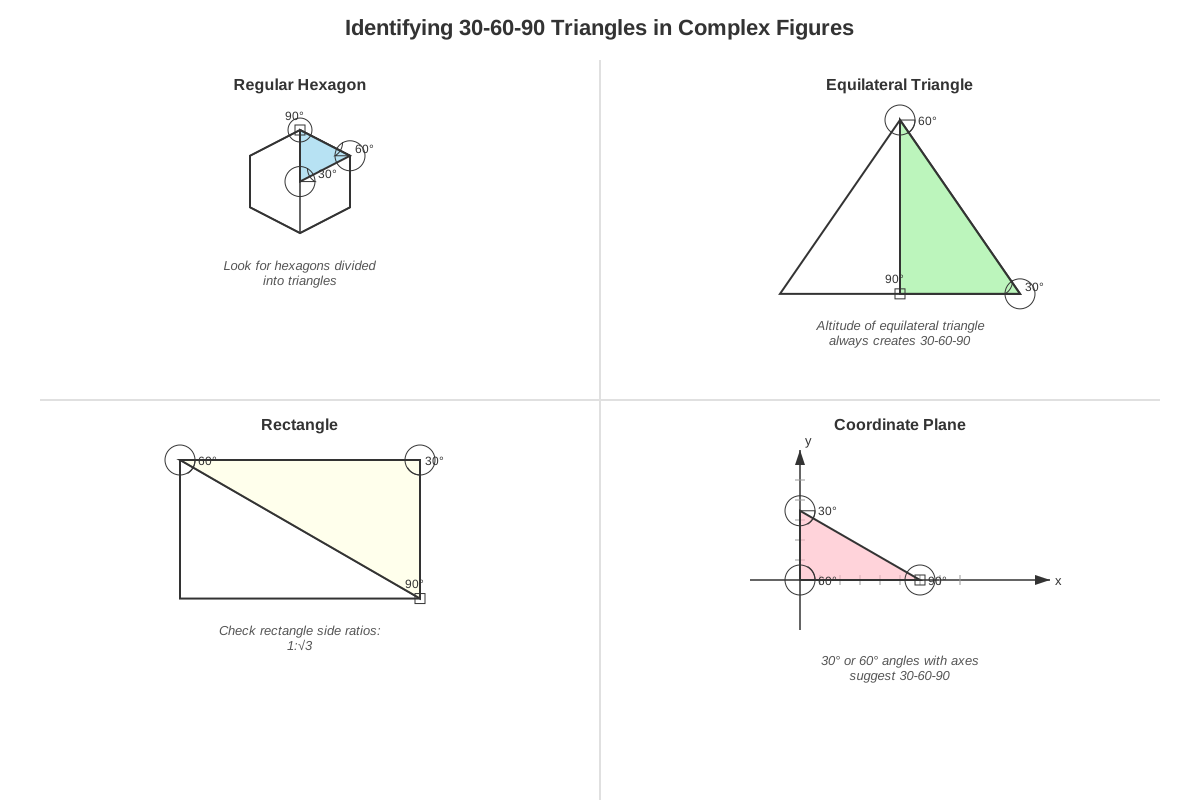
30-60-90 triangles frequently appear embedded within:
- Equilateral triangles: The altitude creates two 30-60-90 triangles
- Regular hexagons: Can be divided into six equilateral triangles, each containing two 30-60-90 triangles
- Rectangles: When a diagonal creates specific angles with the sides
- Coordinate plane: When points are positioned at specific angles from the origin or other reference points
- Trapezoids: When altitudes are drawn creating right triangles with specific angle measures
Concept Relationships
The 30-60-90 triangle serves as a central hub connecting multiple geometric concepts. At its foundation, it derives from equilateral triangles → when an altitude is drawn, it creates two congruent 30-60-90 triangles. This relationship flows bidirectionally: recognizing a 30-60-90 triangle can help reconstruct the original equilateral triangle.
The side ratio relationship connects directly to the Pythagorean theorem → the ratio x : x√3 : 2x can be verified by confirming that x² + (x√3)² = (2x)², which simplifies to x² + 3x² = 4x², confirming the relationship. This verification demonstrates that 30-60-90 triangles are a special case of right triangles where the Pythagorean theorem produces a predictable pattern.
Within the broader category of special right triangles, 30-60-90 triangles complement 45-45-90 triangles. Both provide shortcuts for solving right triangle problems without trigonometry, but they apply to different geometric contexts. The 45-45-90 triangle derives from squares and isosceles right triangles, while the 30-60-90 derives from equilateral triangles.
The concept extends to regular polygons → regular hexagons can be divided into six equilateral triangles, each of which contains two 30-60-90 triangles. This relationship enables efficient calculation of hexagon properties including area, perimeter, and diagonal lengths.
In coordinate geometry, 30-60-90 triangles enable quick calculation of distances and coordinates when points are positioned at 30° or 60° angles from axes or other reference lines. This connects to slope concepts and distance formula applications.
Finally, the area formula for 30-60-90 triangles connects to general area calculation strategies and provides a foundation for finding areas of composite figures that can be decomposed into these special triangles.
High-Yield Facts
⭐ The side ratio for any 30-60-90 triangle is always x : x√3 : 2x, where x is the side opposite the 30° angle
⭐ The hypotenuse of a 30-60-90 triangle is always exactly twice the length of the shortest side
⭐ Drawing an altitude in an equilateral triangle creates two congruent 30-60-90 triangles
⭐ If you know any one side of a 30-60-90 triangle, you can immediately determine the other two sides
⭐ The side opposite the 60° angle is always √3 times the side opposite the 30° angle
- The area of a 30-60-90 triangle with shortest side x is (x²√3)/2
- In a 30-60-90 triangle, the medium-length side is always one of the legs, never the hypotenuse
- A regular hexagon can be divided into 12 congruent 30-60-90 triangles
- The altitude of an equilateral triangle with side length s is (s√3)/2, derived from the 30-60-90 ratio
- When a 30-60-90 triangle appears in the coordinate plane, the ratio of vertical to horizontal distance (or vice versa) often involves √3
- The angles 30° and 60° are complementary (sum to 90°), which is why they appear together in a right triangle
- If the hypotenuse of a 30-60-90 triangle is h, the shortest side is h/2 and the medium side is (h√3)/2
Quick check — test yourself on 30-60-90 triangles so far.
Try Flashcards →Common Misconceptions
Misconception: The side opposite 60° is longer than the hypotenuse because 60 > 30.
Correction: The hypotenuse is always the longest side in any right triangle, regardless of the other angles. In a 30-60-90 triangle, the hypotenuse (2x) is longer than both legs, including the side opposite 60° (x√3 ≈ 1.73x).
Misconception: The ratio x : x√3 : 2x can be simplified to 1 : √3 : 2, so a triangle with sides 2, 2√3, and 4 is not a 30-60-90 triangle.
Correction: The ratio 1 : √3 : 2 is the simplified form, but any multiple of this ratio also represents a 30-60-90 triangle. A triangle with sides 2, 2√3, and 4 is indeed a 30-60-90 triangle (where x = 2).
Misconception: You need to use the Pythagorean theorem to solve every 30-60-90 triangle problem.
Correction: Once you recognize a 30-60-90 triangle, the fixed ratio provides a much faster solution method. The Pythagorean theorem can verify the relationship but isn't necessary for solving problems.
Misconception: The √3 always appears with the hypotenuse.
Correction: The √3 appears with the side opposite the 60° angle, which is one of the legs (not the hypotenuse). The hypotenuse is always 2x with no radical.
Misconception: All triangles with a 30° angle are 30-60-90 triangles.
Correction: A triangle must have all three angle measures of 30°, 60°, and 90° to be a 30-60-90 triangle. A triangle with a 30° angle could have any other two angles that sum to 150°.
Misconception: When an altitude is drawn in any triangle, it creates 30-60-90 triangles.
Correction: Only when an altitude is drawn in an equilateral triangle does it create 30-60-90 triangles. Altitudes in other triangle types create different configurations.
Misconception: The side ratios change if the triangle is oriented differently or appears upside down.
Correction: The side ratios remain constant regardless of the triangle's orientation. What matters is which side is opposite which angle, not the triangle's position on the page.
Worked Examples
Example 1: Finding Missing Sides from the Hypotenuse
Problem: In triangle ABC, angle A = 30°, angle B = 90°, and angle C = 60°. If the hypotenuse AC = 18, find the lengths of sides AB and BC.
Solution:
Step 1: Identify the triangle type and given information.
- This is a 30-60-90 triangle (angles sum to 180° and include 30°, 60°, and 90°)
- The hypotenuse AC = 18 (the side opposite the right angle at B)
Step 2: Determine which side is opposite which angle.
- Side BC is opposite angle A (30°) → this is the shortest side
- Side AB is opposite angle C (60°) → this is the medium side
- Side AC is opposite angle B (90°) → this is the hypotenuse = 18
Step 3: Apply the ratio x : x√3 : 2x.
- The hypotenuse corresponds to 2x in the ratio
- Therefore: 2x = 18
- Solving: x = 9
Step 4: Calculate the remaining sides.
- BC (opposite 30°) = x = 9
- AB (opposite 60°) = x√3 = 9√3
Answer: BC = 9 and AB = 9√3
Connection to learning objectives: This example demonstrates identifying a 30-60-90 triangle from angle measures (Objective 1), applying the core ratio strategy (Objective 2), and accurately solving a GRE-style problem (Objective 3).
Example 2: Area of an Equilateral Triangle
Problem: An equilateral triangle has a side length of 10. What is its area?
Solution:
Step 1: Recognize the connection to 30-60-90 triangles.
- To find the area of an equilateral triangle, we need the height
- Drawing an altitude from any vertex to the opposite side creates two 30-60-90 triangles
Step 2: Analyze one of the 30-60-90 triangles formed.
- The hypotenuse is the original side of the equilateral triangle = 10
- The base of the 30-60-90 triangle is half the equilateral triangle's base = 5
- The altitude is the side we need to find
Step 3: Apply the 30-60-90 ratio.
- In our 30-60-90 triangle: hypotenuse = 10, so 2x = 10, therefore x = 5
- The base (opposite 30°) = x = 5 ✓ (confirms our setup)
- The altitude (opposite 60°) = x√3 = 5√3
Step 4: Calculate the area of the equilateral triangle.
- Area = ½ × base × height
- Area = ½ × 10 × 5√3
- Area = 25√3
Answer: The area is 25√3 (approximately 43.3 square units)
Alternative approach: Using the direct formula for 30-60-90 triangle area, each of the two triangles has area (x²√3)/2 = (5²√3)/2 = (25√3)/2, and two such triangles give 25√3.
Connection to learning objectives: This example shows recognizing 30-60-90 triangles embedded in equilateral triangles (Objective 5), applying the ratio to find heights (Objective 2), and calculating areas (Objective 6).
Exam Strategy
When approaching GRE questions involving 30-60-90 triangles, follow this strategic framework:
Recognition triggers to watch for:
- Explicit mention of "equilateral triangle" with an altitude, median, or height
- Angle measures that include 30° and 60° in a right triangle
- Side lengths in ratios involving √3
- Regular hexagons (which decompose into equilateral triangles)
- Phrases like "half of an equilateral triangle"
- Coordinate geometry with points at specific positions suggesting these angles
Systematic approach:
- Scan for angle information first: Before doing any calculations, check if angles are given or can be deduced
- Draw and label diagrams: Even if a figure is provided, redraw it with clear labels for angles and the x : x√3 : 2x ratio
- Identify the known side: Determine whether you're given the shortest side, medium side, or hypotenuse
- Solve for x immediately: This is your key to unlocking all other measurements
- Check answer choices for form: GRE answers often appear in simplified radical form; don't approximate unless necessary
Time-saving techniques:
Quick Check: If you're given a side length and need to find another, ask yourself: "Is this the shortest side (x), the √3 side (x√3), or the hypotenuse (2x)?" This single question guides your entire solution.
For quantitative comparison questions:
- Often one quantity involves a 30-60-90 triangle and the other involves a 45-45-90 triangle or different configuration
- Calculate the specific values rather than trying to compare ratios abstractly
- Watch for trap answers where the quantities appear equal but differ by a factor of √3
Process of elimination tips:
- Eliminate answers that don't include √3 when the question asks for the side opposite 60°
- Eliminate answers where the hypotenuse is less than twice the shortest side
- Eliminate answers that would make the medium side longer than the hypotenuse
Time allocation:
- Recognition and setup: 15-20 seconds
- Calculation: 30-45 seconds
- Verification: 10-15 seconds
- Total target time: 60-90 seconds per problem
If a problem seems to require the Pythagorean theorem but involves angles of 30° or 60°, pause and reconsider—there's likely a faster 30-60-90 approach.
Memory Techniques
The "1-2-√3" Mnemonic:
Remember the ratio in order of angle size: "Small angle, Small side: 1; Big angle, Big side: 2; Middle angle, Middle side: √3"
- 30° (smallest angle) → x or "1x" (smallest side)
- 90° (biggest angle) → 2x (biggest side)
- 60° (middle angle) → x√3 or "√3x" (middle side)
The "Double Trouble" Memory Hook:
The hypotenuse is always double the shortest side. If you remember nothing else, remember this: "Double the short side to get the hypotenuse." Then the remaining side must be the one with √3.
Visual Memory Technique:
Picture an equilateral triangle with a vertical line down the middle. The line splits it into two identical right triangles. The original side (now the hypotenuse) is split into a base of "1" and the height involves "√3". This image reinforces that these triangles come from equilateral triangles.
The "√3 Goes with 60" Rhyme:
Create a simple rhyme: "√3 goes with 60, that's the rule that's nifty!" This helps remember that the √3 appears with the 60° angle, not the 30° or 90°.
Finger Counting Method:
Hold up your hand:
- Thumb (shortest finger when bent) = 30° angle → shortest side (x)
- Pinky (medium) = 60° angle → medium side (x√3)
- Middle finger (longest) = 90° angle → longest side (2x)
The "Equilateral Split" Visualization:
Whenever you see "equilateral triangle" on the GRE, immediately visualize it splitting into two 30-60-90 triangles. This automatic association helps with rapid problem recognition.
Summary
30-60-90 triangles are special right triangles with angles measuring 30°, 60°, and 90°, and sides in the fixed ratio x : x√3 : 2x. The shortest side (opposite 30°) has length x, the medium side (opposite 60°) has length x√3, and the hypotenuse (opposite 90°) has length 2x. This ratio is derived from bisecting an equilateral triangle with an altitude and remains constant regardless of the triangle's size or orientation. Recognition is key: these triangles appear when equilateral triangles are divided, when specific angle measures are given, or when side lengths suggest the characteristic ratio. Once identified, any single side length allows immediate calculation of the other two sides using the ratio, making these triangles powerful tools for efficient problem-solving. They frequently appear embedded in complex figures including regular hexagons, coordinate geometry problems, and composite shapes. Mastery requires recognizing the pattern quickly, correctly identifying which side corresponds to which part of the ratio, and applying the relationship accurately—skills that are highly testable and valuable for maximizing GRE Quantitative Reasoning scores.
Key Takeaways
- The side ratio for 30-60-90 triangles is always x : x√3 : 2x (shortest to longest)
- The hypotenuse is exactly twice the shortest side; this is the fastest relationship to remember
- Drawing an altitude in an equilateral triangle creates two congruent 30-60-90 triangles
- The side opposite 60° always contains √3, while the sides opposite 30° and 90° do not
- Recognition is more important than calculation—spotting these triangles saves significant time
- Any one known side length allows immediate determination of the other two sides
- These triangles appear in approximately 10-15% of GRE geometry questions, making them high-yield content
Related Topics
45-45-90 Triangles: The other major special right triangle type, derived from isosceles right triangles and squares. Mastering both special right triangles provides comprehensive coverage of efficient right triangle problem-solving on the GRE.
Equilateral Triangles: Understanding all properties of equilateral triangles (equal sides, equal 60° angles, symmetry) deepens comprehension of where 30-60-90 triangles originate and how they function within larger geometric contexts.
Regular Hexagons: These six-sided polygons decompose into six equilateral triangles, each containing two 30-60-90 triangles. Mastery of 30-60-90 triangles enables efficient calculation of hexagon areas, perimeters, and diagonal lengths.
Coordinate Geometry: 30-60-90 triangles frequently appear when calculating distances, slopes, and coordinates of points positioned at specific angles. This topic extends special triangle knowledge into the coordinate plane.
Trigonometric Ratios: While not explicitly tested on the GRE, understanding that sin(30°) = 1/2, cos(30°) = √3/2, sin(60°) = √3/2, and cos(60°) = 1/2 derives directly from the 30-60-90 ratio and provides deeper mathematical insight.
Pythagorean Theorem Applications: Mastering 30-60-90 triangles as a special case reinforces general right triangle problem-solving skills and helps identify when shortcuts are available versus when the full Pythagorean theorem is necessary.
Practice CTA
Now that you've mastered the core concepts of 30-60-90 triangles, it's time to solidify your understanding through active practice. Attempt the practice questions designed specifically for this topic—they mirror actual GRE question formats and difficulty levels. Use the flashcards to drill the essential ratios and recognition patterns until they become automatic. Remember, the difference between knowing these concepts and scoring points on test day is practice. The more problems you solve, the faster you'll recognize these high-yield patterns and the more confident you'll become. Every practice question brings you one step closer to your target score!
Sign up free to keep reading
Create a free AnvayaPrep account to finish this GRE guide on 30-60-90 triangles — plus flashcards and practice questions.