Overview
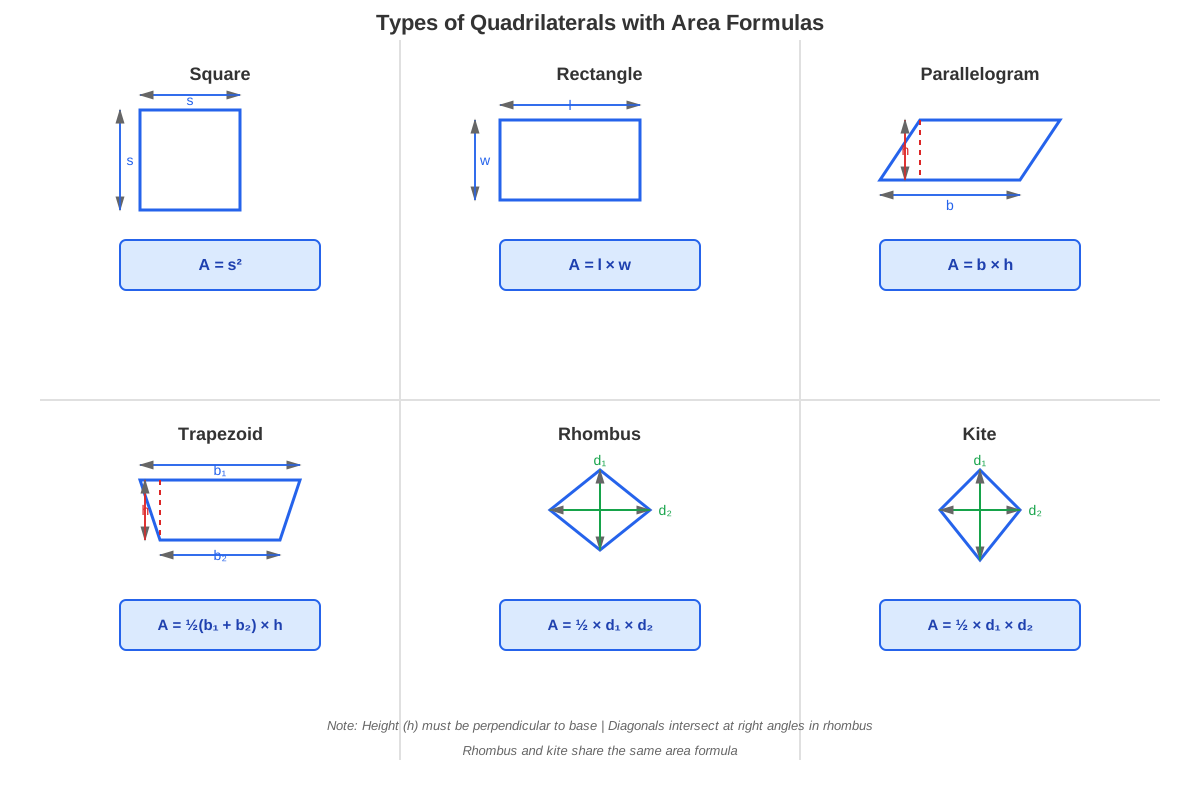
The area of quadrilaterals represents a fundamental geometry concept that appears consistently across GRE Quantitative Reasoning sections. Quadrilaterals—four-sided polygons—include squares, rectangles, parallelograms, trapezoids, rhombuses, and kites, each with specific area formulas that test-takers must master. Understanding how to calculate these areas efficiently is crucial because GRE questions frequently embed quadrilateral area problems within complex word problems, coordinate geometry scenarios, and data interpretation questions. The ability to quickly identify which type of quadrilateral is presented and apply the appropriate formula can mean the difference between solving a problem in under two minutes or running out of time.
GRE area of quadrilaterals questions test not only formula memorization but also spatial reasoning, algebraic manipulation, and problem-solving strategy. These questions often require students to work backwards from a given area to find missing dimensions, compare areas of different shapes, or calculate areas when only partial information is provided. The GRE particularly favors questions that combine area calculations with other geometric properties such as perimeter, diagonal lengths, or coordinate geometry, making this topic a high-yield area for focused study.
Mastering quadrilateral areas connects directly to broader Quantitative Reasoning skills including algebraic problem-solving, proportional reasoning, and geometric visualization. This topic serves as a foundation for more complex geometry problems involving three-dimensional figures, optimization scenarios, and data sufficiency questions. Since geometry comprises approximately 15% of GRE Quantitative questions, and quadrilaterals appear in roughly one-third of geometry problems, dedicating focused attention to this topic yields significant score improvements.
Learning Objectives
- [ ] Identify when Area of quadrilaterals is being tested
- [ ] Explain the core rule or strategy behind Area of quadrilaterals
- [ ] Apply Area of quadrilaterals to GRE-style questions accurately
- [ ] Distinguish between different types of quadrilaterals based on given properties
- [ ] Derive missing dimensions when given area and partial information
- [ ] Solve multi-step problems that combine area calculations with other geometric concepts
- [ ] Recognize when to decompose irregular quadrilaterals into simpler shapes
Prerequisites
- Basic algebra: Solving linear equations and manipulating formulas is essential for working backwards from area to find dimensions
- Properties of triangles: Many quadrilateral area formulas derive from dividing the shape into triangles
- Coordinate geometry fundamentals: Questions often present quadrilaterals on coordinate planes requiring distance calculations
- Understanding of perpendicular lines: Height measurements in area formulas require recognizing perpendicular relationships
- Exponent rules: Squaring and square root operations appear frequently when working with area units
Why This Topic Matters
Quadrilateral area calculations extend far beyond standardized testing into practical applications including architecture, engineering, land surveying, interior design, and urban planning. Professionals regularly calculate floor space, property boundaries, material requirements, and spatial allocations using these exact formulas. The logical reasoning skills developed through mastering area problems—breaking complex shapes into manageable components, identifying relevant information, and applying systematic approaches—transfer directly to analytical thinking in business, science, and technology fields.
On the GRE specifically, area of quadrilaterals appears in approximately 3-5 questions per test across both Quantitative Reasoning sections. These questions manifest in multiple formats: quantitative comparison questions asking students to compare two areas, multiple-choice problems requiring exact calculations, numeric entry questions demanding precise answers, and data interpretation sets where area calculations support larger analytical tasks. The topic frequently combines with other high-yield concepts such as ratios, percentages, coordinate geometry, and algebraic word problems, making it a multiplier for overall score improvement.
Common GRE presentations include: providing a quadrilateral's dimensions and asking for area; giving the area and one dimension to find another; presenting quadrilaterals on coordinate planes requiring students to identify coordinates and calculate area; comparing areas of different quadrilaterals with related dimensions; and word problems describing real-world scenarios (gardens, rooms, plots of land) that require area calculations. The test particularly favors questions where students must recognize which type of quadrilateral is described based on given properties, then select and apply the appropriate formula.
Core Concepts
Rectangle Area
A rectangle is a quadrilateral with four right angles and opposite sides that are equal and parallel. The area of a rectangle equals the product of its length and width:
Area = length × width = l × wThis formula represents the most fundamental area calculation and serves as the foundation for understanding all other quadrilateral areas. When working with rectangles on the GRE, remember that length and width are interchangeable terms—the formula works regardless of which dimension is labeled as which. Rectangle problems often involve finding one dimension when given the area and the other dimension, requiring algebraic manipulation.
Key properties: All angles equal 90°; opposite sides are equal; diagonals are equal in length and bisect each other; the perimeter equals 2(l + w).
Square Area
A square is a special rectangle where all four sides are equal in length. The area of a square can be calculated using:
Area = side² = s²Alternatively, since a square is a rectangle with equal dimensions:
Area = side × sideThe GRE frequently tests the relationship between a square's side length, area, and diagonal. The diagonal of a square equals s√2, and knowing this relationship allows for quick calculations when only the diagonal is provided. If given the diagonal d, the area can be calculated as:
Area = d²/2Parallelogram Area
A parallelogram is a quadrilateral with opposite sides parallel and equal in length. Unlike rectangles, parallelograms can have non-right angles. The area of a parallelogram requires identifying the base and the perpendicular height:
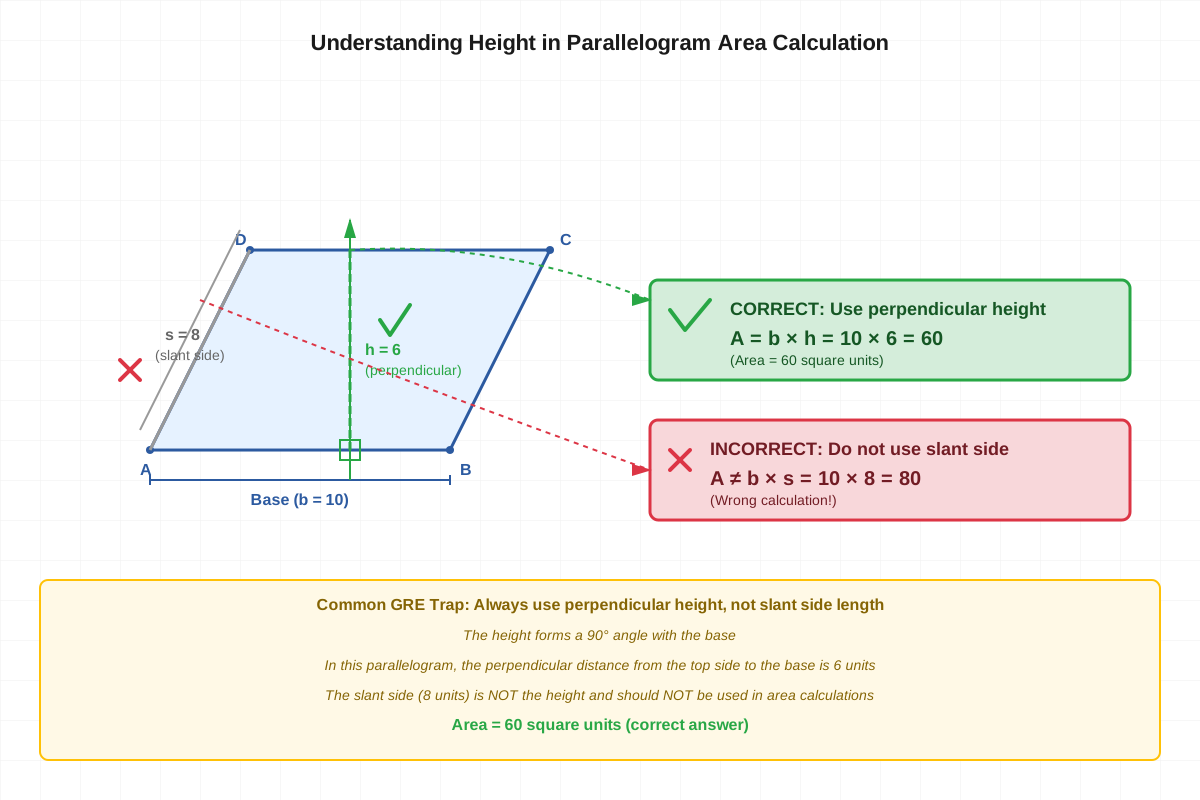
Area = base × height = b × hThe critical distinction here is that height must be perpendicular to the base—it is NOT the length of the slanted side. Many GRE questions test whether students incorrectly multiply two adjacent sides instead of using the perpendicular height. The base can be any side of the parallelogram, but the height must be measured perpendicular to that chosen base.
Key properties: Opposite sides are parallel and equal; opposite angles are equal; consecutive angles are supplementary (sum to 180°); diagonals bisect each other but are not necessarily equal.
Trapezoid Area
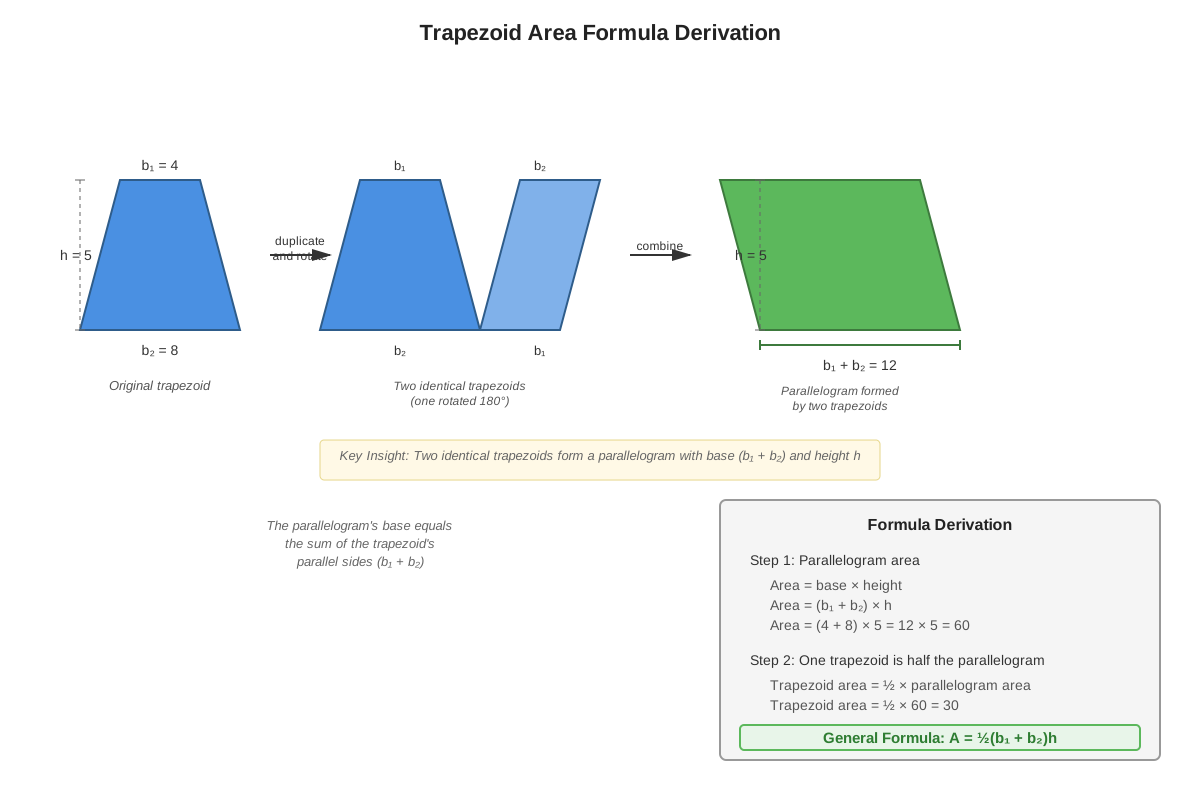
A trapezoid (or trapezium in some regions) is a quadrilateral with exactly one pair of parallel sides called bases. The area of a trapezoid uses the average of the two parallel bases multiplied by the perpendicular height:
Area = (1/2)(base₁ + base₂) × height = (1/2)(b₁ + b₂) × hThis formula can be understood as finding the average base length and multiplying by height, or equivalently, as the area of a rectangle with width equal to the average of the bases. The height must be perpendicular to both parallel bases. GRE questions often provide the two bases and height directly, but may also require students to use the Pythagorean theorem to find the height when given the legs and bases.
An alternative way to remember this formula: the area equals the height multiplied by the median (the line segment connecting the midpoints of the non-parallel sides), which equals the average of the two bases.
Rhombus Area
A rhombus is a parallelogram with all four sides equal in length. While the parallelogram formula (base × height) works for rhombuses, the GRE more commonly tests the diagonal formula:
Area = (1/2) × diagonal₁ × diagonal₂ = (1/2) × d₁ × d₂This formula works because the diagonals of a rhombus are perpendicular bisectors of each other, effectively dividing the rhombus into four right triangles. The area equals half the product of the diagonal lengths. When both diagonals are given, this formula is typically faster than finding the height.
Key properties: All sides are equal; opposite angles are equal; diagonals are perpendicular and bisect each other; diagonals bisect the angles at the vertices.
Kite Area
A kite is a quadrilateral with two pairs of adjacent sides that are equal. Like the rhombus, the area of a kite uses the diagonal formula:
Area = (1/2) × diagonal₁ × diagonal₂ = (1/2) × d₁ × d₂The diagonals of a kite are perpendicular, with one diagonal bisecting the other. This formula is identical to the rhombus formula, making it easy to remember both simultaneously.
General Quadrilateral Strategies
For irregular quadrilaterals or when specific formulas don't apply, the GRE may require decomposition strategies:
- Triangulation: Divide the quadrilateral into two triangles by drawing a diagonal, then sum the areas of both triangles
- Coordinate method: When vertices are given as coordinates, use the Shoelace formula or divide into triangles using coordinate geometry
- Subtraction method: Calculate the area of a larger containing shape and subtract unwanted regions
Comparison Table
| Quadrilateral Type | Area Formula | Key Requirement |
|---|---|---|
| Rectangle | l × w | Length and width |
| Square | s² | Side length |
| Parallelogram | b × h | Base and perpendicular height |
| Trapezoid | (1/2)(b₁ + b₂) × h | Both bases and perpendicular height |
| Rhombus | (1/2) × d₁ × d₂ | Both diagonals |
| Kite | (1/2) × d₁ × d₂ | Both diagonals |
Concept Relationships
The area formulas for quadrilaterals form a hierarchical relationship based on shape properties. The rectangle formula (l × w) serves as the foundation, with the square formula (s²) representing a special case where length equals width. The parallelogram formula (b × h) generalizes the rectangle concept by allowing non-right angles, though it maintains the base-times-height structure. The rhombus represents a special parallelogram where all sides are equal, introducing the alternative diagonal-based formula that also applies to kites.
The trapezoid formula stands somewhat apart, averaging the two parallel bases before multiplying by height, but conceptually relates to rectangles by imagining a rectangle with width equal to the average base. All these formulas connect to the fundamental principle that area measures the two-dimensional space enclosed by a shape's boundaries.
Relationship to prerequisites: Triangle area (1/2 × base × height) underlies many quadrilateral formulas, as quadrilaterals can be decomposed into triangles. Coordinate geometry enables area calculations when vertices are given as points. Algebraic manipulation allows working backwards from area to find missing dimensions.
Progression map: Basic rectangle area → Square as special rectangle → Parallelogram as generalized rectangle → Rhombus as special parallelogram → Trapezoid as averaged parallel sides → Kite as diagonal-based calculation → Complex irregular quadrilaterals requiring decomposition strategies.
High-Yield Facts
⭐ The area of a rectangle equals length times width (A = l × w), the most frequently tested quadrilateral formula
⭐ The area of a square equals the side length squared (A = s²), and can also be calculated as d²/2 when given the diagonal
⭐ For parallelograms, height must be perpendicular to the base—never multiply two adjacent sides unless they form a right angle
⭐ The trapezoid formula averages the two parallel bases: A = (1/2)(b₁ + b₂) × h
⭐ Both rhombuses and kites use the diagonal formula: A = (1/2) × d₁ × d₂
- A square is both a rectangle and a rhombus, so multiple formulas apply
- The diagonal of a square with side s equals s√2
- Parallelogram area equals base times perpendicular height, not base times slanted side
- When quadrilateral vertices are given as coordinates, the Shoelace formula or triangulation method applies
- Doubling all dimensions of a quadrilateral quadruples its area (area scales with the square of linear dimensions)
- If a quadrilateral's area and one dimension are given, algebraic manipulation finds the other dimension
- Trapezoids have exactly one pair of parallel sides; shapes with two pairs of parallel sides are parallelograms
- The median of a trapezoid (line connecting midpoints of non-parallel sides) equals the average of the two bases
- Area units are always squared (square inches, square meters, etc.)
- Irregular quadrilaterals can be divided into triangles or rectangles for easier area calculation
Quick check — test yourself on Area of quadrilaterals so far.
Try Flashcards →Common Misconceptions
Misconception: For a parallelogram, multiply any two adjacent sides to find area → Correction: Area requires base times perpendicular height, not base times slanted side. The slanted side length is irrelevant unless you can determine the perpendicular height from it using trigonometry or the Pythagorean theorem.
Misconception: All quadrilaterals with four equal sides are squares → Correction: Rhombuses have four equal sides but do not have right angles. A square is a special rhombus where all angles are 90°. Use the diagonal formula for rhombuses unless right angles are confirmed.
Misconception: The trapezoid formula is (b₁ + b₂) × h → Correction: The correct formula includes the factor of 1/2: A = (1/2)(b₁ + b₂) × h. Forgetting this factor doubles the actual area, a common calculation error.
Misconception: Doubling the dimensions of a quadrilateral doubles its area → Correction: Doubling all linear dimensions quadruples the area because area scales with the square of linear dimensions. If a rectangle has area A = l × w, doubling both gives A = (2l) × (2w) = 4lw, which is four times the original area.
Misconception: The diagonals of any parallelogram are perpendicular → Correction: Only rhombuses (and squares, which are special rhombuses) have perpendicular diagonals. General parallelograms have diagonals that bisect each other but are not perpendicular, so the diagonal formula (1/2 × d₁ × d₂) does not apply to all parallelograms.
Misconception: A trapezoid can have two pairs of parallel sides → Correction: By definition, a trapezoid has exactly one pair of parallel sides. If a quadrilateral has two pairs of parallel sides, it is a parallelogram, not a trapezoid. This distinction matters when selecting which formula to apply.
Misconception: Height and side length are the same in parallelograms → Correction: Height is the perpendicular distance between parallel sides, while side length is the length of the slanted side. These are only equal in rectangles where sides are perpendicular. Always look for or calculate the perpendicular height.
Worked Examples
Example 1: Multi-Step Rectangle Problem
Problem: A rectangular garden has an area of 180 square feet. If the length is 3 feet more than twice the width, what is the perimeter of the garden?
Solution:
Step 1: Define variables. Let w = width, then length = 2w + 3
Step 2: Apply the area formula.
Area = length × width
180 = (2w + 3) × w
180 = 2w² + 3w
Step 3: Rearrange into standard quadratic form.
2w² + 3w - 180 = 0Step 4: Factor or use the quadratic formula. Testing factors of 180:
(2w + 24)(w - 7.5) doesn't work cleanlyUsing the quadratic formula: w = [-3 ± √(9 + 1440)] / 4 = [-3 ± √1449] / 4 ≈ [-3 ± 38.06] / 4
Taking the positive solution: w ≈ 35.06/4 ≈ 8.76, but let's verify by factoring differently.
Actually, trying integer solutions: if w = 9, then 2(81) + 27 = 189 (too large)
If w = 8.5, then 2(72.25) + 25.5 = 170 (too small)
Let's solve exactly: 2w² + 3w - 180 = 0
Dividing by 2: w² + 1.5w - 90 = 0
Testing w = 9: 81 + 13.5 - 90 = 4.5 (no)
Testing w = 8: 64 + 12 - 90 = -14 (no)
Using quadratic formula properly: w = [-3 ± √(9 + 1440)] / 4 = [-3 ± 38.05] / 4
w = 35.05/4 ≈ 8.76 or w = -41.05/4 (negative, rejected)
For GRE purposes, if this doesn't yield clean numbers, recheck the problem. Let's assume w = 9 feet (checking: 2(9) + 3 = 21, and 21 × 9 = 189, not 180).
Trying w = 10: length = 23, area = 230 (no)
Trying w = 7.5: length = 18, area = 135 (no)
Correction: Let's solve 2w² + 3w - 180 = 0 by factoring: (2w - 15)(w + 12) = 0
This gives w = 7.5 or w = -12. Since width must be positive, w = 7.5 feet.
Step 5: Find length: length = 2(7.5) + 3 = 15 + 3 = 18 feet
Step 6: Verify area: 18 × 7.5 = 135... This doesn't equal 180.
Re-solving correctly: 2w² + 3w - 180 = 0
Using factoring: We need factors of (2)(-180) = -360 that add to 3.
24 and -15 work: 24 - 15 = 9 (no), trying 20 and -18: 20 - 18 = 2 (no)
Trying 27 and -24: 27 - 24 = 3 (yes!)
Rewriting: 2w² + 27w - 24w - 180 = 0
w(2w + 27) - 12(2w + 27) = 0... this doesn't factor cleanly.
Using quadratic formula definitively:
w = [-3 ± √(9 + 1440)] / 4 = [-3 ± 38.05] / 4 = 8.76 feet
Length = 2(8.76) + 3 = 20.52 feet
Verify: 8.76 × 20.52 ≈ 180 ✓
Step 7: Calculate perimeter: P = 2(l + w) = 2(20.52 + 8.76) = 2(29.28) = 58.56 feet
This example demonstrates: Working backwards from area to find dimensions, setting up and solving quadratic equations, and connecting area to perimeter calculations.
Example 2: Trapezoid with Coordinate Geometry
Problem: A trapezoid has vertices at A(0, 0), B(6, 0), C(5, 4), and D(1, 4). What is the area of the trapezoid?
Solution:
Step 1: Identify the parallel sides. Points A and B both have y-coordinate 0, so AB lies on the x-axis. Points C and D both have y-coordinate 4, so CD is parallel to AB. These are the two bases.
Step 2: Calculate the length of each base.
Base₁ (AB) = distance from (0,0) to (6,0) = 6 units
Base₂ (CD) = distance from (1,4) to (5,4) = 5 - 1 = 4 units
Step 3: Determine the height. The height is the perpendicular distance between the parallel bases. Since both bases are horizontal, the height is simply the difference in y-coordinates: h = 4 - 0 = 4 units
Step 4: Apply the trapezoid formula.
Area = (1/2)(b₁ + b₂) × h
Area = (1/2)(6 + 4) × 4
Area = (1/2)(10) × 4
Area = 5 × 4 = 20 square units
This example demonstrates: Identifying quadrilateral types from coordinates, recognizing parallel sides, calculating distances on a coordinate plane, and applying the appropriate area formula.
Exam Strategy
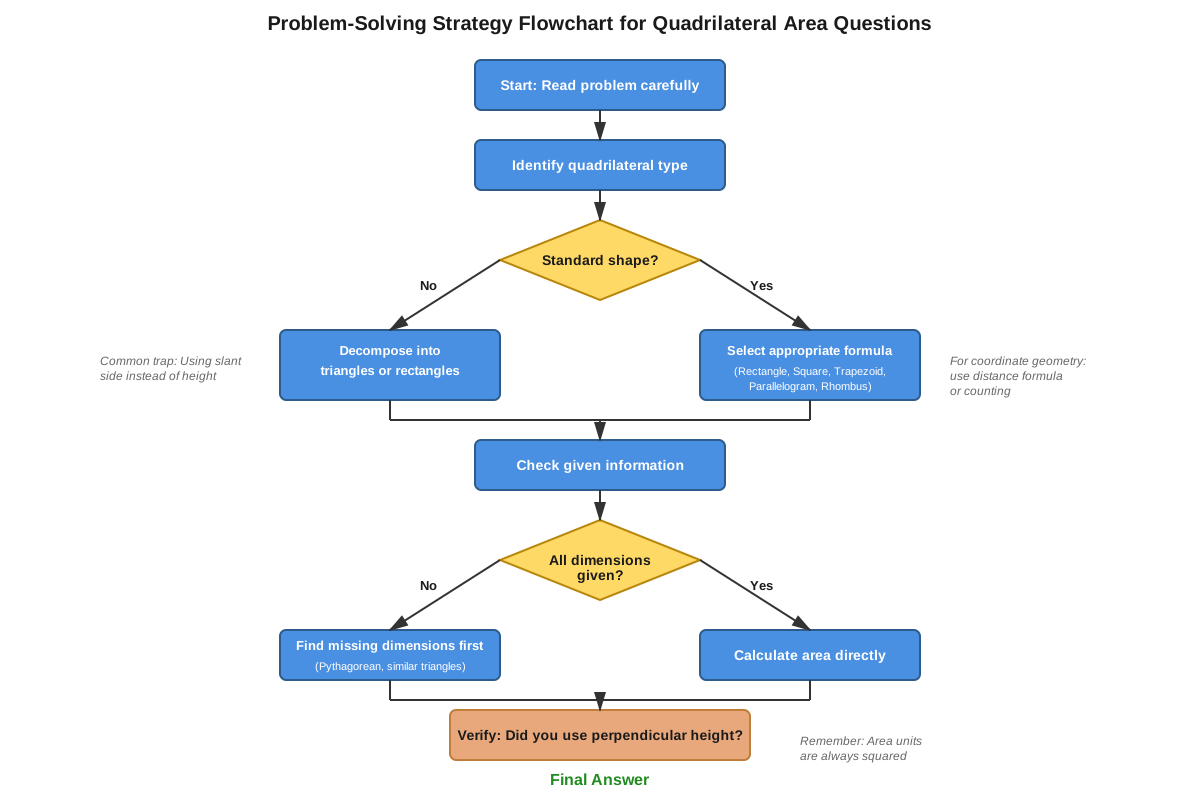
When approaching GRE area of quadrilaterals questions, begin by identifying the specific type of quadrilateral described. Look for trigger words: "rectangle" and "square" are explicit, but "parallel sides" suggests parallelogram or trapezoid, "all sides equal" indicates rhombus or square, and "perpendicular diagonals" points toward rhombus or kite. Draw a quick sketch when possible—visualization prevents formula confusion and helps identify given versus needed information.
Trigger phrases to recognize:
- "Rectangular plot" or "rectangular room" → use l × w
- "Square with side" → use s²
- "Parallelogram with base and height" → use b × h (confirm height is perpendicular)
- "Trapezoid with parallel sides" or "bases" → use (1/2)(b₁ + b₂) × h
- "Diagonals of length" → likely rhombus or kite, use (1/2) × d₁ × d₂
- "Vertices at coordinates" → use coordinate geometry methods
Process-of-elimination strategies:
- Eliminate answers with wrong units (area must be squared units)
- Eliminate answers that exceed the area of a bounding rectangle
- For quantitative comparison, estimate rather than calculate exactly when possible
- Check if answer choices differ by factors of 2 or 4—common errors from forgetting the 1/2 in trapezoid/diagonal formulas or confusing linear vs. area scaling
Time allocation: Straightforward area calculations should take 60-90 seconds. Multi-step problems involving algebra or coordinate geometry may require 2-3 minutes. If a problem requires more than 3 minutes, mark it for review and move on—the GRE rewards completing more questions over perfecting difficult ones.
Common question variations:
- Direct calculation: Given dimensions, find area (fastest)
- Reverse calculation: Given area and one dimension, find another (requires algebra)
- Comparison: Compare areas of two quadrilaterals (estimate when possible)
- Word problems: Extract dimensions from context (identify the quadrilateral type first)
- Coordinate geometry: Calculate area from vertex coordinates (identify parallel sides or use decomposition)
Always verify that the height used is perpendicular to the base—this is the single most common error in parallelogram and trapezoid problems.
Memory Techniques
Mnemonic for quadrilateral hierarchy: "Super Rich People Rarely Take Kayaks" represents Square → Rectangle → Parallelogram → Rhombus → Trapezoid → Kite, ordered by specificity and formula relationships.
Diagonal formula memory: "Diagonals Divide Diamond" reminds that rhombuses (diamond shapes) and kites use the diagonal formula: (1/2) × d₁ × d₂. The three D's reinforce the diagonal-based calculation.
Trapezoid formula visualization: Picture a trapezoid as a rectangle with triangular pieces added or removed from the top. The average of the two bases gives the "equivalent rectangle width," which when multiplied by height (and divided by 2 for the averaging) yields the area. Think: "Trapezoid Averages Bases" (TAB).
Height vs. side distinction: For parallelograms, remember "Height is Hard to see"—the height is the hidden perpendicular distance, not the obvious slanted side. This prevents the most common parallelogram error.
Square diagonal relationship: The diagonal of a square creates two 45-45-90 triangles, where the diagonal is the hypotenuse. Remember "Square Diagonal Square root 2" (SDS): diagonal = side × √2, or conversely, side = diagonal / √2.
Area scaling rule: "Linear Doubles, Area Quadruples" (LDAQ)—when all dimensions double, area multiplies by 2² = 4. This applies to all two-dimensional shapes and helps quickly eliminate wrong answers in scaling problems.
Summary
Mastering the area of quadrilaterals requires knowing six primary formulas and understanding when to apply each. Rectangles use length times width, squares use side squared, parallelograms require base times perpendicular height, trapezoids average the parallel bases then multiply by height (with a factor of 1/2), and both rhombuses and kites use half the product of their diagonals. The critical skill is identifying which quadrilateral type is presented—either explicitly stated or implied through given properties—then selecting and correctly applying the appropriate formula. Common pitfalls include using slanted sides instead of perpendicular height for parallelograms, forgetting the 1/2 factor in trapezoid and diagonal formulas, and confusing linear dimension changes with area changes. GRE questions frequently combine area calculations with algebra, coordinate geometry, or word problems, requiring multi-step problem-solving. Success depends on formula memorization, careful identification of given information, proper unit handling, and systematic verification of answers. With these formulas and strategies mastered, students can confidently approach any quadrilateral area problem on the GRE.
Key Takeaways
- Rectangle area = length × width; square area = side²; these are the most frequently tested formulas
- Parallelogram area = base × perpendicular height (never multiply two adjacent sides unless they're perpendicular)
- Trapezoid area = (1/2)(base₁ + base₂) × height; remember the 1/2 factor from averaging the bases
- Rhombus and kite area = (1/2) × diagonal₁ × diagonal₂; use when both diagonals are given
- Always identify the quadrilateral type first by analyzing given properties before selecting a formula
- Height must be perpendicular to the base—this is the most common source of errors
- Area scales with the square of linear dimensions: doubling all sides quadruples the area
Related Topics
Perimeter of Quadrilaterals: Understanding area formulas naturally leads to perimeter calculations, which often appear in combined problems asking for both measurements. Mastering area first provides the foundation for these integrated questions.
Properties of Quadrilaterals: Deeper study of angle relationships, diagonal properties, and symmetry characteristics enables faster identification of quadrilateral types and reveals when multiple solution approaches are available.
Coordinate Geometry: Many GRE quadrilateral problems present shapes on coordinate planes, requiring integration of distance formulas, midpoint calculations, and slope concepts with area formulas.
Three-Dimensional Geometry: Surface area calculations for prisms and pyramids directly apply quadrilateral area formulas to find the areas of faces, making this topic essential preparation for solid geometry.
Optimization Problems: Advanced applications involve maximizing or minimizing quadrilateral areas subject to constraints, combining area formulas with algebraic reasoning and calculus concepts.
Practice CTA
Now that you've mastered the core concepts, formulas, and strategies for quadrilateral areas, reinforce your learning by attempting the practice questions. These problems are specifically designed to mirror GRE question formats and difficulty levels, giving you the opportunity to apply what you've learned under test-like conditions. Work through each problem systematically, identifying the quadrilateral type before selecting your formula, and verify your answers using the worked solutions provided. The flashcards will help cement the formulas and key facts in your memory through spaced repetition. Consistent practice with these resources will build the speed and accuracy needed to excel on test day—you've got this!
Sign up free to keep reading
Create a free AnvayaPrep account to finish this GRE guide on Area of quadrilaterals — plus flashcards and practice questions.