Overview
Perimeter is one of the foundational concepts in GRE Quantitative Reasoning geometry questions, appearing regularly across multiple question formats including Quantitative Comparison, Multiple Choice, and Numeric Entry problems. Understanding perimeter—the total distance around the boundary of a two-dimensional shape—is essential not only as a standalone concept but also as a building block for more complex geometric problems involving area, coordinate geometry, and optimization. The GRE frequently tests perimeter in combination with other geometric properties, requiring students to demonstrate both computational accuracy and conceptual flexibility.
Mastering gre perimeter questions requires more than memorizing formulas; it demands the ability to recognize when perimeter is being tested (sometimes implicitly), apply appropriate strategies for different shapes, and manipulate algebraic expressions when dimensions are given as variables. The GRE often presents perimeter problems that require multi-step reasoning, such as finding missing side lengths, working with composite figures, or determining relationships between perimeter and other measurements. These questions typically appear in the medium-to-hard difficulty range and can significantly impact your score when handled efficiently.
Within the broader Quantitative Reasoning framework, perimeter connects directly to concepts of measurement, algebraic manipulation, and spatial reasoning. It serves as a gateway to understanding more complex geometric relationships and frequently appears alongside area problems, where students must distinguish between linear measurements (perimeter) and square measurements (area). Strong perimeter skills also support success in coordinate geometry problems, where calculating distances between points becomes essential for determining the boundaries of shapes plotted on the xy-plane.
Learning Objectives
- [ ] Identify when Perimeter is being tested in GRE questions, including implicit references
- [ ] Explain the core rule or strategy behind Perimeter for various geometric shapes
- [ ] Apply Perimeter formulas to GRE-style questions accurately and efficiently
- [ ] Calculate perimeter for composite figures by breaking them into component shapes
- [ ] Solve for unknown dimensions when given perimeter and other constraints
- [ ] Distinguish between perimeter and area in problems that reference both concepts
- [ ] Apply perimeter concepts to coordinate geometry problems involving distance
Prerequisites
- Basic arithmetic operations: Essential for adding side lengths and performing calculations with fractions and decimals in perimeter problems
- Algebraic manipulation: Required for solving equations when perimeter is given and dimensions must be found, or when working with variable expressions
- Properties of basic geometric shapes: Understanding of triangles, rectangles, squares, and circles enables recognition of which perimeter formula to apply
- Understanding of units and measurement: Critical for maintaining consistency in calculations and interpreting answer choices correctly
Why This Topic Matters
Perimeter appears in approximately 10-15% of GRE Quantitative Reasoning geometry questions, making it a high-yield topic that directly impacts your score. Beyond its standalone appearance, perimeter concepts integrate into more complex problems involving optimization (finding maximum or minimum perimeters), coordinate geometry (calculating distances to determine boundaries), and word problems requiring spatial reasoning. The ability to quickly calculate perimeter and recognize its relationship to other geometric properties separates high-scoring test-takers from average performers.
In real-world applications, perimeter calculations are fundamental to fields ranging from architecture and construction (determining material requirements for borders and fencing) to computer graphics (defining object boundaries) and urban planning (calculating property boundaries). This practical relevance means that GRE perimeter questions often appear in word problem contexts that simulate real scenarios, requiring students to translate verbal descriptions into mathematical models.
On the GRE, perimeter most commonly appears in these question formats: Quantitative Comparison questions asking you to compare perimeters of different shapes or the same shape under different conditions; Multiple Choice problems requiring calculation of perimeter given certain dimensions or constraints; word problems where perimeter must be extracted from a scenario description; and coordinate geometry questions where perimeter must be calculated from plotted points. The test frequently combines perimeter with other concepts, such as asking for the ratio of perimeter to area, or presenting optimization problems where you must maximize area given a fixed perimeter.
Core Concepts
Definition and Fundamental Formula
The perimeter of a two-dimensional figure is the total distance around its outer boundary. For any polygon, the perimeter equals the sum of all side lengths. This fundamental principle applies universally, regardless of shape complexity:
Perimeter = sum of all side lengthsFor irregular polygons with sides of lengths s₁, s₂, s₃, ..., sₙ:
P = s₁ + s₂ + s₃ + ... + sₙThis additive property is the foundation for all perimeter calculations and becomes particularly important when working with composite figures or shapes with missing dimensions that must be inferred.
Perimeter Formulas for Common Shapes
Different geometric shapes have specific perimeter formulas derived from their properties. Memorizing these formulas and understanding when to apply each is essential for GRE success.
| Shape | Formula | Key Variables |
|---|---|---|
| Rectangle | P = 2l + 2w or P = 2(l + w) | l = length, w = width |
| Square | P = 4s | s = side length |
| Triangle | P = a + b + c | a, b, c = side lengths |
| Equilateral Triangle | P = 3s | s = side length |
| Regular Polygon | P = n × s | n = number of sides, s = side length |
| Circle (Circumference) | C = 2πr or C = πd | r = radius, d = diameter |
Rectangle Perimeter
For rectangles, the perimeter formula P = 2l + 2w reflects the fact that opposite sides are equal in length. The GRE frequently presents rectangle problems where:
- Both dimensions are given directly
- One dimension and the perimeter are given, requiring you to solve for the other dimension
- The relationship between length and width is described algebraically (e.g., "length is 3 more than twice the width")
When solving for an unknown dimension, rearrange the formula algebraically:
If P = 2l + 2w, then l = (P - 2w)/2 or w = (P - 2l)/2Square Perimeter
Squares, being special rectangles with all sides equal, have the simplified formula P = 4s. This relationship creates a direct proportionality between side length and perimeter, which the GRE exploits in comparison questions. Key relationships to remember:
- If the side length doubles, the perimeter doubles
- If the side length is multiplied by k, the perimeter is multiplied by k
- Given perimeter, side length equals P/4
Triangle Perimeter
Triangle perimeter always equals the sum of all three sides: P = a + b + c. The GRE tests this concept by:
- Providing all three side lengths for direct calculation
- Giving two sides and requiring use of the triangle inequality theorem to determine possible perimeters
- Presenting special triangles (isosceles, equilateral) where side relationships reduce unknowns
- Using the Pythagorean theorem in right triangles to find a missing side before calculating perimeter
For equilateral triangles, where all sides are equal, the formula simplifies to P = 3s, creating direct proportionality similar to squares.
Circle Circumference
The perimeter of a circle is called its circumference and follows the formula C = 2πr (using radius) or C = πd (using diameter). Key points for GRE questions:
- π is typically approximated as 3.14 or left as π in exact answers
- Diameter equals twice the radius: d = 2r
- Semicircle perimeter includes the curved portion (πr) plus the diameter (2r): P = πr + 2r
- Arc length (portion of circumference) equals (θ/360°) × 2πr, where θ is the central angle in degrees
Composite Figures
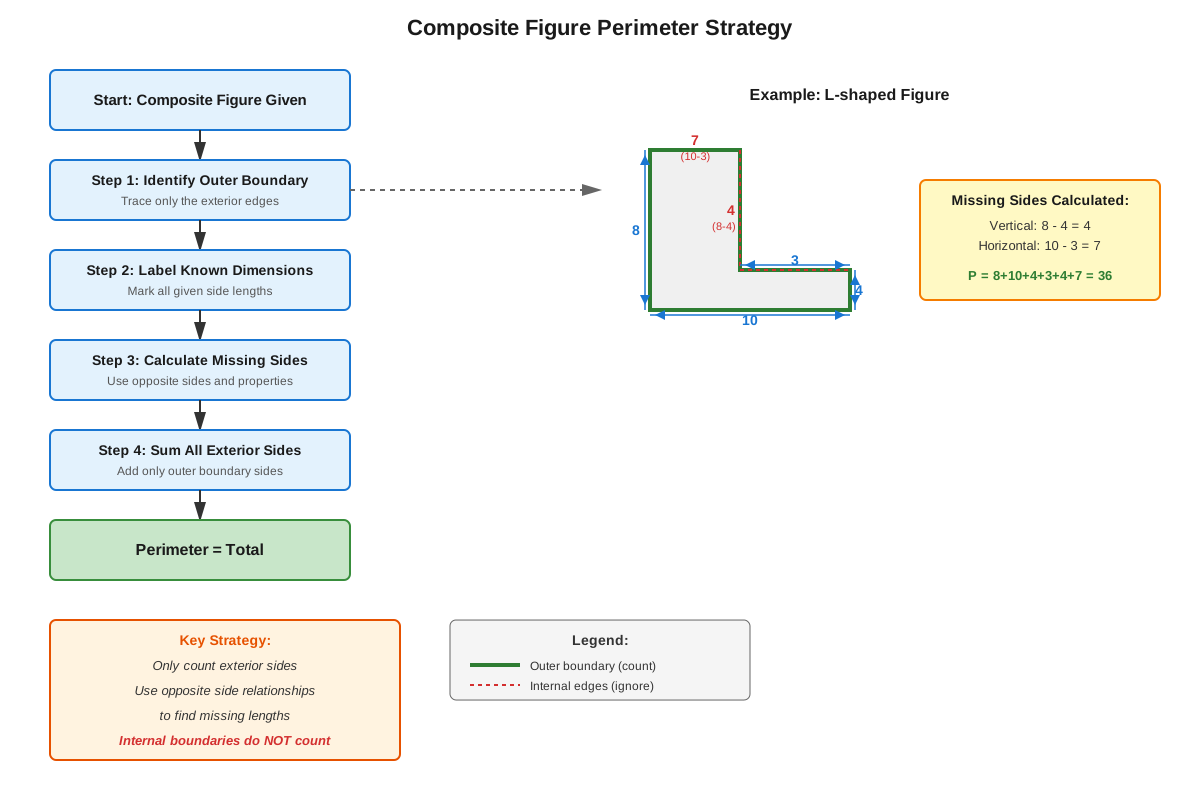
Composite figures consist of multiple basic shapes combined together. Calculating their perimeter requires identifying which segments form the outer boundary. Common strategies include:
- Identify the outer boundary: Only sides on the perimeter count; internal segments where shapes join do not contribute
- Break into components: Decompose the figure into recognizable shapes
- Account for shared sides: Subtract internal boundaries from the total
- Find missing dimensions: Use properties of the component shapes to determine unlabeled sides
For example, an L-shaped figure formed by two rectangles requires identifying all six outer sides, using the fact that opposite sides of rectangles are equal to find missing dimensions.
Perimeter in Coordinate Geometry
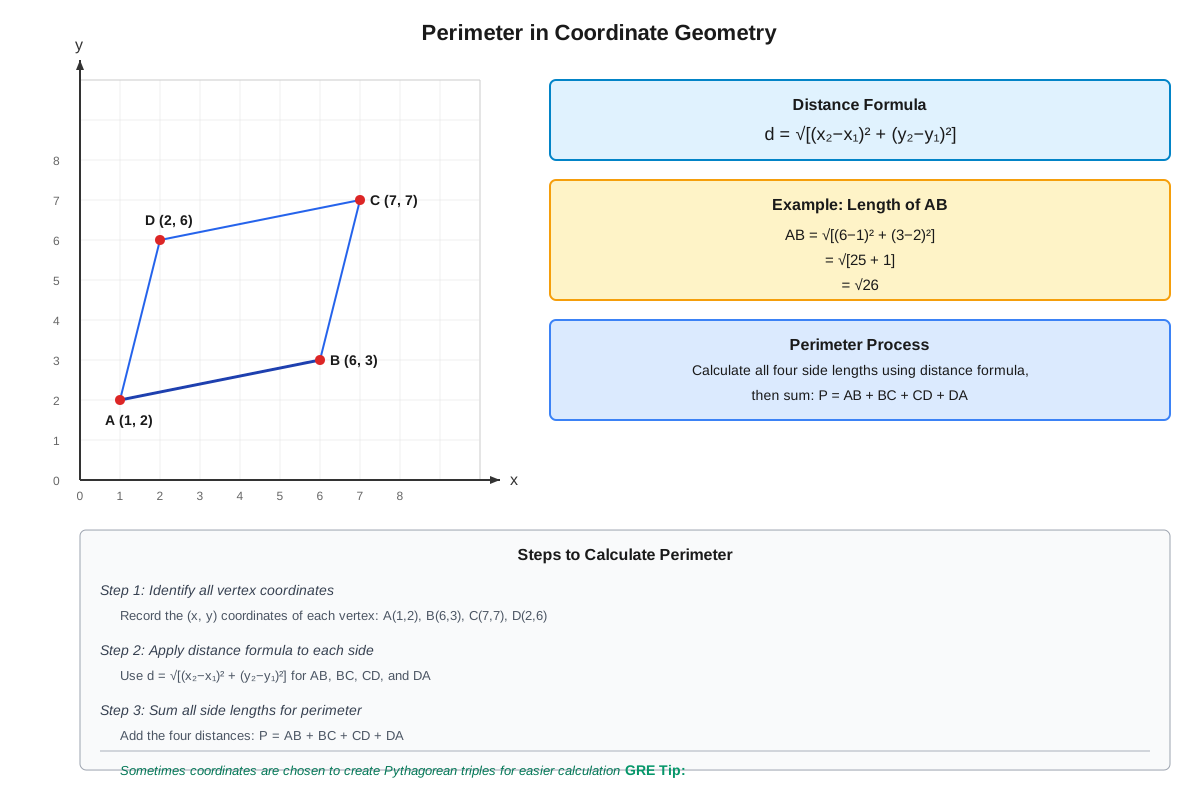
When shapes are plotted on the coordinate plane, perimeter calculation requires finding distances between vertices using the distance formula:
d = √[(x₂ - x₁)² + (y₂ - y₁)²]For a polygon with vertices at known coordinates:
- Calculate the distance between each consecutive pair of vertices
- Sum all distances to find the total perimeter
Special cases simplify calculations:
- Horizontal segments: distance = |x₂ - x₁|
- Vertical segments: distance = |y₂ - y₁|
- Diagonal segments: require the full distance formula
Perimeter vs. Area Relationships
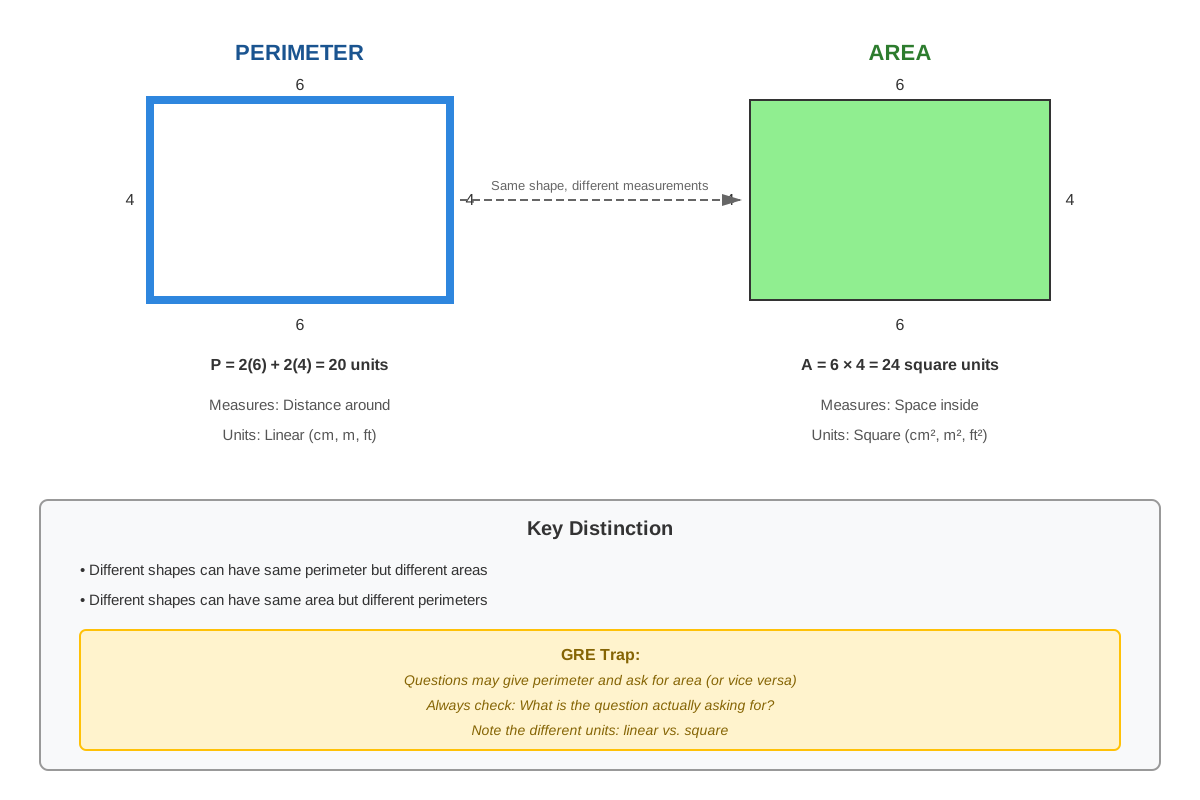
A critical concept the GRE tests is the independence of perimeter and area. Two shapes can have:
- The same perimeter but different areas
- The same area but different perimeters
For example, among all rectangles with a fixed perimeter, the square has the maximum area. Conversely, among all rectangles with a fixed area, the square has the minimum perimeter. Understanding this relationship prevents common errors in comparison questions.
Concept Relationships
The perimeter concepts form an interconnected system where understanding one element strengthens others. The fundamental definition (sum of all sides) → serves as the foundation for → specific shape formulas (rectangle, square, triangle, circle), which are simply applications of the general principle to shapes with known properties.
Basic shape perimeters → combine to solve → composite figure problems, where the strategy involves decomposing complex shapes into familiar components. This decomposition skill → connects to → coordinate geometry applications, where the distance formula provides the tool for finding side lengths of shapes plotted on the xy-plane.
The relationship between perimeter and other measurements (particularly area) → leads to → optimization problems, where constraints on one measurement affect the other. Understanding that perimeter and area are independent → prevents → common misconceptions about their relationship.
Algebraic manipulation skills → enable solving → problems with unknown dimensions, where perimeter is given and side lengths must be found. This connects back to prerequisite algebra knowledge and forward to more complex geometric proofs and derivations.
Quick check — test yourself on Perimeter so far.
Try Flashcards →High-Yield Facts
⭐ The perimeter of any polygon equals the sum of all its side lengths, regardless of shape complexity
⭐ For rectangles: P = 2l + 2w; for squares: P = 4s; these are the most frequently tested formulas on the GRE
⭐ Circle circumference formulas: C = 2πr = πd; semicircle perimeter includes both the arc and the diameter
⭐ Perimeter and area are independent—shapes with equal perimeters can have different areas and vice versa
⭐ In composite figures, only the outer boundary contributes to perimeter; internal segments where shapes join do not count
- For equilateral triangles, P = 3s; for regular n-sided polygons, P = n × s
- When dimensions are scaled by factor k, perimeter is also scaled by factor k (linear relationship)
- In coordinate geometry, use the distance formula √[(x₂ - x₁)² + (y₂ - y₁)²] to find side lengths before calculating perimeter
- The triangle inequality theorem (sum of any two sides must exceed the third) constrains possible perimeters for triangles
- Among all rectangles with the same perimeter, the square has the maximum area; among all rectangles with the same area, the square has the minimum perimeter
- Arc length (portion of circumference) = (central angle/360°) × 2πr for angles measured in degrees
- For right triangles, use the Pythagorean theorem (a² + b² = c²) to find missing sides before calculating perimeter
Common Misconceptions
Misconception: Perimeter and area are directly proportional—if one doubles, the other doubles.
Correction: Perimeter and area are independent measurements. Doubling the perimeter does not double the area. For example, a 2×2 square has perimeter 8 and area 4, while a 1×3 rectangle has perimeter 8 but area only 3.
Misconception: The perimeter of a composite figure equals the sum of the perimeters of its component shapes.
Correction: Only the outer boundary counts toward perimeter. When shapes are joined, the shared internal boundaries must be subtracted. For example, two squares joined side-to-side have perimeter less than 4s + 4s because the shared side doesn't contribute to the outer boundary.
Misconception: A semicircle's perimeter is half the circumference of the full circle.
Correction: A semicircle's perimeter includes both the curved portion (πr, which is half the circumference) AND the straight diameter (2r), giving total perimeter πr + 2r, not just πr.
Misconception: In coordinate geometry, the perimeter of a rectangle can be found by adding the differences in x-coordinates and y-coordinates.
Correction: You must identify opposite sides correctly. For a rectangle with vertices at (x₁,y₁), (x₂,y₁), (x₂,y₂), (x₁,y₂), the perimeter is 2|x₂-x₁| + 2|y₂-y₁|, accounting for both pairs of opposite sides.
Misconception: All shapes with four sides have perimeter formula P = 2l + 2w.
Correction: The formula P = 2l + 2w applies only to rectangles (and squares as a special case). General quadrilaterals require adding all four individual side lengths, which may all be different.
Misconception: When a problem mentions "distance around" or "border," it might be referring to area.
Correction: "Distance around," "border," "fence," "frame," and "boundary" are trigger words specifically indicating perimeter, not area. Area refers to the space enclosed within the boundary.
Worked Examples
Example 1: Rectangle with Algebraic Relationship
Problem: A rectangle has a length that is 5 meters more than twice its width. If the perimeter of the rectangle is 46 meters, what is the width of the rectangle?
Solution:
Step 1: Define variables based on the problem description.
- Let w = width
- Then length l = 2w + 5 (five more than twice the width)
Step 2: Apply the perimeter formula for rectangles.
P = 2l + 2w
46 = 2(2w + 5) + 2w
Step 3: Solve the equation algebraically.
46 = 4w + 10 + 2w
46 = 6w + 10
36 = 6w
w = 6
Step 4: Verify the answer.
- Width = 6 meters
- Length = 2(6) + 5 = 17 meters
- Perimeter = 2(17) + 2(6) = 34 + 12 = 46 ✓
Answer: The width is 6 meters.
Connection to Learning Objectives: This problem demonstrates identifying perimeter testing (recognizing the "perimeter is 46 meters" statement), explaining the core strategy (setting up algebraic equations based on the rectangle formula), and applying the formula accurately to solve for an unknown dimension.
Example 2: Composite Figure Perimeter
Problem: A figure is formed by placing a semicircle on top of a rectangle. The rectangle has dimensions 8 cm by 6 cm, with the semicircle's diameter equal to the rectangle's width (8 cm). What is the perimeter of the entire figure? (Use π = 3.14)
Solution:
Step 1: Identify which segments form the outer boundary.
- The perimeter includes: two long sides of the rectangle (6 cm each), one short side of the rectangle (8 cm bottom), and the semicircular arc (NOT the diameter, as it's internal)
Step 2: Calculate the semicircle's arc length.
- Diameter = 8 cm, so radius = 4 cm
- Full circle circumference = 2πr = 2(3.14)(4) = 25.12 cm
- Semicircle arc = 25.12/2 = 12.56 cm
Step 3: Sum all outer boundary segments.
P = 6 + 6 + 8 + 12.56 = 32.56 cmStep 4: Verify by checking each component.
- Left side of rectangle: 6 cm ✓
- Right side of rectangle: 6 cm ✓
- Bottom of rectangle: 8 cm ✓
- Semicircular arc: 12.56 cm ✓
- Top diameter of rectangle: NOT included (internal boundary) ✓
Answer: The perimeter is 32.56 cm.
Connection to Learning Objectives: This problem requires identifying perimeter in a composite figure context, applying the strategy of determining which segments form the outer boundary, and accurately calculating both straight-line and curved perimeter components.
Exam Strategy
Recognizing Perimeter Questions
Watch for these trigger words and phrases that signal perimeter is being tested:
- "Distance around"
- "Border," "boundary," or "edge"
- "Fencing" or "fence required"
- "Frame" or "trim"
- "Perimeter" (explicit)
- "Circumference" (for circles)
- "How far around"
Exam Tip: When a problem mentions both dimensions and asks about "surrounding" or "enclosing," it's almost certainly testing perimeter, not area.
Systematic Approach to Perimeter Problems
- Identify the shape(s): Determine whether you're working with a single basic shape, a composite figure, or a shape in coordinate geometry
- Select the appropriate formula: Match the shape to its perimeter formula
- Identify given information: Note which dimensions are provided and which must be found
- Solve for unknowns if necessary: Use geometric properties, the Pythagorean theorem, or algebraic relationships to find missing dimensions
- Calculate carefully: Perform arithmetic accurately, maintaining units throughout
- Verify reasonableness: Check that your answer makes logical sense given the dimensions
Quantitative Comparison Strategy
For Quantitative Comparison questions involving perimeter:
- Don't assume visual accuracy: Figures are not necessarily drawn to scale
- Test extreme cases: If dimensions are variable, try making one dimension very large or very small
- Use the independence of perimeter and area: Don't assume shapes with equal areas have equal perimeters
- Look for scaling relationships: If one shape's dimensions are all multiplied by the same factor, its perimeter is multiplied by that factor
Time Management
- Simple perimeter calculations (single shape, all dimensions given): 30-45 seconds
- Algebraic perimeter problems (solving for unknown dimensions): 60-90 seconds
- Composite figures: 90-120 seconds
- Coordinate geometry perimeter: 90-120 seconds
Exam Tip: If a perimeter problem is taking more than 2 minutes, mark it for review and move on. You may be missing a simpler approach or making an arithmetic error.
Process of Elimination Tips
- Eliminate answers with incorrect units (though GRE typically maintains consistent units)
- For composite figures, eliminate answers smaller than the perimeter of the largest component shape
- For shapes inscribed in others, the outer shape always has greater perimeter
- When comparing perimeters, eliminate answers that violate known relationships (e.g., a square always has smaller perimeter than a rectangle with the same area but different dimensions)
Memory Techniques
The "RSCT" Mnemonic for Common Shapes
Rectangle: Remember 2 (P = 2l + 2w)
Square: Simple 4 (P = 4s)
Circle: Curve with 2π (C = 2πr)
Triangle: Three sides add (P = a + b + c)
Visualization Strategy: "Walking the Boundary"
To avoid missing sides in composite figures, mentally "walk" around the entire outer boundary clockwise, counting each segment as you go. This prevents the common error of including internal boundaries or missing segments.
The "Perimeter is Linear" Principle
Remember: "Perimeter grows with the shape"—if all dimensions are multiplied by k, perimeter is multiplied by k. This linear relationship distinguishes perimeter from area (which scales by k²) and volume (which scales by k³).
Semicircle Perimeter Acronym: "CAD"
For semicircles, remember CAD:
- Curve (the arc = πr)
- And
- Diameter (the straight part = 2r)
- Total: πr + 2r
Summary
Perimeter represents the total distance around the boundary of a two-dimensional shape and is a high-yield topic on the GRE Quantitative Reasoning section. Mastery requires knowing the specific formulas for common shapes (rectangles: P = 2l + 2w; squares: P = 4s; triangles: P = a + b + c; circles: C = 2πr), recognizing when perimeter is being tested through trigger words like "distance around" or "fencing," and applying systematic problem-solving strategies. Critical concepts include understanding that perimeter and area are independent measurements, recognizing that only outer boundaries count in composite figures, and being able to work with algebraic relationships when dimensions are unknown. Success on GRE perimeter questions depends on accurate formula application, careful attention to which segments form the outer boundary, and the ability to integrate perimeter concepts with coordinate geometry and algebraic manipulation. The most common errors involve confusing perimeter with area, including internal boundaries in composite figures, and forgetting to add the diameter when calculating semicircle perimeter.
Key Takeaways
- Perimeter equals the sum of all outer boundary lengths; memorize formulas for rectangles (2l + 2w), squares (4s), and circles (2πr)
- Perimeter and area are independent—shapes with equal perimeters can have different areas and vice versa
- In composite figures, only the outer boundary counts; internal segments where shapes join do not contribute to perimeter
- Trigger words like "distance around," "fencing," "border," and "frame" signal perimeter problems
- Semicircle perimeter includes both the arc (πr) and the diameter (2r), not just half the circumference
- Use the distance formula √[(x₂ - x₁)² + (y₂ - y₁)²] for calculating perimeter in coordinate geometry problems
- Perimeter scales linearly—if all dimensions are multiplied by k, perimeter is multiplied by k
Related Topics
Area and Surface Area: Understanding perimeter provides the foundation for area calculations, as many problems require distinguishing between linear measurements (perimeter) and square measurements (area). Mastering perimeter enables progression to optimization problems involving both measurements.
Coordinate Geometry: Perimeter concepts extend naturally to the coordinate plane, where the distance formula becomes essential for calculating side lengths of polygons defined by vertex coordinates.
Similar Figures and Scaling: The linear relationship between dimension scaling and perimeter scaling is fundamental to understanding similarity ratios and how geometric properties change under transformations.
Optimization Problems: Advanced applications involve maximizing or minimizing perimeter subject to constraints, or finding shapes that optimize the relationship between perimeter and area.
Pythagorean Theorem Applications: Many perimeter problems, especially those involving right triangles or composite figures, require using the Pythagorean theorem to find missing side lengths before calculating perimeter.
Practice CTA
Now that you've mastered the core concepts of perimeter, it's time to reinforce your understanding through active practice. Attempt the practice questions to test your ability to identify perimeter problems, apply the appropriate formulas, and solve complex composite figure scenarios. Use the flashcards to drill the essential formulas and relationships until they become automatic. Remember: consistent practice with GRE-style questions is the key to transforming conceptual knowledge into test-day performance. You've built a strong foundation—now strengthen it through application!
Sign up free to keep reading
Create a free AnvayaPrep account to finish this GRE guide on Perimeter — plus flashcards and practice questions.