Overview
The area of triangles is one of the most frequently tested geometry concepts on the GRE Quantitative Reasoning section. Triangles appear in approximately 15-20% of all geometry questions, making this topic essential for achieving a competitive score. Understanding how to calculate triangle area quickly and accurately is not merely about memorizing a formula—it requires recognizing the multiple approaches available and selecting the most efficient method based on the information provided in each question.
Mastery of triangle area calculations serves as a foundation for more complex geometric concepts tested on the GRE, including coordinate geometry, three-dimensional figures, and composite shapes. Many challenging GRE problems embed triangle area calculations within multi-step problems involving polygons, circles, or algebraic relationships. The ability to identify when a triangle area calculation is required, even when not explicitly stated, distinguishes high-scoring test-takers from average performers.
The GRE area of triangles questions test not only computational accuracy but also spatial reasoning, the ability to work with incomplete information, and strategic problem-solving skills. Questions may present triangles in standard orientation, rotated positions, embedded within other figures, or described through coordinate geometry. Success requires fluency with multiple formulas, recognition of special triangle properties, and the flexibility to decompose complex shapes into manageable triangular components.
Learning Objectives
- [ ] Identify when Area of triangles is being tested
- [ ] Explain the core rule or strategy behind Area of triangles
- [ ] Apply Area of triangles to GRE-style questions accurately
- [ ] Calculate triangle area using multiple methods (base-height, Heron's formula, coordinate geometry)
- [ ] Recognize special triangles and apply their area properties efficiently
- [ ] Decompose irregular polygons into triangles to determine total area
- [ ] Solve for unknown dimensions when given triangle area and partial information
Prerequisites
- Basic algebraic manipulation: Essential for solving equations when area is given and a dimension must be found
- Understanding of perpendicular lines: Required to identify valid height measurements in triangles
- Familiarity with coordinate plane: Necessary for applying coordinate geometry methods to find triangle area
- Knowledge of special right triangles (30-60-90 and 45-45-90): Enables quick calculation of heights and areas without extensive computation
- Pythagorean theorem: Used to find missing sides that may serve as base or height measurements
Why This Topic Matters
Triangle area calculations appear across multiple question types on the GRE, including Quantitative Comparison, Multiple Choice (single and multiple answer), and Numeric Entry questions. Research on GRE question distributions indicates that geometry comprises 12-15% of the Quantitative Reasoning section, with triangles being the single most tested geometric figure. Students who master triangle area concepts typically gain 2-3 additional correct answers per exam, translating to a 2-4 point increase in the Quantitative score.
Beyond standardized testing, understanding triangle area has practical applications in architecture, engineering, surveying, computer graphics, and data visualization. The ability to decompose complex shapes into triangular components is fundamental to calculus, trigonometry, and advanced mathematics. In real-world problem-solving, professionals regularly use triangulation methods that rely on these foundational area concepts.
On the GRE specifically, triangle area questions commonly appear in these formats: (1) direct calculation problems providing base and height, (2) problems requiring identification of the appropriate height from multiple line segments, (3) coordinate geometry questions where vertices are given as points, (4) word problems describing real-world scenarios, (5) questions involving composite figures where triangles must be identified within larger shapes, and (6) problems combining area with other properties like perimeter, similarity, or congruence. The topic frequently appears in Quantitative Comparison questions where two triangle areas must be compared without complete calculation.
Core Concepts
The Standard Base-Height Formula
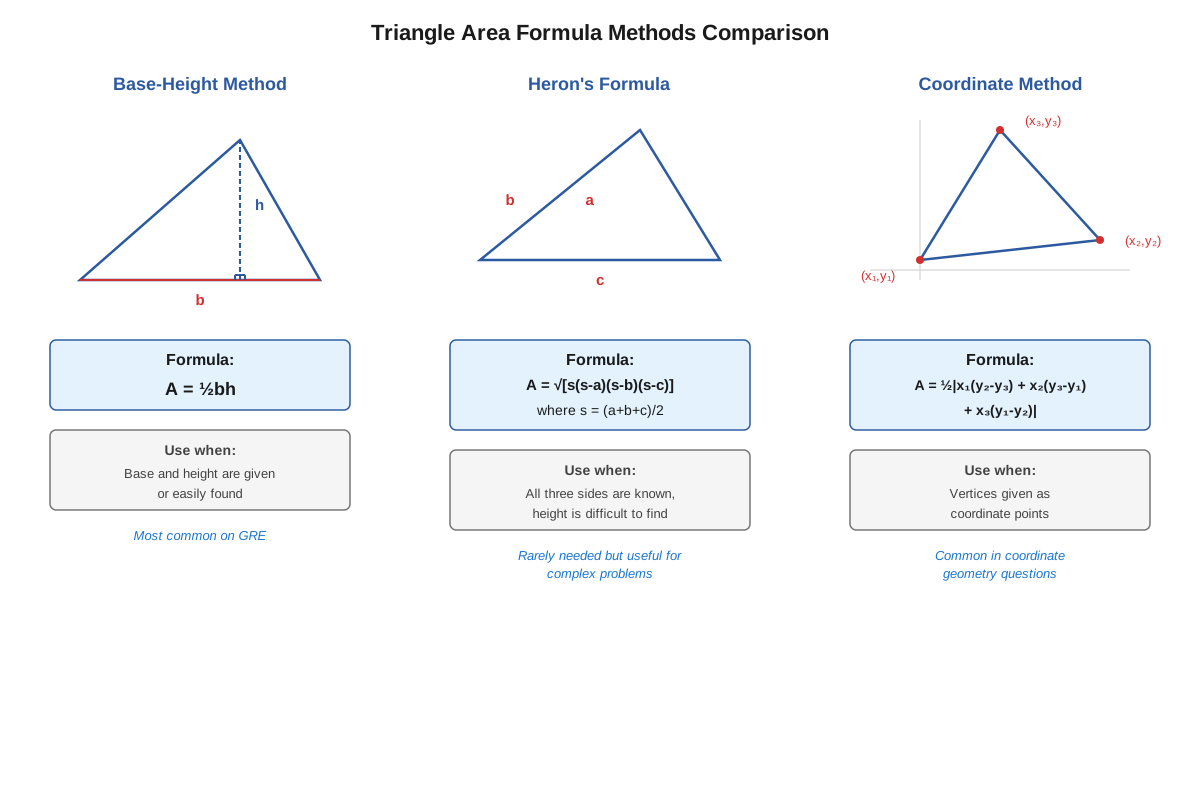
The fundamental formula for calculating the area of triangles is:
Area = (1/2) × base × heightThis formula applies to all triangles regardless of type (scalene, isosceles, equilateral, right, acute, or obtuse). The base can be any side of the triangle, and the height (or altitude) must be the perpendicular distance from that base to the opposite vertex. A critical point that distinguishes strong test-takers is recognizing that the height must form a 90-degree angle with the base—it is not simply any side of the triangle.
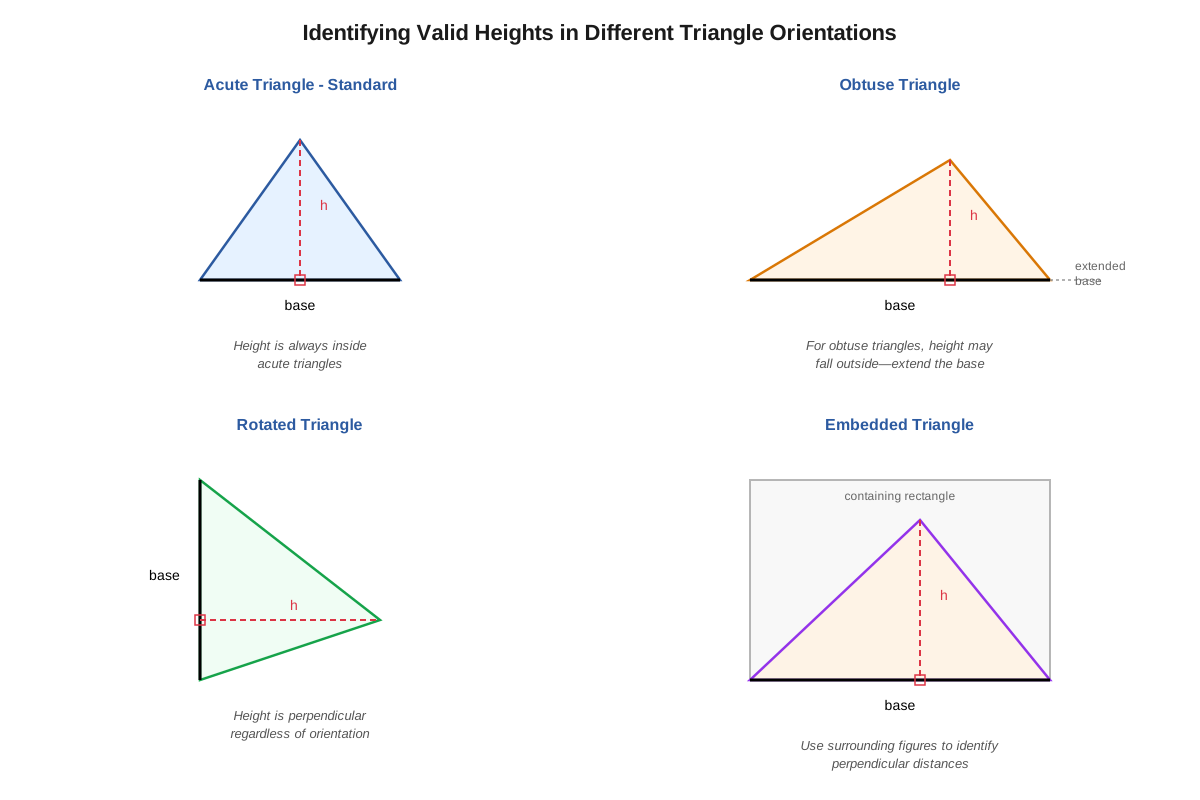
For right triangles, the two legs that form the right angle serve as base and height, making the calculation straightforward. For other triangle types, the height may fall inside the triangle (acute triangles), outside the triangle (obtuse triangles), or coincide with a side (right triangles). The GRE frequently tests whether students can identify the correct height among multiple line segments shown in a diagram.
Heron's Formula for Three Known Sides
When all three sides of a triangle are known but the height is not readily available, Heron's formula provides an alternative calculation method:
Area = √[s(s-a)(s-b)(s-c)]where s is the semi-perimeter: s = (a + b + c)/2, and a, b, c are the three side lengths.
While Heron's formula is computationally intensive for the GRE's time constraints, it becomes valuable when: (1) all three sides are given as simple integers, (2) the calculation yields a perfect square under the radical, or (3) the question asks for area squared rather than area itself. Most GRE questions are designed to avoid requiring Heron's formula, but recognizing when it's the only viable approach demonstrates advanced problem-solving ability.
Coordinate Geometry Method
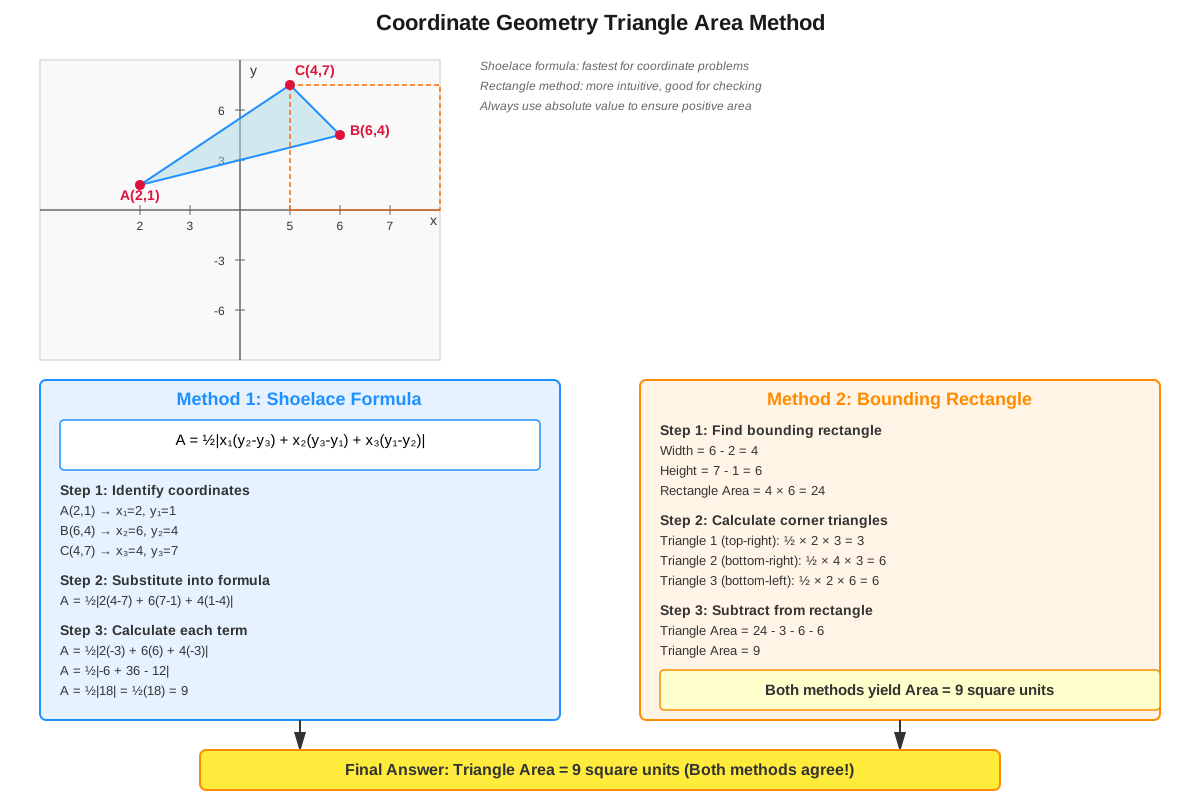
When a triangle's vertices are given as coordinate points (x₁, y₁), (x₂, y₂), and (x₃, y₃), the area can be calculated using:
Area = (1/2)|x₁(y₂ - y₃) + x₂(y₃ - y₁) + x₃(y₁ - y₂)|The absolute value ensures a positive area regardless of vertex ordering. This method is particularly efficient for GRE coordinate geometry questions and eliminates the need to calculate base and height separately. An alternative approach involves using the distance formula to find side lengths, then applying the standard formula or Heron's formula, but this is typically more time-consuming.
For triangles with one side parallel to an axis, a simpler approach exists: use the parallel side as the base (its length is the difference in the relevant coordinates) and the perpendicular distance to the opposite vertex as the height.
Special Triangle Area Formulas
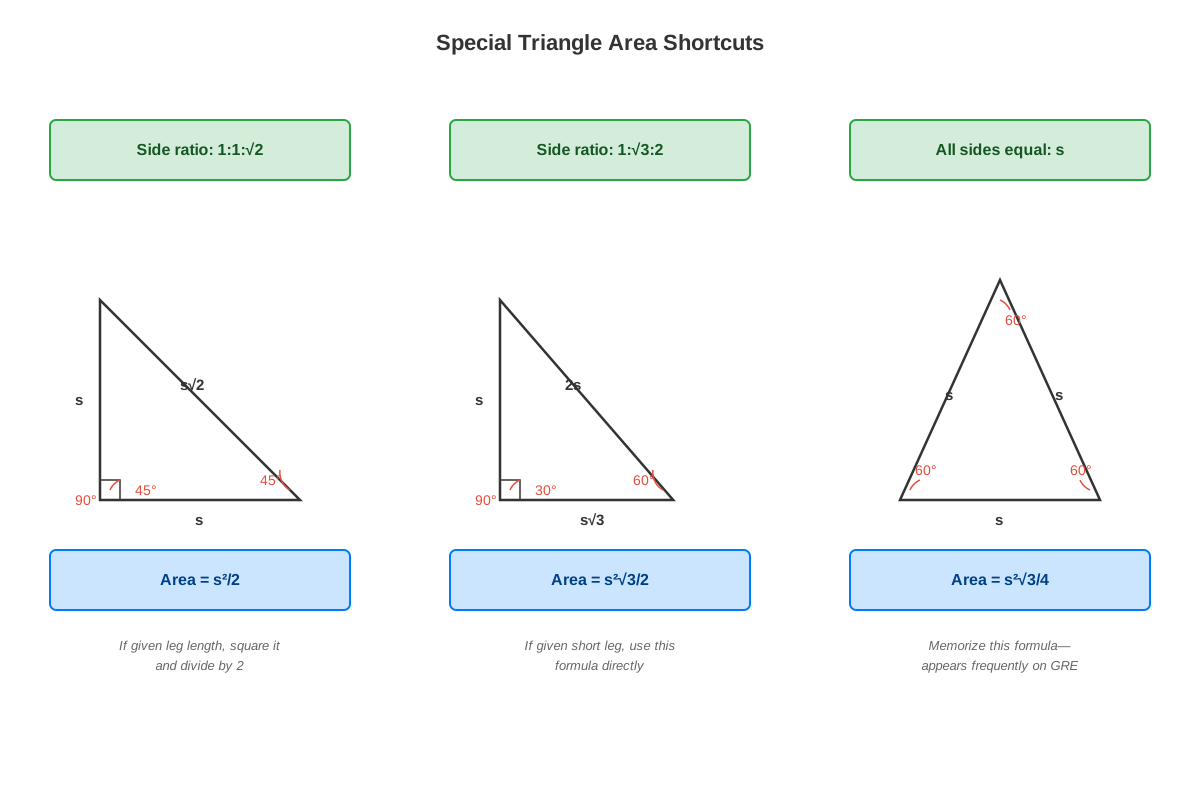
Equilateral triangles with side length s have a dedicated formula:
Area = (s²√3)/4This formula derives from the base-height method but saves calculation time. The height of an equilateral triangle is (s√3)/2, which when substituted into the standard formula yields this result.
Right triangles simplify to:
Area = (1/2) × leg₁ × leg₂since the two legs are perpendicular and serve as base and height.
Isosceles triangles don't have a unique area formula, but recognizing their symmetry often allows for easier height calculation by dropping a perpendicular from the vertex angle to the base, which bisects the base.
Area Relationships and Ratios
The GRE frequently tests understanding of how triangle area changes with dimension changes:
| Dimension Change | Area Change |
|---|---|
| Double one side (base or height) | Area doubles |
| Double both base and height | Area quadruples |
| Triple all linear dimensions | Area increases by factor of 9 (3²) |
| Halve the height | Area halves |
For similar triangles with a linear scale factor of k, the area scale factor is k². This relationship appears frequently in GRE proportion and similarity problems.
When a line segment connects two sides of a triangle parallel to the third side, it creates a smaller similar triangle. If the parallel segment is positioned at ratio m:n from the vertex (where m + n represents the full height), the smaller triangle's area is m²/(m+n)² times the original area.
Composite Figures and Decomposition
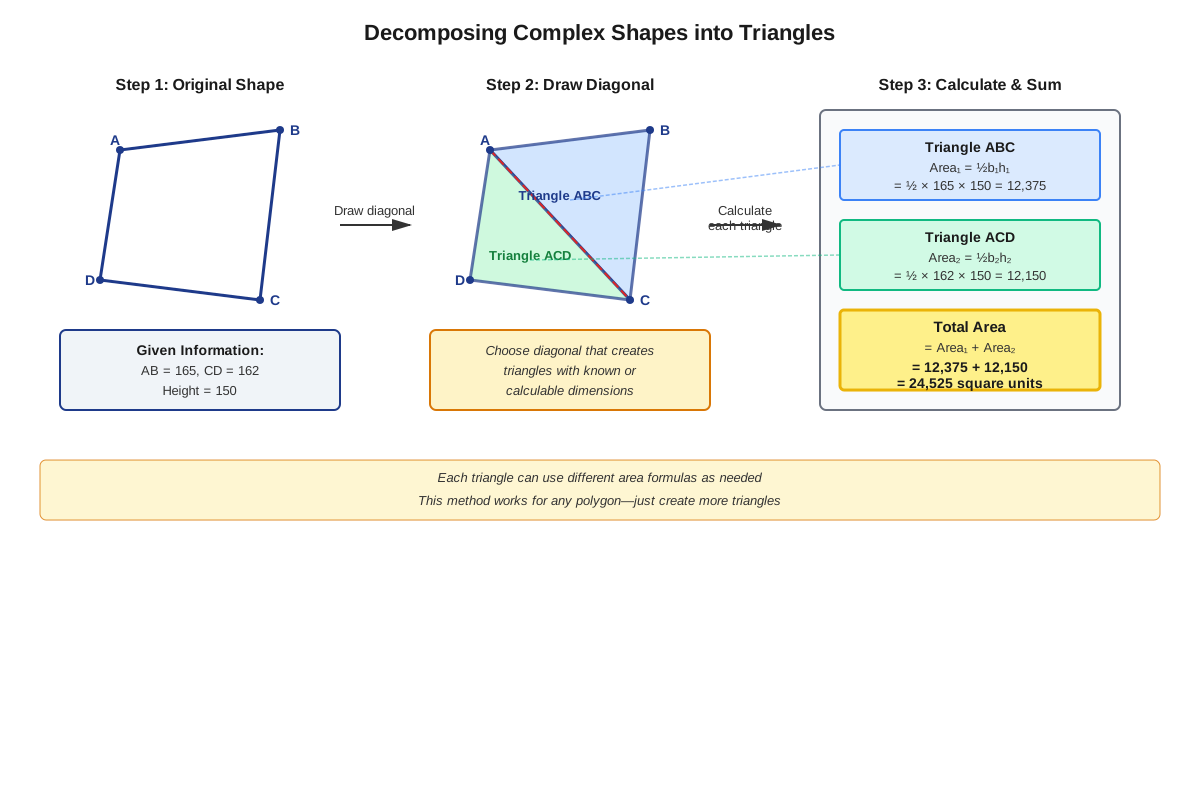
Many GRE problems present irregular polygons or complex figures that must be decomposed into triangles for area calculation. Common strategies include:
- Triangulation from a single vertex: Connect one vertex to all non-adjacent vertices, creating multiple triangles
- Dropping perpendiculars: Create right triangles by drawing heights to a baseline
- Subtracting triangles: Calculate a larger triangle's area and subtract internal triangular regions
- Recognizing embedded triangles: Identify triangles formed by diagonals, medians, or other internal segments
The ability to visualize multiple decomposition strategies and select the most efficient one is a hallmark of high-scoring test-takers.
Concept Relationships
The area of triangles concept connects internally through multiple calculation pathways: the base-height formula serves as the foundation → which extends to special triangle formulas (equilateral, right) as efficient shortcuts → while Heron's formula provides an alternative when heights are unknown → and coordinate geometry methods offer a systematic approach for point-based problems. All these methods ultimately calculate the same quantity but suit different information presentations.
Triangle area connects to prerequisite knowledge through several pathways: perpendicular lines define valid heights → Pythagorean theorem enables height calculation in right triangles → special right triangles (30-60-90, 45-45-90) provide side ratios that simplify area calculations → coordinate geometry foundations enable the point-based area formula → and algebraic manipulation allows solving for unknown dimensions when area is given.
The topic extends forward to more advanced concepts: triangle area understanding enables polygon area calculations through decomposition → supports circle and triangle combination problems → forms the basis for three-dimensional surface area calculations involving triangular faces → and underlies trigonometric area formulas (Area = ½ab sin C) tested in more advanced contexts. Additionally, area ratios connect to similarity and congruence concepts, while area optimization problems link to algebraic word problems and inequality reasoning.
High-Yield Facts
⭐ The area of any triangle equals (1/2) × base × height, where height must be perpendicular to the base
⭐ For right triangles, area = (1/2) × leg₁ × leg₂, using the two perpendicular sides
⭐ An equilateral triangle with side s has area (s²√3)/4
⭐ When all three sides are known, Heron's formula applies: Area = √[s(s-a)(s-b)(s-c)] where s = (a+b+c)/2
⭐ If linear dimensions of a triangle are scaled by factor k, the area scales by k²
- The height of a triangle may fall outside the triangle itself (obtuse triangles)
- Two triangles with the same base and height have equal areas, regardless of shape
- A median divides a triangle into two smaller triangles of equal area
- The three medians of a triangle divide it into six smaller triangles of equal area
- In coordinate geometry, triangle area = (1/2)|x₁(y₂ - y₃) + x₂(y₃ - y₁) + x₃(y₁ - y₂)|
- Triangles between the same parallel lines and sharing a base have equal areas
- The area of a triangle inscribed in a circle with radius r and side a opposite angle A is (a²r)/(2R) where R is the circumradius
- For a triangle with vertices on a coordinate grid, the area can be found by counting grid squares and using the "shoelace formula"
Quick check — test yourself on Area of triangles so far.
Try Flashcards →Common Misconceptions
Misconception: Any side of a triangle can be used as the height in the area formula.
Correction: The height must be perpendicular to the base. Only in right triangles do the legs serve as both base and height because they are perpendicular to each other. In other triangles, the height is the perpendicular distance from the base to the opposite vertex, which may require calculation using the Pythagorean theorem or trigonometry.
Misconception: The longest side of a triangle is always the base.
Correction: Any side can serve as the base—the choice is arbitrary and should be based on which side makes the height easiest to identify or calculate. The GRE often provides the height corresponding to a specific base, making that the most efficient choice regardless of side length.
Misconception: Doubling all sides of a triangle doubles its area.
Correction: Doubling all linear dimensions quadruples the area (increases it by a factor of 2² = 4). This follows from the area formula: if both base and height double, area = (1/2)(2b)(2h) = 4 × (1/2)bh. This is a specific application of the general principle that area scales with the square of linear dimensions.
Misconception: In an isosceles triangle, any of the equal sides can serve as the height.
Correction: The equal sides are typically not perpendicular to the base, so they cannot serve as the height. The height in an isosceles triangle is the perpendicular from the vertex angle to the base, which bisects the base and creates two congruent right triangles.
Misconception: Heron's formula is always the fastest method when three sides are known.
Correction: For right triangles, even when all three sides are known, using the two legs as base and height is much faster than Heron's formula. Additionally, if the triangle can be positioned on a coordinate grid or if one side and its corresponding height can be easily identified, the standard formula is more efficient.
Misconception: The area of a triangle in the coordinate plane requires calculating all three side lengths first.
Correction: The coordinate geometry formula (shoelace formula) calculates area directly from vertex coordinates without finding any side lengths. Alternatively, if one side is horizontal or vertical, it can serve as the base with easily calculated length, and the perpendicular distance to the opposite vertex serves as the height.
Worked Examples
Example 1: Multi-Step Problem with Coordinate Geometry
Problem: Triangle ABC has vertices at A(2, 3), B(6, 3), and C(4, 7). What is the area of triangle ABC?
Solution:
Step 1: Identify the approach
Since we have coordinate points, we can use either the coordinate geometry formula or recognize that side AB is horizontal (both points have y-coordinate 3), making it an ideal base.
Step 2: Using the base-height method
Base AB has length = 6 - 2 = 4 (difference in x-coordinates since y-coordinates are equal)
The height is the perpendicular distance from C to line AB. Since AB lies on the line y = 3, and C is at (4, 7), the height = 7 - 3 = 4
Step 3: Calculate area
Area = (1/2) × base × height = (1/2) × 4 × 4 = 8 square units
Step 4: Verification using coordinate formula
Area = (1/2)|x₁(y₂ - y₃) + x₂(y₃ - y₁) + x₃(y₁ - y₂)|
= (1/2)|2(3 - 7) + 6(7 - 3) + 4(3 - 3)|
= (1/2)|2(-4) + 6(4) + 4(0)|
= (1/2)|-8 + 24 + 0|
= (1/2)|16| = 8 square units ✓
Connection to learning objectives: This problem demonstrates identifying when triangle area is being tested (coordinate geometry context), explaining the core strategy (choosing the most efficient method based on given information), and applying the concept accurately with verification.
Example 2: Complex Problem with Unknown Dimensions
Problem: The area of a right triangle is 54 square inches. If one leg is 3 inches longer than the other leg, what is the length of the hypotenuse?
Solution:
Step 1: Set up variables
Let x = length of shorter leg
Then x + 3 = length of longer leg
Step 2: Use the area formula
For a right triangle: Area = (1/2) × leg₁ × leg₂
54 = (1/2) × x × (x + 3)
54 = (1/2)(x² + 3x)
108 = x² + 3x
Step 3: Solve the quadratic equation
x² + 3x - 108 = 0
(x + 12)(x - 9) = 0
x = -12 or x = 9
Since length must be positive, x = 9 inches
Step 4: Find both legs
Shorter leg = 9 inches
Longer leg = 9 + 3 = 12 inches
Step 5: Calculate hypotenuse using Pythagorean theorem
c² = 9² + 12²
c² = 81 + 144
c² = 225
c = 15 inches
Step 6: Verify
Area = (1/2) × 9 × 12 = 54 ✓
Connection to learning objectives: This problem requires recognizing that triangle area is being tested despite the question asking for the hypotenuse, applying the area formula in reverse to find unknown dimensions, and integrating triangle area concepts with the Pythagorean theorem.
Exam Strategy
When approaching GRE questions involving triangle area, follow this systematic process:
Step 1: Identify the question type
Look for trigger phrases: "what is the area," "how much greater is the area," "if the area is," "compare the areas," or visual diagrams showing triangles. Sometimes triangle area is embedded in questions about polygons, coordinate geometry, or word problems without explicit mention.
Step 2: Catalog the given information
Determine what you know: three sides, base and height, coordinate points, special triangle type, or relationships between dimensions. This inventory determines which formula to apply.
Step 3: Select the most efficient method
- If base and height are given or easily found → use standard formula
- If it's a right triangle → use the two legs
- If it's equilateral → use the special formula
- If three sides are given and it's not a right triangle → consider Heron's formula (but check if it's actually necessary)
- If coordinate points are given → use coordinate geometry method or identify horizontal/vertical sides
Step 4: Watch for these trigger words and phrases
- "Perpendicular distance" → indicates height
- "Altitude" → another term for height
- "Base" → explicitly identifies which side to use
- "Vertices at" → signals coordinate geometry approach
- "Equilateral," "isosceles," "right" → indicates special triangle properties
- "Similar triangles" → area ratio equals square of linear ratio
- "Inscribed in" or "circumscribed about" → may involve additional geometric relationships
Process of elimination tips specific to triangle area:
- Eliminate answers that violate the area-dimension relationship: If dimensions double, area must quadruple—eliminate answers that don't reflect this
- Use estimation: Calculate approximate area mentally (round numbers) to eliminate unreasonable answers
- Check units: Area must be in square units; eliminate answers in linear units
- Apply reasonableness tests: A triangle's area cannot exceed the area of a rectangle with the same base and height
- For Quantitative Comparison: Often you can determine the relationship without calculating exact areas—look for dimension ratios
Time allocation advice:
- Simple base-height problems: 30-45 seconds
- Coordinate geometry problems: 60-90 seconds
- Problems requiring unknown dimension solving: 90-120 seconds
- Complex composite figures: 120-180 seconds
If a problem requires Heron's formula with complicated numbers, consider whether you've missed a simpler approach—the GRE rarely requires extensive calculation. Mark it for review and return if time permits.
Memory Techniques
Mnemonic for the standard formula: "Half the Base times Height"
Remember "HBH" → (1/2) × B × H. The "half" comes first, preventing the common error of forgetting to divide by 2.
Visualization strategy for identifying height:
Imagine the triangle "standing up" with the base as the ground. The height is how tall the triangle stands—it must go straight up (perpendicular) from the ground to the top vertex. This mental image helps identify the correct height even when the triangle is rotated.
Acronym for coordinate geometry: "SHOELACE"
The coordinate geometry formula is called the shoelace formula because the calculation pattern resembles lacing shoes: you multiply coordinates in a crisscross pattern. Remember: x₁ with (y₂ - y₃), x₂ with (y₃ - y₁), x₃ with (y₁ - y₂).
Memory aid for equilateral triangle area: "Side Squared, Root Three, over Four"
The rhythm "s-squared, root-three, over-four" matches the formula (s²√3)/4. Practice saying it aloud to cement the sequence.
Scaling relationship: "Linear times Linear equals Area"
When dimensions scale by k, area scales by k × k = k². This reminds you that area (two-dimensional) depends on two linear dimensions multiplied together.
Right triangle shortcut: "Legs are Perpendicular, Perfect for Area"
The alliteration helps remember that right triangle legs are already perpendicular, so they serve directly as base and height without additional calculation.
Summary
The area of triangles is a foundational GRE geometry concept that appears in multiple question formats and difficulty levels. Mastery requires fluency with the standard formula (Area = ½ × base × height), recognition that the height must be perpendicular to the base, and the ability to identify which calculation method best suits the given information. Special cases—right triangles, equilateral triangles, and coordinate geometry problems—each have optimized approaches that save valuable time. Understanding how area scales with dimension changes (linearly for one dimension, quadratically for all dimensions) enables quick comparison and estimation. The most successful test-takers recognize triangle area problems even when embedded in complex scenarios, select the most efficient calculation method, and verify their answers through reasonableness checks. Whether working with explicit measurements, coordinate points, or algebraic relationships, the core principle remains constant: triangle area represents half the product of a base and its corresponding perpendicular height.
Key Takeaways
- The fundamental formula Area = (1/2) × base × height applies to all triangles, but the height must be perpendicular to the chosen base
- Right triangles simplify to Area = (1/2) × leg₁ × leg₂, and equilateral triangles use Area = (s²√3)/4
- Coordinate geometry problems are efficiently solved using the shoelace formula or by identifying horizontal/vertical sides
- When dimensions scale by factor k, area scales by k²—this relationship is frequently tested in similarity and comparison problems
- The most efficient approach depends on given information: use the standard formula when base and height are available, Heron's formula only when necessary, and special formulas for recognized triangle types
- Triangle area concepts extend to polygon decomposition, making this topic essential for complex geometry problems
- Time management requires selecting the fastest method and using estimation to eliminate unreasonable answer choices
Related Topics
Perimeter of Triangles: Understanding both area and perimeter enables solving optimization problems and questions involving both measurements simultaneously. Mastering area first provides context for perimeter relationships.
Triangle Inequality and Properties: Knowledge of when three sides can form a triangle and properties of different triangle types enhances problem-solving efficiency for area questions.
Similarity and Congruence: These concepts directly connect to area through scaling relationships—similar triangles have areas in the ratio of their corresponding sides squared.
Coordinate Geometry: Advanced coordinate geometry problems frequently require triangle area calculations as intermediate steps in finding distances, slopes, or regions.
Three-Dimensional Geometry: Calculating surface areas of pyramids and other polyhedra requires finding areas of triangular faces, making this topic foundational for solid geometry.
Trigonometry: The formula Area = (1/2)ab sin C extends triangle area concepts to cases where angles are known, bridging geometry and trigonometry.
Practice CTA
Now that you've mastered the core concepts of triangle area, it's time to solidify your understanding through active practice. Attempt the practice questions designed specifically for this topic—they mirror actual GRE question formats and difficulty levels. Use the flashcards to reinforce formulas and key relationships until they become automatic. Remember, the difference between understanding a concept and scoring points on test day lies in repeated, deliberate practice. Each problem you solve strengthens your pattern recognition and builds the confidence needed to tackle any triangle area question the GRE presents. Your investment in practice now will pay dividends in points on exam day!
Sign up free to keep reading
Create a free AnvayaPrep account to finish this GRE guide on Area of triangles — plus flashcards and practice questions.