Overview
Right triangles are among the most frequently tested geometric concepts on the GRE Quantitative Reasoning section. A right triangle is a triangle containing one 90-degree angle, and this special property creates predictable relationships between the sides and angles that the GRE exploits extensively. Understanding GRE right triangles is not merely about memorizing the Pythagorean theorem—it requires recognizing special right triangle patterns, applying trigonometric relationships, and identifying when problems that appear to test other concepts actually depend on right triangle properties.
The importance of right triangles extends far beyond standalone geometry questions. They appear embedded within coordinate geometry problems, three-dimensional figure questions, circle problems, and even data interpretation scenarios involving distances and heights. Approximately 15-20% of GRE Quantitative questions either directly test right triangle concepts or require right triangle knowledge as an intermediate step. Mastering this topic provides a foundation for solving complex multi-step problems efficiently, which is crucial for achieving a competitive score.
Right triangles serve as a bridge between pure geometry and algebraic problem-solving on the GRE. They connect to concepts like the distance formula (which derives from the Pythagorean theorem), area calculations, similarity and proportions, and coordinate geometry. The ability to recognize when a right triangle exists—even when not explicitly stated—and to apply the appropriate theorem or ratio represents a high-yield skill that separates top scorers from average test-takers.
Learning Objectives
- [ ] Identify when Right triangles is being tested
- [ ] Explain the core rule or strategy behind Right triangles
- [ ] Apply Right triangles to GRE-style questions accurately
- [ ] Recognize and apply the Pythagorean theorem and its common variations
- [ ] Identify and use special right triangle ratios (3-4-5, 5-12-13, 30-60-90, 45-45-90)
- [ ] Determine when to construct auxiliary lines to create right triangles in complex figures
- [ ] Calculate areas, perimeters, and missing dimensions using right triangle properties
Prerequisites
- Basic triangle properties: Understanding that the sum of angles in any triangle equals 180° is essential for finding missing angles in right triangles
- Algebraic manipulation: Solving equations with squares and square roots is necessary for applying the Pythagorean theorem
- Ratio and proportion: Special right triangles rely entirely on understanding proportional relationships between sides
- Area formulas: Calculating the area of a right triangle (½ × base × height) connects to broader geometry problem-solving
- Square roots and exponents: Facility with operations like √2, √3, and squaring numbers enables quick calculations
Why This Topic Matters
Right triangles appear in real-world applications ranging from architecture and construction to navigation and computer graphics. Engineers use right triangle principles to calculate structural loads, surveyors use them to measure inaccessible distances, and programmers apply them in game development and animation. This practical utility makes right triangles a natural choice for standardized test creators seeking to assess quantitative reasoning.
On the GRE specifically, right triangles appear in approximately 3-5 questions per test across both Quantitative Reasoning sections. They manifest in multiple question formats: Quantitative Comparison questions asking you to compare side lengths or areas, Multiple Choice questions requiring calculation of specific values, and Numeric Entry questions where you must determine exact measurements. The topic also appears frequently in Data Interpretation sets where geometric figures illustrate relationships between variables.
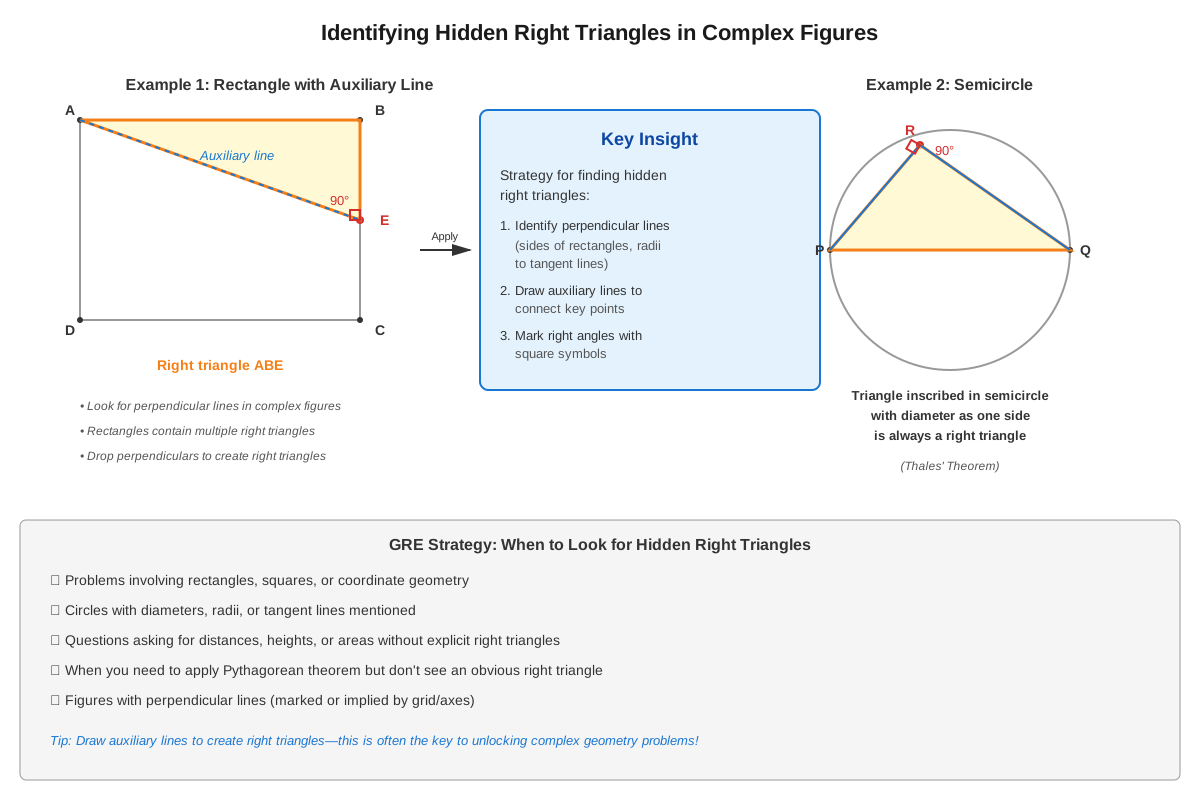
Common GRE manifestations include: coordinate geometry problems where you must find the distance between two points; three-dimensional figures where you need to find the diagonal of a rectangular solid; circle problems where a radius creates a right angle with a tangent line; and word problems involving ladders, shadows, or other scenarios creating right triangles. The test often disguises right triangle problems by embedding them within more complex figures or by requiring you to recognize that drawing an altitude or other auxiliary line will create a right triangle that unlocks the solution.
Core Concepts
The Pythagorean Theorem
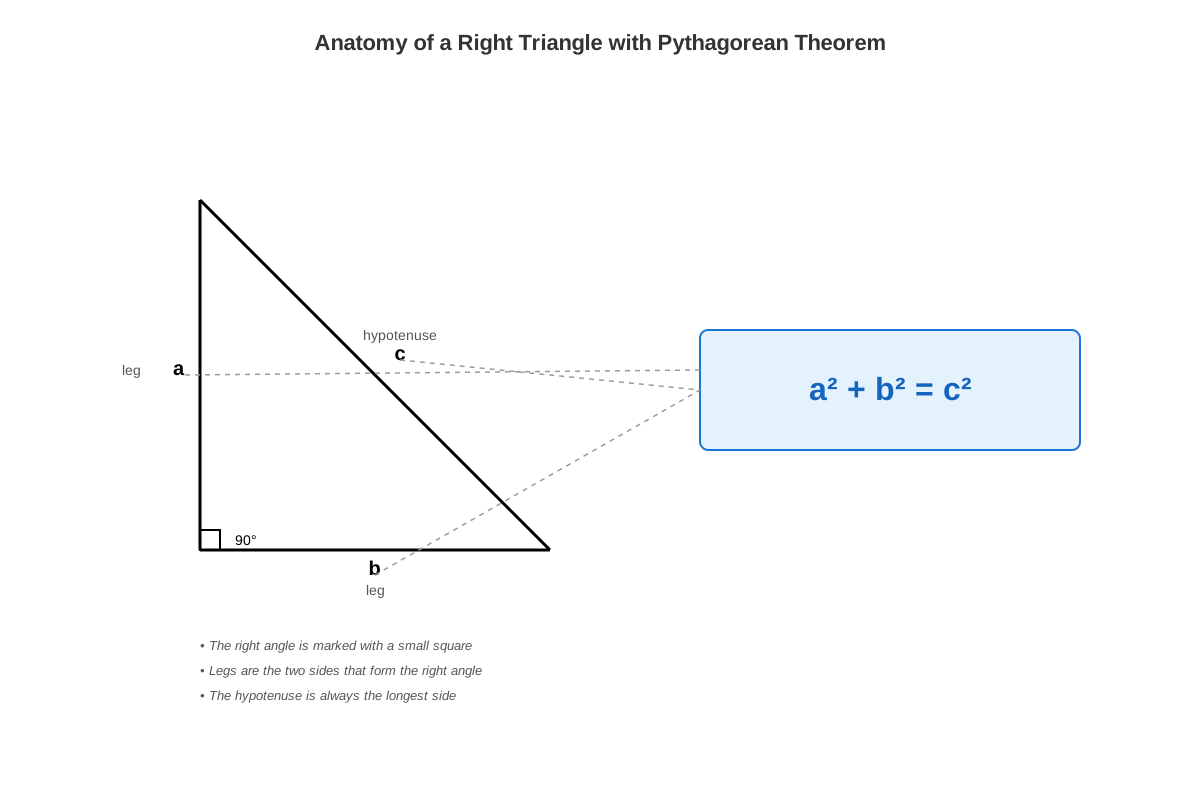
The Pythagorean theorem is the foundational principle for all right triangle problems. For any right triangle with legs of length a and b and hypotenuse of length c, the relationship is:
a² + b² = c²The hypotenuse is always the side opposite the right angle and is always the longest side of a right triangle. The legs are the two sides that form the right angle. On the GRE, you must recognize three applications of this theorem:
- Finding the hypotenuse when both legs are known
- Finding one leg when the hypotenuse and other leg are known
- Verifying whether three given side lengths can form a right triangle
The theorem works in reverse: if three side lengths satisfy the equation a² + b² = c², then the triangle must be a right triangle. This reverse application frequently appears in GRE questions asking whether a triangle is acute, right, or obtuse.
Pythagorean Triples
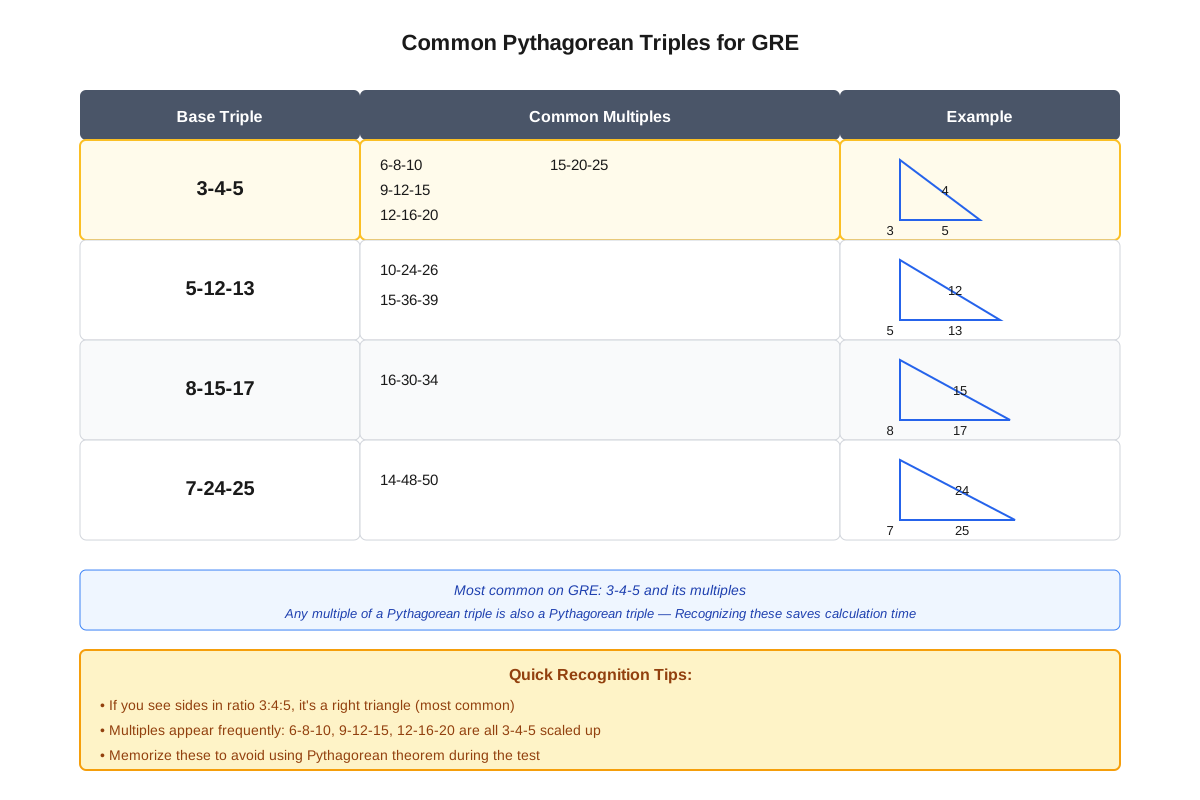
Pythagorean triples are sets of three positive integers that satisfy the Pythagorean theorem. Recognizing these patterns allows for rapid calculation without using a calculator. The most common triples tested on the GRE are:
| Triple | Multiples | Example |
|---|---|---|
| 3-4-5 | 6-8-10, 9-12-15, 15-20-25 | If legs are 6 and 8, hypotenuse is 10 |
| 5-12-13 | 10-24-26, 15-36-39 | If legs are 5 and 12, hypotenuse is 13 |
| 8-15-17 | 16-30-34 | Less common but appears occasionally |
| 7-24-25 | 14-48-50 | Rare but worth knowing |
Any multiple of a Pythagorean triple is also a Pythagorean triple. If you see a right triangle with one leg of 9 and hypotenuse of 15, you should immediately recognize this as a 3-4-5 triple scaled by 3, making the other leg 12. This recognition saves valuable time compared to calculating 15² - 9² = 225 - 81 = 144, then taking the square root.
Special Right Triangles: 45-45-90
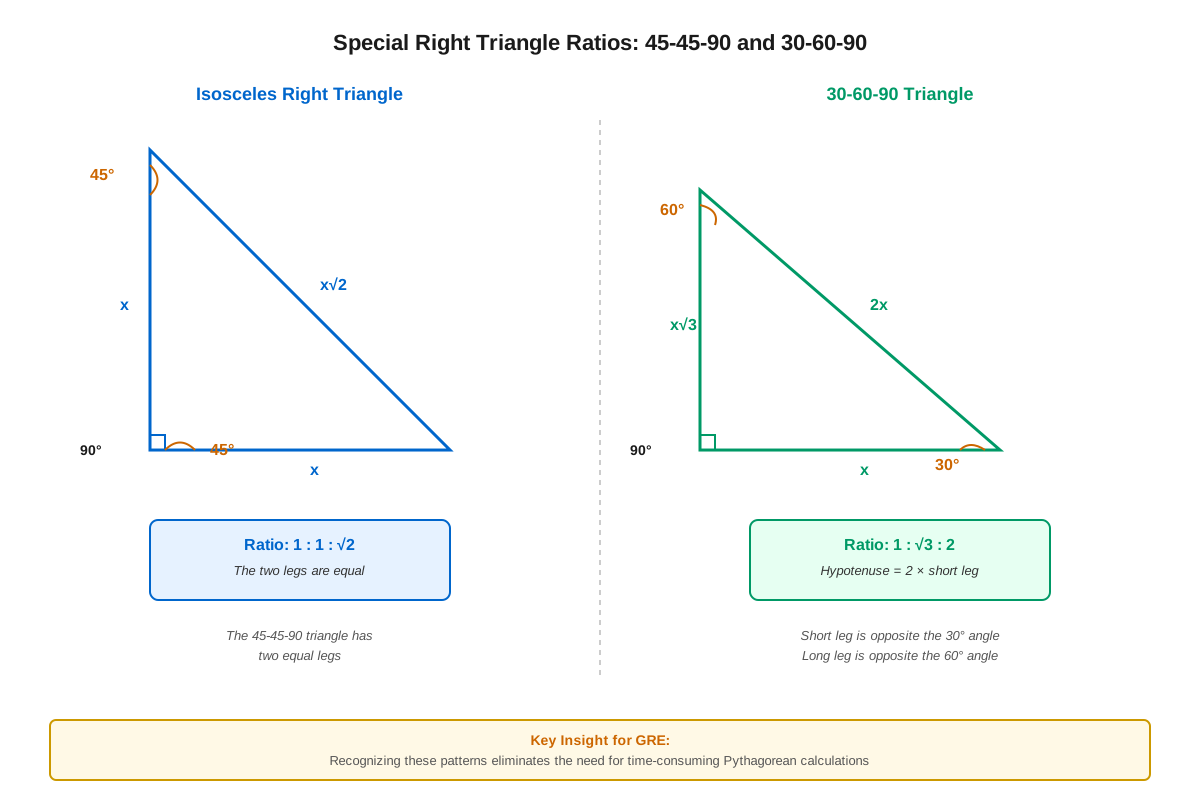
A 45-45-90 triangle is an isosceles right triangle where both acute angles measure 45°. This triangle has a fixed ratio between its sides:
sides ratio = x : x : x√2If each leg has length x, the hypotenuse has length x√2. Conversely, if the hypotenuse has length h, each leg has length h/√2 or (h√2)/2 after rationalizing the denominator.
The GRE frequently tests 45-45-90 triangles in these contexts:
- Squares with diagonals (the diagonal divides a square into two 45-45-90 triangles)
- Coordinate geometry problems involving points like (0,0) and (5,5)
- Isosceles right triangles explicitly stated or implied
Special Right Triangles: 30-60-90
A 30-60-90 triangle results from bisecting an equilateral triangle with an altitude. The side ratios are:
sides ratio = x : x√3 : 2xThe side opposite the 30° angle has length x, the side opposite the 60° angle has length x√3, and the hypotenuse (opposite the 90° angle) has length 2x. This ratio is absolutely critical for GRE success.
Common GRE applications include:
- Equilateral triangles with altitudes drawn
- Problems stating one angle is 30° or 60° in a right triangle
- Regular hexagons (which decompose into six equilateral triangles)
To use this ratio effectively, identify which side you know and which angle it's opposite to, then scale the entire ratio appropriately.
Area of Right Triangles
The area formula for any right triangle is particularly straightforward because the two legs serve as base and height:
Area = (1/2) × leg₁ × leg₂This differs from the general triangle area formula (½ × base × height) only in that you don't need to find a separate altitude—the legs themselves are perpendicular. The GRE often tests whether students recognize this simplification or whether they waste time trying to find an altitude.
Altitude to the Hypotenuse
When an altitude is drawn from the right angle to the hypotenuse, it creates three similar triangles: the original triangle and two smaller triangles. This configuration produces several important relationships:
- The altitude divides the hypotenuse into two segments
- The altitude's length is the geometric mean of these two segments
- Each leg is the geometric mean of the hypotenuse and the adjacent segment
If the altitude has length h and divides the hypotenuse into segments of length p and q, then:
h² = p × qThis relationship appears in advanced GRE problems involving similar triangles or geometric means.
Right Triangles in Coordinate Geometry
On the coordinate plane, any two points create a potential right triangle by drawing horizontal and vertical lines to form legs. For points (x₁, y₁) and (x₂, y₂), the horizontal leg has length |x₂ - x₁| and the vertical leg has length |y₂ - y₁|. The distance between the points (the hypotenuse) is:
d = √[(x₂ - x₁)² + (y₂ - y₁)²]This distance formula is simply the Pythagorean theorem applied to coordinate geometry. The GRE tests this connection frequently, sometimes asking for the distance directly and sometimes embedding it within a larger problem.
Concept Relationships
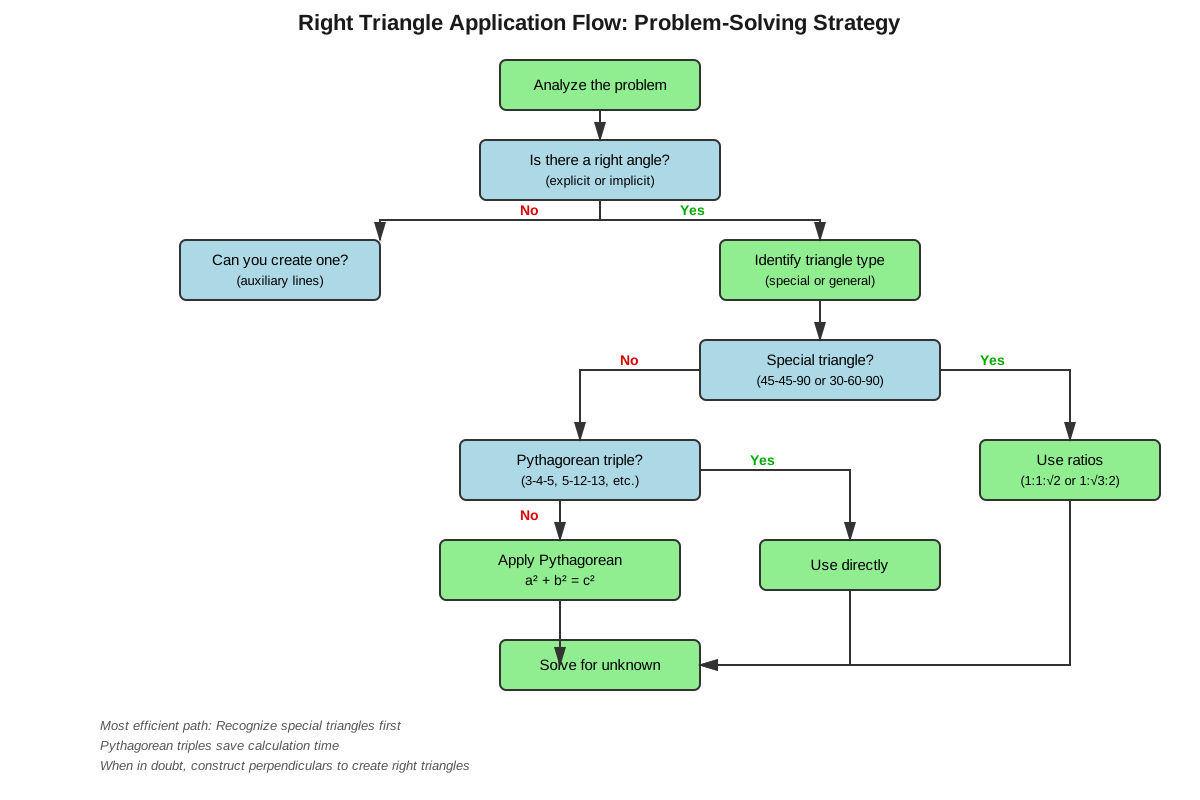
The Pythagorean theorem serves as the central concept from which all other right triangle properties derive. Special right triangles (45-45-90 and 30-60-90) are specific applications where the angle measures create predictable side ratios, allowing you to bypass the Pythagorean theorem for faster calculation. Pythagorean triples represent integer solutions to the Pythagorean theorem and provide shortcuts for common side length combinations.
The relationship flows as follows: Pythagorean Theorem → enables calculation of any unknown side → Special Right Triangles provide shortcuts when specific angles are present → Pythagorean Triples offer even faster recognition for integer sides → Coordinate Geometry applies the Pythagorean theorem to find distances → Area Calculations use the perpendicular legs as base and height.
Right triangles connect to prerequisite knowledge of basic triangle properties (angle sum of 180°) and extend to more advanced topics like trigonometry (sine, cosine, and tangent ratios are defined using right triangles), three-dimensional geometry (finding space diagonals), and circle geometry (radii perpendicular to tangent lines create right angles). The altitude-to-hypotenuse concept links to similarity and proportions, demonstrating how one right triangle can generate multiple similar right triangles.
Quick check — test yourself on Right triangles so far.
Try Flashcards →High-Yield Facts
⭐ The Pythagorean theorem (a² + b² = c²) applies only to right triangles, where c is always the hypotenuse
⭐ The 3-4-5 triangle and its multiples (6-8-10, 9-12-15, etc.) are the most frequently tested Pythagorean triples
⭐ In a 45-45-90 triangle, if each leg is x, the hypotenuse is x√2
⭐ In a 30-60-90 triangle, the sides opposite 30°, 60°, and 90° are in the ratio x : x√3 : 2x
⭐ The diagonal of a square with side s creates two 45-45-90 triangles and has length s√2
- The altitude of an equilateral triangle with side s creates two 30-60-90 triangles and has length (s√3)/2
- Any triangle with sides satisfying a² + b² = c² must be a right triangle (converse of Pythagorean theorem)
- The 5-12-13 triple appears frequently in GRE problems involving coordinate geometry
- The area of a right triangle equals (1/2) × leg₁ × leg₂, using the legs as base and height
- In coordinate geometry, the distance formula is an application of the Pythagorean theorem
- The hypotenuse is always the longest side of a right triangle
- When an altitude is drawn to the hypotenuse, it creates two smaller triangles similar to the original and to each other
Common Misconceptions
Misconception: The Pythagorean theorem can be applied to any triangle to find a missing side.
Correction: The Pythagorean theorem applies exclusively to right triangles. For non-right triangles, you must use the Law of Cosines or other methods.
Misconception: In the Pythagorean theorem, any side can be c.
Correction: The variable c must always represent the hypotenuse (the longest side, opposite the right angle). If you mistakenly use a leg as c, your calculation will be incorrect.
Misconception: A 45-45-90 triangle has sides in the ratio 1:1:2.
Correction: The correct ratio is x : x : x√2, not x : x : 2x. The hypotenuse is √2 times the leg length, not twice the leg length. This is approximately 1.414 times, not 2 times.
Misconception: In a 30-60-90 triangle, the side opposite 30° is half the side opposite 60°.
Correction: The side opposite 30° is x, while the side opposite 60° is x√3 (approximately 1.732x). The side opposite 30° is half the hypotenuse (2x), not half the side opposite 60°.
Misconception: If two sides of a triangle are 3 and 4, the third side must be 5.
Correction: The third side is 5 only if the angle between the sides of length 3 and 4 is a right angle. If that angle is not 90°, the third side will be different. Always verify that you have a right triangle before applying the Pythagorean theorem.
Misconception: The altitude to the hypotenuse in a right triangle equals the average of the two legs.
Correction: The altitude to the hypotenuse equals the geometric mean of the two segments it creates on the hypotenuse, not the arithmetic mean of the legs. For a 3-4-5 triangle, the altitude to the hypotenuse is 2.4, not 3.5.
Misconception: Pythagorean triples only work with the exact numbers given (like 3-4-5).
Correction: Any multiple of a Pythagorean triple is also a valid triple. If you see 30-40-50, recognize it as 10 times the 3-4-5 triple.
Worked Examples
Example 1: Multi-Step Problem with Special Right Triangles
Problem: A square has a diagonal of length 10. What is the area of the square?
Solution:
Step 1: Recognize that the diagonal of a square divides it into two 45-45-90 triangles.
Step 2: In a 45-45-90 triangle, if the legs have length x, the hypotenuse has length x√2. Here, the diagonal is the hypotenuse.
Step 3: Set up the equation: x√2 = 10
Step 4: Solve for x: x = 10/√2 = 10/√2 × √2/√2 = 10√2/2 = 5√2
Step 5: The side of the square is 5√2, so the area is (5√2)² = 25 × 2 = 50
Answer: 50
Connection to Learning Objectives: This problem requires identifying that a right triangle is being tested (the diagonal creates 45-45-90 triangles), explaining the core strategy (using the special right triangle ratio), and applying it accurately to find the area.
Example 2: Pythagorean Triple Recognition
Problem: In the coordinate plane, point A is at (2, 3) and point B is at (14, 8). What is the distance between points A and B?
Solution:
Step 1: Recognize this as a coordinate geometry problem requiring the distance formula, which is based on the Pythagorean theorem.
Step 2: Find the horizontal distance: |14 - 2| = 12
Step 3: Find the vertical distance: |8 - 3| = 5
Step 4: These form the legs of a right triangle. Recognize 5 and 12 as part of the 5-12-13 Pythagorean triple.
Step 5: The distance (hypotenuse) is 13.
Verification: If you didn't recognize the triple, you would calculate: √(12² + 5²) = √(144 + 25) = √169 = 13
Answer: 13
Connection to Learning Objectives: This demonstrates identifying when right triangles are being tested (even in coordinate geometry), recognizing the core strategy (Pythagorean triples for efficiency), and applying the concept accurately.
Example 3: 30-60-90 Triangle Application
Problem: An equilateral triangle has a side length of 8. What is the area of the triangle?
Solution:
Step 1: Recognize that to find the area, you need the base and height. The base is 8, but you need to find the height.
Step 2: The altitude of an equilateral triangle creates two 30-60-90 triangles.
Step 3: In the 30-60-90 triangle formed, the hypotenuse is 8 (the side of the equilateral triangle), and the base is 4 (half of the bottom side).
Step 4: Using the 30-60-90 ratio x : x√3 : 2x, if the hypotenuse is 2x = 8, then x = 4.
Step 5: The altitude (opposite the 60° angle) is x√3 = 4√3.
Step 6: Area = (1/2) × base × height = (1/2) × 8 × 4√3 = 16√3
Answer: 16√3
Connection to Learning Objectives: This shows how right triangles appear in problems about other shapes, requires explaining the 30-60-90 strategy, and demonstrates accurate application to find area.
Exam Strategy
When approaching GRE questions involving right triangles, follow this systematic process:
Step 1: Identify the right angle. Look for the small square symbol in a diagram, the word "perpendicular," phrases like "forms a right angle," or implicit right angles (coordinate axes, radius to tangent, altitude in special triangles).
Step 2: Determine what information is given. Are you given two sides? One side and one angle? Is this a special right triangle?
Step 3: Choose your method:
- If you see 30°, 60°, or 45° angles, use special right triangle ratios
- If you see sides that might be Pythagorean triples (3, 4, 5, 12, 13, etc.), check for multiples
- Otherwise, apply the Pythagorean theorem
Trigger words and phrases to watch for:
- "Perpendicular" or "forms a right angle" → right triangle exists
- "Diagonal of a square" → 45-45-90 triangle
- "Altitude of an equilateral triangle" → 30-60-90 triangle
- "Distance between two points" → coordinate geometry right triangle
- "Isosceles right triangle" → 45-45-90 triangle
- Angles measuring 30°, 60°, or 45° → special right triangles
Process-of-elimination tips:
- In Quantitative Comparison questions, if you can't calculate exact values, estimate using the fact that √2 ≈ 1.4 and √3 ≈ 1.7
- Eliminate answer choices that would make the hypotenuse shorter than a leg
- If a problem seems to require complex calculation, look for a Pythagorean triple or special right triangle shortcut
Time allocation:
- Simple Pythagorean theorem problems: 45-60 seconds
- Special right triangle problems: 30-45 seconds (faster due to ratios)
- Multi-step problems involving right triangles: 90-120 seconds
- If you don't recognize a pattern within 15 seconds, proceed with standard calculation rather than searching for shortcuts
Exam Tip: Draw or redraw the figure if it's not provided or if the given figure is not drawn to scale. Label all known values and mark the right angle clearly. This visual organization prevents errors.
Memory Techniques
Mnemonic for 30-60-90 ratios: "1, 2, root 3" in order of angles (30°, 90°, 60°). The side opposite 30° is 1x, opposite 90° is 2x, opposite 60° is x√3. Note that 90° comes before 60° in this ordering to match the ratio sequence.
Mnemonic for 45-45-90 ratios: "Same, same, root 2" — the two legs are the same length, and the hypotenuse is that length times √2.
Visualization for Pythagorean triples: Picture a 3-4-5 triangle as a small triangle that fits in your hand. Then imagine scaling it up: 6-8-10 is twice as big, 9-12-15 is three times as big. For 5-12-13, visualize a clock face: 5 o'clock and 12 o'clock, with 13 connecting them.
Acronym for right triangle problem-solving: RASH
- Recognize the right angle
- Assess what's given (sides, angles)
- Select method (special triangle, triple, or Pythagorean theorem)
- Hypotenuse check (ensure it's the longest side)
Memory aid for which side is which: The hypotenuse is always opposite the right angle and is always the highest value (longest side). Think "hypo" = "high."
Summary
Right triangles are fundamental to GRE Quantitative Reasoning success, appearing in approximately 15-20% of questions either directly or as embedded components of larger problems. The Pythagorean theorem (a² + b² = c²) is the foundational principle, but efficient test-taking requires recognizing Pythagorean triples (especially 3-4-5 and 5-12-13 with their multiples) and special right triangle ratios. The 45-45-90 triangle has sides in the ratio x : x : x√2, while the 30-60-90 triangle has sides in the ratio x : x√3 : 2x. These patterns enable rapid calculation without extensive computation. Right triangles connect to coordinate geometry through the distance formula, to squares through diagonals, and to equilateral triangles through altitudes. Success requires not just memorizing formulas but recognizing when right triangles are present—even when not explicitly stated—and selecting the most efficient solution method. The ability to identify trigger words, visualize the geometry, and apply the appropriate theorem or ratio distinguishes high scorers from average performers.
Key Takeaways
- The Pythagorean theorem (a² + b² = c²) applies exclusively to right triangles, with c always representing the hypotenuse
- Recognize Pythagorean triples (3-4-5, 5-12-13, and their multiples) for instant calculation without using the formula
- Master the two special right triangle ratios: 45-45-90 (x : x : x√2) and 30-60-90 (x : x√3 : 2x)
- The diagonal of a square and the altitude of an equilateral triangle create special right triangles with predictable ratios
- Right triangles appear embedded in coordinate geometry, three-dimensional figures, and circle problems—not just standalone geometry questions
- Always verify that you have identified the hypotenuse correctly before applying the Pythagorean theorem
- Drawing or redrawing figures with clear right angle markers and labeled values prevents calculation errors
Related Topics
Coordinate Geometry: Mastering right triangles enables efficient calculation of distances, slopes, and midpoints on the coordinate plane, as the distance formula directly applies the Pythagorean theorem.
Three-Dimensional Geometry: Finding diagonals of rectangular solids requires applying the Pythagorean theorem twice—once for a face diagonal, then again for the space diagonal.
Circles and Tangent Lines: Understanding that a radius drawn to a tangent line creates a right angle allows you to solve numerous circle problems using right triangle principles.
Trigonometry: The sine, cosine, and tangent ratios are defined using right triangles, making this topic the foundation for any trigonometric problem-solving.
Similar Triangles: Right triangles with the same acute angles are similar, and the altitude-to-hypotenuse configuration creates multiple similar triangles within a single figure.
Practice CTA
Now that you've mastered the core concepts of right triangles, it's time to solidify your understanding through active practice. Attempt the practice questions associated with this topic, focusing on recognizing patterns quickly and applying the most efficient solution method. Use the flashcards to drill the special right triangle ratios and Pythagorean triples until they become automatic. Remember: recognizing a 5-12-13 triple in 3 seconds versus calculating √(5² + 12²) in 20 seconds can make the difference between finishing the section comfortably and running out of time. Your investment in mastering this high-yield topic will pay dividends across multiple question types on test day!
Sign up free to keep reading
Create a free AnvayaPrep account to finish this GRE guide on Right triangles — plus flashcards and practice questions.