Overview
Polygons are fundamental geometric figures that appear frequently throughout the GRE Quantitative Reasoning section, making them essential for test success. A polygon is a closed two-dimensional figure formed by three or more straight line segments that connect at vertices, creating an enclosed area. Understanding polygons extends far beyond simple shape recognition—it encompasses calculating perimeters, areas, interior and exterior angles, and recognizing relationships between different polygon types. The GRE tests polygon concepts both directly through dedicated geometry problems and indirectly by embedding polygon properties within word problems, data interpretation questions, and quantitative comparison formats.
Mastery of GRE polygons provides the foundation for tackling numerous geometry questions that collectively represent approximately 15-20% of the Quantitative Reasoning section. Questions may ask test-takers to determine the number of sides in a polygon given angle information, calculate the area of irregular shapes by decomposing them into familiar polygons, or compare properties of different polygon types. The topic integrates seamlessly with coordinate geometry, where polygons are plotted on the xy-plane, and with three-dimensional geometry, where polygons form the faces of solid figures.
The strategic importance of polygons in GRE preparation cannot be overstated. This topic serves as a bridge connecting basic geometric principles (lines, angles, and triangles) to more complex applications involving circles, coordinate geometry, and optimization problems. Students who develop fluency with polygon properties gain significant advantages in time management and accuracy, as many seemingly complex GRE problems reduce to straightforward polygon calculations once properly analyzed. Furthermore, polygon knowledge reinforces algebraic thinking through formula manipulation and equation-solving within geometric contexts.
Learning Objectives
- [ ] Identify when Polygons is being tested in GRE questions
- [ ] Explain the core rule or strategy behind Polygons
- [ ] Apply Polygons to GRE-style questions accurately
- [ ] Calculate interior and exterior angle sums for any polygon
- [ ] Decompose irregular polygons into simpler shapes for area calculations
- [ ] Distinguish between regular and irregular polygons and apply appropriate formulas
- [ ] Solve problems involving polygon perimeters, areas, and diagonal counts
Prerequisites
- Basic angle relationships: Understanding complementary, supplementary, and vertical angles is essential for working with polygon interior angles
- Triangle properties: Triangles are the fundamental building blocks for decomposing polygons and understanding their properties
- Area and perimeter formulas: Familiarity with basic rectangle, square, and triangle formulas enables polygon area calculations
- Algebraic equation solving: Many polygon problems require setting up and solving equations involving unknown side lengths or angle measures
Why This Topic Matters
Polygon problems appear in approximately 3-5 questions per GRE Quantitative Reasoning section, making them one of the highest-yield geometry topics for focused study. These questions test not only geometric knowledge but also logical reasoning, spatial visualization, and algebraic manipulation—skills that the GRE values across all question types. Understanding polygons enables efficient problem-solving on questions involving floor plans, tile patterns, garden layouts, and other real-world scenarios that the GRE frequently employs in word problems.
In practical applications, polygon concepts underpin architecture, engineering, computer graphics, and urban planning. The ability to calculate areas, optimize perimeters, and understand spatial relationships translates directly to professional fields requiring quantitative reasoning. For the GRE specifically, polygon mastery provides competitive advantages because these questions often separate mid-range scorers from high scorers—students who can quickly recognize polygon properties and apply appropriate formulas gain precious time for more challenging problems.
The GRE presents polygon questions in multiple formats: quantitative comparison (comparing areas or perimeters of different polygons), multiple-choice (calculating specific values), numeric entry (requiring exact calculations), and data interpretation (analyzing polygon-based charts or diagrams). Common question scenarios include determining the number of diagonals in a polygon, finding missing angle measures, calculating areas of composite figures, and comparing properties of regular versus irregular polygons. The test frequently combines polygon concepts with other topics, such as asking for the area of a polygon inscribed in a circle or the perimeter of a polygon on a coordinate plane.
Core Concepts
Definition and Classification of Polygons
A polygon is a closed plane figure bounded by three or more straight line segments called sides, which meet at points called vertices (singular: vertex). The term derives from Greek roots meaning "many angles." For a figure to qualify as a polygon, it must satisfy three conditions: all sides must be straight line segments (no curves), the figure must be closed (the segments form a continuous boundary), and the segments can only intersect at their endpoints (vertices).
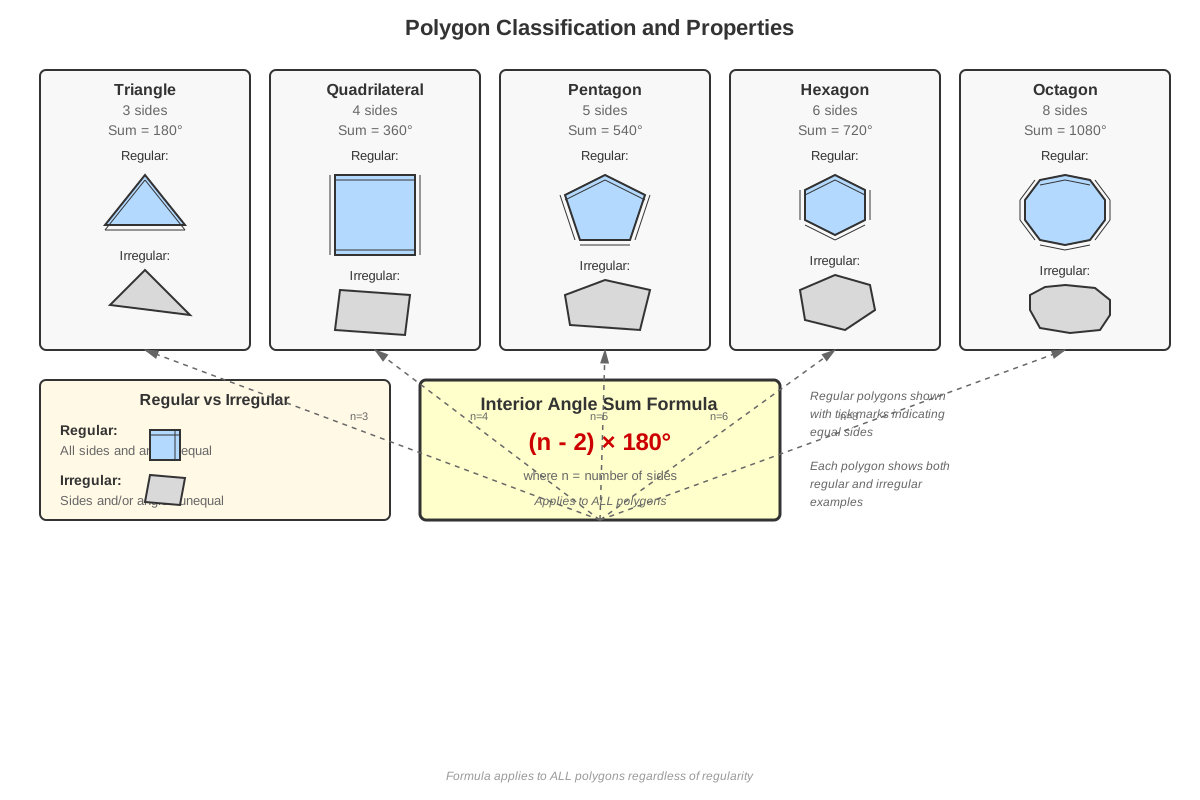
Polygons are classified by the number of sides they possess:
| Number of Sides | Polygon Name | Number of Sides | Polygon Name |
|---|---|---|---|
| 3 | Triangle | 7 | Heptagon |
| 4 | Quadrilateral | 8 | Octagon |
| 5 | Pentagon | 9 | Nonagon |
| 6 | Hexagon | 10 | Decagon |
Beyond these common names, polygons with more sides are typically referred to as "n-gons" where n represents the number of sides (e.g., a 15-gon has 15 sides). The GRE most frequently tests triangles, quadrilaterals, pentagons, hexagons, and octagons, though understanding the general principles allows solving problems involving any polygon.
Regular vs. Irregular Polygons
A regular polygon is one in which all sides have equal length and all interior angles have equal measure. Examples include equilateral triangles, squares, and regular hexagons. Regular polygons possess high symmetry and predictable properties, making calculations more straightforward. An irregular polygon has sides of different lengths or angles of different measures (or both). Most real-world polygons are irregular, and the GRE frequently tests the ability to work with these less symmetric figures.
The distinction matters significantly for problem-solving approaches. Regular polygons allow the use of simplified formulas and symmetry-based reasoning, while irregular polygons often require decomposition into simpler shapes or application of more general formulas. The GRE may present a figure that appears regular but is not labeled as such—test-takers must avoid assuming regularity without explicit confirmation.
Interior Angles of Polygons
The sum of interior angles in any polygon depends solely on the number of sides. For a polygon with n sides, the interior angle sum formula is:
Interior Angle Sum = (n - 2) × 180°This formula derives from the fact that any polygon can be divided into (n - 2) triangles by drawing diagonals from a single vertex, and each triangle contributes 180° to the total. For example, a quadrilateral (n = 4) has an interior angle sum of (4 - 2) × 180° = 360°, while a hexagon (n = 6) has an interior angle sum of (6 - 2) × 180° = 720°.
For regular polygons, where all angles are equal, each interior angle measures:
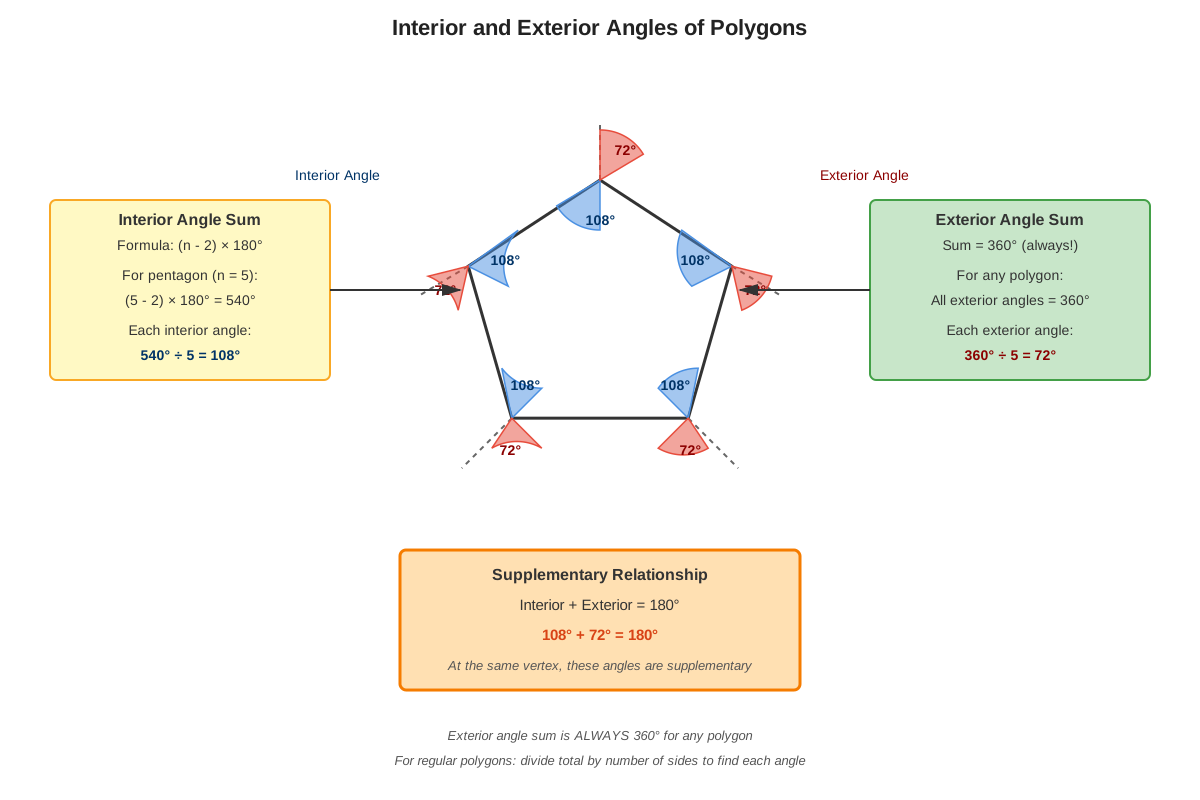
Each Interior Angle = [(n - 2) × 180°] / nThis formula is particularly useful for GRE questions asking about specific angle measures in regular polygons. For instance, each interior angle of a regular pentagon equals [(5 - 2) × 180°] / 5 = 108°.
Exterior Angles of Polygons
An exterior angle of a polygon is formed by extending one side of the polygon beyond a vertex. At each vertex, the interior and exterior angles are supplementary (they sum to 180°). A remarkable property of polygons is that the sum of all exterior angles (taking one at each vertex) always equals 360°, regardless of the number of sides:
Exterior Angle Sum = 360° (for any polygon)For regular polygons, each exterior angle measures:
Each Exterior Angle = 360° / nThis relationship provides an alternative method for finding interior angles in regular polygons, since each interior angle equals 180° minus the exterior angle. The GRE often tests whether students recognize this constant 360° sum, particularly in questions involving regular polygons or those asking about the number of sides given angle information.
Diagonals in Polygons
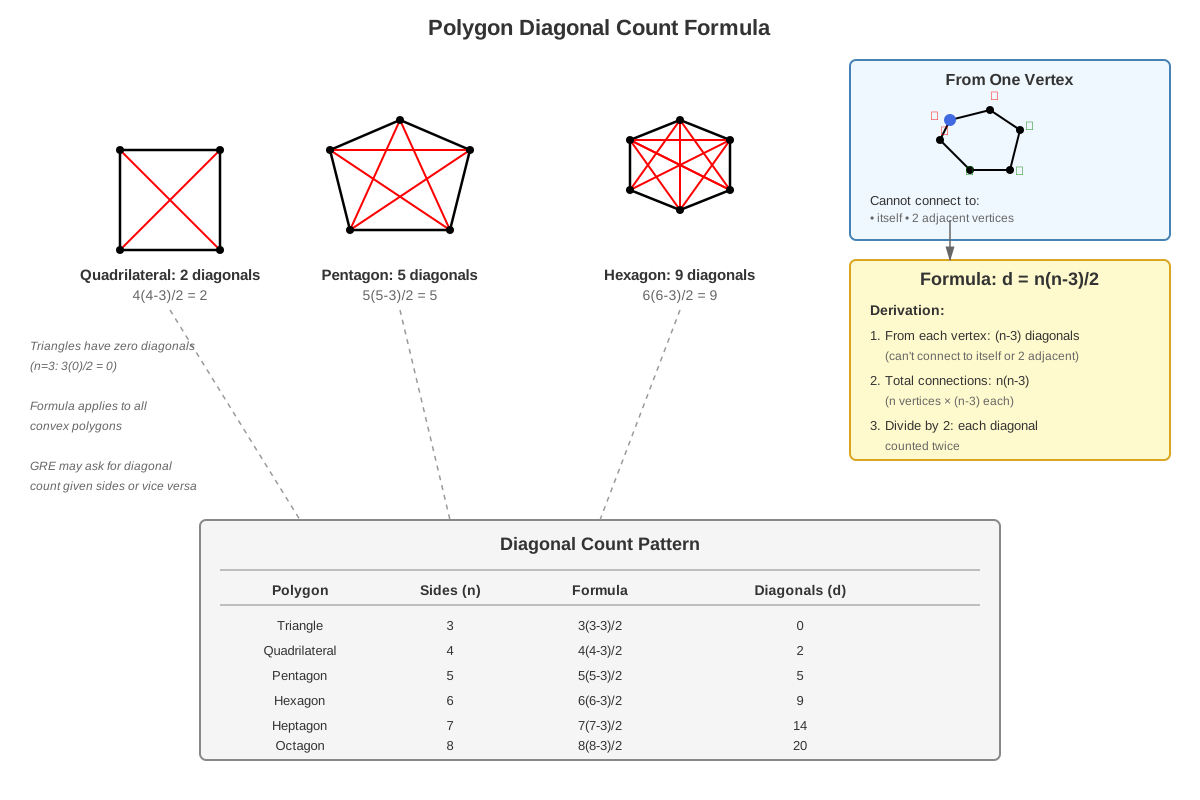
A diagonal is a line segment connecting two non-adjacent vertices of a polygon. The number of diagonals increases rapidly as the number of sides increases. For a polygon with n sides, the total number of diagonals is:
Number of Diagonals = n(n - 3) / 2This formula works because from each vertex, you can draw diagonals to (n - 3) other vertices (excluding the vertex itself and its two adjacent vertices). Multiplying by n counts each diagonal twice (once from each endpoint), so dividing by 2 gives the correct count. For example, a hexagon has 6(6 - 3) / 2 = 9 diagonals.
Perimeter and Area Calculations
The perimeter of any polygon equals the sum of all side lengths. For regular polygons with side length s and n sides:
Perimeter = n × sArea calculations vary significantly by polygon type. The GRE expects familiarity with these key formulas:
- Triangle: Area = (1/2) × base × height
- Rectangle: Area = length × width
- Square: Area = side²
- Parallelogram: Area = base × height
- Trapezoid: Area = (1/2) × (base₁ + base₂) × height
- Regular polygon: Area = (1/2) × perimeter × apothem (where apothem is the perpendicular distance from center to any side)
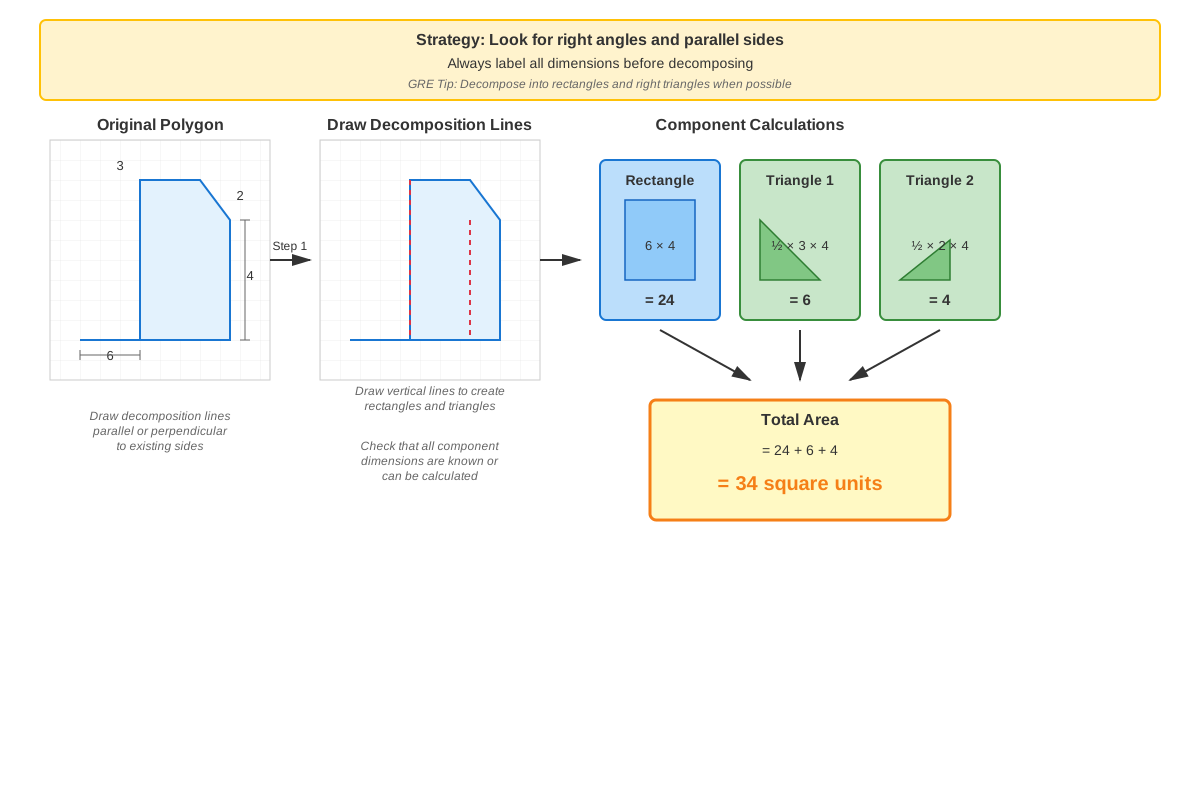
For irregular polygons, the most common GRE strategy involves decomposition—breaking the figure into triangles, rectangles, or other familiar shapes, calculating each area separately, and then adding or subtracting as appropriate.
Convex vs. Concave Polygons
A convex polygon has all interior angles less than 180°, and all diagonals lie entirely inside the polygon. A concave polygon (also called non-convex) has at least one interior angle greater than 180°, creating an indentation where some diagonals pass outside the polygon. While the GRE rarely uses this terminology explicitly, recognizing concave polygons helps avoid errors when decomposing figures or applying formulas. Most standard formulas assume convex polygons unless otherwise specified.
Concept Relationships
The study of polygons builds directly upon foundational angle relationships and triangle properties. Understanding that the interior angle sum formula derives from triangulation (dividing polygons into triangles) reinforces why triangle mastery is prerequisite to polygon work. This connection flows as: Basic angle properties → Triangle angle sum (180°) → Polygon angle sum formula [(n-2) × 180°].
Within polygon study itself, concepts form an interconnected web. The relationship between interior and exterior angles (supplementary pairs) connects to the constant 360° exterior angle sum, which in turn enables solving for the number of sides in regular polygons. This chain appears as: Interior angles ↔ Exterior angles → 360° sum → Solving for n in regular polygons.
Perimeter and area calculations for polygons extend to coordinate geometry, where polygon vertices are given as coordinate pairs and distance formulas determine side lengths. This progression continues: Basic polygon formulas → Coordinate plane polygons → Distance formula applications → Area via coordinate methods (Shoelace formula).
Polygon concepts also connect forward to three-dimensional geometry, where polygons form the faces of polyhedra. Understanding polygon properties enables calculating surface areas and recognizing spatial relationships in prisms, pyramids, and other solids. The pathway extends: 2D polygon properties → Faces of 3D solids → Surface area calculations → Volume relationships.
Finally, regular polygons connect to circle geometry through inscribed and circumscribed relationships. Regular polygons can be inscribed in circles (all vertices on the circle) or circumscribed around circles (all sides tangent to the circle), creating problems that test both polygon and circle properties simultaneously.
Quick check — test yourself on Polygons so far.
Try Flashcards →High-Yield Facts
⭐ The sum of interior angles in any n-sided polygon equals (n - 2) × 180°
⭐ The sum of exterior angles in any polygon always equals 360°
⭐ Each interior angle of a regular n-sided polygon measures [(n - 2) × 180°] / n
⭐ A polygon with n sides has exactly n(n - 3) / 2 diagonals
⭐ For regular polygons, each exterior angle equals 360° / n
- A quadrilateral's interior angles always sum to 360°, regardless of shape
- A hexagon's interior angles sum to 720°
- Each interior angle of a regular hexagon measures 120°
- An octagon has 8 sides and 20 diagonals
- The perimeter of a regular polygon equals the number of sides times the side length
- Interior and exterior angles at any vertex are supplementary (sum to 180°)
- A pentagon can be divided into 3 triangles from a single vertex
- Regular polygons have rotational symmetry of order n (where n is the number of sides)
- The area of a regular polygon can be calculated using: Area = (1/2) × perimeter × apothem
- Irregular polygon areas are typically found by decomposition into triangles and rectangles
Common Misconceptions
Misconception: All polygons with equal side lengths are regular polygons.
Correction: A regular polygon requires both equal side lengths AND equal angle measures. A rhombus has four equal sides but is not a regular polygon unless it's also a square (with all 90° angles).
Misconception: The interior angle sum formula (n - 2) × 180° only works for convex polygons.
Correction: This formula applies to all simple polygons (those without self-intersections), whether convex or concave. The key requirement is that the polygon is closed and non-self-intersecting.
Misconception: If a polygon looks regular in a diagram, it can be assumed to be regular for calculations.
Correction: On the GRE, never assume regularity unless explicitly stated or marked with equal side/angle indicators. Diagrams are not necessarily drawn to scale, and appearances can be deceiving.
Misconception: The number of diagonals equals the number of sides.
Correction: The number of diagonals grows much faster than the number of sides, following the formula n(n - 3) / 2. A hexagon (6 sides) has 9 diagonals, not 6.
Misconception: Exterior angles are always acute angles.
Correction: Exterior angles can be obtuse, especially in polygons with many sides. For example, each exterior angle of a regular pentagon is 72°, but each exterior angle of a regular triangle (equilateral triangle) is 120°.
Misconception: The apothem and radius of a regular polygon are the same measurement.
Correction: The apothem is the perpendicular distance from the center to the midpoint of a side, while the radius extends from the center to a vertex. The radius is always longer than the apothem in any regular polygon.
Misconception: All quadrilaterals can be divided into two triangles, so all quadrilaterals have the same properties.
Correction: While all quadrilaterals have an interior angle sum of 360° and can be divided into two triangles, different quadrilateral types (rectangles, parallelograms, trapezoids, kites) have distinct properties regarding side lengths, angle measures, and symmetry.
Worked Examples
Example 1: Finding the Number of Sides from Angle Information
Problem: Each interior angle of a regular polygon measures 156°. How many sides does the polygon have?
Solution:
Step 1: Recognize that this tests the relationship between interior angles and the number of sides in regular polygons.
Step 2: Use the formula for each interior angle of a regular polygon:
Each Interior Angle = [(n - 2) × 180°] / nStep 3: Set up the equation with the given angle measure:
156 = [(n - 2) × 180] / nStep 4: Solve for n by multiplying both sides by n:
156n = (n - 2) × 180
156n = 180n - 360
Step 5: Collect like terms:
360 = 180n - 156n
360 = 24n
n = 15
Step 6: Verify using the exterior angle approach. If each interior angle is 156°, each exterior angle is 180° - 156° = 24°. Since exterior angles sum to 360°:
n = 360° / 24° = 15 sidesAnswer: The polygon has 15 sides (a 15-gon or pentadecagon).
Connection to Learning Objectives: This problem demonstrates identifying when polygon concepts are tested (angle measures given), applying the core formula for regular polygon angles, and using both interior and exterior angle relationships for verification.
Example 2: Area of an Irregular Polygon by Decomposition
Problem: A pentagon-shaped garden has the following dimensions: three sides form a rectangle measuring 10 feet by 8 feet, and the remaining two sides form a right triangle attached to one of the 10-foot sides. The triangle has a height of 6 feet. What is the total area of the garden?
Solution:
Step 1: Visualize or sketch the composite figure. The pentagon consists of a rectangle plus a triangle.
Step 2: Identify the decomposition strategy. Calculate the area of each component separately, then add them.
Step 3: Calculate the rectangular portion:
Area_rectangle = length × width = 10 × 8 = 80 square feetStep 4: Calculate the triangular portion. The base of the triangle is 10 feet (the side of the rectangle it's attached to), and the height is 6 feet:
Area_triangle = (1/2) × base × height = (1/2) × 10 × 6 = 30 square feetStep 5: Add the two areas:
Total Area = 80 + 30 = 110 square feetAnswer: The garden has a total area of 110 square feet.
Connection to Learning Objectives: This problem illustrates identifying polygon problems in word problem format, applying the core strategy of decomposition for irregular polygons, and accurately calculating areas using multiple formulas. It also demonstrates how the GRE embeds polygon concepts in practical scenarios.
Exam Strategy
When approaching GRE polygon questions, begin by identifying the polygon type and whether it's regular or irregular. This initial classification determines which formulas and strategies apply. Look for explicit statements like "regular hexagon" or visual indicators such as tick marks showing equal sides or arc marks showing equal angles. If regularity isn't specified, assume the polygon is irregular and avoid using regular polygon formulas.
Trigger words and phrases that signal polygon questions include: "n-sided figure," "interior angles," "exterior angles," "perimeter of the figure," "area of the shaded region," "number of diagonals," and specific polygon names (pentagon, hexagon, octagon). Questions asking "how many sides" when given angle information almost always require the interior or exterior angle sum formulas. Phrases like "composite figure" or "shaded region" typically indicate decomposition strategies are needed.
For quantitative comparison questions involving polygons, focus on properties that remain constant (like angle sums) versus those that vary (like individual side lengths in irregular polygons). When comparing areas or perimeters of different polygons, consider whether you can determine the relationship without calculating exact values—sometimes inequality reasoning suffices and saves time.
Process-of-elimination strategies specific to polygons include:
- Eliminate answer choices that violate fundamental properties (e.g., an interior angle sum that isn't a multiple of 180°)
- For "number of sides" questions, test answer choices by substituting into formulas rather than solving algebraically
- When area calculations seem complex, eliminate obviously too large or too small values based on rough estimation
- For regular polygon questions, verify that calculated angles fall within reasonable ranges (interior angles between 60° and 180°)
Time allocation: Straightforward polygon formula application questions should take 60-90 seconds. Problems requiring decomposition or multiple steps warrant 2-2.5 minutes. If a polygon problem requires more than 3 minutes, consider marking it for review and moving forward—these questions may be testing concepts beyond typical GRE scope or may have a simpler approach you're missing.
Always draw or annotate diagrams when working with polygons. Even if a figure is provided, adding angle measures, side lengths, or decomposition lines helps organize thinking and prevents errors. For word problems without diagrams, sketching the described polygon is essential for visualization and solution planning.
Memory Techniques
Angle Sum Mnemonic: "Need Two Triangles" reminds you that the formula involves (n - 2) triangles, each contributing 180°: (N - 2) × 180°
Exterior Angle Constant: Remember "Exterior Equals 360" (three E's, three 6's rotated) to recall that exterior angles always sum to 360° regardless of polygon type.
Diagonal Formula Visualization: Picture yourself at one vertex of an n-sided polygon. You can't draw diagonals to yourself or your two neighbors, leaving (n - 3) possible diagonals. Do this from all n vertices and divide by 2 (since each diagonal connects two vertices): n(n - 3) / 2
Regular Polygon Interior Angle: Use the phrase "Total Divided Equally" to remember: Total angle sum [(n-2) × 180°] Divided by n gives Each angle.
Common Polygon Angle Sums: Create a mental table using the pattern that each additional side adds 180°:
- Triangle (3): 180° (base case)
- Quadrilateral (4): 360° (add 180°)
- Pentagon (5): 540° (add 180°)
- Hexagon (6): 720° (add 180°)
Decomposition Strategy Acronym: STAR - Sketch the figure, Triangulate or divide into rectangles, Add component areas, Review for subtraction needs (if finding shaded regions).
Summary
Polygons represent a high-yield GRE Quantitative Reasoning topic that tests geometric knowledge, formula application, and spatial reasoning. Mastery requires understanding both general principles that apply to all polygons—such as the interior angle sum formula (n - 2) × 180° and the constant 360° exterior angle sum—and specific properties of regular polygons where symmetry enables simplified calculations. The GRE tests polygon concepts through direct calculation questions, quantitative comparisons, and word problems embedded in real-world contexts. Success depends on recognizing when to apply standard formulas versus when to employ decomposition strategies for irregular or composite figures. The ability to quickly classify polygons as regular or irregular, calculate angle measures and side relationships, determine diagonal counts, and find perimeters and areas through multiple approaches distinguishes high-scoring test-takers. Strategic diagram annotation, formula memorization for common polygons (triangles through octagons), and practiced decomposition techniques enable efficient problem-solving within GRE time constraints.
Key Takeaways
- The interior angle sum of any n-sided polygon equals (n - 2) × 180°, derived from triangulation
- Exterior angles of any polygon always sum to exactly 360°, providing an alternative problem-solving approach
- Regular polygons have all equal sides and all equal angles; never assume regularity without explicit confirmation
- The number of diagonals in an n-sided polygon is n(n - 3) / 2, growing quadratically with side count
- Decomposition into triangles and rectangles is the primary strategy for finding areas of irregular or composite polygons
- Each interior angle of a regular n-sided polygon measures [(n - 2) × 180°] / n
- Interior and exterior angles at any vertex are supplementary, summing to 180°
Related Topics
Coordinate Geometry with Polygons: Extends polygon concepts to the xy-plane, where vertices are given as ordered pairs and the distance formula determines side lengths. Mastering basic polygons enables calculating perimeters and areas using coordinate methods, including the Shoelace formula for polygon area.
Circles and Inscribed Polygons: Explores relationships between regular polygons and circles, including inscribed polygons (vertices on the circle) and circumscribed polygons (sides tangent to the circle). Understanding polygon angle properties is essential for solving these hybrid problems.
Three-Dimensional Geometry: Applies polygon knowledge to solid figures where polygons form faces. Calculating surface areas of prisms, pyramids, and other polyhedra requires fluency with polygon area formulas.
Quadrilaterals: Provides deeper study of four-sided polygons, including special types (rectangles, squares, parallelograms, rhombi, trapezoids, kites) with unique properties. This specialized study builds upon general polygon principles.
Transformations and Symmetry: Examines how polygons behave under rotations, reflections, and translations. Regular polygons exhibit high symmetry, making them ideal for studying transformation properties.
Practice CTA
Now that you've mastered the core concepts, formulas, and strategies for GRE polygon questions, it's time to reinforce your learning through active practice. Attempt the practice questions associated with this topic, focusing on applying the angle sum formulas, decomposition strategies, and regular polygon properties you've learned. Use the flashcards to drill essential formulas until they become automatic—this fluency will save precious time on test day. Remember, polygon mastery isn't just about memorizing formulas; it's about recognizing patterns, visualizing spatial relationships, and selecting efficient solution strategies. Each practice problem you solve strengthens these skills and builds the confidence needed for GRE success. You've built a solid foundation—now apply it!
Sign up free to keep reading
Create a free AnvayaPrep account to finish this GRE guide on Polygons — plus flashcards and practice questions.