Overview
Parallelograms represent one of the most frequently tested quadrilateral shapes on the GRE Quantitative Reasoning section. These four-sided figures possess unique properties that distinguish them from other polygons, and understanding these characteristics is essential for solving a wide range of geometry problems. A parallelogram is defined as a quadrilateral with two pairs of parallel opposite sides, and this fundamental property gives rise to numerous other geometric relationships involving angles, sides, diagonals, and area calculations. Mastery of parallelogram properties enables test-takers to quickly identify relationships, calculate missing measurements, and solve complex multi-step problems that appear regularly on the exam.
The importance of GRE parallelograms extends beyond isolated geometry questions. These shapes frequently appear in coordinate geometry problems, area comparison questions, and integrated reasoning scenarios that combine algebraic and geometric thinking. Parallelograms also serve as the foundation for understanding special cases like rectangles, rhombuses, and squares—each of which inherits all parallelogram properties while adding additional constraints. Questions involving parallelograms often test multiple concepts simultaneously, requiring students to apply knowledge of parallel lines, transversals, triangle properties, and coordinate geometry within a single problem.
Within the broader Quantitative Reasoning framework, parallelograms connect directly to fundamental concepts in plane geometry, including angle relationships, perimeter and area formulas, and coordinate plane applications. They bridge the gap between basic polygon knowledge and more advanced geometric reasoning, making them a critical component of a comprehensive GRE preparation strategy. Students who thoroughly understand parallelogram properties gain significant advantages in both Quantitative Comparison and Problem Solving question formats, particularly when dealing with "must be true" versus "could be true" scenarios that frequently appear on the exam.
Learning Objectives
- [ ] Identify when Parallelograms is being tested
- [ ] Explain the core rule or strategy behind Parallelograms
- [ ] Apply Parallelograms to GRE-style questions accurately
- [ ] Distinguish between properties that apply to all parallelograms versus special cases only
- [ ] Calculate area and perimeter of parallelograms using multiple methods
- [ ] Solve for unknown angles and side lengths using parallelogram properties
- [ ] Recognize parallelograms in coordinate geometry contexts and apply appropriate formulas
Prerequisites
- Basic properties of quadrilaterals: Understanding that quadrilaterals are four-sided polygons with interior angles summing to 360° provides the foundation for all parallelogram work
- Parallel lines and transversals: Knowledge of alternate interior angles, corresponding angles, and same-side interior angles is essential for understanding angle relationships in parallelograms
- Triangle properties: Many parallelogram problems involve dividing the figure into triangles, requiring familiarity with triangle area formulas and congruence
- Coordinate plane basics: Problems often place parallelograms on coordinate grids, necessitating comfort with plotting points and calculating distances
- Basic algebraic manipulation: Solving for unknown variables in equations derived from parallelogram properties requires fundamental algebra skills
Why This Topic Matters
Parallelograms appear with remarkable frequency on the GRE, showing up in approximately 10-15% of all geometry questions across both Quantitative Comparison and Problem Solving formats. The Educational Testing Service (ETS) favors parallelogram questions because they efficiently test multiple geometric concepts simultaneously—parallel lines, angle relationships, area formulas, and spatial reasoning—all within a single problem. This efficiency makes parallelograms an ideal vehicle for creating medium-to-hard difficulty questions that differentiate high-scoring test-takers from average performers.
In real-world applications, parallelogram principles appear in engineering, architecture, physics (particularly in vector analysis and force diagrams), computer graphics, and design. The parallelogram law of vector addition, for instance, is fundamental to understanding forces and motion. In construction and design, parallelogram properties ensure structural stability and aesthetic balance. Understanding these shapes develops spatial reasoning skills that extend far beyond standardized testing.
On the GRE specifically, parallelogram questions commonly appear in several distinct formats: Quantitative Comparison questions asking students to compare areas or perimeters of different parallelograms; Problem Solving questions requiring calculation of specific measurements; coordinate geometry problems where vertices are given as ordered pairs; and integrated reasoning questions that combine parallelogram properties with algebraic expressions. The exam frequently tests whether students can distinguish between properties that must be true for all parallelograms versus those that are only true for special cases like rectangles or rhombuses—a subtle but critical distinction that separates correct from incorrect answers.
Core Concepts
Definition and Basic Properties
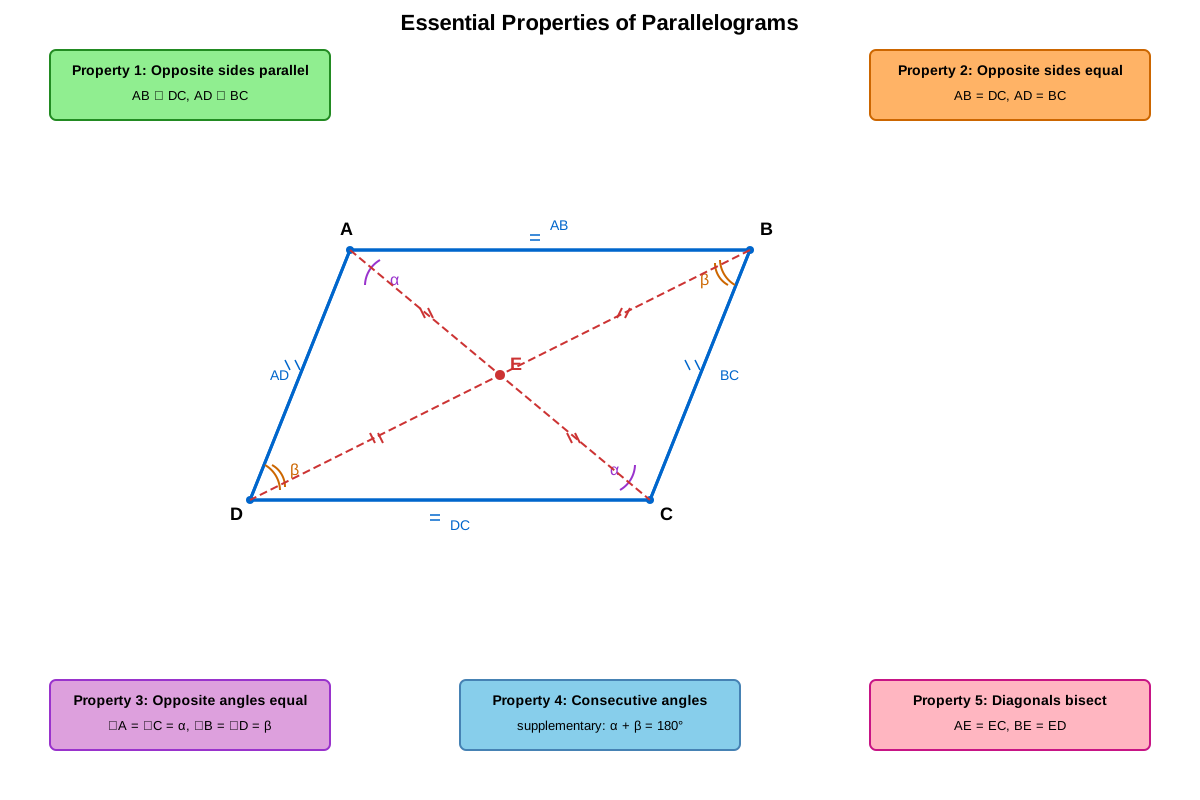
A parallelogram is a quadrilateral (four-sided polygon) in which both pairs of opposite sides are parallel. This defining characteristic—having two pairs of parallel sides—automatically generates several other important properties that hold true for every parallelogram without exception. The symbol for parallelogram is often written as ▱ABCD, where the vertices are labeled in order around the perimeter.
From the fundamental definition of parallel opposite sides, several essential properties emerge:
- Opposite sides are congruent: If ABCD is a parallelogram, then AB = CD and BC = AD
- Opposite angles are congruent: Angle A = Angle C, and Angle B = Angle D
- Consecutive angles are supplementary: Any two angles that share a side sum to 180° (Angle A + Angle B = 180°)
- Diagonals bisect each other: The diagonals intersect at their midpoints, dividing each diagonal into two equal segments
These properties are not independent; they are logically interconnected consequences of the parallel sides. Understanding why these properties must be true—not just memorizing them—enables students to solve complex problems and avoid common traps on the GRE.
Angle Relationships in Parallelograms
The angle properties of parallelograms derive directly from the relationships created when parallel lines are cut by transversals. When one side of a parallelogram acts as a transversal cutting two parallel sides, alternate interior angles are congruent. This fundamental relationship from parallel line geometry explains why opposite angles in a parallelogram must be equal.
Consider parallelogram ABCD where AB is parallel to CD and BC is parallel to AD. When we examine side BC as a transversal cutting the parallel lines AB and CD, angle ABC and angle BCD are same-side interior angles, which must be supplementary (sum to 180°). This pattern repeats around the entire figure, ensuring that any two consecutive angles always sum to 180°.
A critical GRE testing point involves the sum of all interior angles. Like all quadrilaterals, parallelograms have interior angles that sum to 360°. However, because opposite angles are equal, if we know just one angle in a parallelogram, we can determine all four angles. If angle A measures x degrees, then angle C also measures x degrees, while angles B and D each measure (180 - x) degrees.
Side Length Properties and Perimeter
The congruence of opposite sides in parallelograms simplifies perimeter calculations significantly. The perimeter of any parallelogram equals 2(a + b), where a and b represent the lengths of two adjacent sides. This formula reflects the fact that opposite sides are equal, so we have two sides of length a and two sides of length b.
On the GRE, side length problems often involve algebraic expressions rather than numerical values. For example, if one side is represented as (2x + 3) and an adjacent side as (x - 1), the perimeter would be 2[(2x + 3) + (x - 1)] = 2(3x + 2) = 6x + 4. Students must be comfortable manipulating these expressions and solving for unknown variables when given the perimeter.
An important distinction: while opposite sides must be equal in all parallelograms, adjacent sides need not be equal. When all four sides are equal, the parallelogram becomes a special case called a rhombus. This distinction frequently appears in "must be true" versus "could be true" questions on the exam.
Diagonal Properties and Relationships
The diagonals of a parallelogram create several important geometric relationships. The most fundamental property states that diagonals bisect each other—they intersect at their midpoints. If the diagonals of parallelogram ABCD intersect at point E, then AE = EC and BE = ED. This bisection property is both necessary and sufficient: if the diagonals of a quadrilateral bisect each other, the quadrilateral must be a parallelogram.
However, the diagonals of a general parallelogram are neither congruent nor perpendicular. These additional properties only appear in special cases:
- Diagonals are congruent in rectangles and squares
- Diagonals are perpendicular in rhombuses and squares
- Only squares have diagonals that are both congruent and perpendicular
The diagonals divide a parallelogram into four triangles. The two triangles formed by one diagonal are congruent to each other, and each has an area equal to half the parallelogram's total area. This relationship proves useful in many GRE problems involving area calculations.
Area Formulas and Calculations
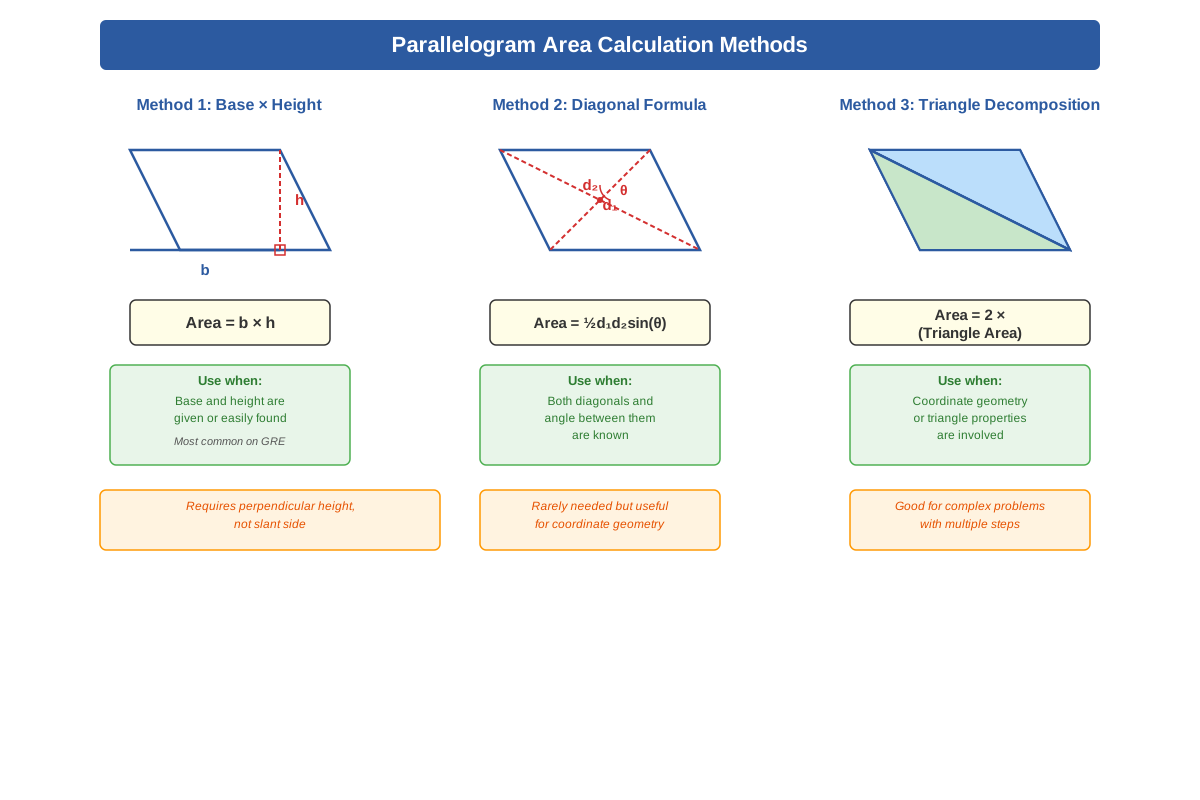
The area of a parallelogram can be calculated using multiple formulas, each useful in different problem contexts. The most common formula is:
Area = base × heightHere, the base can be any side of the parallelogram, and the height is the perpendicular distance from that base to the opposite side. Critically, the height must be perpendicular to the base—it is not the length of an adjacent side unless that side happens to be perpendicular (as in a rectangle).
A common GRE trap involves confusing the side length with the height. If a parallelogram has sides of length 8 and 5, and the angle between them is not 90°, the area is not 40. The height must be calculated using trigonometry or provided separately.
An alternative area formula uses the diagonals:
Area = (1/2) × d₁ × d₂ × sin(θ)where d₁ and d₂ are the diagonal lengths and θ is the angle between them. This formula is particularly useful when diagonal information is provided but base and height are not.
For parallelograms on the coordinate plane, the area can be calculated using the cross product formula or by using the Shoelace formula with the coordinates of the vertices.
Special Cases: Rectangles, Rhombuses, and Squares
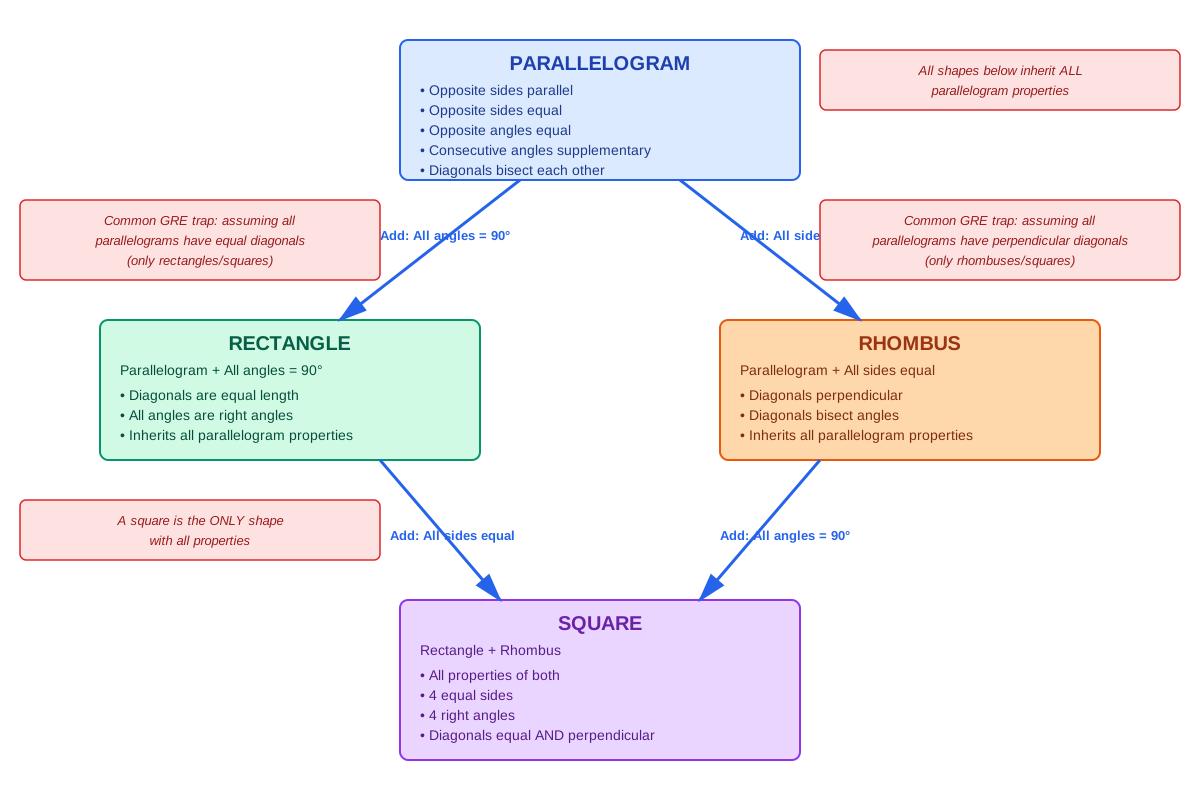
Understanding the hierarchy of parallelograms is crucial for GRE success. All rectangles, rhombuses, and squares are parallelograms, but not all parallelograms are rectangles, rhombuses, or squares.
| Type | Additional Properties Beyond Basic Parallelogram |
|---|---|
| Rectangle | All angles are 90°; diagonals are congruent |
| Rhombus | All sides are congruent; diagonals are perpendicular; diagonals bisect the angles |
| Square | All angles are 90°; all sides are congruent; diagonals are congruent and perpendicular |
This hierarchical relationship creates important logical implications for GRE questions. A statement that is true for all parallelograms must also be true for rectangles, rhombuses, and squares. However, a statement true for rectangles is not necessarily true for all parallelograms. Questions often test whether students can correctly identify which properties apply universally versus which apply only to special cases.
Coordinate Geometry Applications
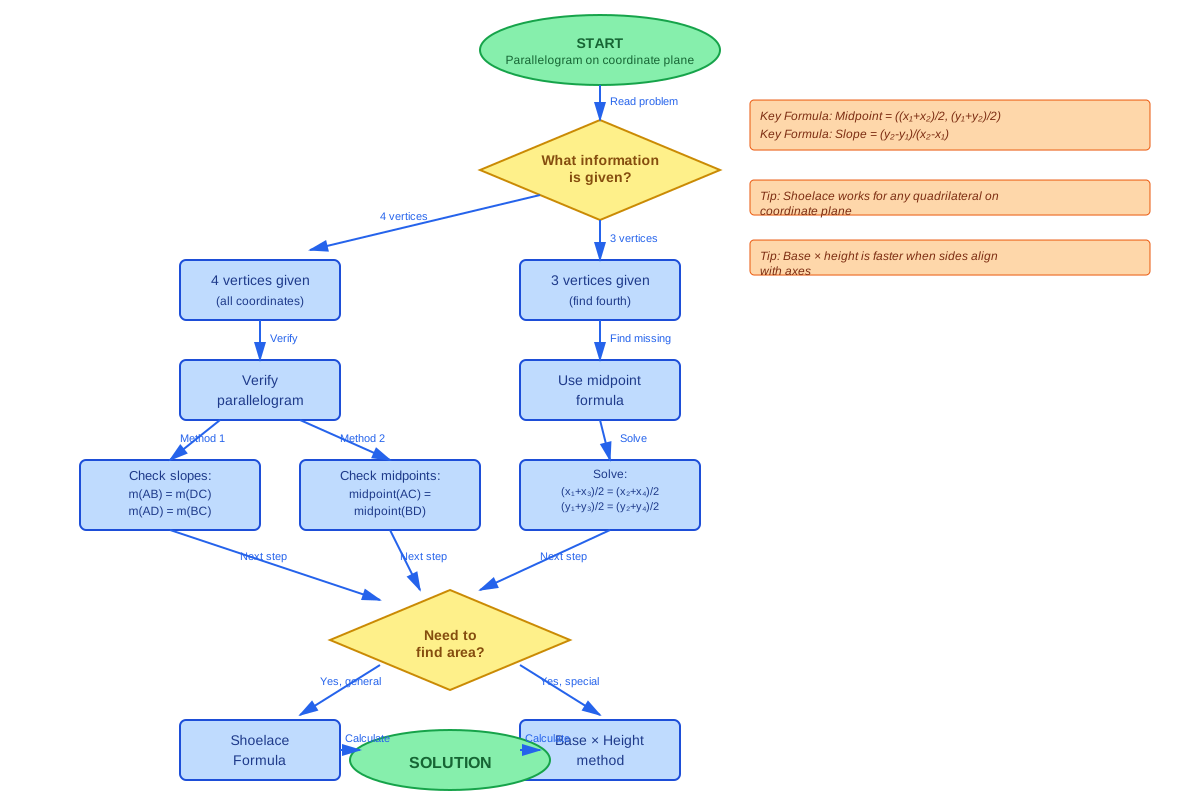
When parallelograms appear on the coordinate plane, several solution strategies become available. If three vertices of a parallelogram are given, the fourth vertex can be found using the property that diagonals bisect each other. If vertices A, B, and C are known, and we need to find vertex D, we can use the midpoint formula: the midpoint of diagonal AC must equal the midpoint of diagonal BD.
The slope concept is particularly useful for verifying that a quadrilateral is a parallelogram. Opposite sides must have equal slopes (indicating they are parallel). If the slopes of AB and CD are equal, and the slopes of BC and AD are equal, then ABCD is a parallelogram.
Distance formulas allow calculation of side lengths and diagonal lengths, which can then be used in area formulas or to verify special cases. For instance, if all four sides have equal length (calculated via distance formula), the parallelogram is a rhombus.
Quick check — test yourself on Parallelograms so far.
Try Flashcards →Concept Relationships
The properties of parallelograms form an interconnected web of logical relationships. The fundamental definition (opposite sides parallel) → generates the property that opposite sides are congruent → which leads to the simplified perimeter formula. Similarly, parallel sides → create specific angle relationships with transversals → resulting in opposite angles being congruent and consecutive angles being supplementary.
The diagonal bisection property connects to coordinate geometry through the midpoint formula, while also relating to triangle congruence (the four triangles formed by the diagonals have specific congruence relationships). Area formulas connect to both the base-height relationship and to trigonometric concepts when angles are involved.
Parallelograms serve as the parent category for rectangles, rhombuses, and squares, creating a hierarchical relationship: parallelogram → rectangle (add perpendicular angles) → square (add equal sides), or parallelogram → rhombus (add equal sides) → square (add perpendicular angles). This hierarchy means that any property true for parallelograms is automatically true for all special cases, but the reverse is not true.
The prerequisite knowledge of parallel lines and transversals directly enables understanding of parallelogram angle relationships. Triangle properties become relevant when diagonals divide the parallelogram into triangular regions. Coordinate plane skills allow application of parallelogram concepts in algebraic contexts, bridging pure geometry with analytic geometry.
High-Yield Facts
⭐ Opposite sides of a parallelogram are always congruent and parallel
⭐ Opposite angles in a parallelogram are always congruent
⭐ Consecutive angles in a parallelogram are always supplementary (sum to 180°)
⭐ The diagonals of a parallelogram always bisect each other
⭐ Area of a parallelogram equals base times height, where height is the perpendicular distance between parallel sides
- The sum of all interior angles in any parallelogram is 360°
- If one angle of a parallelogram is known, all four angles can be determined
- Perimeter of a parallelogram equals 2(a + b) where a and b are adjacent side lengths
- Each diagonal divides a parallelogram into two congruent triangles
- The diagonals of a general parallelogram are neither congruent nor perpendicular (these properties only appear in special cases)
- A quadrilateral is a parallelogram if and only if its diagonals bisect each other
- In a parallelogram, the sum of the squares of the diagonals equals the sum of the squares of all four sides
- A parallelogram with one right angle must be a rectangle (all angles become 90°)
- A parallelogram with two consecutive sides of equal length must be a rhombus (all sides become equal)
- On the coordinate plane, opposite sides of a parallelogram have equal slopes
Common Misconceptions
Misconception: The diagonals of all parallelograms are equal in length. → Correction: Diagonals are only congruent in rectangles and squares, not in general parallelograms or rhombuses. The diagonals of a general parallelogram typically have different lengths.
Misconception: The height of a parallelogram is the same as the length of its side. → Correction: The height is the perpendicular distance between parallel sides, not the length of an adjacent side. The side length equals the height only when the parallelogram is a rectangle (when sides meet at 90° angles).
Misconception: If a quadrilateral has one pair of parallel sides, it's a parallelogram. → Correction: A parallelogram requires two pairs of parallel opposite sides. A quadrilateral with only one pair of parallel sides is a trapezoid, not a parallelogram.
Misconception: All properties of rectangles apply to all parallelograms. → Correction: Rectangles are special parallelograms with additional properties (90° angles, congruent diagonals). General parallelograms do not have these additional properties. Only properties that apply to all parallelograms can be assumed without additional information.
Misconception: The area of a parallelogram with sides 6 and 8 is always 48. → Correction: Area equals base times perpendicular height, not side times side. If the sides are 6 and 8 but not perpendicular, the area will be less than 48. The area equals 48 only if the sides meet at a 90° angle (making it a rectangle).
Misconception: Diagonals of a parallelogram always create four triangles of equal area. → Correction: While the diagonals do create four triangles, only opposite triangles are equal in area. Adjacent triangles may have different areas unless the parallelogram is also a rectangle.
Misconception: If opposite sides of a quadrilateral are equal, it must be a parallelogram. → Correction: While this is actually true (it's one of the sufficient conditions for a parallelogram), students often confuse this with thinking that equal adjacent sides make a parallelogram, which is false. Equal opposite sides do guarantee a parallelogram, but equal adjacent sides do not.
Worked Examples
Example 1: Finding Unknown Angles
Problem: In parallelogram PQRS, angle P measures 65°. What is the measure of angle Q?
Solution:
Step 1: Recall that consecutive angles in a parallelogram are supplementary (they sum to 180°).
Step 2: Angles P and Q are consecutive angles because they share side PQ.
Step 3: Set up the equation: angle P + angle Q = 180°
Step 4: Substitute the known value: 65° + angle Q = 180°
Step 5: Solve for angle Q: angle Q = 180° - 65° = 115°
Answer: Angle Q measures 115°
Connection to Learning Objectives: This problem demonstrates the core strategy of using the supplementary consecutive angles property, which is one of the fundamental rules that defines parallelogram behavior. Recognizing that the problem tests angle relationships in a parallelogram (identifying when parallelograms are being tested) is the first critical step.
Example 2: Area Calculation with Coordinate Geometry
Problem: A parallelogram has vertices at A(1, 2), B(5, 2), C(7, 6), and D(3, 6). What is the area of this parallelogram?
Solution:
Step 1: Visualize or sketch the parallelogram on a coordinate plane. Notice that points A and B have the same y-coordinate (2), and points C and D have the same y-coordinate (6), suggesting that AB and CD are horizontal sides.
Step 2: Calculate the length of the base. Using points A and B (the bottom side):
Base = distance from (1, 2) to (5, 2) = 5 - 1 = 4 units
Step 3: Determine the height. Since AB is horizontal at y = 2 and CD is horizontal at y = 6, the perpendicular distance (height) between these parallel sides is:
Height = 6 - 2 = 4 units
Step 4: Apply the area formula:
Area = base × height = 4 × 4 = 16 square units
Answer: The area is 16 square units
Alternative approach: We could verify this is a parallelogram by checking that opposite sides have equal slopes, then use the Shoelace formula for the area of a polygon given coordinates.
Connection to Learning Objectives: This problem requires applying parallelogram concepts to coordinate geometry contexts, demonstrating how to calculate area using the base-height formula when vertices are given as ordered pairs. It also shows how to identify that a parallelogram is being tested even when the problem is presented in coordinate form.
Exam Strategy
When approaching GRE parallelograms questions, begin by identifying which properties are relevant to the specific problem. Not every parallelogram problem requires knowledge of all properties—focus on what's being asked. If the question involves angles, immediately recall that opposite angles are equal and consecutive angles are supplementary. If it involves area, look for base and height information, being careful not to confuse side length with perpendicular height.
Trigger words and phrases that indicate parallelogram concepts include: "opposite sides parallel," "quadrilateral with," "diagonals bisect each other," "consecutive angles," and any mention of rectangles, rhombuses, or squares (which are all special parallelograms). In Quantitative Comparison questions, phrases like "could be" versus "must be" are critical—they test whether you understand which properties are universal versus which apply only to special cases.
Process of elimination strategies: When answer choices include statements about parallelogram properties, eliminate any choice that claims a special-case property (like perpendicular diagonals or congruent diagonals) applies to all parallelograms. Conversely, any choice stating that opposite sides are parallel or opposite angles are equal will be true for all parallelograms, including special cases. In Quantitative Comparison questions, if you can construct one example where Quantity A is larger and another where Quantity B is larger, the answer must be "The relationship cannot be determined."
Time allocation: Most parallelogram problems on the GRE should take 1.5 to 2 minutes. If you find yourself spending more than 2.5 minutes, you may be overcomplicating the problem. Often, the most elegant solution uses a single key property rather than multiple complex calculations. Practice identifying which property is being tested so you can apply it directly without unnecessary work.
Exam Tip: Draw a diagram if one isn't provided, but don't assume properties that aren't given. A parallelogram drawn to look like a rectangle might not actually be a rectangle unless the problem explicitly states that angles are 90°. Trust only the information provided or properties that must be true for all parallelograms.
Memory Techniques
POCS - Remember the four fundamental properties of parallelograms:
- Parallel opposite sides
- Opposite sides and angles are congruent
- Consecutive angles are supplementary
- Split diagonals (diagonals bisect each other)
The "Special Three" hierarchy: Visualize a pyramid with "Parallelogram" at the base, "Rectangle" and "Rhombus" in the middle tier (each adding one special property), and "Square" at the top (combining both special properties). This helps remember that properties flow upward—everything true for parallelograms is true for squares, but not vice versa.
Height vs. Side visualization: Picture a parallelogram "leaning over" like a pushed-over rectangle. The height is the vertical distance (perpendicular), while the side is the slanted edge. This mental image prevents confusing these two measurements in area calculations.
Diagonal bisection check: Remember "DB" = "Diagonals Bisect" for parallelograms. If you need to verify a quadrilateral is a parallelogram on the coordinate plane, check if the midpoints of the diagonals are the same point.
Angle sum shortcut: If one angle is x, the four angles are: x, (180-x), x, (180-x). This pattern (alternating between two supplementary values) is unique to parallelograms and helps quickly solve angle problems.
Summary
Parallelograms are quadrilaterals defined by having two pairs of parallel opposite sides, a property that generates several essential geometric relationships. The core properties—opposite sides congruent, opposite angles congruent, consecutive angles supplementary, and diagonals bisecting each other—form the foundation for solving virtually all GRE parallelogram problems. Understanding the distinction between properties that apply to all parallelograms versus those specific to rectangles, rhombuses, or squares is critical for avoiding common traps. Area calculations require careful attention to the difference between side length and perpendicular height, with the formula Area = base × height applying universally. When parallelograms appear in coordinate geometry contexts, slope relationships verify parallel sides, while midpoint formulas confirm diagonal bisection. Mastery of these concepts enables efficient problem-solving across multiple question formats, from straightforward calculations to complex Quantitative Comparison scenarios that test deep understanding of geometric relationships.
Key Takeaways
- Parallelograms are defined by two pairs of parallel opposite sides, which automatically generates properties about congruent opposite sides, congruent opposite angles, and supplementary consecutive angles
- The diagonals of any parallelogram bisect each other, but are only congruent in rectangles and only perpendicular in rhombuses
- Area equals base times perpendicular height—never confuse the height with the length of a slanted side
- All rectangles, rhombuses, and squares are parallelograms, but they possess additional properties beyond the basic parallelogram properties
- In Quantitative Comparison questions, distinguish carefully between what "must be true" for all parallelograms versus what "could be true" only in special cases
- Consecutive angles always sum to 180°, so knowing one angle determines all four angles in the parallelogram
- On the coordinate plane, verify parallelograms by checking that opposite sides have equal slopes and that diagonal midpoints coincide
Related Topics
Trapezoids: Understanding parallelograms provides a foundation for studying trapezoids, which have only one pair of parallel sides. Comparing these two quadrilateral types clarifies which properties depend on having two pairs of parallel sides versus just one.
Coordinate Geometry: Mastery of parallelogram properties enables more sophisticated coordinate plane problems, including optimization questions and problems involving transformations of geometric figures.
Vectors and Vector Addition: The parallelogram law of vector addition uses parallelogram geometry to represent the sum of two vectors, connecting geometric concepts to physics and advanced mathematics.
Area and Perimeter Optimization: Understanding parallelogram area formulas is essential for solving optimization problems that ask for maximum or minimum areas given certain constraints.
Geometric Proofs: Parallelogram properties frequently appear in formal geometric proofs, where students must justify each step using established theorems and postulates.
Practice CTA
Now that you've mastered the core concepts of parallelograms, it's time to solidify your understanding through active practice. Attempt the practice questions associated with this topic, focusing on applying the properties and strategies you've learned. Use the flashcards to reinforce the high-yield facts and ensure you can quickly recall essential properties under timed conditions. Remember that geometry problems become significantly easier with practice—each problem you solve strengthens your pattern recognition and builds the confidence you need to excel on test day. Your investment in understanding parallelograms will pay dividends across multiple question types on the GRE Quantitative Reasoning section!
Sign up free to keep reading
Create a free AnvayaPrep account to finish this GRE guide on Parallelograms — plus flashcards and practice questions.