Overview
Trapezoids represent a fundamental quadrilateral shape that appears regularly on the GRE Quantitative Reasoning section, testing students' ability to work with geometric properties, area calculations, and spatial reasoning. A trapezoid is defined as a quadrilateral with exactly one pair of parallel sides, called bases, while the non-parallel sides are called legs. Understanding trapezoids requires synthesizing knowledge of parallel lines, angles, area formulas, and coordinate geometry—making this topic an excellent assessment tool for the GRE test makers to evaluate multiple mathematical competencies simultaneously.
The importance of mastering GRE trapezoids extends beyond simply memorizing the area formula. Questions involving trapezoids often integrate multiple geometric concepts, requiring students to identify when a trapezoid is present (sometimes hidden within complex figures), apply properties of parallel lines and transversals, work with special cases like isosceles trapezoids, and occasionally employ coordinate geometry or algebraic reasoning to find missing dimensions. The GRE frequently embeds trapezoid problems within data sufficiency questions, comparison questions, or multi-step word problems where recognizing the trapezoid structure becomes the key to unlocking the solution.
Within the broader Quantitative Reasoning framework, trapezoids serve as a bridge between simpler quadrilaterals (rectangles, squares, parallelograms) and more complex geometric problem-solving. They test whether students can adapt formulas, recognize special cases, and apply logical reasoning when all information isn't immediately apparent. Mastery of trapezoids demonstrates geometric flexibility—the ability to decompose complex shapes, identify relevant properties, and select appropriate solution strategies under time pressure.
Learning Objectives
- [ ] Identify when Trapezoids is being tested
- [ ] Explain the core rule or strategy behind Trapezoids
- [ ] Apply Trapezoids to GRE-style questions accurately
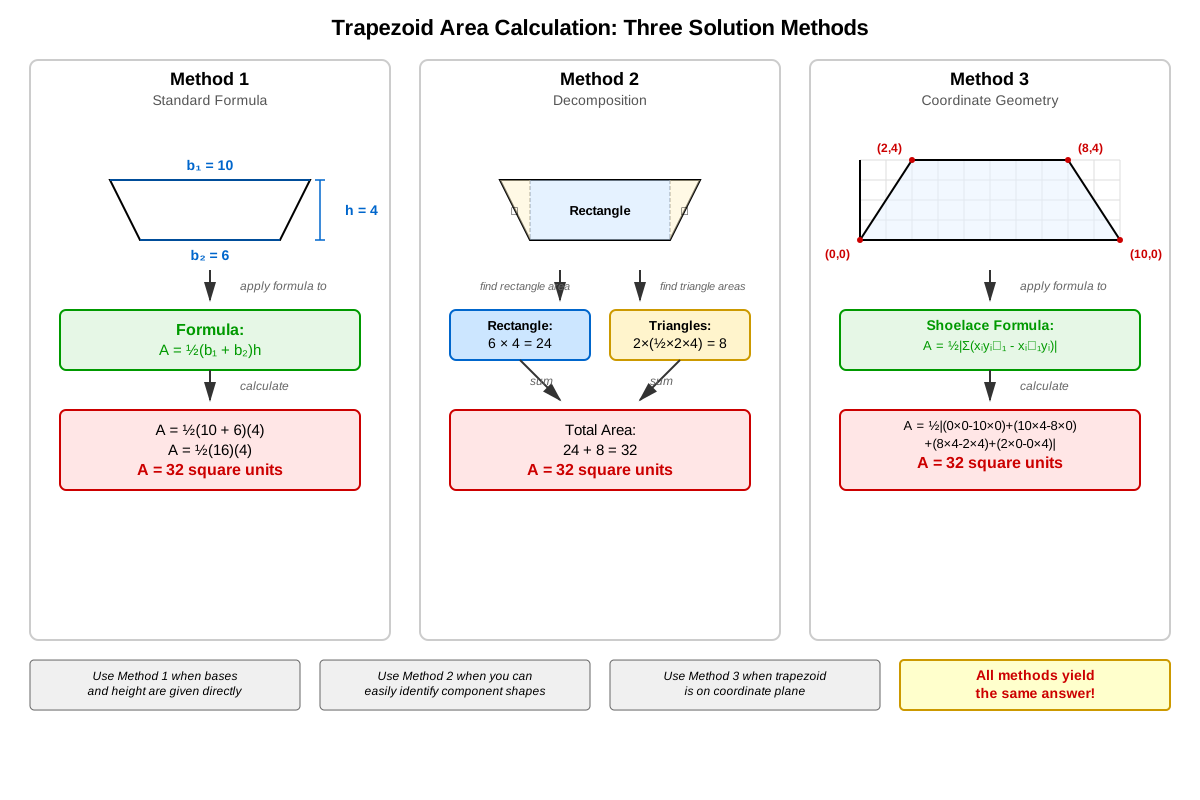
- [ ] Calculate the area of trapezoids using multiple methods (standard formula, decomposition, coordinate geometry)
- [ ] Recognize and apply properties of isosceles trapezoids, including congruent legs and base angles
- [ ] Determine missing dimensions using properties of parallel lines, similar triangles, and the midsegment theorem
- [ ] Solve multi-step problems involving trapezoids embedded in complex figures
Prerequisites
- Parallel lines and transversals: Essential for understanding why certain angle relationships exist in trapezoids and for identifying when sides are parallel
- Area of triangles and rectangles: Necessary for decomposition methods where trapezoids are broken into simpler shapes
- Properties of quadrilaterals: Provides context for how trapezoids relate to parallelograms, rectangles, and other four-sided figures
- Basic algebra: Required for setting up and solving equations when finding unknown dimensions
- Coordinate geometry fundamentals: Needed when trapezoids are presented on the coordinate plane
Why This Topic Matters
Trapezoids appear in approximately 3-5% of GRE Quantitative Reasoning questions, making them a medium-frequency but high-value topic. Their importance stems not from sheer volume but from their versatility as a testing vehicle. The GRE uses trapezoid problems to assess multiple competencies simultaneously: geometric visualization, formula application, algebraic manipulation, and logical reasoning. Questions may present trapezoids explicitly or hide them within composite figures, testing whether students can recognize the underlying structure.
In real-world applications, trapezoid geometry appears in architecture (roof designs, bridge supports), engineering (trapezoidal channels for water flow), and design (perspective drawings where rectangles appear as trapezoids). Understanding trapezoidal shapes helps in calculating areas for irregular plots of land, designing structural supports, and solving optimization problems in various fields.
On the GRE, trapezoid questions commonly appear as:
- Direct area calculations: Given dimensions, find the area
- Reverse problems: Given the area and some dimensions, find missing measurements
- Comparison questions: Comparing areas or perimeters of trapezoids with different dimensions
- Embedded figures: Trapezoids within larger shapes or formed by connecting points on coordinate planes
- Data sufficiency: Determining whether given information is sufficient to calculate area or other properties
- Word problems: Real-world scenarios involving trapezoidal shapes
Core Concepts
Definition and Basic Properties
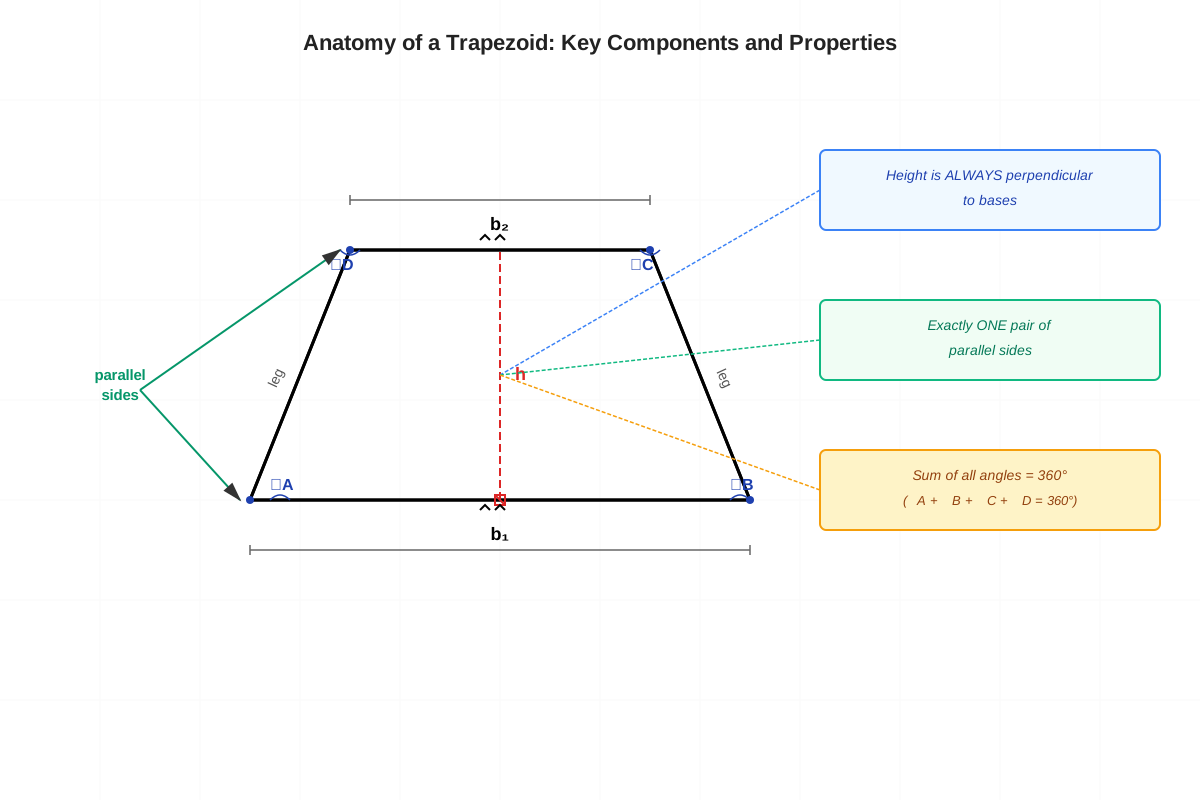
A trapezoid (also called a trapezium in some countries) is a quadrilateral with exactly one pair of parallel sides. The parallel sides are called bases (typically labeled b₁ and b₂), while the non-parallel sides are called legs. The perpendicular distance between the bases is the height (h) or altitude of the trapezoid.
Key properties of all trapezoids:
- Sum of interior angles equals 360° (true for all quadrilaterals)
- Consecutive angles between a base and a leg are supplementary (sum to 180°) due to parallel line properties
- The bases are parallel by definition
- The legs are not parallel (otherwise it would be a parallelogram)
Area Formula
The fundamental formula for the area of a trapezoid is:
Area = ½ × (b₁ + b₂) × hWhere:
- b₁ = length of the first base
- b₂ = length of the second base
- h = perpendicular height between the bases
This formula can be understood intuitively: the average of the two bases multiplied by the height gives the area. Alternatively, think of it as (b₁ + b₂)/2 × h, where (b₁ + b₂)/2 represents the length of the midsegment.
Alternative calculation methods:
- Decomposition into triangles and rectangles: Draw a perpendicular from each end of the shorter base to the longer base, creating a rectangle in the middle and two right triangles on the sides. Calculate each area separately and sum them.
- Decomposition into two triangles: Draw a diagonal to split the trapezoid into two triangles. Calculate each triangle's area using ½ × base × height and add them together.
- Coordinate geometry method: If vertices are given as coordinates, use the Shoelace formula or calculate by decomposition.
Isosceles Trapezoids
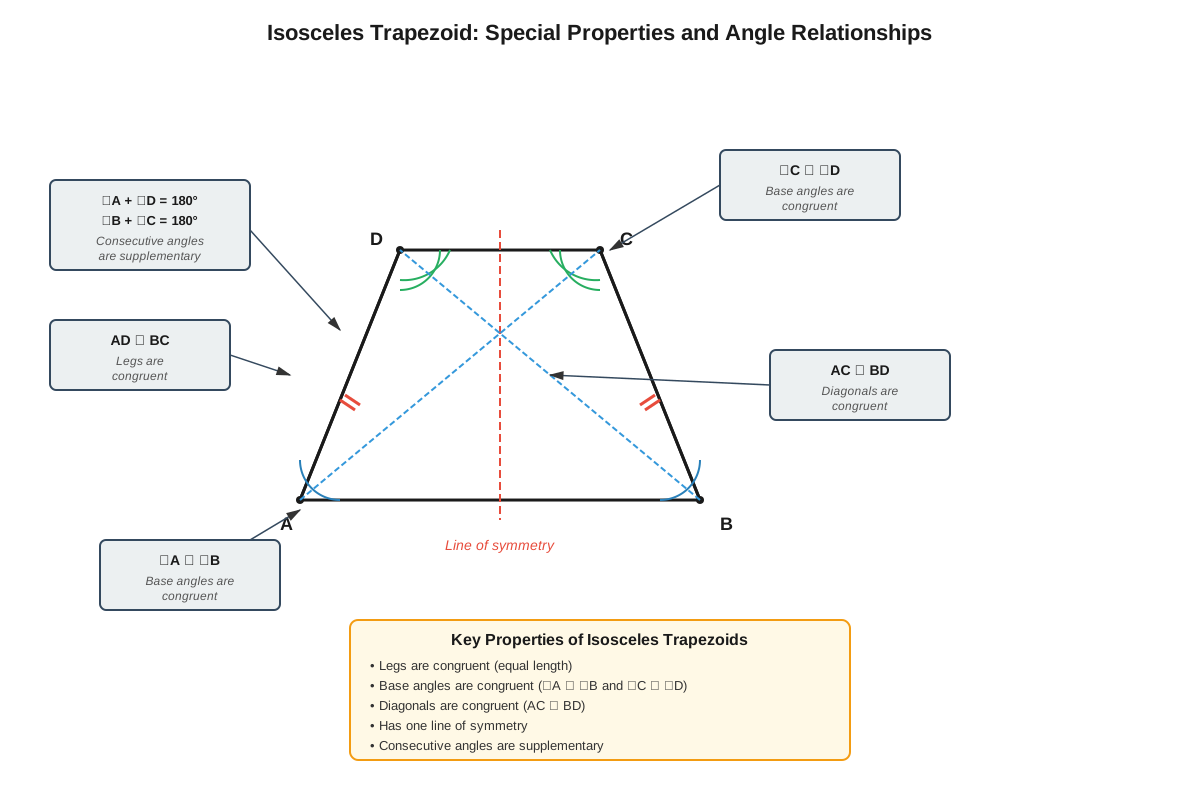
An isosceles trapezoid is a special type where the legs are congruent (equal in length). This creates additional properties:
- Base angles are congruent (angles adjacent to the same base are equal)
- Diagonals are congruent
- The trapezoid has a line of symmetry perpendicular to the bases
- If you know one base angle, you can determine all angles
For an isosceles trapezoid with legs of length l, bases b₁ and b₂ (where b₁ > b₂), and height h:
l² = h² + [(b₁ - b₂)/2]²This relationship comes from the Pythagorean theorem applied to the right triangle formed by dropping a perpendicular from the shorter base.
Midsegment (Median) of a Trapezoid
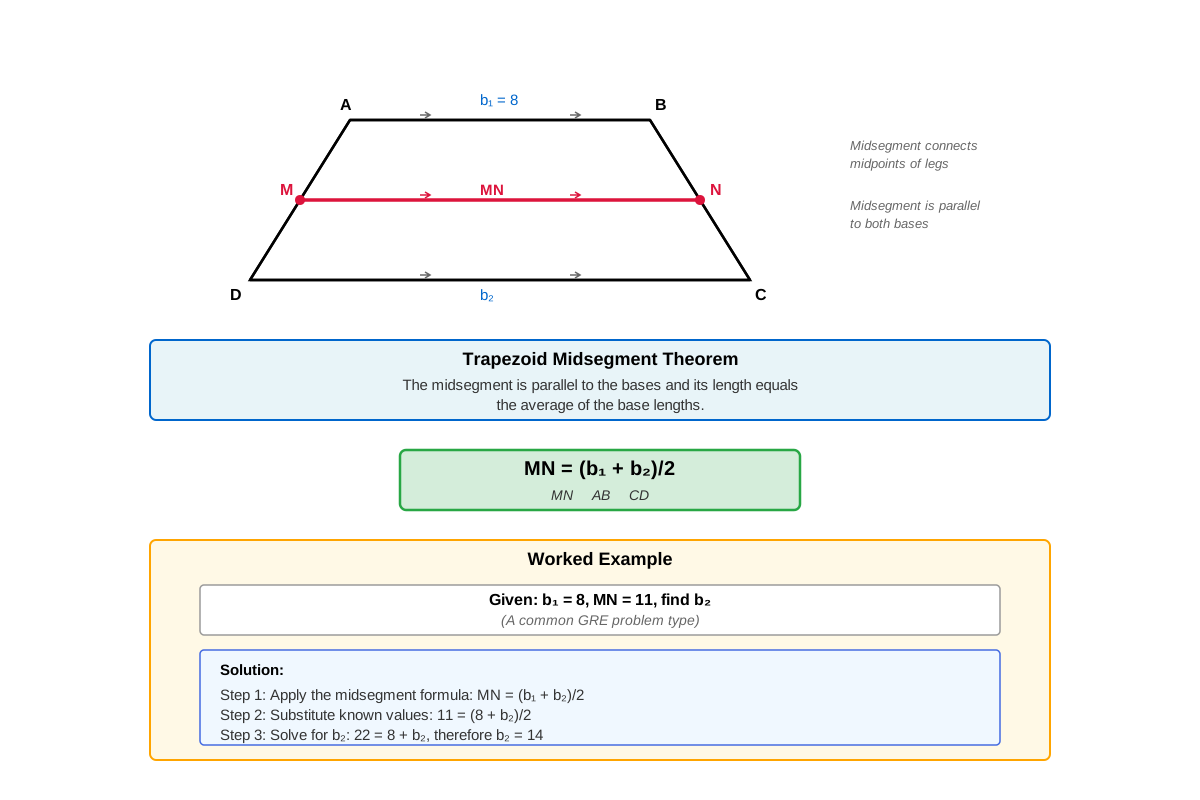
The midsegment is the line segment connecting the midpoints of the two legs. It has two crucial properties:
- The midsegment is parallel to both bases
- The length of the midsegment equals the average of the base lengths:
Midsegment = (b₁ + b₂)/2This property is particularly useful for GRE problems because:
- It provides an alternative way to express the area: Area = midsegment × height
- It helps solve problems where the midsegment length is given instead of both base lengths
- It creates similar triangles that can be used for proportion problems
Right Trapezoids
A right trapezoid has two adjacent right angles, meaning one leg is perpendicular to both bases. In this case, that leg serves as the height, simplifying calculations. Right trapezoids frequently appear on the GRE because they're easier to visualize and work with, especially in coordinate geometry problems.
Trapezoids in Coordinate Geometry
When trapezoid vertices are given as coordinate points, the approach involves:
- Identifying parallel sides: Calculate slopes of all four sides. The pair with equal slopes are the bases.
- Finding the height: Calculate the perpendicular distance between the parallel lines using the point-to-line distance formula, or identify if it's a right trapezoid where one coordinate difference gives the height directly.
- Finding base lengths: Use the distance formula for the parallel sides.
- Calculating area: Apply the standard formula or use the Shoelace formula.
Concept Relationships
The study of trapezoids builds directly upon foundational geometric concepts and connects to more advanced topics. Parallel lines → establish the defining characteristic of trapezoids → which determines angle relationships through transversal properties → leading to the ability to find missing angles using supplementary angle rules.
The area formula connects to simpler shapes: understanding triangle area and rectangle area enables the decomposition method → which reinforces why the trapezoid formula works → and connects to the midsegment concept → which itself relates to averages and midpoint formulas from coordinate geometry.
Isosceles trapezoids represent a special case that bridges to symmetry concepts and congruent triangles → while also connecting to the Pythagorean theorem when finding relationships between legs, bases, and height → which extends to right trapezoids as another special case.
Within the broader geometry unit, trapezoids sit between parallelograms (which have two pairs of parallel sides) and general quadrilaterals (which may have no parallel sides). Understanding this hierarchy helps students recognize when a figure is specifically a trapezoid versus another quadrilateral type. The midsegment theorem for trapezoids parallels the triangle midsegment theorem, showing how geometric principles extend across different shapes.
High-Yield Facts
⭐ The area of a trapezoid equals one-half the sum of the bases times the height: A = ½(b₁ + b₂)h
⭐ The midsegment of a trapezoid is parallel to the bases and equals the average of the base lengths
⭐ In an isosceles trapezoid, the legs are congruent and the base angles are congruent
⭐ Consecutive angles between a base and a leg are supplementary (sum to 180°) due to parallel line properties
⭐ A trapezoid has exactly one pair of parallel sides; if it had two pairs, it would be a parallelogram
- The diagonals of an isosceles trapezoid are congruent but do not necessarily bisect each other
- A right trapezoid has exactly two right angles, and one leg serves as the height
- The area formula can be rewritten as: Area = midsegment × height
- When a trapezoid is inscribed in a circle, it must be an isosceles trapezoid
- The sum of all interior angles in any trapezoid equals 360°
- If you know three angles of a trapezoid, you can always find the fourth by subtracting from 360°
- Trapezoids can be decomposed into simpler shapes (triangles, rectangles) for area calculation
- On the coordinate plane, parallel sides have equal slopes
- The height must be perpendicular to both bases, not the length of a leg (unless it's a right trapezoid)
- In problems involving similar trapezoids, corresponding sides are proportional and areas are proportional to the square of the scale factor
Quick check — test yourself on Trapezoids so far.
Try Flashcards →Common Misconceptions
Misconception: The legs of a trapezoid are the same as the height.
Correction: The height is the perpendicular distance between the bases, while the legs are the non-parallel sides. The legs equal the height only in a right trapezoid where one leg is perpendicular to the bases.
Misconception: All trapezoids have congruent legs and base angles.
Correction: Only isosceles trapezoids have congruent legs and congruent base angles. General trapezoids can have legs of different lengths and all different angles (except that consecutive angles between a base and leg must be supplementary).
Misconception: A parallelogram is a type of trapezoid.
Correction: By the strict definition used on the GRE, a trapezoid has exactly one pair of parallel sides, while a parallelogram has two pairs. Therefore, parallelograms are not trapezoids under this definition (though some mathematical contexts use an inclusive definition).
Misconception: The area formula is ½ × b₁ × b₂ × h (multiplying the bases together).
Correction: The correct formula is ½ × (b₁ + b₂) × h. You add the bases first, then multiply by the height and divide by 2. Multiplying the bases together would give an incorrect result.
Misconception: The midsegment length can be found by taking the difference of the bases divided by 2.
Correction: The midsegment equals the sum (not difference) of the bases divided by 2: (b₁ + b₂)/2. This is the average of the two base lengths.
Misconception: If you know the area and height of a trapezoid, you can find both individual base lengths.
Correction: Knowing the area and height allows you to find the sum of the bases (b₁ + b₂ = 2A/h), but not the individual values. You need additional information to determine each base separately.
Misconception: The diagonals of a trapezoid always bisect each other.
Correction: The diagonals of a trapezoid do not bisect each other (except in the special case where the trapezoid is actually a parallelogram). Only in parallelograms do diagonals bisect each other.
Worked Examples
Example 1: Finding Area with Given Dimensions
Problem: A trapezoid has bases of length 8 cm and 14 cm, with a height of 5 cm. What is the area?
Solution:
Step 1: Identify the given information
- Base 1 (b₁) = 8 cm
- Base 2 (b₂) = 14 cm
- Height (h) = 5 cm
Step 2: Apply the trapezoid area formula
Area = ½ × (b₁ + b₂) × h
Area = ½ × (8 + 14) × 5
Area = ½ × 22 × 5
Area = ½ × 110
Area = 55 cm²Answer: 55 cm²
Connection to learning objectives: This demonstrates the direct application of the core trapezoid formula, addressing the objective of applying trapezoids to GRE-style questions accurately.
Example 2: Multi-Step Problem with Isosceles Trapezoid
Problem: An isosceles trapezoid has bases of 6 inches and 16 inches. If each leg makes a 60° angle with the longer base, what is the area of the trapezoid?
Solution:
Step 1: Visualize the problem
We have an isosceles trapezoid where the legs form 60° angles with the longer base (16 inches).
Step 2: Find the height
When we drop perpendiculars from the ends of the shorter base to the longer base, we create two congruent right triangles on the sides. The base of each triangle is:
(16 - 6)/2 = 10/2 = 5 inchesIn each right triangle:
- The angle at the base is 60°
- The base (adjacent to the 60° angle) is 5 inches
- We need to find the height (opposite to the 60° angle)
Using trigonometry:
tan(60°) = height/5
height = 5 × tan(60°)
height = 5 × √3
height ≈ 5 × 1.732 = 8.66 inches
Or recognizing the 30-60-90 triangle relationship:
If the shorter leg (adjacent to 60°) is 5, then the longer leg (opposite to 60°) is 5√3.
Step 3: Calculate the area
Area = ½ × (6 + 16) × 5√3
Area = ½ × 22 × 5√3
Area = 55√3 square inches
If a numerical answer is needed: 55 × 1.732 ≈ 95.26 square inches
Answer: 55√3 square inches (or approximately 95.26 square inches)
Connection to learning objectives: This problem demonstrates identifying when trapezoid properties are being tested (recognizing the isosceles trapezoid), explaining the strategy (using special right triangles and trigonometry), and applying multiple concepts to solve accurately.
Example 3: Coordinate Geometry Application
Problem: A trapezoid has vertices at A(0, 0), B(6, 0), C(5, 4), and D(1, 4). What is the area?
Solution:
Step 1: Identify which sides are parallel
Points A and B both have y-coordinate 0, so AB lies on the x-axis.
Points C and D both have y-coordinate 4, so CD is parallel to the x-axis.
Therefore, AB and CD are the parallel bases.
Step 2: Find the base lengths
AB = 6 - 0 = 6 units
CD = 5 - 1 = 4 units
Step 3: Find the height
The height is the perpendicular distance between the parallel bases:
h = 4 - 0 = 4 unitsStep 4: Calculate the area
Area = ½ × (6 + 4) × 4
Area = ½ × 10 × 4
Area = 20 square unitsAnswer: 20 square units
Connection to learning objectives: This demonstrates identifying trapezoids in coordinate geometry contexts and applying the standard formula after extracting the necessary dimensions from coordinates.
Exam Strategy
When approaching GRE questions involving trapezoids, follow this systematic process:
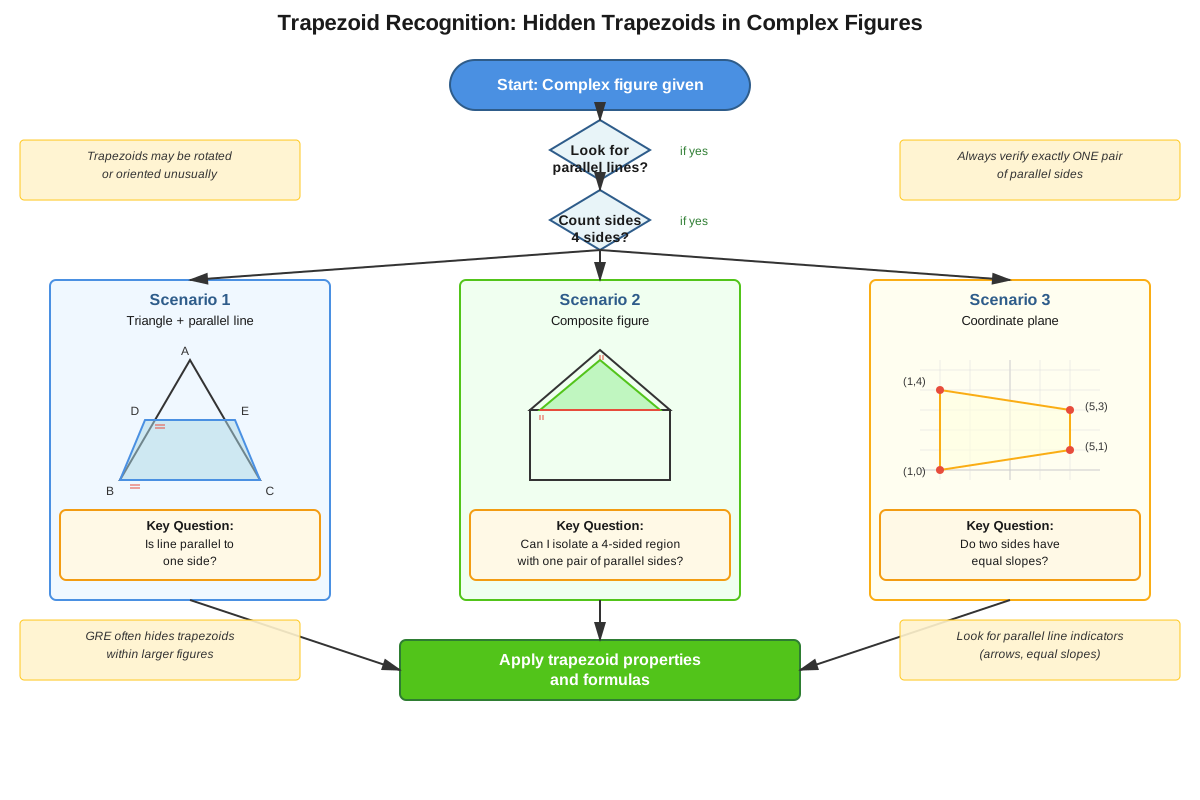
Recognition Phase: Look for trigger words and visual cues
- Explicit mentions: "trapezoid," "parallel sides," "bases and legs"
- Implicit indicators: A quadrilateral with one pair of parallel sides marked, figures that look like tilted rectangles, or coordinate geometry problems where two sides have equal slopes
- Hidden trapezoids: Larger figures that can be divided into trapezoids, or problems asking about "the region between two parallel lines"
Analysis Phase: Determine what type of trapezoid and what's being asked
- Is it a general trapezoid, isosceles, or right trapezoid?
- What information is given (bases, height, angles, coordinates)?
- What needs to be found (area, perimeter, missing dimension, angle)?
- Are there any special properties you can exploit?
Solution Phase: Select the most efficient method
- For area problems with given dimensions: Apply the formula directly
- For missing dimensions: Set up equations using the area formula or geometric properties
- For coordinate geometry: Calculate slopes to identify bases, then find lengths and height
- For complex figures: Consider decomposition into simpler shapes
Time-saving tip: If you need to find the area and you're given or can easily find the midsegment length, use Area = midsegment × height instead of calculating both bases separately.
Process of Elimination for Multiple Choice:
- Eliminate answers that exceed the area of a rectangle with the same height and longer base
- Eliminate answers smaller than the area of a triangle with base equal to the longer base and same height
- For comparison questions, if bases are equal but heights differ, the trapezoid with greater height has greater area
- Check units: if dimensions are in feet but answer choices are in square inches, eliminate mismatched units
Common time traps to avoid:
- Don't confuse leg length with height
- Don't multiply bases together instead of adding them
- Don't forget to divide by 2 in the area formula
- Don't assume a trapezoid is isosceles unless explicitly stated or proven
Allocation advice: Trapezoid problems typically take 1.5-2 minutes. If a problem requires multiple steps (finding height using trigonometry, then calculating area), budget 2-2.5 minutes. If you're stuck after 30 seconds, mark it and move on—these problems rarely require insight beyond the standard formula and properties.
Memory Techniques
Area Formula Mnemonic: "Half the Sum Times Height" → HSTH
- Think: "Has Some Trapezoidal Height"
- Formula: ½ × (Sum of bases) × Height
Midsegment Memory: "Middle Averages Bases"
- The midsegment is in the middle and equals the average of the bases
- Visual: Draw a trapezoid and imagine the midsegment as a "balance point" between the bases
Isosceles Trapezoid Properties: "Legs And Angles Congruent" → LAAC
- Legs are congruent
- Angles at each base are congruent
- Also remember: Diagonals are congruent (add a D: LAACD)
Parallel Properties: "Parallel Creates Supplementary" → PCS
- When a transversal (leg) crosses parallel lines (bases), consecutive interior angles are supplementary
- Visual: Draw a trapezoid and mark consecutive angles as adding to 180°
Decomposition Strategy: "Trapezoid Rectangle Triangles" → TRT
- Any trapezoid can be split into a Rectangle and two Triangles
- Drop perpendiculars from the shorter base to create this decomposition
Coordinate Geometry: "Same Slope Same Side" → SSSS
- Same Slope means Same Side (parallel)
- In a trapezoid, find the two sides with the same slope—those are your bases
Summary
Trapezoids are quadrilaterals with exactly one pair of parallel sides (bases), and mastering them requires understanding both the fundamental area formula and special properties. The core formula—Area = ½(b₁ + b₂)h—represents the average of the bases multiplied by the perpendicular height. Success on GRE trapezoid questions depends on recognizing when trapezoids appear (explicitly or hidden within complex figures), identifying special cases (isosceles or right trapezoids with additional properties), and selecting efficient solution methods. The midsegment theorem provides an alternative approach, stating that the segment connecting the midpoints of the legs is parallel to the bases and equals their average. Isosceles trapezoids feature congruent legs, congruent base angles, and congruent diagonals. Common pitfalls include confusing leg length with height, multiplying rather than adding bases, and assuming properties that only apply to special cases. Whether working with direct measurements, coordinate geometry, or embedded figures, the key is systematically identifying the parallel bases, determining the perpendicular height, and applying the appropriate formula or decomposition strategy.
Key Takeaways
- The area formula A = ½(b₁ + b₂)h requires adding the bases, multiplying by height, and dividing by two—memorize this sequence to avoid common errors
- The midsegment equals the average of the bases and is parallel to both, providing an alternative calculation method: Area = midsegment × height
- Isosceles trapezoids have congruent legs, congruent base angles, and congruent diagonals—recognizing this special case unlocks additional problem-solving approaches
- Consecutive angles between a base and a leg are always supplementary (180°) due to parallel line properties, allowing you to find missing angles
- Height must be perpendicular to the bases; leg length equals height only in right trapezoids where one leg is perpendicular to both bases
- On coordinate geometry problems, identify parallel sides by finding equal slopes, then use the distance formula for base lengths and coordinate differences for height
- Trapezoids can be decomposed into rectangles and triangles for alternative area calculations, useful when the standard formula seems difficult to apply
Related Topics
Parallelograms and Special Quadrilaterals: Understanding how trapezoids relate to parallelograms (two pairs of parallel sides), rectangles, and rhombuses helps build a complete picture of quadrilateral properties and hierarchies. Mastering trapezoids provides a foundation for recognizing when a figure is specifically one type versus another.
Similar Figures and Scale Factors: When trapezoids are similar, their corresponding sides are proportional and their areas are proportional to the square of the scale factor. This extends trapezoid knowledge into ratio and proportion problems.
Coordinate Geometry and Slopes: Deeper work with trapezoids on the coordinate plane reinforces slope concepts, distance formulas, and the relationship between algebraic and geometric representations.
Trigonometry in Geometry: Problems involving isosceles trapezoids with given angles often require trigonometric ratios to find heights or leg lengths, connecting geometric shapes to trigonometric problem-solving.
Composite Figures and Area: Trapezoids frequently appear as components of larger figures. Mastering trapezoid area calculations enables solving complex area problems involving multiple shapes.
Practice CTA
Now that you've mastered the core concepts, properties, and strategies for trapezoid problems, it's time to solidify your understanding through active practice. Work through the practice questions to apply these concepts under test-like conditions, and use the flashcards to reinforce the formulas and properties until they become automatic. Remember, the GRE rewards not just knowledge but efficient application—practice will build both your accuracy and speed. Each problem you solve strengthens your geometric intuition and prepares you for the variety of ways trapezoids can appear on test day. You've got this!
Sign up free to keep reading
Create a free AnvayaPrep account to finish this GRE guide on Trapezoids — plus flashcards and practice questions.