Overview
Avoiding calculation overload is one of the most critical strategic skills for success on the GRE Quantitative Reasoning section, particularly within Quantitative Comparison questions. This concept refers to the deliberate practice of recognizing when full computation is unnecessary and instead using conceptual reasoning, estimation, algebraic manipulation, or pattern recognition to arrive at the correct answer efficiently. The GRE is designed to reward mathematical insight over computational stamina—test-makers intentionally include questions where brute-force calculation is possible but time-consuming, while elegant shortcuts exist for those who recognize them.
Understanding when and how to avoid excessive calculation is essential because the GRE Quantitative section imposes strict time constraints: approximately 1.75 minutes per question across 27 questions in each Quantitative section. Students who attempt to calculate every value to completion often run out of time, make arithmetic errors under pressure, or exhaust their mental energy before reaching later questions. The GRE avoiding calculation overload strategy transforms test-taking from a computational marathon into a strategic exercise in mathematical reasoning.
This topic sits at the intersection of multiple Quantitative Reasoning skills: algebraic manipulation, number properties, estimation techniques, and logical reasoning. It particularly enhances performance on Quantitative Comparison questions, where the goal is not to find exact values but to determine relationships between quantities. Mastering this approach creates a cascading benefit across all GRE math question types, improving both accuracy and speed while reducing cognitive load and test anxiety.
Learning Objectives
- [ ] Identify when avoiding calculation overload is being tested
- [ ] Explain the core rule or strategy behind avoiding calculation overload
- [ ] Apply avoiding calculation overload to GRE-style questions accurately
- [ ] Recognize at least five specific triggers that signal calculation shortcuts are available
- [ ] Demonstrate the ability to simplify complex expressions without computing final numerical values
- [ ] Evaluate the trade-off between calculation and conceptual approaches within 10 seconds of reading a question
Prerequisites
- Basic algebraic manipulation: Ability to factor, expand, and simplify algebraic expressions is essential because many calculation shortcuts involve transforming expressions rather than evaluating them
- Properties of operations: Understanding commutative, associative, and distributive properties enables recognition of equivalent forms without computation
- Number sense and estimation: Familiarity with magnitude comparison and rounding provides the foundation for approximation strategies
- Quantitative Comparison format: Knowledge of the four answer choices (A: Quantity A is greater, B: Quantity B is greater, C: The two quantities are equal, D: The relationship cannot be determined) is necessary to understand when exact values are unnecessary
Why This Topic Matters
In real-world professional contexts, the ability to make quick, accurate judgments without exhaustive calculation is invaluable. Engineers estimate orders of magnitude before detailed design work, financial analysts compare growth rates conceptually before building complex models, and data scientists assess relationships between variables before running computations. The avoiding calculation overload skill develops this professional judgment in mathematical contexts.
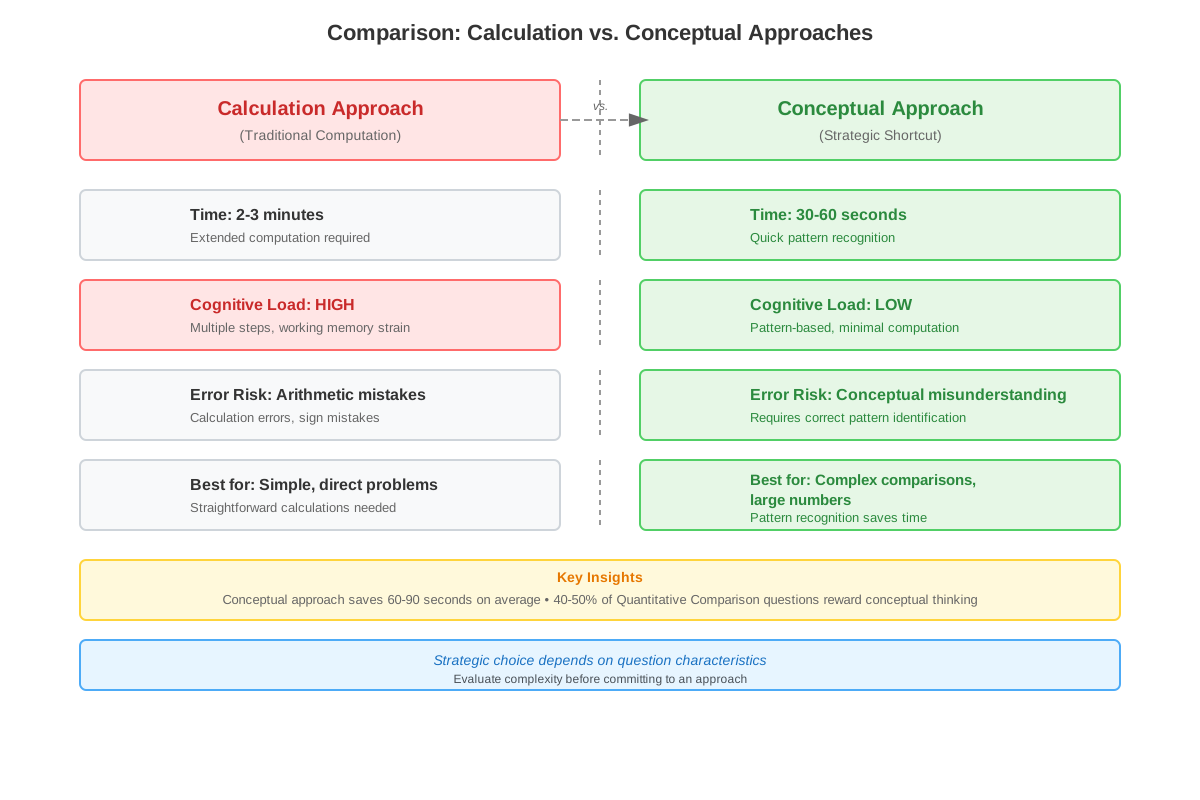
On the GRE specifically, this topic appears with remarkable frequency. Research on GRE question patterns suggests that approximately 40-50% of Quantitative Comparison questions and 20-30% of Problem Solving questions are specifically designed to reward students who avoid full calculation. These questions often feature:
- Large numbers that would be tedious to multiply or divide
- Complex fractions that simplify elegantly
- Expressions that can be compared without finding exact values
- Variables that can be manipulated algebraically rather than substituted with numbers
- Patterns that become obvious through conceptual analysis
Test-makers deliberately create "calculation traps"—questions where the obvious computational approach is feasible but inefficient, while a conceptual shortcut exists. Students who fall into these traps may arrive at correct answers but sacrifice precious time. More critically, computational approaches increase error risk: a single arithmetic mistake in a multi-step calculation yields an incorrect answer, while conceptual approaches often bypass these error opportunities entirely.
Core Concepts
The Fundamental Principle: Compare, Don't Compute
The cornerstone of avoiding calculation overload is recognizing that many GRE questions, especially Quantitative Comparisons, ask about relationships rather than specific values. When comparing Quantity A and Quantity B, the goal is determining which is larger, not calculating what each equals. This distinction is profound.
Consider comparing 347 × 892 versus 348 × 891. Computing both products would require significant time and create multiple opportunities for arithmetic errors. However, recognizing that both expressions are approximately 347 × 892 (since 348 is one more than 347, and 891 is one less than 892), and that the increase from multiplying by a larger first number outweighs the decrease from multiplying by a smaller second number, allows immediate comparison without calculation.
The fundamental principle operates through three mechanisms:
- Algebraic transformation: Manipulate expressions into comparable forms
- Conceptual analysis: Use mathematical properties to determine relationships
- Strategic estimation: Approximate to sufficient precision for comparison
Simplification Through Common Operations
When both quantities in a comparison contain similar terms or factors, simplifying by performing the same operation on both sides preserves the relationship while reducing complexity. This mirrors solving inequalities: adding, subtracting, multiplying, or dividing both sides by the same positive value maintains the inequality direction.
Valid simplification operations include:
| Operation | Example | Result |
|---|---|---|
| Subtract same value from both | A: x + 15, B: x + 12 → A: 15, B: 12 | Relationship preserved |
| Divide both by positive constant | A: 6y, B: 8y (y > 0) → A: 6, B: 8 | Relationship preserved |
| Factor out common terms | A: 5x + 5y, B: 5x + 5z → A: y, B: z | Relationship preserved |
| Square both sides (when both positive) | A: √50, B: √48 → A: 50, B: 48 | Relationship preserved |
Critical warning: Multiplying or dividing by negative numbers or variables of unknown sign reverses or complicates relationships. When the sign is uncertain, this operation should be avoided or handled with extreme care.
Pattern Recognition and Number Properties
Many calculation-heavy questions dissolve when viewed through the lens of number properties. Understanding divisibility rules, prime factorization, properties of even/odd numbers, and characteristics of perfect squares enables instant insights that bypass computation.
For example, determining whether 2^10 × 3^5 or 2^9 × 3^6 is larger doesn't require calculating these six-digit numbers. Instead, factor out common terms: both contain 2^9 × 3^5, leaving a comparison of 2 × 1 versus 1 × 3, making the second quantity larger.
Key number properties for avoiding calculation:
- Even/odd arithmetic: Even + even = even; odd + odd = even; even + odd = odd
- Divisibility shortcuts: A number divisible by both 2 and 3 is divisible by 6
- Exponent rules: When bases are equal, compare exponents; when exponents are equal, compare bases
- Fraction comparison: When numerators are equal, larger denominator means smaller fraction
- Percent relationships: 50% of A compared to 40% of B can be rewritten as 5A compared to 4B
Strategic Substitution and Testing Values
When expressions contain variables, strategic substitution involves choosing convenient numbers that make calculation trivial while revealing the relationship. The art lies in selecting values that simplify computation without obscuring the general pattern.
Effective value selection strategies:
- Use 0, 1, or -1: These values simplify most arithmetic operations
- Choose powers of 10: Makes multiplication and division mental
- Select values that satisfy given constraints: If x > 5, try x = 6 or x = 10
- Test extreme cases: Very large, very small, or boundary values often reveal patterns
- Try multiple values when answer choice D is possible: If the relationship changes with different values, the answer is D
However, strategic substitution should be a secondary approach. When algebraic manipulation or conceptual analysis can resolve the question, these methods are faster and more certain than testing multiple values.
Estimation and Magnitude Comparison
Estimation transforms precise calculation into approximate comparison, sufficient for determining relationships. This technique is particularly powerful when exact values are unnecessary or when numbers are designed to be calculation-intensive.
Effective estimation strategies include:
- Rounding to nearby convenient numbers: 487 × 23 ≈ 500 × 20 = 10,000
- Using benchmark fractions: 7/15 is slightly less than 1/2; 11/19 is slightly more than 1/2
- Comparing to powers of 10: Is this value closer to 100, 1,000, or 10,000?
- Front-end estimation: Focus on leading digits when precision isn't required
The key judgment is determining how much precision the question demands. For Quantitative Comparisons, rough approximation often suffices. For Problem Solving with specific answer choices, estimation must be precise enough to distinguish between options.
Recognizing Calculation Traps
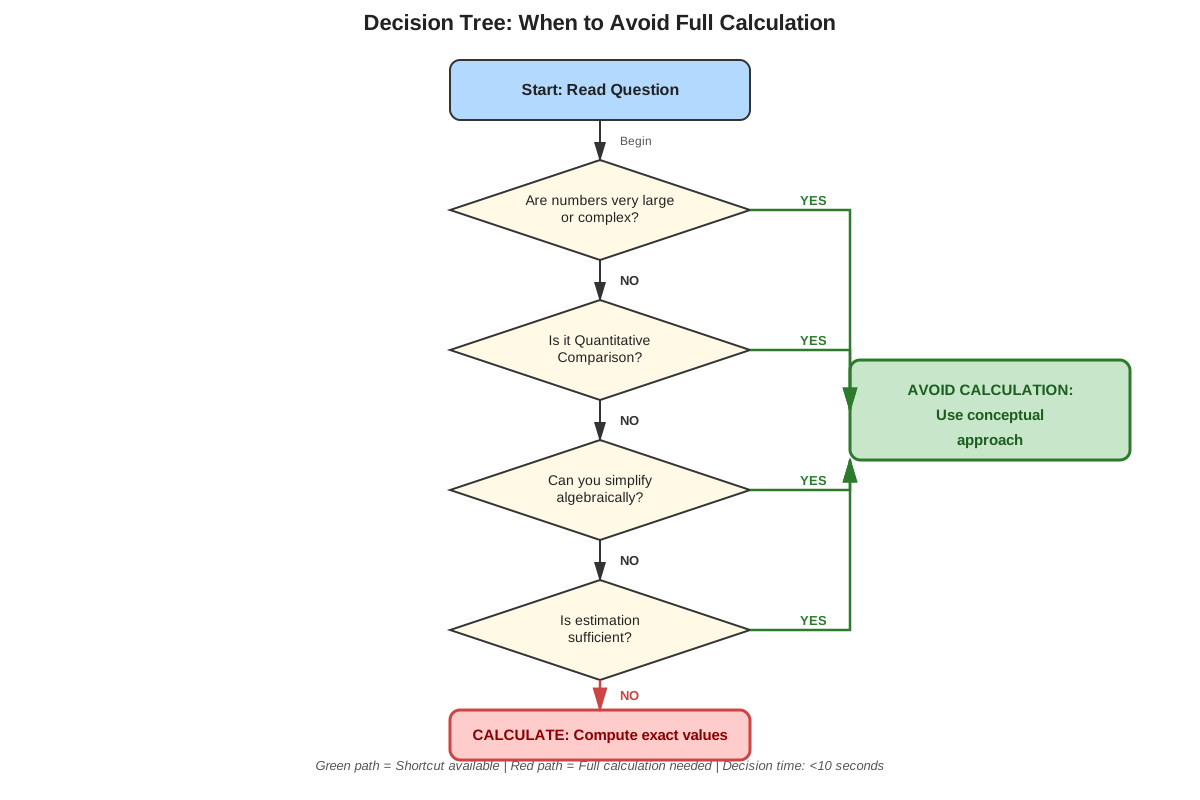
Test-makers deliberately construct questions where calculation appears necessary but isn't. Calculation traps share common characteristics:
- Numbers are large or involve multiple digits (suggesting tedious arithmetic)
- Multiple operations are required in sequence (creating error opportunities)
- The "obvious" approach involves finding exact values
- Answer choices are spread apart (suggesting estimation suffices)
- Variables can be manipulated algebraically
- Common factors or terms appear in both quantities
Developing trap recognition requires practice and metacognition—actively asking "Is there a shortcut?" before beginning calculation. This mental habit, cultivated through deliberate practice, becomes automatic and transforms test performance.
Concept Relationships
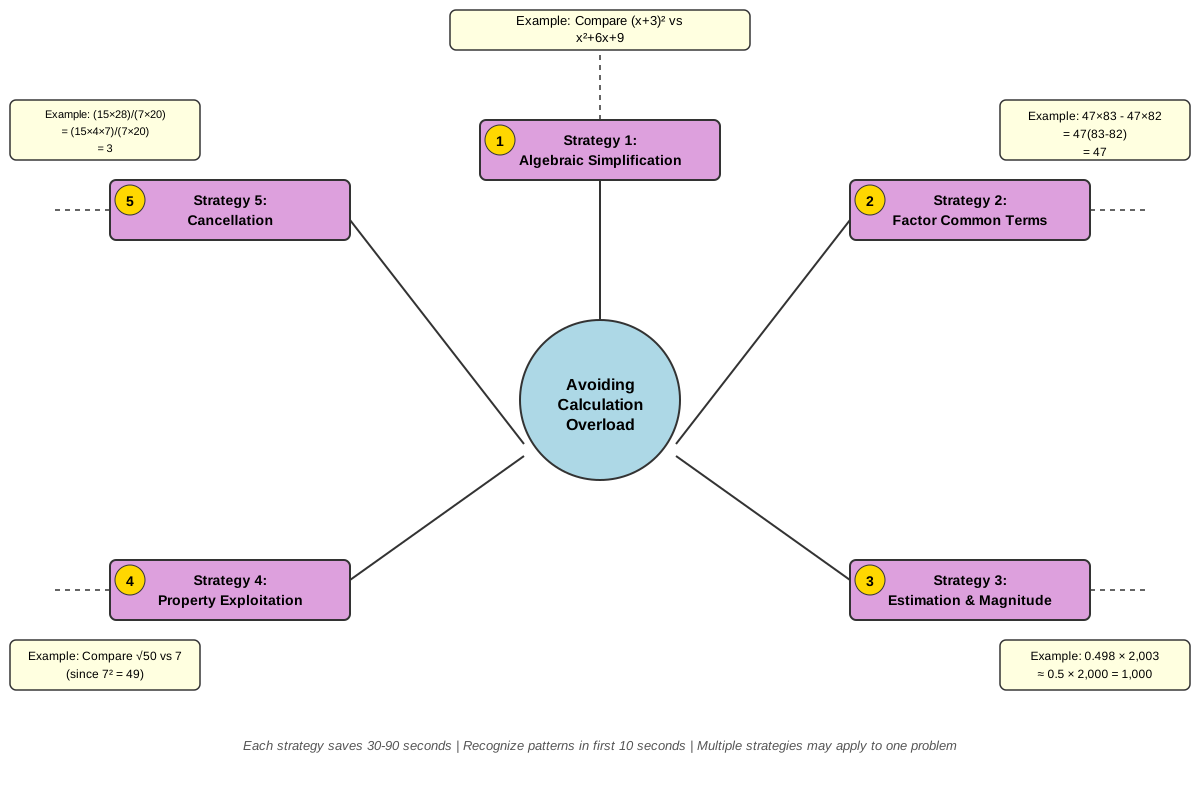
The concepts within avoiding calculation overload form an interconnected strategic framework. The fundamental principle (compare, don't compute) serves as the overarching philosophy that guides all other techniques. This principle manifests through three primary pathways:
Algebraic manipulation → Simplification through common operations → Reduced complexity enabling direct comparison
Number properties → Pattern recognition → Instant insights without computation
Strategic thinking → Estimation and value testing → Approximate answers sufficient for comparison
These pathways are not mutually exclusive; expert test-takers fluidly combine them. For instance, one might begin with algebraic simplification, recognize a number property pattern, then use estimation to confirm the relationship.
The connection to prerequisite knowledge is direct: basic algebra enables simplification techniques, number sense supports estimation, and understanding of Quantitative Comparison format clarifies when exact values are unnecessary. This topic also connects forward to advanced problem-solving strategies, time management skills, and test-taking confidence—students who master calculation avoidance experience reduced anxiety and improved pacing throughout the exam.
The relationship between recognizing calculation traps and choosing appropriate techniques is cyclical: identifying a trap triggers technique selection, while practicing techniques sharpens trap recognition. This positive feedback loop accelerates skill development with focused practice.
Quick check — test yourself on Avoiding calculation overload so far.
Try Flashcards →High-Yield Facts
⭐ The GRE rewards mathematical insight over computational ability—questions are designed so elegant shortcuts exist for those who recognize them
⭐ In Quantitative Comparisons, you never need to calculate exact values—only the relationship between quantities matters
⭐ Subtracting the same value from both quantities preserves their relationship—this is the single most useful simplification technique
⭐ When both quantities contain a common positive factor, dividing both by that factor preserves the relationship—but be cautious with negative or variable factors
⭐ If a calculation would take more than 30 seconds, a shortcut almost certainly exists—pause and look for patterns or simplifications
- Squaring both sides of a comparison is valid only when both quantities are known to be positive
- Testing x = 0, x = 1, and x = -1 reveals the behavior of most algebraic expressions efficiently
- When answer choices in Problem Solving are widely spaced, estimation is usually sufficient
- Large numbers in a question are a signal to look for cancellation, factoring, or conceptual approaches
- Percent problems often simplify by converting to fractions or removing the percent sign from both quantities
- Expressions with radicals can often be compared by squaring both sides rather than calculating decimal approximations
- When variables appear in both quantities, algebraic manipulation is almost always faster than substitution
- The presence of π, √2, or other irrational constants suggests comparison without decimal conversion
- Consecutive integer products often have patterns that bypass multiplication
- If a question seems to require calculator-level computation, reconsider the approach—the GRE doesn't allow calculators for a reason
Common Misconceptions
Misconception: Every GRE math question requires finding a specific numerical answer.
Correction: Quantitative Comparison questions only require determining relationships, and many Problem Solving questions can be answered through elimination or estimation without exact calculation. The test measures reasoning ability, not computational speed.
Misconception: Simplifying expressions always makes them easier to evaluate.
Correction: The goal is not to simplify for its own sake but to simplify in ways that facilitate comparison. Sometimes leaving expressions in factored form or with common terms visible is more useful than expanding or combining them.
Misconception: Testing one value for a variable is sufficient to determine the relationship in Quantitative Comparisons.
Correction: Unless algebraic reasoning proves the relationship holds for all valid values, multiple test values are necessary. If different values yield different relationships, the answer is D (cannot be determined). Always test at least two values, including edge cases like 0, 1, negative numbers, or fractions when permitted.
Misconception: Estimation is less accurate and should only be used as a last resort.
Correction: Strategic estimation is a primary technique on the GRE, not a fallback. When executed properly, estimation provides sufficient precision for comparison while dramatically reducing calculation time and error risk. The key is calibrating estimation precision to question requirements.
Misconception: Avoiding calculation means guessing or taking shortcuts that sacrifice accuracy.
Correction: Avoiding calculation overload means using mathematical reasoning to achieve accurate answers more efficiently. These techniques are rigorous mathematical approaches, not guessing strategies. They often yield more reliable answers than lengthy calculations because they reduce arithmetic error opportunities.
Misconception: If you can perform the calculation, you should, to be certain of the answer.
Correction: Unnecessary calculation consumes time needed for other questions and increases error risk. Even when calculation is possible, conceptual approaches are often faster and more reliable. The goal is maximizing overall test performance, not demonstrating computational ability on individual questions.
Worked Examples
Example 1: Algebraic Simplification in Quantitative Comparison
Question:
- Quantity A: (x + 3)(x - 3)
- Quantity B: x² - 6
Inefficient approach: Expand Quantity A by multiplying (x + 3)(x - 3) = x² + 3x - 3x - 9 = x² - 9, then compare x² - 9 to x² - 6. This requires multiple algebraic steps and creates opportunities for sign errors.
Efficient approach using avoiding calculation overload:
Step 1: Recognize that Quantity A is a difference of squares pattern: (x + 3)(x - 3) = x² - 9
Step 2: Rather than expanding, directly compare the simplified form to Quantity B:
- Quantity A: x² - 9
- Quantity B: x² - 6
Step 3: Subtract x² from both quantities (valid operation that preserves the relationship):
- Quantity A: -9
- Quantity B: -6
Step 4: Compare: -9 < -6, so Quantity B is greater.
Answer: B
Key insight: By recognizing the algebraic pattern and simplifying through subtraction rather than expansion and evaluation, the solution takes 15 seconds instead of 45+ seconds. This example demonstrates how avoiding calculation overload through algebraic manipulation eliminates unnecessary steps.
Example 2: Pattern Recognition with Large Numbers
Question:
- Quantity A: 87 × 92
- Quantity B: 88 × 91
Inefficient approach: Multiply 87 × 92 = 8,004 and 88 × 91 = 8,008, then compare. This requires multi-digit multiplication, significant time, and creates multiple opportunities for arithmetic errors.
Efficient approach using avoiding calculation overload:
Step 1: Recognize both products involve numbers close to each other and close to 90. Look for a pattern rather than computing.
Step 2: Express both products in terms of a middle value (89.5 or use 90 as a reference):
- 87 × 92 = (90 - 3)(90 + 2)
- 88 × 91 = (90 - 2)(90 + 1)
Step 3: Apply the pattern (a - b)(a + c) = a² + ac - ab - bc:
- Quantity A: 90² + 2(90) - 3(90) - 3(2) = 90² - 90 - 6
- Quantity B: 90² + 1(90) - 2(90) - 2(1) = 90² - 90 - 2
Step 4: Subtract 90² - 90 from both:
- Quantity A: -6
- Quantity B: -2
Step 5: Compare: -6 < -2, so Quantity B is greater.
Answer: B
Alternative efficient approach: Recognize that when multiplying two numbers, if you increase one factor and decrease the other by the same amount, the product changes based on the distance from the mean. Here, 88 and 91 are closer together (difference of 3) than 87 and 92 (difference of 5), and products are maximized when factors are closest together.
Key insight: Large numbers signal the need for pattern recognition rather than computation. Multiple conceptual approaches exist, all faster than direct calculation. This exemplifies GRE avoiding calculation overload through number sense and algebraic reasoning.
Exam Strategy
Approaching questions strategically:
- Read the question completely before calculating anything: Understand what's being asked—relationship or specific value—before choosing an approach.
- Spend 5-10 seconds looking for shortcuts: Ask "Can I simplify? Are there common factors? Can I estimate?" before beginning calculation.
- For Quantitative Comparisons, immediately look for common terms: If both quantities contain x, y, or numerical terms, consider what can be subtracted or factored out.
- Trigger words and phrases that signal calculation shortcuts:
- "Compare" → relationship matters, not exact values
- Large multi-digit numbers → look for patterns or estimation
- Variables in both quantities → algebraic manipulation likely optimal
- "Approximately" → estimation explicitly permitted
- Radicals, π, or irrational numbers → compare without decimal conversion
- Fractions with large numerators/denominators → look for cancellation
- Process of elimination for Problem Solving:
- Estimate the magnitude (is the answer in the tens, hundreds, thousands?)
- Eliminate answer choices outside the reasonable range
- Check units and signs to eliminate impossible answers
- Use number properties (even/odd, positive/negative) to eliminate options
- Time allocation:
- If a calculation approach would exceed 45 seconds, stop and reconsider
- Allocate saved time to more challenging questions later in the section
- Don't sacrifice accuracy for speed, but recognize that efficient methods are often more accurate
- When to calculate vs. when to avoid:
- Calculate when: numbers are small, operations are simple, no obvious pattern exists
- Avoid when: numbers are large, multiple steps required, algebraic form reveals relationships, estimation suffices
Memory Techniques
SCRAP mnemonic for when to avoid calculation:
- Simplify: Can common terms be removed?
- Common factors: Can both quantities be divided by the same value?
- Recognize patterns: Do number properties reveal the answer?
- Approximate: Is estimation sufficient?
- Plug in strategically: Would simple test values clarify the relationship?
Visualization for Quantitative Comparison simplification:
Picture a balance scale with Quantity A on the left and Quantity B on the right. Any operation performed equally on both sides keeps the scale's tilt the same. Removing equal weights (subtracting common terms) from both sides doesn't change which side is heavier.
The "30-Second Rule" memory anchor:
If your planned approach would take more than 30 seconds, a shortcut almost certainly exists. This time threshold serves as a mental checkpoint to reconsider strategy.
COMPARE acronym for systematic approach:
- Check for common terms
- Observe number properties
- Manipulate algebraically
- Plug in strategic values if needed
- Approximate when exact values aren't required
- Recognize calculation traps
- Eliminate unnecessary steps
Summary
Avoiding calculation overload is a fundamental strategic skill for GRE Quantitative Reasoning success, particularly in Quantitative Comparison questions. The core principle is recognizing that the GRE tests mathematical reasoning, not computational speed—questions are deliberately designed so elegant shortcuts exist for those who identify them. Rather than calculating exact values, students should focus on determining relationships through algebraic simplification, pattern recognition, strategic estimation, and conceptual analysis. Key techniques include subtracting common terms from both quantities, factoring out common factors, recognizing number properties, testing strategic values, and estimating magnitude. The ability to identify calculation traps—questions where computation appears necessary but conceptual approaches are faster—develops through practice and metacognitive awareness. Students who master this skill save significant time, reduce arithmetic errors, and experience less test anxiety, creating a cascading benefit across the entire Quantitative section. Success requires shifting mindset from "How do I calculate this?" to "What's the fastest way to determine the relationship?"
Key Takeaways
- The GRE rewards mathematical insight over computation; most questions have elegant shortcuts that bypass lengthy calculation
- In Quantitative Comparisons, never calculate exact values when comparing relationships suffices
- Subtracting common terms or dividing by common positive factors preserves relationships and simplifies comparisons dramatically
- Large numbers, complex expressions, and variables in both quantities are signals to seek conceptual approaches rather than compute
- Strategic estimation, pattern recognition, and algebraic manipulation are primary techniques, not fallback strategies
- If a calculation would exceed 30 seconds, pause and reconsider—a shortcut almost certainly exists
- Avoiding calculation reduces both time consumption and error risk, improving overall test performance
Related Topics
Quantitative Comparison Strategy: Mastering calculation avoidance is foundational for all Quantitative Comparison approaches, including recognizing when answer choice D is possible and systematic comparison techniques.
Algebraic Manipulation: Advanced factoring, expanding, and expression transformation skills enhance the ability to simplify quantities before comparison.
Number Properties and Patterns: Deep understanding of divisibility, prime factorization, even/odd arithmetic, and exponent rules enables instant pattern recognition that bypasses calculation.
Estimation Techniques: Developing sophisticated approximation skills, including front-end estimation, benchmark values, and magnitude comparison, extends calculation avoidance to Problem Solving questions.
Time Management: Efficient question-solving through calculation avoidance directly improves pacing, allowing more time for challenging questions and reducing end-of-section time pressure.
Practice CTA
Now that you understand the principles and techniques of avoiding calculation overload, the next critical step is deliberate practice. Attempt the practice questions associated with this topic, consciously applying the strategies you've learned. For each question, challenge yourself to identify at least one calculation shortcut before beginning any computation. Review the flashcards to reinforce pattern recognition and trigger identification. Remember: these techniques feel unnatural at first but become intuitive with consistent practice. Every question where you successfully avoid unnecessary calculation builds the strategic thinking that separates good GRE scores from exceptional ones. Your investment in mastering this skill will pay dividends across the entire Quantitative section!
Sign up free to keep reading
Create a free AnvayaPrep account to finish this GRE guide on Avoiding calculation overload — plus flashcards and practice questions.