Overview
Hidden constraints are unstated limitations or conditions embedded within GRE Quantitative Comparison problems that restrict the possible values or relationships between quantities. Unlike explicit constraints that are directly stated in the problem, gre hidden constraints emerge from the mathematical properties of the quantities themselves, the definitions of mathematical operations, or the logical structure of the problem. These constraints are "hidden" because test-takers must infer them from context rather than read them directly from the problem statement.
Understanding hidden constraints is essential for GRE success because they frequently determine whether Quantity A is greater, Quantity B is greater, the two quantities are equal, or the relationship cannot be determined. Many students incorrectly answer Quantitative Comparison questions by overlooking these implicit restrictions, leading to incorrect conclusions about the relationship between quantities. The GRE deliberately designs questions to test whether students recognize these unstated limitations, making this skill a high-yield area for score improvement.
Hidden constraints connect to broader Quantitative Reasoning concepts by requiring students to integrate knowledge of number properties, algebraic manipulation, geometric principles, and logical reasoning. They appear most frequently in Quantitative Comparison questions but also influence Problem Solving questions where certain values must be excluded from consideration. Mastering hidden constraints develops the critical thinking skills necessary to avoid trap answers and recognize when additional information fundamentally changes the relationship between quantities.
Learning Objectives
- [ ] Identify when Hidden constraints is being tested
- [ ] Explain the core rule or strategy behind Hidden constraints
- [ ] Apply Hidden constraints to GRE-style questions accurately
- [ ] Distinguish between explicit constraints (stated) and implicit constraints (hidden)
- [ ] Recognize the most common sources of hidden constraints in GRE problems
- [ ] Evaluate whether hidden constraints make a relationship determinable or indeterminate
Prerequisites
- Basic algebra: Necessary for manipulating expressions and understanding variable relationships in Quantitative Comparison questions
- Number properties: Required to recognize constraints involving integers, positive/negative numbers, even/odd distinctions, and prime numbers
- Exponents and radicals: Essential for identifying constraints related to square roots (non-negative results) and even/odd powers
- Geometric fundamentals: Needed to understand constraints involving angle measures, side lengths, and area/volume positivity
- Quantitative Comparison format: Students must understand the four answer choices (A, B, C, D) and when each applies
Why This Topic Matters
Hidden constraints represent one of the most frequently tested concepts in GRE Quantitative Comparison questions, appearing in approximately 30-40% of these problems. The GRE uses hidden constraints to separate high-scoring students who think critically about mathematical relationships from those who apply formulas mechanically without considering underlying restrictions. Questions involving hidden constraints often have "D" (the relationship cannot be determined) as the correct answer when students fail to recognize that variables can take multiple values within the hidden constraints.
In real-world applications, recognizing hidden constraints mirrors the critical thinking required in data analysis, engineering, and scientific research, where unstated assumptions can invalidate conclusions. Professionals must identify implicit limitations in datasets, experimental conditions, or logical arguments—skills directly tested through hidden constraints problems.
On the GRE, hidden constraints most commonly appear in Quantitative Comparison questions involving variables, algebraic expressions, geometric figures not drawn to scale, and word problems with incomplete information. They also appear in Problem Solving questions where certain values must be excluded from domains (such as denominators that cannot equal zero) or where the problem setup implicitly restricts possible solutions. Test-makers deliberately craft these questions to punish hasty reasoning and reward careful analysis of what information is truly given versus what is merely assumed.
Core Concepts
Definition and Nature of Hidden Constraints
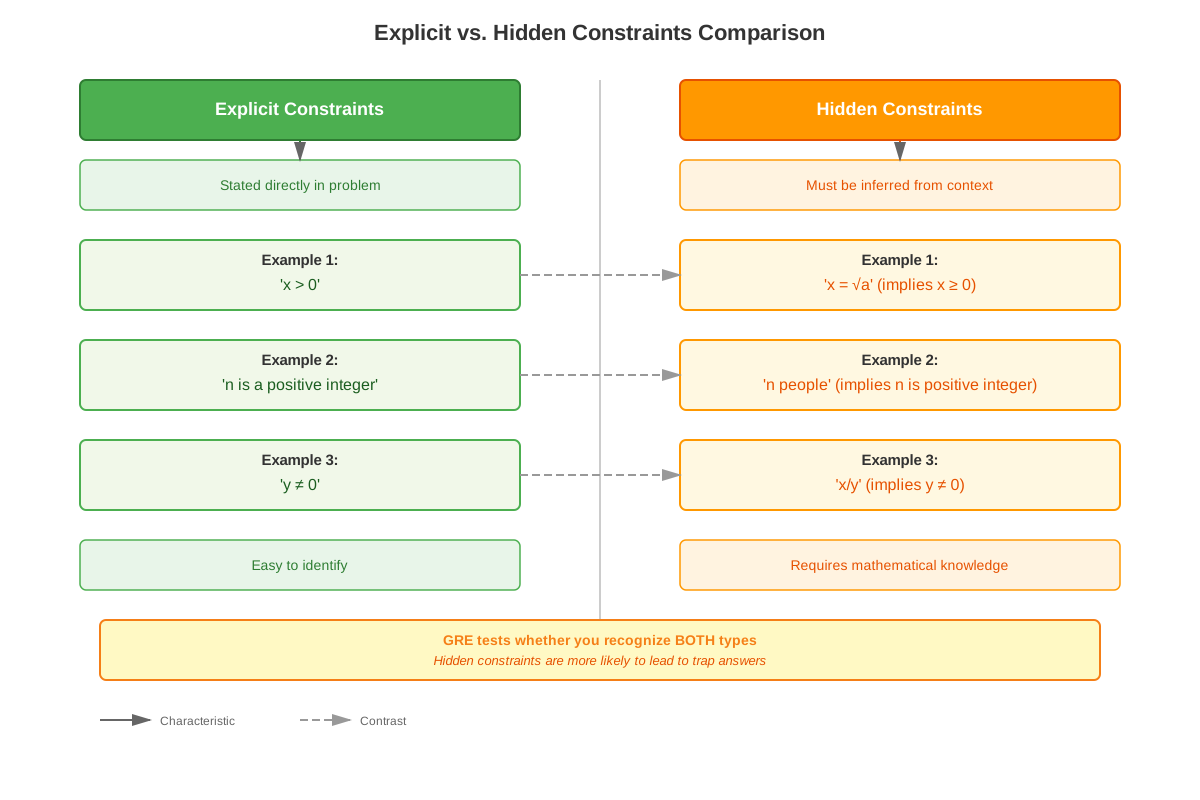
A hidden constraint is any restriction on the values, properties, or relationships in a mathematical problem that is not explicitly stated but must be inferred from the mathematical context. These constraints arise from fundamental mathematical definitions and properties rather than from information provided in the problem statement. For example, if a problem involves the expression √x, there is a hidden constraint that x ≥ 0, even if the problem never states "x is non-negative." Similarly, if a problem discusses "the number of students in a class," there is a hidden constraint that this value must be a positive integer, even without explicit statement.
Hidden constraints differ fundamentally from explicit constraints. An explicit constraint is directly stated: "x > 5" or "n is an even integer." A hidden constraint must be deduced from the mathematical structure: if the problem involves x², students must recognize that x² ≥ 0 for all real x, even though this isn't stated.
Common Sources of Hidden Constraints
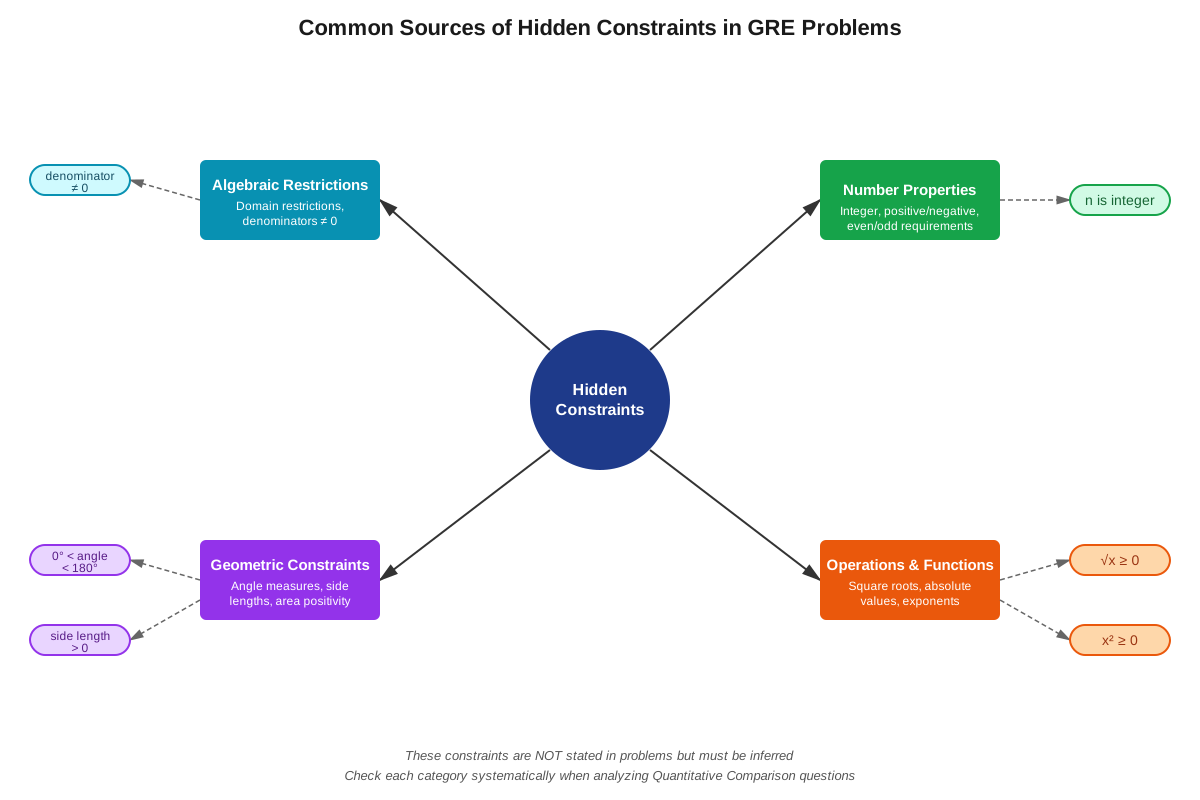
Several mathematical situations consistently generate hidden constraints on the GRE:
Square Roots and Even Roots: The expression √x (or any even root) produces a hidden constraint that x ≥ 0 and that √x ≥ 0. Many students forget that the principal square root is always non-negative by definition. If a problem compares √x to another quantity, recognizing that √x cannot be negative is crucial.
Denominators: Any fraction a/b creates a hidden constraint that b ≠ 0. This constraint becomes particularly important in Quantitative Comparison when variables appear in denominators, as certain values must be excluded from consideration.
Absolute Values: The expression |x| generates a hidden constraint that |x| ≥ 0. Additionally, if |x| = a for some value a, then a ≥ 0 (absolute values cannot equal negative numbers).
Geometric Constraints: Geometric figures impose numerous hidden constraints. Triangle side lengths must satisfy the triangle inequality (the sum of any two sides exceeds the third). Angles in a triangle sum to 180°. Side lengths, areas, and volumes must be positive. When a figure is labeled "not drawn to scale," students cannot assume visual relationships hold, but mathematical constraints still apply.
Counting and Discrete Quantities: Problems involving "number of people," "number of objects," or other counting scenarios have hidden constraints that values must be non-negative integers. A class cannot have 3.7 students or -2 students.
Domain Restrictions from Logarithms: If a problem involves log(x), there is a hidden constraint that x > 0, as logarithms are undefined for non-positive values.
Recognizing When Hidden Constraints Affect Answers
The most critical skill is determining when hidden constraints change the answer to a Quantitative Comparison question. Consider this framework:
| Situation | Impact on Answer | Example |
|---|---|---|
| Hidden constraint makes both quantities always positive | May make relationship determinable | √x vs. -5: Quantity A always greater |
| Hidden constraint restricts variable to specific type | May eliminate some test cases | n is number of people: n must be positive integer |
| Hidden constraint prevents certain values | May change relationship | x/y compared to 1 when y ≠ 0 |
| Multiple hidden constraints interact | Often makes relationship indeterminate | Complex expressions with multiple restrictions |
The Testing Strategy for Hidden Constraints
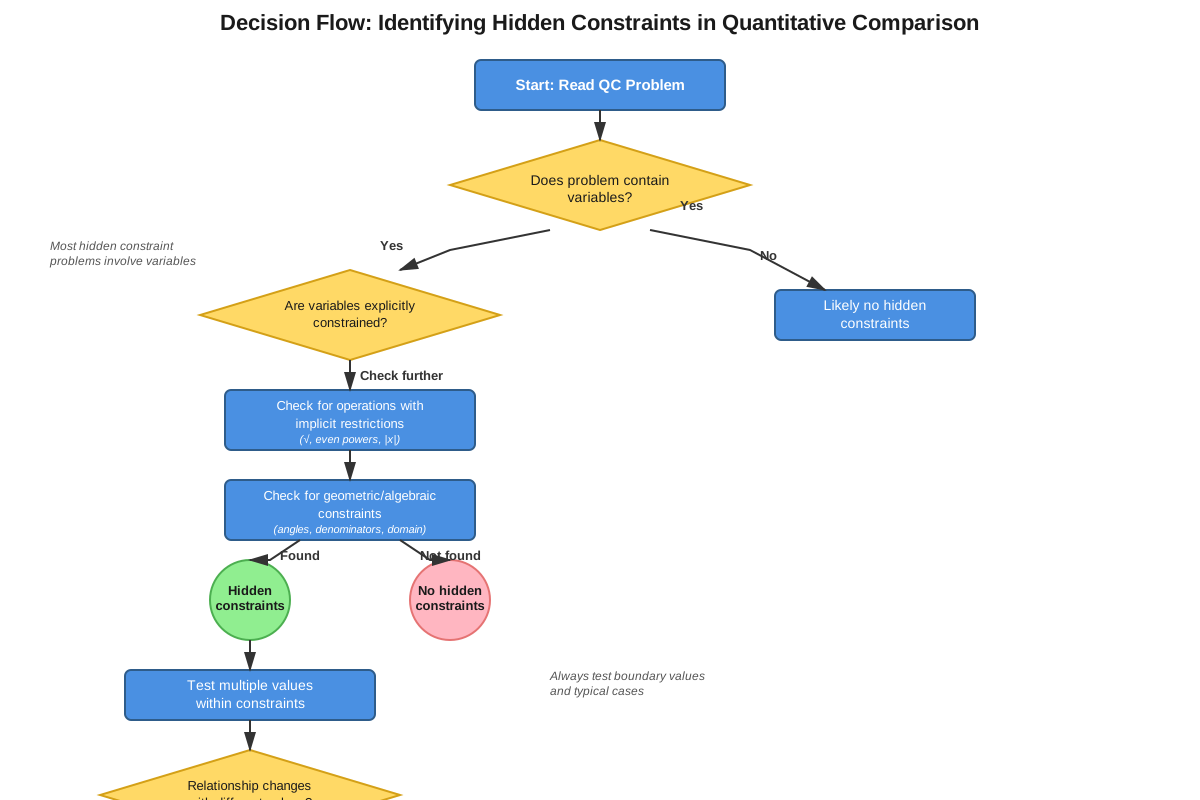
When approaching a Quantitative Comparison question, systematically identify hidden constraints using this process:
- Identify all mathematical operations and expressions: Look for square roots, fractions, absolute values, geometric figures, and counting contexts
- List the hidden constraint for each: Write down what each operation implies (√x means x ≥ 0, etc.)
- Determine the combined effect: Consider how multiple constraints interact to restrict possible values
- Test boundary cases: Try values at the edges of allowed ranges (zero, one, negative values if allowed)
- Evaluate whether the relationship holds for all allowed values: If the relationship changes depending on which allowed values are chosen, the answer is D
Hidden Constraints vs. Insufficient Information
A crucial distinction exists between hidden constraints and insufficient information. Hidden constraints are restrictions that always apply based on mathematical definitions. Insufficient information means the problem hasn't provided enough explicit data to determine a relationship. However, hidden constraints can convert apparently insufficient information into sufficient information. For example, if Quantity A is √x and Quantity B is -3, the hidden constraint that √x ≥ 0 provides sufficient information to conclude Quantity A is greater, even though we don't know x's specific value.
Variable Sign Constraints
One of the most frequently tested hidden constraints involves the signs of variables. When a problem introduces a variable without specifying whether it's positive, negative, or zero, students must consider all possibilities unless hidden constraints eliminate some. For instance:
- If x appears only as x², there's no hidden constraint on x's sign (x can be positive or negative)
- If x appears as √x, there's a hidden constraint that x ≥ 0
- If x represents "the number of apples," there's a hidden constraint that x is a non-negative integer
- If x appears in the denominator as 1/x, there's a hidden constraint that x ≠ 0
Concept Relationships
Hidden constraints connect to multiple Quantitative Reasoning concepts in an integrated framework. The relationship flows as follows:
Number Properties → Hidden Constraints: Understanding integer properties, positive/negative distinctions, and even/odd characteristics enables recognition of hidden constraints in algebraic expressions. For example, knowing that squares of real numbers are non-negative is a number property that creates hidden constraints.
Hidden Constraints → Quantitative Comparison Strategy: Recognizing hidden constraints directly determines the approach to Quantitative Comparison questions. When hidden constraints make all possible values produce the same relationship, the answer is A, B, or C. When hidden constraints still allow values that produce different relationships, the answer is D.
Algebraic Manipulation ↔ Hidden Constraints: These concepts interact bidirectionally. Algebraic manipulation can reveal hidden constraints (simplifying an expression might expose a square root or denominator), while hidden constraints determine which algebraic manipulations are valid (cannot multiply both sides by a variable that might be zero).
Geometric Reasoning → Hidden Constraints: Geometric problems generate numerous hidden constraints through fundamental properties (positive lengths, angle restrictions, triangle inequalities). These constraints often determine whether geometric relationships are fixed or variable.
Domain and Range Concepts → Hidden Constraints: Hidden constraints define the domain (allowed input values) and range (possible output values) of expressions, even when these aren't explicitly stated.
The central relationship map: Mathematical Operations → Generate Hidden Constraints → Restrict Possible Values → Determine Relationship Determinacy → Guide Answer Selection
Quick check — test yourself on Hidden constraints so far.
Try Flashcards →High-Yield Facts
⭐ Square roots always produce non-negative results: √x ≥ 0 by definition, even if x can be any non-negative value
⭐ Variables in denominators create the constraint that the denominator cannot equal zero: This restriction must be considered when testing values
⭐ Geometric measurements (lengths, areas, volumes) must be positive: Even when not stated, these quantities cannot be negative or zero (except degenerate cases)
⭐ Absolute value expressions are always non-negative: |x| ≥ 0 for all real x, and |x| = 0 only when x = 0
⭐ Counting quantities must be non-negative integers: "Number of items" cannot be fractional or negative
- Even powers of real numbers are non-negative: x² ≥ 0, x⁴ ≥ 0, etc., for all real x
- The triangle inequality is a hidden constraint in all triangle problems: the sum of any two sides must exceed the third side
- Angles in a triangle sum to 180°, creating constraints on individual angle measures
- Logarithms require positive arguments: log(x) is defined only when x > 0
- Probability values are constrained between 0 and 1 inclusive, even when not stated
- When a figure is labeled "not drawn to scale," visual relationships don't hold, but mathematical constraints still apply
- The expression x/x equals 1 only when x ≠ 0; this is a hidden constraint often tested
- Distance is always non-negative, creating constraints in rate/distance problems
Common Misconceptions
Misconception: If a variable appears in a problem without restrictions, it can be any real number → Correction: The mathematical context often creates hidden constraints. A variable under a square root must be non-negative; a variable representing a count must be a non-negative integer; a variable in a denominator cannot be zero.
Misconception: When comparing √x to a negative number, the relationship cannot be determined because x's value is unknown → Correction: The hidden constraint that √x ≥ 0 means √x is always greater than any negative number, making the relationship determinable regardless of x's specific value.
Misconception: In Quantitative Comparison, if no explicit constraints are given on a variable, the answer must be D (cannot be determined) → Correction: Hidden constraints may restrict the variable sufficiently to make the relationship determinable. Always identify hidden constraints before concluding the relationship is indeterminate.
Misconception: The expression x² can be negative for some values of x → Correction: For all real numbers x, x² ≥ 0. This is a fundamental hidden constraint that applies even when not stated. The only way x² = 0 is if x = 0.
Misconception: Geometric figures labeled "not drawn to scale" have no constraints on their measurements → Correction: While visual relationships don't hold, mathematical constraints still apply. Side lengths must be positive, angles in a triangle must sum to 180°, and the triangle inequality must be satisfied.
Misconception: If a problem involves x/y, testing x = 2 and y = 1 is sufficient to determine the relationship → Correction: The hidden constraint y ≠ 0 means multiple cases must be tested, including positive and negative values for both x and y (when allowed), to determine if the relationship always holds.
Misconception: Hidden constraints only appear in algebra problems → Correction: Hidden constraints appear across all Quantitative Reasoning topics, including geometry (positive lengths), arithmetic (integer constraints for counting), and word problems (contextual restrictions).
Worked Examples
Example 1: Square Root Hidden Constraint
Problem:
- Quantity A: √(x²)
- Quantity B: x
Solution:
Step 1: Identify mathematical operations that create hidden constraints.
- The square root operation creates a hidden constraint that the result must be non-negative
- The expression √(x²) must be evaluated carefully
Step 2: Simplify Quantity A correctly.
- √(x²) = |x|, not simply x
- This is because √(x²) must be non-negative by definition, so it equals the absolute value of x
Step 3: Reframe the comparison.
- We're comparing |x| to x
Step 4: Test cases considering the hidden constraint.
- If x = 3: |3| = 3, so Quantity A = Quantity B
- If x = -3: |-3| = 3, but x = -3, so Quantity A > Quantity B
- If x = 0: |0| = 0, so Quantity A = Quantity B
Step 5: Determine the relationship.
- The relationship changes depending on whether x is positive, negative, or zero
- Since no explicit constraint restricts x's sign, and the hidden constraint from the square root doesn't eliminate the variability, the answer is D (the relationship cannot be determined)
Key Learning Point: The hidden constraint that √(x²) = |x| (not x) is crucial. Many students incorrectly assume √(x²) = x and choose C, but this overlooks the non-negative constraint on square roots.
Example 2: Denominator and Geometric Hidden Constraints
Problem:
Triangle ABC has sides of length a, b, and c.
- Quantity A: (a + b)/c
- Quantity B: 1
Solution:
Step 1: Identify hidden constraints.
- Since c is a side length, c > 0 (geometric constraint)
- Since c is in the denominator, c ≠ 0 (already satisfied by c > 0)
- The triangle inequality states: a + b > c, a + c > b, and b + c > a
Step 2: Focus on the relevant triangle inequality.
- The inequality a + b > c is directly relevant to our comparison
- This means a + b is always greater than c in any valid triangle
Step 3: Analyze the comparison.
- Since a + b > c and c > 0, we can divide both sides by c (valid because c is positive)
- (a + b)/c > c/c
- (a + b)/c > 1
Step 4: Determine the relationship.
- Quantity A is always greater than Quantity B
- The answer is A (Quantity A is greater)
Key Learning Point: The triangle inequality is a hidden constraint that applies to all triangle problems even when not explicitly stated. Combined with the hidden constraint that side lengths are positive, this makes the relationship determinable. Students who forget the triangle inequality might incorrectly choose D, thinking they need specific values for a, b, and c.
Exam Strategy
Systematic Approach to Hidden Constraints Questions
When approaching any Quantitative Comparison question, use this protocol:
- Scan for constraint-generating elements (15 seconds): Quickly identify square roots, fractions, absolute values, geometric figures, and counting contexts
- List hidden constraints (15 seconds): Write down or mentally note each restriction these elements create
- Test strategic values (30-45 seconds): Choose values that respect hidden constraints but test boundaries (positive, negative, zero, one, fractions)
- Evaluate consistency (15 seconds): Determine if the relationship holds for all tested values
Trigger Words and Phrases
Watch for these indicators that hidden constraints are being tested:
- "Not drawn to scale": Signals that visual relationships don't hold, but mathematical constraints do
- Variables without explicit restrictions: Suggests you must identify hidden constraints to determine allowed values
- Expressions involving square roots: Immediately check for non-negative constraints
- Geometric contexts: Look for positive length constraints and geometric theorems
- "Number of" or counting language: Indicates integer constraints
- Fractions with variables: Check for non-zero denominator constraints
Process of Elimination Tips
- Eliminate C (equal) early if hidden constraints allow the relationship to vary: If testing two different allowed values produces different relationships, C is wrong
- Eliminate D (cannot determine) if hidden constraints make the relationship fixed: If all values satisfying hidden constraints produce the same relationship, D is wrong
- Be suspicious of D when geometric constraints apply: Geometric hidden constraints often make relationships determinable
- Consider D strongly when multiple variables appear without explicit constraints: Multiple unconstrained variables often create indeterminacy
Time Allocation
- Simple hidden constraint questions (one constraint, clear impact): 60-75 seconds
- Complex hidden constraint questions (multiple interacting constraints): 90-120 seconds
- If stuck after 90 seconds: Make an educated guess based on whether constraints seem to fix or allow variation in the relationship, then move on
Exam Tip: If you identify a hidden constraint that makes one quantity always positive and the other always negative, you can immediately select the answer without further testing. This saves valuable time.
Memory Techniques
The SQRT Mnemonic for Common Hidden Constraints
Square roots → Non-negative results and arguments
Quantities (counting) → Non-negative integers
Ratios (fractions) → Denominators cannot be zero
Triangles → Positive sides, angle sum = 180°, triangle inequality
Visualization Strategy
Create a mental "constraint checklist" that automatically activates when you see specific symbols:
- √ symbol → Picture a number line with only the non-negative side highlighted
- Fraction bar → Visualize a "no zero" symbol (⊘) under the denominator
- Triangle → See three inequalities floating around it (a+b>c, a+c>b, b+c>a)
- | | symbols → Picture a V-shape opening upward from zero (always non-negative)
The "HIDDEN" Acronym
Has square roots? (non-negative constraint)
In denominators? (non-zero constraint)
Describes counting? (integer constraint)
Depicts geometry? (positive measurements, theorems)
Expressions with absolute value? (non-negative constraint)
Needs domain check? (logarithms, even roots)
Summary
Hidden constraints are unstated mathematical restrictions that emerge from the fundamental properties of operations, expressions, and contexts in GRE problems. These constraints—including the non-negativity of square roots and absolute values, the non-zero requirement for denominators, the positive nature of geometric measurements, and the integer requirement for counting quantities—frequently determine whether relationships in Quantitative Comparison questions are fixed or variable. Success requires systematically identifying these implicit restrictions by recognizing constraint-generating mathematical elements, understanding how constraints restrict possible values, and testing strategic cases within the allowed range. The GRE deliberately tests whether students can distinguish between explicit information and hidden constraints, making this skill essential for avoiding trap answers and achieving high scores. Students must internalize that mathematical context creates constraints as binding as explicitly stated conditions, and these hidden constraints often provide the key insight needed to determine relationships between quantities.
Key Takeaways
- Hidden constraints are unstated restrictions that must be inferred from mathematical context, not read from the problem statement
- Square roots, absolute values, denominators, geometric contexts, and counting situations are the most common sources of hidden constraints on the GRE
- Always identify hidden constraints before testing values in Quantitative Comparison questions—they determine which values are valid to test
- The non-negativity of √x and |x| is among the most frequently tested hidden constraints and often makes relationships determinable
- Hidden constraints can convert apparently insufficient information into sufficient information by restricting the range of possible values
- When hidden constraints allow values that produce different relationships, the answer is D; when they force a consistent relationship, the answer is A, B, or C
- Geometric problems contain numerous hidden constraints (positive measurements, triangle inequality, angle sums) that often make relationships determinable even without specific values
Related Topics
Quantitative Comparison Strategy: Mastering hidden constraints is fundamental to the broader strategy of efficiently solving Quantitative Comparison questions, including when to test values versus when to manipulate expressions algebraically.
Number Properties: Deep understanding of integer properties, divisibility, and positive/negative distinctions enables faster recognition of hidden constraints in algebraic expressions.
Algebraic Inequalities: Hidden constraints often create inequalities that must be analyzed to determine relationships, making inequality manipulation skills essential.
Geometric Theorems and Properties: Many hidden constraints arise from geometric principles, so strengthening geometric reasoning enhances constraint recognition.
Domain and Range: Formal study of function domains and ranges provides a theoretical framework for understanding why certain hidden constraints exist.
Practice CTA
Now that you understand hidden constraints and their critical role in GRE Quantitative Comparison questions, it's time to cement your mastery through practice. Attempt the practice questions designed specifically to test your ability to identify and apply hidden constraints in various contexts. Use the flashcards to reinforce recognition of common constraint-generating situations. Remember: recognizing hidden constraints is a skill that improves dramatically with deliberate practice. Each question you work through builds the pattern recognition that will make these constraints immediately visible on test day, giving you a significant advantage in both accuracy and speed.
Sign up free to keep reading
Create a free AnvayaPrep account to finish this GRE guide on Hidden constraints — plus flashcards and practice questions.