Overview
Variable constraints represent one of the most critical and frequently tested concepts in GRE Quantitative Comparison questions. When working with algebraic expressions containing variables, students often assume they can manipulate these variables freely, as they would in standard algebra problems. However, on the GRE, variables frequently come with explicit or implicit restrictions that fundamentally change how quantities compare to one another. Understanding GRE variable constraints means recognizing that the relationship between two quantities may depend entirely on the permissible values a variable can take, and that failing to account for these constraints is one of the most common reasons test-takers select incorrect answers.
The essence of this topic lies in recognizing that variables on the GRE are not always "free" to take any real number value. Constraints may be stated directly in the problem (such as "x > 0" or "n is a positive integer"), or they may be implied by the context (such as when a variable represents a physical quantity like distance or when it appears in a denominator). These restrictions dramatically affect comparison outcomes, often making relationships that seem straightforward become conditional or indeterminate. Mastering variable constraints requires developing a systematic approach to identifying restrictions, testing boundary cases, and recognizing when insufficient information exists to make a definitive comparison.
Within the broader landscape of GRE Quantitative Reasoning, variable constraints connect directly to inequality manipulation, number properties, and algebraic reasoning. This topic serves as a bridge between pure algebraic manipulation and the critical thinking skills that distinguish high scorers from average performers. The ability to recognize and properly handle constrained variables appears not only in Quantitative Comparison questions but also in Problem Solving questions involving inequalities, optimization, and word problems where variables represent real-world quantities with inherent limitations.
Learning Objectives
- [ ] Identify when Variable constraints is being tested
- [ ] Explain the core rule or strategy behind Variable constraints
- [ ] Apply Variable constraints to GRE-style questions accurately
- [ ] Distinguish between explicit and implicit variable constraints in problem statements
- [ ] Evaluate how different constraint types (positive/negative, integer/non-integer, bounded/unbounded) affect quantity comparisons
- [ ] Recognize when constraints make a comparison determinable versus indeterminable
- [ ] Test strategic values (positive, negative, zero, fractions, extremes) systematically when constraints allow multiple cases
Prerequisites
- Basic algebraic manipulation: Essential for simplifying expressions and isolating variables when analyzing constrained relationships
- Understanding of inequalities: Required to interpret constraint statements and determine valid value ranges
- Number properties: Necessary to recognize how constraints like "integer only" or "positive values" affect mathematical operations
- Quantitative Comparison question format: Students must understand the four answer choices (A, B, C, D) and when each applies
- Substitution and evaluation: Needed to test specific values within constraint boundaries to determine relationships
Why This Topic Matters
Variable constraints appear in approximately 20-30% of all Quantitative Comparison questions on the GRE, making this one of the highest-yield topics for focused study. The Educational Testing Service (ETS) deliberately designs questions that exploit common assumptions about variables, knowing that students who don't carefully analyze constraints will make predictable errors. Questions involving constrained variables typically appear at medium to hard difficulty levels, meaning they serve as discriminators between good and excellent scores.
In real-world applications, constrained variables model virtually every practical scenario: budgets have upper limits, populations must be non-negative integers, probabilities fall between 0 and 1, and physical measurements cannot be negative. The GRE tests whether students can translate mathematical abstractions back into meaningful contexts where variables have natural limitations. This skill extends beyond test-taking to fields like economics, engineering, data science, and operations research, where optimization problems always involve constrained variables.
On the exam, variable constraints most commonly appear in Quantitative Comparison questions where students must determine whether Quantity A is greater, Quantity B is greater, the quantities are equal, or the relationship cannot be determined. The "cannot be determined" option (Choice D) is frequently the correct answer when constraints allow variables to take multiple values that produce different comparison outcomes. Problem Solving questions also test constraints through inequality problems, word problems with contextual restrictions, and questions asking for maximum or minimum values subject to given conditions.
Core Concepts
Understanding Variable Constraints
A variable constraint is any condition that limits the possible values a variable can assume. On the GRE, these constraints fundamentally alter how algebraic expressions behave and how quantities compare. Without recognizing constraints, students may incorrectly assume relationships hold universally when they actually depend on which values the variable takes within its restricted domain.
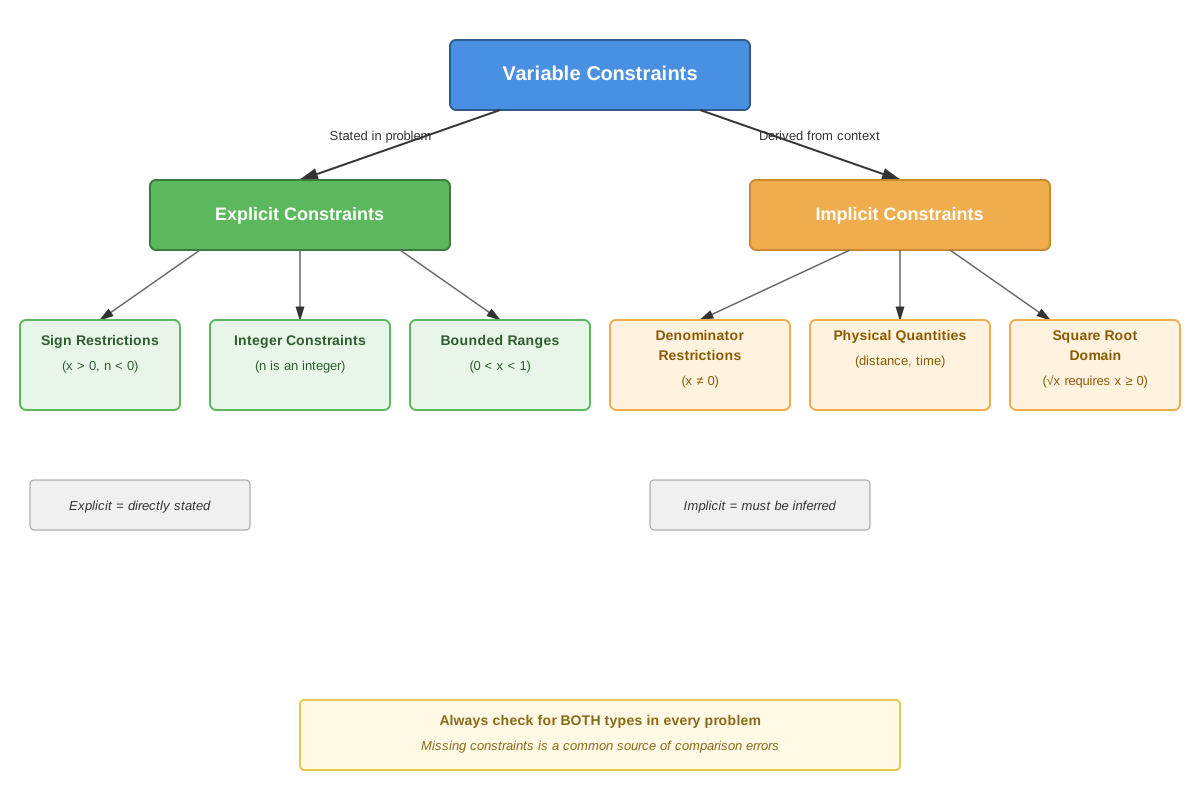
Constraints fall into several categories:
Sign constraints specify whether variables must be positive, negative, or non-negative. For example, "x > 0" restricts x to positive values only, which means x² is always positive and 1/x is defined and has the same sign as x.
Type constraints specify whether variables must be integers, rational numbers, or can be any real number. The constraint "n is a positive integer" means n ∈ {1, 2, 3, ...}, which affects divisibility, parity, and comparison outcomes.
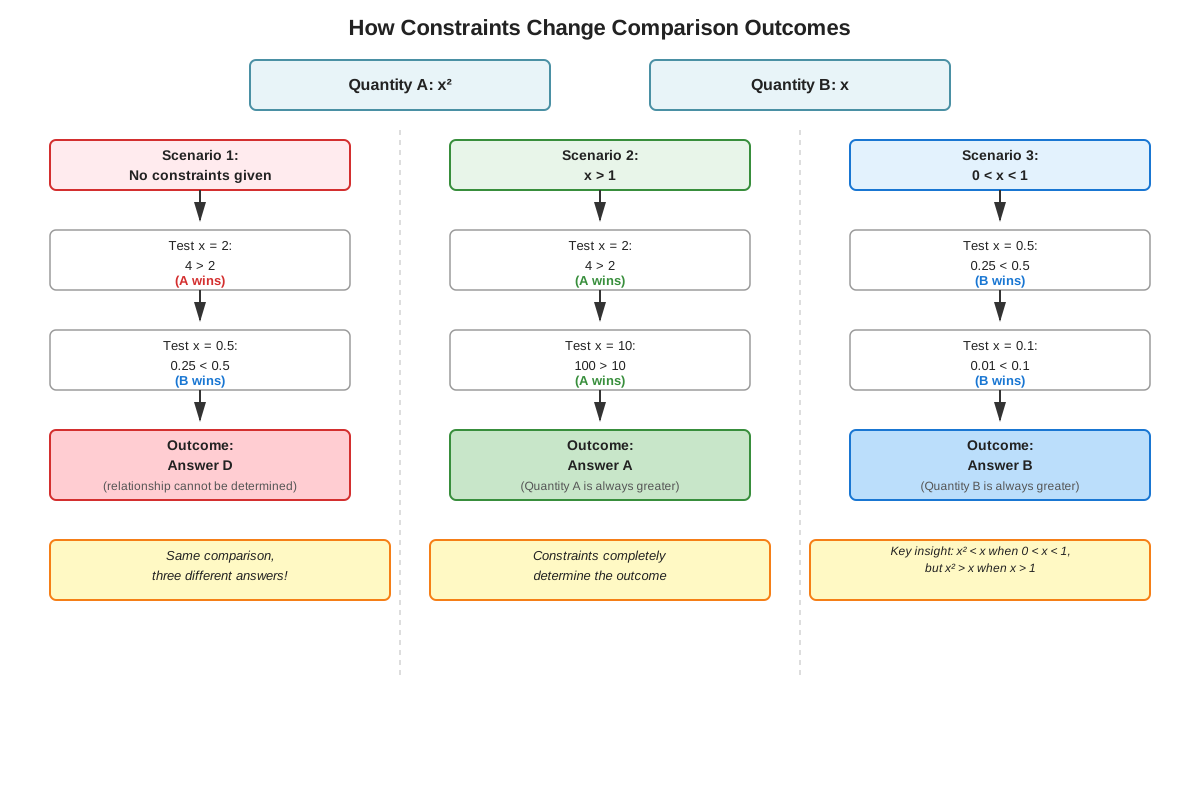
Bounded constraints establish upper or lower limits, such as "0 < x < 1" or "x ≥ 10". These create finite ranges that may produce counterintuitive results (for instance, when 0 < x < 1, we have x² < x).
Implicit constraints arise from mathematical necessity rather than explicit statement. If an expression contains 1/x, then x ≠ 0 is implicitly required. If x represents the number of people, then x must be a non-negative integer.
Explicit vs. Implicit Constraints
Explicit constraints are directly stated in the problem. These appear as inequalities, equations, or descriptive phrases in the given information. Examples include:
- "Given that x > 5"
- "If n is an even integer"
- "For 0 ≤ y ≤ 1"
Students must transcribe these constraints accurately and keep them in mind throughout the problem-solving process. The GRE often places explicit constraints in the centered information above both quantities, meaning they apply to all variables in the comparison.
Implicit constraints require inference from context or mathematical requirements. These are more dangerous because students may overlook them entirely. Common sources of implicit constraints include:
- Variables in denominators (cannot equal zero)
- Square roots of real numbers (radicand must be non-negative)
- Logarithms (argument must be positive)
- Physical quantities (distances, counts, probabilities have natural bounds)
- Geometric measurements (side lengths must be positive, angles in triangles sum to 180°)
The Strategic Value Testing Method
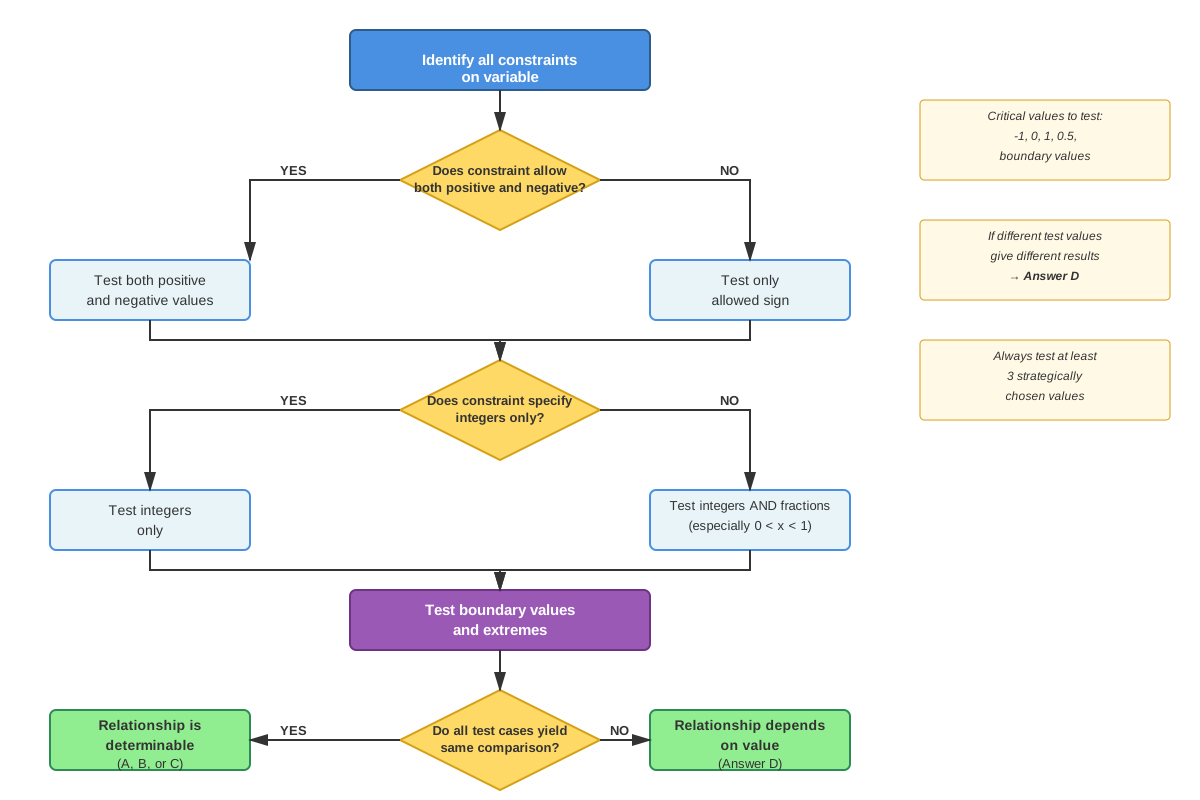
When constraints allow variables to take multiple values, the most reliable approach is strategic value testing: systematically choosing specific values within the constraint range to determine whether the relationship between quantities remains constant or varies.
The key values to test include:
- Positive integers (especially 1 and 2, which often behave differently from larger integers)
- Negative integers (especially -1, which has unique properties)
- Zero (if permitted by constraints)
- Proper fractions between 0 and 1 (like 1/2, which often reverses inequality directions)
- Fractions between -1 and 0 (like -1/2)
- Large positive values (to test behavior as variables grow)
- Large negative values (to test behavior as variables decrease)
- Boundary values (the extreme values permitted by constraints)
If testing different permissible values produces different comparison outcomes (sometimes Quantity A is larger, sometimes Quantity B is larger), the answer must be (D) The relationship cannot be determined.
How Constraints Affect Common Operations
Different mathematical operations respond differently to variable constraints:
| Operation | Constraint Impact | Example | ||
|---|---|---|---|---|
| Squaring | Sign information lost; positive constraint makes x² < x when 0 < x < 1 | If 0 < x < 1, then x² < x | ||
| Taking reciprocals | Reverses inequality direction; requires non-zero constraint | If 0 < a < b, then 1/a > 1/b | ||
| Multiplication | Sign of product depends on factor signs | If x < 0, then x² > x | ||
| Division | Inequality direction depends on divisor sign | Dividing by negative reverses inequality | ||
| Absolute value | Removes sign information; creates cases | If \ | x\ | = 5, then x = 5 or x = -5 |
Constraint-Dependent Relationships
Many algebraic relationships that seem universal actually depend critically on constraints:
For x² vs. x:
- If x > 1, then x² > x
- If x = 1 or x = 0, then x² = x
- If 0 < x < 1, then x² < x
- If -1 < x < 0, then x² > x (both negative, but x² is positive)
- If x < -1, then x² > x (x² is positive, x is negative)
For x vs. 1/x:
- If x > 1, then x > 1/x
- If x = 1, then x = 1/x
- If 0 < x < 1, then x < 1/x
- If x < 0, the relationship depends on whether x < -1 or -1 < x < 0
These constraint-dependent relationships are precisely what the GRE tests. Questions are designed so that students who ignore constraints will confidently select an incorrect answer, while those who test multiple cases within the constraint range will recognize the relationship varies.
The "Cannot Be Determined" Answer
In Quantitative Comparison questions, Choice (D) indicates that the relationship between quantities depends on which permissible values the variables take. This answer is correct when:
- Testing different values within the constraint range produces different comparison outcomes
- The constraints are insufficient to establish a consistent relationship
- The problem involves variables that could be positive or negative (unless constrained otherwise)
Many students under-select Choice (D) because they test only one value or make unwarranted assumptions. Conversely, some students over-select Choice (D) by failing to recognize when constraints actually do determine the relationship. The key is systematic testing: if all permissible values produce the same comparison outcome, the relationship is determined; if different permissible values produce different outcomes, it cannot be determined.
Concept Relationships
The concepts within variable constraints form a logical progression: recognizing that constraints exist → identifying whether they're explicit or implicit → determining the range of permissible values → testing strategic values within that range → concluding whether the relationship is determined or indeterminate.
Explicit constraints directly inform the strategic value testing method by defining which values are permissible to test. Implicit constraints require additional inference but serve the same function once identified. Both types of constraints determine how common operations behave, since operations like squaring, reciprocating, and multiplying have different effects depending on whether variables are positive, negative, greater than 1, between 0 and 1, etc.
Understanding constraint-dependent relationships (like x² vs. x) emerges from systematically applying the strategic value testing method across different constraint scenarios. These relationships, in turn, inform when to select the "cannot be determined" answer in Quantitative Comparison questions.
This topic connects to prerequisite knowledge of inequalities (constraints are often expressed as inequalities) and number properties (integer constraints invoke divisibility and parity considerations). It extends forward to more advanced topics like optimization problems (finding maximum/minimum values subject to constraints), systems of inequalities (multiple simultaneous constraints), and function domains (implicit constraints on function inputs).
The relationship map: Constraint identification → Permissible value range → Strategic testing → Operation behavior analysis → Comparison determination → Answer selection
High-Yield Facts
⭐ Variables on the GRE are constrained unless explicitly stated otherwise; never assume a variable can be any real number without checking given information
⭐ When constraints allow both positive and negative values, or values both greater than and less than 1, test cases from each region
⭐ If testing two different permissible values produces different comparison outcomes, the answer is (D) "cannot be determined"
⭐ The constraint 0 < x < 1 reverses many common relationships: x² < x, x³ < x², and 1/x > x
⭐ Integer constraints eliminate fractional test values and often make relationships more predictable
- Variables in denominators carry the implicit constraint that they cannot equal zero
- Absolute value constraints like |x| = 5 create two cases: x = 5 or x = -5
- When multiplying or dividing inequalities by a variable, the constraint on that variable's sign determines whether to reverse the inequality
- Geometric constraints (side lengths, angles) impose implicit positivity and sometimes upper bound restrictions
- The phrase "x is a positive integer" means x ∈ {1, 2, 3, ...}, excluding zero, negatives, and fractions
- Constraints stated in centered information above both quantities apply to all variables in the comparison
- Testing x = 1 is particularly valuable because many expressions equal each other when x = 1 (x, x², x³, 1/x all equal 1)
- Square root expressions √x implicitly require x ≥ 0 for real number results
- Probability constraints mean 0 ≤ P ≤ 1, which places variables representing probabilities in the "less than 1" category
Quick check — test yourself on Variable constraints so far.
Try Flashcards →Common Misconceptions
Misconception: All variables can take any real number value unless otherwise stated.
Correction: Variables on the GRE frequently have explicit constraints stated in the problem, and many have implicit constraints based on context (like representing counts or appearing in denominators). Always check for restrictions before assuming a variable is unconstrained.
Misconception: If x > y, then x² > y² for all values of x and y.
Correction: This relationship depends on the signs and magnitudes of x and y. For example, if x = 1 and y = -2, then x > y but x² = 1 < 4 = y². The relationship x > y → x² > y² holds reliably only when both variables are positive (or both negative with |x| > |y|).
Misconception: Testing one value within the constraint range is sufficient to determine the relationship.
Correction: A single test value can only prove a relationship is NOT constant (if it contradicts another test). To conclude a relationship holds for all permissible values, you must either test comprehensively across different regions (positive, negative, greater than 1, less than 1, etc.) or use algebraic reasoning that accounts for all cases.
Misconception: The answer "cannot be determined" means there isn't enough information in the problem.
Correction: Choice (D) means the relationship between the quantities varies depending on which permissible values the variables take. The problem provides complete information; that information simply doesn't determine a single consistent relationship.
Misconception: Integer constraints don't significantly affect comparisons.
Correction: Integer constraints eliminate entire regions of the number line (all fractions and irrational numbers), which can fundamentally change relationships. For instance, if x > 0, then x could be 0.5 (making x² < x), but if x is a positive integer, then x ≥ 1 (making x² ≥ x).
Misconception: Implicit constraints are rare and can usually be ignored.
Correction: Implicit constraints appear in most GRE problems involving variables. Any variable in a denominator, under a square root, inside a logarithm, or representing a real-world quantity has implicit constraints that must be recognized and applied.
Misconception: If an expression is undefined for some value, that value should be tested anyway.
Correction: Values that make expressions undefined are excluded from the constraint range. For example, if comparing x and 1/x, the value x = 0 is not permissible and should not be tested. Only test values within the valid domain.
Worked Examples
Example 1: Explicit Constraint with Strategic Testing
Problem: Given that x > 0
Quantity A: x²
Quantity B: x³
Solution:
Step 1: Identify the constraint. The problem explicitly states x > 0, so x must be positive. This eliminates negative values and zero from consideration.
Step 2: Recognize this is a constraint-dependent relationship. The comparison between x² and x³ depends on whether x is greater than, equal to, or less than 1.
Step 3: Test strategic values within the constraint.
Test x = 2 (a positive integer greater than 1):
- Quantity A: 2² = 4
- Quantity B: 2³ = 8
- Result: Quantity B is greater
Test x = 1 (boundary case):
- Quantity A: 1² = 1
- Quantity B: 1³ = 1
- Result: Quantities are equal
Test x = 1/2 (a positive fraction less than 1):
- Quantity A: (1/2)² = 1/4
- Quantity B: (1/2)³ = 1/8
- Result: Quantity A is greater (1/4 > 1/8)
Step 4: Analyze results. Different permissible values produced different comparison outcomes: sometimes A is greater, sometimes B is greater, sometimes they're equal.
Step 5: Select answer. Since the relationship varies depending on which positive value x takes, the answer is (D) The relationship cannot be determined from the information given.
Connection to learning objectives: This example demonstrates identifying when constraints are being tested (the explicit x > 0), applying the strategic value testing method, and recognizing when a relationship is indeterminate.
Example 2: Implicit Constraint with Algebraic Analysis
Problem:
Quantity A: 1/(x-2)
Quantity B: 1/(x-3)
Solution:
Step 1: Identify implicit constraints. Both quantities contain variables in denominators, so x ≠ 2 and x ≠ 3. These are the only constraints; x could be positive, negative, or zero (as long as it's not 2 or 3).
Step 2: Recognize that comparing fractions with different denominators requires considering the signs and magnitudes of those denominators.
Step 3: Test strategic values across different regions.
Test x = 4 (greater than both 2 and 3):
- Quantity A: 1/(4-2) = 1/2
- Quantity B: 1/(4-3) = 1/1 = 1
- Result: Quantity B is greater
Test x = 0 (less than both 2 and 3):
- Quantity A: 1/(0-2) = 1/(-2) = -1/2
- Quantity B: 1/(0-3) = 1/(-3) = -1/3
- Result: Quantity B is greater (-1/3 > -1/2, since -1/3 is closer to zero)
Test x = 2.5 (between 2 and 3):
- Quantity A: 1/(2.5-2) = 1/0.5 = 2
- Quantity B: 1/(2.5-3) = 1/(-0.5) = -2
- Result: Quantity A is greater
Step 4: Analyze results. Testing x = 4 and x = 0 both gave Quantity B greater, but testing x = 2.5 gave Quantity A greater. The relationship changes depending on whether x is between 2 and 3 or outside that interval.
Step 5: Alternative algebraic approach. We can analyze when 1/(x-2) > 1/(x-3):
- This inequality is equivalent to (x-2) < (x-3) when both denominators are positive, or (x-2) > (x-3) when both denominators are negative
- But (x-2) is always greater than (x-3) by exactly 1
- So the inequality holds when both denominators are negative (x < 2) or when the denominators have opposite signs with (x-2) positive and (x-3) negative (2 < x < 3)
Step 6: Select answer. The relationship varies depending on x's value relative to 2 and 3, so the answer is (D) The relationship cannot be determined from the information given.
Connection to learning objectives: This example demonstrates identifying implicit constraints (denominators cannot be zero), testing strategic values including boundary regions, and using both testing and algebraic analysis to determine that the relationship is indeterminate.
Exam Strategy
When approaching GRE questions involving variable constraints, follow this systematic process:
Step 1: Read carefully for constraint statements. Look for phrases like "given that," "where," "if," and inequality symbols. Constraints may appear in centered information above both quantities, in the quantity descriptions themselves, or in answer choices for Problem Solving questions.
Step 2: Identify implicit constraints. Check for variables in denominators (cannot be zero), under even roots (radicand must be non-negative), in logarithms (argument must be positive), or representing contextual quantities (counts must be non-negative integers, probabilities must be between 0 and 1).
Step 3: Determine the permissible value range. Combine explicit and implicit constraints to establish exactly which values the variable(s) can take. Note whether variables must be integers, can be any real number within a range, or have multiple disconnected permissible regions.
Step 4: Test strategic values systematically. Don't test randomly; choose values that represent different cases:
- If no sign constraint exists, test both positive and negative values
- If no magnitude constraint exists, test values greater than 1 and between 0 and 1
- Always test boundary values and special cases like 0, 1, and -1 (when permissible)
- For integer constraints, test small integers like 1, 2, -1, -2
Step 5: Track comparison outcomes. As you test each value, note whether Quantity A is greater, Quantity B is greater, or they're equal. If you get different outcomes for different permissible values, you can immediately select Choice (D) without further testing.
Trigger words and phrases to watch for:
- "positive" or "negative" (sign constraints)
- "integer" (type constraint eliminating fractions)
- "between," "at least," "at most" (bounded constraints)
- "where," "given that," "if" (introducing constraint statements)
- "number of," "count of" (implicit non-negative integer constraint)
- "probability," "proportion" (implicit 0 to 1 constraint)
Time allocation advice: Variable constraint questions typically require 1.5 to 2 minutes. Spend 20-30 seconds identifying constraints, 60-90 seconds testing strategic values, and 20-30 seconds confirming your answer. If you find yourself testing more than 4-5 values, you're likely not choosing strategic values effectively—step back and think about which cases truly represent different scenarios.
Process of elimination for Quantitative Comparison: If you test one value and get A > B, you can eliminate choices (B) and (C). If you then test another value and get B > A, you can eliminate choice (A), leaving only (D). This makes strategic testing particularly efficient for these questions.
Exam Tip: The GRE deliberately designs questions where the "obvious" answer (obtained by testing only positive integers or only one value) is incorrect. Always test at least two values from different regions of the permissible range, especially including fractions between 0 and 1 if allowed.
Memory Techniques
Mnemonic for strategic test values: "POZN-BIG"
- Positive integers (especially 1, 2)
- O (zero, if permissible)
- Zero-to-one fractions (like 1/2)
- Negative integers (especially -1, -2)
- Boundary values (extremes of the constraint range)
- In-between values (when multiple regions exist)
- Giant values (very large positive or negative)
Visualization for x² vs. x relationships: Picture a number line with marked regions:
- Far left (x < -1): x² > x (both negative, but x² is positive)
- Between -1 and 0: x² > x (x² is positive, x is negative)
- At 0: x² = x (both equal 0)
- Between 0 and 1: x² < x (squaring makes smaller)
- At 1: x² = x (both equal 1)
- Right of 1 (x > 1): x² > x (squaring makes larger)
Acronym for constraint types: "STIB"
- Sign constraints (positive/negative)
- Type constraints (integer/rational/real)
- Implicit constraints (from mathematical necessity)
- Bounded constraints (upper/lower limits)
Memory aid for reciprocal relationships: "Flip the fraction, flip the inequality" - when taking reciprocals of positive numbers, the inequality direction reverses. If 0 < a < b, then 1/a > 1/b.
Rhyme for testing discipline: "Test two or more, or you'll get it wrong for sure" - reminds you never to rely on a single test value when constraints allow multiple cases.
Summary
Variable constraints represent restrictions on the values variables can assume, fundamentally affecting how algebraic expressions behave and how quantities compare on the GRE. These constraints may be explicit (directly stated as inequalities or conditions) or implicit (arising from mathematical requirements like non-zero denominators or contextual meanings like counting numbers). The core strategy for handling constrained variables involves identifying all applicable constraints, determining the permissible value range, and systematically testing strategic values across different regions of that range. When different permissible values produce different comparison outcomes, the relationship cannot be determined. Common constraint types include sign restrictions (positive/negative), type restrictions (integer/real), and bounded restrictions (upper/lower limits). Many algebraic relationships that seem universal—like x² > x or x > 1/x—actually depend critically on whether x is greater than 1, between 0 and 1, negative, or in other specific ranges. Mastering variable constraints requires developing the discipline to test multiple cases rather than assuming relationships hold universally, recognizing implicit constraints that aren't explicitly stated, and understanding how operations like squaring, reciprocating, and multiplying behave differently depending on variable constraints.
Key Takeaways
- Variable constraints limit permissible values and fundamentally affect quantity comparisons; always identify both explicit and implicit constraints before solving
- The strategic value testing method—systematically testing positive/negative, greater than 1/less than 1, integers/fractions, and boundary values—is the most reliable approach for constraint problems
- When different permissible values produce different comparison outcomes, the answer is (D) "cannot be determined"—this is a feature, not a flaw, of the problem
- Common relationships like x² vs. x, x vs. 1/x, and x² vs. y² are constraint-dependent and reverse direction in different regions of the number line
- Integer constraints eliminate fractions and often make relationships more predictable; constraints like 0 < x < 1 often reverse intuitive relationships
- Implicit constraints from denominators, square roots, logarithms, and contextual meanings are just as important as explicit constraint statements
- Testing only one value or only positive integers is insufficient; comprehensive testing across constraint regions is essential for accurate answers
Related Topics
Inequality Manipulation: Understanding how to add, subtract, multiply, and divide inequalities while preserving or reversing their direction connects directly to variable constraints, as constraints are often expressed as inequalities. Mastering variable constraints provides the foundation for solving complex inequality systems.
Number Properties and Special Cases: The behavior of special numbers (0, 1, -1) and number categories (integers, fractions, irrationals) under various operations relates closely to how constraints affect comparisons. Variable constraints often invoke these special cases as strategic test values.
Absolute Value and Piecewise Functions: Absolute value expressions create implicit constraints by splitting the domain into cases (positive and negative), similar to how variable constraints partition the number line into regions with different comparison behaviors.
Optimization Problems: Finding maximum or minimum values subject to constraints represents an advanced application of variable constraint concepts, where the constraint boundaries often contain optimal solutions.
Function Domain and Range: The permissible input values for functions (domain) and resulting output values (range) are direct applications of variable constraints, extending these concepts to functional relationships.
Practice CTA
Now that you've mastered the core concepts of variable constraints, it's time to solidify your understanding through active practice. Attempt the practice questions designed specifically for this topic, focusing on identifying constraints, testing strategic values, and recognizing when relationships are determinate versus indeterminate. Use the flashcards to reinforce high-yield facts and constraint-dependent relationships until they become automatic. Remember: variable constraints appear in 20-30% of Quantitative Comparison questions, making this one of the highest-return topics for your study time. Every question you practice builds the pattern recognition and systematic thinking that will serve you throughout the Quantitative Reasoning section. You've got this!
Sign up free to keep reading
Create a free AnvayaPrep account to finish this GRE guide on Variable constraints — plus flashcards and practice questions.