Overview
Percent comparison is a critical quantitative reasoning skill tested extensively on the GRE, particularly within the Quantitative Comparison question format. This topic requires students to evaluate relationships between percentages, percentage changes, and the underlying values they represent. Unlike straightforward percentage calculations, GRE percent comparison questions demand deeper conceptual understanding of how percentages behave when applied to different base values, how percentage increases and decreases interact, and how to compare relative versus absolute changes.
The GRE frequently tests percent comparison because it reveals whether students truly understand proportional reasoning or merely memorize formulas. Questions often present two quantities involving percentages and ask which is greater, whether they're equal, or if the relationship cannot be determined. These questions appear not only in dedicated Quantitative Comparison sections but also in Problem Solving questions disguised as word problems about sales, discounts, population changes, or financial scenarios. The ability to quickly assess percentage relationships without extensive calculation is essential for achieving high scores in the time-constrained GRE environment.
Mastering percent comparison connects directly to broader quantitative reasoning skills including ratio and proportion analysis, algebraic manipulation, and logical reasoning. This topic serves as a foundation for understanding data interpretation questions, where students must compare percentage changes across different categories or time periods. The conceptual framework developed through percent comparison practice extends to real-world applications in business analytics, scientific research, and financial literacy, making it both practically valuable and academically essential.
Learning Objectives
- [ ] Identify when Percent comparison is being tested in GRE questions
- [ ] Explain the core rule or strategy behind Percent comparison
- [ ] Apply Percent comparison to GRE-style questions accurately
- [ ] Distinguish between percentage change and absolute change in comparative contexts
- [ ] Evaluate compound percentage changes and their cumulative effects
- [ ] Determine when insufficient information prevents definitive percentage comparisons
- [ ] Recognize common trap answers involving percentage misconceptions
Prerequisites
- Basic percentage calculations: Understanding how to convert between percentages, decimals, and fractions is essential for manipulating percentage expressions efficiently
- Algebraic manipulation: The ability to work with variables and equations allows students to represent unknown quantities and solve for relationships between percentages
- Proportional reasoning: Recognizing that percentages represent proportional relationships helps students understand why the same percentage of different base values yields different results
- Order of operations: Correctly sequencing mathematical operations prevents errors when calculating compound percentage changes or complex percentage relationships
Why This Topic Matters
Percent comparison appears in approximately 15-20% of GRE Quantitative Reasoning questions, making it one of the highest-yield topics for focused study. The GRE tests this concept because it efficiently distinguishes between students who understand mathematical relationships conceptually versus those who rely on rote memorization. Questions involving percent comparison appear across multiple question types: Quantitative Comparison (most common), Multiple Choice with one answer, Multiple Choice with multiple answers, and Numeric Entry questions.
In real-world contexts, percent comparison skills are indispensable for interpreting business reports, understanding scientific studies, evaluating investment returns, and making informed consumer decisions. When a news article reports that "Company A's profits increased by 50% while Company B's increased by 30%," percent comparison skills help determine whether Company A actually earned more profit or simply had a larger percentage increase from a smaller base. This distinction between relative and absolute measures is fundamental to quantitative literacy.
On the GRE, percent comparison questions commonly appear in scenarios involving: price changes and discounts (successive discounts, markup then markdown), population growth or decline across different regions, test score improvements for different student groups, sales performance comparisons, and investment returns over time. The exam writers deliberately craft questions where intuitive but incorrect reasoning leads to wrong answers, rewarding students who understand the underlying mathematical principles rather than those who guess based on superficial pattern recognition.
Core Concepts
Understanding Percentage as a Proportion
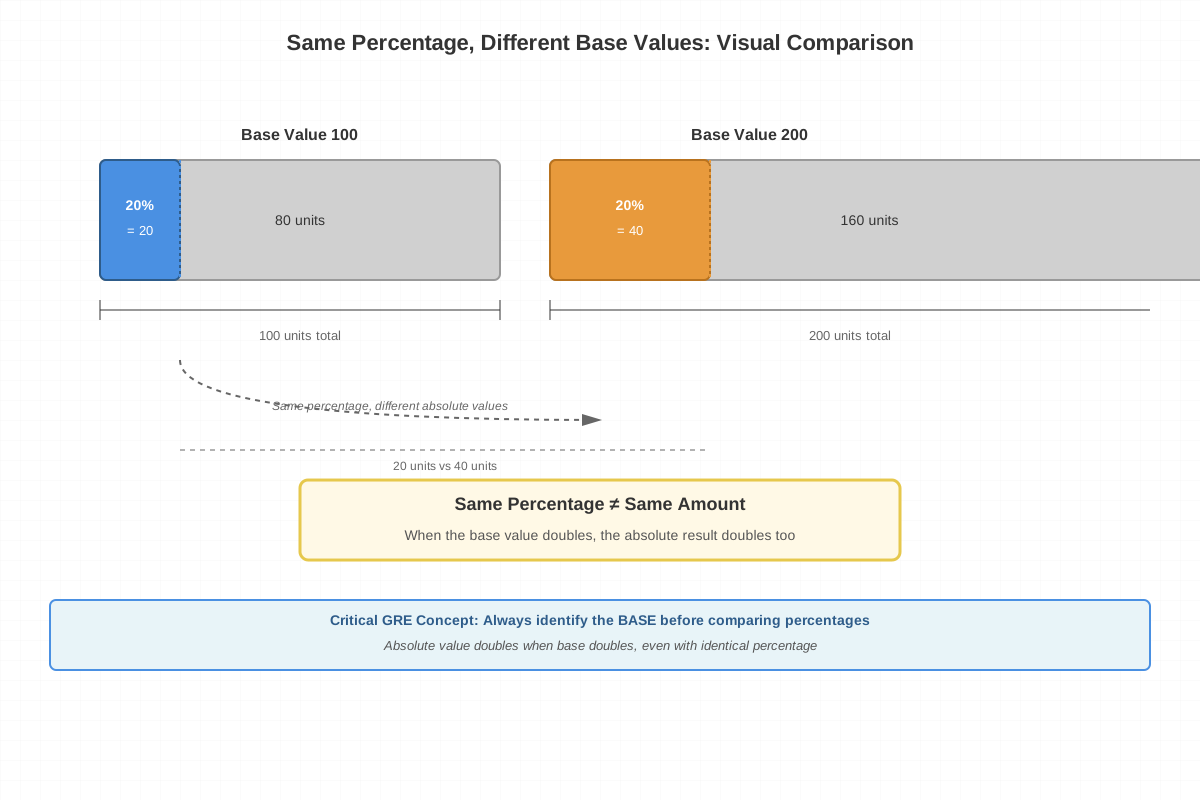
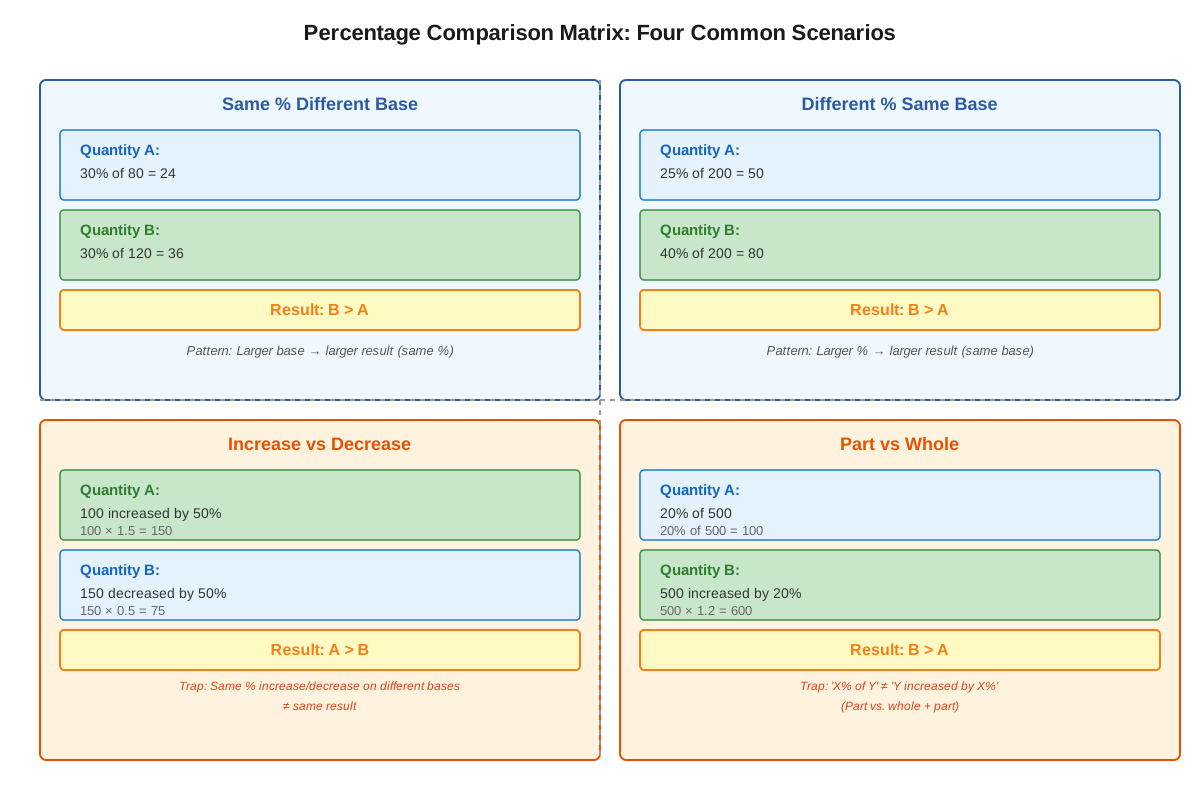
A percentage represents a part-to-whole relationship expressed per hundred units. When comparing percentages, the critical insight is that the same percentage of different base values produces different absolute amounts. For example, 20% of 500 equals 100, while 20% of 200 equals 40. This fundamental principle underlies most GRE percent comparison questions: percentages are relative measures, not absolute measures.
The formula for calculating a percentage of a value is:
Percentage Amount = (Percent/100) × Base ValueWhen comparing two percentage-based quantities, students must identify whether the comparison involves the same or different base values. If the bases differ, direct percentage comparison can be misleading.
Percentage Increase and Decrease
A percentage increase represents how much a quantity grows relative to its original value:
Percentage Increase = [(New Value - Original Value) / Original Value] × 100A percentage decrease follows the same logic:
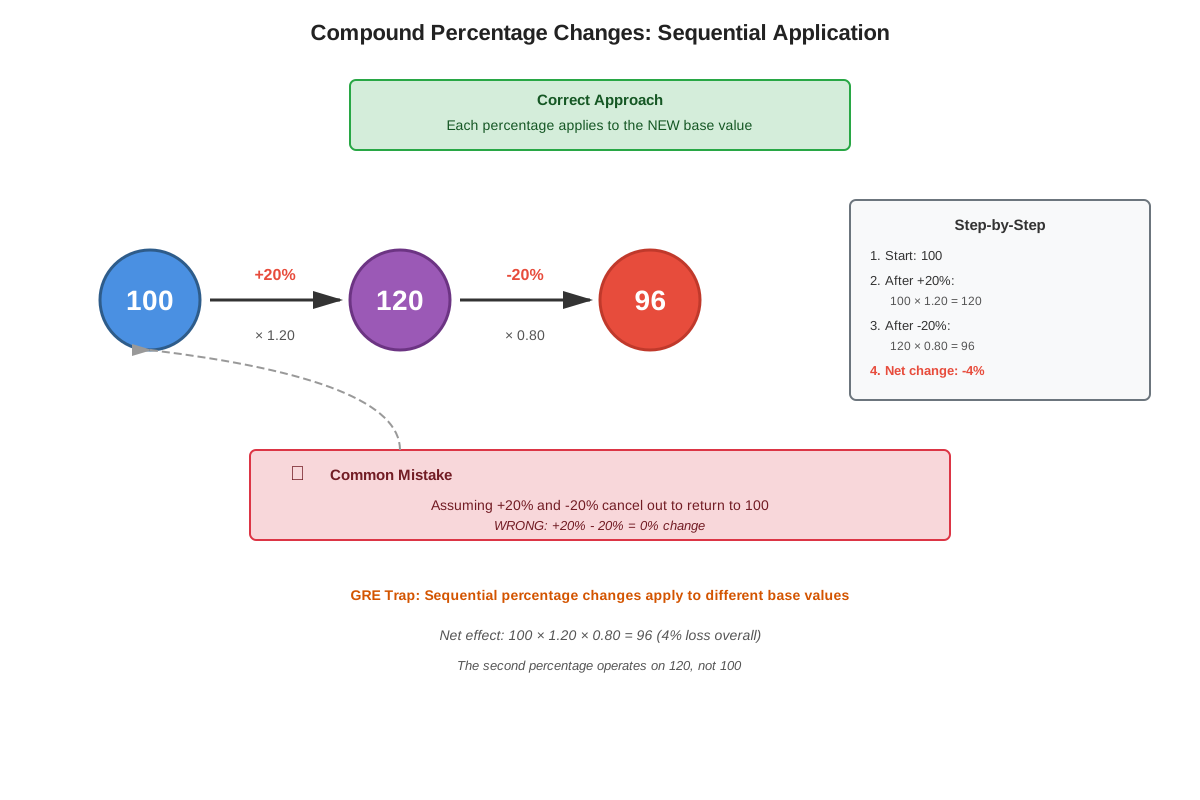
Percentage Decrease = [(Original Value - New Value) / Original Value] × 100The key insight for GRE questions is that percentage changes are not symmetric. A 50% increase followed by a 50% decrease does not return to the original value. If a quantity increases from 100 to 150 (50% increase), then decreases by 50%, it becomes 75, not 100. This asymmetry occurs because the second percentage operates on a different base value.
Comparing Percentage Changes with Different Bases
When comparing percentage changes applied to different starting values, the relationship between final values depends on both the percentage and the base. Consider:
- Quantity A: 100 increased by 30%
- Quantity B: 80 increased by 40%
Quantity A becomes 130, while Quantity B becomes 112. Despite the larger percentage increase, Quantity B remains smaller because its base value was significantly lower. This illustrates the base value principle: larger percentage changes don't necessarily produce larger final values.
Compound Percentage Changes
Compound percentage changes occur when multiple percentage changes apply sequentially. The critical rule is that these changes multiply rather than add. If a price increases by 20% then decreases by 20%, the net effect is:
Final Value = Original × 1.20 × 0.80 = Original × 0.96The result is a 4% decrease, not a return to the original value. For any two successive percentage changes of +a% and -b%, the combined effect is:
Combined Effect = (1 + a/100)(1 - b/100) - 1This formula reveals that the order of operations doesn't matter for the final value (multiplication is commutative), but the intermediate values differ.
Percentage Points versus Percent Change
A crucial distinction for GRE questions is between percentage points and percent change. If an interest rate increases from 5% to 8%, it has increased by 3 percentage points but by 60% in relative terms (3/5 = 0.60 = 60%). The GRE exploits this distinction by asking questions where one interpretation seems obvious but the other is correct.
| Change Type | Example | Calculation |
|---|---|---|
| Percentage Points | 5% to 8% | 8 - 5 = 3 percentage points |
| Percent Change | 5% to 8% | (8-5)/5 × 100 = 60% increase |
Comparing Percentages of Percentages
Some GRE questions involve percentages of percentages, such as "20% of 30% of a value." These calculations require sequential multiplication:
20% of 30% of X = 0.20 × 0.30 × X = 0.06X = 6% of XWhen comparing such expressions, students can often simplify by recognizing that multiplication is commutative: 20% of 30% equals 30% of 20%.
The Role of Unknown Values
Many GRE Quantitative Comparison questions deliberately omit specific numerical values to test conceptual understanding. When comparing percentage-based quantities with unknown bases, students must determine whether the relationship holds for all possible values or depends on the specific numbers. If the relationship varies with different values, the answer is "Cannot be determined."
Concept Relationships
The concepts within percent comparison build hierarchically. Understanding percentages as proportions forms the foundation, enabling comprehension of percentage increases and decreases. This understanding then extends to compound percentage changes, which require recognizing that each successive change operates on a modified base value. The distinction between percentage points and percent change represents a parallel concept that requires the same foundational understanding but applies it to rates or percentages themselves rather than to absolute quantities.
The relationship map flows as follows:
Basic Percentage Calculation → Percentage Change (Increase/Decrease) → Compound Percentage Changes → Comparing Changes with Different Bases
Simultaneously, Percentage as Proportion → Percentage Points vs. Percent Change → Comparing Rates of Change
These concepts connect to prerequisite topics through proportional reasoning (ratios and proportions) and algebraic manipulation (solving for unknown values). They extend forward to data interpretation questions, where students must compare percentage changes across multiple categories, and to probability questions, where percentages represent likelihood. The logical reasoning skills developed through percent comparison—particularly recognizing when information is insufficient for definitive comparison—transfer directly to Quantitative Comparison strategy across all mathematical topics.
High-Yield Facts
⭐ The same percentage of different base values produces different absolute amounts: 10% of 500 ≠ 10% of 200 in absolute terms
⭐ Percentage changes are not symmetric: A 50% increase followed by a 50% decrease does not return to the original value
⭐ Compound percentage changes multiply, not add: Two successive 10% increases produce a 21% total increase (1.1 × 1.1 = 1.21), not 20%
⭐ Percentage points and percent change are different measures: An increase from 20% to 25% is 5 percentage points but a 25% increase
⭐ When comparing percentage changes with unknown base values, the relationship often cannot be determined: Without knowing the actual starting values, percentage comparisons may be insufficient
- A percentage increase of X% followed by a decrease of X% always results in a net decrease
- Comparing "A is 50% more than B" versus "B is 50% less than A" yields different relationships (the first is true when A = 1.5B; the second is never true for the same relationship)
- When a value increases by 100%, it doubles; when it decreases by 50%, it halves—these are inverse operations
- The percentage change between two values depends on which value is considered the base (reference point)
- In Quantitative Comparison questions, if the relationship between percentage-based quantities changes depending on the specific values chosen, the answer is always D (cannot be determined)
Quick check — test yourself on Percent comparison so far.
Try Flashcards →Common Misconceptions
Misconception: A 25% increase followed by a 25% decrease returns to the original value.
Correction: The second percentage operates on the increased value, not the original. If starting with 100, a 25% increase yields 125, then a 25% decrease from 125 yields 93.75, which is 6.25% below the original value.
Misconception: If Quantity A increases by 30% and Quantity B increases by 20%, Quantity A must be larger.
Correction: The final comparison depends on the starting values. If Quantity A started at 100 and Quantity B started at 200, the final values are 130 and 240 respectively, making Quantity B larger despite the smaller percentage increase.
Misconception: "50% more than X" and "50% of X" represent the same amount.
Correction: "50% more than X" equals 1.5X (the original plus 50% of it), while "50% of X" equals 0.5X. These differ by a factor of three.
Misconception: Percentage points and percent change are interchangeable terms.
Correction: These measure different things. An increase from 10% to 15% is 5 percentage points but a 50% increase. The GRE specifically tests this distinction.
Misconception: When comparing percentages of unknown values, you can always determine which is larger by comparing the percentages alone.
Correction: Without knowing the base values, you cannot determine absolute amounts. 80% of an unknown large value might exceed 90% of an unknown small value.
Misconception: The order of successive percentage changes affects the final result.
Correction: While the order affects intermediate values, the final result is the same regardless of order because multiplication is commutative: 1.2 × 0.8 = 0.8 × 1.2.
Worked Examples
Example 1: Compound Percentage Changes
Question: The price of a stock increased by 20% in January, then decreased by 15% in February. If the stock price was $100 at the beginning of January, what is the final price, and what is the overall percentage change?
Solution:
Step 1: Calculate the price after January's increase.
- January increase: $100 × 1.20 = $120
Step 2: Calculate the price after February's decrease.
- February decrease: $120 × 0.85 = $102
Step 3: Calculate the overall percentage change.
- Change: $102 - $100 = $2
- Percentage change: ($2/$100) × 100 = 2% increase
Key Insight: Despite a 20% increase and a 15% decrease, the net effect is only a 2% increase, not a 5% increase. This demonstrates that percentage changes multiply rather than add. We can verify: 1.20 × 0.85 = 1.02, confirming a 2% net increase.
Connection to Learning Objectives: This example demonstrates applying percent comparison to calculate compound changes and identifying the non-additive nature of percentage changes, directly addressing the core strategy behind percent comparison.
Example 2: Quantitative Comparison with Unknown Values
Question:
- Quantity A: 30% of x increased by 40%
- Quantity B: 40% of x increased by 30%
Which quantity is greater, or is the relationship indeterminate?
Solution:
Step 1: Express Quantity A algebraically.
- 30% of x = 0.3x
- Increased by 40%: 0.3x × 1.40 = 0.42x
Step 2: Express Quantity B algebraically.
- 40% of x = 0.4x
- Increased by 30%: 0.4x × 1.30 = 0.52x
Step 3: Compare the expressions.
- Quantity A = 0.42x
- Quantity B = 0.52x
- Since 0.52x > 0.42x for all positive values of x, Quantity B is greater.
Key Insight: Even though both quantities involve the same base value (x) and the same percentages (30% and 40%), the order matters because we're taking a percentage OF a percentage, then applying an increase. The larger initial percentage (40%) in Quantity B, even with the smaller increase (30%), produces a larger final result. This can be verified by recognizing that 0.40 × 1.30 = 0.52 while 0.30 × 1.40 = 0.42.
Connection to Learning Objectives: This example shows how to identify percent comparison testing (recognizing the question type), apply the core strategy (algebraic representation), and accurately solve GRE-style questions by determining the relationship holds for all positive values of x.
Exam Strategy
When approaching GRE questions involving percent comparison, follow this systematic process:
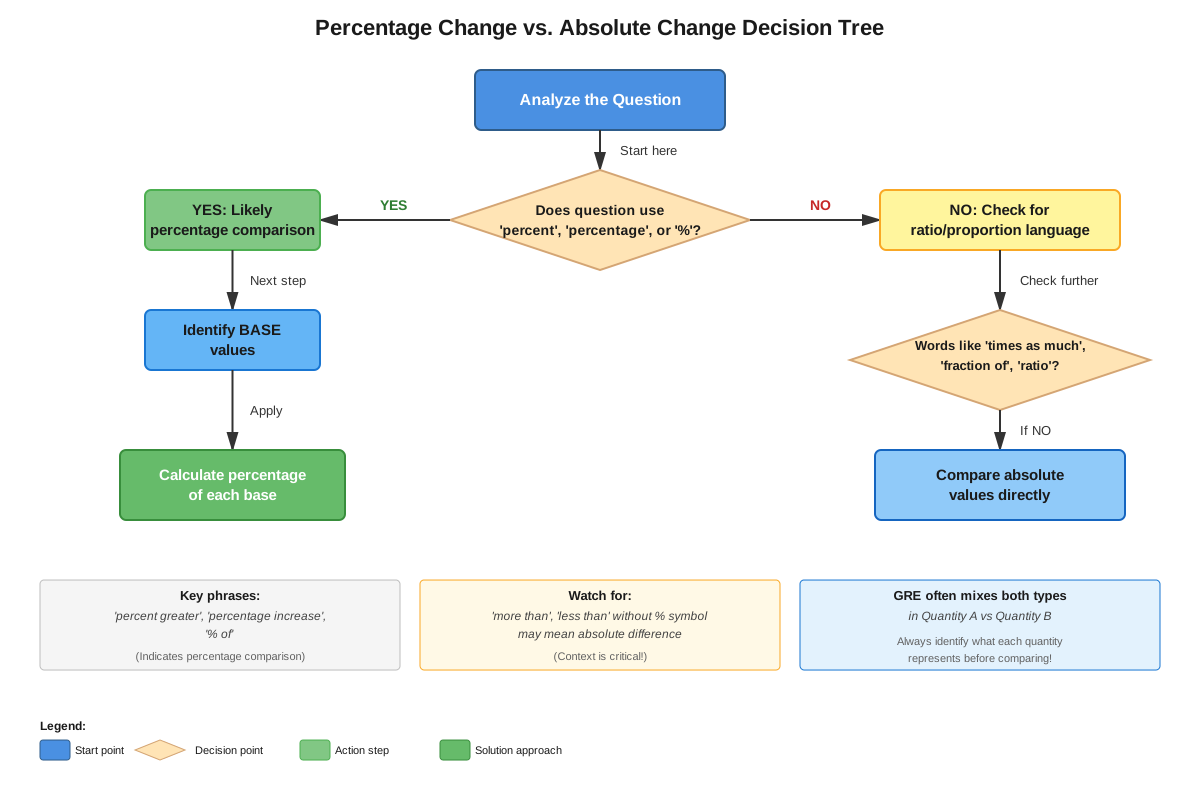
Step 1: Identify the base values. Determine whether the percentages being compared operate on the same or different base values. If different, you cannot directly compare percentages without considering the bases.
Step 2: Watch for trigger words that signal percent comparison:
- "increased by," "decreased by," "more than," "less than"
- "percentage points" versus "percent"
- "successive," "compound," "consecutive" (indicating multiple percentage changes)
- "of" (indicating a percentage of another percentage)
Step 3: For Quantitative Comparison questions, use strategic value testing:
- If variables are present, test x = 100 (makes percentage calculations simple)
- Test a second value to confirm the relationship holds consistently
- If the relationship changes with different values, select "Cannot be determined"
Step 4: Recognize common traps:
- Questions designed to make you add percentages when you should multiply
- Comparisons where the larger percentage doesn't produce the larger result due to different bases
- Symmetric-looking changes that aren't actually symmetric (e.g., +20% then -20%)
Step 5: Time allocation. Spend 1-1.5 minutes on straightforward percent comparison questions, but allow up to 2 minutes for complex Quantitative Comparison questions with multiple variables. If a question requires extensive calculation, consider whether algebraic simplification or strategic estimation can yield the answer faster.
Exam Tip: In Quantitative Comparison questions, if you can construct even one example where Quantity A is larger and one where Quantity B is larger, immediately select D (cannot be determined) without further calculation.
Process of elimination for percent comparison:
- Eliminate answers that ignore the base value principle
- Eliminate answers that treat percentage changes as additive rather than multiplicative
- Eliminate answers that confuse percentage points with percent change
Memory Techniques
Mnemonic for compound changes: "MULTIPLY, DON'T ADD" - Remember that successive percentage changes multiply their multipliers (1.20 × 0.80), not their percentages (20% + (-20%)).
Visualization for asymmetric changes: Picture a rubber band. Stretching it by 50% (multiplying by 1.5) then compressing by 50% (multiplying by 0.5) doesn't return it to original length—you end up with 75% of the original (1.5 × 0.5 = 0.75).
Acronym for comparison strategy: BASE
- Base values: Identify them first
- Algebraic representation: Use variables when values are unknown
- Simplify: Reduce expressions before comparing
- Example testing: Try specific numbers to verify relationships
Memory hook for percentage points: Think "POINTS are ABSOLUTE, PERCENT is RELATIVE." Percentage points measure absolute differences between percentages (8% - 5% = 3 points), while percent change measures relative change (3/5 = 60% increase).
The "100 Rule": When testing percentage problems, always start with 100 as your base value—it makes all calculations straightforward and percentages equal their absolute amounts (30% of 100 = 30).
Summary
Percent comparison is a high-yield GRE topic that tests conceptual understanding of how percentages behave in various contexts. The fundamental principle is that percentages are relative measures dependent on base values—the same percentage of different bases produces different absolute amounts, and different percentages of different bases require careful analysis to compare. Compound percentage changes multiply rather than add, creating asymmetric effects where a percentage increase followed by an equal percentage decrease results in a net decrease. The distinction between percentage points (absolute difference between percentages) and percent change (relative change in a percentage) frequently appears in GRE questions designed to trap students who conflate these concepts. Success requires identifying whether base values are known or unknown, using algebraic representation when values are unspecified, and recognizing when insufficient information prevents definitive comparison. Mastery of percent comparison enables efficient solution of Quantitative Comparison questions, data interpretation problems, and word problems involving real-world scenarios like pricing, population changes, and financial calculations.
Key Takeaways
- Percentages are relative measures: The same percentage of different base values produces different absolute amounts, making base value identification critical for comparisons
- Compound percentage changes multiply: Successive changes of +a% and +b% produce a total change of (1 + a/100)(1 + b/100) - 1, not simply (a + b)%
- Percentage changes are asymmetric: A percentage increase followed by an equal percentage decrease always results in a net decrease
- Percentage points ≠ percent change: These measure different things and are deliberately confused in GRE questions
- Unknown base values often prevent definitive comparison: In Quantitative Comparison questions, if the relationship varies with different possible values, the answer is "Cannot be determined"
- Strategic value testing with x = 100 simplifies calculations: This choice makes percentages equal their absolute values for easy computation
- Order doesn't affect final results in compound changes: While intermediate values differ, the final result of successive percentage changes is independent of order due to the commutative property of multiplication
Related Topics
Ratio and Proportion: Percent comparison builds directly on ratio concepts, as percentages represent specific ratios (parts per hundred). Mastering percent comparison strengthens proportional reasoning skills essential for more complex ratio problems.
Data Interpretation: Charts and graphs frequently present percentage changes over time or across categories. Percent comparison skills enable accurate interpretation of these visual representations and comparison of trends.
Interest and Growth Problems: Compound interest, population growth, and exponential decay all involve successive percentage changes. The principles learned in percent comparison apply directly to these more advanced topics.
Quantitative Comparison Strategy: While percent comparison is one specific content area, the strategic approaches developed here—particularly testing values and recognizing insufficient information—transfer to all Quantitative Comparison questions.
Algebraic Word Problems: Many GRE word problems embed percentage comparisons within narratives about business, science, or everyday scenarios. Mastering percent comparison enables efficient translation of these verbal descriptions into mathematical relationships.
Practice CTA
Now that you've mastered the core concepts of percent comparison, it's time to solidify your understanding through active practice. Attempt the practice questions designed specifically for this topic, focusing on applying the strategies and recognizing the patterns discussed in this guide. Use the flashcards to reinforce high-yield facts and test your ability to quickly recall key principles under time pressure. Remember that percent comparison appears in approximately 15-20% of GRE Quantitative questions—your investment in mastering this topic will pay dividends across multiple questions on test day. Approach each practice problem systematically, identifying base values, watching for compound changes, and distinguishing between percentage points and percent change. With focused practice, you'll develop the intuition to recognize percent comparison questions instantly and solve them efficiently!
Sign up free to keep reading
Create a free AnvayaPrep account to finish this GRE guide on Percent comparison — plus flashcards and practice questions.