Overview
Probability word problems represent one of the most frequently tested quantitative concepts on the GRE, appearing in approximately 10-15% of all Quantitative Reasoning questions. These problems require students to translate real-world scenarios involving chance, likelihood, and uncertainty into mathematical expressions and calculations. Unlike straightforward probability calculations, GRE probability word problems embed the mathematical relationships within narrative contexts—ranging from selecting colored marbles from bags to determining the likelihood of scheduling conflicts or weather patterns.
Mastering probability word problems is essential for GRE success because these questions test multiple skills simultaneously: reading comprehension, logical reasoning, mathematical computation, and strategic problem-solving. The GRE frequently uses probability scenarios to assess whether test-takers can identify relevant information, ignore distractors, and apply fundamental probability rules correctly under time pressure. These questions often appear as both Quantitative Comparison and Problem Solving formats, requiring flexible thinking and adaptability.
Within the broader Quantitative Reasoning framework, probability word problems connect directly to concepts in combinatorics, ratios, fractions, and data interpretation. They require facility with basic arithmetic operations while demanding higher-order thinking about relationships between events. Success with probability word problems builds a foundation for understanding statistics, data analysis, and logical reasoning—skills that extend beyond the GRE into graduate-level coursework and professional applications across business, science, and social science disciplines.
Learning Objectives
- [ ] Identify when Probability word problems is being tested
- [ ] Explain the core rule or strategy behind Probability word problems
- [ ] Apply Probability word problems to GRE-style questions accurately
- [ ] Distinguish between independent and dependent probability events in word problem contexts
- [ ] Calculate compound probabilities involving multiple sequential or simultaneous events
- [ ] Recognize and avoid common probability traps and misleading language in GRE questions
- [ ] Convert between different probability representations (fractions, decimals, percentages) efficiently
Prerequisites
- Basic probability concepts: Understanding that probability represents favorable outcomes divided by total possible outcomes; essential for interpreting what word problems are asking
- Fraction operations: Ability to multiply, divide, add, and subtract fractions fluently; probability calculations almost always involve fractional arithmetic
- Ratio and proportion reasoning: Recognizing relationships between parts and wholes; probability fundamentally expresses these relationships
- Basic combinatorics: Understanding permutations and combinations at an introductory level; many probability word problems involve counting arrangements
- Set theory basics: Familiarity with concepts like union, intersection, and complement; these underpin compound probability calculations
Why This Topic Matters
Probability word problems appear with remarkable consistency on the GRE, making them a high-yield study investment. Test-makers favor these questions because they efficiently assess multiple competencies: quantitative literacy, logical reasoning, and the ability to extract mathematical relationships from verbal descriptions. Approximately 2-3 questions per Quantitative Reasoning section involve probability concepts, and word problem formats account for the majority of these appearances.
In real-world applications, probability reasoning underpins decision-making across virtually every professional field. Business analysts use probability to assess market risks and forecast outcomes. Medical researchers calculate the likelihood of treatment success. Social scientists determine the significance of their findings through probabilistic models. Engineers design systems with redundancy based on failure probabilities. The GRE tests this skill because graduate programs across disciplines require students to think probabilistically about uncertainty and make evidence-based decisions.
On the exam, probability word problems typically appear in several characteristic formats: selection problems (drawing items from containers), scheduling scenarios (likelihood of conflicts or coincidences), game or competition outcomes, quality control situations, and weather or event forecasting. The GRE particularly favors problems involving two or more sequential events, complementary probability (finding the probability something does NOT happen), and scenarios requiring students to recognize independence versus dependence between events. Questions often include deliberate distractors—irrelevant numerical information designed to confuse test-takers who haven't clearly identified what the problem is actually asking.
Core Concepts
Fundamental Probability Formula
The foundation of all probability word problems rests on a single relationship:
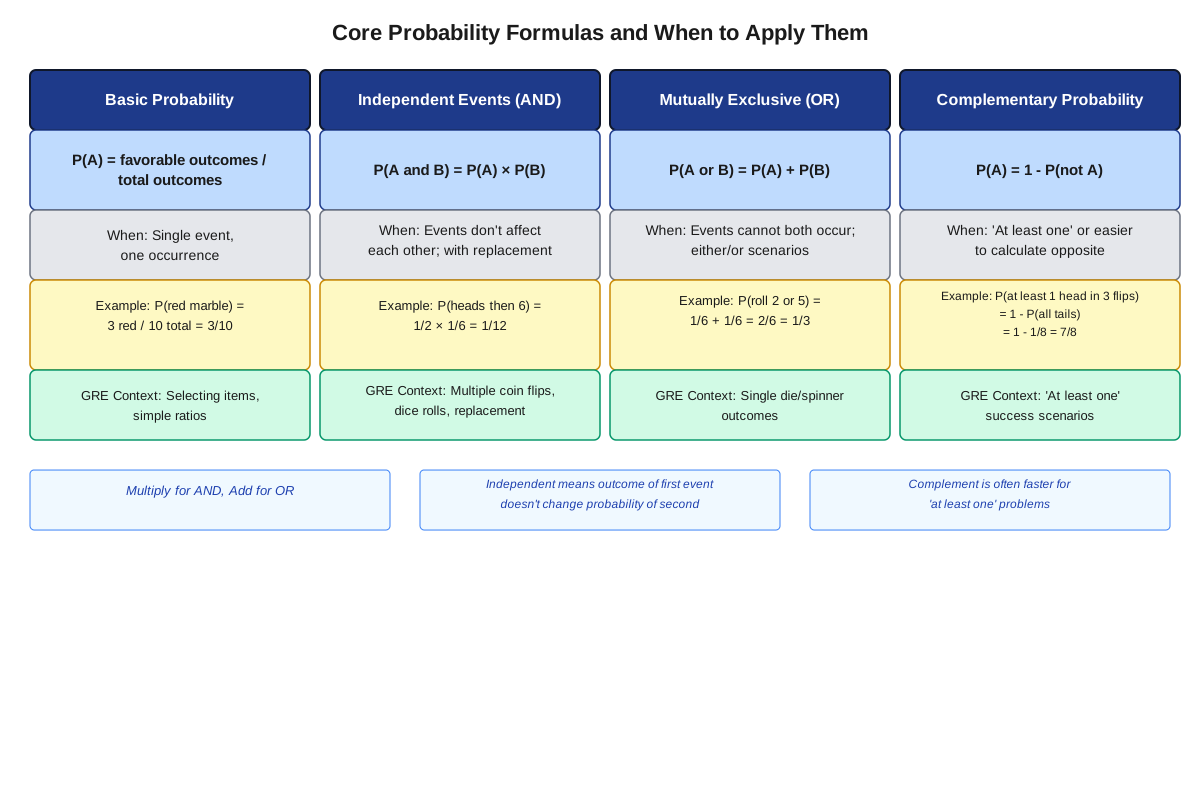
Probability = (Number of Favorable Outcomes) / (Total Number of Possible Outcomes)This ratio always produces a value between 0 (impossible event) and 1 (certain event), often expressed as a fraction, decimal, or percentage. In word problems, the challenge lies in correctly identifying both the numerator and denominator from the narrative description. The "favorable outcomes" are those that satisfy the condition described in the question, while "total possible outcomes" represents the complete sample space of what could occur.
For example, if a problem states "A bag contains 5 red marbles and 7 blue marbles. What is the probability of selecting a red marble?" the favorable outcomes equal 5 (red marbles) and total outcomes equal 12 (all marbles), yielding a probability of 5/12.
Independent Events
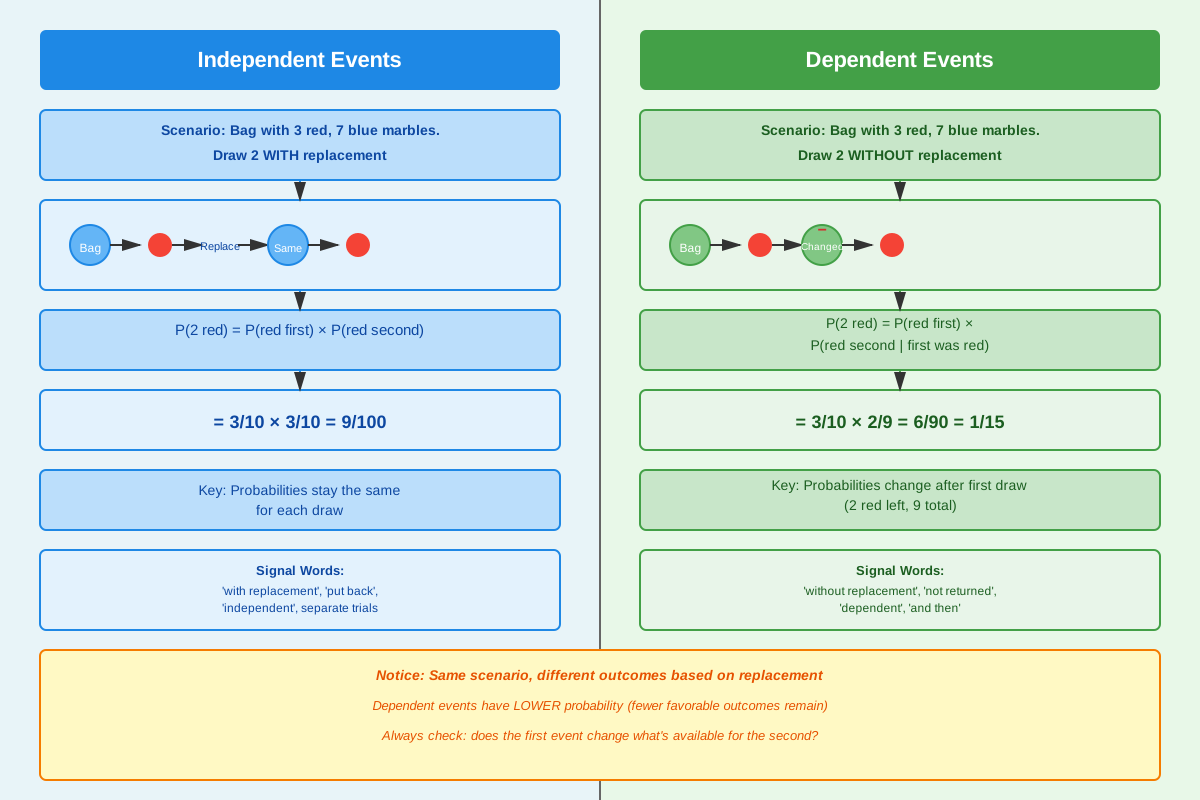
Independent events are occurrences where the outcome of one event does not affect the probability of another event. This concept is crucial for GRE probability word problems because the test frequently asks about multiple events happening in sequence or simultaneously.
When events are independent, the probability of both occurring equals the product of their individual probabilities:
P(A and B) = P(A) × P(B)Classic independent event scenarios include:
- Flipping a coin multiple times (each flip doesn't affect subsequent flips)
- Rolling dice repeatedly (previous rolls don't influence future rolls)
- Selecting items with replacement (returning the item before the next selection)
- Separate, unrelated events (weather in two different cities)
The key indicator of independence in word problems is whether the first event changes the conditions for the second event. If the problem explicitly states "with replacement" or describes completely separate situations, assume independence.
Dependent Events
Dependent events occur when the outcome of one event affects the probability of subsequent events. These problems require careful attention to how the sample space changes after each event.
For dependent events, calculate the probability of the first event, then recalculate the probability of the second event given the new conditions:
P(A and B) = P(A) × P(B|A)Where P(B|A) means "the probability of B given that A has occurred."
Common dependent event scenarios include:
- Selecting items without replacement (the first selection changes what remains)
- Drawing cards from a deck without returning them
- Choosing people from a group for sequential positions
- Any situation where the first outcome reduces or changes available options
The critical skill is recognizing when the denominator (total possible outcomes) changes between events. If a problem involves selecting multiple items and doesn't mention replacement, assume dependence.
Complementary Probability
The complement of an event represents all outcomes where that event does NOT occur. This concept provides a powerful shortcut for many GRE probability word problems, especially those asking about "at least one" occurrence.
The fundamental relationship:
P(event) + P(not event) = 1Therefore:
P(event) = 1 - P(not event)This approach dramatically simplifies problems asking "What is the probability that at least one..." because calculating "at least one" directly often requires considering multiple scenarios, while calculating "none" typically involves a single calculation.
For example, finding the probability that at least one of three coin flips is heads requires calculating: P(exactly 1 head) + P(exactly 2 heads) + P(exactly 3 heads). Using complementary probability, simply calculate P(no heads) = (1/2)³ = 1/8, then subtract from 1: P(at least one head) = 1 - 1/8 = 7/8.
Compound Probability with Multiple Events
Many GRE probability word problems involve calculating the likelihood of complex scenarios with multiple events. These require combining the concepts above strategically.
"And" scenarios (both events must occur) use multiplication:
- For independent events: multiply the individual probabilities
- For dependent events: multiply the first probability by the conditional probability
"Or" scenarios (either event can occur) use addition, with an adjustment for overlap:
P(A or B) = P(A) + P(B) - P(A and B)The subtraction prevents double-counting outcomes where both events occur. However, for mutually exclusive events (events that cannot both occur), the formula simplifies to:
P(A or B) = P(A) + P(B)Probability with Restrictions and Conditions
Advanced GRE probability word problems often include restrictions or special conditions that modify the sample space. These require careful analysis of what outcomes remain valid under the stated constraints.
Common restriction types include:
- Ordering requirements: "What is the probability that person A is selected before person B?"
- Grouping constraints: "What is the probability that all selected items are the same color?"
- Exclusion conditions: "What is the probability of selecting a number that is NOT divisible by 3?"
- Conditional selections: "Given that the first selection was red, what is the probability the second is blue?"
The strategy for restriction problems involves redefining either the favorable outcomes or the total outcomes (or both) to reflect only those possibilities that satisfy the constraint.
Concept Relationships
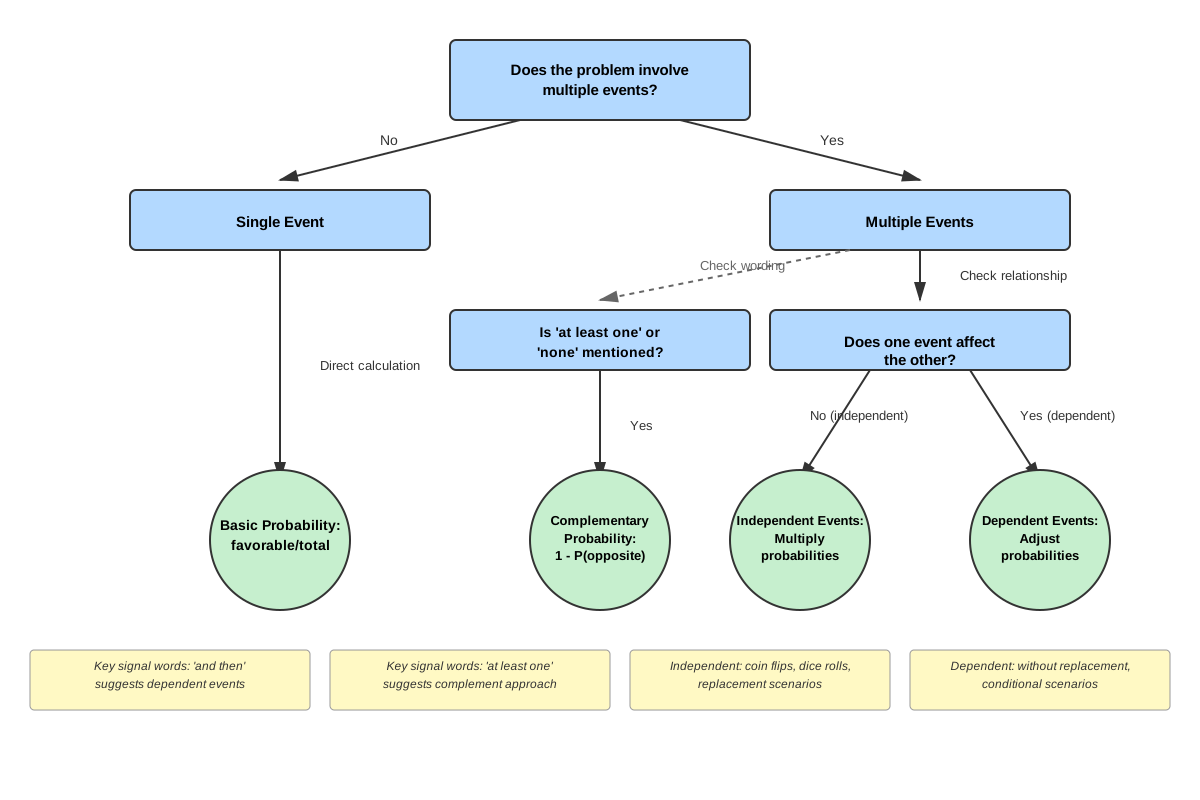
The concepts within probability word problems form an interconnected hierarchy. The fundamental probability formula serves as the foundation, providing the basic calculation method for all scenarios. This formula branches into two major pathways based on event relationships: independent events and dependent events.
Independent events → lead to → multiplication of unchanged probabilities, while dependent events → require → recalculation of probabilities after each occurrence. Both pathways can involve compound probability, which combines multiple events using "and" (multiplication) or "or" (addition) logic.
Complementary probability functions as a strategic overlay applicable to any probability calculation, offering an alternative computational path particularly valuable for "at least one" scenarios. This concept connects back to the fundamental formula through the relationship that all probabilities in a complete sample space sum to 1.
Restrictions and conditions modify any of the above concepts by constraining the sample space, effectively creating a new probability problem with adjusted favorable or total outcomes. These connect to prerequisite knowledge of combinatorics when counting restricted arrangements and to ratio reasoning when interpreting conditional probabilities.
The relationship to broader Quantitative Reasoning topics flows through fractions (the natural expression of probability), percentages (alternative probability representation), data interpretation (probability as a predictive tool), and logical reasoning (identifying event relationships). Mastery of probability word problems enables progression to statistics, data analysis, and expected value calculations—topics that appear in advanced GRE questions and graduate-level coursework.
Quick check — test yourself on Probability word problems so far.
Try Flashcards →High-Yield Facts
⭐ The probability of any event always falls between 0 and 1 inclusive (or 0% to 100%), with 0 representing impossibility and 1 representing certainty.
⭐ For independent events occurring together, multiply their individual probabilities: P(A and B) = P(A) × P(B).
⭐ For dependent events without replacement, the denominator decreases after each selection while the numerator adjusts based on what was removed.
⭐ Complementary probability provides a shortcut: P(event) = 1 - P(not event), especially useful for "at least one" questions.
⭐ "With replacement" signals independent events; "without replacement" signals dependent events.
- Mutually exclusive events cannot occur simultaneously, so P(A and B) = 0 for such events.
- The sum of all possible outcome probabilities in a complete sample space equals 1.
- "Or" probability for mutually exclusive events simply adds the individual probabilities: P(A or B) = P(A) + P(B).
- "Or" probability for non-exclusive events requires subtracting the overlap: P(A or B) = P(A) + P(B) - P(A and B).
- Conditional probability P(B|A) represents the probability of B occurring given that A has already occurred.
- The probability of multiple independent events all occurring equals the product of all individual probabilities, regardless of how many events are involved.
- When a problem asks for probability as a percentage, multiply the fractional result by 100.
- The order of multiplication doesn't matter for independent events, but the sequence matters when calculating dependent events.
Common Misconceptions
Misconception: Adding probabilities when the problem asks for multiple events to occur together.
Correction: When events must occur together ("and"), multiply probabilities. Addition applies to "or" scenarios where either event satisfies the condition. The word "and" signals multiplication; "or" signals addition (with adjustment for overlap).
Misconception: Treating all sequential events as independent.
Correction: Sequential events are only independent if the first event doesn't change the conditions for the second. Without replacement, events are dependent. Always check whether the sample space changes between events.
Misconception: Forgetting to subtract the overlap when calculating "or" probability for non-exclusive events.
Correction: When events can occur simultaneously, P(A or B) = P(A) + P(B) - P(A and B). Only skip the subtraction when events are mutually exclusive (cannot both occur).
Misconception: Calculating "at least one" by finding the probability of exactly one occurrence.
Correction: "At least one" means one OR more, requiring multiple calculations if approached directly. Instead, use complementary probability: P(at least one) = 1 - P(none).
Misconception: Using the original denominator for the second event in dependent probability problems.
Correction: In dependent events without replacement, both the numerator and denominator change. If you select one item from 10, the next selection occurs from 9 remaining items, not 10.
Misconception: Confusing P(A and B) with P(A or B) when interpreting word problems.
Correction: "And" means both conditions must be satisfied (intersection); "or" means at least one condition must be satisfied (union). Read carefully to determine which the question asks for.
Misconception: Assuming that "random selection" means equal probability for all outcomes without checking the problem setup.
Correction: Random selection means each item has an equal chance of being selected, but if there are different quantities of items (5 red, 3 blue), the probability of selecting each color differs. Equal selection probability doesn't guarantee equal outcome probability.
Worked Examples
Example 1: Dependent Events Without Replacement
Problem: A box contains 6 red balls, 4 blue balls, and 5 green balls. If two balls are selected randomly without replacement, what is the probability that both balls are red?
Solution:
Step 1: Identify the problem type. The phrase "without replacement" signals dependent events. The question asks for both selections to be red, indicating an "and" scenario requiring multiplication.
Step 2: Calculate the probability of the first event.
- Favorable outcomes: 6 red balls
- Total outcomes: 6 + 4 + 5 = 15 total balls
- P(first ball is red) = 6/15 = 2/5
Step 3: Calculate the probability of the second event, given the first occurred.
- After removing one red ball, favorable outcomes: 5 red balls remain
- After removing one ball total, total outcomes: 14 balls remain
- P(second ball is red | first was red) = 5/14
Step 4: Multiply the probabilities for dependent events.
- P(both red) = P(first red) × P(second red | first red)
- P(both red) = (2/5) × (5/14) = 10/70 = 1/7
Answer: The probability that both balls are red is 1/7 or approximately 0.143 or 14.3%.
Connection to learning objectives: This problem demonstrates identifying dependent probability (objective 1), applying the core multiplication strategy for "and" scenarios (objective 2), and distinguishing between independent and dependent events (objective 4).
Example 2: Complementary Probability with Multiple Events
Problem: A fair coin is flipped four times. What is the probability of getting at least one head?
Solution:
Step 1: Recognize the "at least one" trigger phrase. Calculating directly would require finding P(exactly 1 head) + P(exactly 2 heads) + P(exactly 3 heads) + P(exactly 4 heads)—four separate calculations. Complementary probability offers a shortcut.
Step 2: Identify the complement. The complement of "at least one head" is "no heads" or "all tails."
Step 3: Calculate P(all tails). Each flip is independent, and each has P(tails) = 1/2.
- P(all tails) = P(T) × P(T) × P(T) × P(T)
- P(all tails) = (1/2) × (1/2) × (1/2) × (1/2) = 1/16
Step 4: Apply complementary probability.
- P(at least one head) = 1 - P(no heads)
- P(at least one head) = 1 - 1/16 = 15/16
Answer: The probability of getting at least one head in four flips is 15/16 or approximately 0.938 or 93.8%.
Connection to learning objectives: This example shows recognizing when complementary probability provides an efficient strategy (objective 2), calculating compound probability with multiple independent events (objective 5), and avoiding the trap of lengthy direct calculation (objective 6).
Exam Strategy
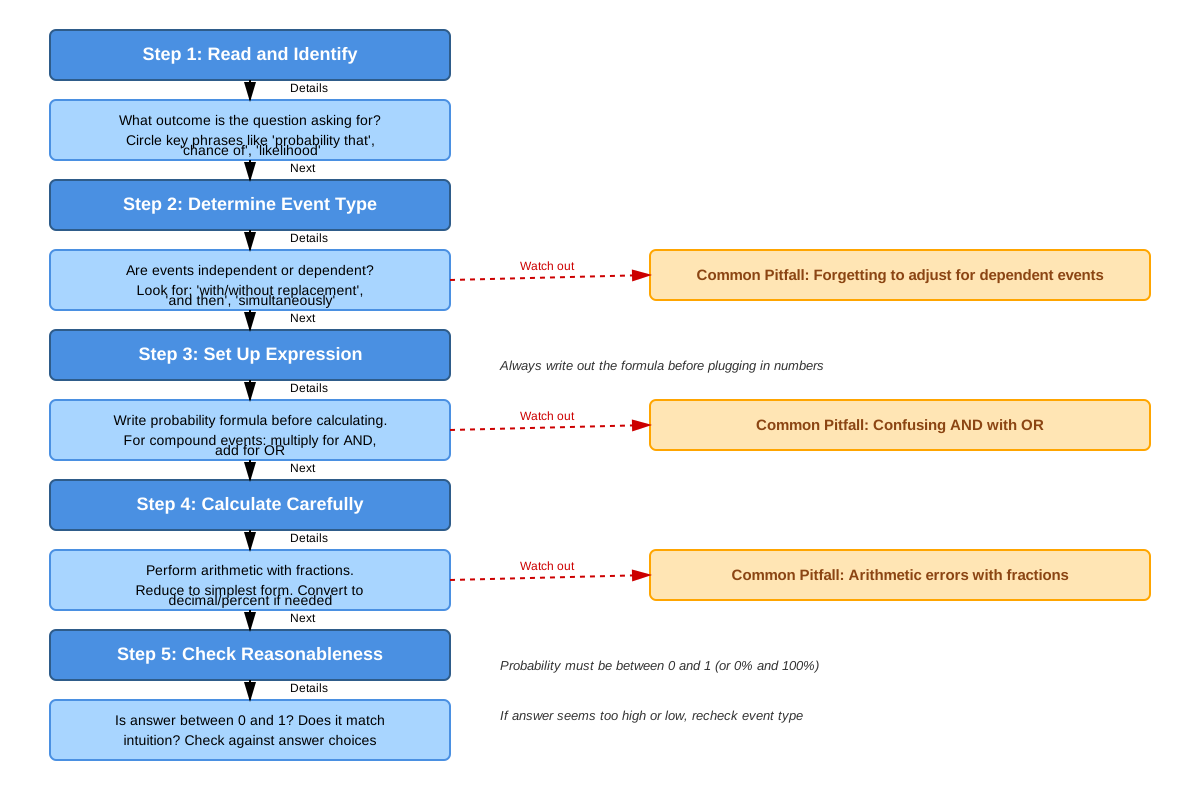
When approaching GRE probability word problems, follow this systematic process to maximize accuracy and efficiency:
Step 1: Identify the probability type. Before calculating anything, determine whether the problem involves independent or dependent events. Look for trigger phrases: "with replacement" or separate unrelated events signal independence; "without replacement" or sequential selections from the same group signal dependence.
Step 2: Clarify what the question asks. GRE probability problems often include extraneous information. Underline or mentally note the specific probability being requested. Does it ask for "and" (both/all events) or "or" (either event)? Does it ask for "at least one" (complement opportunity)?
Step 3: Define favorable and total outcomes explicitly. Write down or mentally articulate: "Favorable outcomes = [number], Total outcomes = [number]." This prevents confusion, especially in multi-step problems where these values change.
Step 4: Watch for "at least one" language. Phrases like "at least one," "one or more," or "not all" should trigger complementary probability thinking. Calculate the probability of the opposite outcome (usually "none") and subtract from 1.
Step 5: Track denominator changes in dependent events. For problems without replacement, after each selection, reduce both the numerator (if that type was selected) and denominator (always) by 1. Create a mental or written note: "First selection: x/y, Second selection: ?/?"
Trigger words and phrases to recognize:
- "Without replacement": dependent events, changing denominators
- "With replacement": independent events, constant probabilities
- "At least one": use complementary probability
- "Both," "all": multiplication ("and" logic)
- "Either," "or": addition, check for mutual exclusivity
- "Given that": conditional probability, adjust sample space
- "Random" or "randomly": equal selection probability for each item
Process-of-elimination tips:
- Eliminate any answer greater than 1 or less than 0 (impossible probabilities)
- For "and" scenarios with probabilities less than 1, the result must be smaller than either individual probability
- For "or" scenarios with mutually exclusive events, the result must be larger than either individual probability but cannot exceed 1
- If the problem involves fractions, answers in simplified form are more likely correct than unsimplified versions
Time allocation advice: Allocate 1.5-2 minutes for standard probability word problems. If a problem requires more than three calculation steps, verify that you've chosen the most efficient approach—you may have missed a complementary probability shortcut. If stuck after 30 seconds of reading, identify what type of probability is being tested and work backward from answer choices if necessary.
Memory Techniques
"AND means MULTIPLY, OR means ADD": This fundamental mnemonic helps distinguish between compound probability operations. When events must occur together (and), multiply their probabilities. When either event satisfies the condition (or), add their probabilities (remembering to subtract overlap for non-exclusive events).
"WORM" for dependent events: Without Replacement Means dependent events. This acronym reminds you that when items aren't returned, probabilities change between selections.
"1 minus NONE gives you ONE (or more)": For "at least one" problems, remember that 1 - P(none) = P(at least one). The rhyme helps recall the complementary probability shortcut.
Visualization strategy for dependent events: Picture a bag or container physically losing items as you select them. Visualize the bag getting lighter and having fewer items helps remember that the denominator decreases. Imagine looking inside and seeing fewer options for the next selection.
The "Probability Number Line": Visualize a number line from 0 to 1. Impossible events sit at 0, certain events at 1, and all real probabilities fall between them. This mental image helps eliminate unreasonable answer choices and provides intuition about whether calculated probabilities make sense.
"First THEN Second": For dependent events, always calculate the first event's probability, THEN calculate the second event's probability using the new conditions. This sequential thinking prevents the common error of using original values for subsequent events.
Acronym for problem-solving steps - "IFTAC":
- Identify the probability type (independent/dependent)
- Find what the question asks
- Tally favorable and total outcomes
- Apply the appropriate formula
- Check that the answer makes sense (between 0 and 1)
Summary
Probability word problems on the GRE test the ability to translate narrative scenarios into mathematical probability calculations. Success requires mastering the fundamental probability formula (favorable outcomes divided by total outcomes), distinguishing between independent and dependent events, and recognizing when complementary probability offers computational shortcuts. Independent events multiply unchanged probabilities, while dependent events require recalculating probabilities as the sample space changes. The GRE frequently tests compound probability involving multiple events, particularly "and" scenarios (multiplication) and "or" scenarios (addition with overlap adjustment). Recognizing trigger phrases like "without replacement," "at least one," and "given that" enables quick identification of the appropriate strategy. The most efficient approach often involves complementary probability for "at least one" questions, calculating what doesn't happen and subtracting from 1. Systematic problem-solving—identifying event type, clarifying the question, defining outcomes explicitly, and checking answer reasonableness—maximizes accuracy under time pressure.
Key Takeaways
- Probability always equals favorable outcomes divided by total possible outcomes, producing values between 0 and 1
- Independent events multiply unchanged probabilities; dependent events require recalculating probabilities after each occurrence
- "Without replacement" signals dependent events with decreasing denominators; "with replacement" signals independent events
- Complementary probability (1 - P(not event)) provides the most efficient solution for "at least one" questions
- "And" scenarios multiply probabilities; "or" scenarios add probabilities, subtracting overlap for non-exclusive events
- Systematic identification of problem type and explicit definition of favorable/total outcomes prevents calculation errors
- Trigger phrases like "at least one," "both," "either," and "given that" signal specific probability strategies
Related Topics
Combinatorics and Counting Principles: Probability problems often require counting arrangements, permutations, or combinations to determine total possible outcomes. Mastering probability word problems provides foundation for advanced counting scenarios where probability and combinatorics intersect.
Statistics and Data Analysis: Probability concepts underpin statistical reasoning, including sampling, distributions, and hypothesis testing. The probability skills developed here enable understanding of statistical significance and data interpretation questions on the GRE.
Expected Value: This advanced topic extends probability by calculating the average outcome when events have different values. Mastering basic probability word problems is essential before tackling expected value scenarios.
Conditional Probability and Bayes' Theorem: More sophisticated GRE questions may involve updating probabilities based on new information. The dependent event skills learned here provide the foundation for conditional probability reasoning.
Set Theory and Venn Diagrams: Visual representation of probability relationships through sets and Venn diagrams offers alternative problem-solving approaches. Understanding probability word problems enhances ability to translate between verbal, numerical, and visual representations.
Practice CTA
Now that you've mastered the core concepts, strategies, and common pitfalls of probability word problems, it's time to solidify your understanding through active practice. Attempt the practice questions designed specifically for this topic, applying the systematic approach and trigger word recognition you've learned. Use the flashcards to reinforce high-yield facts and formulas until they become automatic. Remember: probability word problems reward methodical thinking and pattern recognition—skills that improve dramatically with deliberate practice. Each problem you solve strengthens your ability to quickly identify problem types and select efficient solution strategies. You've built the foundation; now construct mastery through application!
Sign up free to keep reading
Create a free AnvayaPrep account to finish this GRE guide on Probability word problems — plus flashcards and practice questions.