Overview
Algebraic modeling is the process of translating real-world scenarios, word problems, and complex relationships into mathematical equations and expressions that can be solved systematically. On the GRE Quantitative Reasoning section, this skill represents one of the most frequently tested competencies, appearing in approximately 20-30% of all quantitative questions. Rather than presenting straightforward computational problems, the GRE challenges test-takers to interpret verbal descriptions of mathematical relationships and construct appropriate algebraic representations before solving.
The essence of GRE algebraic modeling lies in bridging the gap between language and mathematics. Students must parse through contextual information, identify relevant variables, establish relationships between quantities, and formulate equations that accurately capture the problem's constraints. This skill extends beyond simple translation—it requires recognizing patterns, understanding implicit relationships, and making strategic decisions about which variables to define and which equations to construct. Mastery of algebraic modeling directly impacts performance on word problems involving rates, mixtures, age relationships, work problems, geometry applications, and optimization scenarios.
Within the broader Quantitative Reasoning framework, algebraic modeling serves as a foundational skill that integrates arithmetic operations, equation-solving techniques, and logical reasoning. It connects directly to topics such as linear equations, systems of equations, ratios and proportions, percentages, and rate problems. Students who excel at algebraic modeling demonstrate not just computational proficiency but also analytical thinking—the ability to deconstruct complex scenarios into manageable mathematical components. This topic is particularly high-yield because it appears across multiple question formats, including Quantitative Comparison, Multiple Choice (single and multiple answer), and Numeric Entry questions.
Learning Objectives
- [ ] Identify when Algebraic modeling is being tested in GRE questions
- [ ] Explain the core rule or strategy behind Algebraic modeling
- [ ] Apply Algebraic modeling to GRE-style questions accurately
- [ ] Translate complex verbal descriptions into appropriate algebraic expressions and equations
- [ ] Distinguish between relevant and irrelevant information in word problems
- [ ] Construct systems of equations from multi-variable scenarios
- [ ] Verify that algebraic models accurately represent the constraints described in problems
Prerequisites
- Basic algebra skills: Ability to solve linear equations, manipulate expressions, and work with variables—essential for executing solutions once models are constructed
- Arithmetic operations: Proficiency with fractions, decimals, percentages, and ratios—necessary for translating quantitative relationships accurately
- Equation-solving techniques: Knowledge of substitution, elimination, and isolation methods—required to find solutions after modeling
- Understanding of variables: Comfort with using letters to represent unknown quantities—fundamental to the modeling process itself
- Order of operations: Mastery of PEMDAS/BODMAS—critical for constructing expressions that reflect the correct sequence of calculations
Why This Topic Matters
Algebraic modeling represents a critical bridge between abstract mathematical thinking and practical problem-solving. In real-world contexts, professionals across fields—from engineering and economics to medicine and business—regularly translate complex situations into mathematical frameworks to analyze data, make predictions, and optimize outcomes. The ability to model scenarios algebraically enables decision-making based on quantitative analysis rather than intuition alone.
On the GRE specifically, algebraic modeling appears with remarkable frequency and variety. Research indicates that approximately 6-9 questions per Quantitative Reasoning section involve some form of algebraic modeling, making it one of the highest-yield topics for focused study. These questions appear in multiple formats: as standalone word problems, within Data Interpretation sets, in Quantitative Comparison questions requiring relationship analysis, and in complex multi-step problems that combine several mathematical concepts.
The GRE tests algebraic modeling through several common scenarios: age problems requiring relationships between people's ages at different times; rate problems involving distance, speed, and time; work problems with multiple workers completing tasks at different rates; mixture problems combining substances with different concentrations; consecutive integer problems; geometric problems requiring algebraic representation of shapes; and optimization problems seeking maximum or minimum values. The exam deliberately embeds these scenarios in realistic contexts—business transactions, travel situations, construction projects, and scientific experiments—requiring students to extract mathematical structure from narrative descriptions. Questions often include extraneous information to test whether students can identify relevant variables and relationships, making the modeling skill itself as important as computational accuracy.
Core Concepts
The Algebraic Modeling Process
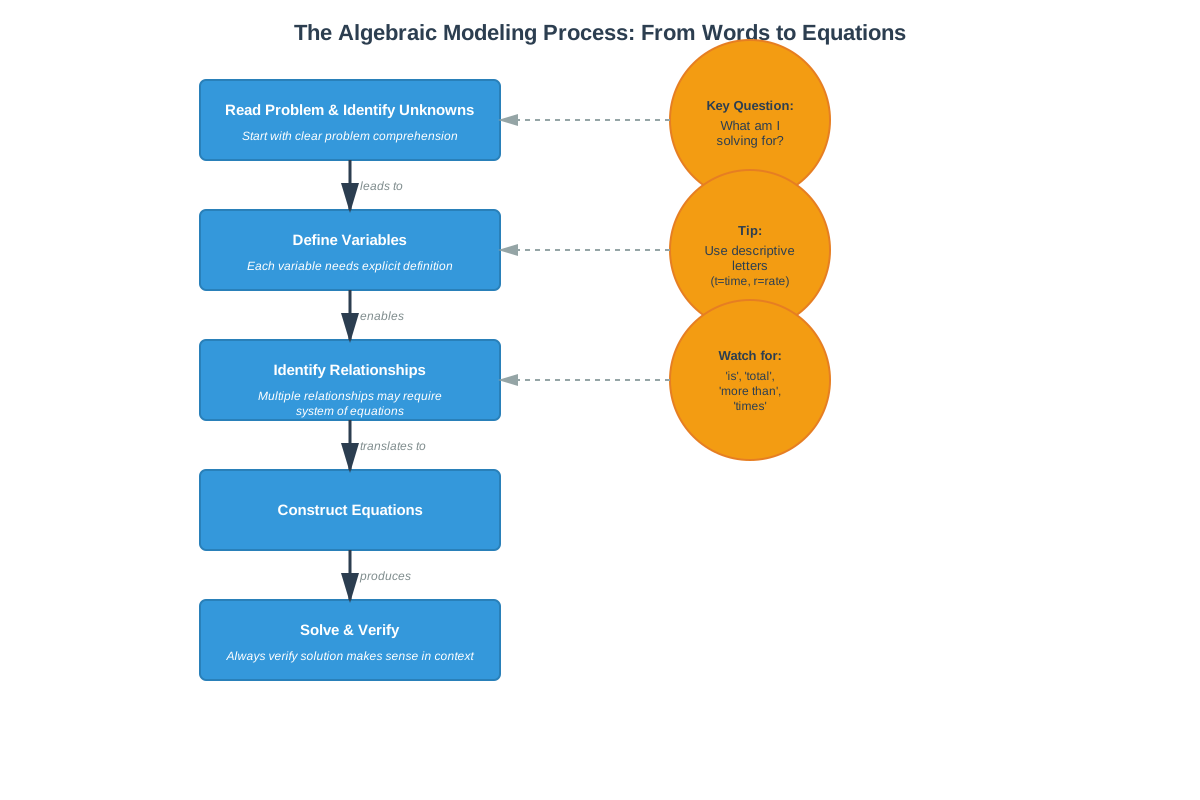
The systematic approach to algebraic modeling follows a structured five-step process that transforms word problems into solvable equations:
- Read and understand: Carefully read the entire problem, identifying what is being asked
- Define variables: Assign letters to represent unknown quantities explicitly
- Identify relationships: Determine how quantities relate to each other mathematically
- Construct equations: Translate relationships into algebraic expressions and equations
- Solve and verify: Execute algebraic techniques and check solutions against original constraints
This process is not merely procedural but requires active interpretation at each stage. The most critical phase is often defining variables strategically—choosing what to represent algebraically can significantly impact solution efficiency.
Variable Definition Strategies
Effective variable definition requires strategic thinking about which unknowns to represent directly. Consider these approaches:
Direct representation: Assign variables to the quantities explicitly asked for in the problem. If a question asks "How old is Maria?", define M as Maria's current age.
Relationship-based representation: When multiple quantities are related, define one variable and express others in terms of it. For example, if John is 5 years older than Sarah, define S as Sarah's age and represent John's age as S + 5, rather than introducing a second independent variable.
Time-indexed variables: For problems involving changes over time, use subscripts or different variables to distinguish between values at different moments. Current age versus age 10 years ago might be represented as A and A - 10.
| Scenario Type | Variable Strategy | Example |
|---|---|---|
| Single unknown | Direct variable | "Find the number" → Let n = the number |
| Related quantities | Express in terms of one variable | "One number is twice another" → Let x = smaller, 2x = larger |
| Multiple time periods | Time-indexed representation | "Age now and in 5 years" → Let A = age now, A + 5 = age in 5 years |
| Rate problems | Use standard formulas | Distance = rate × time → d = rt |
Translating Verbal Phrases to Algebra
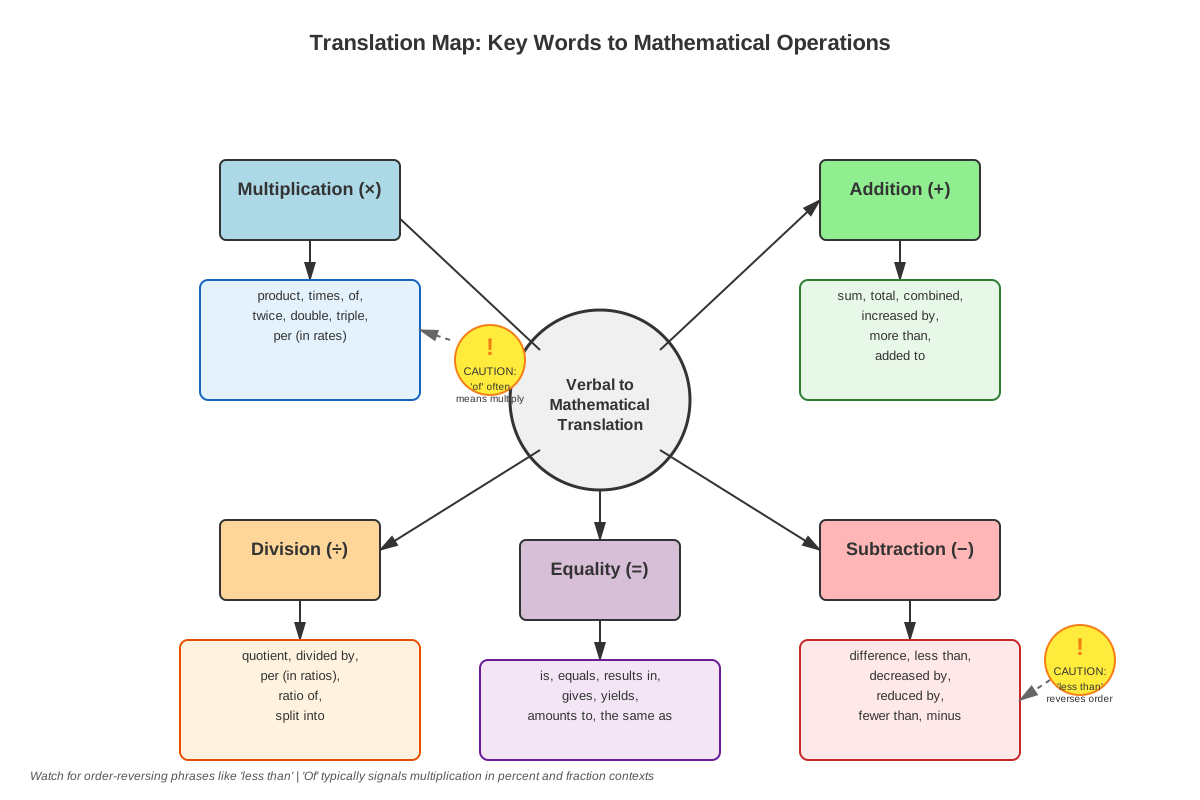
The core of algebraic modeling involves converting English phrases into mathematical expressions. This translation requires recognizing linguistic patterns that signal specific operations:
Addition indicators: "sum," "total," "combined," "increased by," "more than," "added to"
- "5 more than a number" → x + 5
- "the sum of two consecutive integers" → n + (n + 1)
Subtraction indicators: "difference," "decreased by," "less than," "reduced by," "minus," "fewer than"
- "7 less than a number" → x - 7
- "the difference between two numbers" → x - y
Multiplication indicators: "product," "times," "of" (with fractions/percentages), "twice," "triple"
- "the product of two numbers" → xy
- "30% of a quantity" → 0.30x
Division indicators: "quotient," "divided by," "ratio of," "per"
- "the quotient of a number and 5" → x/5
- "miles per hour" → distance/time
Equality indicators: "is," "equals," "is the same as," "results in," "yields"
- "Five more than twice a number is 17" → 2x + 5 = 17
Exam Tip: Pay special attention to the order of operations implied by phrases. "5 less than x" translates to x - 5, NOT 5 - x. The phrase structure often reverses the algebraic order.
Common Problem Types and Their Models
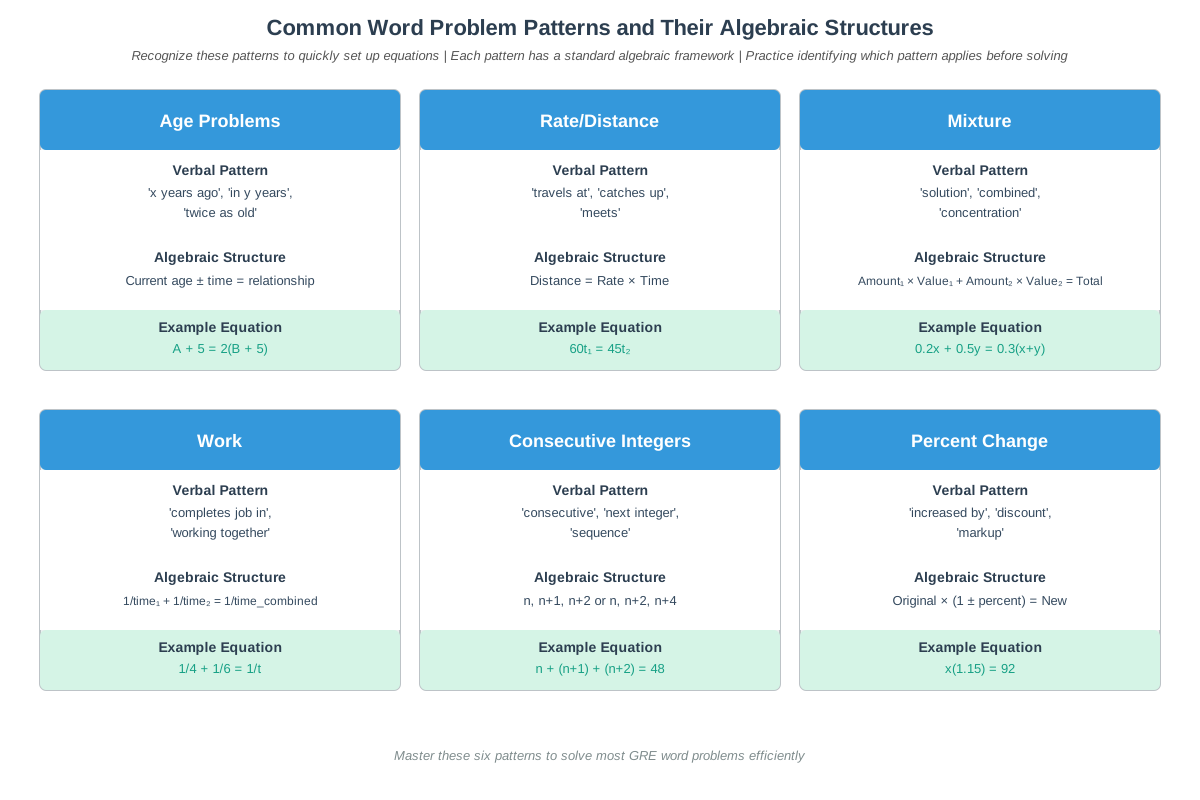
Age Problems: These involve relationships between people's ages at different times. The key principle is that everyone ages at the same rate—if 5 years pass, add 5 to everyone's age.
Standard model structure:
- Define current ages as variables
- Express past/future ages by subtracting/adding time elapsed
- Set up equations based on stated relationships
Rate Problems: Following the fundamental relationship distance = rate × time (d = rt), these problems involve motion, work completion, or flow rates.
Standard model variations:
- Same direction travel: relative speed = |r₁ - r₂|
- Opposite direction travel: relative speed = r₁ + r₂
- Work problems: combined rate = r₁ + r₂
Mixture Problems: Involving combining substances with different properties (concentration, price, purity), these use the principle that total amount = sum of individual amounts.
Standard model: (amount₁)(property₁) + (amount₂)(property₂) = (total amount)(final property)
Consecutive Integer Problems: These exploit the pattern that consecutive integers differ by 1, consecutive even/odd integers differ by 2.
Standard representations:
- Consecutive integers: n, n+1, n+2
- Consecutive even/odd integers: n, n+2, n+4
Constraint Identification
Many GRE problems include multiple constraints that must all be satisfied simultaneously. Identifying each constraint and translating it into an equation or inequality is crucial:
Explicit constraints: Directly stated relationships ("The sum is 50," "One number is three times another")
Implicit constraints: Logical requirements not explicitly stated (ages must be positive, you cannot have fractional people, percentages must sum to 100%)
Boundary conditions: Limits on possible values ("at least," "no more than," "between")
Systems of Equations from Word Problems
When problems involve multiple unknowns with multiple relationships, construct a system of equations:
- Count the unknowns—you need as many independent equations as unknowns
- Extract each relationship as a separate equation
- Ensure equations are truly independent (not multiples of each other)
- Solve using substitution or elimination
Example structure: "The sum of two numbers is 15, and their difference is 3"
- Let x = first number, y = second number
- Equation 1: x + y = 15
- Equation 2: x - y = 3
- Two equations, two unknowns—solvable system
Concept Relationships
Algebraic modeling serves as the central hub connecting multiple quantitative reasoning skills. The modeling process begins with reading comprehension → requires variable definition → demands relationship identification → leads to equation construction → necessitates algebraic manipulation → concludes with solution verification.
Within the topic itself, the five-step modeling process creates a linear dependency: each stage builds on the previous one. Accurate variable definition enables correct relationship identification; proper relationship identification allows appropriate equation construction; well-formed equations facilitate efficient solving; and systematic solving permits meaningful verification.
Algebraic modeling connects backward to prerequisite topics: basic algebra provides the manipulation techniques needed after modeling; arithmetic operations enable the calculations within models; equation-solving methods execute the solutions to constructed models. It connects forward to advanced topics: systems of equations extend modeling to multi-variable scenarios; inequalities model constraint-based problems; functions represent more complex relationships; optimization problems use modeling to find maximum/minimum values.
The relationship to other word problem types is particularly strong: rate problems are specialized applications of algebraic modeling using d = rt; percentage problems model proportional relationships; ratio problems model comparative relationships; work problems model combined rates. Each represents a specific modeling pattern that can be mastered through the general algebraic modeling framework.
High-Yield Facts
⭐ The number of independent equations needed equals the number of unknown variables for a system to have a unique solution.
⭐ "Less than" reverses the order: "5 less than x" means x - 5, not 5 - x.
⭐ In rate problems, distance = rate × time (d = rt) is the fundamental relationship; all variations derive from this.
⭐ Consecutive integers are represented as n, n+1, n+2; consecutive even or odd integers as n, n+2, n+4.
⭐ When quantities are combined, the total equals the sum of parts: crucial for mixture and work problems.
- Age problems rely on the principle that everyone ages at the same rate over any time period.
- "Of" typically signals multiplication, especially with fractions and percentages (30% of x = 0.30x).
- In work problems, if person A completes a job in a hours and person B in b hours, their combined rate is 1/a + 1/b jobs per hour.
- The sum of n consecutive integers equals n times the middle value (for odd n) or n times the average of the two middle values (for even n).
- Mixture problems use the equation: (amount₁)(concentration₁) + (amount₂)(concentration₂) = (total amount)(final concentration).
- When two objects travel toward each other, their relative speed is the sum of their individual speeds.
- Percent increase/decrease problems model as: new value = original value ± (percentage)(original value).
- The phrase "is" in word problems almost always translates to an equals sign in the equation.
Quick check — test yourself on Algebraic modeling so far.
Try Flashcards →Common Misconceptions
Misconception: All information provided in a word problem must be used in the solution.
Correction: GRE problems frequently include extraneous information to test whether students can identify relevant versus irrelevant data. Part of algebraic modeling is determining which quantities matter for the specific question asked.
Misconception: More variables always mean more complex problems requiring more equations.
Correction: Strategic variable definition often allows expressing multiple quantities in terms of a single variable, simplifying the problem. If "x is twice y," defining only y and representing x as 2y is more efficient than defining both x and y separately.
Misconception: The order of words in a phrase directly translates to the order of terms in an expression.
Correction: Phrases like "5 less than a number" or "the difference of 10 and x" reverse the algebraic order. "5 less than x" means x - 5, and "the difference of 10 and x" means 10 - x. Always consider the mathematical meaning, not just word order.
Misconception: In age problems, if someone is currently x years old, they were x - 5 years old 5 years ago, so their age 5 years ago should be represented as a separate variable.
Correction: Time relationships are deterministic, not independent. If current age is x, then age 5 years ago is definitively x - 5, not a new variable. Introducing unnecessary variables creates unsolvable systems.
Misconception: Algebraic modeling is only necessary for complex problems; simple problems can be solved by guessing or testing values.
Correction: While testing values works for some problems, algebraic modeling provides a systematic, reliable approach that scales to complex scenarios and reduces error. On the GRE, time pressure makes systematic methods more efficient than trial-and-error.
Misconception: Once an equation is set up, the modeling phase is complete.
Correction: Verification is a critical component of algebraic modeling. After solving, substitute the solution back into the original problem context to ensure it satisfies all stated conditions and makes logical sense (e.g., ages are positive, speeds are reasonable).
Misconception: "Twice as much" and "two more than" mean the same thing.
Correction: "Twice as much" indicates multiplication (2x), while "two more than" indicates addition (x + 2). These represent fundamentally different relationships and lead to different equations.
Worked Examples
Example 1: Age Problem with Multiple Time Periods
Problem: Sarah is currently three times as old as her daughter Emma. In 10 years, Sarah will be twice as old as Emma. How old is Emma now?
Solution:
Step 1 - Define variables: Let E = Emma's current age. Since Sarah is three times as old, Sarah's current age = 3E. (Note: We use one variable and express the related quantity in terms of it.)
Step 2 - Identify relationships: We have two time periods (now and in 10 years) and a relationship at each time.
Step 3 - Construct equations:
- Current ages: Emma = E, Sarah = 3E
- Ages in 10 years: Emma = E + 10, Sarah = 3E + 10
- Relationship in 10 years: Sarah's age = 2 × Emma's age
Step 4 - Write the equation:
3E + 10 = 2(E + 10)Step 5 - Solve:
3E + 10 = 2E + 20
3E - 2E = 20 - 10
E = 10
Step 6 - Verify:
- Emma is currently 10 years old
- Sarah is currently 3(10) = 30 years old
- In 10 years: Emma will be 20, Sarah will be 40
- Check: Is 40 twice 20? Yes ✓
- Check: Is Sarah currently three times Emma's age? 30 = 3(10) ✓
Answer: Emma is currently 10 years old.
Connection to learning objectives: This example demonstrates identifying when algebraic modeling is tested (age relationship problem), applying the core strategy (defining variables efficiently, setting up equations for different time periods), and accurately solving a GRE-style question.
Example 2: Rate Problem with Opposite Directions
Problem: Two trains leave stations 450 miles apart and travel toward each other. Train A travels at 60 mph, and Train B travels at 75 mph. How many hours will it take for the trains to meet?
Solution:
Step 1 - Define variables: Let t = time (in hours) until the trains meet.
Step 2 - Identify relationships:
- Both trains travel for the same amount of time
- The sum of distances traveled equals the total distance between stations
- Distance = rate × time for each train
Step 3 - Construct expressions:
- Distance traveled by Train A: 60t
- Distance traveled by Train B: 75t
- Total distance: 450 miles
Step 4 - Write the equation: When traveling toward each other, distances add:
60t + 75t = 450Step 5 - Solve:
135t = 450
t = 450/135
t = 10/3 hours (or 3 hours 20 minutes)
Step 6 - Verify:
- Train A travels: 60 × (10/3) = 200 miles
- Train B travels: 75 × (10/3) = 250 miles
- Total: 200 + 250 = 450 miles ✓
Answer: The trains will meet in 10/3 hours (or 3 hours 20 minutes).
Alternative approach: Recognize that when traveling toward each other, the relative speed is 60 + 75 = 135 mph. Time = distance/speed = 450/135 = 10/3 hours. This demonstrates how understanding the underlying model enables multiple solution paths.
Connection to learning objectives: This example shows recognizing rate problems as algebraic modeling scenarios, applying the d = rt framework, and translating "toward each other" into the appropriate equation structure.
Exam Strategy
Approaching GRE Algebraic Modeling Questions:
Begin by reading the entire problem carefully before attempting any calculations. Identify the question being asked—circle or underline it—to maintain focus on the goal. Many students waste time solving for the wrong quantity because they lose track of what the question requests.
Trigger words and phrases to recognize:
- "How many," "how much," "what is" → signals what to solve for
- "The sum/difference/product/quotient of" → indicates the operation to model
- "More than," "less than," "times as much" → specifies relationships between quantities
- "In x years," "x years ago" → indicates time-based relationships requiring adjustment
- "Combined," "together," "total" → suggests addition of quantities or rates
- "Ratio of," "proportion" → indicates multiplicative relationships
Process-of-elimination strategies:
For Quantitative Comparison questions involving algebraic modeling, test extreme values and special cases rather than solving completely. If the relationship holds for all tested values, it likely holds generally.
For Multiple Choice questions, use answer choices strategically. If answers are numerical, consider working backward—substitute each answer into the problem context to see which satisfies all conditions. This "backsolving" technique often proves faster than algebraic solving, especially for complex models.
Eliminate answers that violate logical constraints immediately. If a problem asks for someone's age, negative answers are impossible. If asking for a number of people, non-integer answers are invalid.
Time allocation advice:
Allocate approximately 2 minutes for algebraic modeling problems. Spend the first 30 seconds reading and understanding, 30 seconds defining variables and identifying relationships, 45 seconds constructing equations, and 45 seconds solving and verifying.
If a problem seems to require extensive calculation after modeling, reconsider the approach—the GRE rarely requires tedious computation. Look for simplifications, common factors, or alternative strategies like backsolving or testing values.
Strategic variable definition:
Choose variables that minimize the number of unknowns. If three quantities are related, express all three in terms of one variable when possible. This reduces the system complexity and often eliminates the need for multiple equations.
Verification as strategy:
Always verify solutions by substituting back into the original problem context, not just the equation. This catches modeling errors that algebraic checking misses. Ask: "Does this answer make sense given the problem scenario?"
Memory Techniques
DRIVE mnemonic for the modeling process:
- Define variables clearly
- Read and identify relationships
- Identify what's being asked
- Verify the solution makes sense
- Equations: construct and solve
"Less than FLIPS" for order reversal:
When you see "less than," remember it FLIPS the order: "5 less than x" becomes x - 5 (the 5 flips to the right side of x).
"Of means MULTIPLY":
In percentage and fraction problems, "of" signals multiplication: "30% of x" = 0.30 × x.
Age problem visualization:
Create a mental timeline with "NOW" in the middle, past to the left, future to the right. Place each person's age on the timeline at each relevant time point. This visual structure helps identify relationships.
Rate problem triangle:
Visualize a triangle with D (distance) at the top, R (rate) and T (time) at the bottom corners. Cover what you're solving for; the remaining positions show the operation: D = R × T, R = D/T, T = D/R.
Consecutive integer pattern:
Remember "n, n+1, n+2" by visualizing a staircase—each step is one higher. For even/odd, visualize skipping steps: "n, n+2, n+4."
Summary
Algebraic modeling represents the critical skill of translating verbal descriptions and real-world scenarios into mathematical equations that can be solved systematically. On the GRE, this competency appears in approximately 20-30% of Quantitative Reasoning questions across multiple formats and problem types. The systematic five-step process—reading and understanding, defining variables strategically, identifying relationships, constructing equations, and solving with verification—provides a reliable framework for approaching any modeling problem. Success requires not just computational skill but analytical thinking: distinguishing relevant from irrelevant information, recognizing linguistic patterns that signal mathematical operations, and choosing variable definitions that simplify rather than complicate. The most common problem types—age relationships, rate problems, mixture scenarios, and consecutive integers—each follow predictable patterns that can be mastered through practice. Critical to GRE success is understanding that algebraic modeling is not merely about setting up equations but about strategic problem-solving: choosing efficient representations, verifying solutions against original constraints, and recognizing when alternative approaches like backsolving might prove faster than traditional algebraic methods.
Key Takeaways
- Algebraic modeling is the systematic translation of word problems into solvable equations, appearing in 20-30% of GRE Quantitative Reasoning questions across multiple problem types.
- Strategic variable definition minimizes complexity: express related quantities in terms of one variable rather than introducing multiple independent unknowns.
- The five-step process (read, define, identify, construct, verify) provides a reliable framework for approaching any algebraic modeling problem systematically.
- Order matters in translation: phrases like "less than" and "difference of" reverse the algebraic order compared to word order.
- Common problem types follow predictable patterns: age problems use time-adjusted variables, rate problems use d = rt, mixture problems use weighted averages, and consecutive integers follow n, n+1, n+2.
- Verification is essential: always check solutions against the original problem context, not just the equations, to catch modeling errors.
- The GRE tests modeling skill as much as computational ability: identifying relevant information, choosing efficient approaches, and recognizing when to use alternative strategies like backsolving are as important as algebraic manipulation.
Related Topics
Systems of Equations: Extends algebraic modeling to scenarios requiring multiple equations with multiple unknowns; mastering basic modeling enables efficient construction of systems.
Linear Inequalities: Applies modeling principles to constraint-based problems where solutions must satisfy ranges rather than exact values; builds on equation construction skills.
Functions and Function Notation: Represents more complex relationships where one quantity depends on another; algebraic modeling provides the foundation for understanding functional relationships.
Optimization Problems: Uses algebraic models to find maximum or minimum values subject to constraints; requires advanced modeling skills to set up objective functions.
Coordinate Geometry: Applies algebraic modeling to geometric scenarios, representing shapes and relationships with equations; connects algebraic and visual reasoning.
Data Interpretation: Often requires constructing algebraic models from graphical or tabular information; modeling skills enable extraction of mathematical relationships from data.
Practice CTA
Now that you've mastered the core concepts and strategies of algebraic modeling, it's time to solidify your understanding through active practice. Attempt the practice questions designed specifically for this topic, focusing on applying the five-step modeling process systematically. Use the flashcards to reinforce key translation patterns and common problem types until they become automatic. Remember: algebraic modeling is a skill that improves dramatically with deliberate practice. Each problem you work through strengthens your pattern recognition and builds the confidence needed to tackle any modeling scenario on test day. Your investment in mastering this high-yield topic will pay dividends across the entire Quantitative Reasoning section!
Sign up free to keep reading
Create a free AnvayaPrep account to finish this GRE guide on Algebraic modeling — plus flashcards and practice questions.