Overview
The study of interior angles of polygons is a foundational geometry topic that appears frequently on the GRE Quantitative Reasoning section. This topic requires students to understand the relationships between the number of sides in a polygon and the sum of its interior angles, as well as how to calculate individual angle measures in both regular and irregular polygons. Mastery of this concept enables test-takers to solve a wide variety of geometry problems efficiently, from straightforward angle calculations to complex multi-step problems involving multiple geometric principles.
Understanding GRE interior angles of polygons is essential because these questions often serve as building blocks for more complex geometry problems. The GRE frequently tests this concept both directly—asking students to find missing angles or verify angle relationships—and indirectly, embedding polygon angle calculations within larger problems involving coordinate geometry, area calculations, or geometric reasoning. The ability to quickly recall and apply the interior angle sum formula can save valuable time during the exam and prevent careless errors that result from attempting to calculate angles through less efficient methods.
This topic connects intimately with other Quantitative Reasoning concepts, including properties of triangles (the fundamental polygon), quadrilaterals, circles, and coordinate geometry. The principles governing interior angles also relate to exterior angles, supplementary and complementary angle relationships, and the broader study of geometric transformations. A solid grasp of polygon interior angles provides the foundation for understanding more advanced topics such as similar polygons, regular polygon properties, and the relationship between polygons and circles (inscribed and circumscribed figures).
Learning Objectives
- [ ] Identify when Interior angles of polygons is being tested
- [ ] Explain the core rule or strategy behind Interior angles of polygons
- [ ] Apply Interior angles of polygons to GRE-style questions accurately
- [ ] Derive the interior angle sum formula for any polygon using triangle decomposition
- [ ] Calculate individual interior angles in regular polygons of any number of sides
- [ ] Solve for unknown angles in irregular polygons using algebraic equations
- [ ] Recognize and apply the relationship between interior and exterior angles
Prerequisites
- Basic angle relationships: Understanding of complementary, supplementary, and vertical angles is necessary because polygon problems often require combining multiple angle relationships to solve for unknowns.
- Properties of triangles: Knowledge that the sum of interior angles in a triangle equals 180° is fundamental, as the polygon angle formula derives from dividing polygons into triangles.
- Algebraic equation solving: Ability to set up and solve linear equations is essential for finding unknown angle measures when given relationships between angles.
- Basic polygon terminology: Familiarity with terms like vertices, sides, regular vs. irregular polygons, and convex vs. concave shapes enables proper interpretation of problem statements.
Why This Topic Matters
Interior angles of polygons represent a practical application of geometric principles that extends beyond standardized testing. Architects, engineers, and designers regularly use polygon angle calculations when creating structures, tiling patterns, and mechanical components. Understanding how angles relate within polygons enables professionals to ensure structural integrity, create aesthetically pleasing designs, and solve spatial planning challenges. The mathematical reasoning developed through studying polygon angles also strengthens logical thinking and problem-solving skills applicable across numerous fields.
On the GRE, polygon interior angle questions appear with moderate to high frequency, typically comprising 1-3 questions per exam administration. These questions most commonly appear as Quantitative Comparison problems (where students compare two angle measures or sums) or Problem Solving questions requiring direct calculation. The GRE also integrates polygon angle concepts into Data Interpretation sets and complex multi-step geometry problems. According to test preparation data, approximately 15-20% of geometry questions involve polygon properties, with interior angles being the most frequently tested polygon concept.
The exam presents this topic in several characteristic ways: direct calculation problems asking for the sum of interior angles or individual angle measures in regular polygons; algebraic problems where angle relationships are given and students must solve for unknowns; comparison questions contrasting angles in different polygons; and integrated problems combining polygon angles with other geometric concepts like area, perimeter, or coordinate geometry. Recognizing these patterns enables efficient problem identification and solution strategy selection.
Core Concepts
The Interior Angle Sum Formula
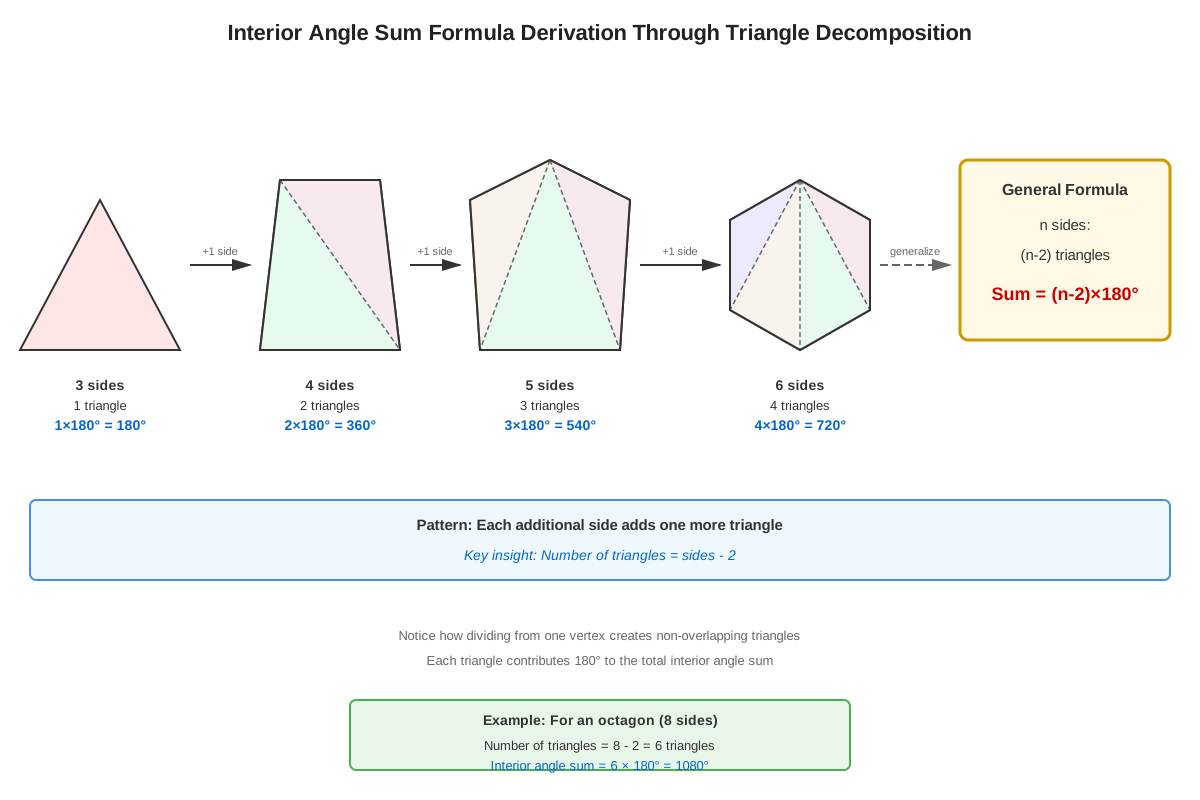
The fundamental principle governing interior angles of polygons is the interior angle sum formula, which states that the sum of all interior angles in a polygon with n sides equals (n - 2) × 180°. This formula derives from the fact that any polygon can be divided into triangles by drawing diagonals from a single vertex. A polygon with n sides can be divided into exactly (n - 2) triangles, and since each triangle contains 180° of angle measure, the total interior angle sum equals the number of triangles multiplied by 180°.
For example, a quadrilateral (4 sides) can be divided into 2 triangles, yielding an interior angle sum of (4 - 2) × 180° = 2 × 180° = 360°. A pentagon (5 sides) divides into 3 triangles, producing (5 - 2) × 180° = 3 × 180° = 540°. This pattern continues consistently for all convex polygons, making the formula universally applicable and highly testable on the GRE.
Common Polygon Angle Sums
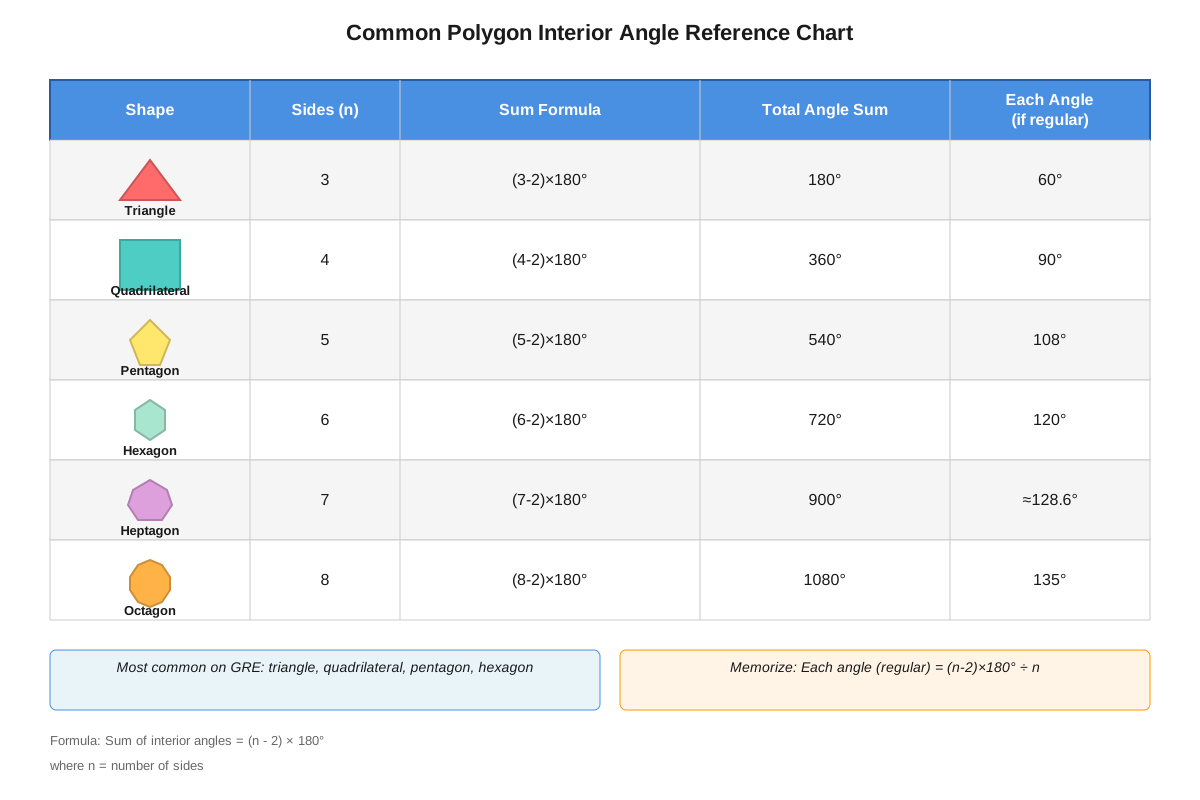
Understanding the interior angle sums for frequently encountered polygons accelerates problem-solving and reduces calculation errors. The following table presents the most commonly tested polygons:
| Polygon Name | Number of Sides (n) | Interior Angle Sum | Individual Angle (if regular) |
|---|---|---|---|
| Triangle | 3 | 180° | 60° |
| Quadrilateral | 4 | 360° | 90° (square) |
| Pentagon | 5 | 540° | 108° |
| Hexagon | 6 | 720° | 120° |
| Heptagon | 7 | 900° | 128.57° |
| Octagon | 8 | 1080° | 135° |
| Nonagon | 9 | 1260° | 140° |
| Decagon | 10 | 1440° | 144° |
Memorizing the angle sums for triangles through hexagons provides significant time savings on the GRE, as these polygons appear most frequently in test questions.
Regular vs. Irregular Polygons
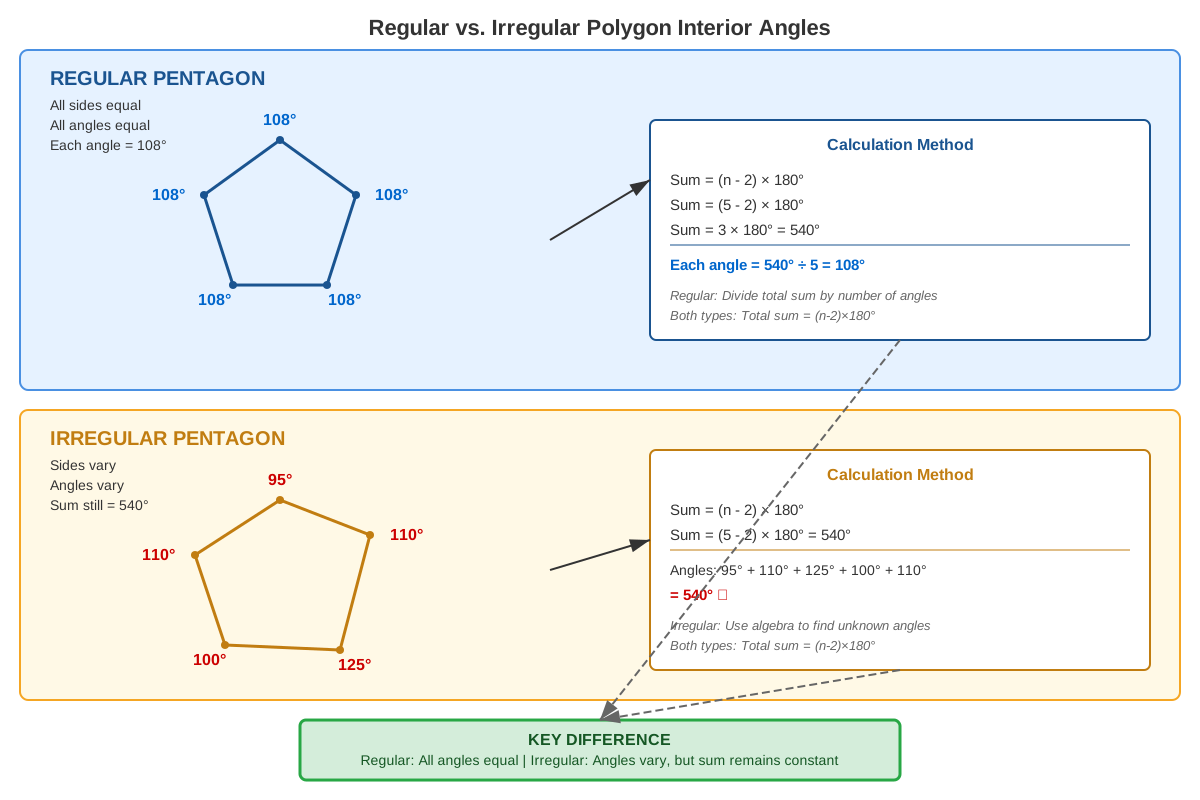
A regular polygon is one in which all sides have equal length and all interior angles have equal measure. In a regular polygon with n sides, each interior angle measures (n - 2) × 180° ÷ n. This formula simplifies angle calculations significantly when dealing with regular polygons, as finding one angle immediately reveals all angles.
For instance, each interior angle of a regular hexagon measures (6 - 2) × 180° ÷ 6 = 4 × 180° ÷ 6 = 720° ÷ 6 = 120°. Regular polygons appear frequently on the GRE because they allow test-makers to create clean, elegant problems with integer solutions.
Irregular polygons have sides and/or angles of different measures. When working with irregular polygons, students must use the total interior angle sum in combination with given information about specific angles to solve for unknowns. These problems typically require setting up algebraic equations based on the relationships between angles.
Solving for Unknown Angles
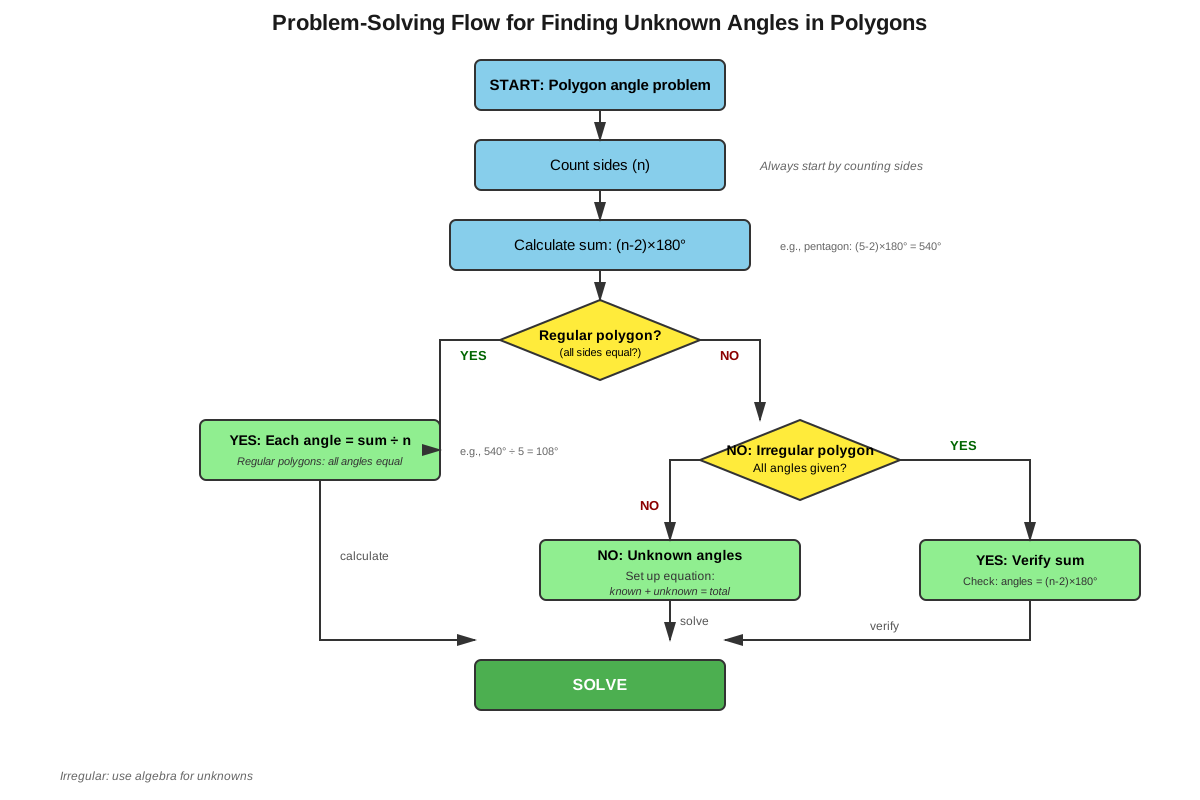
GRE problems frequently present polygons with some angles given and others expressed algebraically. The solution process follows these steps:
- Identify the number of sides in the polygon
- Calculate the total interior angle sum using (n - 2) × 180°
- Express all known and unknown angles, using variables for unknowns
- Set up an equation: sum of all angles = total interior angle sum
- Solve the equation algebraically
- Verify that the solution makes geometric sense
For example, if a quadrilateral has angles measuring 80°, 110°, x°, and (x + 20)°, the solution process would be:
- Total angle sum: (4 - 2) × 180° = 360°
- Equation: 80 + 110 + x + (x + 20) = 360
- Simplify: 210 + 2x = 360
- Solve: 2x = 150, therefore x = 75°
- The angles are 80°, 110°, 75°, and 95°
Relationship to Exterior Angles
Each interior angle of a polygon forms a linear pair with its corresponding exterior angle, meaning they are supplementary and sum to 180°. This relationship provides an alternative approach to some polygon problems. Additionally, the sum of all exterior angles of any convex polygon always equals 360°, regardless of the number of sides. While exterior angles are a separate topic, understanding their relationship to interior angles can provide solution shortcuts and verification methods.
Special Quadrilaterals
Certain quadrilaterals have specific angle properties that extend beyond the general 360° sum:
- Rectangles and squares: All four angles measure 90°
- Parallelograms: Opposite angles are equal; consecutive angles are supplementary
- Trapezoids: The sum of angles on each leg equals 180° (for isosceles trapezoids, base angles are equal)
- Rhombi: Opposite angles are equal; consecutive angles are supplementary
Recognizing these special cases enables faster problem-solving when these specific quadrilaterals appear in GRE questions.
Concept Relationships
The interior angle sum formula serves as the central concept from which all other polygon angle relationships derive. This formula connects directly to triangle properties (the foundational polygon) through the decomposition method: any polygon → divides into triangles → each triangle contributes 180° → total sum equals (n - 2) × 180°.
For regular polygons, the relationship flows as: interior angle sum → divided equally among all angles → individual angle measure = sum ÷ n. This creates a direct pathway from the number of sides to each angle's measure. The concept of regular polygons also connects to symmetry, rotational properties, and the relationship between polygons and circles (regular polygons can be inscribed in circles with vertices equally spaced).
The relationship between interior and exterior angles creates a bridge to other geometric concepts: interior angle + exterior angle = 180° (linear pair) → sum of all exterior angles = 360° → connects to angle rotation and circular measure. This relationship also enables alternative solution strategies when exterior angle information is provided.
Within irregular polygons, the concept map extends to algebraic reasoning: given angle relationships → expressed as algebraic expressions → combined with interior angle sum → creates solvable equations → yields unknown angle measures. This demonstrates how geometric knowledge integrates with algebraic problem-solving skills.
The broader connection to coordinate geometry emerges when polygons are placed on coordinate planes: vertices have coordinates → slopes of sides can be calculated → angles can be determined from slope relationships → interior angles can be verified using the sum formula. This integration appears in more complex GRE problems that combine multiple mathematical domains.
Quick check — test yourself on Interior angles of polygons so far.
Try Flashcards →High-Yield Facts
⭐ The sum of interior angles in any polygon with n sides equals (n - 2) × 180°
⭐ Each interior angle of a regular n-sided polygon measures [(n - 2) × 180°] ÷ n
⭐ The interior angle sum of a quadrilateral always equals 360°, regardless of shape
⭐ The interior angle sum of a hexagon equals 720°, with each angle in a regular hexagon measuring 120°
⭐ The interior angle sum of a pentagon equals 540°, with each angle in a regular pentagon measuring 108°
- A triangle's interior angles always sum to 180°, making it the fundamental polygon for deriving other angle sums
- Each interior angle of a regular octagon measures 135°
- In any polygon, the number of triangles formed by diagonals from one vertex equals (n - 2)
- Interior and exterior angles at the same vertex are supplementary (sum to 180°)
- The interior angles of a square or rectangle each measure 90°
- As the number of sides in a regular polygon increases, each interior angle approaches (but never reaches) 180°
- In a parallelogram, opposite angles are equal and consecutive angles are supplementary
Common Misconceptions
Misconception: The interior angle sum formula is (n × 180°) → Correction: The correct formula is (n - 2) × 180°. The subtraction of 2 accounts for the fact that a polygon with n sides divides into (n - 2) triangles, not n triangles. Using n × 180° would incorrectly add 360° to every polygon's angle sum.
Misconception: All quadrilaterals have four 90° angles → Correction: Only rectangles and squares have four right angles. General quadrilaterals can have any combination of angles as long as they sum to 360°. Trapezoids, parallelograms, and irregular quadrilaterals typically have no right angles or only specific right angles.
Misconception: Regular polygons and irregular polygons have different interior angle sum formulas → Correction: Both regular and irregular polygons use the same formula (n - 2) × 180° for the total sum. The difference is that regular polygons distribute this sum equally among all angles, while irregular polygons have varying individual angle measures.
Misconception: A pentagon always has at least one right angle → Correction: Pentagons have no requirement for right angles. A regular pentagon has five 108° angles, and irregular pentagons can have any combination of angles that sum to 540°. The presence of right angles depends on the specific pentagon's construction.
Misconception: The interior angle formula only works for convex polygons → Correction: While the GRE primarily tests convex polygons, the formula (n - 2) × 180° technically applies to any simple polygon (one without self-intersections). However, concave polygons require careful attention to angle measurement direction, and the GRE rarely tests these cases.
Misconception: If a polygon has more sides, each individual angle must be larger → Correction: This is only true for regular polygons. In irregular polygons, adding sides doesn't necessarily increase any particular angle. For regular polygons, as n increases, each interior angle does increase, approaching 180° as the polygon approaches a circle.
Worked Examples
Example 1: Finding Unknown Angles in an Irregular Pentagon
Problem: A pentagon has interior angles measuring 95°, 110°, 125°, x°, and (x + 10)°. Find the value of x.
Solution:
Step 1: Identify the polygon type and calculate the interior angle sum.
- The polygon is a pentagon with n = 5 sides
- Interior angle sum = (5 - 2) × 180° = 3 × 180° = 540°
Step 2: Set up an equation with all angles.
- Sum of all angles: 95° + 110° + 125° + x° + (x + 10)° = 540°
Step 3: Simplify and solve for x.
- Combine like terms: 330° + x + x + 10° = 540°
- Simplify further: 340° + 2x = 540°
- Subtract 340° from both sides: 2x = 200°
- Divide by 2: x = 100°
Step 4: Verify the solution.
- The five angles are: 95°, 110°, 125°, 100°, and 110°
- Sum: 95 + 110 + 125 + 100 + 110 = 540° ✓
- All angles are positive and less than 180° ✓
Connection to Learning Objectives: This example demonstrates applying the interior angle sum formula to solve for unknown angles algebraically, a core GRE skill. It also shows the importance of verifying solutions to ensure they make geometric sense.
Example 2: Comparing Regular Polygons (Quantitative Comparison)
Problem:
Quantity A: The measure of each interior angle of a regular hexagon
Quantity B: The measure of each interior angle of a regular pentagonSolution:
Step 1: Calculate Quantity A (regular hexagon).
- A hexagon has n = 6 sides
- Each interior angle = [(6 - 2) × 180°] ÷ 6
- Each interior angle = [4 × 180°] ÷ 6 = 720° ÷ 6 = 120°
Step 2: Calculate Quantity B (regular pentagon).
- A pentagon has n = 5 sides
- Each interior angle = [(5 - 2) × 180°] ÷ 5
- Each interior angle = [3 × 180°] ÷ 5 = 540° ÷ 5 = 108°
Step 3: Compare the quantities.
- Quantity A = 120°
- Quantity B = 108°
- 120° > 108°
Answer: Quantity A is greater.
Connection to Learning Objectives: This example illustrates how to identify when interior angles are being tested in Quantitative Comparison format and demonstrates the efficient application of the individual angle formula for regular polygons. It also reinforces the pattern that as the number of sides increases in regular polygons, each interior angle increases.
Exam Strategy
When approaching GRE interior angles of polygons questions, begin by identifying the polygon type and counting its sides. This immediate step determines which formula to apply and prevents errors from misidentifying the shape. Look for keywords like "regular," "equilateral," "equiangular," or specific polygon names (pentagon, hexagon, octagon) that signal which approach to use.
Trigger words and phrases that indicate interior angle problems include: "sum of interior angles," "each angle measures," "find the measure of angle," "regular polygon," "angles of a quadrilateral/pentagon/hexagon," and "unknown angles." When these phrases appear, immediately recall the formula (n - 2) × 180° and determine whether the problem involves regular or irregular polygons.
For Quantitative Comparison questions involving polygon angles, calculate each quantity separately rather than attempting to compare them abstractly. Regular polygon angles follow predictable patterns (increasing as sides increase), but irregular polygon comparisons require complete calculation. If both quantities involve the same polygon type with different given information, look for relationships that might allow comparison without full calculation.
Process-of-elimination strategies include: eliminating answer choices that would make the angle sum incorrect for the given polygon; rejecting answers that produce negative angles or angles greater than 180° in convex polygons; and eliminating choices that violate stated relationships between angles (such as "angle A is twice angle B"). For regular polygons, eliminate any answer that doesn't divide evenly into the total angle sum.
Time allocation for polygon angle questions should typically be 1-1.5 minutes for straightforward calculation problems and 2-2.5 minutes for multi-step algebraic problems. If a problem requires more than three minutes, consider marking it for review and moving forward. Memorizing common polygon angle sums (especially for triangles through hexagons) can save 15-30 seconds per problem by eliminating calculation steps.
Exam Tip: Always verify that your calculated angles make geometric sense. Each interior angle of a convex polygon must be between 0° and 180°, and the sum must exactly equal (n - 2) × 180°. This quick check catches calculation errors before submitting answers.
Memory Techniques
Mnemonic for the Interior Angle Sum Formula: "Need Two Less Triangles" reminds you that the formula is (n - 2) × 180°. The number of sides (N) minus two gives the number of triangles, each contributing 180°.
Visualization Strategy: Picture drawing diagonals from one vertex of a polygon to all non-adjacent vertices. Visualize counting the triangles formed—this concrete image reinforces why the formula uses (n - 2). For a pentagon, visualize three triangles; for a hexagon, visualize four triangles.
Acronym for Common Polygons: "Try Quickly Practicing Hexagon Octagon" represents Triangle (180°), Quadrilateral (360°), Pentagon (540°), Hexagon (720°), Octagon (1080°). The pattern increases by 180° each time, making it easy to reconstruct if you forget one value.
Pattern Recognition: Notice that each additional side adds 180° to the interior angle sum. Starting from a triangle (180°), each new side adds one more triangle's worth of angles: quadrilateral = 180° + 180° = 360°; pentagon = 360° + 180° = 540°; hexagon = 540° + 180° = 720°. This additive pattern provides a backup method for calculating angle sums.
Regular Polygon Angle Memory: For regular polygons, remember that as sides increase, individual angles approach 180° but never reach it. A regular hexagon (120°) is particularly memorable because it's exactly two-thirds of 180°, and hexagons appear frequently in nature (honeycombs) and design (tile patterns).
Summary
Interior angles of polygons represent a high-yield GRE Quantitative Reasoning topic that combines geometric principles with algebraic problem-solving. The fundamental formula—that the sum of interior angles in an n-sided polygon equals (n - 2) × 180°—derives from dividing polygons into triangles and serves as the foundation for all polygon angle calculations. Regular polygons distribute this sum equally among all angles, while irregular polygons require algebraic approaches to find unknown angle measures. Success on GRE polygon angle questions depends on quickly identifying polygon types, accurately applying formulas, and efficiently solving for unknowns using equation-based methods. Memorizing common polygon angle sums (especially for triangles through hexagons) accelerates problem-solving and reduces calculation errors. The relationship between interior and exterior angles provides alternative solution pathways and verification methods. Mastery of this topic enables students to tackle both straightforward calculation problems and complex multi-step questions that integrate polygon angles with other geometric concepts.
Key Takeaways
- The interior angle sum of any polygon with n sides equals (n - 2) × 180°, derived from dividing the polygon into (n - 2) triangles
- Each interior angle of a regular n-sided polygon measures [(n - 2) × 180°] ÷ n
- Memorize angle sums for common polygons: triangle (180°), quadrilateral (360°), pentagon (540°), hexagon (720°), octagon (1080°)
- Irregular polygon problems typically require setting up algebraic equations using the total angle sum and given angle relationships
- Always verify that calculated angles are positive, less than 180° (for convex polygons), and sum to the correct total
- Interior and exterior angles at the same vertex are supplementary, providing an alternative approach to some problems
- Regular polygon angles increase as the number of sides increases, approaching but never reaching 180°
Related Topics
Exterior Angles of Polygons: Understanding that exterior angles sum to 360° for any convex polygon and exploring the relationship between interior and exterior angles deepens geometric reasoning and provides alternative problem-solving approaches.
Properties of Special Quadrilaterals: Mastering specific angle relationships in parallelograms, rectangles, rhombi, and trapezoids builds on general polygon angle knowledge and addresses frequently tested GRE geometry concepts.
Regular Polygons and Circles: Studying how regular polygons inscribe in circles and the relationships between central angles, inscribed angles, and polygon angles connects multiple geometric concepts tested on the GRE.
Coordinate Geometry with Polygons: Learning to calculate angles using slope relationships when polygons are placed on coordinate planes integrates algebraic and geometric reasoning for advanced problem-solving.
Polygon Area and Perimeter: Combining angle knowledge with area and perimeter calculations enables solving complex multi-step problems that test multiple geometric concepts simultaneously.
Practice CTA
Now that you've mastered the core concepts of interior angles of polygons, it's time to solidify your understanding through active practice. Attempt the practice questions designed specifically for this topic, focusing on both straightforward calculations and multi-step problems that mirror actual GRE questions. Use the flashcards to reinforce formula memorization and common polygon angle values until recall becomes automatic. Remember that consistent, focused practice transforms conceptual understanding into test-day performance. Each problem you solve strengthens your pattern recognition and builds the confidence needed to tackle any polygon angle question the GRE presents. Your investment in mastering this high-yield topic will pay dividends across multiple geometry questions on test day!
Sign up free to keep reading
Create a free AnvayaPrep account to finish this GRE guide on Interior angles of polygons — plus flashcards and practice questions.