Overview
Rectangles are among the most frequently tested geometric shapes on the GRE Quantitative Reasoning section, appearing in approximately 15-20% of all geometry questions. Understanding rectangles goes far beyond simply recognizing a four-sided figure with right angles—it requires mastery of their properties, relationships with other shapes, and the ability to apply these concepts in complex problem-solving scenarios. The GRE tests rectangles both directly through straightforward calculation problems and indirectly through coordinate geometry, area optimization, and composite figure questions.
The importance of GRE rectangles extends throughout the Quantitative Reasoning section because rectangular concepts form the foundation for understanding more complex geometric shapes and real-world applications. Questions involving rectangles often integrate multiple mathematical concepts simultaneously, such as combining perimeter calculations with algebraic equations, or using the Pythagorean theorem to find diagonal lengths. This integration makes rectangle problems excellent vehicles for testing multiple skills in a single question, which is precisely why the GRE favors them.
Mastering rectangles creates a strong foundation for understanding parallelograms, squares, and coordinate geometry. The properties of rectangles serve as building blocks for analyzing composite figures, calculating areas of irregular shapes, and solving optimization problems. Additionally, rectangle concepts frequently appear in Data Interpretation questions where students must analyze bar graphs, tables, and visual representations that inherently use rectangular frameworks. A thorough understanding of rectangles is not merely helpful—it is essential for achieving a competitive Quantitative Reasoning score.
Learning Objectives
- [ ] Identify when Rectangles is being tested in GRE questions
- [ ] Explain the core rule or strategy behind Rectangles
- [ ] Apply Rectangles to GRE-style questions accurately
- [ ] Calculate perimeter, area, and diagonal measurements using appropriate formulas
- [ ] Solve multi-step problems involving rectangles in coordinate geometry
- [ ] Recognize and exploit the relationship between rectangles and other quadrilaterals
- [ ] Apply rectangle properties to optimization and constraint problems
Prerequisites
- Basic algebra: Necessary for setting up and solving equations involving rectangle dimensions, particularly when one or more measurements are unknown
- Pythagorean theorem: Essential for calculating diagonal lengths and understanding the relationship between a rectangle's sides and its diagonal
- Area and perimeter concepts: Fundamental understanding of these measurements provides the foundation for all rectangle calculations
- Coordinate plane basics: Required for problems involving rectangles positioned on the xy-coordinate system
- Properties of angles: Understanding right angles (90°) is crucial since all four corners of a rectangle contain right angles
Why This Topic Matters
Rectangles appear throughout everyday life—from room dimensions and screen sizes to garden plots and building layouts—making them one of the most practical geometric concepts tested on the GRE. This real-world relevance means that rectangle problems often present scenarios involving construction, design, optimization, and spatial reasoning that mirror actual quantitative challenges in graduate-level work and professional settings.
On the GRE specifically, rectangle questions appear in multiple formats: Quantitative Comparison questions asking students to compare areas or perimeters, Problem Solving questions requiring multi-step calculations, and Data Interpretation questions where rectangular graphs and tables must be analyzed. Approximately 3-5 questions per GRE exam directly test rectangle concepts, while many additional questions incorporate rectangular elements within larger geometric or algebraic problems. This frequency makes rectangles one of the highest-yield geometry topics for focused study.
The GRE commonly embeds rectangle questions within word problems involving fencing, flooring, painting, or framing scenarios. Questions may ask students to maximize area given a fixed perimeter, find missing dimensions when given partial information, or calculate the impact of proportional changes to dimensions. Rectangle problems also frequently appear in coordinate geometry contexts, where students must determine whether four given points form a rectangle or calculate the area of a rectangle whose vertices are defined by coordinates. Understanding these common question patterns enables efficient recognition and solution strategies during the actual exam.
Core Concepts
Definition and Essential Properties
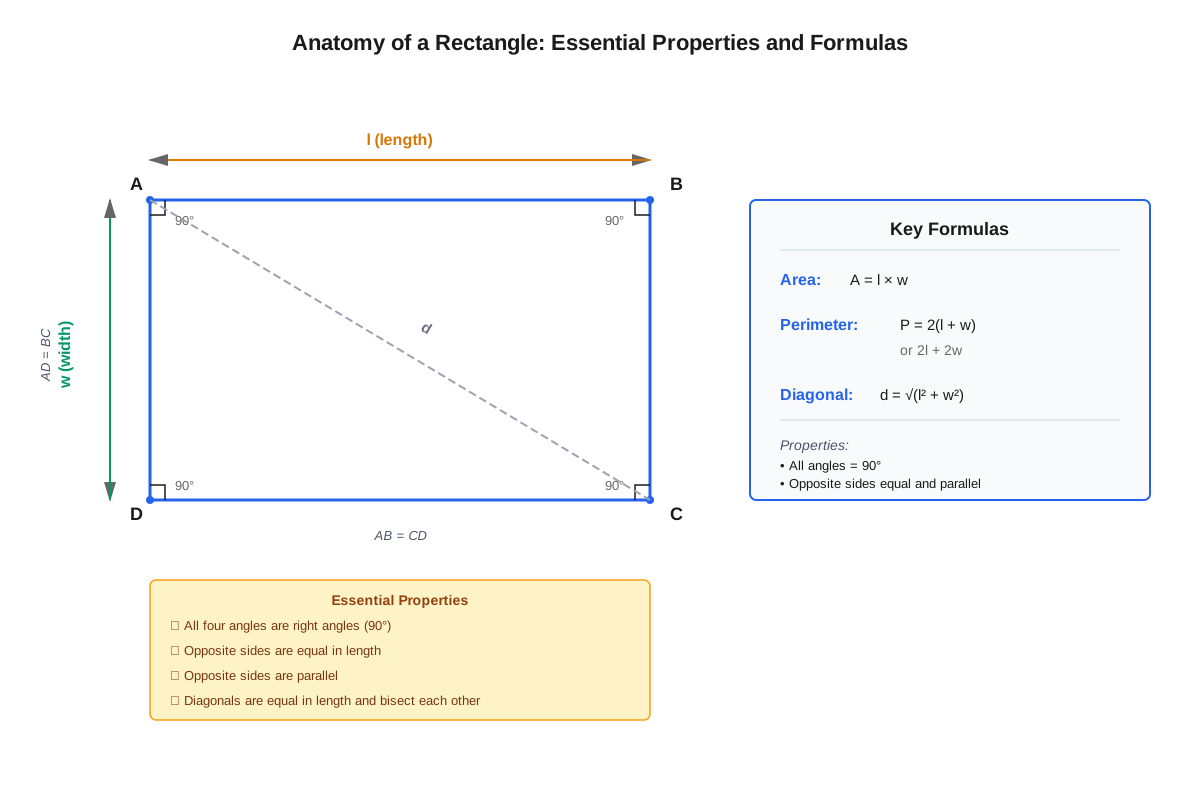
A rectangle is a quadrilateral (four-sided polygon) with four right angles (90° angles). This defining characteristic leads to several critical properties that the GRE tests extensively. The opposite sides of a rectangle are parallel and equal in length, meaning that if one side measures length l, the opposite side also measures l, and if an adjacent side measures width w, its opposite side also measures w. These properties distinguish rectangles from other quadrilaterals and form the basis for all rectangle calculations.
The diagonals of a rectangle possess special properties that frequently appear in GRE questions. Both diagonals are equal in length and bisect each other (cut each other exactly in half). The length of each diagonal can be calculated using the Pythagorean theorem, since a diagonal divides the rectangle into two congruent right triangles. If a rectangle has length l and width w, each diagonal has length d where:
d = √(l² + w²)Perimeter Calculations
The perimeter of a rectangle represents the total distance around its boundary. Since a rectangle has two pairs of equal sides, the perimeter formula is:
P = 2l + 2w = 2(l + w)where l represents length and w represents width. GRE questions often provide the perimeter and one dimension, requiring students to solve for the unknown dimension. Alternatively, questions may describe constraints on the perimeter and ask students to determine possible dimensions or maximize/minimize area within those constraints.
Common GRE variations include:
- Providing perimeter and the relationship between length and width (e.g., "length is 3 times the width")
- Asking for the change in perimeter when dimensions are altered by specific amounts or percentages
- Comparing perimeters of rectangles with different dimensions but equal areas
Area Calculations
The area of a rectangle represents the amount of two-dimensional space enclosed within its boundaries. The area formula is fundamental:
A = l × wThis simple formula becomes powerful when combined with constraints or relationships between dimensions. The GRE frequently tests whether students understand that rectangles with the same perimeter can have different areas, and rectangles with the same area can have different perimeters.
Optimization problems represent a high-yield application of rectangle area concepts. For example, given a fixed perimeter, the rectangle with maximum area is always a square (where l = w). Conversely, given a fixed area, the rectangle with minimum perimeter is also a square. Understanding these optimization principles helps students quickly eliminate incorrect answer choices.
Rectangles in Coordinate Geometry
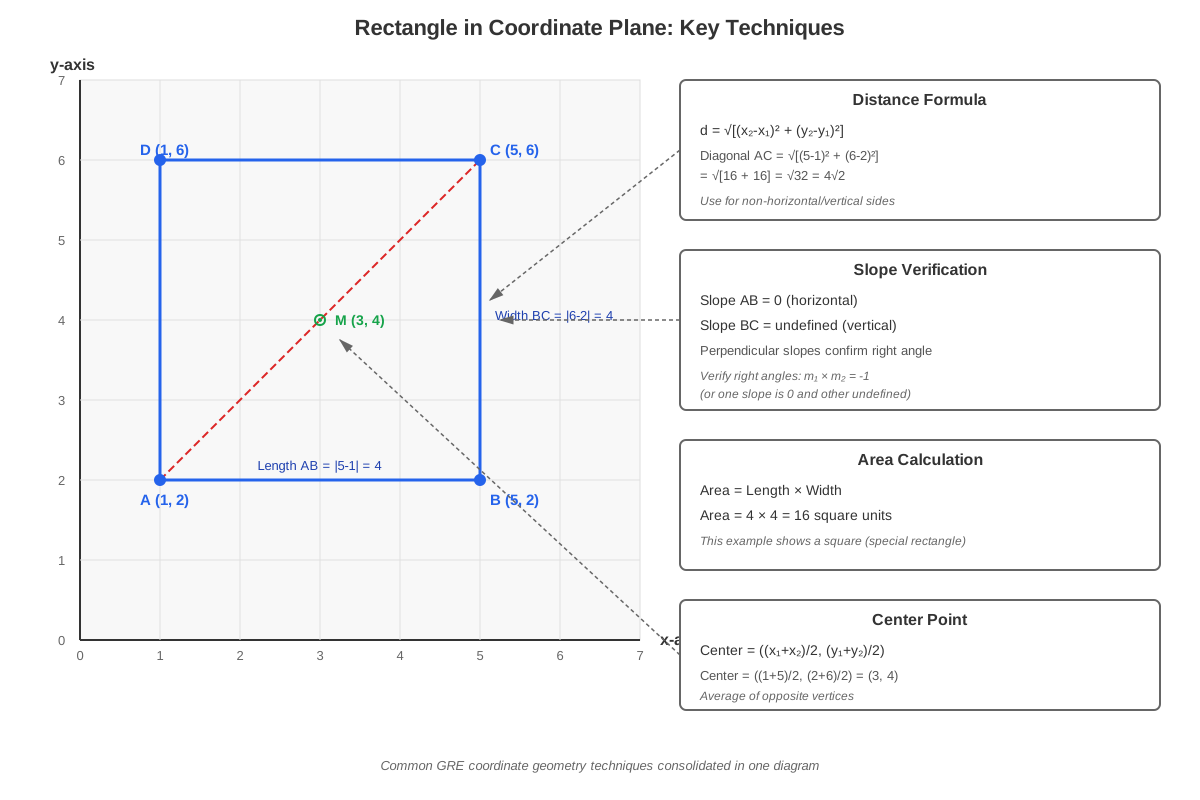
When rectangles appear on the coordinate plane, their sides are typically parallel to the axes (horizontal and vertical), though the GRE occasionally presents tilted rectangles to increase difficulty. For axis-aligned rectangles, calculating area becomes straightforward: find the horizontal distance between vertical sides and the vertical distance between horizontal sides, then multiply.
For a rectangle with vertices at coordinates (x₁, y₁), (x₂, y₁), (x₂, y₂), and (x₁, y₂):
- Length = |x₂ - x₁|
- Width = |y₂ - y₁|
- Area = |x₂ - x₁| × |y₂ - y₁|
The GRE may provide three vertices and ask students to determine the fourth vertex, or provide all four vertices and ask whether they form a rectangle (testing whether opposite sides are equal and all angles are 90°).
Special Case: Squares
A square is a special type of rectangle where all four sides are equal in length (l = w = s, where s represents the side length). All properties of rectangles apply to squares, but squares have additional properties:
- All four sides are congruent
- Diagonals are equal, perpendicular, and bisect each other at 45° angles
- Diagonal length: d = s√2
- Area: A = s²
- Perimeter: P = 4s
The GRE often includes squares in answer choices for rectangle problems, testing whether students recognize that squares satisfy all rectangle properties.
Composite Figures and Rectangles
Many GRE geometry questions involve composite figures—shapes formed by combining multiple geometric figures. Rectangles frequently serve as components of composite figures, requiring students to:
- Decompose irregular shapes into rectangular components
- Calculate total area by adding or subtracting rectangular regions
- Recognize that complex perimeters may involve only some sides of component rectangles
For example, an L-shaped figure can be divided into two rectangles, and its total area equals the sum of the two rectangular areas. However, the perimeter of the composite figure does not equal the sum of the two rectangles' perimeters, since some sides are internal to the composite shape.
Proportional Reasoning with Rectangles
Understanding how changes to dimensions affect area and perimeter is crucial for GRE success. Key principles include:
| Change to Dimensions | Effect on Perimeter | Effect on Area |
|---|---|---|
| Both dimensions doubled | Doubled (×2) | Quadrupled (×4) |
| Both dimensions tripled | Tripled (×3) | Multiplied by 9 (×9) |
| Both dimensions multiplied by k | Multiplied by k | Multiplied by k² |
| One dimension doubled, other unchanged | Increased by original dimension | Doubled |
These relationships allow students to quickly solve problems involving scaled rectangles without recalculating from scratch.
Concept Relationships
The properties of rectangles build upon each other in a logical hierarchy. The fundamental definition (four right angles) → leads to → the property of opposite sides being parallel and equal → which enables → straightforward perimeter and area calculations. The right angles also → create → right triangles when diagonals are drawn → allowing → application of the Pythagorean theorem to find diagonal lengths.
Rectangle concepts connect directly to prerequisite knowledge: basic algebra provides the tools to set up equations when dimensions are unknown, while the Pythagorean theorem enables diagonal calculations. The coordinate plane serves as the framework for positioning rectangles in space, and understanding angle properties confirms that all four corners measure 90°.
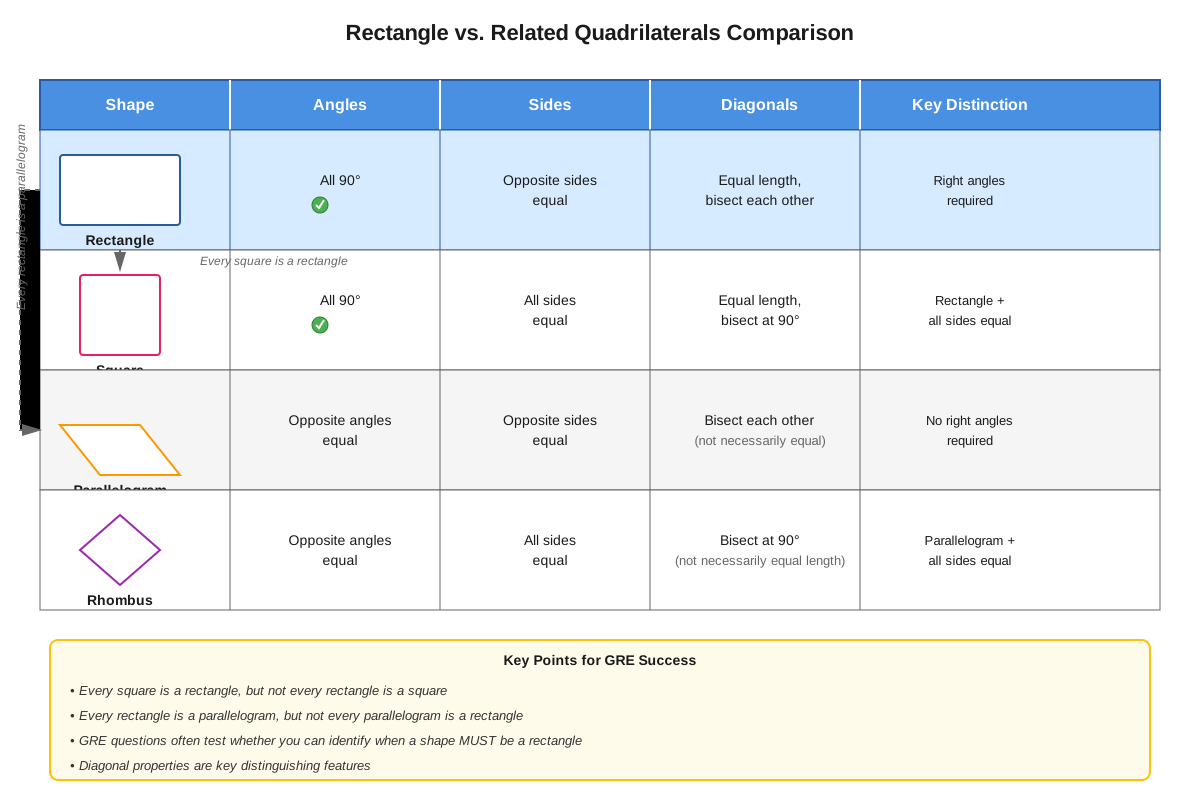
Within the broader geometry unit, rectangles → serve as → the foundation for understanding parallelograms (rectangles are special parallelograms with right angles) and squares (squares are special rectangles with equal sides). Rectangle area concepts → extend to → calculating volumes of rectangular prisms (three-dimensional shapes). The optimization principles learned with rectangles → apply to → more complex geometric optimization problems involving circles, triangles, and irregular shapes.
Quick check — test yourself on Rectangles so far.
Try Flashcards →High-Yield Facts
⭐ The area of a rectangle equals length times width: A = l × w
⭐ The perimeter of a rectangle equals twice the sum of length and width: P = 2(l + w)
⭐ The diagonal of a rectangle can be found using the Pythagorean theorem: d = √(l² + w²)
⭐ Opposite sides of a rectangle are parallel and equal in length
⭐ All four angles in a rectangle measure exactly 90 degrees
- The diagonals of a rectangle are equal in length and bisect each other
- A square is a special rectangle where all four sides are equal (l = w)
- For a fixed perimeter, the rectangle with maximum area is a square
- For a fixed area, the rectangle with minimum perimeter is a square
- When both dimensions of a rectangle are multiplied by k, the area is multiplied by k²
- In coordinate geometry, if a rectangle's sides are parallel to the axes, its area equals the product of the horizontal and vertical distances between opposite sides
- The diagonal of a rectangle divides it into two congruent right triangles
- If a rectangle's length is increased by x% and width is decreased by x%, the area changes (it does not remain constant)
Common Misconceptions
Misconception: A rectangle must have one "long" side (length) and one "short" side (width). → Correction: Length and width are simply labels for the two different dimensions of a rectangle. A square is a rectangle where length equals width, and the terms can be assigned to either pair of opposite sides.
Misconception: The diagonal of a rectangle can be found by adding the length and width. → Correction: The diagonal must be calculated using the Pythagorean theorem: d = √(l² + w²). Simply adding dimensions would significantly overestimate the diagonal length.
Misconception: If two rectangles have the same perimeter, they must have the same area. → Correction: Rectangles with identical perimeters can have vastly different areas. For example, a 1×9 rectangle and a 5×5 square both have perimeter 20, but their areas are 9 and 25 respectively.
Misconception: Doubling both dimensions of a rectangle doubles its area. → Correction: Doubling both dimensions quadruples the area (multiplies it by 4). If original area is l×w, the new area is (2l)×(2w) = 4lw.
Misconception: The perimeter of a composite figure made from two rectangles equals the sum of the two rectangles' perimeters. → Correction: When rectangles are joined, some sides become interior to the composite figure and are not part of the perimeter. Only the outer boundary contributes to the composite figure's perimeter.
Misconception: In coordinate geometry, any four points form a rectangle if they create a closed figure. → Correction: To form a rectangle, the four points must create a quadrilateral with opposite sides equal and parallel, and all angles must be 90°. This requires specific distance and slope relationships between the points.
Worked Examples
Example 1: Multi-Step Rectangle Problem with Constraints
Problem: A rectangular garden has a perimeter of 60 meters. If the length is 6 meters more than twice the width, what is the area of the garden?
Solution:
Step 1: Define variables. Let w = width and l = length.
Step 2: Translate the given information into equations.
- Perimeter equation: 2l + 2w = 60
- Relationship equation: l = 2w + 6
Step 3: Substitute the relationship equation into the perimeter equation.
- 2(2w + 6) + 2w = 60
- 4w + 12 + 2w = 60
- 6w + 12 = 60
- 6w = 48
- w = 8 meters
Step 4: Find the length using the relationship equation.
- l = 2(8) + 6 = 16 + 6 = 22 meters
Step 5: Calculate the area.
- A = l × w = 22 × 8 = 176 square meters
Step 6: Verify the solution by checking the perimeter.
- P = 2(22) + 2(8) = 44 + 16 = 60 ✓
Connection to Learning Objectives: This problem demonstrates identifying rectangle concepts being tested (perimeter and area relationships), applying the core formulas, and accurately solving a GRE-style multi-step problem involving algebraic manipulation.
Example 2: Coordinate Geometry Rectangle Problem
Problem: In the xy-coordinate plane, three vertices of a rectangle are located at points A(2, 3), B(2, 8), and C(7, 8). What is the area of the rectangle, and what are the coordinates of the fourth vertex D?
Solution:
Step 1: Plot or visualize the three given points. Points B and C share the same y-coordinate (8), so BC is a horizontal side. Points A and B share the same x-coordinate (2), so AB is a vertical side.
Step 2: Calculate the lengths of the known sides.
- Length of AB (vertical side): |8 - 3| = 5 units
- Length of BC (horizontal side): |7 - 2| = 5 units
Step 3: Recognize that this is actually a square (both sides equal 5), but treat it as a rectangle for completeness.
Step 4: Determine the fourth vertex. Since ABCD must form a rectangle with sides parallel to the axes:
- D must have the same x-coordinate as C (7) and the same y-coordinate as A (3)
- Therefore, D = (7, 3)
Step 5: Verify that opposite sides are equal.
- AB = 5 (vertical), CD would be |8 - 3| = 5 ✓
- BC = 5 (horizontal), AD would be |7 - 2| = 5 ✓
Step 6: Calculate the area.
- A = length × width = 5 × 5 = 25 square units
Connection to Learning Objectives: This problem demonstrates applying rectangle concepts in coordinate geometry, identifying when rectangles are being tested in a coordinate context, and using the core strategy of finding distances between points to calculate area.
Exam Strategy
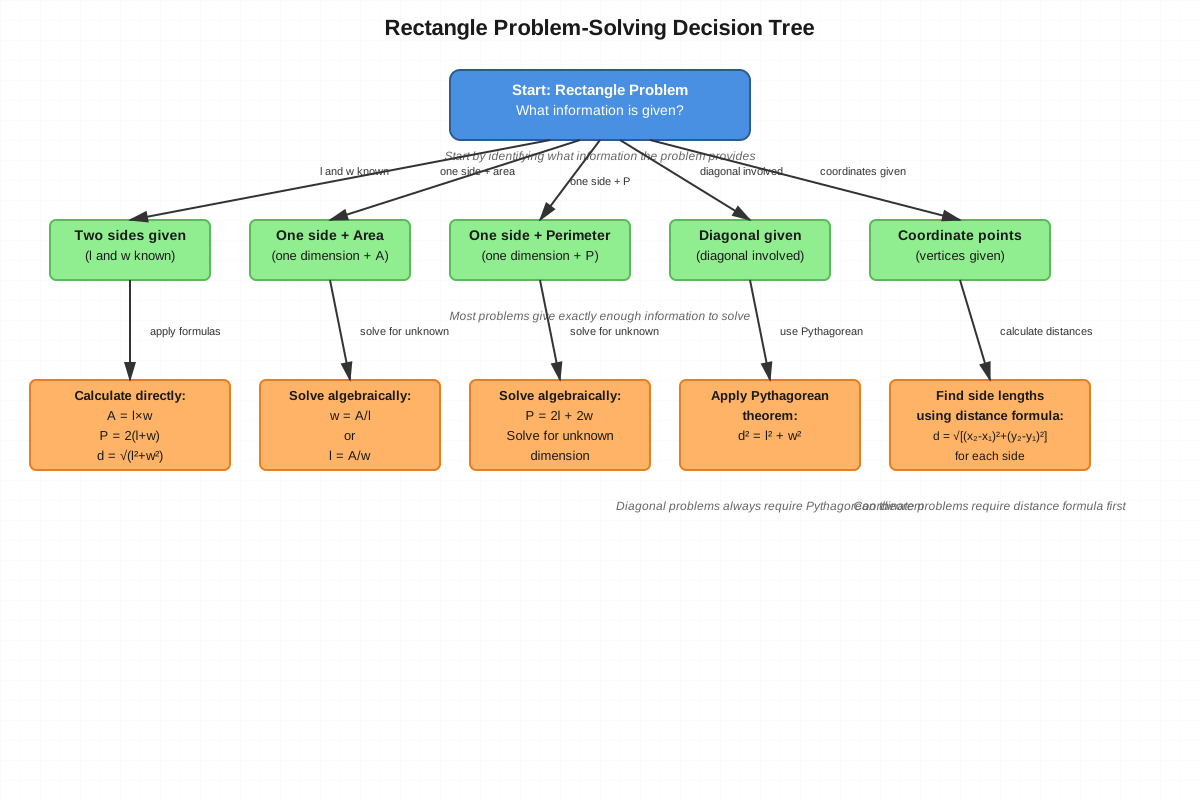
When approaching GRE questions involving rectangles, begin by identifying what information is given and what is being asked. Trigger words that signal rectangle problems include: "rectangular," "length and width," "perimeter," "area," "diagonal," "four right angles," and "opposite sides." In coordinate geometry, phrases like "vertices at points" or "quadrilateral with sides parallel to the axes" often indicate rectangle problems.
For Quantitative Comparison questions involving rectangles, remember that:
- Rectangles with equal perimeters do not necessarily have equal areas
- Rectangles with equal areas do not necessarily have equal perimeters
- Changing one dimension while keeping area constant requires an inverse change to the other dimension
- Squares represent the extreme case (maximum area for given perimeter, minimum perimeter for given area)
Process-of-elimination strategies specific to rectangles:
- Eliminate answer choices that violate basic properties (e.g., negative dimensions, perimeter less than twice the longest side)
- For optimization problems, eliminate choices that aren't squares when the problem asks for maximum area with fixed perimeter
- Check whether answer choices satisfy all given constraints before performing full calculations
- Use estimation: if a rectangle is approximately 10×20, its area should be approximately 200, allowing elimination of answers like 150 or 300
Time allocation: Simple rectangle problems (direct application of area or perimeter formulas) should take 30-45 seconds. Multi-step problems involving algebra or constraints typically require 1-2 minutes. Coordinate geometry problems with rectangles may take 1.5-2 minutes. If a rectangle problem is taking longer than 2.5 minutes, mark it for review and move on—you may be missing a simpler approach.
Exam Tip: When a problem provides the perimeter and a relationship between dimensions, always set up two equations and solve systematically. Don't try to solve it mentally, as this leads to errors under time pressure.
Memory Techniques
Mnemonic for Rectangle Properties - "ROAD":
- Right angles (all four corners are 90°)
- Opposite sides equal and parallel
- Area equals length times width
- Diagonals are equal and bisect each other
Visualization Strategy: Picture a rectangle as a "stretched square." This mental image helps remember that squares are special rectangles, and that rectangles become squares when length equals width.
Formula Memory Aid - "2-2-2": The perimeter formula has three 2's: P = 2l + 2w = 2(l + w). This pattern makes the formula harder to forget.
Diagonal Memory Technique: Remember "Diagonal = Distance" to recall that you use the distance formula (based on Pythagorean theorem) to find diagonal length: d = √(l² + w²).
Scaling Memory Rule - "Square the Scale": When both dimensions are scaled by factor k, the area is scaled by k² (k squared). This rhyme helps remember that area scaling involves squaring the dimension scaling factor.
Summary
Rectangles represent one of the most essential and frequently tested geometric concepts on the GRE Quantitative Reasoning section. Mastery requires understanding the fundamental definition—a quadrilateral with four right angles—and the properties that flow from this definition: opposite sides are parallel and equal, diagonals are equal and bisect each other, and all angles measure exactly 90 degrees. The core formulas for area (A = l × w) and perimeter (P = 2l + 2w) must be automatic, as must the Pythagorean relationship for diagonals (d = √(l² + w²)). Success on GRE rectangle problems demands more than formula memorization; students must recognize how rectangles appear in various contexts including word problems, coordinate geometry, composite figures, and optimization scenarios. Understanding the relationship between dimension changes and their effects on area and perimeter—particularly that scaling both dimensions by k multiplies area by k²—enables quick elimination of incorrect answers. Finally, recognizing that squares are special rectangles and represent optimal solutions for many constraint problems provides a powerful problem-solving tool for maximizing efficiency on test day.
Key Takeaways
- Rectangles are defined by having four right angles, which guarantees opposite sides are parallel and equal
- The three essential formulas are: Area = l × w, Perimeter = 2(l + w), and Diagonal = √(l² + w²)
- Rectangles with the same perimeter can have different areas; rectangles with the same area can have different perimeters
- For a fixed perimeter, maximum area occurs when the rectangle is a square (l = w)
- When both dimensions are multiplied by k, perimeter is multiplied by k but area is multiplied by k²
- In coordinate geometry with axis-aligned rectangles, area equals the product of horizontal and vertical distances between opposite sides
- Squares are special rectangles where all sides are equal, and they represent optimal solutions for many constraint problems
Related Topics
Squares: As special rectangles with all sides equal, squares deserve focused study for their unique properties including diagonal relationships (d = s√2) and their role in optimization problems. Mastering rectangles provides the foundation for understanding all square properties.
Parallelograms: Rectangles are special parallelograms with right angles. Understanding rectangles enables progression to general parallelograms, where opposite sides are parallel and equal but angles are not necessarily 90°.
Coordinate Geometry: Rectangle problems frequently appear in coordinate plane contexts. Mastering rectangles strengthens skills in calculating distances between points, determining whether points form specific shapes, and finding areas using coordinates.
Triangles and the Pythagorean Theorem: The diagonal of a rectangle creates right triangles, making rectangle problems excellent practice for applying the Pythagorean theorem in geometric contexts.
Three-Dimensional Geometry: Understanding rectangular areas is essential for calculating surface areas and volumes of rectangular prisms (boxes), a common GRE topic in solid geometry.
Practice CTA
Now that you've mastered the core concepts, properties, and strategies for rectangle problems, it's time to solidify your understanding through active practice. Attempt the practice questions associated with this topic, focusing on applying the formulas and strategies you've learned. Use the flashcards to reinforce the high-yield facts and formulas until they become automatic. Remember that consistent practice with GRE-style questions is the key to transforming knowledge into test-day performance. Each problem you solve strengthens your pattern recognition and builds the confidence needed to tackle any rectangle question the GRE presents. You've built a strong foundation—now put it to work!
Sign up free to keep reading
Create a free AnvayaPrep account to finish this GRE guide on Rectangles — plus flashcards and practice questions.